You're probably looking at a pile of retired laptops, a half-finished move plan, and three departments that all think someone else owns the next step. IT wants the devices inventoried and wiped, Facilities wants the hallway cleared, Finance wants to know whether anything still has value, and Sustainability wants proof the equipment won't end up in the wrong waste stream. That's exactly where cross-department collaboration stops being a nice-to-have and starts becoming the difference between a clean ITAD project and an expensive cleanup.
Modern work already runs on coordinated effort. Microsoft's 2019 Work Trend Index data showed employees were spending about 50% more time in collaborative work in 2020 than in 2015 (cross-functional collaboration benchmark). For IT asset disposition, that means the handoffs between IT, logistics, finance, and compliance need to be managed deliberately, not improvised. Reworx Recycling sees the same pattern in electronics recycling projects, the companies that plan the handoffs early move faster and lose less value.
Why Ad-Hoc IT Cleanouts Fail
The usual failure starts with a calendar invite that goes to everyone and no one. IT assumes Facilities has the truck timing figured out, Facilities assumes IT already finished the inventory, and Finance doesn't get involved until somebody asks whether any of the old hardware can offset the next refresh. By then, the storage room is full, the schedule is slipping, and a few devices are still sitting there with unverified data on them.
That pattern creates real exposure around data security, chain of custody, and compliance records. It also weakens value recovery because asset lists are incomplete, devices get mixed with trash, and nobody has a clean picture of what can be reused, donated, or recycled through a formal ITAD process.
A first formal cleanout should start with the inventory, not the truck.
That is the point of an inventory review before equipment leaves the site. IT inventory audits matter before recycling because the audit gives every department the same reference point for what exists, what is missing, and what still needs approval before disposition.
The deeper problem is how many teams work by habit. IT finishes its task, then Facilities takes over, then Finance reviews the leftovers, then Sustainability is asked to confirm the waste stream after the fact. That sequence creates delays, but it also creates avoidable decisions, because the team sorting devices at the end is working with partial information. A better ITAD run treats the cleanout as a shared process with clear ownership, not a pile of disconnected handoffs.
Mapping Your Key Stakeholders for ITAD Success
Start by naming the people who can block or move the project. In a first formal ITAD program, that usually means IT, Facilities, Finance, Legal or Compliance, and Sustainability. Each group cares about a different outcome, and each one has a different kind of friction if you leave them out too late.

What each department is trying to protect
IT is usually focused on secure removal, asset inventory, and proof that sensitive data is gone before devices leave the building. The friction point is simple, they don't want a rushed logistics plan to override wipe procedures or skip device verification.
Facilities cares about access, timing, dock space, elevator use, and avoiding disruption to daily operations. If they aren't involved early, the project often collides with other building activity and turns into a storage problem.
Finance looks at residual value, cost recovery, and whether the disposal path makes financial sense. Their concern is that devices disappear into a cleanout with no documented disposition, no buyback visibility, and no way to reconcile the asset list later.
Legal or Compliance wants defensible records, approved vendors, and documentation that can stand up in an audit. Their friction point is ambiguity, especially when teams use informal pickup arrangements or can't show who authorized each transfer.
Sustainability wants responsible diversion, donation potential, and measurable environmental handling. If they're left out, the project can still “finish” while missing the organization's broader recycling or community-impact goals.
Build the map before the work starts
A practical stakeholder map only needs three columns, role, primary concern, and decision power. Add one more note for likely objections, because objections are where the schedule usually slips. Once those points are visible, it's much easier to decide who needs to approve, who only needs to be informed, and who should be consulted before pickup day.
That also helps you identify a champion. In many organizations, the best champion isn't the highest-ranking person, it's the one who feels the operational pain most sharply and can keep the rest of the team focused on the shared outcome.
For a useful reference on clarifying the IT side of that ownership, see Reworx's guidance on IT manager responsibilities. The useful habit is to treat stakeholder mapping as part of the project, not as admin work before the project.
Designing Your Collaboration Governance Model
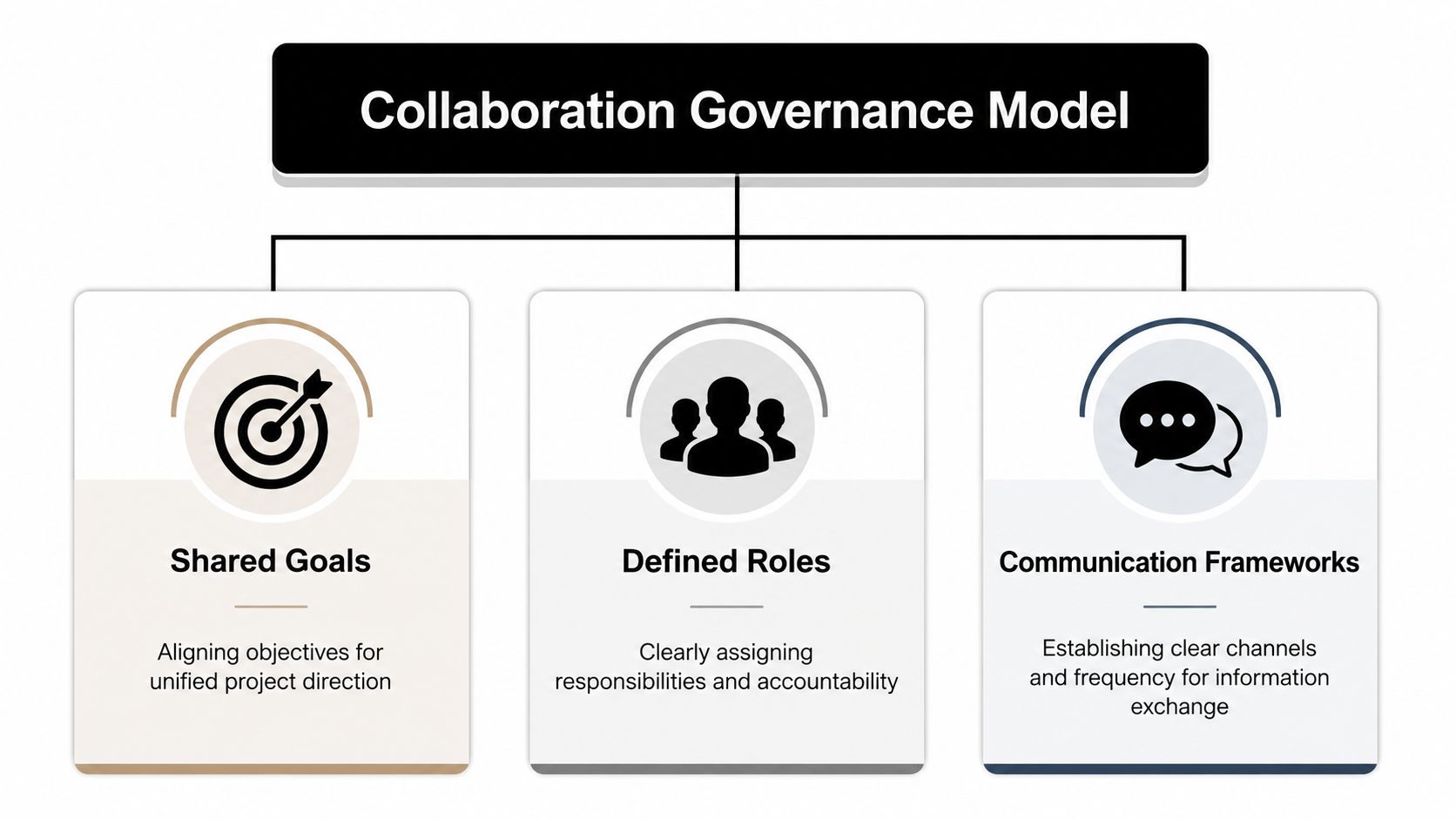
A good governance model doesn't add bureaucracy, it removes guesswork. For an ITAD project, it works best as a small project charter that tells people three things, what success looks like, who owns each handoff, and how often updates happen. Without that structure, collaboration becomes a series of informal side conversations that are hard to audit and easy to forget.
Keep the model lightweight and explicit
The first pillar is shared goals. For ITAD, those goals should be outcome-based, not activity-based. A team might aim for full data destruction documentation, clean asset reconciliation, or maximum value recovery on eligible equipment, depending on the project's priorities.
The second pillar is defined roles. A simple RACI works well here, because it forces the team to separate the person doing the work from the person accountable for the outcome. That matters when Facilities schedules the pickup, IT confirms the device list, Finance reviews recovery value, and Compliance checks the paperwork.
The third pillar is a communication cadence. That doesn't mean more meetings. It means a predictable rhythm for updates, decisions, and exceptions, so nobody has to chase five different inboxes for one answer.
Practical rule: if a meeting doesn't change a decision, remove it and replace it with a written update.
A shared dashboard or scheduled email summary often works better than a standing status call, especially for SMBs and public-sector teams that need tight time discipline. For a deeper service-level approach, Reworx's SLA guidance fits well with this model because it keeps expectations visible between departments.
What a useful charter includes
A useful charter can be short, but it should cover scope, approvers, handoff triggers, and escalation rules. It should also say how exceptions are handled, because every ITAD project eventually runs into a missing asset tag, a device that won't power on, or a pickup window that changes.
Keep the language plain. If the team can't explain the rules in one minute, the charter is too complicated for day-to-day use.
Building Collaborative E-Waste and ITAD Workflows
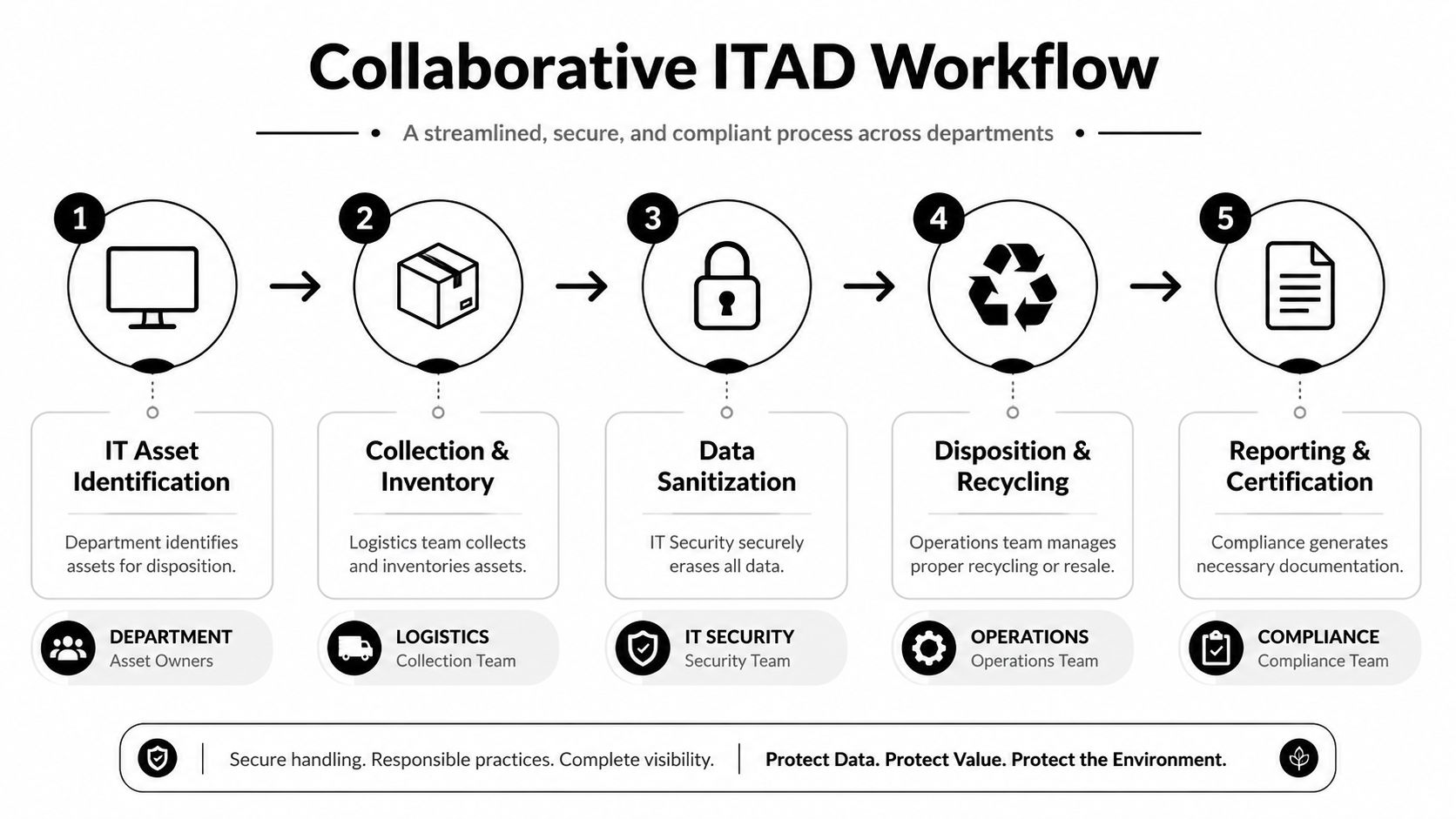
The workflow should be written like an operating playbook, not a policy memo. Each step needs a clear owner, a clear input, and a clear handoff, because a disposition project breaks down at the transitions, not usually inside one department. That's especially true when you're coordinating secure destruction, logistics, and reporting across multiple teams.
Make each handoff visible
The first handoff is asset identification. IT builds the list, confirms what's eligible for disposition, and flags any special handling needs. Facilities then uses that list to plan staging, access, and pickup timing without disrupting normal operations.
The second handoff is data sanitization. IT security needs to know which devices require wipe, shred, or physical destruction, and that decision has to be locked before equipment leaves controlled space. Finance doesn't need the technical wipe process, but it does need the confirmation trail afterward.
The third handoff is value recovery. If devices have resale or buyback potential, Finance and IT should review the criteria before anything is picked up. That keeps eligible assets from being treated like scrap too early, which is one of the easiest ways to lose money in an ITAD project.
The fourth handoff is reporting. Compliance, Finance, and Sustainability each need different pieces of the final package, but they all need the same chain of custody story. If the logs are built as the work happens, the final report is much easier to assemble.
Use a certified partner when the workflow touches both security and logistics, because the last thing a cleanout needs is a gap between who handled the asset and who documented it.
That's where reverse logistics matters. Reworx's reverse logistics guidance is relevant because pickup, sorting, and downstream routing all depend on the same chain of coordination. In practical terms, a partner like Reworx Recycling can handle donation-based recycling, IT equipment disposal, and secure data destruction while giving the business a cleaner handoff sequence.
Don't separate the physical asset from the paperwork
The physical pickup and the paper trail need to move together. If the devices are collected before the inventory is approved, or the certificate arrives before the shipment log is complete, someone has to reconstruct the process later. That's where collaboration becomes more than teamwork, it becomes evidence.
Global e-waste reached 62 million tonnes in 2022, and only 22.3% was formally recycled (global e-waste figures). For businesses, that gap is exactly why disciplined ITAD workflows matter, because a coordinated process keeps assets on a traceable path instead of letting them drift into undocumented disposal.
Measuring Success and Sustaining Momentum
If the only metric is how many meetings happened, the project is already off track. More coordination can easily create more overhead without improving the result, which is why the better question is whether the organization got cleaner disposition, stronger compliance, and better value recovery for the effort invested. That's the kind of measurement that helps leaders fund the next round.

Track outcomes, not activity
A useful dashboard for an ITAD program usually starts with time-to-disposition for retired assets, percentage of assets with certified data destruction, value recovered per device, and e-waste diverted from landfill. Those measures show whether the process is moving faster, staying secure, and producing a return that the business can see.
The point is not to build a giant reporting system. The point is to prove that cross-department collaboration improved business results instead of adding another coordination layer. That distinction matters for SMBs and public-sector teams, where time and accountability are always part of the equation.
For an internal measurement framework, Reworx's impact measurement page is a good example of how reporting can support both operational and sustainability goals. Keep the dashboard simple enough that Finance, IT, and Sustainability can all read it without a separate interpretation meeting.
Use the metrics to keep the program alive
Once the first cleanout is complete, keep the reporting cadence going on the next equipment refresh, office move, or facility consolidation. That turns a one-time project into a repeatable operating model, which is where significant value resides. A good program should get easier to run because the team is learning the handoffs, not because everyone is tolerating more meetings.
One practical way to keep momentum is to review exceptions after each project. If IT always delays the inventory, fix the intake step. If Facilities keeps getting pulled in too late, move them into the approval stage. If Finance needs a different report format, standardize it before the next pickup.
Many organizations also need the final documentation to satisfy audit, finance, and sustainability reviews. Reworx Recycling handles certificates of data destruction, equipment pickup coordination, and reporting tied to electronics recycling and ITAD, which makes the metrics easier to tie back to a completed disposition record.
Common Pitfalls and a Small Business Success Story
The first trap is unclear ownership. If no one is accountable for the inventory, the pickup date, or the final certificate, the project drifts. The second trap is scope creep, where a cleanout turns into a facility purge, a closet purge, and a backlog review all at once.
The third trap is weaker than people expect, skipping data security just because the devices look old. That mindset is how a simple disposal project becomes a risk event, because the appearance of obsolescence has nothing to do with the presence of sensitive information.
A mid-sized apparel company planning a technology refresh ran into that exact mix of problems. The operations manager wanted the old laptops out of the office, Finance wanted to know whether anything could be recovered, and the facilities lead was worried about dock access during shipping hours. The turning point was a stakeholder map that made those concerns visible before the project launched.
The team kept the governance model small. IT owned the asset list and data handling, Facilities owned staging and pickup access, Finance reviewed buyback eligibility, and Compliance tracked the documentation package. They partnered with Reworx Recycling to manage the pickup, data destruction, and downstream electronics recycling, and that kept the handoffs tight enough that nobody had to rebuild the story after the fact.
A useful lesson from companies outside the IT space is that launch planning matters just as much in physical operations. Teams looking at how to launch your apparel business can see the same pattern, the work moves faster when roles, timing, and approval steps are defined before execution begins. In this case, the company finished with cleared storage space, a buyback payment, and a certificate of data destruction ready for records retention.
If your ITAD process is still running on email chains and hallway conversations, it's time to formalize it. Reach out to Reworx Recycling to donate old equipment, schedule a pickup, or partner on secure data destruction, office cleanout, and sustainable recycling that supports both your compliance goals and your community impact.