An IT manager gets the email at 7:12 a.m., the one that says the client wants proof of current recycler certification before the next shipment leaves the warehouse. Facilities has cabinets full of retired laptops, finance wants the asset list closed out, and the legal team wants chain-of-custody records that won't collapse under audit. That's where certification maintenance stops being an abstract compliance term and becomes an everyday operating risk.
For ITAD and electronics recycling teams, the core challenge isn't getting certified once. It's keeping every requirement current, documented, and easy to verify when a customer, auditor, or downstream partner asks for proof. In a market where recurring renewal cycles are the norm and public SSL/TLS certificates are already moving to six-month renewals in 2026, maintenance is now a repeat process, not a one-time event, and the scale is massive, with 10,940,896,117 new SSL/TLS certificates recorded in Q1 2026 alone according to certificate transparency logs. That same recurring logic applies to environmental and data security standards, and it's why a disciplined maintenance system matters for every organization handling retired technology.
The Growing Importance of Certification Maintenance
A certification lapse rarely starts with a dramatic failure. It usually starts with a missed date, a stale file, or a responsibility that nobody clearly owned. One vendor assumes another team is tracking the renewal, the audit packet gets rebuilt from memory, and suddenly the business is explaining why its proof is incomplete when a customer asks for it.
That's the practical side of certification maintenance, and it's why recertification is described as a distinguishing feature of certifications in the ANSI and Workcred study on recertification maintenance. The credential only stays valid if the holder keeps meeting the program's ongoing requirements, whether that means continuing education, re-examination, ethics compliance, or other renewal conditions. In other words, the certification is only as credible as the maintenance behind it, and that affects trust, contract retention, and the internal discipline of the team managing the program. certification maintenance guidance from ANSI and Workcred

For ITAD operators, the business risk is bigger than a missed renewal fee. A lapsed certification can interrupt customer onboarding, slow procurement approvals, and force emergency vendor changes when a downstream buyer or corporate sustainability team asks for proof of active status. That's why maintenance belongs in the same category as access control or incident response, it's part of operational risk management, not just paperwork.
Practical rule: if a certification can't be proved current in minutes, it isn't maintained well enough for an audit-driven business.
Reworx Recycling approaches electronics recycling as a combination of donation-based recycling, secure handling, and documented disposition, which is exactly the kind of operating model that depends on current certification evidence. For an ITAD program, maintenance isn't a back-office task. It's the part that keeps the whole promise believable, from pickup scheduling to final downstream reporting. Reworx Recycling and IT asset disposition
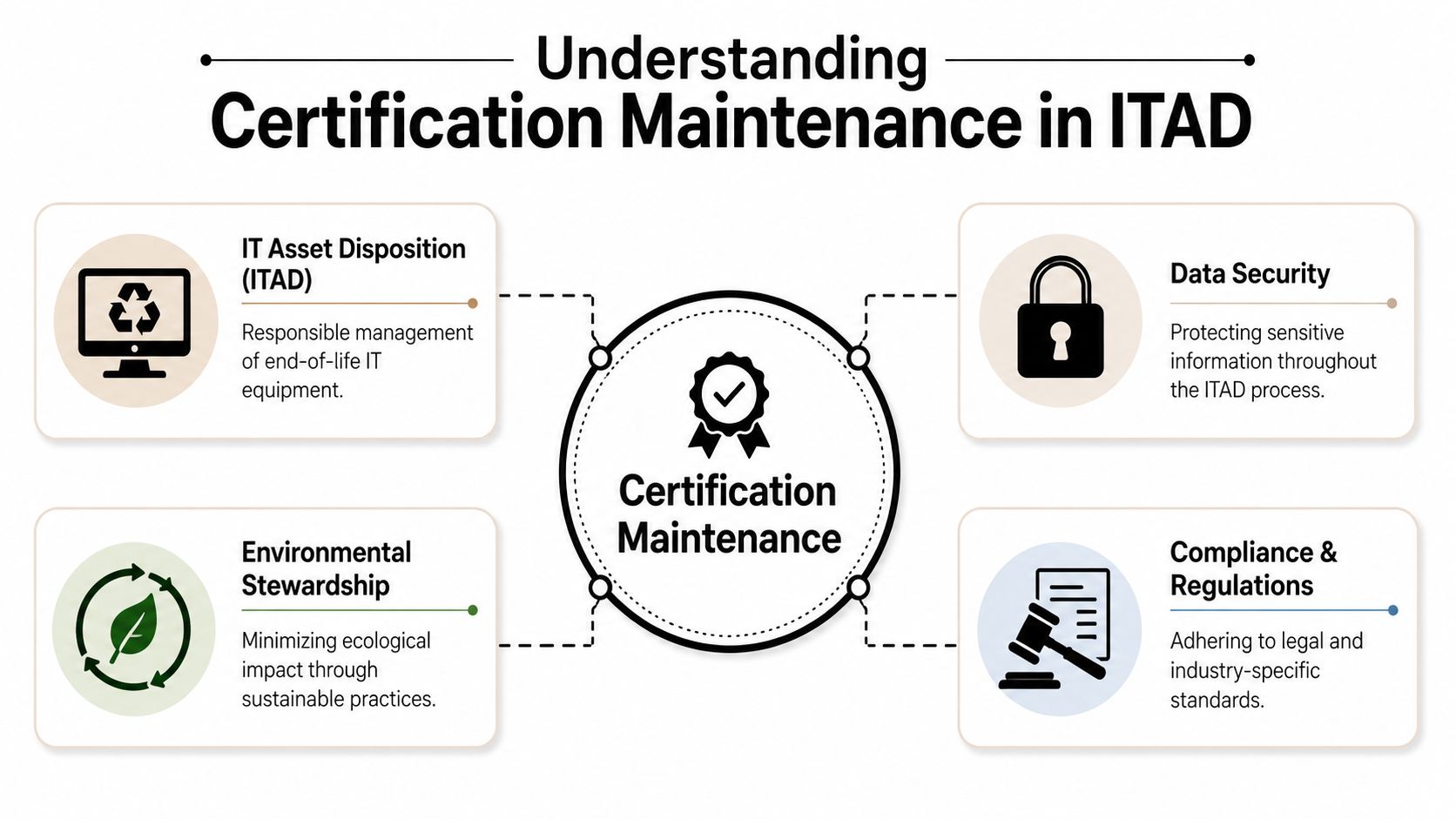
Understanding Certification Maintenance in ITAD
Certification maintenance in IT asset disposition is the ongoing process of proving that a recycler or ITAD provider still meets the standard after the original certification has been earned. Think of certification as the factory install, and maintenance as the system updates, routine inspections, and service checks that keep the machine reliable. Without those checks, the original achievement still exists on paper, but it stops being a trustworthy operating signal.
That's especially important in electronics recycling because the work spans multiple risk domains at once. A provider has to manage environmental stewardship, data destruction, handling controls, downstream vendor expectations, and evidence retention. Maintenance is what keeps those controls visible over time, so a vendor doesn't drift between audits or adopt weaker practices without notice when the pressure rises.
The broader market context shows why this is now a structured business function, not an edge-case compliance chore. ISO's survey ecosystem and the related reporting infrastructure reflect how certification programs have matured into lifecycle systems with renewals, audits, and dataset tracking. The same logic shows up in the global inspection, repair, and maintenance market, which was valued at USD 58.76 billion in 2025 and is projected to reach USD 100.7 billion by 2032, according to the ISO-linked market reference. That projection signals how seriously recurring maintenance is treated across industries, including ITAD and recycling compliance. ISO survey and maintenance market context
What maintenance protects
A maintained certification does three things at once. It preserves customer trust, it gives auditors something current to verify, and it keeps internal teams from improvising under deadline. In ITAD, that usually means documented procedures, current training, traceable asset movement, and evidence that downstream partners still meet the same standard.
A certifier can only trust what the records can prove.
The difference between good and weak maintenance is usually visible in the records. Good programs keep documents centralized, dates visible, and exceptions tracked before they become failures. Weak programs rely on tribal knowledge, scattered spreadsheets, and last-minute email chains.
For organizations comparing vendors, this is also where the maintenance model becomes a screening tool. A recycler that can show current standards, renewal history, and a disciplined file structure usually handles chain of custody the same way. That's why Reworx Recycling's environmental certifications page is worth reviewing alongside its service descriptions, especially if your team needs secure data destruction, computer recycling, or facility-level asset removal under one operating framework. Reworx Recycling environmental certifications
Key ITAD Certifications and Their Renewal Rules
A certification file that looks current on paper can still fail an audit if the renewal process is loose. In ITAD, that risk shows up fast, because R2, e-Stewards, and NAID AAA each demand different evidence, different internal controls, and different review habits. The practical job is not just to hold the badge, it is to keep the proof organized so a client, auditor, or regulator can verify the record without chasing the team for missing documents.
The main ITAD certifications all share the same underlying logic, but they do not stay current in the same way. That matters because a team cannot build one renewal process and assume it fits every standard. R2 pushes process integrity and environmental handling. e-Stewards pushes ethical downstream control and export discipline. NAID AAA focuses on secure destruction and protection of sensitive information.
For customers, the value is in knowing what each framework is designed to stop. R2 is built around responsible electronics recycling operations and process controls. e-Stewards emphasizes ethical downstream handling and avoidance of illegal exports. NAID AAA centers on secure destruction and the handling of sensitive information. If you understand the maintenance purpose, you can ask better questions when you evaluate a recycling partner.
ITAD Certification Maintenance at a Glance
| Certification | Renewal Cycle | Primary Maintenance Focus |
|---|---|---|
| R2 | Ongoing certification with recurring audits and documentation upkeep | Process controls, environmental handling, downstream accountability |
| e-Stewards | Ongoing certification with recurring audits and strict evidence review | Ethical recycling, export prevention, responsible downstream management |
| NAID AAA | Ongoing recertification with recurring reviews | Secure data destruction, facility controls, procedural compliance |
For ASCM/APICS credentials such as CPIM, CSCP, and CLTD, the maintenance structure is explicitly different, with a five-year cycle ending on the last day of the month the credential was earned and 75 maintenance points required. ASCM splits points into Education and Service with no category maximums, which makes it easier for holders to combine coursework, conferences, publications, and service work efficiently. That kind of point-based framework is useful to study because it shows how structured, recurring maintenance can be kept manageable without lowering the standard. ASCM maintenance handbook
For SMRP's CMRP, recertification is required every three years through 30 recertification points, earned through continuing education, conference attendance, publications, or volunteer work. The pattern is familiar, the holder has to keep learning while also proving active engagement in the field. That same discipline matters in ITAD, where audits, training, and chain-of-custody records have to stay current at the same time. SMRP recertification overview
The best renewal program does not just ask, “Are we certified?” It asks, “Can we prove it on demand, and can we keep proving it next quarter?”
The scale of electronics recovery makes this discipline even more important. The EPA reports that the United States generated an estimated 2.7 million tons of consumer electronics in 2018, and 38.5% was collected for recycling, so documented recovery still matters a great deal when businesses choose certified partners. EPA consumer electronics recovery facts
A certified ITAD partner should be able to show how its renewal cycle ties to environmental controls, data handling, and downstream accountability. If a vendor can explain the badge but not the maintenance behind it, that is a warning sign. A partner's file structure, audit trail, and corrective-action history usually reveal more than the sales deck.
Building Your Internal Maintenance Workflow
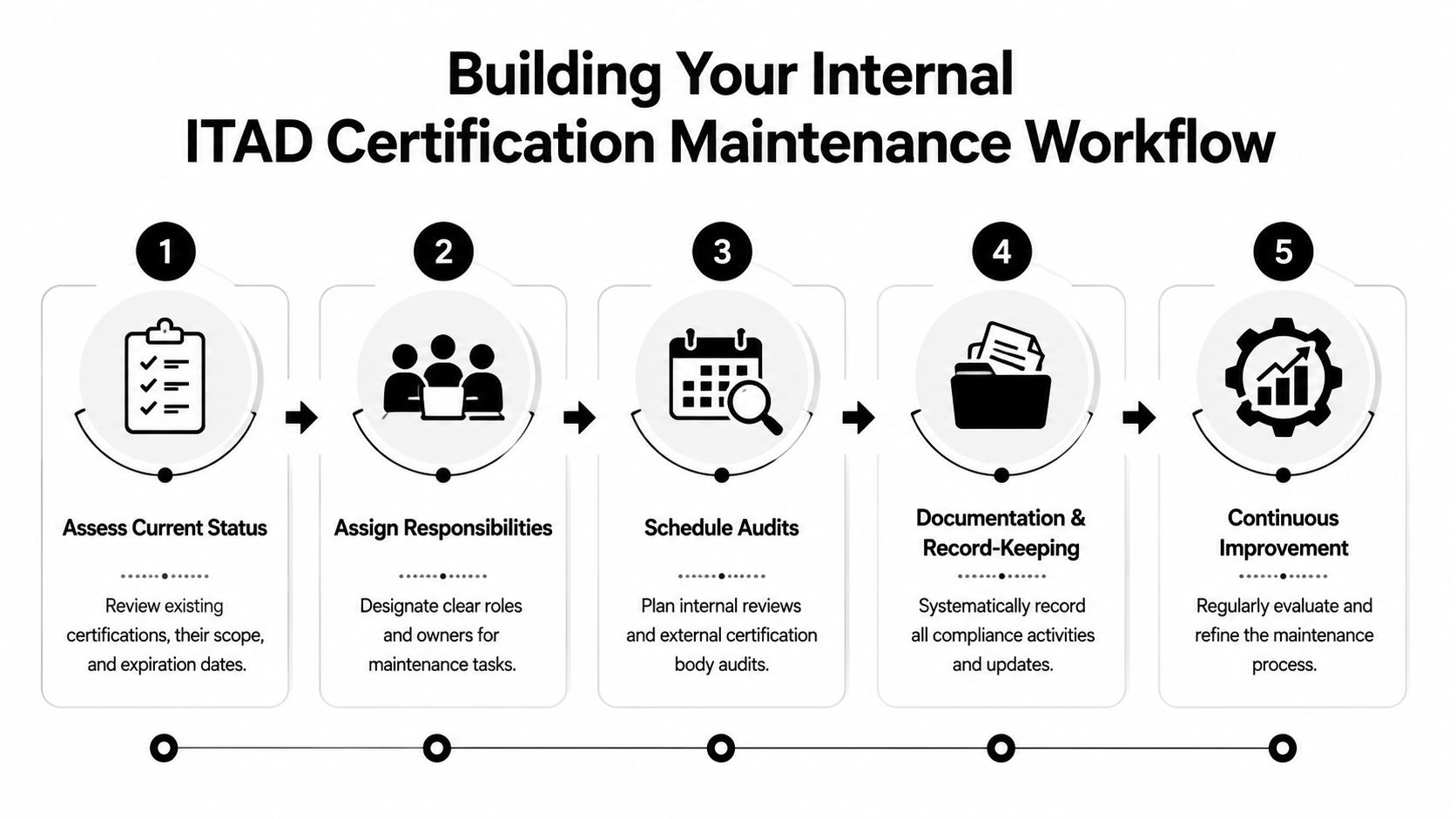
A repeatable workflow solves most certification problems before they happen. The goal is simple, build a system that tells you what's due, who owns it, where the proof lives, and how exceptions get handled. If that sounds basic, that's because certification maintenance usually fails at the basics, not at the technical standard.
Documentation hub
Start by centralizing every certificate, audit report, training log, corrective action, and downstream approval in one repository. A scattered file structure creates false confidence because each department thinks another team is holding the proof. A single hub, whether that's a shared compliance drive, a document management system, or a controlled SharePoint library, gives your team one source of truth.
Task scheduling
Next, build a calendar that includes renewal dates, audit windows, employee training deadlines, and reporting milestones. A strong schedule prevents the classic end-of-cycle scramble, where the team discovers too late that one form is missing or one responsibility was never assigned. If your group already manages projects in Google Workspace, streamlining project workflows with Google can help you think about shared calendars, task ownership, and document routing in a more disciplined way.
Role assignment
Give each maintenance task a named owner. Not a department, a person. One person should own document retention, another should own renewal tracking, and another should confirm that the chain-of-custody packet is complete before assets leave the site. When ownership is vague, accountability disappears right when auditors start asking questions.
Internal controls
Spot-check training records, shipment files, and serial-number logs during the cycle, not only at the end. That habit catches drift early. It also makes the eventual external audit feel routine instead of adversarial, because your team has already tested the same evidence path internally.
Globally, 62 million tons of e-waste are generated annually, but only 22.3% was documented as properly collected and recycled in 2022, so internal discipline matters far beyond one facility's paperwork. Global e-waste facts
For teams handling secure disposal, the workflow should also include a clear compliance checklist template and an evidence trail for every asset class, especially when you're managing laptop disposal, office cleanout, or larger data center decommissioning projects. Reworx Recycling's compliance checklist template is a useful reference point for building that kind of repeatable control set. Reworx Recycling compliance checklist template
Preparing for Your Next Compliance Audit
An audit should feel like a controlled checkpoint, not a surprise. If your maintenance program is working, the review confirms that your records, procedures, and controls still match the standard. That shift in mindset keeps the team steady and keeps findings contained.
Audit readiness starts long before the auditor arrives. Build the file as part of normal operations, so the evidence is already there when someone asks for it.
Before the audit
Build your packet early and keep it current. The usual request list includes current certificates, scope statements, training records, downstream vendor approvals, chain-of-custody logs, corrective action records, and internal review notes. Brief the team on who speaks to the auditor, where records live, and which files must be ready first.
Check the packet the same way an auditor will. If the certificate copy does not match the scope statement, or if a vendor approval is outdated, fix it before the review starts. That avoids the common problem of having the right policy on paper and the wrong evidence in the file.
During the audit
Answer the question asked, not the one you wish had been asked. Auditors want consistency, evidence, and traceability. If something is incomplete, say so and point to the follow-up record instead of improvising a story that cannot be verified later.
Keep your responses tied to the actual process. If the auditor asks about a shipment, show the shipment record, the receiving record, and the disposal or recycling outcome in the same line of sight. That makes it easier to show control without turning the discussion into a debate.
After the audit
Treat findings like operations data. If the auditor flags a gap, assign it, fix it, and document the fix in the same system you use for the rest of the program. That closes the loop and turns the audit into a process-improvement tool instead of a recurring fire drill.
The same discipline matters in tightly controlled environments, where the records have to support the work as it happens, not after the fact. Securitec Security on WA standards is a useful reminder that compliance programs work best when the records, procedures, and accountability structure are aligned before the inspection begins.
The cleanest audit file is the one built during the year, not the one assembled the night before.
Maintenance also has a cost profile that teams need to plan for. A recent review estimated maintenance of certification costs at about $23,000 over 10 years for specialists and $40,000 for subspecialists, which helps explain why professionals often see maintenance as a resource problem, not just a rules problem. The same tension shows up in ITAD operations when staff time, documentation, and vendor oversight compete with day-to-day work. Maintenance of certification cost review
If your audit program includes medical equipment disposal, laboratory equipment disposal, or product destruction, the same before, during, and after structure still applies. The records just need to be tighter, because the compliance consequences are usually higher.
How to Verify Your ITAD Partner's Certifications
A vendor's certificate is only useful if it matches what the official registry shows. Start with the document in hand, then check the company name, scope, and expiration details against the relevant directory for that standard. If anything is missing, inconsistent, or expired, stop there and get a corrected record before you move the conversation forward.
The better question is how that partner keeps certification active between audits. Ask who owns renewals, how corrective actions are logged, and what happens if a downstream vendor falls out of approved status. Those answers show whether the partner runs a repeatable maintenance process or just scrambles when an audit is close, and your risk depends on the weakest link in the chain, not only on your own controls.
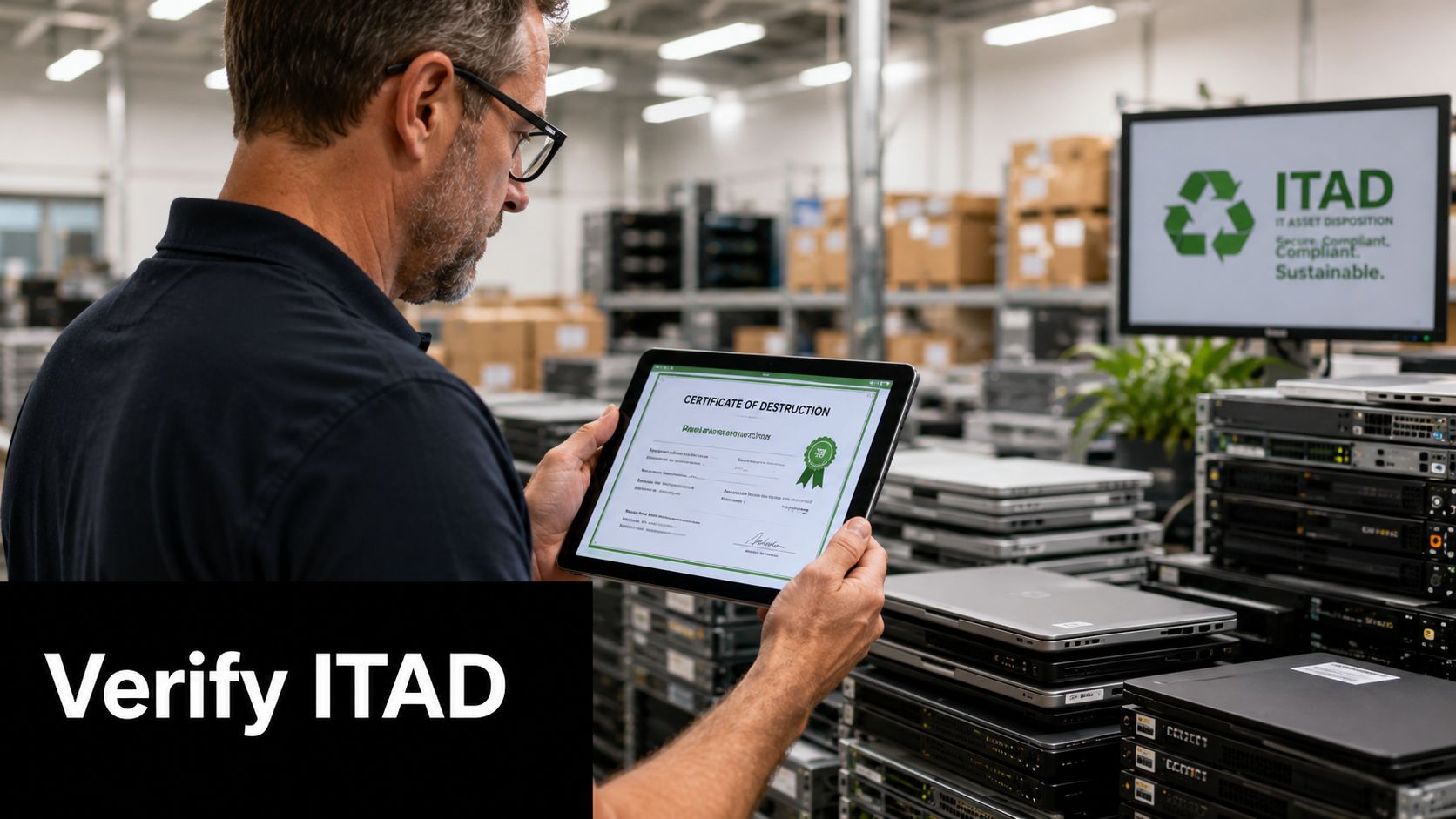
A 2026 CNET tech recycling survey found that only 39% of U.S. adults recycle outdated tech. That gap is a reminder that good intentions do not equal verified handling, which is why businesses should rely on certified vendors instead of informal disposal habits. CNET 2026 tech recycling survey
For vendor screening, ask these questions:
- Active status: Can you show the current certificate and the directory listing that matches it?
- Maintenance process: Who tracks renewals, corrective actions, and audit deadlines?
- Downstream control: How do you approve and monitor downstream vendors?
- Documentation: How long do you retain chain-of-custody and destruction records?
- Scope clarity: Does your certification cover the exact services we need, such as secure data destruction, IT asset disposition (ITAD), or computer recycling?
Choosing a partner who meets these criteria makes due diligence easier and reduces the chance that assets are handled outside your compliance requirements. That's the kind of transparent, verifiable process we've built at Reworx Recycling.
Reworx Recycling's model fits this kind of verification-driven procurement because it combines electronics recycling, secure handling, and donation-based reuse pathways under a social enterprise structure. If your team is ready to retire old hardware responsibly, schedule a pickup, donate retired equipment, or partner on a corporate donation program through Reworx Recycling.