
30.3% of employed people in the U.S. worked on an average weekend day in 2025, and 22.4% of employed people in the EU usually worked weekends in 2023. If your Saturday pickup needs chain-of-custody, serial capture, and a downstream processor ready to receive, weekend availability is a staffing decision, not a switch you flip after Friday at 5 p.m.
That's the constraint most IT managers run into too late. Monday feels safe because everyone is on-site, but the question is whether your assets can leave the building on Saturday without breaking the audit trail, blowing up labor plans, or forcing your team into sloppy exceptions. If the scope is a few boxed laptops with no data-bearing media, the answer may be yes. If it's a mixed load with drives, tagged equipment, and a disposal record that has to survive audit scrutiny, you need more than an open calendar slot.
What Weekend Availability Actually Means in ITAD
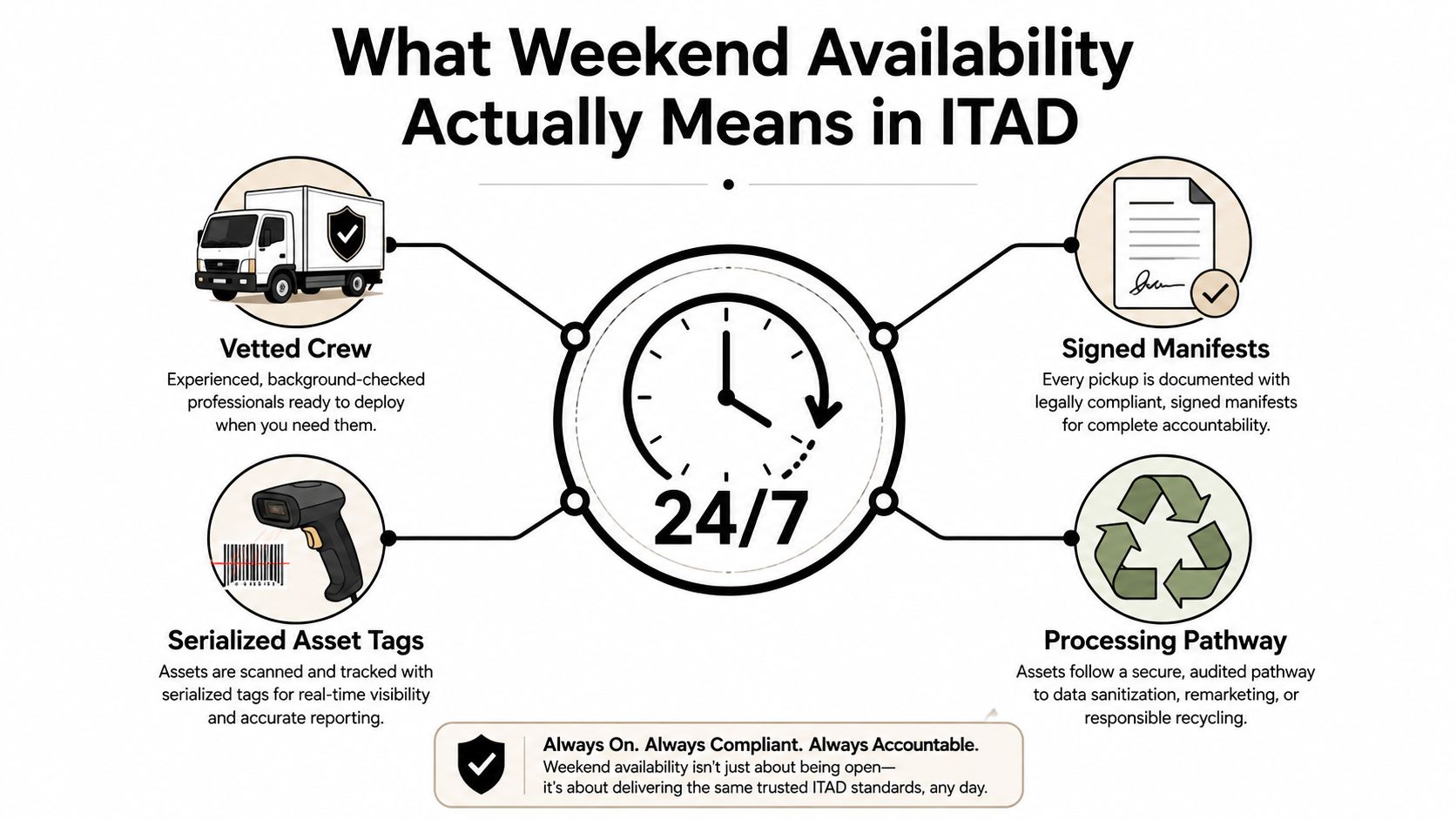
In IT asset disposition, weekend availability means a provider can do the whole job on a non-business day, not just answer the phone. That includes dispatching a vetted crew, capturing serials, signing manifests, moving assets in a secure vehicle, and sending them into a downstream processing path that's already approved.
The five things that have to be true on Saturday
A Saturday window only works when five things are set in writing before the truck shows up. You need a pre-approved job scope, a named site contact, a secure transport vehicle, serial-scanning capability, and a downstream processor with weekend intake.
Miss one of those, and the job turns into improvisation. Improvisation is where custody gaps start, especially when a driver is waiting at the dock and the facility manager is trying to find the only person who can release assets.
Practical rule: if the crew can't scan, seal, sign, and stage the load before it leaves your dock, you don't have weekend availability, you have a loose promise.
The cleanest way to think about it is this. Weekend availability is a labor model plus a routing model plus an audit model, all tied together. Reworx Recycling's overview of IT asset disposition basics is useful here because it frames the job as a controlled end-of-life process, not a hauling appointment.
What it is not
It's not a customer-service checkbox. A team can answer emails on Sunday and still be unable to move a single pallet without breaking policy, because the labor, transport, and downstream intake aren't lined up.
That's why I push managers to stop asking, “Do you do weekends?” Ask, “Can you execute the full custody chain on Saturday, in writing, with named people and a defined destination?” If the answer is fuzzy, the weekend slot isn't real.
For MSPs and IT teams that need a tighter service wrapper, Recepta.ai for MSPs is a good example of how operations get packaged around service delivery. The lesson transfers directly to ITAD, standardize the workflow first, then promise the hours.
Why Demand Spikes on Saturday and Sunday
Saturday demand is heavier because that's when people can finally touch the equipment without disrupting Monday operations. Production servers stay online, lab machines stay in use, classroom devices stay deployed, and the only safe removal window is the weekend.
That pattern also tracks with broader labor reality. In the U.S., weekend work is still substantial, with 30.3% of employed people working on an average weekend day in 2025, compared with 80.5% on an average weekday, and that share has stayed near roughly one-third for two decades, not vanished with digital scheduling (BLS time-use data). Weekend access is normal because modern operations are still split across weekdays and off-hours.
Saturday fills first for practical reasons
Saturday is where lease returns, warranty deadlines, and inventory cleanouts tend to collide. Schools and universities often line up equipment turnover when buildings are quieter, and offices do the same around planned refreshes and move-outs.
Sunday is usually thinner. It's more likely to be used by retail back-office teams, healthcare operations, or facilities that need equipment gone before Monday rounds. If you're trying to book one slot for a mixed corporate load, Saturday is usually the more competitive day because it gives the crew more daylight, more time for cage-side scanning, and fewer occupied floors to work around.
The scheduling lesson is simple. Demand on the weekend isn't random, it's predictable. That's why the job should be reserved ahead of time, not treated like a last-minute favor when the building finally clears.
The operational signal to watch
Your real signal isn't whether someone wants weekend access. It's whether the building access window, internal escort plan, and asset release authority all line up on the same day. When those three move together, weekend pickup makes sense. When they don't, you're forcing a complex job into a bad slot.
A good reference point for this kind of planning is the server decommissioning checklist on Reworx Recycling's server decommissioning checklist. The value isn't the checklist itself, it's the discipline of sequencing work before the truck arrives.
Three Operating Models for Weekend Coverage
There are only three models that hold up in the real world. Everything else is marketing.
| Model | Staffing Cost | Audit Rigor | SLA Risk | Burnout Risk | Best-Fit Scope |
|---|---|---|---|---|---|
| Internal weekend coverage | High | Medium to high if disciplined | Medium | High | Small loads, trusted staff, simple routes |
| Contracted third-party weekend service | Medium | High | Low | Low | Mixed ITAD, decommissioning, multi-site pickups |
| Weekday-only with tighter planning | Low | High during weekdays | High when deadlines slip | Low | Stable refresh cycles, flexible timelines |
Internal coverage works when your own team already knows the load, the labels, and the security rules. The upside is control. The downside is obvious, you're asking your staff to own overtime, transport, and documentation after hours, and that gets old fast.
Contracted third-party service is the cleanest compliance path for most mid-market environments. A provider like Reworx Recycling can supply the crew, manifests, transport, and downstream chain on the weekend under a master agreement, which keeps the work inside one documented workflow.
Weekday-only planning looks cheap until a lease return or data center shutdown lands on a Saturday. Then it becomes expensive in a hurry because the calendar, not the policy, is driving the job. That's why this model works only if your refresh cycles are flexible.
For teams trying to design shifts without burning out staff, Pebb's insights on shift scheduling are a useful reminder that coverage has to be built around human limits, not assumed. In ITAD, that matters because tired crews make document mistakes, and document mistakes become audit problems.
My recommendation: for most mid-market ITAD scopes, use a contracted weekend provider. It's the best balance of audit rigor, labor control, and SLA reliability.
If your policy already uses service-level language, anchor it to the same logic that appears in Reworx Recycling's service-level agreement guidance. Define the work, define the handoff, and define who owns exceptions before the route starts.
Chain of Custody and Compliance on a Weekend
A Saturday pickup should hold the same audit standard as a Tuesday pickup. If it doesn't, the weekend slot is a liability, not a convenience.
What has to happen on-site
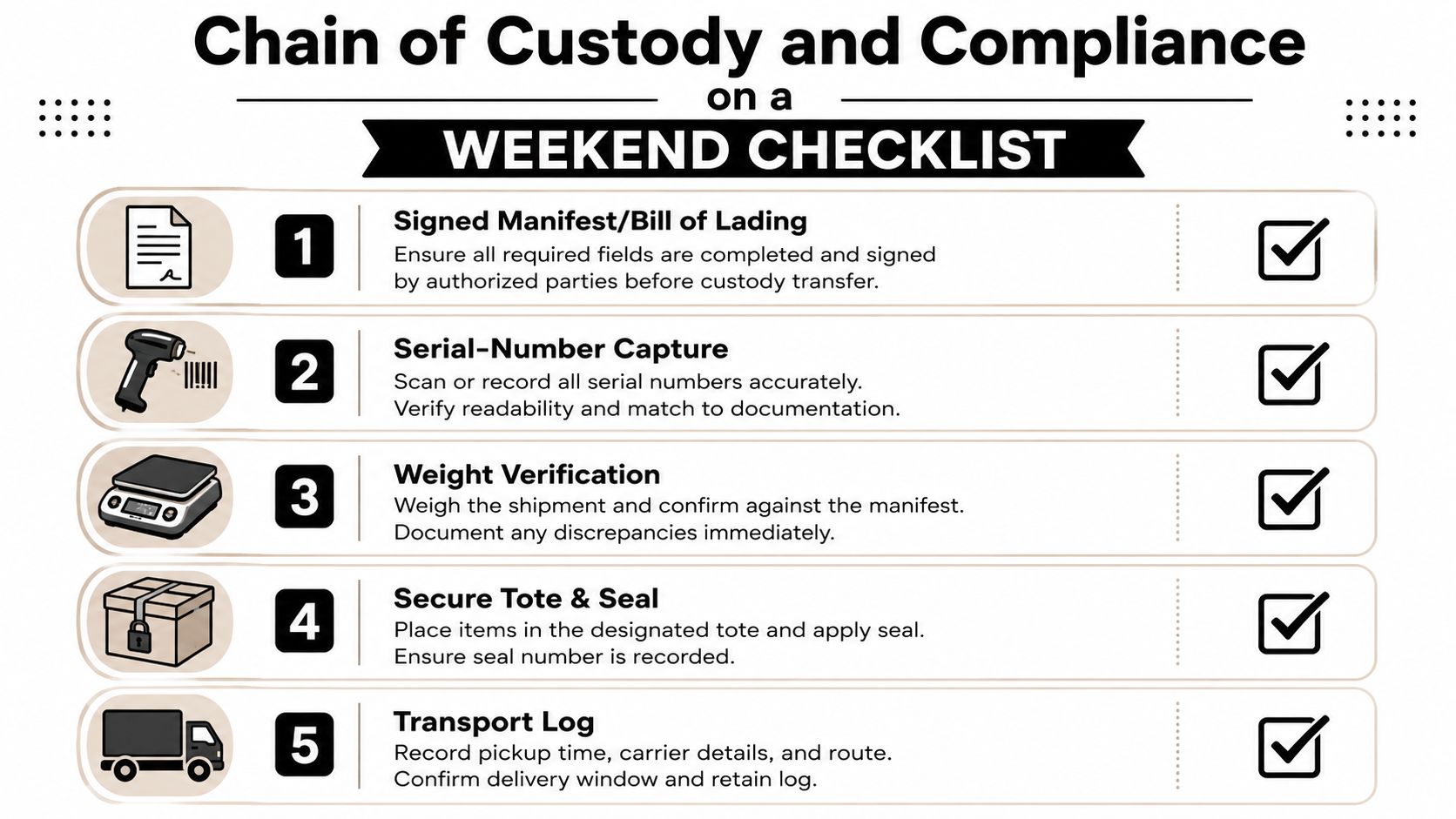
The manifest or Bill of Lading needs to be signed on-site, with serial-number capture, weight, container seals, and driver signatures all completed before the truck leaves. Timestamped photos should be uploaded before departure, not later when someone “gets a minute.”
Data-bearing devices need to be tagged for the correct sanitization path, and the method should be recorded per device, not just per pallet. That's the difference between a defensible record and a pile of assumptions.
For the sanitization standard itself, NIST SP 800-88 uses the Clear, Purge, Destroy framework, which is a practical way to decide whether data is sanitized for reuse or physically destroyed before recycling (NIST framework reference via the ITAD guide).
Who can release the assets
If the normal security manager is off, you still need a pre-authorized alternate with release authority. Don't let a dock supervisor improvise because the right signer didn't come in.
Any deviation, a missing seal, a damaged pallet, a skipped serial, should become a documented exception, not a verbal workaround. That protects the client, the vendor, and the receiving facility.
A compliance team also needs the certificate to be useful after the truck leaves. A good Certificate of Data Destruction should list the equipment make and model, the destruction date, and the company that performed the work, which gives you auditable proof for records and audits (certificate content guidance). If the destruction happened on a weekend job, the job ID should still trace back to the original manifest and downstream facility.
Practical rule: if the manifest, the serial log, and the certificate can't be tied together cleanly, the weekend job isn't done.
For a deeper operational view of custody records, Reworx Recycling's chain-of-custody documentation page is the right place to align expectations before pickup day.
The same logic shows up in compliance-heavy logistics more broadly. Logivo's compliance guidance is useful because it treats exceptions as part of the process, not as noise to be ignored.
Real-World Scenarios for Weekend Pickups
A K-12 district doing a summer cleanout across four buildings needs the weekend because the network team can't free a switch stack until Saturday at 6 a.m. before the firewall cutover. If the crew arrives with a two-hour window, the cutover stays on schedule and the integrator starts Monday with cleared racks.
That's the value of weekend availability in plain terms. It aligns physical removal with the actual maintenance window, not the ideal one.
A regional insurer decommissioning a single 40-rack data center room over a long weekend has a different problem. The inventory gets barcode-scanned Friday, the secure wipe or destruction work happens Saturday, transport and shredding happen Sunday, and the certificate lands Monday before the audit closes.
The weekend isn't about convenience. It's about matching the building's access rules to the equipment's removal window.
The same principle applies in healthcare, higher education, and any office where facilities and security escorts run on different schedules from the IT team. Weekend access changes the plan because badge control, key custody, and escort coverage are different from weekday norms.
I wouldn't treat either scenario as a special case. They're the normal case when the assets are tied to operations that can't stop during business hours.
The trade-off is real. You gain schedule alignment, but you pay for staffing, escort time, and stricter pre-planning. If you don't need that alignment, don't buy it. If you do, lock it in early.
Sample Policy and Vendor Request Templates
A weak weekend policy is how good plans get wrecked. Put the rules in writing, keep them short, and make the release authority obvious.
Internal policy paragraph you can drop into an SOP
Weekend asset removal is permitted only for pre-approved scopes scheduled in advance with a named site contact and an authorized alternate release signer. All data-bearing devices must be inventoried, tagged, and documented according to the required sanitization method, and no assets may leave the site without a signed manifest, serial record, and transport receipt. Any exception, including missing seals, damaged containers, or unmatched serials, must be recorded before departure and escalated to the security officer the same day.
Vendor request template
Send this version to your provider of choice, including Reworx Recycling if they fit the scope.
We need a Saturday pickup window for the following asset classes, [insert asset classes and counts]. The job must support NIST SP 800-88 Purge or Destroy, provide a Certificate of Destruction in a format that lists the sanitized equipment, the destruction date, and the issuing company, and require R2v3 or e-Stewards downstream handling where applicable. Please confirm insurance coverage, on-site manifest handling, and who signs custody documents on Saturday.
Questions to ask before you book
- Who staffs the pickup? Ask whether the crew is W-2 employees or subcontractors.
- Who holds the manifest? You need one named person responsible on Saturday.
- What happens if a seal breaks? The vendor should have a documented exception path.
- How fast is the certificate? Don't accept vague turnaround language.
- What's the backup plan? A real weekend provider has one.
You can use a provider like Reworx Recycling for donation-based recycling, secure hard drive shredding, and IT equipment disposal when the job fits a social-enterprise model, but the paperwork still has to be tight. A mission-driven brand doesn't excuse sloppy custody records.
Approval block before the truck arrives
Get one approval line for the security officer and one for finance. If those signatures happen after pickup, you've already lost control of the process.
The point is simple. The weekend job should be authorized before arrival, not negotiated on the dock.
A Decision Checklist and the Case for Donation-Based Recycling
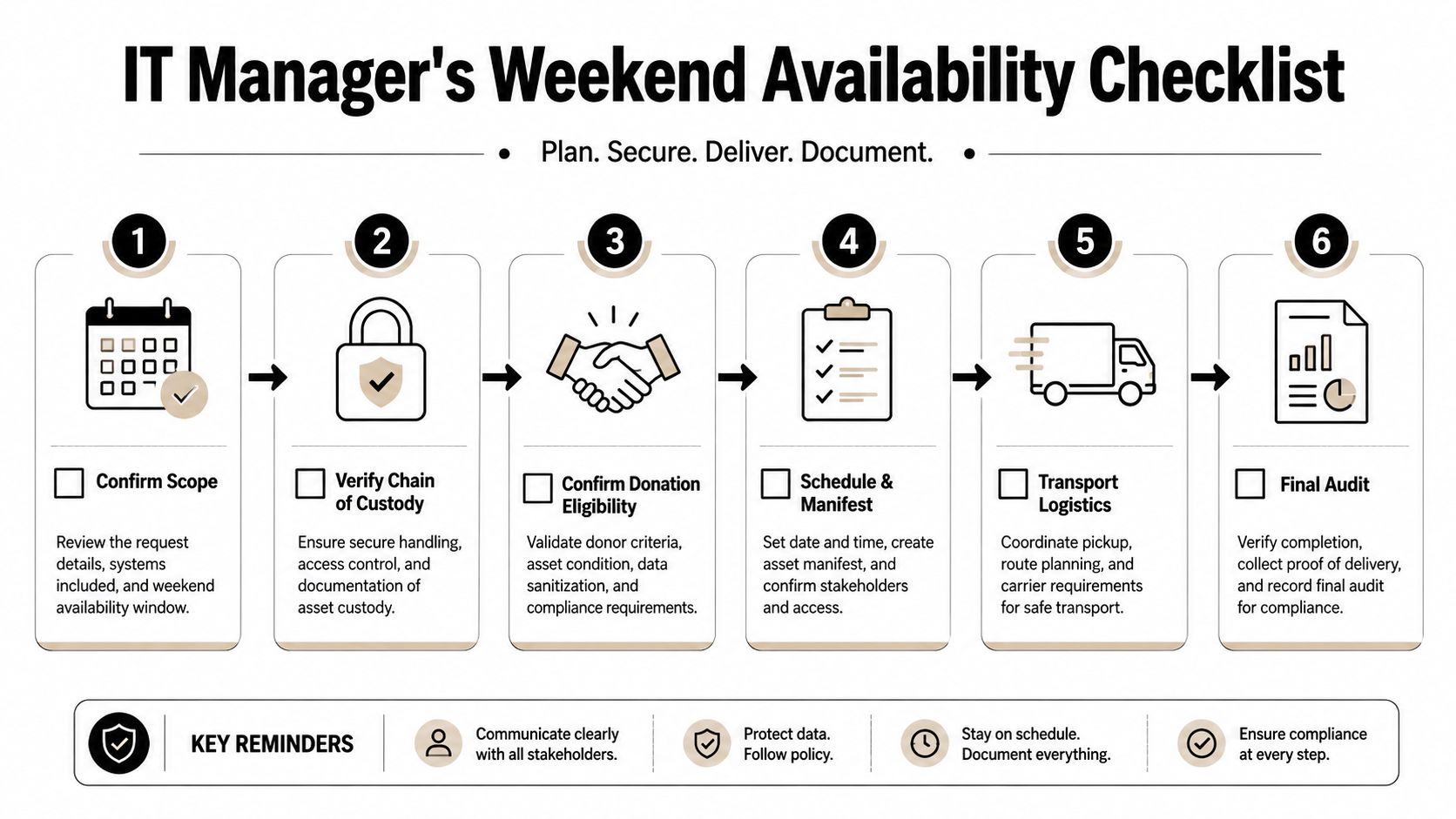
Run the decision the same way every time. First, confirm whether the scope is a single pickup or a recurring need. Then verify that chain-of-custody controls will hold on Saturday, check the sanitization standard, confirm when the certificate will be delivered, and make sure labor coverage matches the access window.
Use donation when the asset still has life left
If the equipment is functional or refurbishable, donation-based recycling should be the first question, not the afterthought. A reuse-first path changes the outcome for ESG reporting, community impact, and corporate social responsibility because the asset doesn't stop at disposal, it keeps moving into refurbishment, nonprofit placement, or downstream resale.
That's especially useful for laptops, office cleanouts, and mixed surplus loads where not everything belongs in shredding. A weekend pickup can still feed a reuse-first route if the vendor can document custody cleanly and route the equipment into the right next step.
If your team is sorting laptops for redeployment or donation, Reworx Recycling's donate-a-laptop page is the kind of destination that should sit beside your disposal path, not replace it.
The decision rule that keeps you out of trouble
If the scope crosses a weekend, the policy must name it explicitly. No ambiguity, no verbal approvals, no “we'll figure it out when the truck gets here.”
That single rule protects the schedule, the audit trail, and the staff carrying the load. It also keeps you honest about whether you're buying weekend access because you need it, or because nobody planned the work early enough.
Frequently Asked Questions About Weekend Availability
Weekend pickup is necessary when the building access window, maintenance schedule, or custody rules make weekday removal impractical. If none of those are true, you probably don't need it, you just need better planning.
For a Saturday job, proof of sanitization should still follow NIST SP 800-88 methods, either Clear, Purge, or Destroy, and the certificate should identify what was sanitized and by whom. If the certificate lands Monday, that's fine, as long as the underlying manifest and device records were captured on the weekend.
Pricing can change for after-hours work because staffing and transport are harder to schedule. Don't assume it's automatic, and don't chase the cheapest quote if it weakens custody controls.
Electronic signatures can work when no office staff are present, but only if the vendor's process preserves the same level of accountability as a wet signature. The important question isn't whether it's digital, it's whether the record is complete and attributable.
Multi-site chains should stage loads before the weekend, then move them according to the pickup order that keeps escorts and truck time efficient. If a pickup window is missed, the vendor should document the miss and reschedule, not improvise a partial handoff.
Sunday is available in some operations, but it should be treated as a separate staffing decision, not an assumed extension of Saturday. Residential-grade hard drives still need proper handling if they're data-bearing assets, because the custody standard doesn't get looser just because the equipment is smaller.
Recurring weekend contracts are usually the right move when the business has predictable shutdowns, refreshes, or decommissioning cycles. That's where a provider like Reworx Recycling can set a repeatable schedule, but the client still needs to define release authority and documentation rules up front.
If you need weekend pickup, secure data destruction, or donation-based electronics recycling, stop guessing and put the process in writing. Visit Reworx Recycling to review services, then schedule the pickup window, custody requirements, and certificate expectations before the truck rolls.