A storage room full of retired laptops usually starts as a temporary problem. Then it turns into a quarter-end problem, a security problem, and eventually a facilities problem.
That is a familiar reality in New York City. A company refreshes employee devices, closes a floor, consolidates offices, or decommissions a small server room. Suddenly there are pallets of monitors, docking stations, phones, hard drives, printers, cables, and miscellaneous gear with no clean path out of the building. The city talks a lot about nyc recycling, but most public guidance speaks to households, curbside bins, and compost. Business electronics sit in a different category entirely.
For IT managers, office managers, and sustainability leads, the issue is not just disposal. It is chain of custody, secure data destruction, building logistics, internal approvals, vendor documentation, and the practical question of what can be reused, donated, remarketed, or recycled. In NYC, where space is tight and compliance expectations are real, old equipment cannot sit around waiting for someone to “figure it out later.”
The NYC Business Recycling Challenge
A facilities manager in Manhattan clears out a locked storage room after a technology refresh. Inside are old desktops, flat screens, a few legacy servers, and a stack of laptops nobody wants to claim. Some assets may still work. Some definitely do not. A few still contain drives.
That is where nyc recycling gets difficult for businesses. The city’s sustainability goals are public and ambitious, but the operational playbook for corporate electronics is often fragmented. Residential rules do not map neatly onto office cleanouts. Internal IT controls do not always align with building move-out deadlines. Procurement may want reuse. Legal may want documented destruction. Finance may ask whether there is residual value.

Where the pressure shows up first
The first problem is physical space. Equipment piles up faster than anticipated.
The second problem is risk. A monitor is bulky. A laptop with a drive is a liability. A box of mixed cables and peripherals looks harmless until someone realizes regulated devices, batteries, or storage media are mixed in with general surplus.
A third problem is uncertainty. Many business teams know they need to act responsibly, but they do not know which path is acceptable for electronics and which path only works for ordinary recyclables. That is why guidance on the environmental and legal impacts of improper commercial e-waste disposal matters. It helps frame e-waste as a compliance issue, not just a housekeeping task.
What works and what fails
Some approaches fail in practice:
- Waiting for a one-time cleanup day: Equipment accumulates, inventory gets weaker, and chain of custody gets harder to document.
- Treating all assets the same: Reusable laptops, broken CRTs, drives, and accessories require different handling.
- Letting departments self-manage disposal: That creates inconsistent sorting, missing records, and avoidable data risk.
More durable programs do three things well:
- Separate reusable equipment from scrap early.
- Put data-bearing devices into a controlled workflow.
- Use a documented pickup and disposition process that facilities and IT both understand.
Tip: If a device ever stored company, employee, patient, student, or customer information, handle it as a data security item first and a recycling item second.
Decoding NYC's General Recycling Environment
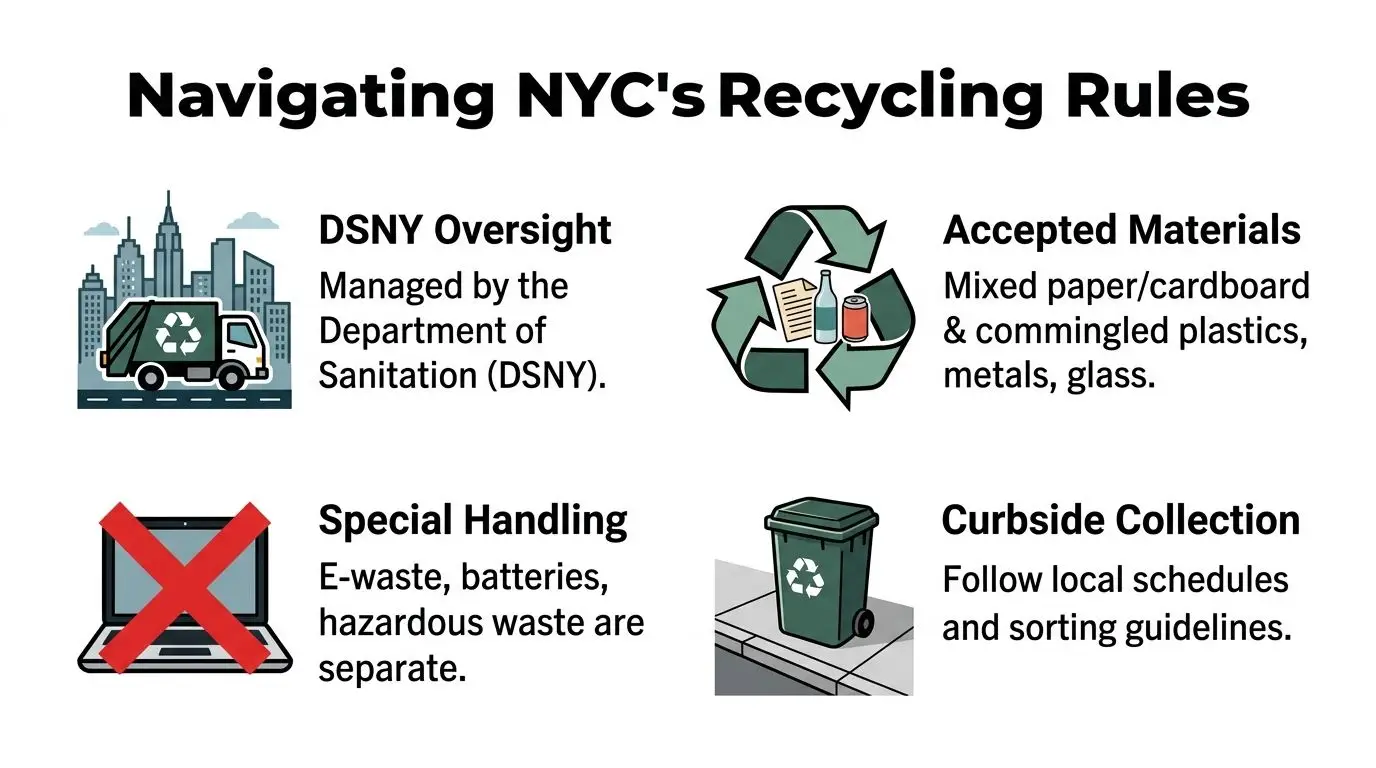
NYC recycling makes more sense once you separate general municipal recycling from special material handling. Paper, cardboard, metal, glass, and many plastics fit the city’s familiar framework. Electronics do not.
What the city system is built to handle
For standard streams, the city’s structure is visible and mature. Businesses need clear internal sorting, labeled collection points, and a hauling arrangement that fits their building and tenant setup.
The baseline categories are straightforward:
- Paper and cardboard: Office paper, corrugated boxes, and other accepted fiber materials.
- Metal, glass, and plastic: Bottles, jars, cans, foil, and accepted rigid plastics.
- Organics: A separate stream with growing city attention, especially on the residential side.
The most recent city data shows NYC collected 295,454 tons of paper/cardboard recycling, 283,639 tons of metal/glass/plastic recycling, and 90,223 tons of organics in fiscal year 2025, with an overall diversion rate of 21.8% according to the DSNY FY2025 collections and diversion data. The same source notes that statewide, only 30% of packaging and paper products are being recycled despite infrastructure existing to capture 76% of these materials.
That tells business leaders something important. Access to recycling infrastructure is not the same as strong recycling performance.
Why availability does not guarantee results
A lot of companies assume the hard part is getting bins in place. It is not. The harder part is getting clean material into the right stream, every day, across multiple departments and shifting occupancy patterns.
Common breakdowns include:
- Mixed materials in one tote: Cardboard, food residue, shrink wrap, and electronics accessories end up together.
- Loading dock confusion: Janitorial teams, tenants, and movers follow different rules.
- Labeling that makes sense to managers, not staff: “Commingled recyclables” means less to employees than “bottles, cans, jars, empty containers.”
What belongs outside the normal flow
A practical NYC program should mark several items as separate from ordinary recycling:
| Material type | Normal recycling bin | Separate handling needed |
|---|---|---|
| Paper and cardboard | Yes | Usually no |
| Bottles, cans, jars, accepted rigid plastics | Yes | Usually no |
| Laptops, monitors, servers | No | Yes |
| Batteries | No | Yes |
| Hazardous materials | No | Yes |
Accuracy suffers in many office programs at this point. Teams build a decent system for paper and containers, then assume that same system can absorb old electronics. It cannot.
Key takeaway: A city can offer broad recycling access and still struggle with actual diversion. Businesses need operating discipline, not just containers.
For a facilities or IT lead, the lesson is simple. Use city-style recycling rules for ordinary materials. Build a separate workflow for electronics, batteries, and sensitive devices.
That distinction matters because electronics bring different questions: who owns the asset record, who authorizes release, how data is destroyed, whether equipment can be donated, and what paperwork will be available after pickup.
The E-Waste Gap in NYC's Official Guidance
A lot of people use the word “recycling” as if it covers every item leaving an office. In NYC, that assumption causes trouble.
Public-facing city discussions around recycling tend to focus on curbside material, composting, contamination, and neighborhood participation. Those topics matter. They just do not answer the questions a business asks when it needs to retire laptops, network gear, drives, copiers, lab electronics, or obsolete AV equipment.
Where the guidance falls short
There is a documented blind spot in the public conversation. As noted in Urban Green Council’s discussion of the city’s waste system, there is a critical gap in official NYC recycling narratives around electronics recycling and IT asset disposition. Residential curbside and compost get extensive attention, while business users get little practical direction on compliant e-waste pathways, device retirement security, or how electronics fit into broader sustainability goals.
For a business, that gap creates friction at exactly the wrong moment. Office closures move fast. Hardware refresh cycles are planned on procurement calendars, not public collection schedules. Data-bearing equipment needs control from the minute it leaves a desk.
Why ordinary recycling logic breaks down
Electronics are different for two reasons.
First, they contain materials that should not be handled like paper, bottles, or cans. Second, many devices hold or once held sensitive information. That turns disposal into a governance issue.
A simple example makes the point:
- A cardboard box from a monitor shipment goes into a paper stream.
- The monitor itself needs specialized downstream handling.
- The laptop that came with it may need documented sanitization or physical destruction before it leaves your custody.
The more regulated your environment, the less room there is for improvisation. Schools, healthcare providers, financial firms, law offices, agencies, and companies with distributed workforces all feel this acutely.
What businesses should do instead
The first step is admitting that public nyc recycling guidance is not a complete operating manual for corporate electronics.
The second step is using standards that were built for this category. Teams that need a framework for evaluating downstream vendors should review e-waste certification standards before scheduling a pickup or authorizing removal.
That kind of due diligence helps answer practical questions:
- Will the recycler document chain of custody?
- How are data-bearing devices processed?
- Are reusable assets separated from scrap responsibly?
- What happens to non-working equipment after collection?
Without that structure, businesses often rely on assumptions, and assumptions are expensive when electronics are involved.
Compliant Electronics Recycling and ITAD for Businesses
Business electronics need a different playbook from household drop-off programs. That difference is not just about volume. It is about control.
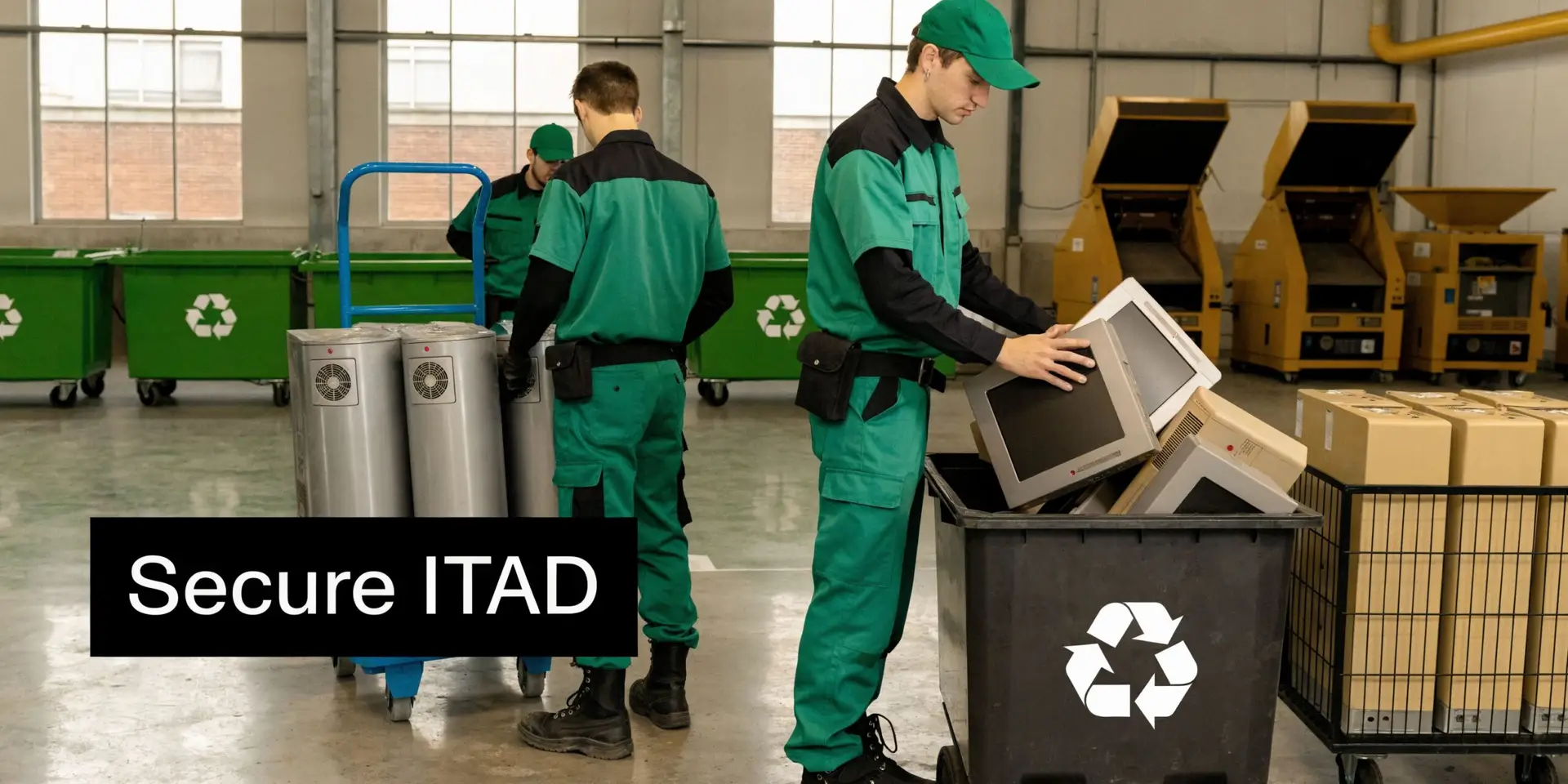
A household may need occasional disposal for a few devices. A company may need pickup from a loading dock, serialized inventory handling, data destruction, deinstallation, packing, palletization, and final reporting. Those are IT asset disposition, or ITAD, functions. They sit at the intersection of sustainability, security, and operations.
Residential options versus business needs
The city provides limited pathways that can help residents manage special materials. Businesses, however, need services that look very different.
Here is the practical comparison:
| Need | Residential-style option | Business ITAD requirement |
|---|---|---|
| Small, occasional device disposal | Sometimes workable | Usually insufficient |
| Bulk pickup from office or facility | Rarely suitable | Essential |
| Data-bearing assets | Limited relevance | Central requirement |
| Serialized reporting | Usually not available | Often required |
| Decommissioning support | Minimal | Often needed |
| Donation and reuse screening | Inconsistent | Valuable for many fleets |
That is why generalized nyc recycling advice leaves business teams unsatisfied. The missing pieces are the operational ones.
What a compliant workflow looks like
Strong electronics recycling programs follow a sequence like this:
- Inventory first. Know what is leaving the building. Even a simple spreadsheet with asset tag, device type, condition, and data status is better than a pile with no record.
- Separate data-bearing items. Laptops, desktops, servers, phones, tablets, backup media, and loose drives should move in a controlled stream.
- Triage for reuse, donation, resale, or recycling. Not every retired asset is waste.
- Use documented data destruction. Software wiping, drive shredding, or another approved method should match your internal policy.
- Keep final records. Pickup documentation and destruction records matter during audits, internal reviews, and sustainability reporting.
Why professional handling matters
NYC’s broader recycling performance shows the limits of access without execution. Waterfront Alliance describes a citywide paradox in which recycling is legally mandated, yet only 16-19% of waste is recycled citywide. For businesses handling electronics, that gap matters because complex materials do not improve through good intentions alone.
Electronics create sorting challenges that ordinary recycling programs do not solve:
- Loose peripherals get mixed into general recycling or trash
- Storage media move without documentation
- Building staff and IT staff use different handoff processes
- Old devices remain in closets because nobody owns the exit process
A specialist can close those gaps. If your team needs a baseline definition of service scope, what IT asset disposition means in practice is a useful starting point.
How to evaluate a provider
Do not choose an electronics recycler based only on who can show up fastest. Speed matters, but downstream controls matter more.
Ask direct questions such as:
- Chain of custody: Who signs at pickup, and what records follow the load?
- Data security: Are drives wiped, shredded, or handled under a documented policy?
- Reuse hierarchy: How are devices evaluated for donation or refurbishment before material recycling?
- Site logistics: Can the provider manage dock appointments, elevators, cartons, pallets, and building access rules?
- Reporting: What paperwork will your IT, compliance, or sustainability team receive?
One option businesses use for electronics recycling, secure data destruction, office cleanouts, and pickup coordination is Reworx Recycling. The useful point is not branding. It is that NYC businesses need a provider that can handle both environmental processing and IT control requirements in one workflow.
Tip: If you cannot explain exactly what happened to a retired drive after pickup, your disposal process is not mature enough.
From Responsibility to Opportunity with Social Enterprise Recycling
The best disposal programs do more than remove risk. They turn end-of-life equipment into a community asset where possible.
That matters because many organizations still treat old hardware as a cost center only. Once teams separate data-bearing items, test what is reusable, and route non-working material properly, a different picture emerges. Some devices still have useful life. Some can support digital inclusion. Some can support internal ESG and CSR reporting in a way that generic scrap removal never will.

Why the social enterprise model changes the conversation
A donation-based model adds another decision layer before shredding and smelting. That is good discipline.
Instead of asking only, “How do we get rid of this safely?” a company can also ask:
- Can these laptops support a community donation program after proper processing?
- Can a refresh cycle produce both environmental and social outcomes?
- Can sustainability reporting reflect more than landfill avoidance?
For IT and sustainability teams, that creates a stronger internal story. The project is not just waste removal. It becomes circularity, access, and responsible technology transition.
Better sorting improves the wider system
The city’s recycling stream works better when electronics stay out of ordinary bins. The 2023 NYC Waste Characterization Study found declining recycling outcomes and rising contamination, with resident error playing a role, according to the study summary shared by SHNNY. That is a residential finding, but the operational lesson applies to commercial sites too. Wrong items in the wrong stream make every downstream step harder.
Professional handling helps in three ways:
- Cleaner DSNY-managed streams: Fewer misplaced electronics in paper or container recycling.
- Higher-value recovery: Reusable devices are identified before they become scrap.
- Stronger documentation: Sustainability teams can report actions with more confidence.
Pair hardware planning with asset tracking
Donation and reuse decisions are easier when the asset record is not a mess. Teams that are tightening inventory and lifecycle controls may also benefit from reviewing practical guides to IT Asset Management software. A better asset system will not solve recycling by itself, but it makes refreshes, retrievals, and disposition decisions much cleaner.
For organizations that want the donation path to be tangible, donating a laptop is one example of how retired equipment can move into a more constructive channel when it is still suitable for use.
Key takeaway: Social enterprise recycling gives facilities and IT teams a better answer to the question, “What happened to the equipment after it left?”
Your Action Plan for NYC Office and Facility Cleanouts
A successful cleanout does not begin on pickup day. It begins when someone defines scope, ownership, and chain of custody.
That matters even more in NYC, where building access windows are tight, loading docks are scheduled, and one missed handoff can delay an entire project. The strongest nyc recycling programs for business electronics are boring in the best way. Everyone knows what leaves, how it leaves, and who signs off.
Start with an asset map
Do not begin with labor. Begin with visibility.
Create a working list of what is on site and group it into practical categories:
- Devices with storage media
- Peripherals and accessories
- Infrastructure gear
- Potential donation candidates
- Obvious scrap or broken equipment
This does not need to be perfect on day one. It needs to be usable. During office cleanouts, a rough but controlled inventory beats a detailed but delayed one.
Build the disposition logic before the movers arrive
Many companies reverse the sequence. They schedule a move or cleanout first and ask IT to sort the hardware later. That is how mixed pallets and undocumented removals happen.
A better sequence is:
- Identify what must be retained.
- Mark what can be donated or reused.
- Flag every data-bearing asset for approved destruction or sanitization.
- Assign a collection area with restricted access.
- Schedule removal only after internal approvals are clear.
If your team is planning furniture and workspace reduction at the same time, resources on responsible office cleanouts can help align facilities planning with surplus management.
Treat data destruction as a project milestone
Data destruction should not be an afterthought line item.
For most organizations, this means setting a clear internal rule for each asset class. Laptops may be wiped or shredded depending on policy. Loose drives often require tighter handling. Printers, copiers, and multifunction devices are easy to miss, even though they can retain information.
Use a short control list:
- Who approved release of the assets
- Which devices contained data
- Which destruction method applies
- What certificate or disposition record is required
- Who receives final documentation
Expect scrutiny to increase
City enforcement around waste streams is not theoretical. In fiscal year 2025, NYC’s mandatory organics program reached a 7.2% residential capture rate, up from 4.2% in FY24, and during spring 2025 enforcement it rose to 8.8% in April and 10.4% in May, supported by roughly 4,000 tickets issued over three weeks, according to the NYC Zero Waste Report 2025. That is organics, not electronics, but the operational message is clear. The city is willing to use enforcement to improve waste compliance.
For businesses, the smart interpretation is not panic. It is preparation.
A practical cleanout checklist
Here is the version I would want an NYC office or facilities team to use before any major decommissioning event:
- Assign one owner: One person should coordinate IT, facilities, security, and vendor communication.
- Lock down staging space: Do not let retired electronics drift through common areas or shared storage.
- Separate reusable equipment early: Donation potential drops fast when working devices are mixed with scrap.
- Document serials where needed: Especially for laptops, desktops, servers, and networking gear.
- Confirm building logistics: Elevator reservations, COIs, dock appointments, and after-hours access often decide whether pickup succeeds.
- Request final records: Certificates, inventory summaries, and disposition documentation should be part of the scope, not an afterthought.
Tip: The easiest time to improve your e-waste process is before a relocation, merger, refresh cycle, or lease-end event. The hardest time is the week you need the space back.
Partner with Reworx for Smarter NYC Recycling
NYC recycling is straightforward only at the surface level. Once your organization is dealing with retired laptops, drives, monitors, servers, phones, medical or lab equipment, or a full office cleanout, the task changes. It becomes a coordination problem across compliance, security, logistics, and sustainability.
That is why many business teams struggle. Public recycling guidance explains bins and accepted materials well, but it does not give IT and facilities leaders a full operating model for corporate electronics. The missing pieces are chain of custody, secure data destruction, reuse screening, donation pathways, reporting, and building-ready pickup execution.
A stronger approach combines those functions into one managed workflow. The provider matters less than the discipline. You need a process that separates reusable assets from scrap, protects sensitive data, supports clean removal from the site, and gives your team documentation it can use.
For organizations that want a defined IT disposition path, the right place to start is a service built around IT asset disposition. That is where recycling, secure handling, and operational control come together in a way generic hauling does not provide.
The broader opportunity is worth noting too. A disciplined electronics program can reduce clutter, lower disposal risk, improve reporting, support donation-based reuse, and help sustainability teams tell a more credible story. In a city where waste systems are under pressure, that kind of program is not just responsible. It is practical management.
If your NYC business is planning a device refresh, office cleanout, facility cleanout, or data center decommissioning, Reworx Recycling offers a clear next step. Use them to donate old equipment, schedule a pickup, or explore a compliant path for electronics recycling, secure data destruction, and corporate donation programs that support both environmental goals and community impact.