When your business needs a reliable solution to recycle lead acid batteries near me, the first and most crucial step is finding a certified, professional partner. These aren't just standard batteries; they are the heavy-duty power sources in your UPS systems, fleet vehicles, and critical industrial equipment. Managing their disposal correctly is a serious matter of environmental compliance, operational safety, and corporate responsibility.
For a B2B audience, this process goes beyond simple waste management. It's a fundamental component of your risk mitigation, sustainability reporting, and overall operational strategy.
Your Guide to Local Lead Acid Battery Recycling
If you're an IT manager, business owner, or sustainability lead, you understand the challenge of dealing with end-of-life lead-acid batteries is more than just a quick search. It involves navigating complex environmental regulations, ensuring data security for the equipment they powered, and verifying that your disposal methods align with your company's ESG (Environmental, Social, and Governance) goals.
These batteries are classified as hazardous waste due to their lead content and corrosive sulfuric acid, making improper disposal a significant liability. The good news? The EPA notes that lead-acid batteries have a recycling rate of over 99%, making them one of the most successfully recycled products. This incredible rate is only possible because a structured, professional recycling infrastructure is in place to handle them safely.
Why a Strategic Approach Is Necessary
A casual approach to battery disposal can backfire, leading to steep fines and reputational damage. A strategic plan ensures every battery is accounted for and processed correctly, providing a clear chain of custody from your facility to final reclamation.
This becomes especially critical during large-scale projects like:
- Data Center Decommissioning: Racks of UPS systems contain dozens of heavy lead-acid batteries that must be managed in bulk.
- Office or Facility Cleanouts: Old emergency lighting, security systems, and other forgotten infrastructure often depend on these batteries.
- Fleet Vehicle Maintenance: Regularly swapping out vehicle batteries creates a steady stream of hazardous waste that requires a consistent disposal solution.
To better understand the widespread use of these batteries, it's useful to review resources that compare . The context reveals just how many commercial applications rely on this type of power.
Partnering with a certified electronics recycler like Reworx Recycling transforms this compliance task into a strategic opportunity. As a donation-based social enterprise, Reworx ensures your batteries are handled in full compliance with all regulations. Furthermore, when these batteries are part of a larger IT equipment disposal project, we guarantee secure data destruction for any associated hardware.
By choosing a responsible partner, you’re not just protecting the environment—you're reinforcing your company's commitment to sustainable business practices. For more details on finding a convenient and certified facility, check out our guide on locating a recycling center near you.
How to Safely Prepare Batteries for Recycling
Before you even begin searching for a facility to "recycle lead acid batteries near me," the most important work happens at your own site. Proper preparation isn't just a box to check—it's how you protect your team, prevent dangerous and costly accidents, and maintain environmental compliance. A minor mistake at this stage can create a significant problem.
First, conduct a visual inspection of every battery. Look for red flags such as cracks in the casing, unusual bulging, or obvious leaks. If you identify a compromised battery, it poses a major hazard and must be segregated immediately. Crucially, never stack batteries on top of each other, as this can damage terminals and create a serious fire risk.
Establishing Safe Handling Protocols
When it comes to your team, Personal Protective Equipment (PPE) is non-negotiable. This includes acid-resistant gloves and safety glasses or goggles, at a minimum. The sulfuric acid inside these batteries is highly corrosive and can cause severe chemical burns to skin and eyes.
Proper storage while awaiting pickup or drop-off is equally critical.
- Designate a specific area: Find a location that is cool, dry, and well-ventilated. Keep the batteries far away from heat sources, potential sparks, or open flames.
- Prevent short circuits: The terminals are the primary danger zone. Secure them with protective plastic caps. If caps are unavailable, several wraps of heavy-duty electrical tape will suffice. This simple step prevents them from accidentally making contact and creating a spark or fire.
- Use proper containment: Always store batteries upright on non-conductive surfaces. For an extra layer of safety against leaks, understanding how to go about selecting the appropriate spill containment pallets can make a significant difference in keeping your storage area safe and compliant.
This infographic breaks down the simple, three-step approach for businesses looking to recycle responsibly.
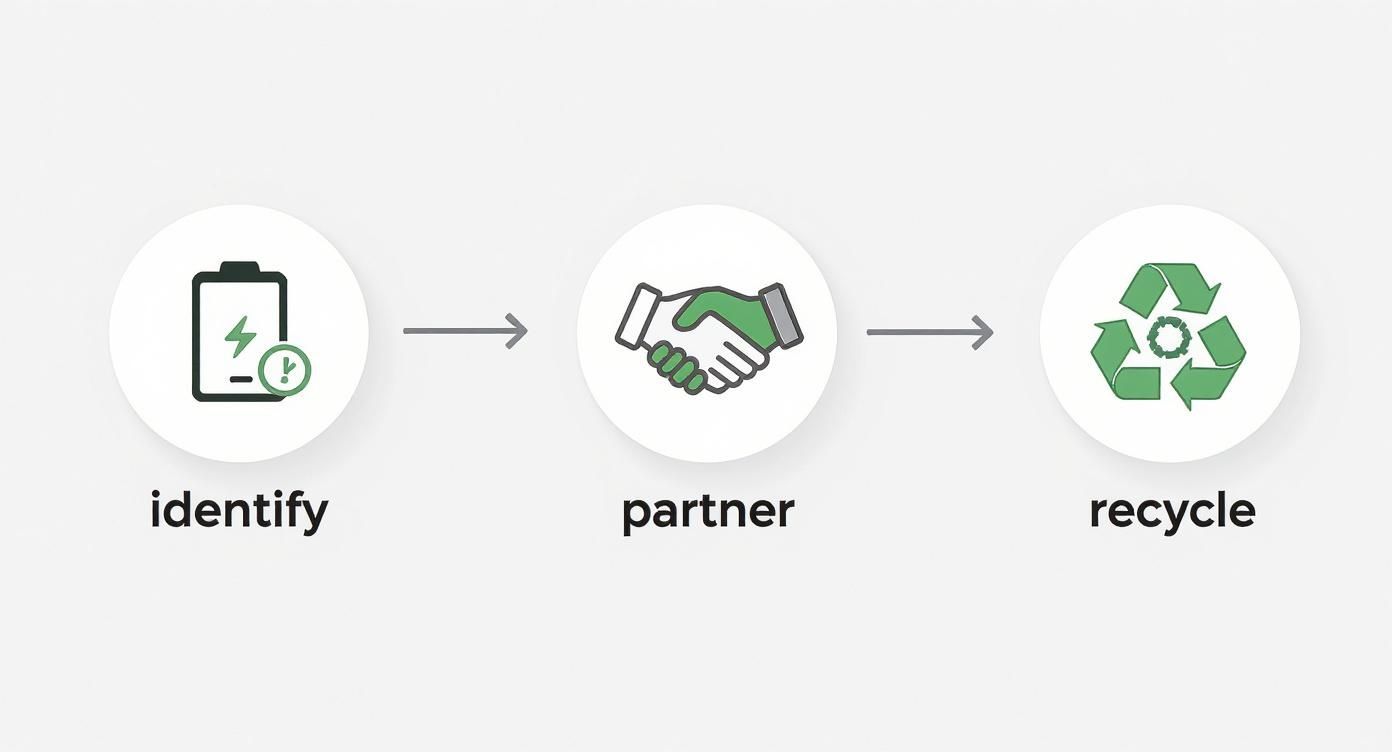
As you can see, a solid recycling program always starts with identifying your materials, finding a partner you can trust, and ensuring everything is recycled the right way.
Key Takeaway: Treat a damaged lead-acid battery with extreme caution. Your first action should be to place it inside a secondary, leak-proof plastic container. Then, ensure it’s clearly labeled as damaged so no one on your team—or your recycling partner's—mishandles it.
Mastering these preparation steps ensures a smooth, safe recycling handoff. For more detailed tips covering a wide range of corporate equipment, you may want to review our comprehensive guide on how to prepare your company's electronics for recycling. By implementing these safety measures now, you’re setting up your materials for a seamless transfer to a professional partner like Reworx Recycling, ensuring the entire process is handled responsibly.
Finding and Vetting Certified Recycling Partners
A quick search for "recycle lead acid batteries near me" is a starting point, but for any business, the real work is just beginning. Finding a partner that shields you from liability is paramount. You cannot simply drop off hazardous materials at the nearest facility and consider the job done; proper due diligence is essential to protect your company, ensure compliance, and align with your corporate sustainability goals.
The first step is to identify certified recyclers. Your state's environmental protection agency and the federal EPA are the best resources. Both maintain updated lists of businesses authorized to handle hazardous waste, including lead-acid batteries. Using these official directories helps you immediately filter out uncertified operators who could expose your business to serious risks.
Key Questions for Potential Partners
Once you have a shortlist, it’s time to dig deeper and ask critical questions. Any reputable recycler will not only expect this level of scrutiny but will welcome it with transparent answers. Your goal is to get a complete picture of their process, from the moment they pick up your batteries to their final material recovery.
Here are a few key areas to investigate:
- Downstream Accountability: You need to know where the batteries go after they leave the recycler's facility. A certified partner should provide a clear chain of custody, proving materials are processed responsibly and are not being shipped to unregulated facilities overseas.
- Certifications: Always look for credentials like R2 (Responsible Recycling) or e-Stewards. These certifications are the gold standard in the IT asset disposition (ITAD) industry, signaling that the recycler adheres to the highest environmental and data security standards.
- Compliance Documentation: Ask if they provide a Certificate of Recycling. This document is your legal proof that you disposed of hazardous waste correctly. It is an absolute must-have for any corporate sustainability report or environmental audit.
Lead-acid batteries are a massive recycling success story. They hold the unique distinction of being the most recycled consumer product in the United States, with a staggering 99% recycling rate. This nearly closed-loop system keeps over 160 million batteries out of landfills each year, conserving vital resources. You can learn more about the impressive industry-wide recycling efforts that make this possible.
Vetting becomes even more critical when your batteries are part of a larger IT equipment disposal project. For instance, if they’re from UPS systems connected to servers, you must confirm the recycler's data destruction capabilities. Be sure to ask specifically about their process for any associated hardware to ensure total data security.
Making the right choice involves more than just logistics. We've put together a detailed guide on the various factors when choosing an e-waste recycling partner that can help you think through all the angles.
Choosing a partner like Reworx Recycling, a social enterprise, adds another layer of value. Our transparent processes and commitment to community impact mean your decision supports both environmental responsibility and social good. We provide all necessary documentation and ensure your brand’s reputation is protected at every stage.
Comparing Drop-Off Locations and Pickup Services

Every business operates differently, and when you need to recycle lead acid batteries near me, selecting the right disposal method is key to maintaining efficiency and compliance. You have two main options: self-service drop-off or a scheduled professional pickup. The optimal route depends on your company’s scale, resources, and the volume of batteries you are managing.
For a small business with just a few batteries from an emergency light or security system, a local drop-off might seem straightforward. An employee transports them, drops them off, and the task is complete. However, this approach often carries hidden costs—employee time, fuel, and the significant liability of having your team transport hazardous materials.
When Professional Pickup Becomes Essential
Once you begin dealing with more than a handful of batteries, the inefficiencies of the DIY drop-off model become apparent. This is where a scheduled pickup service transitions from a luxury to a strategic business necessity.
Consider these common business scenarios:
- Data Center Decommissioning: You're managing dozens, if not hundreds, of heavy UPS batteries—a major logistical challenge.
- Fleet Maintenance: A steady stream of used car and truck batteries requires a consistent, reliable disposal process.
- Facility Cleanout: A large-scale cleanout of a warehouse or laboratory can uncover a surprising number of batteries from various legacy equipment.
In these situations, a professional pickup service ensures your hazardous materials are handled by trained professionals with the right equipment. It completely removes the burden—and the liability—from your team.
Making the Right Choice for Your Business
To help you see the differences clearly, let's break down the two methods side-by-side.
Choosing Your Recycling Method: Drop-Off vs Scheduled Pickup
Deciding how to manage your used lead-acid batteries can impact your operational efficiency and compliance. This table compares the key factors of doing it yourself versus using a professional service.
| Factor | Self-Service Drop-Off | Scheduled Business Pickup (e.g., Reworx Recycling) |
|---|---|---|
| Best For | Very low volume, one-time disposal | Bulk quantities, recurring needs, facility cleanouts |
| Logistics | Managed internally by your staff | Handled entirely by trained recycling professionals |
| Liability | Your business is responsible during transport | Liability transfers to the recycler upon pickup |
| Documentation | Varies by location; may be minimal | Comprehensive, including Certificates of Recycling |
| Cost | Hidden costs (labor, fuel, time) | Transparent, upfront service fee; often more cost-effective at scale |
| Convenience | Requires significant staff effort | Minimal disruption to your daily operations |
When viewed this way, the choice becomes clear for any business that prioritizes efficiency, safety, and compliance. A professional service like Reworx Recycling handles the heavy lifting, safe transport, and all necessary paperwork, ensuring your assets are managed responsibly from the moment they leave your site. This frees your team to focus on core business functions, not waste management.
If you're ready to move beyond the complexities of DIY disposal, you can easily schedule a pickup with Reworx Recycling for a process that is as seamless as it is secure.
Making Sense of Recycling Compliance and Paperwork
In the corporate world, what isn't documented can quickly become a significant liability. When recycling lead-acid batteries, that paperwork is your compliance shield. It serves as official proof that your company acted responsibly and adhered to all applicable regulations. Simply handing off old batteries to a recycler is not the final step—it is the beginning of creating a solid, defensible audit trail.
The entire process is governed by a framework of federal and state regulations. The Environmental Protection Agency (EPA) classifies lead-acid batteries as hazardous waste, which means their disposal falls under the Resource Conservation and Recovery Act (RCRA). While the Universal Waste Rule simplifies some handling requirements, it does not absolve your business of accountability.
Why Documentation Is a Must-Have
For any business, especially one managing a large facility cleanout or data center decommissioning, the paperwork is non-negotiable. It serves as your official record, proving you transferred hazardous materials to a certified facility equipped to process them correctly. This documentation is essential for internal audits, stakeholder reporting, and demonstrating compliance to regulators.
There are two critical documents you must obtain from your recycling partner:
- Certificate of Recycling: This is the key document. It certifies that your batteries were received and processed in accordance with all environmental laws. It is the cornerstone of your compliance record.
- Certificate of Data Destruction: This may seem unrelated to batteries, but if they came from IT hardware like UPS systems connected to servers, this document proves any associated data-bearing devices were securely wiped or destroyed. It closes the loop on data security liability.
Without these certificates, you are left with no verifiable proof of proper disposal. That exposure can leave your company vulnerable to serious legal and financial penalties.
A Quick Tip from the Trenches: I always advise clients to view their recycling paperwork as an insurance policy. In the event of an environmental audit, a complete set of certificates from a certified partner like Reworx Recycling instantly proves you performed due diligence. It is the fastest way to protect your brand’s reputation.
Let a Professional Partner Handle the Hassle
Managing this paperwork internally can be a significant administrative burden, particularly if you are already juggling multiple vendors for IT asset disposition (ITAD) and battery recycling. This is where a professional partner adds immense value. At Reworx Recycling, we manage the entire compliance process for you, removing the burden from your team. We provide all necessary documentation to create a seamless, transparent, and fully defensible record.
This paperwork does more than just satisfy a compliance requirement. It provides tangible data you can integrate directly into your corporate sustainability reports. By partnering with us, you are not just meeting regulatory obligations—you are also gaining the hard evidence needed to showcase your commitment to responsible environmental stewardship and positive community impact.
The Reworx Advantage: Partnering for Community Impact
When your business needs to recycle lead acid batteries near me, the partner you select reflects your corporate values. This decision extends beyond simple logistics—it is a direct expression of your commitment to corporate social responsibility. This is precisely where Reworx Recycling stands apart, transforming a routine disposal task into a powerful act of community support.
Unlike a traditional recycler, Reworx operates as a donation-based social enterprise. This means your end-of-life batteries and obsolete IT equipment become a catalyst for meaningful, positive change. When you partner with us, you aren't just fulfilling an environmental compliance requirement. You are actively funding digital inclusion initiatives and helping place essential technology into the hands of underserved communities.
Turning Obsolete Assets into Community Opportunity
Your decision to recycle with Reworx creates a positive ripple effect. The value we recover from responsibly recycling materials—from lead-acid batteries to entire server rooms—directly fuels our mission. We use these resources to provide refurbished computers to students, support workforce development programs, and bridge the digital divide for families in need.
This model provides a unique social return on your investment. You gain the peace of mind that comes with secure data destruction and compliant recycling, all while enhancing your brand’s reputation as a socially conscious leader. Suddenly, that facility cleanout or data center decommissioning becomes a story of community empowerment. To see how this works in practice, you can explore the benefits of partnering for impact with Reworx.
The need for responsible partners is growing. The lead-acid battery recycling market was valued at around $12.1 billion in 2024 and is projected to more than double by 2034. This growth is driven by stricter environmental laws and the increasing use of these batteries in everything from industrial forklifts to renewable energy storage. It underscores how critical it is to choose a partner who aligns with both economic sense and social good. You can discover more insights about this growing market and see why sustainable partnerships are the future.
Got Questions About Business Battery Recycling? We've Got Answers.
When it's time to manage the logistics of recycling lead-acid batteries, a few common questions always arise. Business leaders, facility managers, and IT professionals all need to ensure they are handling the process correctly. Here are clear, direct answers to help you finalize your plan with confidence.
What Kinds of Batteries Can We Actually Recycle?
An excellent question. While "lead-acid batteries" is the focus, most certified recyclers, including Reworx, handle a much broader range. We manage everything from the batteries in your UPS systems and fleet vehicles to the heavy-duty power sources in industrial machinery.
Furthermore, we often handle batteries that are still housed within other electronics during an IT equipment cleanout—such as in laptops, medical devices, and server racks. This enables a single-stream solution for your entire facility cleanout, simplifying logistics immensely.
What Happens to Our Data? Is It Secure?
This is a critical concern, and rightly so. It is often the first question from IT managers, especially when batteries are being removed as part of a data center decommissioning project.
Rest assured, whenever we handle hardware that could potentially contain data, security is our top priority. At Reworx, we provide certified, secure data destruction services. You receive a complete audit trail from start to finish, providing documented proof that your information was handled properly and protecting your business from data breach risks.
How Does the Social Enterprise Model Actually Benefit Us?
This is where your choice of a recycling partner can make a significant difference. Working with a social enterprise like Reworx transforms what is typically a line-item expense into a powerful community benefit. The value recovered from your donated assets—batteries included—goes directly toward funding our mission.
In practice, this supports digital inclusion initiatives and workforce development programs within the community. It becomes a powerful story to include in your corporate sustainability reports. The global lead-acid battery recycling market is massive—estimated at USD 12.12 billion in 2024—and your choice of partner determines where that value is directed. Does it merely go to a processor, or does it also create local opportunities?
You can learn more about the global battery recycling market trends to see just how significant this industry is. Your participation truly matters.
Ready to turn your old IT equipment and batteries into a positive community impact while ensuring full compliance? Reworx Recycling makes it easy to manage your electronics and battery disposal responsibly. Partner with us to schedule a pickup or donate your old equipment today. Your business can make a difference. https://www.reworxrecycling.org/schedule-a-pickup/