You're comparing a short PATH ride to Lower Manhattan, a direct Midtown train, a flexible bus route, and the possibility of getting a larger suburban home. The fastest trip on a transit map may not be the easiest trip from your front door to your desk. Your destination, housing budget, school priorities, station access, tolerance for transfers, and need for backup routes all change the answer.
This ranking of the New Jersey best commuter towns near New York City evaluates the complete door-to-desk experience. Each profile weighs the Manhattan destination, primary mode, nearest station or terminal, housing trade-offs, family fit, walkability, advantages, drawbacks, and the type of resident most likely to thrive there. Commute times are typical planning ranges drawn from the supplied town information, not guarantees. Service disruptions, traffic, weather, crowding, and the final walk can change the result.
The broader market explains why these decisions matter. In 2022, 447,112 Northern New Jersey residents worked in New York City, representing 9.6% of all NYC workers, with total wages of about $61.68 billion and an average wage of $137,953, according to the Regional Plan Association's commuter analysis. The ranking starts with the towns offering the strongest combination of access and daily livability, not the shortest advertised ride.
1. Hoboken, Hudson County
Hoboken is the clearest choice for a commuter who wants the shortest practical connection to Manhattan and can accept a premium housing market. Its compact Hudson River grid puts PATH, ferries, buses, restaurants, shops, offices, and waterfront parks within a highly walkable environment. For many residents, the commute starts on foot rather than with a drive to a remote station.
The town's strongest advantage is modal redundancy. PATH provides a fast connection to Lower Manhattan, while NY Waterway ferries and NJ TRANSIT buses create alternatives when one route is disrupted. A PATH trip from downtown Hoboken to the World Trade Center takes about 11 minutes, based on the supplied commuter-town data, although walking to the station, waiting, and reaching the final office can materially extend the door-to-desk journey.
The waterfront also offers a one-seat ferry option to Midtown West from Hoboken 14th Street. That's useful for workers whose offices sit near the west side of Midtown, while PATH is usually more logical for Lower Manhattan.
Why Hoboken ranks first
- Best for Lower Manhattan: PATH is particularly well suited to offices near the World Trade Center and the Financial District.
- Best for redundancy: PATH, NY Waterway ferries, and NJ TRANSIT buses let commuters change modes instead of relying on one corridor.
- Best for car-light living: The grid, dining scene, retail, and waterfront amenities reduce the need for routine driving.
- Best for employers: High rental liquidity and corporate short-term housing options can help businesses attract workers who need flexible placements.
The trade-off is cost. Hoboken sits in the premium tier for rents and home prices compared with many New Jersey markets, and peak ferries can become crowded. PATH and ferry schedules can also change during construction or severe weather, so redundancy doesn't mean every alternative will operate identically.
Practical rule: Choose Hoboken when saving daily transfer time matters more than maximizing interior space or minimizing housing costs.
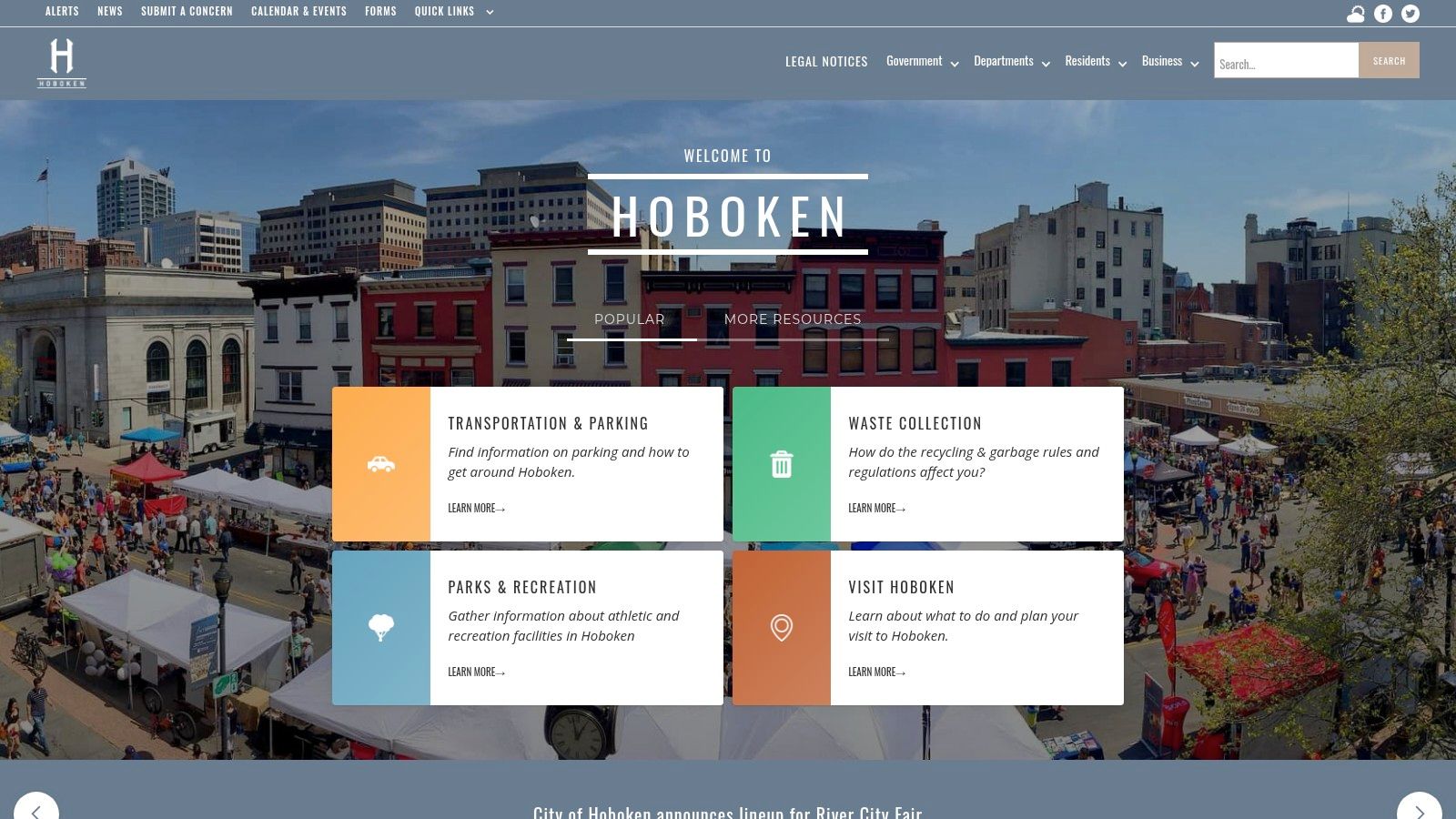
For local context, the City of Hoboken website is useful for municipal information, while this New York City travel guide can help new residents plan around the city they'll be entering. Hoboken fits solo professionals, hybrid workers with frequent Lower Manhattan meetings, and companies prioritizing access and amenities for talent retention.
2. Jersey City, Hudson County
Jersey City offers a broader housing and neighborhood menu than Hoboken while preserving unusually fast access to Manhattan. The city's scale matters. A renter or buyer can choose among high-rise buildings, brownstones, new amenity properties, and neighborhoods with different relationships to PATH, ferry terminals, light rail, and local services.
For Lower Manhattan workers, Grove Street and Exchange Place are especially convenient starting points. Journal Square expands the search area and connects residents to the PATH system, although the experience depends heavily on the distance between home and station. A short train ride can become a less attractive commute if the first mile requires a long walk, a shuttle, or a crowded local connection.
Jersey City also gives commuters more than one way across the Hudson. Ferry service around Paulus Hook supplements PATH, while light rail connections can help residents reach parts of the waterfront and nearby neighborhoods. The result is a useful balance between speed and choice, though no option eliminates peak crowding or construction risk.
Access versus housing choice
The city's larger apartment pipeline and frequent building-level concessions can create more negotiating room than Hoboken, but prospective residents shouldn't treat every listing as interchangeable. Building management, sound conditions, elevator reliability, neighborhood feel, and the actual walk to PATH can change the daily experience.
- For Lower Manhattan: Prioritize Exchange Place, Grove Street, or Paulus Hook access.
- For broader inventory: Consider Journal Square and other neighborhoods, then calculate the complete first-mile route.
- For corporate housing: The city's scale can make larger rental blocks and corporate leases easier to locate.
- For families: Compare building amenities and school arrangements by neighborhood rather than judging the city as one uniform market.
Jersey City's main weakness is variation. Two homes in the same city can produce very different commutes and lifestyle patterns. PATH crowding is another practical concern, particularly for workers with fixed arrival times.
The Jersey City municipal website is the appropriate starting point for local services and resident information. Businesses managing technology transitions for Jersey City offices can also review IT asset disposition services in Newark and New Jersey when planning equipment retirement around a relocation or office cleanout.
3. Montclair, Essex County
A commuter working in Midtown may find Montclair's Bay Street station highly convenient, while someone bound for Lower Manhattan faces a less direct trip. That distinction captures the town's position in this ranking. Montclair combines several village centers, restaurants, arts venues, cultural programming, schools, and varied housing, but its complete door-to-desk result depends on office location and the home's distance from rail.
Bay Street provides Midtown Direct service to New York Penn Station when normal operations run. The direct ride removes a transfer for Midtown employees, although the office-to-station journey continues after arrival. Lower Manhattan workers may need another subway or rail connection, and residents who live farther from Bay Street must add a walk, drive, parking arrangement, or local ride before boarding.
A lifestyle choice with a rail-resilience test
Montclair's multiple centers give former New Yorkers more than a station-based commute. Restaurants, cultural activities, and neighborhood identity can support an active routine after work. Families may value the combination of schools, civic services, community programming, and housing that includes condos and single-family homes.
The rail line also introduces a planning risk. Service changes associated with Portal Bridge and related adjustments can alter or divert Midtown Direct trains. A prospective resident should test the backup route before choosing a home, whether that means reaching Hoboken, using a bus, or driving to another station. A direct train is useful, but dependable alternatives determine how well the commute holds up when service changes.
Montclair fits different households for different reasons:
- For creative and professional workers: Village centers and arts programming support a fuller after-work routine.
- For families: Housing variety and community services add value beyond the train schedule.
- For Midtown offices: Bay Street is most attractive when direct trains operate normally.
- For hybrid workers: Fewer weekly trips can make variable service easier to accept, especially when lifestyle benefits carry greater weight.
Affordability remains a limitation. Supplied planning information places the typical home value at approximately $1.17 million in mid-2026, according to the Montclair municipal site and associated town information. Treat that time-specific figure as a screening reference, not a substitute for reviewing current listings, taxes, and property condition.
Montclair suits families and former city residents who value culture, schools, and neighborhood character alongside rail access. Organizations handling an office cleanout can arrange New Jersey electronics recycling services separately from employee commute planning.
4. Maplewood, Essex County
A Maplewood commute can work well for a household that values the full daily routine, not only the train timetable. Leafy neighborhoods, a lively village center, community events, and Midtown Direct access to New York Penn Station give the town a broad appeal when normal service operates. Compared with Montclair, Maplewood can offer a somewhat better value for a similar mix of walkability, family appeal, and Manhattan access, though home condition and location create wide variation.
The practical test is the distance between home, station, and destination office. Residents who can walk or cycle to the train capture more of the rail connection's value than those who need a car, parking permit, or local shuttle. Supplied town information places the typical Midtown journey at approximately 40 to 45 minutes when direct trains run. That range excludes the trip from home to the station and the final connection from Penn Station to work.
Maplewood's trade-off: strong local fit, less certainty on rail days
Maplewood's downtown supports errands, meals, and informal social activity, while civic programs and community events can give families a stronger local routine. That combination matters for hybrid workers, who may spend more weekdays in town and place greater value on nearby amenities.
Rail reliability requires closer scrutiny. The Morris and Essex corridor can be affected by Portal Bridge work and related diversions, creating transfers or alternate routes despite the usual direct-service profile. A worker with early meetings, school pickup duties, or little tolerance for variable arrival times should assess backup options before choosing a home.
The best location depends on the household's priorities:
- Families: Walkable amenities and community programming support a settled routine.
- Hybrid commuters: Direct rail access has more value when office days are concentrated.
- Value-conscious buyers and renters: Maplewood may compare favorably with nearby Montclair for a similar lifestyle profile.
- Daily Midtown commuters: Confirm the normal train pattern, diversion history, and backup route before making an offer or signing a lease.
The Township of Maplewood website helps prospective residents verify local services and programs. Maplewood is a practical choice for buyers seeking a village center and family-oriented setting. It is a weaker fit for anyone who treats a one-seat train as guaranteed rather than as an advantage under normal conditions.
5. Summit, Union County
A Summit commuter may leave a well-served suburban neighborhood, walk through a compact downtown, board an express train, and still face a final Manhattan leg after arriving at Penn Station. That sequence explains the town's appeal and its limitation. Summit performs well across housing stability, schools, services, and rail access, but the package is priced accordingly.
Morris and Essex line trains provide Midtown Direct service, including express options. Under normal conditions, the trip to New York Penn Station is approximately 35 to 45 minutes, according to commuter-town guidance covering NJ TRANSIT's fastest corridor. Door-to-desk planning must also include the trip to Summit station, parking or drop-off arrangements, and the connection from Penn Station to the office.
A premium paid for daily convenience
Summit's downtown supports errands, meals, and professional appointments without requiring every trip to begin by car. Schools, municipal services, and a settled neighborhood structure make the town attractive to families planning to remain for years. The official city website can help relocating households verify local programs and services before choosing a neighborhood.
Housing is the central trade-off. Summit is among North Jersey's pricier suburban markets, so buyers and renters are paying for more than rail access. The premium reflects the combined value of schools, downtown quality, community stability, and potential resale appeal. That calculation is harder for households that will use few local amenities or that need the lowest monthly housing cost.
Service changes remain part of the commute analysis. Rail projects and Portal Bridge work can disrupt normal patterns, so a daily Midtown commuter should check backup routes and station logistics rather than treating direct service as guaranteed.
- Families: Schools, services, and a stable community setting support a long-term household routine.
- Executives: Express rail and a professional downtown can reduce daily friction, provided the station and Manhattan legs fit the schedule.
- Budget-conscious buyers and renters: Compare the housing premium with the actual value of schools, walkability, and local services.
- Hybrid workers: The town's cost is easier to justify when its amenities are used throughout the week, not only on office days.
For household cleanouts, the Cranford conservation center resource offers information on responsible material handling, including obsolete electronics that should not automatically enter ordinary waste streams.
6. Ridgewood, Bergen County
Ridgewood ranks well for the complete door-to-desk experience when a household values an independent downtown as much as Manhattan access. Historic Main Street, parks, shops, schools, and family programs support a settled suburban routine. The trade-off is distance and transfers, not a shortage of daily amenities.
Its strongest commuting feature is route choice. Rail service can run through Secaucus for a connection to New York Penn Station or toward Hoboken, where PATH or ferry service may continue the trip. Direct Manhattan-bound buses offer another option, especially for offices near Port Authority. This redundancy helps when one route is delayed, though each alternative has its own schedule and transfer requirements.
A better town fit for flexible schedules
Ridgewood has no one-seat rail trip to Penn Station. A well-timed transfer can work, but it adds uncertainty that commuters in inner-ring towns may avoid. Weather, crowding, and early meetings make that extra step more consequential, particularly for workers expected in Manhattan every day.
Station location changes the calculation. A home within an easy walk of the village or station can reduce the local portion of the commute and make the town more practical without a car.
- For families: Schools, parks, and community programs may justify accepting the longer Manhattan trip.
- For flexible professionals: Multiple rail, bus, and connecting routes provide options when schedules change.
- For station walkers: Proximity to the village or station improves the door-to-door experience more than a distant address with nominally similar rail access.
- For strict Midtown commuters: A direct bus may be more useful than a rail itinerary requiring a transfer.
The Borough of Ridgewood website provides municipal service and community information. Businesses relocating to Bergen County may also need procedures for laptop disposal, secure data destruction, and office cleanout. The Glen Rock recycling center resource offers a nearby reference for responsible materials planning.
7. Fort Lee, Bergen County
A Midtown office near Port Authority changes the Fort Lee calculation. Instead of traveling to a rail station, many residents can use Manhattan-bound express buses, including NJ TRANSIT Route 158. The town's position beside the George Washington Bridge supports direct road connections, while nearby Port Imperial ferries add another option for some commuters.
That convenience comes with exposure to traffic. A bus itinerary can look direct yet vary substantially during peak periods, so the relevant measure is the full trip from home to office, not the scheduled ride alone. Workers in Lower Manhattan generally face a less direct journey and may need an additional connection.
Fort Lee's housing mix makes the trade-off more useful for some buyers and renters. Older co-ops, established condos, and luxury towers create more building choices than a rail-centered suburb with a narrower housing stock. Compared with some Hudson River waterfront towns, Fort Lee can offer access to Manhattan without requiring the highest-cost riverfront location, though value depends on building condition, fees, parking, and the exact bus stop.
Decision test:
- Port Authority commuters: A direct express bus can simplify the daily trip when the office is close to the terminal.
- Condo buyers: Compare co-ops, older condos, and newer towers by monthly costs as well as purchase price.
- Car-light households: Bus service and nearby ferries may reduce routine driving, but neither removes traffic risk.
- Schedule-sensitive workers: Test the route during peak periods, including the walk from home to the stop and the final Manhattan leg.
Fort Lee has fewer walk-to-rail choices than towns built around commuter stations. Address-level access therefore matters. A shorter walk to a dependable bus stop may improve the door-to-desk result more than a larger home farther from transit. Municipal information is available through the Borough of Fort Lee website. Households weighing healthcare access can also review at-home medical care in Bergen County.
Fort Lee suits commuters who value housing variety, Midtown bus access, and bridge proximity over a rail-first routine. It is a weaker fit for workers who need a predictable, transfer-free trip to Lower Manhattan or who cannot absorb peak traffic variability.
7 Top NJ Commuter Towns Near NYC, Quick Comparison
| Location | Transit complexity 🔄 | Commute speed ⚡ | Cost / housing 📊 | Expected outcomes ⭐ | Ideal use cases & tip 💡 |
|---|---|---|---|---|---|
| Hoboken, Hudson County | PATH + ferries + buses (high redundancy) 🔄🔄🔄 | Very fast to WTC (~11 min) ⚡⚡⚡⚡ | High rents/home values (mid–upper tier) 📊 | Short door-to-desk; dense amenities ⭐⭐⭐⭐⭐ | Best for daily Manhattan commuters; expect peak ferry crowding 💡 |
| Jersey City, Hudson County | Multiple PATH stations + ferries + light rail 🔄🔄🔄 | Fast to WTC/Midtown; station-dependent ⚡⚡⚡⚡ | Moderate–high; larger inventory than Hoboken 📊 | Strong access with broader housing choice ⭐⭐⭐⭐ | Good for those needing scale/variety; evaluate by ZIP/building 💡 |
| Montclair, Essex County | Midtown Direct when running; village shuttles 🔄🔄 | Direct Midtown intermittently; diversions possible ⚡⚡⚡ | High single‑family prices; competitive market 📊 | Culture-forward suburb with strong schools ⭐⭐⭐⭐ | Ideal for families/creative professionals; check Midtown Direct schedules 💡 |
| Maplewood, Essex County | Midtown Direct when normal; walkable downtown 🔄🔄 | ~40–45 min to Midtown when direct ⚡⚡⚡ | Slightly better value than Montclair 📊 | Family-friendly downtown and civic engagement ⭐⭐⭐⭐ | Good value alternative to Montclair; plan for rail diversions 💡 |
| Summit, Union County | Frequent Midtown Direct express service 🔄🔄 | Reliable express trains (~35–45 min) ⚡⚡⚡⚡ | Very high; upscale suburb 📊 | Stable market, top schools, polished downtown ⭐⭐⭐⭐ | Suited for executives/families wanting dependable commutes 💡 |
| Ridgewood, Bergen County | Multiple rail options with transfers + direct buses 🔄🔄🔄 | Longer door-to-door vs inner-ring towns ⚡⚡ | High; village premium 📊 | Village character, strong schools, flexible routes ⭐⭐⭐⭐ | Best for families seeking Main Street feel; expect transfers/time tradeoffs 💡 |
| Fort Lee, Bergen County | Express buses predominant; ferry access nearby 🔄🔄 | Variable, fast off-peak, traffic-sensitive ⚡⚡ | Wide price spectrum; generally better than riverfront 📊 | Good Manhattan access without Hudson riverfront prices ⭐⭐⭐⭐ | Cost-conscious commuters reliant on buses; account for bridge traffic and peaks 💡 |
Turn a Shortlist Into a Door-to-Door Decision
A shortlist becomes useful only after you test it against your actual workday. Start with the Manhattan destination. A Lower Manhattan office points you toward Hoboken or Jersey City, while a Midtown address may make Summit, Maplewood, Montclair, Ridgewood, or Fort Lee more competitive. Penn Station, the World Trade Center, and Port Authority are not interchangeable endpoints, and the last segment can erase much of the apparent advantage of a fast cross-Hudson ride.
Next, test the complete route from each prospective home. Walk from the front door to the station, bus stop, or ferry terminal. Include time for finding the platform, waiting, transferring, leaving the Manhattan terminal, and reaching the office. NJ TRANSIT identifies service between Newark Penn Station and New York Penn Station on the Northeast Corridor and North Jersey Coast Line as a 15 to 20-minute trip, according to the supplied NJ commuter-town reference. That's a useful corridor benchmark, not a complete door-to-desk promise.
Compare the costs that listings omit
Housing price or rent is only one part of the decision. Add station parking where required, local transportation, ferry or rail costs, and the opportunity cost of a longer commute. The supplied commuter coverage highlights a major gap in many town comparisons, they often emphasize ride time without combining pass pricing, parking, and housing trade-offs. For hybrid workers, a slightly cheaper town with a higher transit burden may or may not be better value depending on how often they travel.
Use a consistent review for every address:
- Destination: Which Manhattan terminal and neighborhood serve the office best?
- Primary route: Is the trip PATH, ferry, rail, bus, or a combination?
- First mile: Can you walk, bike, use a local shuttle, or park near the station?
- Backup route: What happens during a rail diversion, ferry cancellation, traffic incident, or severe weather?
- Household fit: Do schools, parks, childcare logistics, and downtown services match family needs?
- Housing trade-off: Are you paying for access, space, schools, amenities, or some combination?
Test the commute three ways: weekday peak travel, an evening return, and a weather or disruption scenario. The route that wins only under ideal conditions isn't necessarily the best home base.
The Regional Plan Association's data shows why North Jersey towns remain central to New York's labor market. Northern New Jersey residents working in NYC earned about 23.3% of all wages in their home region, while a separate NYC Planning report identifies the Inner New Jersey subregion as accounting for 37% of all NYC in-commuters, with Hudson, Bergen, and nearby counties together representing 58% of inbound commuters. These figures are available in the RPA commuter report, but they shouldn't encourage a one-size-fits-all decision. A large commuter market contains very different daily experiences.
Choose the town whose combined commute reliability, housing value, amenities, schools, and lifestyle match your priorities. Hoboken and Jersey City favor speed and redundancy. Montclair and Maplewood emphasize walkable community life with rail dependence. Summit offers a polished family and executive profile. Ridgewood trades transfer simplicity for village character, while Fort Lee leans on buses, ferries, and housing variety. The right answer is the one that still works when the train is delayed, the weather changes, or your office schedule evolves.
Reworx Recycling helps New Jersey businesses manage electronics recycling, IT equipment disposal, secure data destruction, equipment decommissioning, business pickups, and responsible technology donations. Visit Reworx Recycling to plan a pickup, retire outdated computers and laptops, or build a corporate donation and sustainable recycling program that supports communities while reducing e-waste.