
Is a rising home price automatically a reason to wait, or can improving inventory make a purchase more attractive even while borrowing remains expensive? Atlanta's 2026 market forces buyers to separate the price of the house from the cost of financing it. Those two indicators are moving in different directions, which makes the answer to “Is now a good time to buy a home in Atlanta?” depend less on a citywide forecast and more on a buyer's cash flow, timeline, and negotiating position.
Understanding the Current Market Conditions
Is Atlanta still an overheated bidding-war market, or have buyers gained room to act despite rising prices? Recent 2026 figures point to a mixed answer. Redfin recorded a median sale price of $427,000 for the three months ending in August, up 9.1% year over year. Homes sold in an average of 57 days, compared with 61 days a year earlier, while 1,723 homes sold in August, slightly below the previous year's 1,780, according to Redfin's Atlanta housing market data.
Prices are climbing, yet demand has not accelerated at the same pace. That combination gives buyers more time to inspect properties, compare alternatives, and negotiate than they would have in a severely supply-constrained market. It does not make Atlanta inexpensive, and stronger listings may still attract competing offers.
Reading the sale-to-list ratio
Zillow's Atlanta snapshot reported a median list price of $364,100 and a median sale-to-list ratio of 0.985, meaning homes closed at about 98.5% of asking price. The figure does not promise a discount on every property. Desirable homes can still receive multiple offers, but sellers collectively are not consistently closing above their original expectations.
A citywide average also requires property-level scrutiny. The 57-day marketing average may combine well-priced homes that sell quickly with listings that remain available after weak pricing or condition concerns. Buyers should review a property's listing history, price changes, condition, and comparable sales before treating the median as relevant to their offer.
Practical rule: A strong Atlanta opportunity may be a fairly priced home with a patient seller, rather than the lowest-priced listing.
Atlanta is neither a distressed market nor the ultra-tight seller's market associated with earlier boom conditions. Prices remain high, but slower transaction activity and sale-to-list performance suggest selective negotiating room. Readers comparing citywide figures with county-level evidence can review this Georgia and Atlanta real estate market trends and home prices analysis before judging local availability.
Inventory Growth and Price Trends
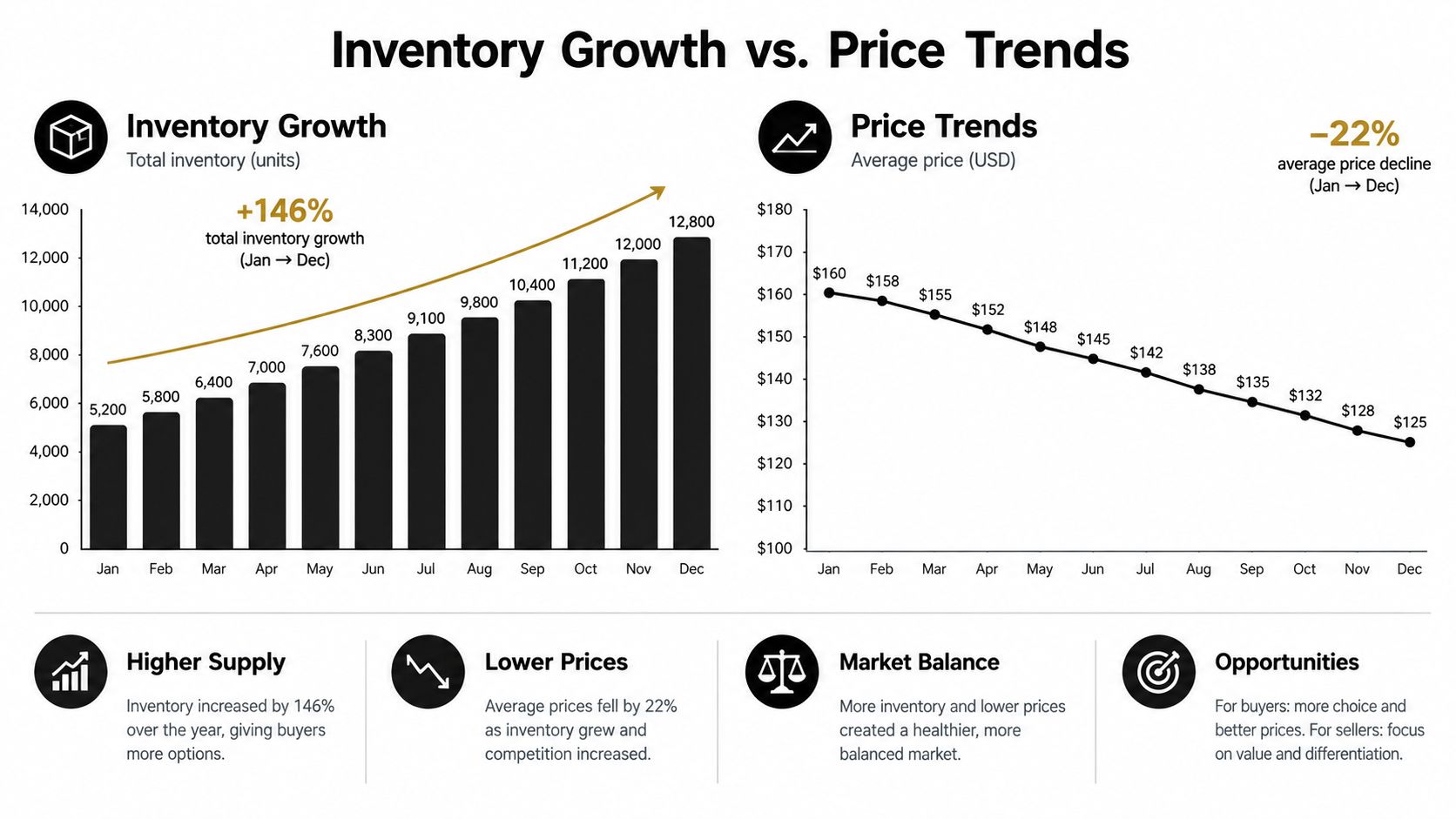
Supply has improved enough to change the buyer's process. Atlanta REALTORS® reported 20,453 active listings in June 2026, alongside a 4.6-month supply of homes, 21 average days on market, and a median sales price of $442,500 in its June 2026 market brief. A separate midyear snapshot from the organization reported 42,141 active listings across metro Atlanta, up 11.4% year over year, with median days on market at 59.3 and only 14.4% of homes selling above their original list price.
The figures don't line up perfectly because they describe different geographic scopes and reporting periods. That difference is useful rather than problematic. It shows why buyers should distinguish the city of Atlanta, specific counties, and the wider metro area before drawing conclusions about availability.
More selection, but not universal relief
Late-summer reporting added another demand signal. Pending sales across the 12-county metro area fell 29% year over year in August, while Fulton County had 5.7 months of supply. The metro median sales price was near $400,000, down 1.7% year over year, and the median home spent about 54 days on the market, according to the Atlanta Journal-Constitution's market analysis.
This is a classic affordability-led rebalancing. Inventory has expanded, but higher monthly costs are keeping many households from bidding. For a buyer, that creates a meaningful distinction between selection and affordability. More listings can improve negotiating position without making ownership comfortable.
Zillow also showed Atlanta's home value around $381,948, homes going pending in about 50 days, and for-sale inventory near 4,753 in its market snapshot. The spread between list prices, sale prices, and estimated values reinforces the need to evaluate the complete purchase equation. A lower asking price may not compensate for an uncomfortable loan payment, taxes, insurance, maintenance, and future mobility needs.
Atlanta's uneven economic geography matters too. Buyers searching around technology, logistics, aviation, healthcare, and corporate employment centers may encounter different inventory conditions from those in outer suburban markets. Readers researching the relationship between employment concentration and housing demand can also review Atlanta's digital economy growth and IT demand, while treating neighborhood-level evidence as more relevant than a single metro headline.
The Impact of Mortgage Rates on Affordability
Mortgage rates are the market's central constraint. Freddie Mac's 30-year fixed survey reached 6.95% in mid-September 2026, while local reporting tied Atlanta's average monthly mortgage payment to $3,122 in August 2026, more than $1,200 above the area's average rent, as summarized in this Atlanta market report.
The practical implication is straightforward. A buyer may negotiate a lower purchase price and still experience a higher monthly obligation than expected because financing absorbs much of the savings. The house price is a one-time figure on the listing sheet. The interest rate affects every scheduled payment for as long as the loan remains outstanding.
Test the payment, not just the price
A sound comparison starts with the full monthly budget. Buyers should model principal and interest alongside property taxes, homeowners insurance, association fees where applicable, utilities, maintenance, and commuting costs. They should also examine how the proposed payment interacts with other obligations using this practical resource on debt to income ratio explained.
Rate management can improve the deal without requiring a dramatic price cut. Buyers may ask whether the seller will contribute toward closing costs or a temporary rate buydown, compare offers from multiple lenders, or increase the down payment if doing so doesn't deplete necessary reserves. These strategies don't eliminate the cost of ownership, but they can change the payment profile that determines whether the home fits the household budget.
A softer market improves negotiating power, but it doesn't make an unaffordable payment affordable.
The rent comparison deserves caution. A mortgage payment above rent isn't automatically a bad decision, because ownership can provide stability and potential long-term equity. It also isn't automatically a good one, because owners assume repair, insurance, tax, and resale risks that renters don't carry in the same way.
Buyers who work in Atlanta's technology, healthcare, education, or professional services sectors may have different income stability and relocation horizons. Those evaluating technology transitions and responsible asset retirement in Georgia can find related local context through this discussion of green jobs and electronics recycling in Georgia, although employment confidence should remain a personal financial assessment rather than a substitute for mortgage underwriting.
Strategic Timing and Negotiation Tactics
Rising prices and improving inventory create a market where preparation matters more than speed. Buyers should evaluate each property with evidence rather than treat Atlanta's overall direction as a reason to rush or wait indefinitely.
Build the offer around the property
Begin with recent comparable sales, days on market, price reductions, visible repairs, and the seller's likely timeline. A home that has stayed listed longer than the local median may provide room to request a price adjustment, closing-cost contribution, or repair credit. That evidence supports a specific request without assuming the seller must accept an arbitrary discount.
A disciplined offer process can follow four steps:
- Set the payment ceiling: Establish the maximum monthly housing cost before selecting the offer price.
- Separate value from emotion: Base the price on comparable evidence and condition, not competition among buyers.
- Use concessions strategically: Request terms that reduce upfront cash or monthly payment pressure when the seller's position permits.
- Protect the exit: Keep inspection and financing protections aligned with the buyer's risk tolerance.
A clean, well-supported offer may appeal more to a seller than a higher proposal with uncertain financing. Buyers should ask their agent to assess appraisal exposure, repair negotiations, and whether local competition justifies waiving protections. More available homes reduce the cost of rejecting a weak deal, which strengthens the case for patience during negotiations.
Location adds another layer to the decision. Atlanta's airport, logistics corridors, and commercial districts involve tradeoffs involving commuting, noise, and future demand. Buyers comparing those factors can consult this Atlanta Hartsfield-Jackson location guide as part of broader local research, while relying on property-specific due diligence for the final decision.
Evaluating Buyer Scenarios
Consider three buyers viewing the same Atlanta market.
The first is a first-time buyer with stable income, manageable debt, and enough cash for the transaction without exhausting reserves. This buyer may benefit from the increased selection and the opportunity to negotiate concessions, but only if the monthly payment remains comfortable at current rates. Zillow ranked Atlanta among the strongest U.S. markets for first-time buyers because 45.2% of listings were affordable to a median-income household and rent burden was 22.3% of income, according to its 2026 first-time buyer analysis. Those citywide measures don't replace a personal budget, but they suggest that Atlanta's opportunity is uneven rather than absent.
The second is an existing homeowner upgrading from a smaller property. This buyer may have equity, but the calculation depends on selling first or carrying two homes. A purchase can make sense when the household needs more space and expects to remain in the area, yet a new loan at current rates can still raise the payment substantially even after proceeds from the sale.
The third is an investor or highly indebted buyer. Improved inventory may create more choice, but weaker demand and expensive debt make assumptions about rent, vacancy, repairs, and resale especially important. A buyer focused solely on future appreciation may be taking more risk than one purchasing for stable occupancy and a long holding period.
The best-positioned buyer isn't necessarily the one with the largest budget. It's the one with reliable income, flexible timing, and a payment that remains manageable if conditions change.
For readers weighing ownership as a shelter from a shaky economy, the key question is durability. Atlanta's neighborhoods also offer different lifestyle and transportation profiles, so buyers should study local amenities and connectivity, including the Atlanta BeltLine guide, without assuming that every nearby property will perform identically.
Making the Final Decision
So, is now a good time to buy a home in Atlanta? It can be, but only for buyers whose finances work at today's rates. Inventory growth, longer marketing periods, and sale-to-list behavior create more negotiating opportunity than Atlanta buyers had during the tightest part of the boom. Price data remains mixed, which argues against waiting for a dramatic citywide correction as a complete strategy.
Waiting may make sense if the payment consumes too much income, the buyer's job or location is uncertain, or purchasing would drain available cash. Buying now may make sense when the household has stable income, a long expected holding period, a carefully tested payment, and the patience to negotiate rather than overbid.
Use a simple test: if the home remains affordable without optimistic assumptions about refinancing, rapid appreciation, or future income increases, the timing may be defensible. If the purchase only works after several favorable events occur, waiting is the more disciplined choice.
Reworx Recycling helps Georgia businesses manage electronics recycling, IT equipment disposal, secure data destruction, equipment pickups, and responsible technology donations during office or facility transitions. Visit Reworx Recycling to learn how to donate old equipment, schedule a pickup, or build a responsible IT asset disposition program that supports environmental stewardship and community access to technology.