A data destruction policy often looks complete until someone asks a simple question: prove that this device was sanitized correctly. The document may carry an executive signature, yet technicians use inconsistent tools, vendors issue incomplete certificates, and no one can connect a retired asset to an approved retention trigger. That gap creates exposure across privacy, security, records management, and sustainability programs.
A defensible policy is more than a legal artifact. It's an operating control that tells people what to destroy, when to destroy it, who approves the action, which method applies, and what evidence proves completion. NIST defines media sanitization as rendering access to target data infeasible for a given level of effort and organizes the work into clear, purge, and destroy actions (NIST SP 800-88 Rev. 2). The practical challenge is turning that framework into repeatable behavior across laptops, servers, cloud environments, paper derivatives, and vendor-managed assets.
The Audit-Week Wake-Up Call
On Tuesday morning, an IT compliance manager at a mid-sized healthcare B2B firm receives an email from outside counsel. A HIPAA on-site visit is confirmed for Friday. The company's data destruction policy was signed by the CISO last quarter, but implementation never followed.
Technicians wiped storage devices whenever they had time. One used a vendor utility, another reformatted drives, and a third relied on a device reset. No certificates of sanitization exist. Procurement selected the asset disposition vendor based on commercial terms, while Security never reviewed the destruction method or subcontractor controls.
By Tuesday afternoon, the compliance manager pulls in IT Operations, Security, Privacy, Legal, Procurement, Facilities, Records Management, and Internal Audit. The first requests are predictable:
- A current data destruction policy and revision history
- A media inventory tied to retired assets
- Sanitization logs and certificates
- Chain-of-custody records for devices leaving the site
- Vendor contracts, service descriptions, and subcontractor terms
- Evidence of workforce training
- Exception approvals and legal holds
- Proof that electronic protected health information was removed before reuse
The team spends Wednesday reconstructing asset histories from tickets, spreadsheets, and email. On Thursday, they discover certificates missing serial numbers and several devices with no recorded method. The auditor doesn't need to prove a breach. Missing ownership, inconsistent execution, and unverifiable destruction are enough to create findings.
The audit distinction: A policy on paper describes intent. A policy as a control produces assigned work, approved methods, and retrievable evidence.
That distinction matters beyond healthcare. The U.K. Information Commissioner's Office retention principle says organizations should keep information only as long as needed and dispose of it when there's no longer a reason to retain it. The rest of this guide turns that principle into an enforceable operating model.
Core Elements Every Data Destruction Policy Needs
A complete data destruction policy should contain eight elements before it discusses specific tools or wipe commands. Auditors look for language that connects each requirement to a procedure, a record, and an owner.
Scope must cover digital media, physical media, cloud-hosted information, paper derivatives, backups, removable storage, mobile devices, and equipment managed by third parties. “Company systems” is too vague. Name the environments and business units covered.
Definitions should establish what the organization means by media, sanitization, disposition, destruction, end-of-life, personal information, and regulated information. Shared terminology prevents a technician from treating deletion as destruction.
Classification linkage must connect sensitivity tiers to approved actions. A policy should state that restricted data requires a method capable of meeting the organization's recovery standard, while lower-risk data may follow a controlled reuse path.
Method selection criteria should account for media type, data sensitivity, physical condition, reuse intent, and whether the asset leaves organizational control. Approved methods need named standards, not informal phrases such as “wipe securely.”
Retention and triggers must identify the event that starts destruction. Examples include an approved asset retirement, supersession of a backup, closure of a customer relationship, or completion of a records hold.
Roles and responsibilities need a named policy owner, execution owner, verifier, approver, and records custodian. “IT is responsible” won't survive scrutiny because IT is a department, not an accountable person or role.
Exceptions and waivers should require documented justification, an expiry date, compensating controls, and approval from a named authority. Permanent exceptions are uncontrolled alternate policies.
Audit evidence must specify required records, retention, access restrictions, and reconciliation routines. NIST SP 800-88 Rev. 2 highlights certificates of sanitization, personnel responsibilities, and tool calibration or maintenance controls (NIST FAQ).
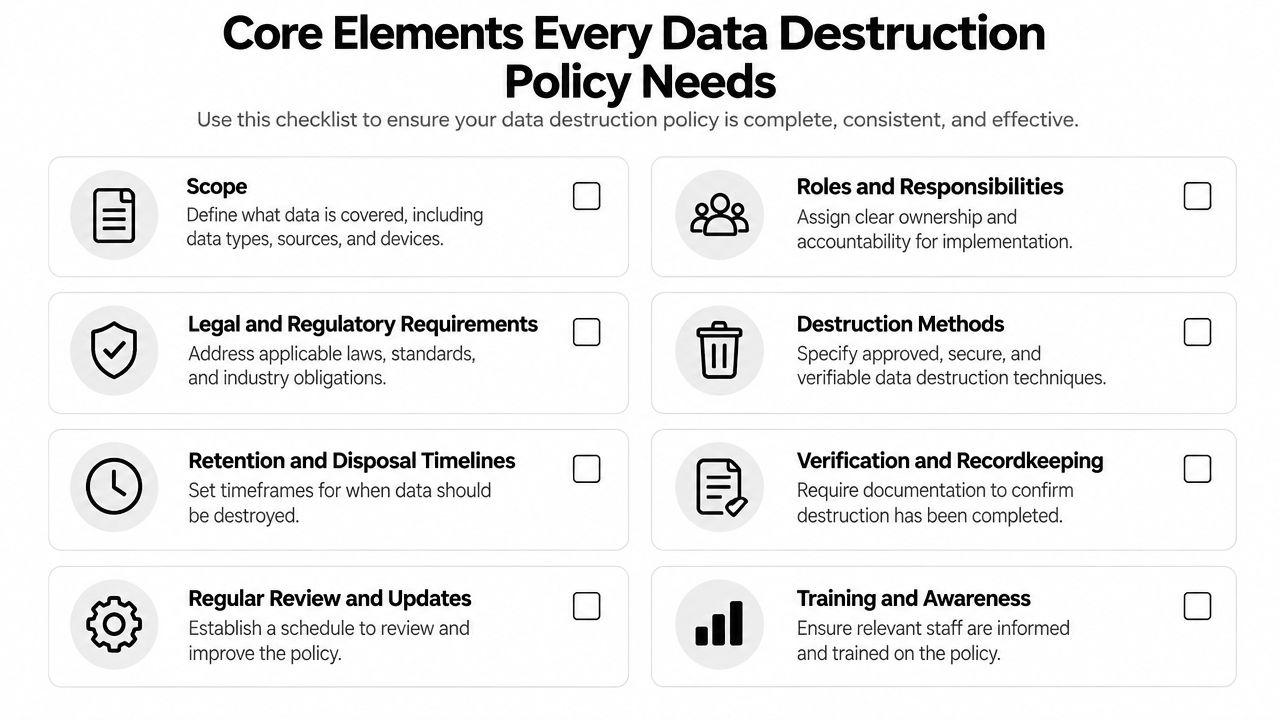
Use one test for every clause: Can an employee follow it, can the organization prove it happened, and is a specific role accountable? If the answer to any part is no, the clause is policy language without control value.
Sanitization Methods and When Each One Applies
Method selection starts with the media and the reuse decision, not with whichever tool a technician already has installed. NIST separates sanitization into clear, purge, and destroy, while ISO/IEC 27040 describes destructive techniques such as disintegration, incineration, melting, pulverizing, and shredding for media that must no longer store data (NIST and ISO/IEC 27040 guidance).
Clear is generally suited to controlled reuse where the organization accepts a lower recovery threat and the media remains within an environment it controls. Purge provides stronger protection and may support redeployment when the method is appropriate for the media. Destroy is the right decision when the device leaves organizational control, contains especially sensitive information, is damaged, or must not remain capable of storing data.
SSD handling deserves special attention. Logical overwriting can fail to address remapped cells and wear-leveling behavior, so a policy should require a media-appropriate purge technique, cryptographic erasure where supported, or physical destruction. A factory reset on a phone is not evidence of regulated-data sanitization.
Policy rule: Match the method to sensitivity, media technology, and reuse intent. Never let convenience determine the control.
| Method | Media Type | Classification Met | Reuse Intent | Evidence Required |
|---|---|---|---|---|
| Clear | Reusable magnetic drives and supported devices | Lower-risk or approved internal data | Internal reassignment | Tool log, asset serial, operator verification |
| Purge | SSDs, encrypted storage, supported enterprise media | Sensitive data requiring stronger recovery resistance | Controlled redeployment or transfer | Sanitization record, method, verification result |
| Cryptographic erasure | Properly encrypted storage with controlled key destruction | Data protected by approved encryption controls | Reuse or resale where policy permits | Key-destruction record, asset match, verification |
| Degauss and destroy | Magnetic tapes and unsuitable magnetic media | High-sensitivity data | No reuse | Degauss record, destruction certificate, chain of custody |
| Destroy | Any media leaving control or failing sanitization | Restricted or high-assurance data | No reuse | Certificate, serial reconciliation, witness or verifier record |
Organizations should document the decision in a method matrix and keep the approved procedure with the asset ticket. Teams evaluating sanitization methods for different media should also require post-destruction confirmation, serialized reconciliation, and documented verification.
Retention Schedules and Destruction Triggers
Retention is the connective tissue between records management and a data destruction policy. A schedule that lists only a period, without a system, justification, trigger, and method, leaves employees guessing when the clock starts and what action ends it.
Build each row around six fields: data category, system of origin, retention period, justification basis, trigger event, and disposition method. Separate deletion from final destruction. Removing a record from an application may not remove copies from backups, exports, archives, or retired devices.
The schedule below uses the requested planning examples. These periods must be validated against applicable law, contracts, litigation requirements, and sector rules before adoption.
| Data Category | Retention Period | Destruction Trigger | Disposition Method |
|---|---|---|---|
| Customer PII | 7 years after relationship ends | Relationship closure and hold release | Approved purge or destroy |
| Financial records | 7 years, subject to SOX requirements | Period close and hold release | Controlled records destruction |
| Employee files | 7 years after termination | Employment end and hold release | Secure deletion and media sanitization |
| Access logs | 12 months | Log-period expiry | Verified system deletion |
| Encrypted backup tapes | 90 days after supersession | Replacement backup validated | Cryptographic key destruction or physical destruction |
A litigation hold pauses ordinary destruction. Active investigations, tax disputes, regulatory inquiries, and unresolved access requests can extend retention. A closed data-subject access request or completed legal review can permit the normal process to resume. Guidance on litigation hold and HIPAA compliance is useful when legal preservation intersects with healthcare records.
Where regulation is silent, establish a documented default rather than allowing indefinite retention. A practical internal starting point is 3 years as a floor and 7 years as a defensible ceiling for most business records, but counsel and the records owner must approve the final schedule.
Roles, Responsibilities, and Escalation Paths
Accountability should be assigned by activity, not department. A RACI map makes gaps visible before an auditor does.
| Activity | Responsible | Accountable | Consulted | Informed |
|---|---|---|---|---|
| Classification | Data owner or asset manager | CISO | Privacy, Records Management | Compliance |
| Schedule maintenance | Records Management | CIO or designated executive | Legal, Privacy | Internal Audit |
| Sanitization execution | IT Operations or ITAD team | CISO | Security Engineering | Compliance |
| Vendor oversight | Procurement and Vendor Management | CIO | Security, Legal | Internal Audit |
| Exception approval | Control owner | Named executive approver | Legal, Privacy | Compliance |
| Evidence collection | Asset Management | Control owner | Internal Audit | Business owner |
Disputed classifications should escalate first to the data owner and Security, then to the CISO if they cannot agree. A sanitization failure discovered after a certificate was issued requires a stop-work action, incident assessment, certificate correction, and review of all affected assets. Vendor non-conformance during off-site shredding should trigger quarantine of the batch, notification to Security and Legal, and corrective action before further transfers.
Create a quarterly Destruction Review Board with representatives from Security, IT Operations, Legal, Privacy, Records Management, Procurement, and Internal Audit. The board should review exceptions, failed sanitizations, vendor performance, overdue destruction, and sampled evidence.
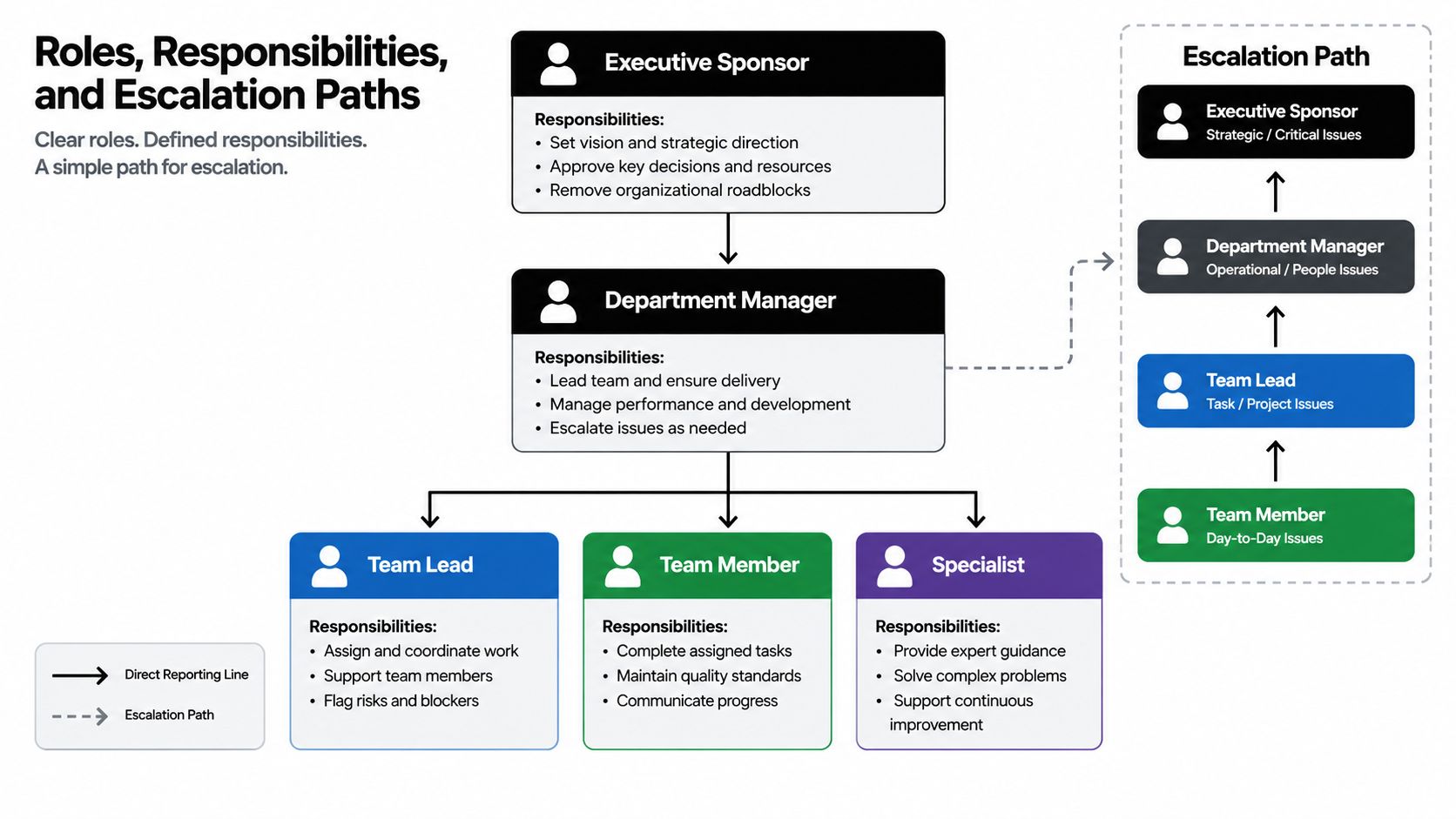
An undocumented owner is, for audit purposes, an absent owner. Every control needs a role that can approve it, perform it, verify it, and answer questions about it.
Compliance Controls for HIPAA, FERPA, and GDPR
Regulations should appear in the policy as enforceable clauses, not as a list of acronyms. HIPAA requires covered entities to establish procedures for the final disposition of electronic protected health information and the hardware or electronic media on which it resides, including removal of ePHI before reuse (HHS disposal guidance). The policy should also require workforce training, documented device and media controls, approved methods, and evidence for decommissioned hardware.
FERPA-related guidance requires student information to be destroyed when it's no longer needed for the authorized purpose. The policy must also prohibit destruction when a parent or eligible student has a pending access request, and it should extend the same obligations to vendors holding education records.
For GDPR, write clauses around storage limitation and erasure rights. The organization should identify the lawful or contractual basis for retaining information, define the process for Article 17 requests, and document the exception path when a legal obligation, investigation, or claim requires preservation. California guidance similarly requires information owners to retain or destroy personal-information records under an approved policy and to keep information only as long as necessary (California records management guidance).
| Regulation | Key Clause | Required Policy Element |
|---|---|---|
| HIPAA | Final disposition and removal before reuse | Media procedure, training, certificate, verification |
| FERPA | Destroy when no longer needed, subject to access requests | Education-record trigger and hold control |
| GDPR | Storage limitation and right to erasure | Retention basis, request workflow, documented exception |
| State overlays | Approved disposal and preservation gates | Jurisdiction review and records-owner approval |
Every compliant policy should contain three baseline clauses: a named retention basis, a sanitization method tied to media type, and an evidence retention rule for sanitization records. Teams also managing household technology can consult guidance on how to protect your home devices, but enterprise controls need formal ownership, verification, and records. Organizations can align those requirements with data security and compliance services.
Sample Policy Language You Can Adapt
Copy-ready language reduces ambiguity, but Legal should approve jurisdiction-specific requirements and retention periods. The following defaults are operational starting points, not legal opinions.
Scope: “This policy applies to all employees, contractors, business units, systems, devices, removable media, cloud services, paper derivatives, backups, and third-party providers that store, process, transport, or dispose of organizational information.”
Definitions: “Sanitization means rendering access to target data infeasible for the approved level of effort. Media includes physical and virtual storage capable of retaining information. End-of-life means the approved point at which an asset or storage resource leaves active service.”
For method selection, use direct language: “The control owner shall select clear, purge, or destroy based on data classification, media type, physical condition, reuse intent, and whether the media leaves organizational control. Factory reset, reformatting, or ordinary file deletion shall not qualify as sanitization unless an approved procedure explicitly validates the result for that media.”
Exception language should prevent open-ended waivers: “No exception may bypass sanitization without written approval from the CISO or delegate, documented business and legal justification, compensating controls, an expiry date, and a scheduled review.”
Vendor language must flow down the control: “Service providers and subcontractors shall follow approved methods, preserve chain-of-custody records, provide asset-level evidence, report failures promptly, and permit compliance review. The organization remains accountable for vendor-managed destruction.”
When a failure occurs, require action: “Any suspected sanitization failure shall be reported through the security incident process, and affected media shall be quarantined until Security and Legal authorize disposition.”
Use version-controlled clauses with an owner, effective date, review date, approval record, and change summary. Teams can route asset requests through the IT asset disposal form so the policy starts with a controlled intake rather than an informal email.
Evidence, Documentation, and Audit Trails
An auditor should be able to select an asset serial number and trace it from retirement approval to final disposition without interviewing five people. That requires a linked evidence model, not a folder of disconnected certificates.
A certificate of sanitization should identify the asset, serial number, media type, sanitization method, tool or process, operator, date, result, verifier, and any exception. For physical destruction, retain the destruction certificate, witness or verification record, batch details, and serialized reconciliation. For media leaving the facility, chain-of-custody logs should record release, carrier or receiving party, timestamps, condition, and acceptance.
Cryptographic erasure requires evidence that the relevant keys were destroyed or rendered unusable, along with a match between the key event and the asset or storage population. Exception registers should capture the reason, approver, compensating control, expiry date, and closure evidence.
| Sanitization Method | Required Artifact | Minimum Records | Verification Step |
|---|---|---|---|
| Clear | Sanitization log | Serial, operator, tool, result | Review log against asset ticket |
| Purge | Certificate of sanitization | Media type, method, timestamp, verifier | Validate method and successful result |
| Cryptographic erasure | Key-destruction record | Key identifier, asset scope, approver | Reconcile key event to asset inventory |
| Physical destruction | Certificate and witness record | Serial list, batch, facility, date | Confirm destruction and serialized match |
| Vendor disposal | Chain-of-custody package | Transfer, receipt, subcontractor, outcome | Sample contract and asset records |
Store evidence in an access-controlled repository with retention aligned to legal and audit needs. Tag every record to the originating asset, service ticket, purchase or disposal order, and vendor contract. A structured chain-of-custody documentation process makes a single lookup sufficient to demonstrate end-to-end accountability.
Test the trail before an auditor does. Select random retired assets, request the full evidence package, and record every missing field as a control defect.
Balancing Destruction With Value Recovery
Secure destruction and value recovery aren't opposing goals. The policy should prevent two errors: destroying working equipment without assessing reuse, and redeploying media without proving that sensitive data is inaccessible.
Classify first. Redeployment can be appropriate when the drive has been sanitized with a method suited to its technology, the data isn't restricted, the warranty or service condition supports reuse, and the device stays within a trusted environment. A transfer outside the organization demands stronger evidence and may require purge or destruction based on the classification.
Physical destruction is mandatory when recovery must be infeasible, the media is damaged or unsupported, a sanitization attempt fails, or the asset leaves organizational control with residual risk that the approved method cannot address. For SSDs, cryptographic erasure can support resale when encryption and key management meet policy requirements. For donated equipment, remove or sanitize restricted media before transfer and retain the evidence package.
The policy should also define a finance and Security decision gate. Finance can identify residual value and reuse opportunities, while Security determines whether the proposed method meets the risk threshold. Neither team should be able to override the other informally.
The 2026 reporting cited in the research shows why this balance matters. It found that 43% of mobile devices, 35% of laptops and desktops, and 44% of data center assets were functional when destroyed, while best-practice software sanitization was used by 32% of mobile devices, 18% of laptops and desktops, and 23% of data center assets (2026 State of Data Sanitization reporting). A controlled asset recovery program can preserve value without weakening the destruction control.
Policy Readiness Checklist and Final Review
Run this review against the current policy, procedures, and evidence repository. It should take about 30 minutes if the control is operating properly.
Required clauses
- Scope: Covers media, cloud, paper derivatives, backups, vendors, and jurisdictions. Artifact: approved policy. Accountable role: policy owner.
- Definitions: Distinguishes deletion, sanitization, disposition, and destruction. Artifact: definitions block. Accountable role: CISO.
- Method selection: Maps classification and media type to clear, purge, or destroy. Artifact: decision matrix. Accountable role: Security.
- Exceptions: Requires justification, compensating controls, approval, and expiry. Artifact: exception register. Accountable role: executive approver.
- Vendor obligations: Includes subcontractor flow-down, evidence, incident reporting, and review rights. Artifact: contract and service record. Accountable role: Vendor Management.
- Retention triggers: Identifies the event that starts and ends the destruction process. Artifact: retention schedule. Accountable role: Records Management.
Ownership and verification
- Named owners: Every control has Responsible, Accountable, Consulted, and Informed roles. Artifact: RACI map. Accountable role: CIO or CISO.
- Certificate review: Certificates include asset identifiers, method, result, operator, and verifier. Artifact: sampled certificate. Accountable role: control owner.
- Custody sampling: Transfer records reconcile to inventory and receiving evidence. Artifact: chain-of-custody sample. Accountable role: Asset Management.
- Quarterly reconciliation: Exceptions, overdue items, failed wipes, and vendor issues are reviewed. Artifact: review minutes and action log. Accountable role: Destruction Review Board.
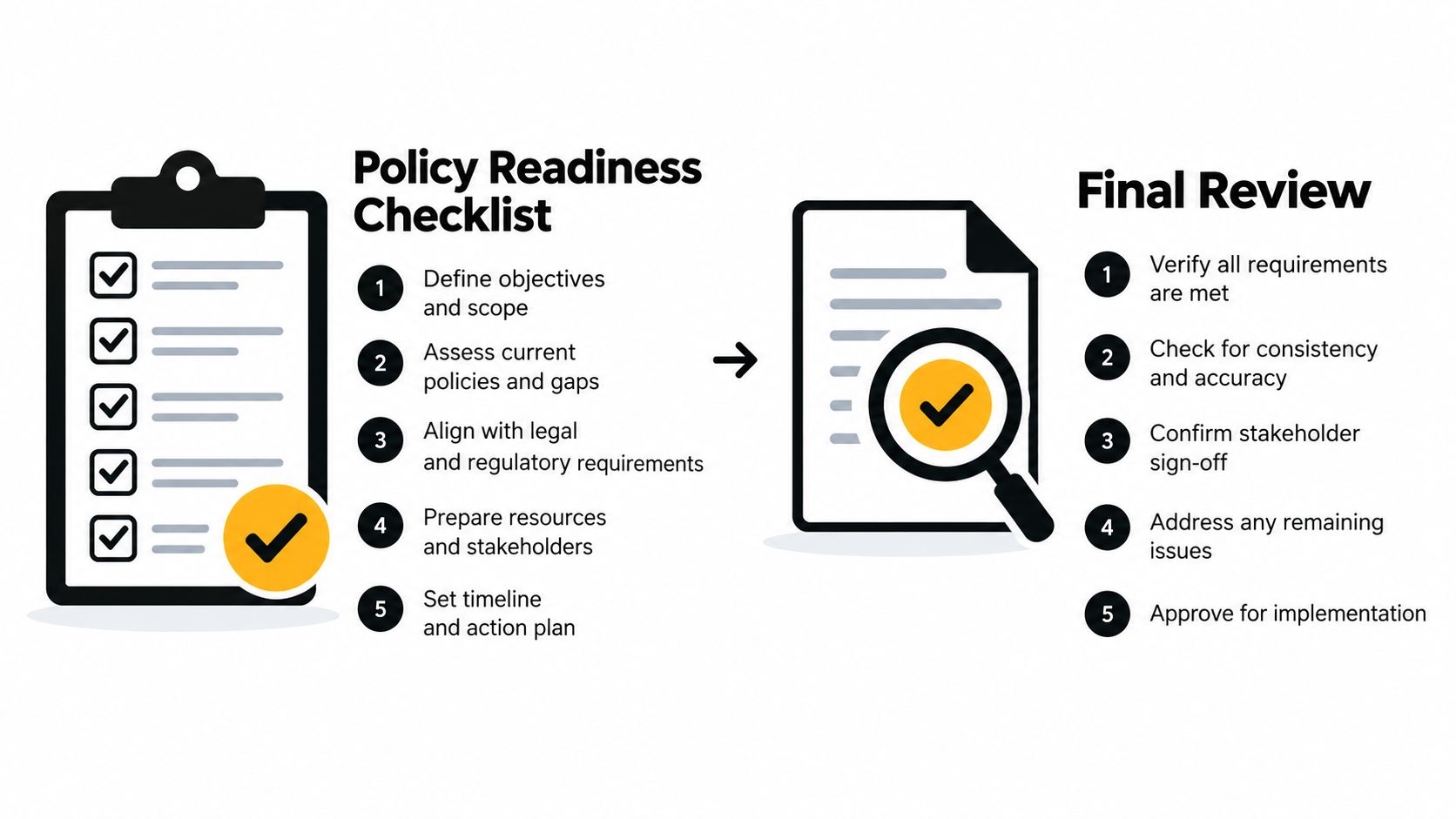
Two failure modes deserve immediate attention: exception records without expiry dates and unsigned certificates of sanitization. Both indicate that the organization documented an activity without completing the control. A data destruction policy that passes this checklist has a defensible chance of surviving review because its clauses connect to owners, procedures, and evidence.
Reworx Recycling provides business electronics recycling, IT equipment disposal, secure data destruction, asset recovery, and documented disposition support for organizations retiring technology. Visit Reworx Recycling to review practical guidance, donate or schedule equipment pickups, and build a compliant retirement process that protects data while supporting responsible reuse and community impact.