

Atlanta enters 2026 with vacancy easing, apartment supply normalizing, and price growth remaining modest. The clearest forecast is a stabilizing market, not a broad recovery, with affordability still determining which buyers can transact.
The headline numbers point in the same direction. Georgia's housing inventory reached 53,118 homes by June 2026, while the median sales price was $360,000, only 0.3% higher year to date, according to Georgia REALTORS®. Another view is less comfortable for owners, with Zillow placing Atlanta home values at $381,948 in August 2026, down 2.0% year over year, while Redfin reported a $427,000 median sale price over the three months ending August 2026, up 9.1% year over year. Those figures aren't necessarily contradictory. They measure different market slices, which is precisely why Atlanta requires a segment-by-segment forecast.
For business owners, IT managers, and corporate sustainability leaders, the implications extend beyond housing. Office consolidation, lease turnover, facility cleanouts, and technology retirement will follow the neighborhoods and property types where demand is strongest. The Atlanta real estate market forecast for 2026 is therefore also a planning question about equipment flows, data security, and sustainable recycling.
Atlanta Real Estate at the Start of 2026
Atlanta's market is normalizing unevenly. Residential buyers have more choice than during the tightest years, renters face a slower delivery pipeline, and office demand is concentrating in higher-quality buildings. Those conditions create different outcomes by neighborhood, property type, and household budget.
The statewide figures support a cautious reading. Georgia inventory reached 53,118 homes by June 2026, up 2.1% year over year, with 4.9 months of supply and a $360,000 median sales price, according to Georgia REALTORS® midyear data. The Atlanta price picture remains fragmented. Zillow estimated home values at $381,948, while Redfin recorded a $427,000 median sale price over the three months ending August 2026. Different methodologies and time periods explain some of the gap, but the practical conclusion is more important: buyers and sellers should underwrite the relevant submarket rather than rely on one citywide figure.
Analyst's view: Atlanta supports disciplined planning, but broad forecasts cannot replace property-level underwriting or an affordability test.
Commercial evidence points to selective improvement rather than a full office recovery. CBRE reported 25.9% overall office vacancy in mid-2026, while prime vacancy had fallen 500 basis points year over year. Q2 new leasing increased 11.2% year over year, prime asking rents approached $55 per square foot, and Buckhead rents were growing 5.5%. Overall rent growth was expected to follow the national average of about 3% in 2026, according to the Atlanta 2026 market outlook.
Atlanta 2026 market snapshot
| Metric | Mid-2026 reading |
|---|---|
| Home inventory | 53,118, up 2.1% year over year |
| Months of supply | 4.9 months |
| Median sales price | $360,000 |
| Overall office vacancy | 25.9% |
| Prime office vacancy | Down 500 basis points year over year |
| Q2 new office leasing | Up 11.2% year over year |
| Prime asking rent | Near $55 per square foot |
| Buckhead rent growth | 5.5% |
The operational implications extend beyond property valuation. Residential turnover and multifamily stabilization can support targeted facility moves, while office consolidation creates work for landlords, tenants, and vendors handling furniture and retired technology. Businesses reviewing Atlanta real estate market trends and home prices should pair neighborhood analysis with a buyer-segment test: which households can still transact at current financing costs? That answer will shape both real estate demand and the timing of IT asset retirement during relocations.
Economic and Policy Drivers Shaping the Market
Atlanta's 2026 ceiling will be set by three forces, jobs, household formation, and financing conditions. The city remains diversified across logistics, fintech, film, healthcare, education, and corporate services, but diversification doesn't eliminate sensitivity to borrowing costs. It changes where weakness appears first and how quickly demand can recover.
Employment quality matters more than population growth alone. A household may move to Atlanta and still postpone buying if payment requirements remain too high. An employer may expand locally while reducing office space because hybrid work has changed its real estate needs. That split helps explain why housing demand can remain present while office vacancy remains high.
Interest rates also affect commercial assets through valuation. Multifamily owners can absorb a slower rent environment when occupancy improves, but buyers still need financing that supports the purchase price. Office owners face an even wider spread between trophy properties with leasing momentum and older buildings that require capital before tenants will commit.
Policy can redirect supply without solving affordability by itself. Georgia's tax incentives for data centers and film support investment in specialized facilities and related employment, while proposed zoning changes involving accessory dwelling units and missing-middle housing could eventually broaden the range of housing formats. Municipal infrastructure spending tied to TSPLOST renewals can influence which corridors receive the roads, transit connections, and utilities needed for new development.

Why the drivers interact
The important connection is timing. Infrastructure can make a corridor investable, but households still need financing capacity. Job creation can support rents, but apartment operators still need to absorb deliveries. Tax incentives can attract facilities, but those facilities may use advanced technology and limited headcount rather than generating broad demand for traditional office space.
For readers building an investment thesis, independent broker market research can add local deal context to public market indicators. The useful discipline is to separate a policy tailwind from a near-term transaction catalyst. A zoning proposal isn't new housing, and an announced employer isn't the same as occupied space.
Residential Prices, Inventory, and Rents
Atlanta's residential market is producing a mixed affordability signal. Listings have expanded, price measures disagree, and rents are growing slowly enough that buyers and renters cannot be assessed as one group. The practical question for 2026 is which households can still transact at current rates, not whether the metro has become broadly affordable.
The price measures introduced earlier, including the $360,000 Georgia REALTORS® median, $381,948 Zillow estimate, and $427,000 Redfin median, diverge because they sample different property mixes. That distinction matters when sellers set expectations or investors establish an acquisition target. A metro-wide average can conceal the payment pressure facing entry-level buyers and workforce renters.
Buyers have more choice, not unlimited negotiating power
Inventory is healthier, but rate-locked owners still have less reason to sell than they did before financing costs increased. New construction adds alternatives, although builders and resale owners are not competing for exactly the same households. An entry-level purchaser may therefore face few workable choices even when aggregate listings appear adequate.
Affordability also shapes operational decisions. A household that cannot qualify for a higher payment may delay buying, choose a smaller home, or remain a renter. For owners preparing an office consolidation or IT asset retirement, that distinction matters because local housing demand can support labor retention only when employees can reasonably live near the workplace.
The multifamily market shows a clearer normalization pattern. Matthews reported 564,659 occupied apartment units at the end of Q2 2026, up 1.8% year over year, with 5.86% vacancy and effective rent averaging $1,594. Its forecast expected vacancy to ease to 5.6% by year-end and effective rent to reach $1,602, implying 1.5% annual rent growth, according to Matthews' Atlanta multifamily outlook.
Atlanta residential outlook by segment
| Segment | Price Trend | Inventory Signal | Rent Trend |
|---|---|---|---|
| Multifamily | Asset values normalizing | Vacancy still above the lowest historical levels | Modest growth projected |
| Workforce rentals | More sensitive to payment pressure | Demand remains tied to household affordability | Restrained by vacancy |
Rent exposure is concentrated in multifamily and workforce housing. Existing homes and new construction affect rental supply indirectly, but they do not carry a direct rent trend in this comparison.
Northmarq projected roughly 10,000 new apartment units in 2026, while another Atlanta forecast placed completions at approximately 9,800 to 10,000 units, materially below recent peak delivery years. Slower deliveries should give absorption more time to catch up, although well-located properties may perform differently from buildings still dependent on concessions.
For buyers assessing timing, the payment must work without rapid appreciation. This Atlanta home-buying timing analysis provides additional context, but the decision still turns on income stability, cash reserves, property condition, and the cost of waiting. The same discipline applies to employers planning office consolidation: housing constraints can affect staffing choices, while IT asset retirement should follow confirmed workspace and headcount plans.
Office and Multifamily Outlook
Atlanta's office and multifamily markets are separating by use case. Office demand is concentrating in modern, well-located buildings, while multifamily is benefiting from a slower construction pipeline and improving absorption. That split matters for owners, tenants, and companies deciding whether to consolidate space or retire technology assets.
The CBRE figures introduced earlier show the office divide: prime vacancy fell 500 basis points, while overall vacancy remained 25.9%. New leasing growth and premium asking rents point to selective demand rather than a broad recovery across every building. Midtown and Buckhead continue to attract tenants seeking quality, access, and reliable infrastructure, although sublease availability can keep effective occupancy costs below headline rents.
Older Class B properties face a different test. Lower face rents may not offset tenant improvement allowances, rent abatement, connectivity upgrades, or common-area work. Federal agency backfills around Mechanicsville and the Georgia Tech corridor could support localized demand, but individual backfills will not resolve metro-wide vacancy. Downtown and South Downtown conversions may work in selected buildings, subject to floor plates, plumbing, financing, and residential code requirements.
Operational implication: Lease comparisons should include equipment retirement, data-room moves, and documented secure data destruction alongside quoted rent.
Multifamily has a more constructive supply setup, though the outlook remains sensitive to absorption. Northmarq expects year-end vacancy of 6.1%, while Matthews projects 5.6%. The gap signals forecast uncertainty, not a dependable single-point outcome. Cap rates are expected to remain in the low-4% to mid-5% range, with one outlook placing stabilized assets between 4.8% and 5.4%. Investors should therefore underwrite the specific asset, financing structure, and submarket rather than apply one metro-wide assumption.
Atlanta office versus multifamily outlook snapshot
| Metric | Office | Multifamily |
|---|---|---|
| Vacancy direction | Improving most clearly in prime space | Expected to ease as deliveries slow |
| Demand pattern | Flight to quality | Absorption moving closer to supply |
| Pricing | Premium locations retain pricing power | Rent growth remains modest |
| Main risk | Obsolete Class B space | Concession pressure in heavily supplied pockets |
| Planning priority | Efficient footprint and infrastructure | Lease-up, operating costs, and financing |
Building selection should match technology requirements as Atlanta's digital economy expands. Atlanta's digital economy growth and IT demand offers local context for companies consolidating offices or retiring server, networking, and end-user equipment. The practical decision is whether the building's operating profile justifies its rent after relocation, infrastructure, and IT asset disposition costs are included.
Affordability and the Buyer Gap
The consensus forecast often treats modest appreciation as evidence of market health. That conclusion skips the harder question, which households can afford to enter the market without stretching their budgets beyond sustainable limits?
Georgia REALTORS® reported a $360,000 median sales price, 4.9 months of supply, and only 0.3% year-to-date price growth by June 2026. Those conditions can help buyers negotiate, but they don't automatically make homes affordable. A household facing high borrowing costs may prefer to wait even when inventory rises, especially if the available homes require repairs, higher insurance costs, or a long commute.
Redfin's $427,000 median sale price for the three months ending August 2026 and Zillow's $381,948 Atlanta home-value estimate demonstrate the range of observed market measures. Buyers shouldn't build a household budget from a metro headline. They should calculate the full payment for the specific property, including taxes, insurance, maintenance, and any association charges.
Affordability gap by price tier
The verified data don't provide monthly principal-and-interest payments, qualifying-income thresholds, FHA limits, or months of supply by price tier. Those fields shouldn't be filled with invented precision.
| Price Tier | Est. Monthly P&I | Min. Qualifying Income | Months of Supply |
|---|---|---|---|
| Entry-level | Depends on loan terms and down payment | Must be calculated from the borrower's application | Metro figure available: 4.9 months |
| Middle-market | Depends on loan terms and down payment | Must be calculated from the borrower's application | Metro figure available: 4.9 months |
| Upper-market | Depends on loan terms and down payment | Must be calculated from the borrower's application | Metro figure available: 4.9 months |
This missing granularity is itself a market signal. Rising aggregate inventory may mostly benefit households shopping at higher price points, while first-time buyers continue competing for a narrower set of attainable homes. Workforce households in Gwinnett, DeKalb, and south Fulton should compare the payment against verified household income and lender qualification rules rather than relying on a metro-wide appreciation forecast.
Business owners buying commercial property face a related issue. The financing structure can matter as much as the asking price, so a practical guide to SBA commercial real estate loans for owners can help frame questions about eligibility, occupancy, and capital requirements without treating loan availability as guaranteed.
The same affordability divide affects local employers. When workers can't move easily, companies may retain hybrid schedules, choose smaller offices, or prioritize locations near existing labor pools. That makes office consolidation and IT asset retirement operational questions, not merely real estate questions. Businesses tracking Atlanta's technology activity can also review Atlanta tech mergers and acquisitions to watch for context on how organizational change can create equipment turnover.
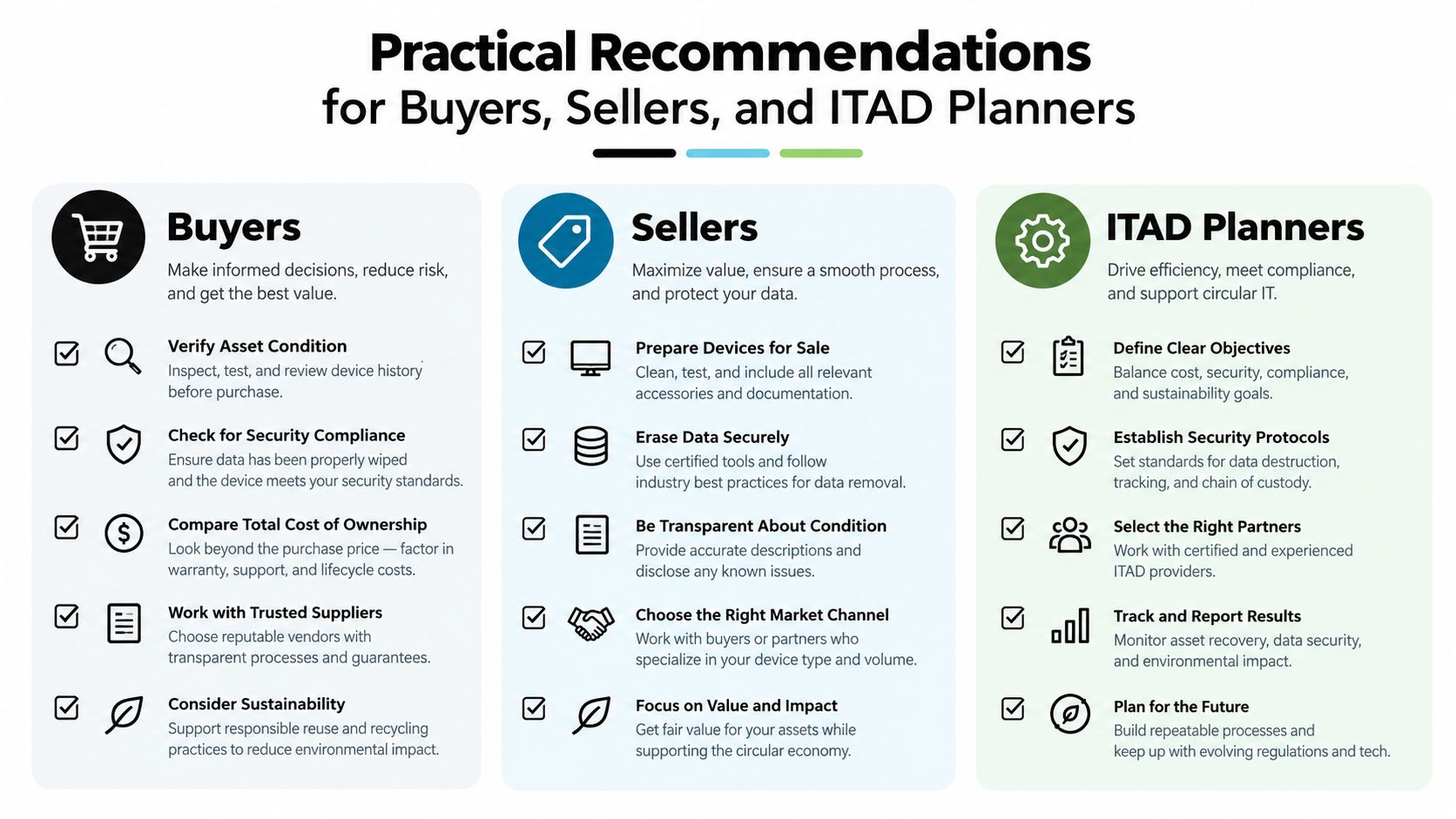
Practical Recommendations for Buyers, Sellers, and ITAD Planners
The 2026 market rewards preparation more than prediction. Buyers should preserve flexibility, sellers should price against comparable transactions, and facility leaders should treat a move as a coordinated property and technology event.
For buyers
Start with payment capacity, then narrow the geography. A buyer who can transact should compare properties where new deliveries or slower absorption create negotiation power, including parts of the Perimeter, the Upper Westside, and South Atlanta revitalization zones. The right opportunity may be a well-maintained property with a realistic seller rather than the cheapest listing.
Use inspection findings as a pricing tool. A lower offer supported by documented repairs is stronger than a broad request for a discount. For owner-occupants and small business buyers, a resource such as trusted Atlanta home buyer Cyber Homes can provide additional context on transaction alternatives, but buyers should still verify terms independently.
For sellers and investors
Price inside the relevant comparable range instead of testing a speculative ceiling. The market data show that Atlanta isn't moving uniformly, so a property that sits may lose more value through repeated reductions than it would have gained from an aggressive initial price.
Investors should underwrite stabilized multifamily at the asset level. Vacancy is expected to improve as deliveries slow, but concession exposure, insurance, taxes, repairs, and financing can overwhelm a favorable rent-growth assumption. Office-to-residential conversions in Downtown and South Downtown deserve feasibility review, not automatic approval. Building depth, utility placement, residential code compliance, and basis will determine whether a conversion works.
For facility and IT managers
Lease expirations often create a predictable technology retirement window. Coordinate the property schedule with an asset register, chain-of-custody controls, certified data destruction, resale review, and environmentally responsible recycling.
A useful sequence is:
- Confirm the move scope: Identify equipment staying in place, transferring to the new site, being redeployed, or reaching end of life.
- Freeze the asset record: Match serial numbers, users, locations, and storage media before packing begins.
- Schedule secure handling: Arrange pickup, equipment decommissioning, and secure data destruction before contractors remove hardware.
- Document outcomes: Retain transfer records, destruction certificates, recycling documentation, and resale information for audit and ESG reporting.
Reworx Recycling provides business pickups, equipment decommissioning, IT asset disposition, secure hard drive shredding, data destruction, drop-off options, and equipment buyback services for organizations retiring surplus electronics. Its IT asset disposition services in Atlanta for corporate IT teams fit the point where an office move becomes an asset retirement project.
Planning rule: Don't wait until the final week of a lease to decide what happens to laptops, servers, monitors, networking equipment, or storage media.
A coordinated workflow reduces the chance of stranded equipment, rushed disposal, missing serial records, and gaps between a relocation plan and sustainability reporting. It also gives finance teams a clearer view of recoverable value before assets leave the building.
Risks, Uncertainties, and the Bottom Line
Atlanta enters 2026 with a stable baseline, but the operating plan remains exposed to several changes. A delayed Federal Reserve pivot could keep mortgage rates above the level many households can support. An employer relocation or layoff cycle could also weaken payroll growth in Fulton or DeKalb. Multifamily deliveries and office vacancy require attention, although they affect underwriting in different ways.
The central risk is uneven performance. A prime office building may improve while an older neighboring property loses tenants. Apartment vacancy may ease across the metro while a heavily supplied submarket continues offering concessions. Home inventory can increase while entry-level buyers still struggle to find a property that fits both their budget and commute.
Atlanta 2026 forecast risks versus watch signals
| Risk Factor | Probability in 2026 | Signal to Watch | Operational Response |
|---|---|---|---|
| Higher-for-longer mortgage rates | Uncertain | Federal Reserve path and mortgage-rate movement | Preserve payment flexibility and avoid taking on additional debt |
| Employer relocation or layoffs | Uncertain | Local payroll and employment announcements | Reassess office demand and household mobility assumptions |
| High-rise oversupply | Submarket-specific | Deliveries, absorption, and concessions | Underwrite lease-up conservatively |
| Insurance cost increases | Property-specific | Renewal quotes and underwriting changes | Reprice ownership costs before closing |
| Office obsolescence | High for older stock | Leasing velocity in Class B buildings | Budget improvements or plan consolidation |
| Multifamily concession pressure | Submarket-specific | New deliveries and effective rents | Stress-test occupancy and incentives |
The forecast divergence noted earlier is material for acquisition models. Investors should test assumptions at the submarket and asset level rather than apply one metro-wide recovery view. Leasing velocity, concessions, renewal quotes, and delivery schedules should feed directly into purchase pricing, reserve requirements, and lease-up budgets.
For buyers, bargaining power may improve, but affordability determines who can transact at current rates. Entry-level households remain more exposed than higher-income buyers or cash purchasers. Sellers should price against relevant comparables instead of optimistic headlines. Investors should distinguish stabilized assets from properties requiring a costly turnaround.
Atlanta therefore enters 2026 as a normalizing market, not a recovering market. That distinction matters for office consolidation, multifamily acquisition, and residential purchasing decisions.
Facility leaders should connect confirmed vacancy, lease dates, headcount plans, and infrastructure requirements to technology decisions. Those inputs determine when teams consolidate offices, refresh hardware, decommission data rooms, and arrange secure data destruction. Planning IT asset retirement with the property schedule protects information, reduces waste, preserves recoverable value, and supports auditable donation and recycling records.
Reworx Recycling helps Atlanta-area businesses manage electronics recycling, IT equipment disposal, secure data destruction, equipment pickups, decommissioning, and responsible recovery during office moves or technology refreshes. Visit Reworx Recycling to plan a pickup, donate usable equipment, or discuss an ITAD workflow supporting environmental responsibility and community impact.