Only 22.3% of global e-waste was properly collected and recycled in 2022, while 25 U.S. states plus the District of Columbia have enacted electronics-recycling laws. A trend analysis report in ITAD tracks how electronic waste generation changes over time, helping businesses plan better recycling schedules, protect data, and meet sustainability goals.
The need becomes obvious when an IT manager receives a wave of retired laptops, monitors, servers, and peripherals with no warning. Facilities teams need floor space, finance wants recoverable value, security teams need proof of secure data destruction, and sustainability leaders need evidence that equipment didn't just disappear into an opaque disposal chain. A well-built report turns that scramble into a managed operating rhythm.
For a company managing computer recycling, office cleanout projects, data center decommissioning, or corporate donation programs, historical ITAD data provides a practical planning foundation. It shows when devices usually leave service, which locations generate the most material, and where pickup capacity or downstream processing needs attention. The result isn't a prettier chart. It's a more accountable way to move equipment from active use to reuse, donation-based recycling, or documented material recovery.
Why Your Business Needs Trend Analysis Reports for IT Disposition
A facilities manager may know that another laptop refresh is coming, but not whether the next batch will arrive in a month, next quarter, or after a departmental expansion. Without a record of past retirements, the team usually reacts when storage fills up or an audit deadline approaches. That pattern creates avoidable pressure across IT, facilities, security, and procurement.
A trend analysis report replaces guesswork with a time-based view of asset movement. The method examines historical data, plots it over time, and uses trend lines to help forecast future performance. In project settings, milestone trend analysis compares milestone dates across reporting dates in graphical and tabular form, a structure documented by SAP's milestone trend analysis guidance.
From irregular cleanouts to planned disposition
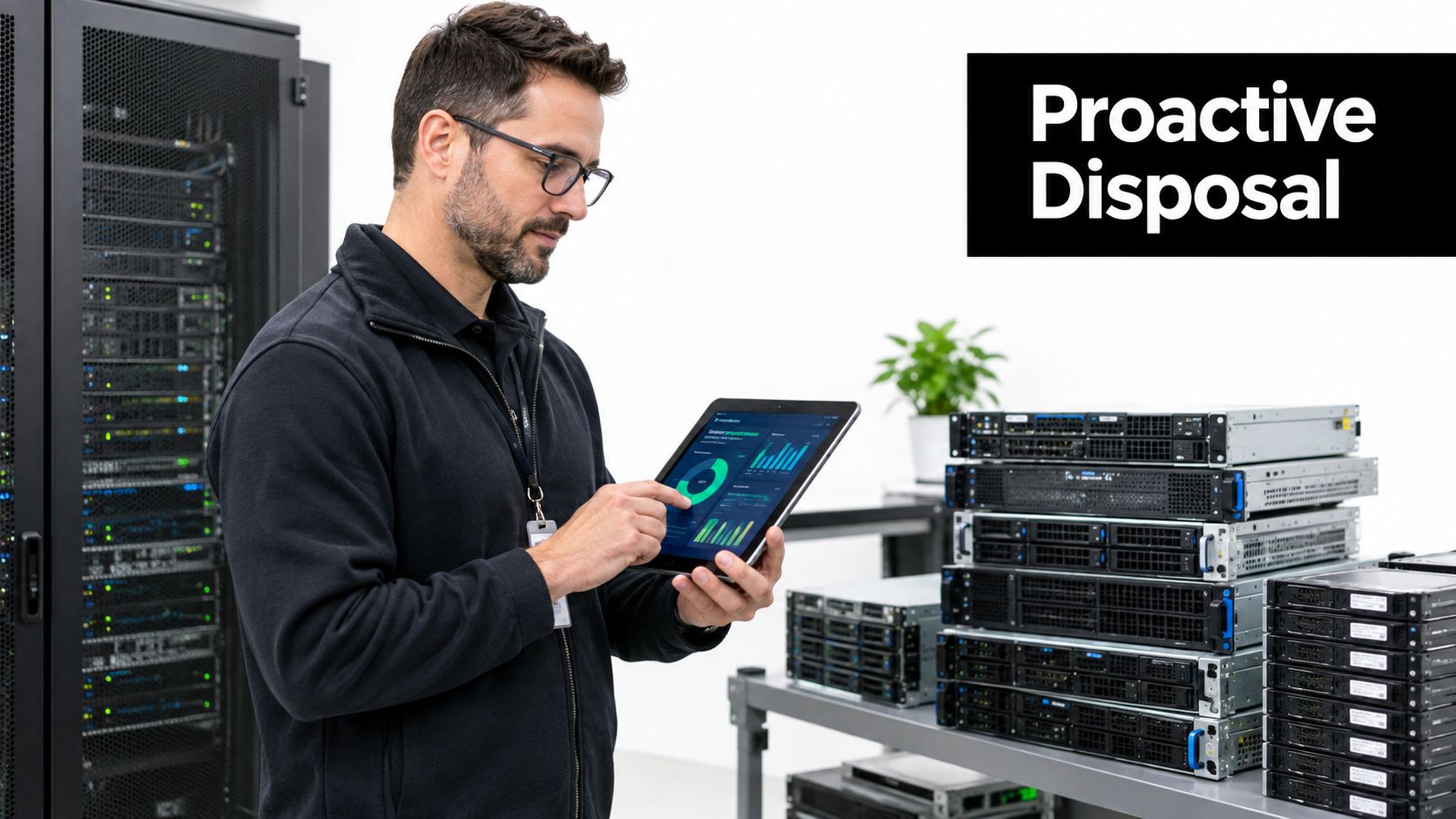
Start with the basic question, when do assets typically reach end of life? Group equipment by acquisition period, department, location, device type, and retirement reason. Then compare those groups with procurement records and prior disposal volumes. A pattern may reveal that laptop disposal rises after a scheduled refresh, while monitors remain in service longer or servers leave through separate data center decommissioning projects.
A useful report can support several operational decisions:
- Schedule capacity: Give a recycling or ITAD partner advance notice before a large pickup.
- Protect working space: Move equipment through a planned facility cleanout instead of storing it indefinitely.
- Prepare security controls: Align secure data destruction, chain-of-custody records, and device inventories before collection.
- Separate disposition paths: Identify assets suitable for reuse or donation from equipment requiring product destruction or material recovery.
Practical rule: A disposal forecast is only useful when operations teams can act on it. Tie each trend to an owner, a decision date, and a documented disposition route.
The method works best with a stable longitudinal dataset. Project guidance notes that meaningful operational trend analysis often requires at least 6 months of consistent data, with 12 months preferred for stronger signal quality. Those periods aren't universal requirements, but they illustrate why a single office cleanout rarely provides enough context for a reliable forecast.
For businesses working with Reworx Recycling, the opportunity is to treat old technology as a scheduled flow rather than a one-time waste problem. That supports responsible electronics recycling while creating more room for technology donations, digital inclusion, and workforce development.
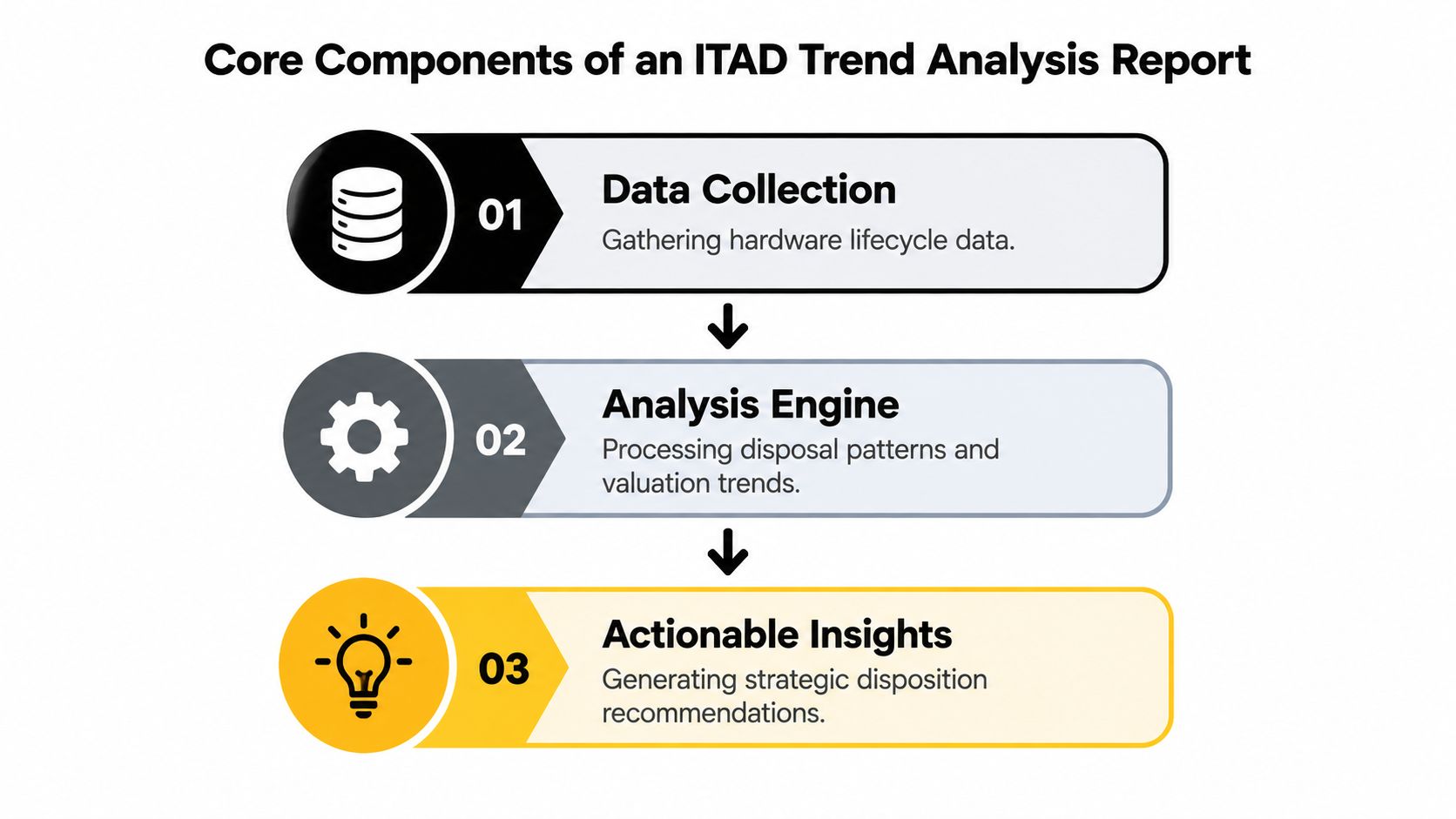
Core Components of an ITAD Trend Analysis Report
An inventory export is not a trend report. A spreadsheet listing asset tags, serial numbers, purchase dates, and current locations describes what exists. A trend analysis report explains how that inventory changes over time and what managers should do next.
The first component is data collection. Useful inputs include asset management records, procurement history, help-desk replacement records, pickup manifests, data destruction certificates, resale or donation outcomes, and recycling weights where available. Definitions must remain consistent. If one quarter counts monitors individually and another counts a mixed pallet as one unit, the apparent trend reflects a reporting change rather than a disposal change.
Data quality determines forecast quality
The second component is the analysis engine. Reliable reporting requires consistent time intervals, reconciled definitions, and cleaned source data. Snowflake's overview of trend analysis also describes techniques such as smoothing, seasonal adjustment, and regression modeling, along with segmentation by region, product line, customer cohort, or channel.
For ITAD, segmentation can be more useful than a single organization-wide line. Compare laptops with desktops, corporate offices with warehouses, and active replacement programs with ad hoc retirements. Then test whether a movement is sustained, cyclical, accelerating, flattening, or reversing. A short-lived spike after a merger shouldn't automatically become the baseline for future pickups.
Insights must connect to physical outcomes
The third component is actionable insight. A report should translate analysis into decisions such as:
- Reserve pickup capacity for a predictable retirement period.
- Route working laptops and tablets toward donation-based recycling.
- Send data-bearing drives through secure data destruction.
- Plan laboratory equipment disposal or medical equipment disposal separately from standard office hardware.
- Flag assets that need product destruction because reuse or resale isn't appropriate.
- Track community outcomes alongside environmental and operational results.
A social enterprise recycling partner can add impact fields that traditional inventory systems often omit, such as the number of devices prepared for community use, the destination of donated equipment, or workforce development activity connected to processing. Those fields don't replace compliance documentation, but they give sustainability leaders a fuller view of what happened after collection.
The report should preserve evidence at each handoff. Businesses can use chain-of-custody documentation for ITAD to connect asset records with collection, transport, data handling, and final disposition. That connection is what turns a dashboard into an auditable operating record.
Key Metrics That Drive Better Disposal Decisions
A generic operations dashboard might show total units processed or the average time to close a ticket. Those measures matter, but they don't tell an IT manager whether the organization is creating a future disposal backlog, missing donation opportunities, or sending equipment through the wrong security path.
ITAD reporting needs metrics that connect asset lifecycle, physical volume, data risk, recoverable value, and impact. The most useful comparison isn't between a large number and a small number. It's between a metric that describes activity and one that supports a decision.
Activity metrics versus decision metrics
| Standard view | ITAD-specific view | Decision supported |
|---|---|---|
| Units processed | Retirements by device age and category | Whether replacement planning is creating a predictable flow |
| Pickup count | Volume by location and reporting period | Where to schedule collections and staging space |
| Disposal cost | Cost by disposition route | Whether reuse, donation, resale, or recycling is appropriate |
| Tickets closed | Assets with verified data destruction | Whether security evidence is complete |
| Waste diverted | Reused, donated, recycled, or destroyed outcomes | Whether sustainability claims reflect actual disposition |
Track the rate of equipment obsolescence alongside new procurement. If purchases consistently outpace retirements, storage and future cleanout requirements may rise. If retirements accelerate without corresponding procurement, teams should investigate whether a failed deployment, merger, or unexpected technology change is driving the movement.
Device age also needs context. Older equipment isn't automatically waste. A laptop may retain practical value for donation, while a damaged drive may require destruction regardless of its age. The report should therefore separate condition, data-bearing status, ownership, and disposition eligibility, rather than treating every retired asset as equivalent.
Measure outcomes, not just exits
A strong report follows equipment after collection. It records whether an asset was reused, donated, resold, recycled for materials, or destroyed. It can also capture whether secure data destruction was completed and whether the organization received the documentation required by its internal controls.
For sustainability teams, ITAD impact measurement can help connect operational records with environmental and community reporting. The important discipline is to avoid presenting all processed equipment as an environmental success. A device sent for material recovery has a different outcome from one placed back into service, and both differ from product destruction.
Use trend lines to ask better questions. Is the retirement volume sustained or temporary? Is one facility creating the rise? Has the share of reusable equipment changed? Does a new procurement policy appear to shorten or extend device lifecycles? These questions make the report useful to finance, security, facilities, and sustainability leaders at the same time.
How Reworx Uses Trend Data to Support Communities
A donated laptop has two destinations to manage. The first is physical, from a business location to a processing site. The second is social, from surplus corporate equipment to a person, school, nonprofit, or workforce program that can use it. Trend data helps coordinate both paths without treating community impact as an afterthought.
Consider a regional pattern in which educational organizations retire more laptops around the summer break. A recycling partner that recognizes the timing can plan collection capacity, prepare data handling resources, and identify suitable devices before the seasonal flow arrives. Working equipment can move toward donation-based recycling, while damaged or obsolete units follow secure recycling or product destruction routes.
Turning volume patterns into better service
A similar pattern can appear across corporate offices. One location may generate laptops and docking stations during a technology refresh, while another produces printers, networking hardware, and server equipment during a facility move. Treating both locations as identical creates inefficient pickups and weakens the inventory record.
A more useful operating approach matches the service to the trend:
- Laptop disposal: Separate working devices from damaged units before collection.
- Data center decommissioning: Build a detailed asset schedule for servers, storage, drives, and networking equipment.
- Office cleanout: Stage mixed equipment by category and data risk.
- Corporate donation programs: Reserve suitable devices for preparation and redistribution.
- Workforce development: Track how processing and refurbishment support practical skills and employment pathways.
Reworx Recycling operates as a donation-based electronics recycling social enterprise, so the report can support both logistics and mission. The business still needs accurate asset counts, secure handling, and documented final disposition. It also needs visibility into which devices can support digital inclusion rather than entering a material-only stream.

A report can protect the human outcome
The community benefit depends on operational discipline. If a donation program receives more equipment than it can prepare, devices may wait in storage. If pickups arrive without accurate categories, staff spend time sorting instead of refurbishing. If data destruction isn't verified, a potentially valuable device becomes a security liability.
Businesses considering a social enterprise partner can review ways to partner for measurable community impact. The practical test is simple: does the reporting show where equipment went, what happened to data, and how the disposition route supported environmental responsibility or community access?
Trend reports won't create digital inclusion on their own. They help teams plan the volume, timing, staffing, and controls that make responsible redistribution possible.
Building Your Own ITAD Reporting Workflow
Start with the decision, not the dashboard. A report built without a defined operational question usually becomes a collection of attractive charts that nobody uses. Decide whether the immediate need is forecasting pickup volume, planning a refresh, proving secure data destruction, improving recovery value, or measuring sustainability outcomes.
Establish a dependable reporting cycle
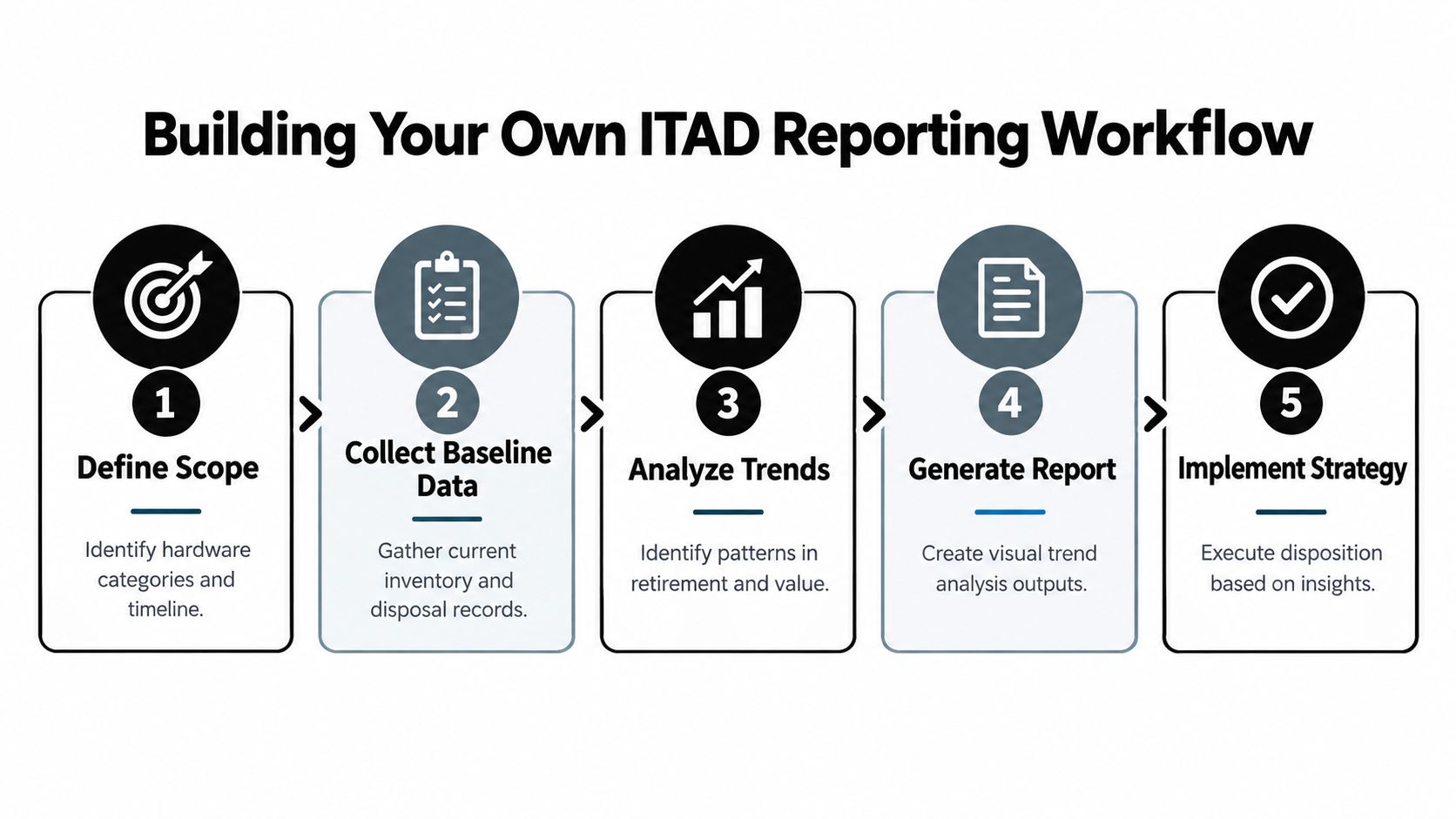
Use a workflow that connects inventory records with physical disposition:
- Define the scope. Choose hardware categories, locations, reporting dates, and the lifecycle question you need to answer. Include servers, laptops, mobile devices, peripherals, medical equipment, or laboratory equipment only when the available records support consistent tracking.
- Create the baseline. Export current inventory and prior disposal records. Reconcile asset tags, serial numbers, ownership, locations, and status codes before calculating movement.
- Clean and classify. Standardize device names, retirement reasons, condition grades, data-bearing status, and final disposition. Keep unknown values visible rather than silently converting them into assumptions.
- Analyze patterns. Plot retirements over consistent intervals. Compare categories and locations, then test whether unusual movement reflects a sustained pattern, a seasonal cycle, a project, or a data correction.
- Turn findings into action. Assign pickup dates, staging requirements, destruction controls, donation routes, and reporting owners. Record whether each decision was completed.
The data model can live in an asset management platform, spreadsheet, database, or business intelligence tool. The platform matters less than the controls around it. A Power BI dashboard may make regional volumes easy to view, while an IT service management system may provide stronger ownership and workflow controls. Many organizations use both, provided the definitions remain aligned.
Build the report around exceptions
The most valuable view often highlights what changed. Flag a location with an unexpected retirement surge, an asset category with missing disposition records, or a device group that remains in storage after its planned pickup. Drill-down capability matters because managers need to identify where an anomaly started, not merely observe that the organization-wide line moved.
A partner can close the loop between reporting and execution. Reworx Recycling's real-time inventory management service is one example of a service designed to keep asset visibility connected to collection and disposition activity.
Keep the final report concise enough for executives and detailed enough for operators. The summary should state the trend, confidence level, operational implication, and recommended action. The supporting view should preserve the asset-level evidence behind those conclusions.
Regulatory Compliance and E-Waste Reporting
Compliance reporting becomes difficult when the organization can't connect a discarded device to a documented disposition path. A trend analysis report helps by showing the flow over time, but it doesn't replace certificates, manifests, chain-of-custody records, or verified data destruction evidence. Its role is to reveal gaps before an audit or regulatory inquiry does.
The regulatory environment varies by location and device category. As of 2026, 25 U.S. states plus the District of Columbia have enacted electronics-recycling laws, and 23 states plus DC maintain express landfill bans for covered electronics, according to a 2026 overview of U.S. corporate e-waste regulations. Businesses should confirm the rules that apply to their facilities, equipment, vendors, and transportation arrangements rather than relying on a national assumption.
Connect environmental and information controls
Pennsylvania's Covered Device Recycling Act has prohibited covered devices from municipal waste disposal since January 24, 2013, including desktop and laptop computers, monitors, peripherals, connected tablets and e-readers, and televisions, as described in the Mid-Atlantic e-waste compliance summary. That same summary notes data-destruction statutes in New Jersey, Delaware, and Maryland for data-bearing devices.
Data security adds another layer. Wisconsin guidance says many electronics can't be placed in the trash and advises businesses to verify recycler data protections, disconnect devices from online services, erase sensitive information, and look for NAID certification or equivalent safeguards. The Wisconsin electronics recycling guidance is a practical reference for those controls.
A compliance-oriented trend report should show:
- Jurisdiction: Which facility and state handled the equipment.
- Device classification: Whether the item falls under a covered electronics category.
- Data status: Whether storage media required secure data destruction.
- Disposition evidence: Which certificate, manifest, or processing record supports the outcome.
- Exception status: Which assets lack documentation or need investigation.
The global recovery context is also significant. The European Commission's Raw Materials Information System reports that only 22.3% of global e-waste was properly collected and recycled in 2022. Sustainability teams can use Kagool sustainability reporting insights to think more broadly about how operational evidence feeds environmental reporting, while Reworx environmental impact reporting can connect electronics disposition records with organizational impact communication.
Partnering for Sustainable and Secure Disposal
Trend analysis reports are most valuable when they influence what happens next. A forecast that doesn't change pickup scheduling, device preparation, data destruction, procurement timing, or facility planning is only documentation. The report earns its place when it helps people make safer and more sustainable decisions before equipment becomes a backlog.
The strongest operating model combines three disciplines:
- Business intelligence: Track lifecycle movement, volume, location, condition, and recovery opportunities.
- Information security: Verify data-bearing devices, apply secure destruction controls, and preserve evidence.
- Environmental responsibility: Direct equipment toward reuse, donation, sustainable recycling, or documented product destruction.
That combination also clarifies trade-offs. Holding equipment may preserve reuse or buyback value, but uncontrolled storage increases security and space risk. Recycling everything immediately may simplify logistics, but it can remove devices that could support digital inclusion. Sending mixed equipment to an unverified outlet may appear convenient, but it weakens chain of custody and sustainability claims.
A practical ITAD partner should help businesses distinguish those routes. Reworx Recycling provides electronics recycling, business pickups, equipment decommissioning, IT asset management, secure hard drive shredding with data destruction, equipment buyback options, and donation-oriented processing. The right partner should also work within the reporting rhythm, so collection records and final outcomes can be reconciled with the trend report.
Schedule reporting as part of the normal IT and facilities calendar. Review the movement, investigate exceptions, update the forecast, and reserve capacity before the next retirement wave. That turns IT equipment disposal from a reactive cleanout into a repeatable program that protects information, recovers useful resources, and supports community access to technology.
Reworx Recycling helps businesses plan electronics recycling, secure data destruction, IT equipment disposal, equipment pickups, and donation-based recycling using clearer asset and disposition records. Visit Reworx Recycling to learn how to donate old equipment, schedule a pickup, or develop an ITAD partnership that supports sustainability and community impact.