Make every retired asset work harder. Electronics recycling efficiency isn't about moving obsolete equipment out of storage and calling the job complete. It depends on a coordinated lifecycle that identifies assets, protects data, selects the highest-value disposition path, consolidates logistics, documents outcomes, and measures environmental and community results.
That matters to business owners, IT managers, facilities teams, government agencies, schools, and sustainability leaders. Reworx Recycling is a donation-based social enterprise that helps organizations retire technology responsibly while supporting technology donations, digital inclusion, and workforce development. The right operating model can improve turnaround time, reduce security and compliance risk, recover value from usable equipment, and make environmental impact easier to demonstrate.
The methods below move from foundational visibility and control to specialized operations and reporting. They apply to IT asset disposition (ITAD), computer recycling, secure data destruction, office cleanout projects, medical equipment disposal, and data center decommissioning.
For broader technology operations, teams can also find cloud efficiency frameworks when aligning infrastructure decisions with retirement planning.
The best efficiency gains come from connecting internal processes with a dependable disposition partner.
1. IT Asset Disposition Program Implementation
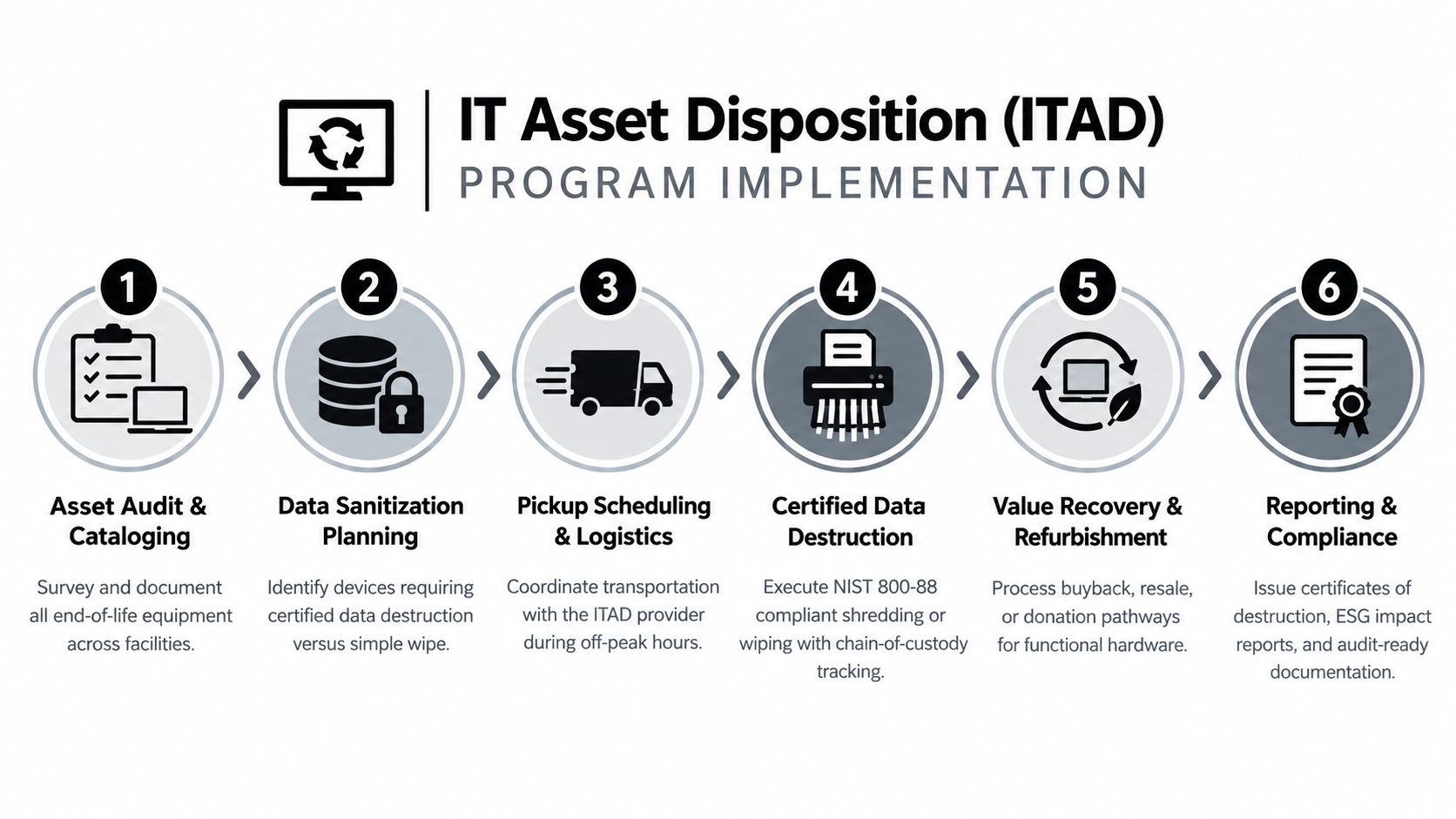
A structured IT asset disposition (ITAD) program turns retirement from an improvised cleanup task into a controlled business process. It covers computers, servers, networking equipment, peripherals, and other technology from the moment an asset is identified for retirement through data destruction, reuse, resale, donation, or recycling.
Start with a baseline inventory. Record the asset type, serial number, location, condition, assigned department, data sensitivity, and preferred disposition path. That inventory gives IT, finance, facilities, and sustainability teams a shared operating record instead of separate spreadsheets and informal handoffs.
The process also needs clear decision rules. A functional laptop may be suitable for donation or refurbishment, while a damaged drive may require secure data destruction and material recovery. A healthcare organization replacing medical computing equipment will need to coordinate clinical operations, privacy controls, and equipment handling rather than treating every device as ordinary scrap.
Build the workflow around control points
Schedule pickups during lower-demand periods, document custody at each handoff, and require destruction records for equipment containing sensitive information. Track completed activities in the asset management system so the organization can support internal reviews and compliance audits.
Useful KPIs include:
- Retirement cycle time: Measure the time from approval to final disposition.
- Inventory completeness: Compare recorded assets with physical findings.
- Destruction completion: Confirm every data-bearing asset receives its assigned treatment.
- Recovery and donation volume: Separate reuse, buyback, donation, and recycling outcomes.
- Documentation completion: Check that certificates and disposition records are attached to each asset group.
Reworx Recycling can help organizations define ITAD implementation timelines that coordinate inventory, pickup, secure processing, and reporting. The strongest programs don't treat ITAD as a one-time event. They make it part of every refresh cycle, office move, and facility closure.
2. Lean Waste Elimination in Equipment Lifecycle Management
Lean principles expose waste that accumulates between acquisition and retirement. In technology operations, that waste often appears as duplicate equipment, unneeded spare stock, idle devices, repeated approvals, long storage queues, and unclear ownership.
Map the full equipment lifecycle from procurement to deployment, maintenance, reassignment, retirement, and final disposition. Mark every waiting point and manual handoff. A manufacturing facility may discover that backup servers sit in storage long after a replacement strategy has changed. An office may find legacy computers occupying valuable space because no department owns the retirement decision.
A lean review should distinguish between necessary controls and avoidable friction. Removing chain-of-custody records would create risk, not efficiency. Replacing repeated data entry with standardized fields, barcode scanning, or a scheduled pickup process can reduce handling without weakening accountability.
Use staged improvement rather than wholesale copying
Benchmarking is often easier to adopt than heavier transformation frameworks. Research on benchmarking adoption found informal benchmarking used by 69% of respondents, performance benchmarking by 49%, and best-practice benchmarking by 40%, while lean management was used by 36% and Six Sigma by 22% according to the benchmarking study. These figures point to a practical sequence, establish internal baselines, compare comparable operations, then adopt proven practices selectively.
Track equipment retirement age, storage duration, disposition accuracy, labor time per asset group, and exception volume. Use the results to remove bottlenecks rather than just shifting them to facilities or a recycling vendor. A clear asset lifecycle management process helps teams coordinate IT, finance, procurement, and facilities around the same retirement rules.
3. Secure Data Destruction and Risk Mitigation Protocols
Secure data destruction is both a security control and an efficiency method. Organizations lose time when employees keep retired devices in offices because nobody can confirm whether the data has been sanitized. They also create unnecessary exposure when equipment moves without documented custody.
Set the policy before the next refresh cycle. Define which devices require logical sanitization, physical destruction, or escalation to a specialized provider. Include laptops, desktops, servers, removable media, smartphones, printers, and equipment with embedded storage. The policy should identify who approves destruction, who handles the asset, what evidence the organization retains, and how exceptions are resolved.
Treat documentation as part of the service
A financial institution may require traceable destruction for devices that held transaction data. A healthcare organization may need a controlled process for patient-facing computers. An educational institution must account for systems that stored protected student records. In each case, an informal wipe notification isn't enough for an auditable workflow.
Use chain-of-custody records from collection through final processing. Request certificates of destruction for applicable assets, reconcile them against the original inventory, and retain records according to the organization's governance requirements. Providers should be able to explain their methods and align them with recognized sanitization practices such as NIST 800-88 or an equivalent standard.
Data destruction should happen inside the retirement workflow, not as a separate task someone remembers after pickup.
Reworx Recycling provides secure data destruction services for organizations that need to reduce internal handling while protecting sensitive information. KPIs include destruction completion, certificate issuance, custody exceptions, unresolved asset identity, and time from collection to documented completion.
4. Equipment Donation Programs for Tax Efficiency and Community Impact
Donation creates a second value stream for functional technology. Instead of sending usable laptops, monitors, or other equipment directly to material recycling, an organization can route suitable assets toward nonprofits, schools, workforce programs, or community technology initiatives.
The operational benefit starts with clear grading. Separate equipment that can be refurbished from hardware that needs parts, secure destruction, or material recovery. Document model, specifications, condition, quantity, and accessories. A corporate IT department may donate refurbished laptops to a workforce development program, while a school district may redirect surplus lab equipment to an under-resourced school.
Donation programs require more than goodwill. Organizations should work with a partner that can document recipients, condition, transfer, and final placement. Finance teams should review applicable tax requirements and maintain records, including recipient eligibility and donation receipts, rather than assuming every transfer qualifies in the same way.
Connect donation with digital inclusion
Community impact KPIs can include usable devices placed, recipient organizations supported, workforce programs supplied, and equipment diverted from disposal. Business KPIs can include processing time, storage space released, disposition cost, and the share of assets routed to reuse.
Reworx Recycling's laptop donation program can support organizations building corporate donation programs around responsible reuse. Donation isn't always the right path. Devices with damaged storage, unsafe batteries, missing critical components, or unsuitable configurations may require secure data destruction and recycling instead.

5. Automated Asset Tracking and Inventory Optimization
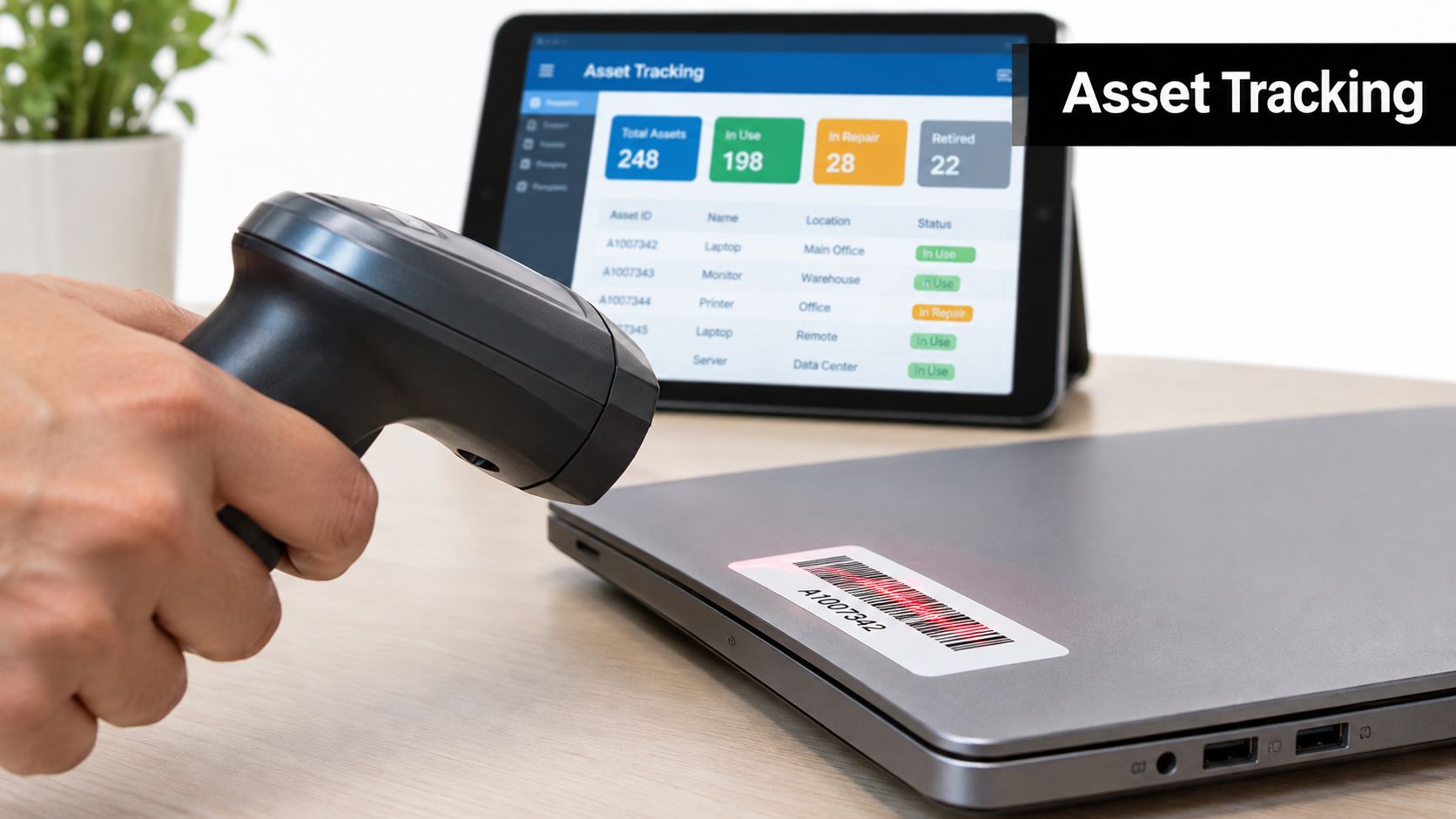
Manual inventory creates blind spots across distributed offices, campuses, warehouses, and clinical sites. Automated asset tracking gives teams a current view of where equipment is located, what condition it is in, who owns it, and which lifecycle stage comes next.
Begin with a pilot in one department or facility. Use consistent categories for laptops, desktops, servers, networking equipment, peripherals, and specialized devices. Assign lifecycle statuses such as received, deployed, repair, storage, pending destruction, donation candidate, resale candidate, and recycled.
Barcode scanning can improve handoff accuracy without requiring a complex transformation. A technician scans an asset when it leaves a department, a facilities employee confirms receipt, and the disposition partner reconciles the shipment against the manifest. Historical records can then help forecast future retirement volumes and pickup requirements.
Integrate tracking with decisions
Connect asset data with procurement, budgeting, service management, and retirement scheduling where practical. Configure alerts for devices approaching end of life, assets that have remained in storage, and records missing a location or custodian. The objective isn't to collect more fields. It's to make each field useful for a decision.
Useful measures include inventory accuracy, unidentified assets, audit completion time, missing handoffs, and forecast variance. A healthcare system managing equipment across campuses may prioritize location accuracy, while a corporate office may focus on storage aging and refresh coordination.
6. Consolidated Vendor Relationships and Single-Source ITAD Solutions
Managing separate providers for pickup, data destruction, refurbishment, resale, recycling, and reporting can create coordination overhead. A consolidated vendor model gives the organization one operating relationship while preserving distinct controls for each disposition path.
The case for consolidation is strongest when several teams touch the same asset. IT may authorize retirement, facilities may move equipment, security may approve destruction, finance may review recovery, and sustainability may need outcome data. If each group works with a different vendor, staff spend time reconciling schedules, manifests, invoices, and records.
Evaluate capability, not just convenience
A single provider should be assessed across service coverage, data security, environmental practices, insurance, reporting, escalation procedures, and ability to handle specialized equipment. Ask how the provider separates donation candidates from recycling streams, manages damaged assets, documents custody, and handles exceptions.
Volume-based pricing and service-level agreements may improve predictability, but consolidation can also create concentration risk. Maintain documented requirements, review performance regularly, and establish an escalation route for missed pickups or incomplete records. A provider that handles ordinary computer recycling may not be suitable for laboratory equipment disposal or a complex data center decommissioning project.
Reworx Recycling's service model can reduce the internal burden associated with inventorying, data wiping, pickup coordination, resale, donation, and final disposition. The relevant KPIs are vendor response time, pickup turnaround, documentation accuracy, unresolved exceptions, invoice variance, and the number of internal handoffs eliminated.
7. Scheduled Facility and Office Cleanout Programs
Accumulated equipment creates operational friction long before a formal disposal project begins. Storage rooms fill with retired desktops, cables, monitors, furniture, and miscellaneous hardware. Employees then spend time searching around obsolete material, while asset records become less reliable.
A scheduled office cleanout or facility cleanout prevents that buildup. Start with a pre-cleanout audit that identifies every room, department, storage area, and equipment category. Notify affected teams, define what must remain operational, and separate donation, resale, recycling, and secure destruction streams before the pickup date.
Coordinate the cleanout across departments
Facilities should manage access and loading conditions. IT should validate asset identity and data requirements. Finance may need records for recovered value or charitable transfers. Sustainability teams can define the environmental reporting fields. One shared plan avoids the common failure where a truck arrives before equipment is ready or where assets leave the building without proper documentation.
Schedule work during lower-activity periods, such as weekends, planned shutdowns, or academic breaks. For an office relocation, combine furniture removal with laptop disposal and computer recycling. For a cloud migration, connect the cleanout with data center decommissioning and network equipment recovery.
Track space reclaimed, assets processed, pickup turnaround, exceptions, and documentation completion. Before-and-after photos can support facilities reporting, but they don't replace an asset manifest. The most efficient cleanout is controlled at the source, with labeled staging zones and a disposition decision for every item.
8. Data Center Decommissioning and Equipment Recovery Planning
Data center decommissioning needs a project plan, not a last-minute hauling appointment. The work can involve servers, storage arrays, network switches, racks, power systems, cabling, cooling components, batteries, and removable media. Each category may require a different sequence for shutdown, data destruction, recovery, recycling, or specialized handling.
Begin with a complete inventory and a facility exit schedule. Identify dependencies between systems, owners for each workstream, access constraints, lease obligations, and compliance requirements. Sequence data destruction before final equipment movement when the risk assessment requires it, and preserve evidence for every data-bearing asset.
Protect value while reducing disruption
A server with usable components may have a recovery path, while obsolete or damaged equipment may go to material recycling. Experienced recovery partners can help distinguish those paths and provide valuation information before equipment is packed. Facilities and finance teams should also agree on what happens to racks, power distribution units, batteries, and other infrastructure that doesn't fit a standard ITAD shipment.
Coordinate IT, facilities, finance, security, procurement, and compliance in one schedule. Define acceptance criteria for each milestone, including inventory reconciliation, secure destruction completion, equipment removal, environmental documentation, and final site clearance.
Common KPIs include assets reconciled, destruction records completed, recovery value assessed, removal exceptions, schedule adherence, and floor space released. The program should also document specialized material handling and any applicable regulatory records rather than treating the entire site as one undifferentiated equipment load.
9. Laboratory and Medical Equipment Disposition Compliance
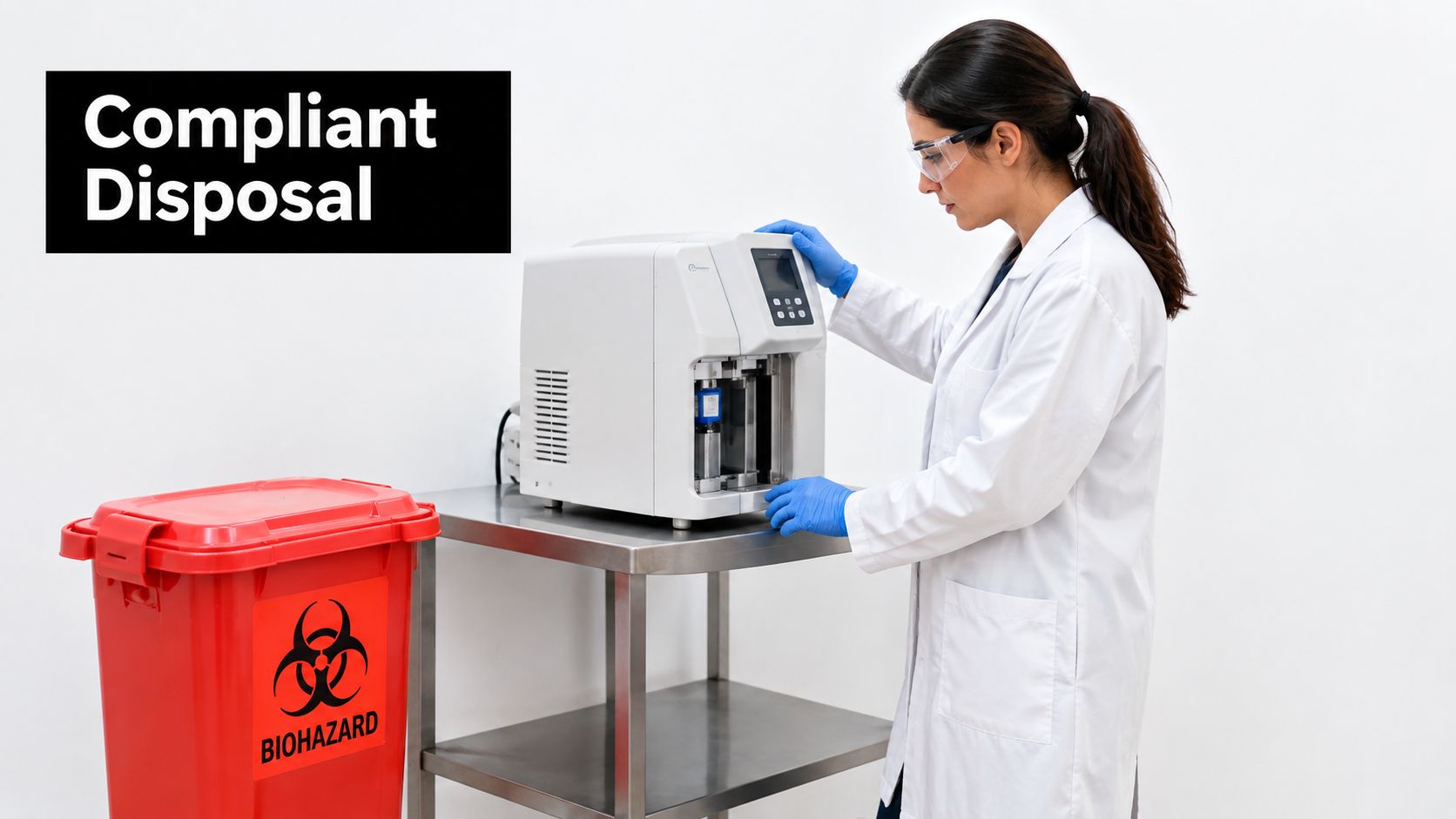
Medical equipment disposal and laboratory equipment disposal demand a more careful process than ordinary laptop disposal. Patient monitors, diagnostic systems, analyzers, imaging equipment, and research instruments may contain sensitive data, regulated materials, batteries, fluids, or components requiring specialized handling.
Start by classifying the equipment and documenting its specifications, condition, ownership, and operating context. A hospital retiring patient monitors may need to coordinate clinical continuity and data removal. A research institution decommissioning laboratory instrumentation may need to address residual chemicals, contamination controls, or facility-specific safety procedures.
Match the provider to the equipment
Verify credentials, insurance, handling capabilities, and documentation practices before scheduling a removal. Ask how the provider prepares equipment, manages regulated materials, records custody, and supplies environmental or compliance documentation. Jurisdictional requirements can vary, so the organization should confirm applicable rules with its compliance and environmental teams.
Don't assume resale or donation is automatically appropriate. Functional equipment may still require decontamination, software removal, calibration review, or a controlled transfer. Equipment that cannot be safely reused should move through an approved recycling or disposal route.
Operational KPIs include preparation completion, approved equipment classifications, documentation accuracy, pickup readiness, compliance exceptions, and time out of service. The right partner reduces handling delays without replacing the organization's responsibility to identify hazards and define release conditions.
10. Environmental Impact Reporting and Sustainability Metrics Tracking
Environmental reporting turns responsible recycling into management information. A sustainability leader needs more than a statement that equipment was “recycled.” The organization should know what was collected, which assets were reused or donated, what materials were recovered, whether data destruction was completed, and how the activity supports environmental and community goals.
The scale of the challenge makes measurement relevant. The World Health Organization cites an estimate of 62 million tonnes of e-waste generated worldwide in 2022, equal to 7.8 kilograms per person, with only 22.3% formally collected and recycled in environmentally sound conditions according to the WHO. Those figures support a practical priority, keep usable equipment in productive use where appropriate, and ensure end-of-life materials enter responsible channels.
Build a defensible reporting record
Collect weights, quantities, equipment categories, disposition outcomes, certificates, and recipient information. Separate environmental KPIs from community KPIs, then connect both to business measures such as storage space reclaimed, recovery value, pickup turnaround, and processing time.
A reporting framework may include:
- Material outcomes: Track e-waste diversion, material recovery, and regulated materials handled.
- Reuse outcomes: Record equipment donated, refurbished, resold, or placed with community organizations.
- Security outcomes: Reconcile destruction records and certificates with the asset manifest.
- Governance outcomes: Maintain compliance documentation and partner records.
- Community outcomes: Document technology donations, digital inclusion support, and workforce development contributions.
Reworx Recycling offers environmental impact reporting to help organizations organize outcome data for internal dashboards and sustainability communications. Use established conversion factors carefully, label assumptions, and avoid claiming an environmental benefit that the available records can't support.
Efficiency Improvement Methods: 10-Point Comparison Guide
| Method / Program | Implementation Complexity 🔄 | Resource Requirements ⚡ | Expected Outcomes 📊 | Ideal Use Cases 💡 | Key Advantages ⭐ |
|---|---|---|---|---|---|
| IT Asset Disposition (ITAD) Program Implementation | Moderate; requires inventory, protocols, scheduling, and provider coordination | Asset management staff, certified ITAD partner, logistics support, documentation systems | Faster retirement, secure data handling, value recovery, compliance records | Enterprise refresh cycles, healthcare, education, and government equipment retirement | Scalable process, reduced staff workload, improved security, and stronger ESG reporting |
| Lean Waste Elimination in Equipment Lifecycle Management | Moderate to high; requires process mapping, training, and continuous measurement | Process analysts, staff training, inventory data, lifecycle KPIs | Lower storage and procurement costs, faster retirement, improved asset utilization | Organizations with redundant, underused, or poorly managed equipment | Reduces operational waste and creates more predictable technology spending |
| Secure Data Destruction and Risk Mitigation Protocols | Moderate; requires policy development, certified methods, and chain-of-custody controls | Certified destruction provider, security staff, secure logistics, audit documentation | Reduced breach risk, faster disposition, and defensible compliance evidence | Healthcare, finance, government, education, and any data-sensitive environment | ⭐ Strong security assurance, regulatory support, and documented destruction |
| Equipment Donation Programs for Tax Efficiency and Community Impact | Moderate; requires recipient verification, condition assessment, and tax documentation | Donation partner, valuation records, logistics coordination, functional equipment | Tax deductions, lower disposal costs, community access, and extended asset life | Functional surplus equipment suitable for nonprofits, schools, and community programs | 💡 Combines financial efficiency, social impact, and sustainability benefits |
| Automated Asset Tracking and Inventory Optimization | High; requires software deployment, tagging, integration, and staff adoption | Asset management platform, barcode or RFID hardware, implementation team, training | Real-time visibility, faster audits, fewer losses, and improved retirement forecasting | Distributed enterprises, campuses, healthcare networks, and government agencies | ⚡ Automates inventory control and improves redeployment and budgeting decisions |
| Consolidated Vendor Relationships and Single-Source ITAD Solutions | Moderate; requires vendor assessment, transition planning, and service agreements | Single qualified provider, procurement support, SLAs, consolidated reporting | Lower coordination overhead, simpler billing, consistent service, and improved scheduling | Organizations managing multiple ITAD, recycling, destruction, and donation vendors | Simplifies administration and enables volume-based pricing |
| Scheduled Facility and Office Cleanout Programs | Moderate; requires cross-department planning, inventory review, and pickup scheduling | Facilities, IT, finance, recycling partner, temporary labor, transport support | Reclaimed space, reduced storage costs, improved safety, and accurate asset records | Office relocations, annual refreshes, data center closures, and campus cleanouts | 🔄 Prevents equipment accumulation through predictable, repeatable removal cycles |
| Data Center Decommissioning and Equipment Recovery Planning | High; involves phased shutdowns, complex logistics, valuation, and compliance controls | Specialized project team, ITAD provider, secure transport, engineers, compliance staff | Capital recovery, secure infrastructure transition, and faster facility exits | Cloud migrations, facility consolidation, infrastructure modernization, and lease exits | ⭐ Manages large-scale transitions while maximizing recovery value and security |
| Laboratory and Medical Equipment Disposition Compliance | High; requires decontamination, regulated handling, testing, and detailed certification | Specialized disposal provider, compliance staff, safety protocols, certified transport | Reduced regulatory exposure, safer handling, compliant disposal, and potential resale | Hospitals, laboratories, pharmaceutical firms, imaging centers, and clinical facilities | Protects safety and compliance while supporting recovery of suitable equipment |
| Environmental Impact Reporting and Sustainability Metrics Tracking | Moderate; requires standardized data collection, calculations, and reporting workflows | Recycling partner data, sustainability staff, reporting tools, verification support | Measurable waste diversion, emissions reduction, ESG evidence, and stakeholder reporting | Organizations with ESG commitments, sustainability disclosures, or environmental targets | 📊 Converts disposition activity into measurable environmental and community impact |
Turn Retirement Work Into Measurable Progress
The most effective efficiency improvement methods work as a sequence rather than a collection of disconnected initiatives. Establish asset visibility first. Define ITAD ownership and secure data destruction controls next. Then remove lean process waste, choose donation and recovery paths, consolidate logistics, schedule recurring cleanouts, plan complex decommissioning, handle regulated equipment carefully, and report environmental and community outcomes.
That sequence doesn't require a large transformation program. Select the first two or three methods that address the biggest bottlenecks. If storage is full and records are unreliable, begin with asset tracking and a scheduled facility cleanout. If security concerns delay retirement, prioritize data destruction controls and chain-of-custody documentation. If sustainability reporting lacks evidence, establish disposition records and environmental impact reporting before expanding the program.
Assign an owner to each method. IT may own inventory and data destruction, facilities may own staging and access, finance may review recovery and donation records, and sustainability may manage impact reporting. Reworx Recycling can support the operational connection between those groups through pickup coordination, secure processing, donation, recycling, and IT asset disposition services.
Review results after the next equipment retirement cycle. Compare the baseline with actual performance, document exceptions, and adjust the workflow. Lean implementation research cited by ASME found that the top 10% of lean implementers outperformed the bottom 10% by 12% in value added per employee, 9% in productivity, 6% in employment, and 2% in profitability per sale as reported by ASME. The same source reports that a survey of 300 British manufacturers found leaner companies were 17% less energy intensive. The lesson is practical, not cosmetic. Adoption quality matters.
KPI checklist
Use a small, consistent scorecard:
- Retirement cycle time
- Inventory accuracy
- Secure destruction completion
- Certificates issued
- Storage space reclaimed
- Recovery or donation volume
- Pickup turnaround
- Compliance documentation
- E-waste diversion
- Community technology placement
Automation can strengthen this scorecard when applied to repetitive handoffs. A 2026 industry compilation reports that 66% of organizations have automated at least one business function, while 74% of IT and engineering leaders say automation saves 11% to 30% of time previously spent on manual work, and repetitive administrative error rates can fall by up to 75% after automation according to the industry compilation. Use those findings as context, not as a substitute for your own baseline.
Businesses should also verify local disposal requirements. The EPA states that electronics can't be recycled curbside and must be taken to specific collection sites, including manufacturer and retailer take-back options for items such as cell phones, computers, and televisions in its recycling guidance. The agency also says 25 U.S. states plus the District of Columbia have electronics recycling laws in its electronics stewardship regulations. For CRT equipment, EPA guidance explains that the 2006 CRT rule changed RCRA treatment under specified conditions, with export provisions later revised on June 18, 2014 in its electronics management guidance.
Responsible electronics recycling protects information, recovers resources, and expands community access to technology.
Businesses can start by donating old equipment, scheduling a pickup, arranging secure data destruction, or discussing an ITAD, office cleanout, facility cleanout, laboratory equipment disposal, or data center decommissioning project with Reworx Recycling. The right plan connects operational efficiency with data security, environmental stewardship, and community impact.
For organizations balancing operational performance with environmental objectives, balancing performance with sustainability is a useful lens for evaluating infrastructure and retirement decisions together.
Reworx Recycling helps businesses manage electronics recycling, IT asset disposition, secure hard drive shredding, equipment donations, business pickups, and specialized cleanout projects. Visit Reworx Recycling to plan a responsible equipment retirement program and discuss the next pickup, data destruction, donation, or decommissioning project.