
Most Atlanta neighborhood guides answer the wrong question. They compare brunch, nightlife, and residential walkability, then declare Buckhead the luxury choice and Midtown the urban choice. That advice is useful for a weekend visit, but it's inadequate for a headquarters, regional office, or technology-heavy operation.
A corporate relocation should be judged by total cost of operations, employee transit equity, facility logistics, and sustainability performance. A prestigious address can create daily friction if employees need cars for routine trips, clients struggle to reach the office, or obsolete servers and laptops become an afterthought during the move. The practical question behind Buckhead vs Midtown is simple: which district supports the way your organization operates?
Redefining the Atlanta Office Relocation Decision
The most expensive relocation mistake isn't always an above-budget lease. It's choosing a building that looks right in a marketing deck but performs poorly for employees, visitors, vendors, and facilities teams.
Buckhead and Midtown serve different operating models. Buckhead offers a broad collection of commercial, retail, and residential pockets with a strong executive and client-facing profile. Midtown functions more like a concentrated urban business center, where offices, apartments, cultural destinations, restaurants, and MARTA access sit closer together. That difference affects recruiting, meeting attendance, parking requirements, delivery planning, and the employee experience.
A leadership team evaluating Atlanta office space should score each neighborhood against four operating questions:
- Workforce access: Can employees reach the office without relying on a private vehicle?
- Client convenience: Can customers, partners, and visiting executives arrive predictably?
- Facility efficiency: Can loading, storage, equipment removal, and building access support the move?
- Sustainability execution: Can the company retire technology securely while documenting responsible reuse and recycling?
The last question deserves more attention. A relocation creates a concentrated stream of computers, monitors, networking equipment, furniture, batteries, and cabling. That creates an opportunity to combine IT asset disposition, secure data destruction, donation-based recycling, and office cleanout planning instead of sending usable equipment into an unmanaged waste stream.
Operational rule: Choose the neighborhood that reduces recurring friction, not the one that wins the lifestyle comparison.
Corporate leaders should also review local commercial conditions before committing to a site. Atlanta's office market is changing, and a 2026 Atlanta real estate market forecast can help frame the relocation conversation alongside lease terms, submarket demand, and building quality. The neighborhood decision should then be tested against actual employee locations, work schedules, client travel patterns, and the physical requirements of the IT environment.
My initial recommendation is direct. Start with Midtown for organizations that prioritize transit access, dense amenities, and a car-light workforce. Start with Buckhead for companies whose value proposition depends on premium surroundings, executive presence, larger residential choice, or a more distributed operating pattern.
Geographic Scale and Demographic Realities
Buckhead and Midtown aren't comparable units of geography in the way many relocation guides imply. Midtown is a relatively compact, mixed-use urban district. Buckhead is much larger and more varied, with subareas that can feel materially different from one another.

Buckhead was officially annexed into the City of Atlanta in 1952, after Henry Irby purchased about 202 acres for $650 in 1838, a transaction associated with the area that became the neighborhood's core. Modern estimates place Buckhead at roughly 108,000 residents, approximately one-fifth of Atlanta's population and geographic area, according to Atlanta Magazine's history and facts about Buckhead. Another local demographic profile describes Greater Buckhead as having about 87,000 residents and an estimated daytime population of 140,000, reflecting the flow of workers, visitors, and business users documented by Livable Buckhead.
That daytime volume matters to employers. It supports a strong commercial identity, but it can also produce more variable traffic, parking pressure, and travel patterns across the district. A Buckhead address doesn't tell you enough. The specific pocket, building access plan, MARTA proximity, and employee distribution matter just as much.
Midtown's concentrated urban pattern
Midtown's demographic change tells a different story. Historical planning information records approximately 9,453 residents in 2000 and 17,124 residents in 2019, an increase of roughly 81%, as reported by the Atlanta History Center. Other estimates place the neighborhood near 29,581 residents today, with a median age of 37 and a population density around 30,642 people per square mile, reinforcing Midtown's role as a dense, mixed-use market.
Midtown's structure is easier to understand operationally. Employees can live, work, eat, and run routine errands within a tighter geography. That concentration supports businesses recruiting from different parts of the region, particularly when the office sits near rail stations and major pedestrian routes.
Buckhead's scale creates more choice, while Midtown's concentration creates more consistency. For a corporate real estate decision, that distinction affects foot traffic forecasts, visitor access, employee commuting, and the reliability of everyday services.
Real Estate Costs and Multimodal Transit Access
The cost comparison isn't Buckhead versus Midtown rent. It's occupancy cost plus transportation cost, parking requirements, employee travel burden, and the effect of accessibility on recruiting and retention.
One neutral market snapshot reports Buckhead's median home price at about $478,000 and effective rents around $1,700, compared with Midtown's median home price of about $274,000 and rents around $1,660. The same snapshot reports a Walk Score of 62 for Buckhead and 78 for Midtown, with crime-rate metrics of 41 and 57, respectively, in Zillow's Atlanta neighborhood comparison. These are neighborhood-level indicators, not a substitute for building-specific underwriting, but they illustrate the trade-off between a higher-cost, lower-density profile and a denser urban environment.
A separate Atlanta neighborhood guide reports Midtown with a Walk Score of 87 and a Transit Score of 61, compared with 81 and 52 for Buckhead Heights, respectively, in Vesta's Atlanta neighborhood data.
| Metric | Midtown Profile | Buckhead Profile |
|---|---|---|
| Median home price | About $274,000 | About $478,000 |
| Effective rent | About $1,660 | About $1,700 |
| Walk Score | 87 in a separate market guide | 81 for Buckhead Heights |
| Transit Score | 61 | 52 for Buckhead Heights |
| Operating profile | Dense, mixed-use, more multimodal | Premium, broader, more vehicle-oriented |
The recommendation is clear for car-light operations. Midtown is the stronger benchmark when proximity to MARTA, walking access to services, and reduced vehicle dependency drive the decision. Midtown has three MARTA rail stations, North Avenue, Midtown, and Arts Center. MARTA opened North Avenue in 1981, followed by Midtown and Arts Center in 1982, according to Midtown's neighborhood history.
Buckhead remains the better fit for organizations prioritizing premium retail, corporate prestige, upscale residential inventory, or a quieter executive environment. It also has MARTA access, but its larger footprint and lower-density pattern make vehicle use more central to daily life.
The right rent comparison includes the transportation burden your employees and visitors carry after they leave the building.
Facilities teams should also evaluate how prospective buildings are represented before touring. For leadership teams comparing properties remotely, this guide to real estate video cost explained offers useful context for assessing virtual property marketing and deciding when an in-person inspection is necessary. For teams that value pedestrian connectivity, Atlanta's broader trail and mobility context is also relevant, including this Atlanta BeltLine guide for visitors and locals.
Managing IT Asset Disposition During Your Move
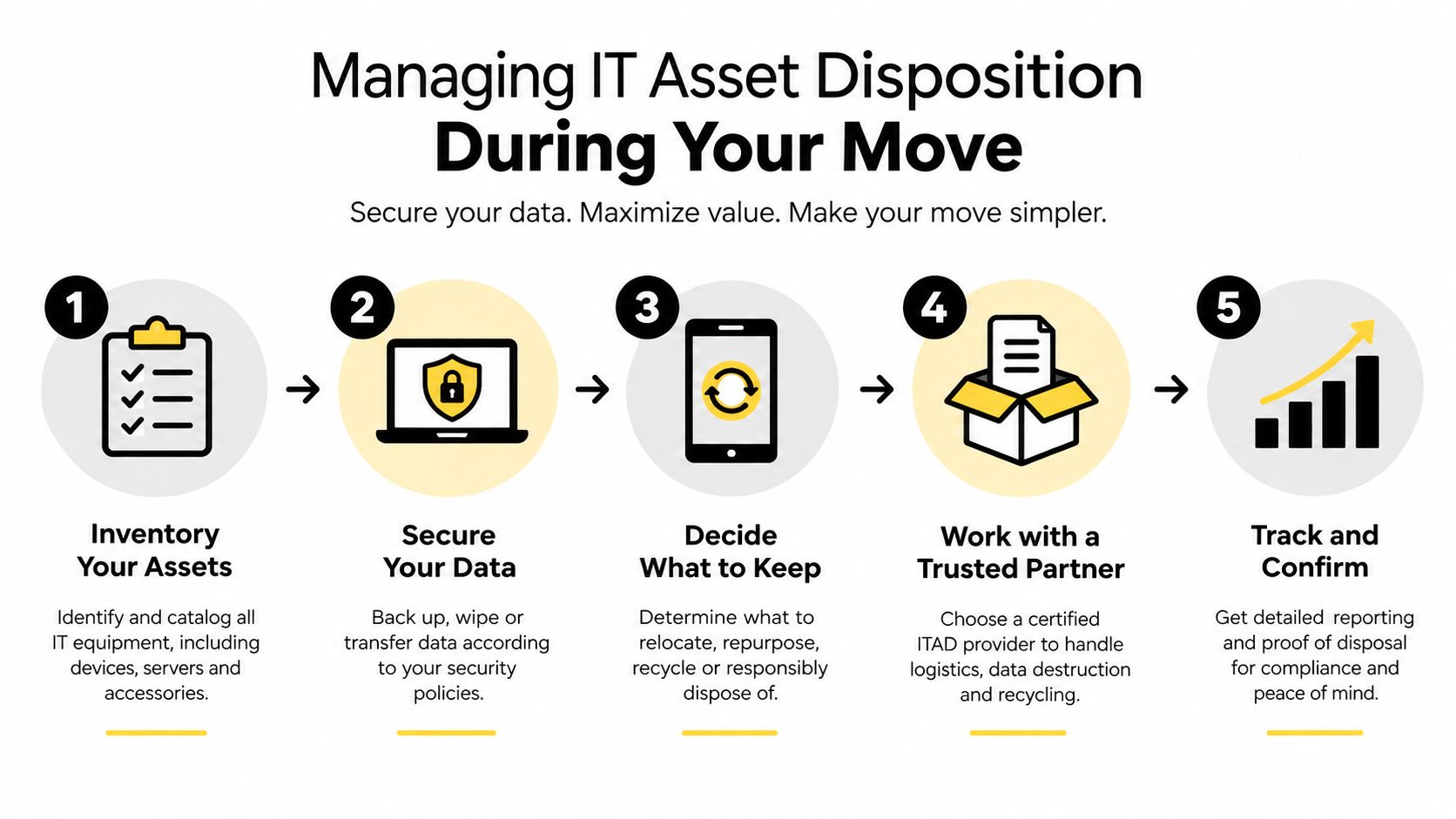
An office move is a forced checkpoint in the technology lifecycle. Treat it as a simple transfer of desks and devices, and you'll carry obsolete hardware, duplicate inventory, unsecured storage media, and avoidable disposal risk into the new facility.
A disciplined IT asset disposition, or ITAD, program starts before movers arrive. The objective is to identify what will be redeployed, remarketed, donated, recycled, or destroyed, then preserve a clear chain of custody for every device that contains data.
Build the disposition plan before packing
Begin with an asset register that includes laptops, desktops, monitors, printers, servers, storage arrays, networking hardware, laboratory equipment, and medical devices. Match serial numbers to users or rooms, then flag equipment that has reached end of life, failed security requirements, or no longer supports the new workplace design.
Use separate handling paths:
- Redeployment: Wipe, test, label, and reassign equipment that remains serviceable.
- Value recovery: Evaluate surplus hardware for buyback or resale before recycling.
- Donation: Route functional devices into a corporate donation program when reuse creates community value.
- Recycling: Send non-reusable electronics to a responsible electronics recycling partner.
- Destruction: Use secure data destruction or hard drive shredding for media that can't be sanitized appropriately.
The same logic applies beyond ordinary office technology. A headquarters move may involve data center decommissioning, laptop disposal, product destruction, laboratory equipment disposal, medical equipment disposal, and facility cleanout. Each category needs an owner, a disposition decision, and documentation.
The Atlanta IT asset disposition services for corporate IT teams page describes the type of service scope companies should evaluate when selecting a local partner. Reworx Recycling handles business pickups, equipment decommissioning, IT asset management, recycling consultations, equipment buyback options, and secure hard drive shredding with data destruction.
Protect data and document outcomes
Data-bearing assets require special control. Don't place retired laptops or servers in an open loading area, and don't allow a general moving crew to decide what happens to drives. IT and security leaders should define approved sanitization or destruction methods, verify completion, and retain records that support internal governance and applicable regulatory expectations.
A responsible disposition record should identify the equipment category, quantity, serial information where available, final treatment, and service documentation. Sustainability teams can then distinguish reuse, donation, material recycling, and destruction rather than reporting one vague waste figure.
The EPA's electronics donation and recycling guidance provides useful background for separating donation, reuse, and recycling decisions. That distinction helps an Atlanta relocation become an IT lifecycle project, not merely a hauling exercise.
Matching Neighborhood Profiles to Business Needs
The best answer to Buckhead vs Midtown depends on the company's operating rhythm. A client-facing law firm, a software company, and a regional sales office may all need high-quality space, but they won't place the same value on transit, prestige, visitor parking, or neighborhood density.
When Midtown is the better operating platform
Choose Midtown when employee access and daily convenience are strategic priorities. The neighborhood's dense, mixed-use structure supports organizations with a broad employee base, frequent collaboration, and a workforce that benefits from MARTA and walking access.
Midtown is particularly well suited to:
- Technology and professional services firms: Recruiters can market an urban office environment with access to transit, restaurants, housing, and cultural destinations.
- Regional training or collaboration hubs: Visitors can reach the office without navigating a large, dispersed district.
- Employers pursuing commute equity: Employees who don't own cars face fewer daily barriers when the office is near rail and services.
- Companies with flexible workplace programs: A compact neighborhood can make occasional office attendance more attractive than a car-dependent campus.
Midtown's concentration also helps technology operations. Vendors, employees, and facilities staff can coordinate service visits without making every task depend on parking and road access.
When Buckhead earns the premium
Buckhead is the stronger choice for executive-oriented, highly client-facing, or premium-brand operations. Financial services, private equity, luxury brands, high-end healthcare practices, and firms that host senior clients may value the district's established commercial identity and upscale surroundings.
Buckhead also gives companies more subarea choice. A premium retail core, a major office cluster, and a quieter residential pocket can support different workplace strategies. The downside is that leadership must evaluate the micro-area carefully. A building near a MARTA station and client destinations has a different operating profile from one that depends heavily on parking and arterial roads.
For distributed sales teams, the decision should include travel geography, not just office aesthetics. A company serving clients across North Atlanta may accept Buckhead's vehicle orientation because the location aligns with customer routes. A team whose employees primarily come from rail-accessible areas may find Midtown more equitable.
Even unconventional mobile businesses need the same connectivity discipline. Leaders evaluating field operations can use this overview of business internet for RV entrepreneurs as a reminder that reliable connectivity must be matched to the workforce's actual mobility pattern, not assumed from a prestigious address.
The practical conclusion follows the geography. Midtown behaves like one dense urban center. Buckhead behaves like several neighborhoods. That distinction, emphasized in Atlanta's guide to neighborhood areas, should shape the site-selection process more than broad lifestyle labels.
Integrating Corporate Sustainability and Community Impact
A relocation produces a visible sustainability test. Employees see what happens to old monitors, laptops, servers, printers, cables, and furniture. Clients may ask how the company handles data-bearing equipment. Sustainability leaders need evidence that the move supports environmental commitments rather than creating a one-time exception.
That's why the relocation plan should include sustainable recycling and social enterprise recycling from the start. Reusable equipment can support donation programs, while obsolete electronics can move through documented recycling and secure destruction channels. The company gains better control over sensitive information and a clearer account of where retired technology went.

Turn surplus equipment into a managed program
A corporate donation program should never mean placing untested devices in a donation pile. IT teams need to assess condition, remove organizational data, record the transfer, and determine whether the recipient can use the equipment safely.
That process can support digital inclusion and workforce development when suitable devices are directed toward community use. It also creates a stronger internal narrative than reporting that equipment was removed from the building. The organization can show that its technology transition considered reuse, resource recovery, data protection, and local social impact together.
A local partner can coordinate business pickups and separate equipment by disposition path. Reworx Recycling is one option for organizations seeking electronics recycling, IT equipment disposal, secure hard drive shredding, business pickups, and equipment donation support in the Atlanta area. Its social enterprise model connects responsible device retirement with community impact, including technology donations and workforce development.
Make ESG reporting operational
Sustainability reporting improves when facilities, IT, procurement, and security use the same records. Capture the number and type of assets processed, the share directed to reuse or donation, the materials sent for recycling, and the media destroyed under secure procedures. Don't claim a diversion result unless the service provider can substantiate the treatment.
The case for donating data center equipment in Atlanta is especially relevant to organizations replacing servers or consolidating infrastructure. The decision isn't only about reducing truckloads during a move. It's about protecting data, recovering value, reducing avoidable waste, and making community impact part of the relocation budget.
The Facility Manager Relocation Checklist
Facility managers should run the move as a sequence of controlled decisions, not as a single moving date. Assign owners across facilities, IT, information security, procurement, sustainability, and the moving contractor. Then require written confirmation at each handoff.
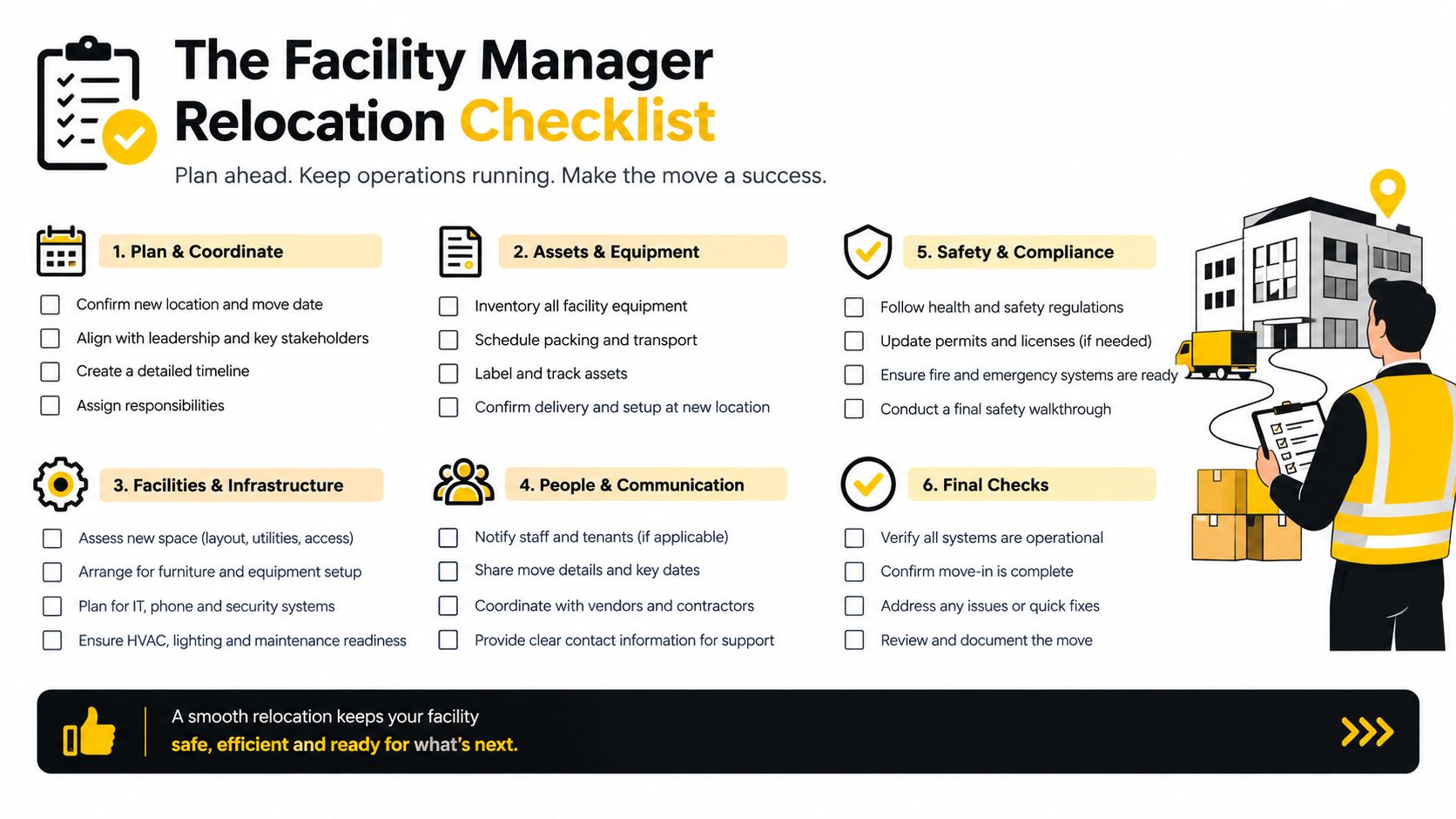
Before the move
- Create the asset register: Record laptops, desktops, monitors, servers, network equipment, storage media, printers, and specialized equipment.
- Classify every item: Mark each asset for redeployment, resale, donation, recycling, or secure destruction.
- Review the lease and building rules: Confirm loading access, elevator reservations, staging areas, insurance requirements, and approved vendors.
- Select the disposition partner: Verify pickup capacity, data destruction procedures, documentation, and downstream recycling practices.
- Set the sustainability baseline: Decide which reuse, donation, recycling, and destruction outcomes will appear in ESG reporting.
A broader office relocation checklist can help facilities leaders organize general move dependencies, but IT equipment needs its own chain-of-custody process. General movers shouldn't control data-bearing assets without direction from IT security.
During the move
Keep retired equipment separate from active inventory. Use labeled cages, locked rooms, or controlled staging areas, and reconcile the asset list when equipment leaves the old facility. If a server room is being dismantled, document rack locations, cabling, storage devices, and any components that require secure destruction.
Coordinate the final pickup around the building's access window. A missed loading appointment can delay the move and leave sensitive equipment unattended. Confirm who signs the transfer record and where service certificates will be stored.
After occupancy
- Reconcile inventory: Compare the old-site register with redeployed assets and final disposition records.
- Verify destruction: Collect certificates or equivalent documentation for drives and other media processed through secure data destruction.
- Close vendor actions: Confirm that recycling, pickup, resale, donation, and product destruction invoices match the approved scope.
- Report outcomes: Give sustainability and leadership teams a concise record of reuse, donation, recycling, and secure destruction.
- Update the playbook: Record what worked, what caused delay, and which building requirements should influence the next relocation.
Use the Reworx Recycling office relocation service to coordinate retired electronics, business pickups, data-bearing equipment, and responsible recycling as part of the move plan.
Reworx Recycling helps Atlanta-area businesses manage electronics recycling, IT equipment disposal, secure data destruction, equipment pickups, and technology donations during office relocations. Visit Reworx Recycling to plan a pickup, donate usable equipment, or build a documented ITAD and recycling program for your next facility transition.