Your facilities team has cleared the conference rooms, replaced aging laptops, and found a storage area packed with monitors, servers, cables, printers, and batteries. A search for “e-waste recycling near me” may return convenient drop-off points, but a business technology retirement project needs more than a nearby address. It needs secure data handling, documented custody, appropriate transport, and a clear decision about what should be reused, donated, resold, or processed for materials.
For corporate IT managers, facilities directors, sustainability leaders, schools, and public agencies, local electronics recycling is an IT asset disposition decision. The right partner should handle computer recycling and office cleanout logistics without creating a data breach, compliance gap, or environmental liability. A donation-based recycling model can also turn usable equipment into community technology while supporting digital inclusion and workforce development.
The Reality of Local E-Waste Recycling for Businesses
An office cleanout often starts with a simple question: where can we take this equipment? That question changes once the inventory includes employee laptops, network switches, server drives, medical equipment, laboratory equipment, and devices that may contain confidential information. A consumer drop-off site may accept electronics, but acceptance alone doesn't prove secure processing or suitable reporting for a business.
The global context makes the local decision more urgent. The world generated 62 billion kg of e-waste in 2022, equal to 7.8 kg per person, yet only 22.3% was documented as formally collected and recycled in an environmentally sound way, according to the Global E-waste Monitor 2024. The same report projects 82 million tonnes by 2030, roughly a 33% increase from 2022 levels. Local capacity matters because demand for responsible electronics recycling is increasing faster than documented formal recycling capacity.
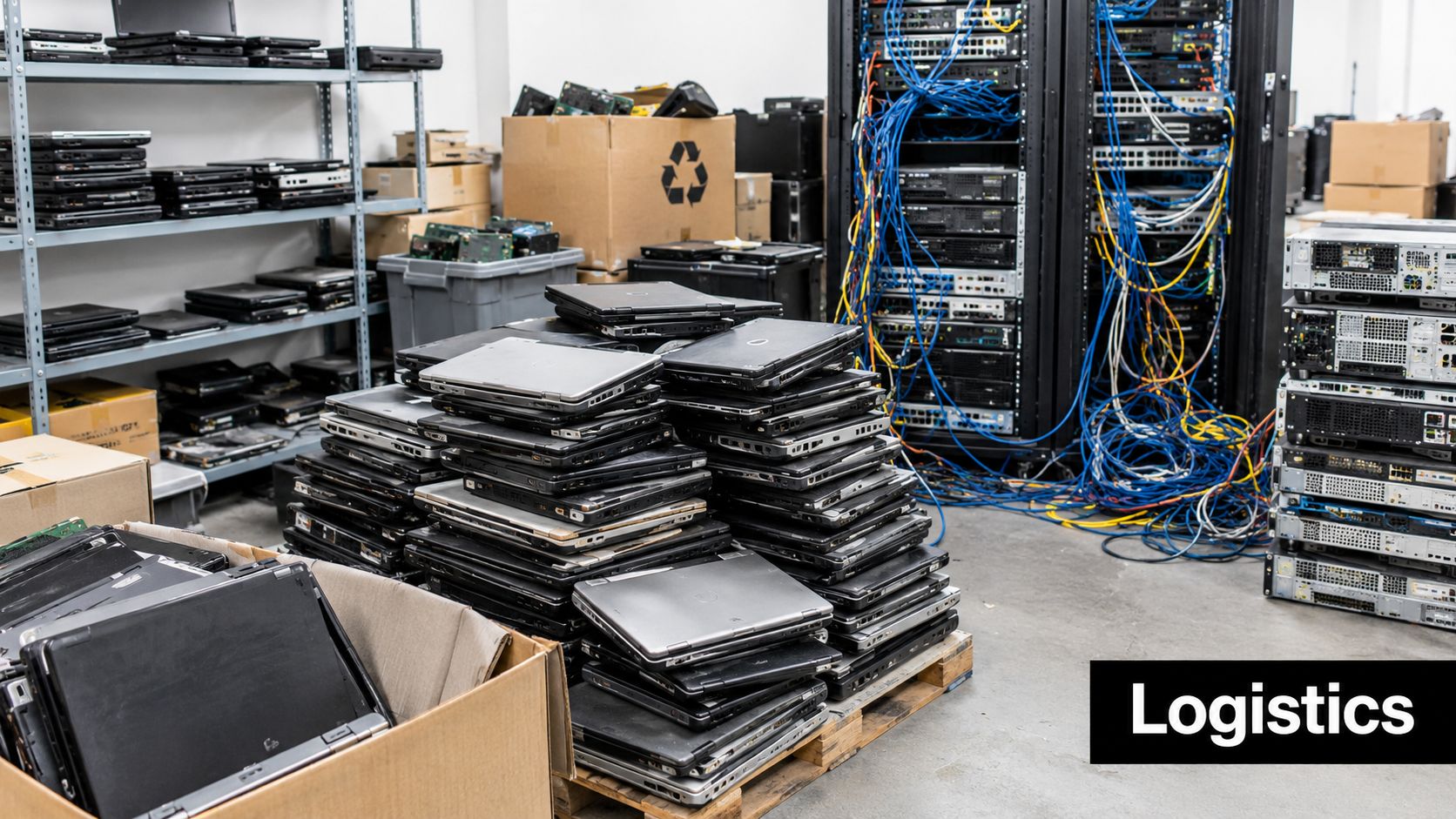
Proximity is only one screening factor
The closest recycler may be useful for a small, low-risk load, but distance shouldn't outrank processing controls. Ask who receives the equipment, whether serial numbers are recorded, how hard drives are sanitized or destroyed, and what happens to materials after the first facility receives them.
A responsible local option should be able to explain its downstream chain. It should distinguish reusable laptops from damaged batteries, separate servers from mixed cables, and provide documentation that matches your organization's asset records. If a provider only offers a scale ticket or a generic receipt, it may not meet the needs of an enterprise office cleanout.
Practical rule: Treat local geography as a logistics advantage, not as proof of secure or sustainable processing.
The EPA's electronics information and recycling resources also show why organizations should check jurisdictional requirements. Electronics recycling laws are state-driven, and 25 U.S. states plus the District of Columbia have electronics recycling laws. A business operating across locations may need a consistent internal standard even when local rules differ.
What a business-ready recycler should provide
A suitable provider can support more than computer recycling. Depending on the inventory, services may include laptop disposal, data center decommissioning, medical equipment disposal, laboratory equipment disposal, product destruction, secure data destruction, and facility cleanout support. The vendor should explain which services it performs directly and which it assigns to downstream specialists.
The strongest choice is rarely the vendor that promises to take everything. It's the provider that can show how each asset category moves from collection to final disposition, with custody records and environmental controls at each important handoff.
Evaluating Local Recyclers for Secure IT Disposition
A nearby recycler may accept a truckload of equipment, yet still lack the controls needed for corporate IT disposition. Vetting an ITAD partner requires evidence that protects company data, supports audit requirements, and shows where materials go after collection. Ask whether the facility maintains recognized certifications such as R2 or e-Stewards. Certification does not replace your own due diligence, but it can indicate a structured environmental, health, safety, and downstream-management program.
Request the certificate scope and confirm that it covers the services and locations handling your equipment. A website badge is insufficient if the certified entity is a different company, the certificate has expired, or the downstream processor is outside the certification's scope.
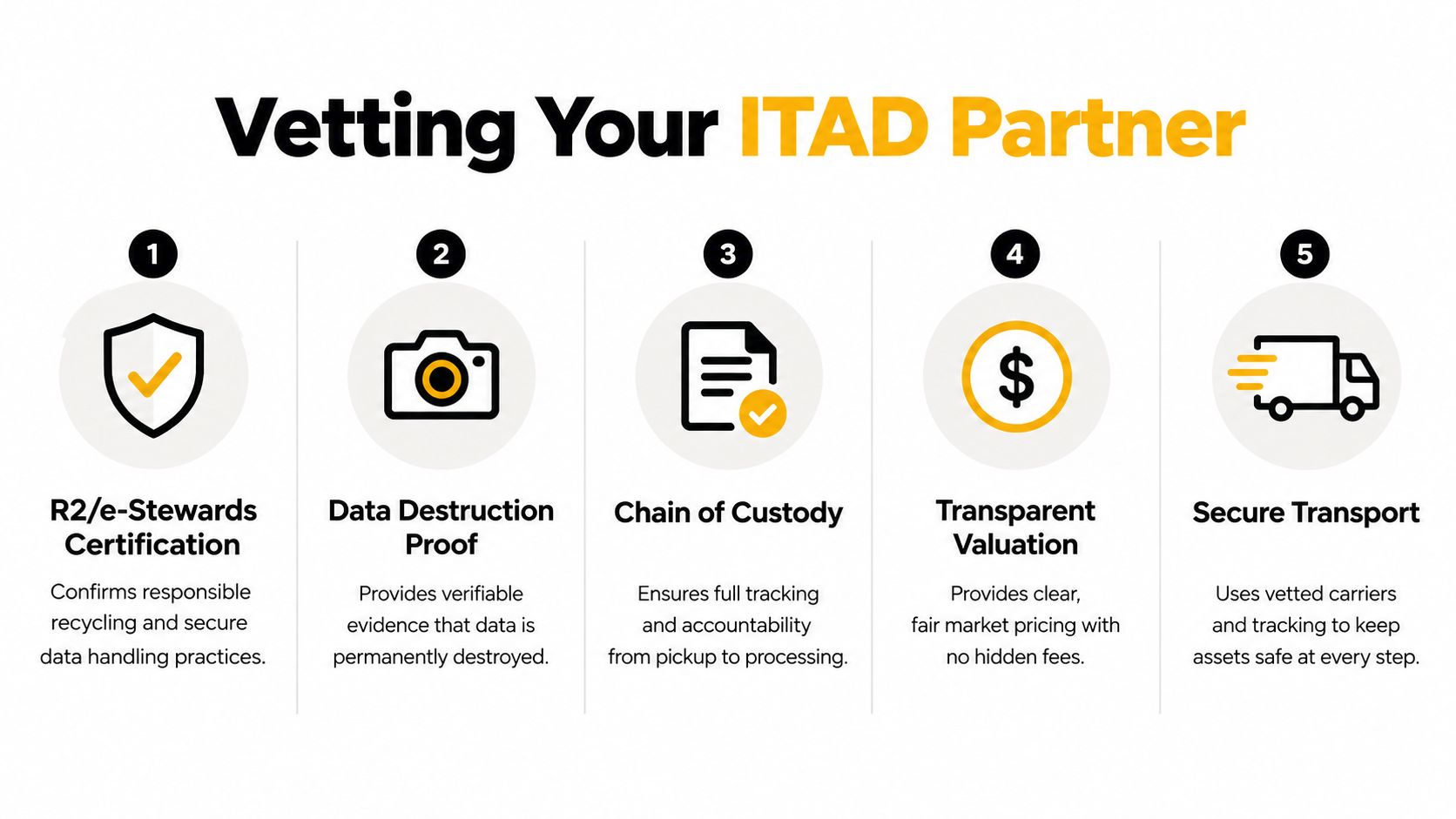
Ask questions that expose the operating model
Use a written questionnaire instead of relying on a sales call. The responses should identify the people, controls, and records supporting the service.
- Confirm certification and facility scope. Ask which location receives your assets and whether the relevant activities fall within the provider's certification.
- Verify data destruction evidence. Determine whether the provider uses software wiping, drive shredding, or both. Ask whether certificates identify asset serial numbers, destruction dates, and the method used.
- Trace the chain of custody. Require custody records from pickup through final disposition, including transfer points and responsible parties.
- Clarify valuation and disposition. The provider should explain how it assesses testing, refurbishment, resale, donation, recycling, and product destruction.
- Review transport controls. Confirm how assets are secured during loading, transit, and unloading, particularly for after-hours pickups or multi-site moves.
Reworx Recycling's vendor selection criteria provides a practical reference for comparing providers. Select the vendor that can produce records for your internal audit, security review, and sustainability reporting, rather than judging a recycler by its service-list length.
Dismantling before shredding affects recovery
Processing order affects both recovery and documentation. The ITU's recycling guidance describes a practical sequence: segregate device classes before transport, manually dismantle high-value and hazardous components before shredding, and route sorted fractions to specialized downstream processors.
Mechanical processing handles bulk metals such as iron and copper well, but precious-metal recovery can suffer when complex boards and connectors are shredded without prior dismantling. Reviews cited by the ITU report gold losses as high as 40% under those conditions. Ask whether the recycler performs pre-shred dismantling and whether it documents material-specific outcomes.
A facility that shreds everything immediately may process material quickly, while sacrificing reuse opportunities, data-handling control, and high-value recovery. A controlled process requires more planning and produces stronger records.
Preparing IT Assets for Secure Transport and Processing
The recycling process begins in your server room, not at the loading dock. Before a pickup, assign an internal owner, freeze the asset list, and decide which equipment is being redeployed, donated, resold, recycled, or destroyed. This prevents an employee from removing a laptop from the load after the manifest has been approved or sending a device to the wrong disposition stream.
Data handling should follow your organization's security policy and the sensitivity of the information. A software wipe may be appropriate for equipment intended for reuse when the process is verified and documented. Physical destruction is the safer route for drives that are damaged, encrypted under uncertain controls, or subject to a policy requiring destruction.
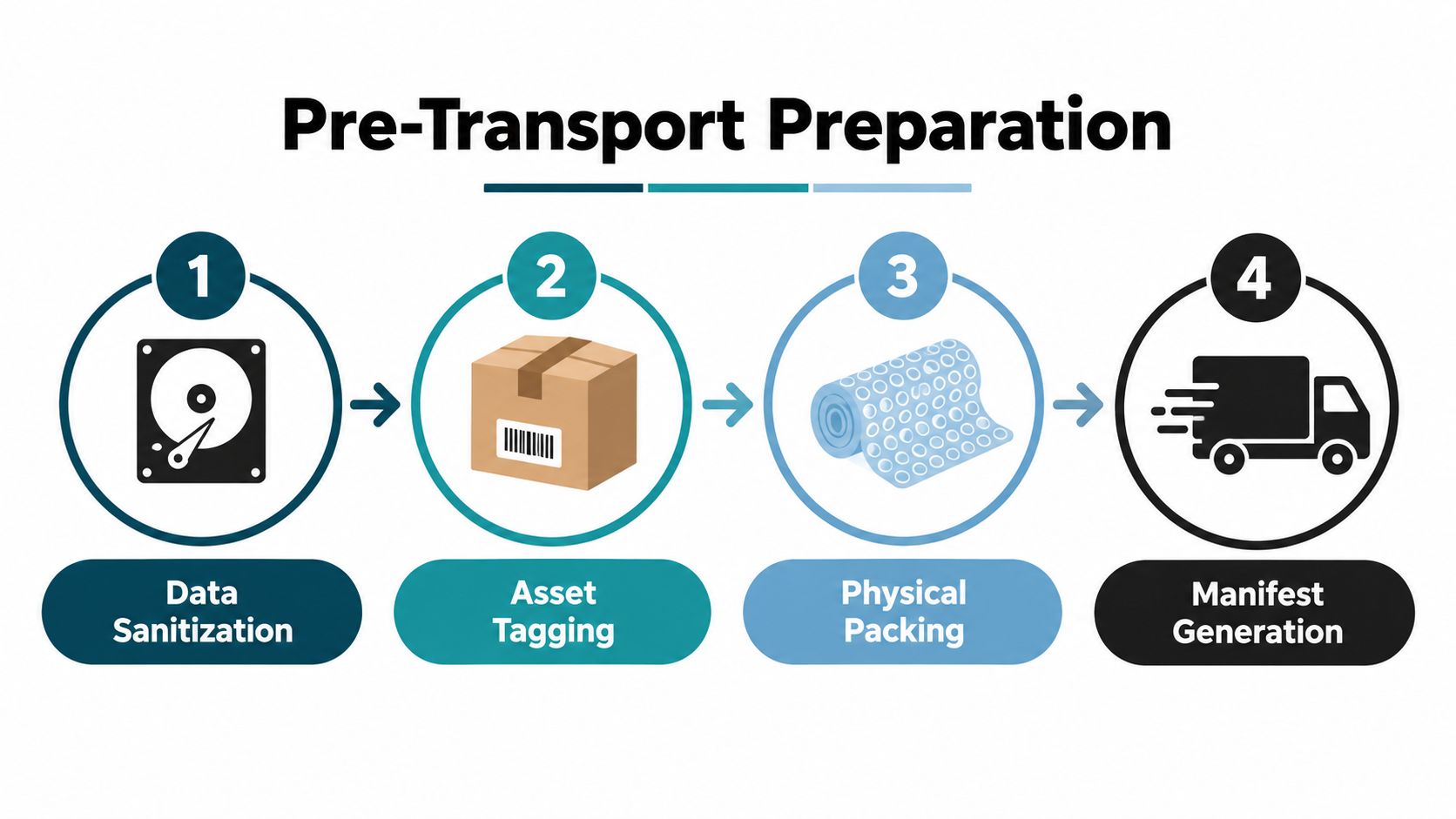
Build a manifest that can survive an audit
A useful manifest connects the physical item to the business record. Include the asset tag, manufacturer, model, serial number where available, assigned department, condition, and intended disposition. Record exceptions such as missing drives, swollen batteries, broken screens, or equipment that can't be powered on.
Use separate containers or pallets for different streams:
- Reusable laptops and desktops: Keep complete devices together so technicians can test, wipe, and grade them efficiently.
- Servers and networking hardware: Identify drives, rails, transceivers, and removable components before packing.
- Batteries and damaged devices: Isolate lithium-ion batteries and visibly damaged equipment, and tell the transporter about them before loading.
- Cables, peripherals, and mixed accessories: Consolidate them separately to avoid contaminating higher-value equipment streams.
- Medical or laboratory assets: Flag devices that may contain regulated components, fluids, lamps, or specialized materials before the recycler accepts them.
Don't place unmarked equipment beside a sealed pallet and assume the recycler can reconstruct the inventory later. A mixed load makes reconciliation harder and can reduce the chance of reuse.
Control custody during the handoff
The internal team should record who packed each group, when the load was sealed, which vehicle collected it, and who accepted it. Photograph pallet labels and container seals when your policy permits. At pickup, compare the provider's count and paperwork with your approved manifest.
For smaller projects, Reworx Recycling's preparation guidance provides a useful checklist for organizing electronics before collection. The operational principle is simple: sanitize, tag, pack, and document before transport. Secure data destruction at the destination can't correct an undocumented handoff that occurred inside your building.
Choosing Between Drop-Off and Managed Business Pickups
Drop-off and managed pickup solve different problems. A drop-off works when the load is small, the devices are already sorted, the organization can transport them safely, and the team can preserve a clear record from storage room to receiving point. It's often practical for a limited number of laptops, peripherals, or small electronics that don't require a complex loading plan.
A business pickup makes more sense when equipment is distributed across departments, stored on pallets, or tied to a full office cleanout. It also fits projects involving data center decommissioning, school technology refreshes, branch closures, and facility cleanout work where staff shouldn't spend working hours loading personal vehicles or arranging multiple trips.
Compare the operational trade-offs
| Consideration | Drop-off | Managed business pickup |
|---|---|---|
| Best fit | Smaller, sorted loads | Office, warehouse, campus, or multi-site projects |
| Internal effort | Staff handle loading and transport | The provider coordinates collection and loading |
| Custody control | Your team must document the route | The provider can begin formal custody at pickup |
| Equipment condition | Easier for boxed, stable items | Better for servers, pallets, mixed assets, and bulky hardware |
| Planning needs | Minimal scheduling | Requires access details, loading conditions, and site coordination |
The hidden cost of self-transport isn't only fuel. Employees lose time, vehicles require loading and unloading, and fragile equipment can shift during transit. The organization also assumes responsibility for keeping devices secured between the storage room and the receiving facility.
Match the service to the site
For a small business, a scheduled drop-off may be the cleanest option when assets are already sanitized and serialized. For a hospital, school district, manufacturer, or corporate campus, a managed pickup can reduce disruption by coordinating dock access, elevators, pallet jacks, loading windows, and after-hours work.
An after-hours option can help a facility avoid interrupting staff or exposing equipment in a public lobby. Review Reworx Recycling's electronics drop-off and after-hours options before deciding whether your project needs a customer drop-off arrangement or a business pickup.
The mission also matters. A social enterprise recycling partner can combine practical collection with community technology donations, digital inclusion, and workforce development. That makes the logistics decision part of a broader corporate donation program, provided the organization receives the records and controls required for its own governance.
Maximizing Value Through ITAD and Equipment Buyback
Recycling shouldn't be the first disposition decision for every device. A laptop with a working display, a server with recoverable components, or a network appliance that fits another department's requirements may have more value through redeployment, refurbishment, donation, or resale than through immediate material processing.
A capable ITAD partner begins with testing and data handling. Technicians assess condition, confirm specifications, remove organizational data, and determine whether the item can return to service. Equipment that fails testing can still move into parts recovery or sustainable recycling, but it shouldn't be mixed with reusable inventory before that decision is made.
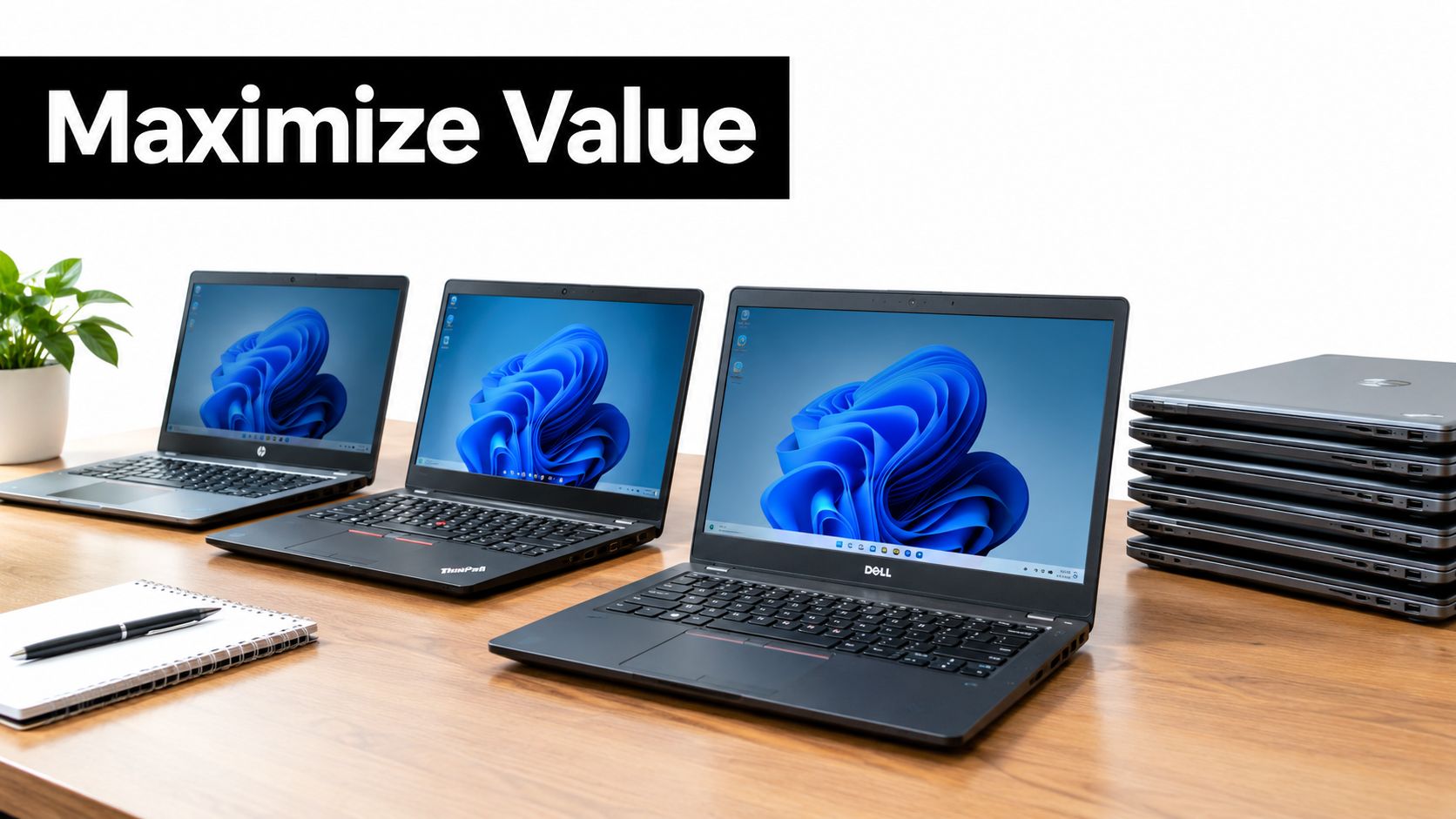
Request a disposition hierarchy
Write the hierarchy into the service request so the recycler doesn't treat every asset as scrap:
- Redeploy equipment internally when it meets a documented business requirement.
- Refurbish and resell devices that can be securely wiped, tested, graded, and marketed.
- Donate suitable technology through a program that can support community access and provide appropriate records.
- Recover parts from equipment that isn't suitable for complete reuse.
- Recycle or destroy assets that are damaged, obsolete, contaminated, or restricted by policy.
This sequence supports both sustainability and value recovery. Refurbishment extends the useful life of equipment, while donation-based recycling can connect corporate surplus to schools, nonprofits, job training, and households that need access to technology. The organization should still confirm how the recipient is selected and what documentation accompanies the donation.
Ask what the buyback actually includes
Buyback proposals should identify the assets being valued, the assumptions behind the valuation, and the treatment of items that fail inspection. Ask whether the offer changes after testing, whether data destruction is included, and how the provider handles equipment with missing drives, damaged screens, or locked firmware.
Reworx Recycling's equipment buyback programs can be considered alongside other ITAD options when a business wants to assess reusable equipment before recycling. Reworx operates as a donation-based social enterprise, combining electronics recycling and secure data destruction with community-focused technology reuse and workforce development.
Material recovery still matters for end-of-life assets. A published analysis of waste printed circuit boards reported recovery of 97.3% copper, 91.6% tin, 78.9% gold, and 67.7% silver in a specific process, as described in this technical review of e-waste recovery methods. Those figures aren't a universal promise for every load, but they show why process selection, dismantling, and fraction-specific refining affect the value recovered from obsolete equipment.
Building a Sustainable E-Waste Strategy for Your Organization
A one-time cleanout removes stored equipment. A sustainable program prevents the next storage room from filling up. Add retirement requirements to procurement, hardware refresh, office closure, and facilities-move procedures so IT and facilities teams know who owns each step before equipment becomes surplus.
Your policy should define approved vendors, data sanitization methods, pickup rules, asset records, battery handling, donation approvals, and final reporting. It should also distinguish everyday office electronics from specialized streams such as medical equipment disposal, laboratory equipment disposal, product destruction, and data center decommissioning.
Make the process repeatable
Use a recurring operating rhythm rather than waiting for an emergency:
- At procurement: Record asset ownership, expected lifecycle, and security requirements.
- During refresh planning: Forecast volumes, identify storage limits, and reserve transport capacity.
- Before retirement: Approve the disposition hierarchy and freeze the asset manifest.
- At collection: Verify seals, custody records, loading conditions, and exceptions.
- After processing: Reconcile certificates, resale or donation records, destruction documentation, and environmental reports.
- During review: Track recurring failure points, such as missing serial numbers, unplanned storage, or mixed loads.
State requirements deserve a separate review for organizations operating across several locations. New York, for example, requires manufacturers to provide free and convenient recycling for many users, including for-profit businesses, corporations with fewer than 50 full-time employees, schools, and government entities, according to the New York electronics recycling requirements. The state's wireless phone law also requires service suppliers to offer free reuse and recycling of up to 10 cell phones from any person. Those rules don't replace internal security controls, but they demonstrate why a national policy should account for local obligations.
Measure outcomes that management can use
Track the number of assets processed, the share directed to reuse or donation, the volume sent to material recovery, the number of drives destroyed, and the percentage of assets reconciled to a manifest. Keep qualitative notes on pickup delays, packaging failures, and recurring data-record exceptions. These measures help sustainability leaders report progress while giving IT managers concrete evidence that the process is controlled.
Organizations searching for e-waste recycling near me should choose a partner that can support this complete workflow, not just receive a load. Reworx Recycling offers business pickups, equipment decommissioning, secure hard-drive shredding and data destruction, electronics recycling consultations, and equipment buyback services. Its social enterprise model connects responsible IT equipment disposal with technology donations, digital inclusion, and workforce development. For a broader operating framework, review this guide to optimizing a company's e-waste recycling strategy.
If your business has aging laptops, servers, monitors, batteries, or surplus technology waiting for a decision, contact Reworx Recycling to arrange a secure pickup, equipment assessment, donation, or data destruction service. Visit Reworx Recycling to plan a compliant electronics recycling program that protects company information, recovers usable value, and supports the community.