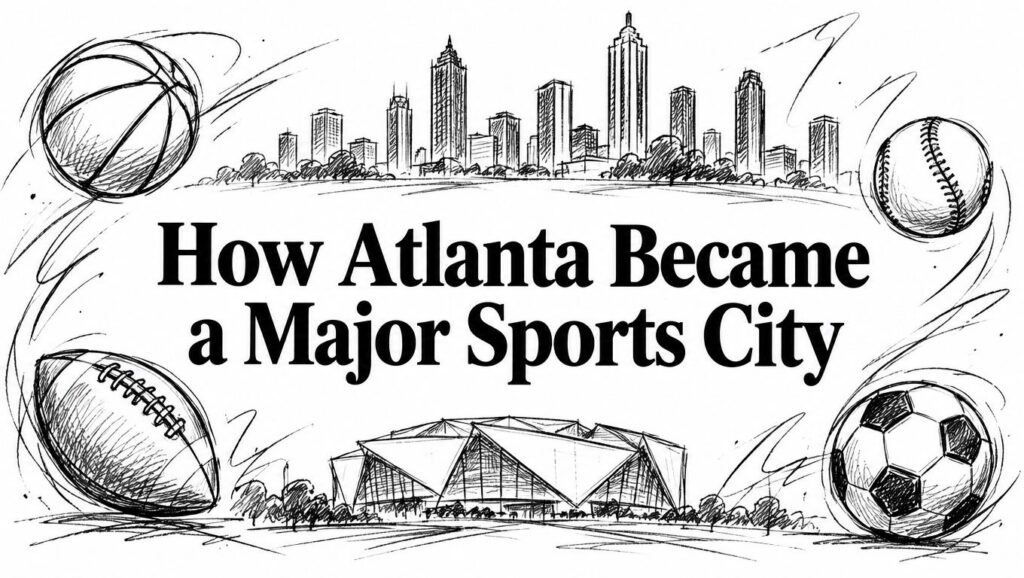
Atlanta's sports identity wasn't created by fan loyalty alone. It was built through franchise relocation, public infrastructure, venue conversion, and repeat event selection. The clearest turning point came at the 1996 Centennial Olympic Games, which used 28 competition venues, including 9 newly built, 2 temporary, and 17 existing sites. That strategy left Atlanta with assets that continued serving professional and college sports after the closing ceremony. Atlanta History Center documents the venue approach that helped turn a mega-event into a long-term urban platform.
What Made Atlanta a Major Sports City
Atlanta became a major sports city through a chain of decisions that reinforced one another. Franchise arrivals created demand for a central stadium. Public authorities supplied the venue. The Olympics expanded and modernized the infrastructure. Corporate headquarters, hotels, transit, and downtown redevelopment then gave national events a reason to return.
That sequence matters because it changes the usual explanation. Atlanta's sports rise wasn't the result of an unusually passionate market waiting for teams to arrive. City leaders used sports facilities as urban-development instruments, placing major venues where they could anchor a broader downtown strategy. The Braves and Falcons established the initial foothold, while later basketball, hockey, college, and soccer activity added scheduling density.
The chronology begins in the 1960s, when the Braves moved from Milwaukee and the Falcons began play in Atlanta. Both teams used Atlanta–Fulton County Stadium, a purpose-built facility created to support the city's ambition to become a big-league market. The Hawks followed in 1968, and the Omni opened in 1972, adding basketball and large-scale indoor entertainment to the same central geography. Encyclopaedia Britannica's Atlanta overview connects those franchise moves with the city's broader sports development.
The 1996 Olympics supplied the decisive infrastructure test. Atlanta didn't just host competitions. It built, refurbished, and converted facilities with post-Games use in mind. Centennial Olympic Stadium became a baseball park, while other sites continued serving universities and local sports programs. That conversion-first logic made the Olympics a capital investment program, not merely a temporary global spectacle.
For businesses evaluating the city's sports economy, the practical implication is clear. A dense sports district creates recurring needs for facilities management, technology refreshes, event operations, logistics, and responsible IT equipment disposal. Atlanta's sports story is therefore also a story about how public policy creates durable operating ecosystems. A useful local view of that ecosystem appears in Atlanta Braves and the city's sports landscape.
Policy lens: Atlanta's most important sports investment wasn't a single team or stadium. It was the ability to keep converting event infrastructure into everyday urban assets.
The 1960s Franchise Move and Atlanta–Fulton County Stadium
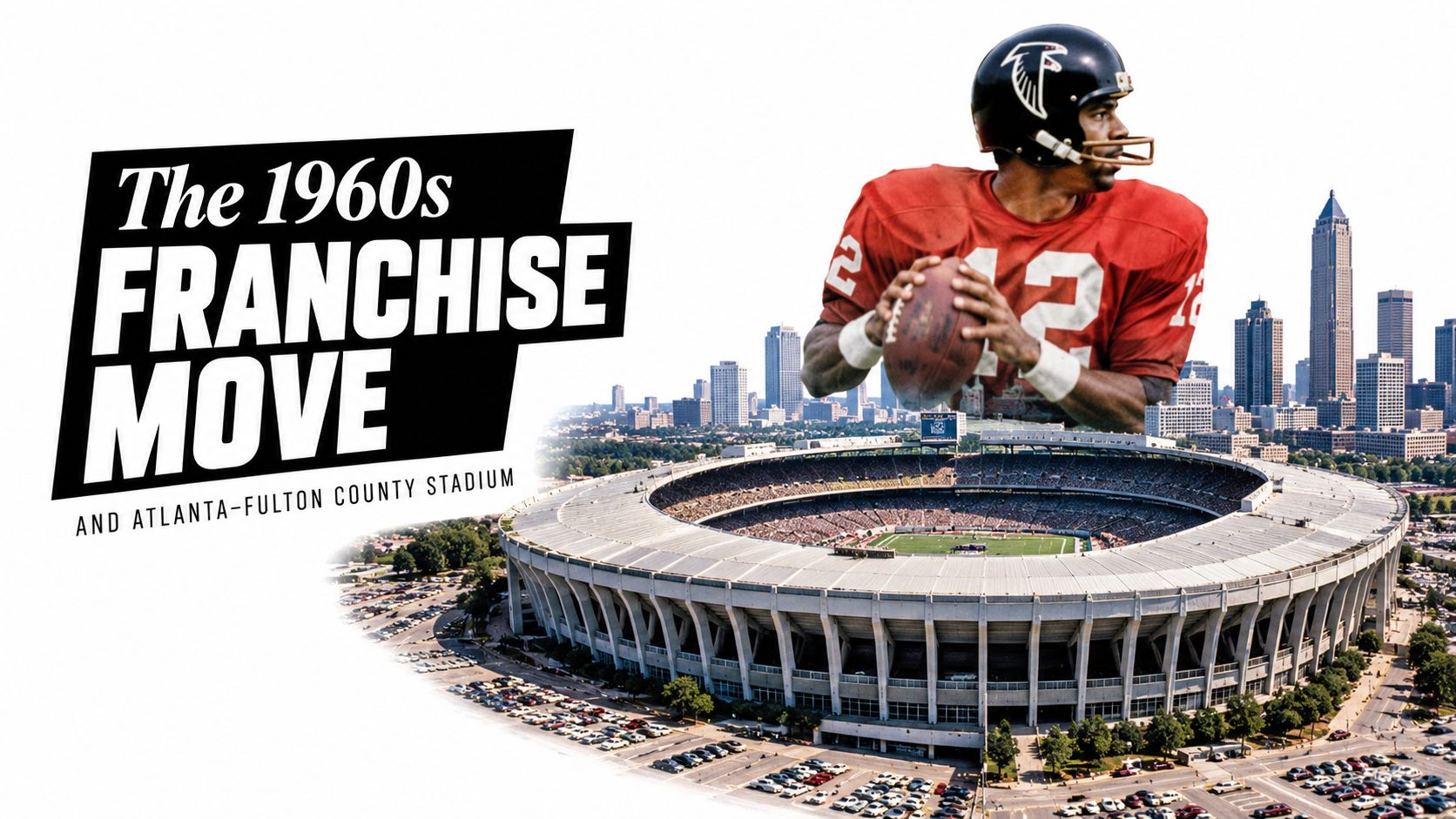
Atlanta's first major sports breakthrough came from pairing two franchise arrivals with one public stadium. Atlanta–Fulton County Stadium opened in 1966, after being built in just over a year to fulfill Mayor Ivan Allen Jr.'s campaign promise to bring major league sports to the city. The Atlanta History Center records the facility's opening and its role as the home of the Braves and Falcons.
The Braves moved from Milwaukee for the 1966 season, and the expansion Falcons began play that same year. Their shared home gave Atlanta more than two new tenants. It created a predictable calendar of baseball and football, helping establish the downtown area as a place where national sports media, sponsors, visitors, and local businesses could concentrate activity.
The stadium also represented a policy choice. City leaders treated a large venue as essential public infrastructure, using a stadium authority structure supported by public financing tools. The arrangement created a model in which lease revenue, hotel-motel tax collections, and ticket-related charges could support debt service. That template would influence Atlanta's later approach to major sports facilities.
Why the shared venue mattered
Atlanta–Fulton County Stadium's importance extended beyond its seating bowl. A dual-use facility allowed one public investment to support two major professional franchises, increasing the number of event days and broadening the city's national visibility. It also created an identifiable downtown sports footprint before later additions such as the Omni and CNN Center reshaped the surrounding district.
The Braves' presence gave baseball a permanent institutional home, while the Falcons added an annual professional football calendar. That combination produced the kind of scheduling density that attracts broadcasters and corporate partners. A city with multiple teams can support more consistent hospitality, advertising, and transportation activity than a city dependent on occasional events.
The stadium's cultural role expanded when Hank Aaron reached his home-run milestone there in 1972. That moment linked Atlanta's public investment to a nationally recognized sports achievement, but the deeper policy lesson was less visible. The facility gave the city a durable platform on which individual athletes, franchises, and future events could build.
Atlanta's later success didn't begin with the Olympics. It began when municipal leaders accepted the risk of building a venue before the city had a complete professional sports portfolio. The Braves and Falcons supplied the tenants, but the stadium supplied the market structure.
How the 1996 Olympics Reshaped Atlanta's Sports Infrastructure
The 1996 venue plan divided 28 competition sites into three categories, and that split explains why Atlanta retained usable infrastructure after the Games. Organizers scheduled the Centennial Olympic Games from July 19 to August 4, 1996, marking the 100th anniversary of the modern Olympics. The program combined new construction, temporary facilities, and existing venues rather than treating every site as a permanent Olympic monument.
Atlanta built 9 new venues, used 2 temporary venues, and incorporated 17 existing venues. Among those existing facilities, 14 were refurbished with marketing revenues tied to the Games. This allocation spread investment across the city and reduced the risk of leaving behind buildings designed for only one event.
| Venue Category | Count | Primary Funding | Post-Games Use |
|---|---|---|---|
| Newly built venues | 9 | Olympic-related construction and event financing | Long-term sports and institutional uses |
| Temporary venues | 2 | Event-specific investment | Removed or limited after the Games |
| Existing venues | 17 | Existing assets and refurbishment funding | Continued sports and community use |
Conversion created the lasting value
Centennial Olympic Stadium shows how the policy worked. The 85,000-seat facility hosted ceremonies and track and field before being converted into a 50,000-seat baseball park, later known as Turner Field. That redesign preserved a major Olympic asset for professional baseball and gave the Braves a venue aligned with post-Games operations.
The conversion also gave Atlanta a test for future public projects. Officials could assess a facility by its planned second use, its operator, and its role in the surrounding district, not only by the quality of the event it hosted. That approach connected Olympic spending to professional franchises, universities, downtown visitors, and later event organizers.
Conversion principle: A mega-event becomes a city-building investment when its venues have identified operators and uses after the closing ceremony.
The Games also required Atlanta to coordinate venues, transportation, security, hospitality, and corporate partnerships across a single program. That experience strengthened the city's case with organizers considering later Super Bowls and college championships. The mechanism was practical: a city that could operate a complex, multi-venue event had a stronger record than one offering only a stadium.
The planning lesson extends beyond sports facilities. Large redevelopment programs need operating plans for both physical sites and the systems that support them. Organizations managing technology across venues, campuses, and public facilities must also plan for computer recycling, secure data destruction, and IT asset disposition when equipment is replaced. Atlanta's transportation, technology, and smart-mobility context illustrates how venue districts increasingly depend on digital infrastructure as well as buildings.
The Recurring Event Pattern After the Olympics
Atlanta's post-Olympic achievement went beyond just hosting another headline event. It was earning repeated selection. The city hosted the first Super Bowl in Atlanta in 1994, followed by Super Bowls in 2000 and 2019, a pattern that showed national organizers continued to trust the market as a major-event host. Atlanta Magazine's account of the city's sports development describes the broader progression from Olympic host to recurring sports destination.
College basketball reinforced that pattern. Atlanta hosted the women's Final Four in 1993 and 2003, and the men's Final Four in 2002, 2007, and 2013, with another men's Final Four scheduled for 2031, according to the same account. These selections indicate that Atlanta's infrastructure remained useful across different sports calendars and venue formats.
| Event | Year or years | Venue | Selection Driver |
|---|---|---|---|
| Super Bowl | 1994, 2000, 2019 | Atlanta football venues | Large-scale event capacity and host-market readiness |
| Women's Final Four | 1993, 2003 | Atlanta basketball venues | Established college-sports infrastructure |
| Men's Final Four | 2002, 2007, 2013, 2031 scheduled | Atlanta basketball venues | Repeat selection and durable event operations |
Selection is an infrastructure signal
Selection committees don't evaluate fan enthusiasm in isolation. They assess whether a city can provide suitable venues, hotel capacity, transportation, corporate sponsorship, security coordination, and experienced local operators. Atlanta's repeated selections show that the city converted Olympic capability into a credible operating reputation.
Each successful event also generates institutional knowledge. Local authorities learn how to coordinate traffic and public safety. Venues refine staffing and guest services. Hotels and sponsors become familiar with the demands of national tournaments. That accumulated experience lowers uncertainty for the next bid, creating a hosting flywheel.
Atlanta's four major men's professional teams, the Braves, Falcons, Hawks, and Atlanta United FC, add a year-round foundation to that event portfolio. Atlanta's city overview identifies the four franchises, whose combined schedules help maintain a regular sports presence between major tournaments.
This is why the post-1996 record matters more than a list of celebrations. Repeated selection demonstrates that Atlanta's sports economy can support national events across decades. The city didn't remain important because the Olympics were memorable. It remained important because its venues and operating institutions stayed useful.
For companies serving event districts, recurring selection creates a recurring business environment. Venue operators need reliable programs for office cleanout, facility cleanout, product destruction, and sustainable recycling, particularly as temporary installations and technology systems cycle out after events. The city's continually changing calendar is part of the economic infrastructure described in Atlanta's guide to major local events.
Venue-Led Redevelopment Versus Fan Demand
Atlanta's sports rise is often explained through fan culture. That explanation misses the supply-side mechanism. The city first created places where professional sports could operate, then used those places to concentrate visitors, investment, and commercial activity.
The franchise arrivals of the 1960s required a facility before Atlanta had a mature major-league market. Later projects continued that pattern. The Omni added an indoor venue, the Georgia Dome expanded football and event capacity, and Olympic construction created a larger network of sites. In each case, public decisions shaped the physical conditions under which demand could grow.
Districts changed the economics
A stadium on its own can host games, but a district can monetize the rest of the calendar. Restaurants, offices, hotels, public spaces, residential development, and entertainment venues give visitors reasons to arrive earlier and stay later. Those uses also help a district remain active when no team is playing.
Atlanta's downtown sports geography developed through that gradual layering. Centennial Olympic Park connected Olympic memory with daily downtown activity. The former Georgia Dome site became part of a broader redevelopment conversation, including Centennial Yards. The area around State Farm Arena and Mercedes-Benz Stadium demonstrates how venues can function as anchors within a larger urban plan rather than isolated structures.
The Atlanta Encyclopedia entry on the city highlights the importance of the venue sequence, from the Braves and Falcons to the Hawks, Omni, and Olympics, while also pointing toward the redevelopment model continuing into 2026 through projects such as Centennial Yards and Cosm. Cosm's position as a major entertainment addition gives the district another non-game-day use.
Development test: If a stadium district depends entirely on game attendance, it isn't a district strategy yet. Planners need uses that operate between fixtures.
That doesn't mean fan demand is irrelevant. Teams need supporters, and successful events depend on participation. But demand alone doesn't explain why Atlanta gained a durable event portfolio. Infrastructure gave that demand a place, schedule, and commercial ecosystem.
Cities copying Atlanta should therefore avoid treating a new stadium as a complete economic-development plan. Without transit access, mixed-use zoning, public-space investment, and a credible tenant strategy, a venue may reproduce the limitations of a single-purpose facility. The Atlanta BeltLine guide offers useful context for understanding how connectivity and public-space systems influence the city's wider visitor environment.
Comparing the Modern Stadium District Era
Atlanta's newer venues reveal a shift from building large containers to building districts around anchors. Earlier facilities concentrated on seating and event operations. The modern model adds restaurants, offices, entertainment, naming rights, hospitality, and non-game-day programming to the revenue logic.
The comparison is clearest when venues are viewed as urban systems rather than architectural objects.
| Venue | Era | Capacity | Public Cost | District Integration |
|---|---|---|---|---|
| Atlanta–Fulton County Stadium | 1966 | Not specified in verified data | Public stadium-authority model | Downtown sports anchor |
| Georgia Dome | 1992 | Not specified in verified data | Not specified in verified data | Falcons and major-event venue |
| Centennial Olympic Stadium, later Turner Field | 1996 conversion | 85,000 originally, then 50,000 as a baseball park | Olympic venue strategy | Olympic and baseball infrastructure |
| Mercedes-Benz Stadium | Modern era | Not specified in verified data | Not specified in verified data | Stadium district and major-event anchor |
| State Farm Arena | Modern era | Not specified in verified data | Not specified in verified data | Downtown entertainment district |
| Truist Park | Modern era | Not specified in verified data | Not specified in verified data | Mixed-use district outside downtown |
From buildings to operating ecosystems
The Georgia Dome illustrates the limits of a large single-purpose facility. It opened in 1992 and was demolished 25 years later, according to the New Georgia Encyclopedia. Its lifespan shows that a venue can be central to a city's sports identity and still become obsolete when the surrounding development model or building requirements change.
The post-Olympic conversion of Centennial Olympic Stadium offers a different lesson. Reusing the facility as a baseball park preserved its value for the Braves, but the later movement toward integrated districts indicates that a stadium's surrounding land can be as important as the building itself. Modern planning asks what visitors do before and after an event, not only how many seats the venue contains.
Naming-rights agreements, transportation access, mixed-use development, and residential density all influence that equation. They create additional points of contact between sports and the wider economy. A venue with active surrounding uses can support employment, hospitality, maintenance, technology services, and visitor spending beyond the game schedule.
The Atlanta guide to sports bars for Braves and Falcons fans reflects the consumer side of this district effect. Sports venues generate a broader network of businesses that serve fans away from the seating bowl.
The central shift is strategic. Atlanta's newer sports environment treats venues as district anchors, while earlier generations treated them primarily as event containers. That doesn't eliminate public risk, but it gives planners more ways to measure value across the year.
Lessons for City Managers and the Road Ahead
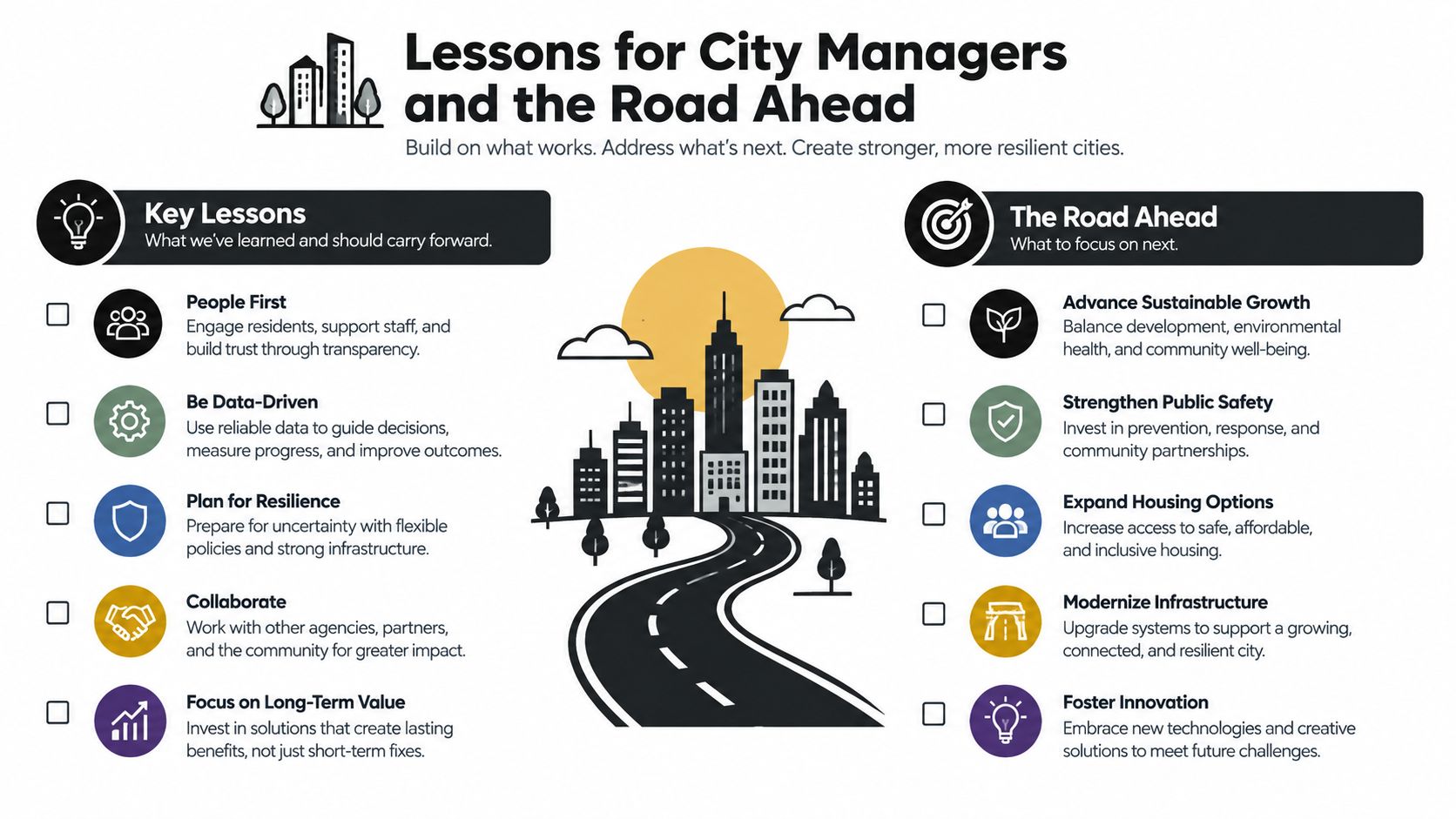
Atlanta's experience offers city managers a practical playbook, but it also shows why copying the visible parts can be dangerous. The visible assets are teams and stadiums. The underlying system includes financing, land policy, transportation, event operations, and long-term reuse.
Build the institution before chasing the event
A city needs anchor tenants and capable public partners before it bids for a mega-event. Atlanta's early stadium decision created a home for the Braves and Falcons, while later institutions supported Olympic and championship operations. Event selection followed the development of that capacity.
Public finance should also spread risk across credible revenue sources. A stadium authority, lease structure, hotel-motel tax allocation, and private investment can each play a role, but officials need transparent debt assumptions and enforceable obligations. A franchise promise shouldn't become the only justification for a large public commitment.
Pair every venue with a district plan
A stadium without surrounding uses leaves value on the table. City managers should address:
- Transit and access: Connect venues to reliable transportation and pedestrian routes.
- Mixed-use activity: Plan offices, housing, hospitality, restaurants, and entertainment for non-game days.
- Neighborhood protection: Measure displacement and land-value pressure before approving redevelopment.
- Asset reuse: Specify future operators and conversions before construction begins.
- Technology lifecycle: Include secure data destruction, equipment recovery, and sustainable recycling in venue operations.
The final point is easy to overlook. Sports districts depend on ticketing systems, communications equipment, security hardware, displays, workstations, and network infrastructure. When those assets reach end of life, responsible ITAD and data destruction protect both public information and environmental goals.
Measure the district, not the ribbon-cutting
Atlanta's suburban stadium development also raises a metropolitan-governance question. When a team relocates from a central venue to a mixed-use site outside downtown, the investment may benefit the host jurisdiction while fragmenting regional revenue, transit, and infrastructure planning. City managers should evaluate the full geography of costs and gains rather than treating attendance as proof of public value.
The next major test is the 2026 FIFA World Cup, when Mercedes-Benz Stadium is scheduled to host matches. That future event will test Atlanta's ability to coordinate security, transportation, hospitality, public spaces, and international visitors at a scale that extends beyond the stadium. The relevant measure won't be only whether matches run smoothly. It will be whether the city strengthens the operating relationships and district assets that remain after the tournament.
Longer-term risks include changing college-sports economics, franchise lease obligations, and possible efforts to add or strengthen professional women's sports. These issues require scenario planning rather than automatic expansion. Atlanta became a major sports city by connecting facilities to policy. Its next phase will depend on whether leaders connect sports investment to inclusive redevelopment, resilient public finance, and measurable district-level outcomes.
Reworx Recycling helps Atlanta-area businesses manage electronics recycling, IT equipment disposal, business pickups, equipment decommissioning, and secure hard-drive shredding while supporting technology donations and workforce development. If your organization is planning a venue upgrade, office cleanout, facility cleanout, or technology transition, visit Reworx Recycling to explore responsible donation, data destruction, and recycling options.