
The most affordable Atlanta suburb isn't automatically the best value. College Park has a median home sale price of $178,000 and a two-bedroom median rent of $1,162, while Johns Creek has a reported median home value of $587,438. That gap illustrates the central challenge for relocating employees and business owners: lower housing costs can come with longer commutes, weaker school access, higher car dependence, or fewer nearby services. (Affordable Atlanta suburbs comparison)
The right choice depends on the trade-off between housing costs, access to Atlanta and Smyrna, schools, safety, parks, amenities, and business infrastructure. This comparison examines Marietta, Smyrna, Alpharetta, Dunwoody, Johns Creek, Sandy Springs, Roswell, and Brookhaven through that practical lens. Where verified housing or commute metrics are available, they're cited directly. Other observations are qualitative and should be confirmed against current listings, school information, local safety sources, and transportation conditions before publication.
For organizations moving, expanding, or completing an office cleanout, suburb selection also affects electronics recycling, IT equipment disposal, secure data destruction, and IT asset disposition planning. Smyrna-based Reworx Recycling gives businesses a donation-focused resource for retiring computers, servers, laptops, and other electronics while supporting community access to technology. Its business donation services, pickup planning, and secure data destruction guidance can help facilities teams coordinate technology transitions responsibly. Businesses should also review the EPA's electronics donation and recycling guidance when building an e-waste program.
1. Tech-Forward Marietta and Georgia's Emerging IT Hub
Marietta works well for companies that want suburban operating conditions without giving up access to Atlanta's employment base. Its combination of established neighborhoods, a recognizable historic center, parks, schools, healthcare access, and nearby business corridors gives relocating employees more than a low-cost address. It gives them a range of daily-life options, from walkable downtown living to quieter family-oriented areas.
The affordability case is relative rather than absolute. Marietta's value depends on the neighborhood, the employee's commute destination, and whether the household needs school access, larger housing, or proximity to commercial services. The city's business environment also benefits from a mix of technology, healthcare, manufacturing, logistics, and professional services activity, according to local moving and safety coverage. (Marietta relocation and safety overview)
A practical base for technology transitions
A software company replacing employee laptops, a corporate office consolidating workstations, or a regional operation preparing for a facility cleanout needs a plan that covers more than hauling. Teams should identify equipment owners, separate reusable devices from damaged materials, document serial numbers, and confirm how storage media will be handled before pickup.
Marietta companies can use electronics recycling in Marietta to coordinate responsible retirement of computers and office electronics. A donation-based approach can also redirect usable equipment toward community benefit instead of treating every device as waste. For regulated or sensitive environments, secure data destruction should be planned before equipment leaves the site.
Practical rule: Schedule pickups during early morning or late afternoon when possible, and align bulk IT asset disposition with a planned refresh, relocation, or fiscal close.
Marietta is especially suitable for organizations that need reasonable access to Atlanta and Smyrna while keeping office operations outside the city core. Employees should test the actual commute at their normal departure time, not rely only on a map estimate. Businesses should also account for loading access, parking, elevator capacity, and whether a historic or multi-tenant building complicates a facility cleanout.
2. Smyrna's Sustainable Business District
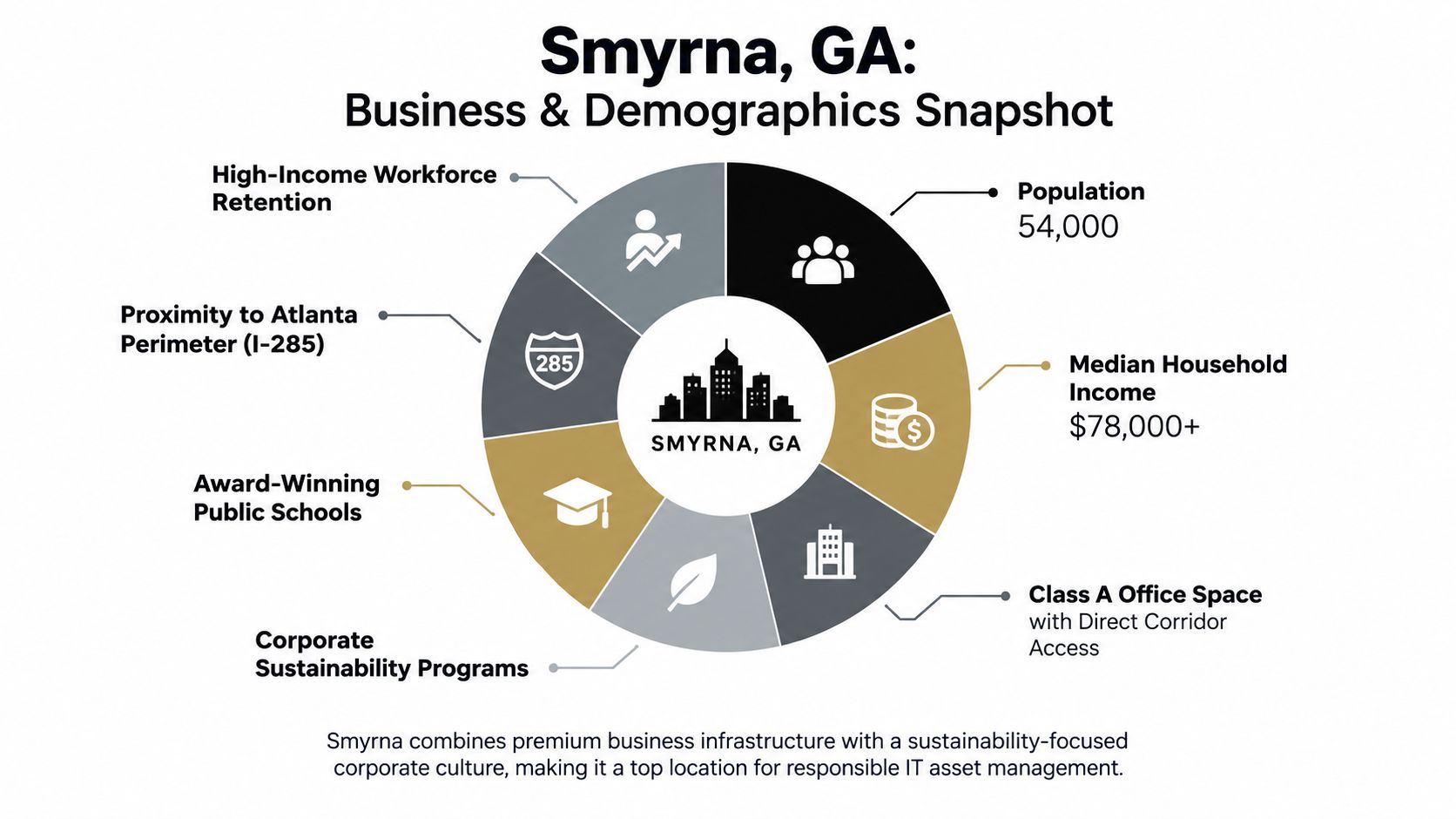
Smyrna is the strongest fit for companies that want a suburban location with direct access to Atlanta-area business networks and a visible sustainability story. The city is also the home base of Reworx Recycling, which makes it particularly practical for organizations planning recurring pickups, donation programs, office recycling initiatives, or larger ITAD projects.
Smyrna is often presented as an affordable alternative with access to popular destinations such as The Battery, Truist Park, and Vinings Village. (Atlanta suburbs comparison) That combination matters for employers recruiting workers who want amenities close to home and for companies that want a recognizable location without placing every operation in central Atlanta.
Where quality of life meets corporate responsibility
Smyrna's business community includes offices, professional services firms, healthcare operations, and other organizations with significant technology inventories. Those inventories can include laptops, desktops, network equipment, monitors, printers, servers, and specialized devices. Each category may require a different decision, including reuse, donation, resale, recycling, or product destruction.
A financial services office might need documented handling for retired drives. A healthcare organization may need a carefully controlled process for medical IT equipment and storage media. A multi-site company may need reverse logistics that moves equipment from several offices into one managed disposition program.
Businesses can review hard-drive shredding services from Reworx Recycling before an office move or technology refresh. The company's donation-based model connects environmental responsibility with community impact, including technology donations and workforce development. Organizations researching broader operational support can also find the right IT services for their infrastructure needs.
Smyrna's location makes it a sensible base for relocating employees who need access to Atlanta and nearby employment centers. It also gives facilities managers an opportunity to build sustainability into routine operations. Quarterly e-waste drives, employee donation campaigns, and documented equipment recovery can make electronics recycling visible rather than an afterthought.
3. Alpharetta's Innovation Corridor
Alpharetta suits technology-centered employers that place a high value on talent access, business amenities, and a polished suburban environment. Its reputation as a major technology and innovation center attracts software companies, IT service providers, corporate technology teams, and professional firms. That concentration creates a distinctive operational issue: fast-growing companies often accumulate hardware faster than their internal processes mature.
A startup may expand into a larger office after a funding event. A managed service provider may consolidate client equipment. An innovation team may test devices that become obsolete after a short project cycle. Without a clear chain of custody, those transitions can leave companies with unsecured drives, undocumented assets, and storage rooms full of equipment nobody has assigned.
ITAD planning for fast-moving teams
Alpharetta businesses should establish a standing process for laptop disposal, computer recycling, secure data destruction, and data center decommissioning. The process should identify who approves disposition, who verifies data erasure or destruction, and who receives the final documentation. That structure protects the business while helping finance and sustainability teams measure recovery and diversion outcomes.
Reworx Recycling's Alpharetta electronics recycling service can support organizations that need a local resource for technology retirement. Donation-based recycling is especially relevant for companies with usable workstations, monitors, or laptops that no longer meet internal specifications but may still support digital inclusion.
A company choosing Alpharetta should compare residential convenience with business logistics. A highly attractive office location may still create challenges for loading, scheduled pickups, or multi-floor removals. Relocating employees should evaluate schools, parks, commute routes, and access to everyday services. Employers should evaluate whether the office can support future equipment storage, secure staging, and controlled vendor access.
The best fit in Alpharetta isn't the office with the strongest technology image. It's the location where a company can recruit effectively, operate efficiently, and retire equipment with the same discipline it uses to deploy it.
4. Dunwoody's Corporate Park Excellence
Dunwoody is a strong choice for professional services firms, regional offices, and companies that need business visibility near major Atlanta transportation corridors. Its corporate parks and commercial districts create a more formal operating environment than many outer suburbs, while its residential areas offer employees access to schools, parks, restaurants, and established services.
That premium positioning changes the IT disposal question. A corporate relocation in Dunwoody may involve multiple departments, leased equipment, conference-room technology, networking hardware, and records stored across redundant systems. A simple office cleanout can quickly become a coordinated IT asset disposition project involving facilities, information security, finance, legal, and a recycling partner.
Compliance and continuity matter
Professional services and multinational organizations need documentation that supports internal controls and sustainability reporting. They should define how equipment is inventoried, how data-bearing devices are isolated, how destruction or reuse decisions are approved, and how certificates or other records are retained. The exact requirements depend on the organization and the information involved, so teams should confirm obligations with their compliance and legal advisers.
Dunwoody companies can also reduce disruption by planning reverse logistics before a lease ends. A phased pickup may be preferable to removing every asset on the final day. Facilities teams should confirm elevator reservations, loading-dock rules, building insurance requirements, and access windows before scheduling a vendor.
Dunwoody's value comes from alignment. Employers get a professional setting and strong regional access, while relocating staff can evaluate residential options without moving into the downtown core. The trade-off is that buyers and renters should not assume corporate convenience equals low housing cost. Compare total monthly expenses, commute burden, school access, and service availability before treating Dunwoody as an affordable choice.
5. Johns Creek's Affluent Business Community
Johns Creek is a strong quality-of-life choice, but its housing costs make affordability a relative advantage rather than a low-price proposition. 2026 coverage describes the city as one of the best places to live in the United States, reporting a median home value of $587,438 and median household income of $165,117. (Atlanta suburb affordability overview) These figures give employers and relocating employees a useful baseline: Johns Creek can support residential stability and household purchasing power, while presenting a higher entry cost for buyers on tighter budgets.
Schools, safety, amenities, and residential continuity shape the city's appeal. North Fulton communities such as Milton and nearby suburbs are also associated with strong schools and low crime. (Atlanta suburbs quality-of-life overview) For businesses, that profile can support recruitment and retention among employees who value family services. Employees should still compare neighborhood access, housing costs, and actual travel times to Atlanta, Smyrna, or their assigned office. A desirable address does not remove commute constraints.
Premium service expectations
Johns Creek's business base may include financial services offices, healthcare operations, corporate headquarters, and professional firms. Each setting can create different equipment and data risks. A healthcare organization consolidating locations, for example, should separate medical equipment from ordinary office electronics and identify any data-bearing components before disposal.
A suitable IT asset disposition program should cover scheduled pickups, asset records, secure data destruction options, and reporting that executives can review. Equipment buyback or value recovery may help fund replacement technology, but organizations should compare offers with data security, environmental handling, and documentation requirements.
Johns Creek electronics recycling support from Reworx Recycling gives local employers a starting point for planning these services. Reworx Recycling's social enterprise model may also suit organizations that want technology transitions to support donation programs and digital inclusion.
Johns Creek is best assessed as a quality-first suburb. Relocation teams should compare housing, schools, safety, amenities, and commute reliability alongside the cost of maintaining a secure equipment lifecycle. That broader assessment helps employers choose a residential base that works for staff and a disposal plan that protects data, supports responsible recycling, and limits disruption during technology changes.
6. Sandy Springs' Mixed-Use Business Excellence
Sandy Springs offers one of the broadest business profiles in the Atlanta suburbs. Technology, healthcare, financial services, professional services, and mixed-use developments create different equipment streams and different risk profiles. A single recycling policy may not work equally well for a healthcare network, a financial office, and a property with several commercial tenants.
The city's business appeal comes from access and variety. Employees can live near offices, services, parks, and restaurants, while companies can remain connected to Atlanta's wider market. That flexibility can support recruiting, but workers still need to test their real commute and compare neighborhood conditions rather than assuming proximity on a map will produce a short daily journey.
One program, several equipment categories
Sandy Springs facilities teams should build an equipment register before a consolidation or tenant turnover. The register can divide assets into practical groups:
- Data-bearing devices: Laptops, desktops, servers, hard drives, and network equipment need a documented data destruction or sanitization decision.
- Specialized technology: Medical equipment and laboratory equipment may require separate handling, vendor coordination, or compliance review.
- Reusable hardware: Functional computers, monitors, and peripherals may fit a donation-based recycling or refurbishment pathway.
- Residual materials: Damaged electronics, cables, batteries, and obsolete accessories require responsible electronics recycling.
This approach keeps an office cleanout from becoming an untracked collection of mixed materials. It also helps property managers coordinate facility cleanout work when several tenants leave at different times.
Sandy Springs aligns well with companies that want sustainability to operate across departments. Procurement can consider refurbished equipment, IT can manage secure retirement, facilities can coordinate pickups, and sustainability leaders can report community impact. Reworx Recycling's donation-focused mission gives businesses a way to connect material recovery with technology access and workforce development.
7. Roswell's Historic Charm Meets Modern Enterprise
Roswell gives employers a distinctive combination of historic character, modern business space, and access to outdoor amenities. Office options range from contemporary buildings to renovated properties near the historic district. Each setting can support recruitment, while also creating different requirements for equipment moves, loading access, and facility preparation.
Growth-stage companies and professional services firms may value Roswell's identity outside Atlanta. Its quality-of-life profile also includes substantial access to nature. Roswell is associated with more than 900 miles of parkland and seven miles of trails along the Chattahoochee River, making outdoor access a practical consideration for employees and relocating teams. (Atlanta suburb quality-of-life comparison)
Flexible logistics for growing companies
A startup entering Roswell may choose refurbished workstations to control initial spending. An established firm relocating from Atlanta may need to clear deskside computers, monitors, printers, conference equipment, and network hardware. Redevelopment projects can create another requirement: removing equipment from older buildings while protecting the property and limiting disruption for neighboring tenants.
Businesses can review effective computer recycling options in Roswell while setting a disposition schedule. The plan should separate equipment suitable for donation from devices requiring data destruction or material recovery. It should also assign responsibility for confirming data handling before collection.
Roswell's mix of historic and modern properties makes site planning important. Narrow entrances, shared parking, tenant rules, and preservation requirements may affect removal work. Facilities managers should inspect the route from each office to the loading area, identify access limits, and provide those details to the recycling partner before pickup.
The same planning supports business continuity. Employees need working devices at the new location, while retired equipment needs a documented path that protects information and reduces waste.
For relocating employees, Roswell balances residential amenities, parks, business access, and a strong community identity. It may not be the least expensive suburb in the metro area, but employers can support the choice when talent retention, workplace character, and responsible IT asset disposition carry meaningful weight.
8. Brookhaven's Progressive Corporate Culture
Brookhaven appeals to companies that want a more urban-suburban setting, access to Atlanta-area employment centers, and a visible commitment to sustainable development. Its newer municipal identity and walkable, mixed-use character can suit technology companies, healthcare organizations, professional services firms, and entrepreneurial teams that want quality of life to reinforce their brand.
The sustainability opportunity is practical. A company can demonstrate its values through responsible procurement, refurbished equipment, employee donation programs, and a documented end-of-life process. These activities matter most when they become repeatable operating procedures rather than one-time campaigns during a move.
Turning sustainability into an operating standard
A Brookhaven startup may use donation-based recycling to place functional equipment into community programs. A healthcare facility may need a controlled process for medical equipment disposal and data-bearing devices. A professional services firm may combine laptop disposal, office cleanout, secure data destruction, and sustainable recycling during a relocation.
Reworx Recycling's social enterprise model fits organizations that want environmental and community outcomes in the same program. Businesses can create an annual electronics collection event, provide employees with clear donation instructions, and document the equipment transferred for internal sustainability reporting. They should avoid promising tax treatment or regulatory outcomes without advice from their finance and legal teams.
Brookhaven's mixed-use environment also makes logistics worth planning early. Businesses should confirm building access, loading rules, parking, elevator availability, and the separation of tenant-owned equipment from landlord property. A pickup schedule that works for one office may not work for a multi-tenant facility.
The city is a strong option for values-driven employers and relocating employees who want services, amenities, and a progressive business culture nearby. It is less useful to label Brookhaven universally affordable without checking current housing, rent, commute, and school conditions for the specific household.
8 Affordable Atlanta Suburbs: Quality of Life & Business Comparison
| Location | Implementation Complexity 🔄 | Resource Requirements ⚡ | Expected Outcomes ⭐📊 | Ideal Use Cases 💡 | Key Advantages ⭐ |
|---|---|---|---|---|---|
| Tech-Forward Marietta | Moderate 🔄, scheduling & some older parks complicate decommissions | Moderate ⚡, local logistics, coordination with BIDs and pickups | ⭐⭐⭐⭐ 📊, measurable recycling, cost savings, documented compliance | Suburban HQ refreshes, facility cleanouts, donation partnerships | Lower operating costs; proximity to Atlanta; growing tech community |
| Smyrna | Low–Moderate 🔄, HQ proximity reduces coordination friction | Moderate ⚡, premium decommissioning capability, rapid pick-ups | ⭐⭐⭐⭐⭐ 📊, rapid response, strong compliance documentation | Corporate HQs, healthcare decommissions, data center clearouts | Direct Reworx access; premium facilities; sustainability leadership |
| Alpharetta | High 🔄, frequent refresh cycles and specialized equipment needs | High ⚡, advanced data destruction, data center expertise, frequent pickups | ⭐⭐⭐⭐⭐ 📊, large e-waste streams, high buyback recovery, strong compliance | Startups scaling, MSP/data center consolidations, frequent refreshes | Dense tech ecosystem; high-value equipment; ESG focus |
| Dunwoody | High 🔄, multinational compliance and formal procurement processes | High ⚡, certified processes, international compliance reporting | ⭐⭐⭐⭐ 📊, robust compliance assurance and lifecycle optimization | Professional services, multinational HQ decommissions, RFP-driven projects | Operational excellence; strong compliance; corporate-grade services |
| Johns Creek | Moderate–High 🔄, premium service expectations and procurement timelines | High ⚡, executive reporting, HIPAA/SOX-capable workflows | ⭐⭐⭐⭐ 📊, strong compliance, high-value asset recovery | Financial services, healthcare HQs, executive-level reporting needs | Affluent clientele; executive buy-in; attractive buyback economics |
| Sandy Springs | Moderate 🔄, mixed industries require tailored workflows | Moderate ⚡, industry-specific expertise (healthcare, finance, tech) | ⭐⭐⭐⭐ 📊, versatile impact across sectors, measurable sustainability gains | Mixed-use cleanouts, multi-tenant projects, industry-specific decommissions | Diverse equipment streams; smart-city alignment; cross-sector partnerships |
| Roswell | Moderate 🔄, downtown logistics and historic building constraints | Moderate ⚡, flexible staging, downtown access planning | ⭐⭐⭐ 📊, community partnerships, strong donation program uptake | Downtown startups, relocations, revitalization projects | Historic + modern mix; strong local business associations; startup-friendly |
| Brookhaven | Low–Moderate 🔄, progressive policies simplify adoption but portfolios may be smaller | Low–Moderate ⚡, donation-focused programs, municipal partnership support | ⭐⭐⭐ 📊, solid ESG alignment and community impact | Startups, progressive firms, pilot sustainability initiatives | Intentional sustainability focus; proactive municipal support; young demographic |
Choose the Suburb That Fits Your Priorities
No Atlanta suburb wins every category. College Park and East Point can make a lower-cost case, while Johns Creek, Milton, and other north Fulton communities tend to offer stronger school and safety profiles at much higher housing costs. East Point has been identified as an affordable option with home prices about $140,000 lower than Atlanta, according to Redfin's comparison. (Affordable Atlanta suburbs from Redfin) That kind of difference can matter to a first-time buyer, but it shouldn't end the analysis.
Housing affordability has tightened across Atlanta's suburbs and exurbs. JPMorgan Chase found that affordability declined most in those areas between 2019 and 2024, with a deterioration larger than the nationwide pattern for large cities. (JPMorgan Chase housing affordability analysis) Buyers should therefore compare current listings and total monthly costs instead of relying on older suburb rankings or headline prices.
Commute practicality is another major filter. Market summaries list Duluth at a median home value of about $283,100 with a mean commute of 16.8 minutes, while Kennesaw and Lilburn were listed around $291,300 and $278,600, with commute times near 33.4 and 31.1 minutes, respectively. (Atlanta suburb housing and commute comparison) These figures don't make one community universally better. They show why buyers should compare the price-to-commute trade-off for the actual workplace.
Atlanta's broader cost of living has been reported as 2% to 3% below the national average, with housing, utilities, and transportation identified as major drivers, while the same relocation source gives Atlanta's median home price as about $420,000. (Atlanta relocation guide) Those figures provide regional context, not a substitute for a household budget.
Use this relocation framework before choosing a suburb:
- Verify housing: Compare current sale prices, rents, insurance, taxes, utilities, and expected transportation costs.
- Test the commute: Drive or ride the route to Atlanta, Smyrna, or the relevant business corridor during normal working hours.
- Review schools: Check the specific attendance zone and confirm current information directly with the district.
- Review safety sources: Compare official and reputable local information for the exact neighborhood, not only the suburb label.
- Inspect amenities: Evaluate parks, healthcare, grocery access, childcare, restaurants, and services that employees will use weekly.
- Plan technology retirement: Identify whether the move includes laptop disposal, computer recycling, office cleanout, facility cleanout, medical equipment disposal, laboratory equipment disposal, or data center decommissioning.
- Protect information: Decide how hard drives and other data-bearing devices will receive secure data destruction before pickup.
- Document outcomes: Keep asset records, donation information, recycling documentation, and internal approvals for sustainability and audit purposes.
For employers, the best suburb is the one that supports both people and operations. A location with attractive housing but difficult commutes may undermine retention. A premium business district may improve access and recruiting but require a larger facilities budget. A donation-based electronics recycling program can help organizations manage that balance by reducing storage burden, supporting community technology access, and giving IT and sustainability teams a repeatable process for end-of-life equipment.
Reworx Recycling brings that mission to businesses across the region through electronics recycling, business pickups, equipment decommissioning, IT asset management, equipment buyback options, and secure hard-drive shredding. Its social enterprise approach helps organizations retire technology responsibly while supporting environmental stewardship, digital inclusion, and workforce development. Whether a company is moving into Marietta, expanding in Alpharetta, consolidating in Dunwoody, or operating from Smyrna, the equipment plan should begin before the first box is packed.
Reworx Recycling helps Atlanta-area businesses donate usable technology, schedule equipment pickups, manage office and facility cleanouts, and arrange secure data destruction for retired devices. Visit Reworx Recycling to discuss a sustainable recycling or ITAD partnership for your next relocation, technology refresh, or corporate donation program.