The hydrometallurgical recycling market is already past the experimental stage, with one estimate putting it at USD 1.18 billion in 2024, USD 1.23 billion in 2025, and USD 1.81 billion by 2032 with a 5.48% CAGR (360iResearch). That matters for IT and facilities leaders because end-of-life electronics are no longer just a waste stream, they're a feedstock stream for nickel, cobalt, lithium, and copper recovery, and procurement teams are now buying into that downstream economics whether they realize it or not.
For organizations handling laptops, server gear, batteries, and mixed electronics, the question isn't whether recycling happens. The question is whether the recycler can recover value, control chemical risk, and document what happened to the material. That's where hydrometallurgical recycling becomes more than a technical term, it becomes a contract issue, a reporting issue, and a due-diligence issue.
One practical comparison point comes from the way end-of-life vehicle and electronics sectors overlap. If you're looking at adjacent recovery workflows, a useful reference on scrap handling and material routing is Car Removals Whangarei fast cash, which helps illustrate how collection logic, downstream processing, and material value all sit in the same chain.
Why Hydrometallurgical Recycling Matters for Modern E Waste
Hydrometallurgical recycling has moved from a niche process to an industrial market with measurable scale. That's important because businesses rarely get to choose between “recycle” and “don't recycle”, they choose between a set of downstream processes with very different recovery outcomes, compliance burdens, and cost structures. When the market itself is expanding, it usually means buyers should stop treating the process as theoretical and start treating it as part of vendor selection.
The biggest strategic reason to care is the material mix. Electronics and batteries contain nickel, cobalt, lithium, and copper, the same elements that supply chains struggle to secure for EVs, consumer devices, and grid storage (360iResearch). That means end-of-life IT assets aren't just liabilities. They're potential inputs for another industrial system, if the recycler can separate them cleanly enough.
Why procurement teams should care now
For IT managers and facilities leaders, the practical issue is not terminology, it's contract risk. If a recycler can't explain where metals go after collection, how residues are handled, or how product destruction is verified, then the organization is taking operational and reputational risk without a clear benefit.
A lot of recycling conversations stay stuck at the pickup truck level. That's too shallow for modern asset disposition. The core questions start after collection, because that's where yield, purity, and compliance are either created or lost.
Practical rule: if a vendor can't describe its downstream recovery path in plain language, it probably isn't controlling it well enough to be a dependable partner.
How the Hydrometallurgical Process Works
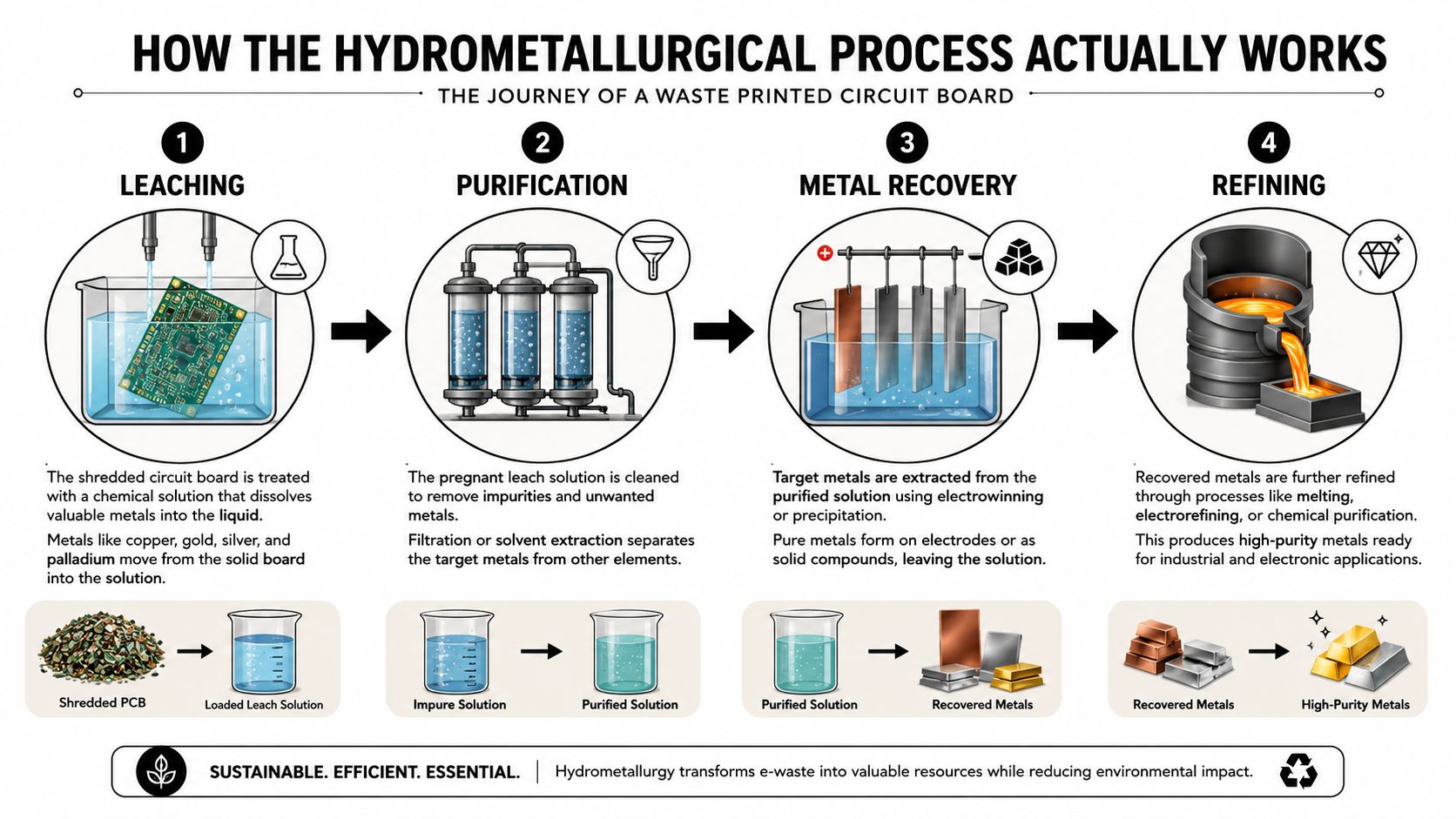
A circuit board does not become reusable metal in one pass. In hydrometallurgical recycling, the value is created step by step, and each step can raise or destroy the final recovery rate. A review of waste printed circuit boards breaks the process into pre-treatment, complete or selective leaching, purification of metals from the leach solution, and recovery of metals as final products (review on WPCBs). For procurement teams, that matters because the cost is not just collection. It is the chemical handling, residue control, and how much usable metal survives the chain.
The four stages that matter
Pre-treatment prepares the board or battery feed for chemistry. Shredding, sorting, and physical separation are not decorative steps. They shape how uniform the feedstock is, how much contamination enters the liquid process, and how hard the downstream separation work will be.
Leaching is the dissolution stage. A chemical solution pulls targeted metals out of the solid material, which is why this route can be more selective than thermal treatment when a recycler is chasing specific elements instead of melting mixed scrap into one output stream. The catch is chemical consumption. Stronger leachants can improve extraction, but they also increase reagent use, waste handling needs, and the burden on the treatment system that follows.
Purification removes unwanted material from the leach solution. Many recycling summaries skip this part, but it is where commercial value is won or lost. If the solution is too contaminated, the recovered product may be difficult to sell into refining or manufacturing channels. That is also where buyers should ask about separation chemistry, residue management, and whether the plant is set up for mixed feedstocks or only clean, narrow streams.
Final recovery turns dissolved metals into usable products through precipitation, electrowinning, or another recovery route. For buyers seeking precious metals recovery from circuit boards, this is the point where a liquid solution becomes a saleable product again, provided the upstream chemistry has not been overloaded with impurities. Poor control here often shows up as lower purity, more rework, and more material sent to secondary treatment instead of back into market use.
A useful procurement question is direct. Ask the recycler which stage carries the most operational risk, how they handle dirty or mixed incoming material, and what changes when the load is battery-heavy.
That question matters even more as chemistry shifts. Circuit boards are one feedstock, but battery black mass and newer chemistries bring different extraction problems, different reagent demands, and different recovery economics. Recyclers that can explain those trade-offs clearly are usually the ones that understand their process, not just their marketing.
Comparing Hydrometallurgy with Pyrometallurgy and Mechanical Methods
The practical comparison is not chemistry versus heat versus sorting. It is selectivity, contamination tolerance, and how much downstream value a recycler can keep. Hydrometallurgy is preferred when buyers want high recovery and tighter separation by metal. Pyrometallurgy is still useful for dirty, mixed, or difficult feedstock. Mechanical methods do the front-end work of dismantling, shredding, and separation, but they rarely finish the job on their own.
A commercial battery recycling review reports that hydrometallurgical routes can recover more than 99% of key pay metals such as nickel, cobalt, and manganese, and lithium can also be recovered as lithium carbonate or lithium phosphate (RSC review). The same review notes one commercial process with an annual capacity of 4,500 tonnes and an overall process that recycles 60% of the battery pack materials, while mechanical recycling alone reached 72% and improved to 91% when electrolyte and graphite recovery were included. That comparison matters for procurement teams, because it shows that the most elegant chemistry on paper is not always the best overall recovery path once pre-sorting, electrolyte handling, and residue streams are included.
Recycling Method Comparison
| Criteria | Hydrometallurgy | Pyrometallurgy | Mechanical |
|---|---|---|---|
| Recovery profile | High selectivity, especially for battery metals and precious metals | Strong for broad metal recovery, less selective | Best as a front-end separation route, not final recovery |
| Energy profile | Generally lower energy than smelting | Higher energy because of furnace-based processing | Lower energy, but limited without chemical or thermal follow-on |
| Chemical intensity | High, because it depends on leaching and purification | Lower reagent intensity in the core melt step | Low chemical intensity, mostly physical processing |
| Feedstock fit | Strong for batteries, black mass, circuit boards, and mixed metal streams | Useful for mixed, difficult, or contaminated input | Useful for dismantling, shredding, and sorting |
| Output quality | High purity when purification is well controlled | Alloy and slag outputs, often needing follow-on refining | Material fractions, not final metals |
| Commercial role | Often the preferred recovery step for valuable metals | Often the fallback for complex residues | Usually the pre-processing layer |
If you are evaluating where sorted material goes after pre-processing, the downstream route matters as much as the separation line. The details in downstream processing details are worth reviewing because a recycler can produce a clean fraction and still lose value if the next step is poorly matched to the feed.
The key takeaway is simple. Mechanical methods usually feed hydrometallurgy, they do not replace it. Pyrometallurgy still makes sense when input purity is poor, contamination is high, or the recycler needs a route that can absorb mixed streams at scale. Hydrometallurgy is better when the goal is high-purity metal salts, lithium recovery, or a tighter commercial split between saleable product and residue. For procurement teams, the useful question is not which process sounds greener. It is which process fits the chemistry of your waste stream, the purity your downstream buyers require, and the residue handling your recycler can prove with real documentation, including proper lab chemical tracking spreadsheets.
Environmental Impacts and Hidden Chemical Trade-Offs
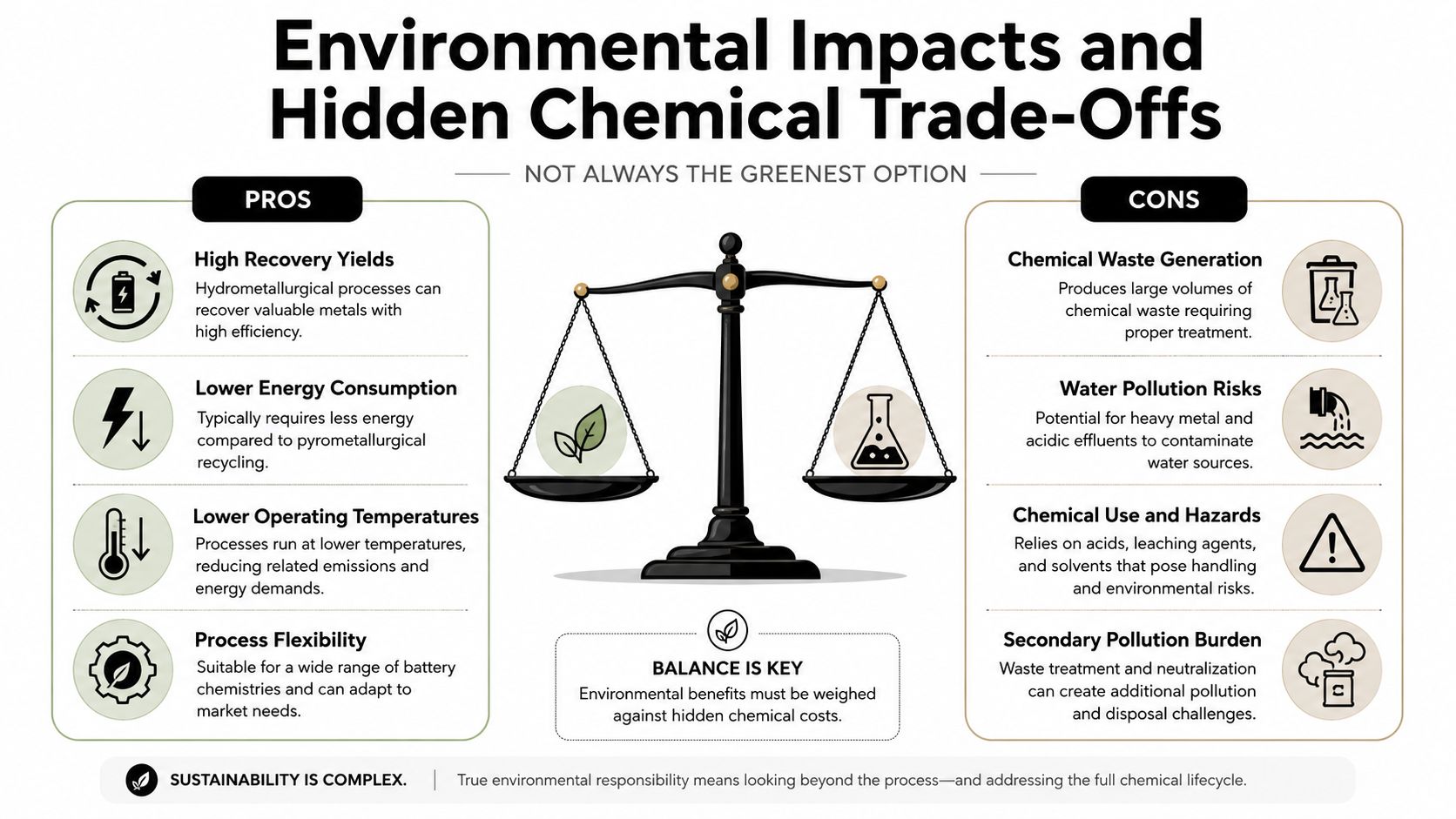
Hydrometallurgical recycling is often presented as the cleaner route compared with smelting, and that is partly accurate. It usually avoids the very high heat of pyrometallurgy, and lifecycle assessment work reported average total CO2 emissions of −25.5 kg CO2eq per kWh, which the authors say corresponds to a 39% reduction in emissions from battery cell production, plus an average cumulative energy demand reduction of almost 17% (Business Chemistry). Those figures matter, but they only describe part of the environmental picture.
The hidden burden shows up in reagent use, purification, and wastewater treatment. Reviews of hydrometallurgical recovery from end-of-life electronic wastes say the method can achieve up to 95% metal recovery efficiency, but it depends on hazardous chemicals and therefore needs careful waste management. Another comparative study found some hydrometallurgical routes can generate about three times higher GHG emissions than organic-acid routes because reagent demand is higher (ULiège review PDF).
What procurement teams should verify
A recycler can describe the process as sustainable and still leave a messy operational footprint if the chemistry is not managed tightly. Chemical inventory control, residue handling, and wastewater treatment should be part of the commercial discussion, not an afterthought.
For teams that track lab or plant reagents, a practical reference point is lab chemical tracking spreadsheets. The value is not the spreadsheet itself, it is the discipline behind it. If a recycler cannot show that level of control, the environmental claim deserves a second look.
Sustainability reporting gets weaker when a vendor gives you a broad “green recycling” claim but no detail on reagent use, residue disposal, or water treatment.
The same logic applies to corporate ESG narratives. If your reporting team needs defensible language, the better question is not whether hydrometallurgy is green. It is whether the specific facility manages its chemistry well enough to justify the claim.
For those comparing outputs and environmental trade-offs across material recovery options, the rare metals side of the process is worth checking here: rare earth extraction considerations.
The LFP Battery Challenge and Emerging Chemistry Gaps
Older recycling playbooks were built around nickel-rich chemistries. That model breaks down with lithium iron phosphate, or LFP, because there is no nickel or cobalt value to recover. The process has to focus on iron removal and lithium recovery instead, which changes both the chemistry and the economics.
Recent LFP hydrometallurgy work describes multi-stage flows with Fe precipitation, ion exchange, Al precipitation, and Li precipitation. That is a more demanding process than the simplified “battery recycling” language many procurement decks still use, and it is why contract language should ask what chemistries the vendor can handle, not just whether they accept batteries.
Mixed chemistry is the real planning problem
The hardest feedstocks are often mixed. IT fleets, consumer batteries, and EV-adjacent streams do not always arrive neatly sorted by chemistry, and black mass can include combinations that do not fit a single recovery recipe. A recycler that only talks confidently about classic NMC inputs may be less prepared for LFP-heavy volumes or mixed-chemistry loads.
The same review notes that a commercial-scale comparison of full-process technologies is still lacking. That matters for procurement because long-term contracts need room for chemistry shifts. A vendor's answer should show how the plant will adapt when the incoming stream changes, not just how it handles today's feedstock.
Ask the recycler how it manages chemistry-specific routing before you sign a multi-year battery or ITAD agreement.
The practical implication for end-of-life planning is straightforward. If your asset mix includes batteries, chargers, backup systems, or mixed electronic equipment, the chemistry profile matters as much as the item category. That becomes even more important when the organization is trying to align secure data destruction, disposal logistics, and sustainability claims under one vendor relationship.
Battery-heavy programs also need to address disposal before material moves into the recycling stream. Review the lithium battery disposal guidance alongside your recycling scope, because packaging, transport, and fire risk controls can affect which recycler is a fit.
Procurement teams should also ask whether the recycler can explain how it handles emerging LFP volumes without leaning on old nickel-cobalt assumptions. A vendor that understands chemistry-specific routing, residue handling, and recovery limits is more likely to give you usable reporting than one that only sells a generic battery-recycling story.
For teams that need a clearer sourcing process across ITAD and recycling bids, AI for Government Contracts can help surface opportunities and support a more disciplined vendor review.
Evaluating Recyclers and Building Your ITAD Partnership
Procurement teams usually get too little detail in recycling bids. The vendor says they handle electronics recycling, maybe mentions ITAD, and then offers a flat rate or a pickup schedule. That isn't enough when the downstream process depends on chemical handling, purity control, and residue management.
Questions that expose real capability
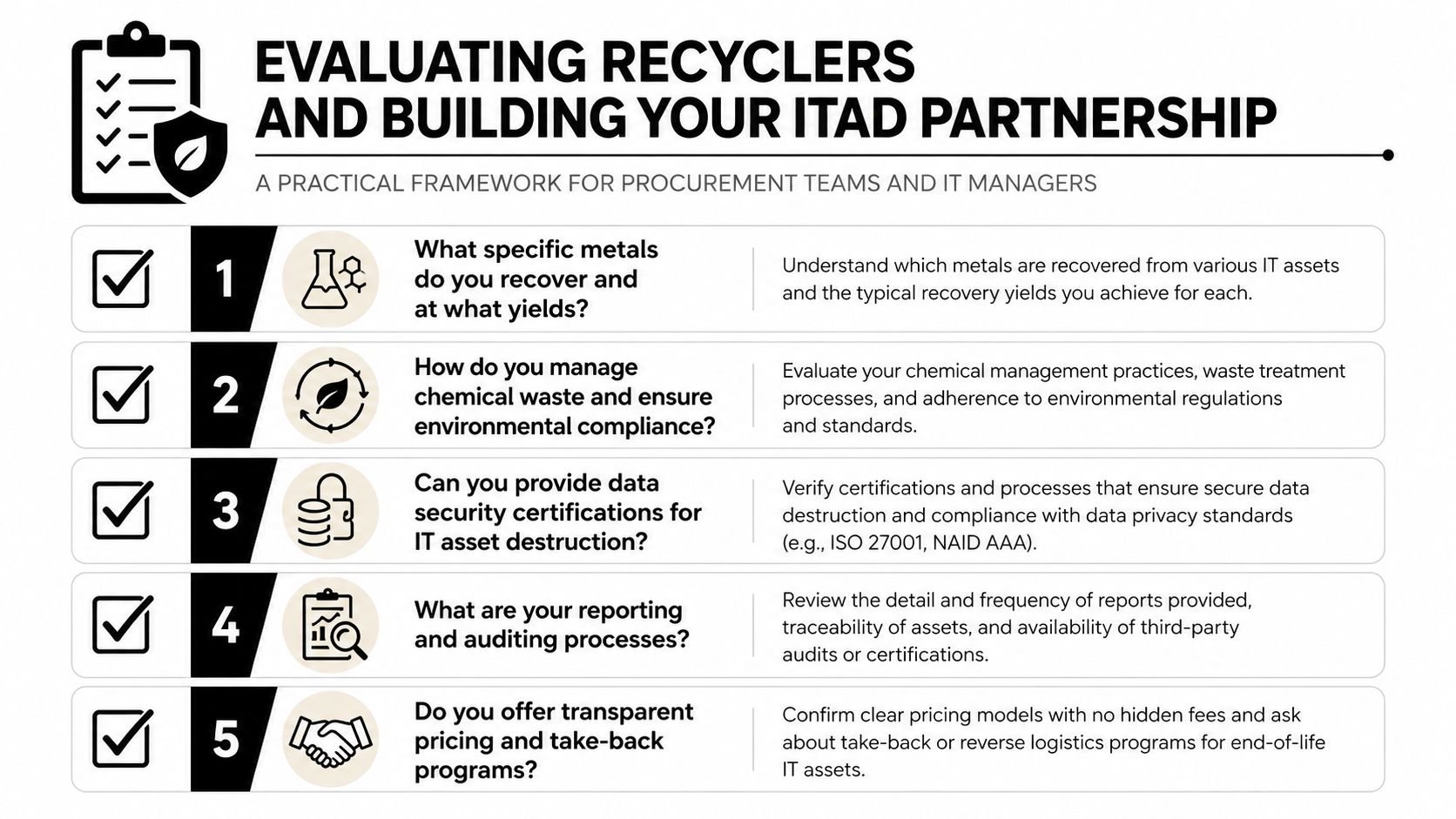
- What metals do you recover, and at what yields? Ask for chemistry-specific answers, not a generic list of “recoverable commodities.”
- How do you manage chemical waste and environmental compliance? The answer should mention reagent control, wastewater treatment, and residue handling.
- Can you document secure data destruction? This matters when your recycling load still includes drives, laptops, or other data-bearing assets.
- What do your reporting and audit trails look like? Good partners can show chain-of-custody and downstream documentation.
- Do you offer transparent pricing and take-back options? Hidden fees usually show up when the material is mixed or the process is more complex than advertised.
A practical addition for sourcing teams is to look at how public-sector bid search tools can support discovery. AI for Government Contracts can help teams spot opportunities and compare vendors more efficiently, which is useful when you're screening recycling and disposal partners under procurement pressure.
The main point is simple. Don't accept “we recycle batteries” as a complete answer. A reliable partner can explain where the material goes, how it's processed, what gets recovered, and what controls keep the operation compliant.
For teams building a formal IT asset disposition workflow, it also helps to confirm whether the recycler can support broader battery and electronics routing like the services described here: battery recycling service details.
Partnering with Reworx Recycling for Responsible E Waste Management
Hydrometallurgical recycling shows why end-of-life electronics should be treated as a managed material stream, not a disposal afterthought. The best outcomes come when organizations pair secure handling with clear downstream recovery, documented data destruction, and a recycler that can explain what happens after pickup. That's the standard IT and facilities leaders should expect, especially when batteries, circuit boards, and mixed assets are all moving through the same retirement cycle.
Reworx Recycling supports that kind of responsible transition with electronics recycling, IT equipment disposal, free customer drop-off, business pickups, equipment decommissioning, IT asset management, recycling consultations, and secure hard drive shredding with data destruction. It's a practical fit for office cleanouts, facility cleanouts, laptop disposal, computer recycling, product destruction, and broader social enterprise recycling goals that include community impact through technology donations.
If your organization is planning an office refresh, a data center decommissioning, or a mixed electronics pickup, Reworx Recycling can help you move equipment out safely while keeping sustainability and data security in view. Visit Reworx Recycling to connect with a team that can help you donate old equipment, schedule a pickup, or build a recycling program that supports both compliance and community impact.