A recall notice lands on a Tuesday morning. Your warehouse, a distributor, and a few hundred customers may all hold the same defective laptop, battery pack, or payment terminal. The pressing question isn't which shredder to rent. It's how many units exist, where they are, and whether you can prove none of them went back on sale. That's how manufacturers destroy recalled products defensibly, by building a proof chain first and treating destruction as its final link.
The Recall Destruction Workflow from Quarantine to Certificate
Say your operations team gets a recall notice for a power supply that overheats. Don't start with destruction equipment. Start by finding every unit, because a count you can't reconcile later will stall the entire file.
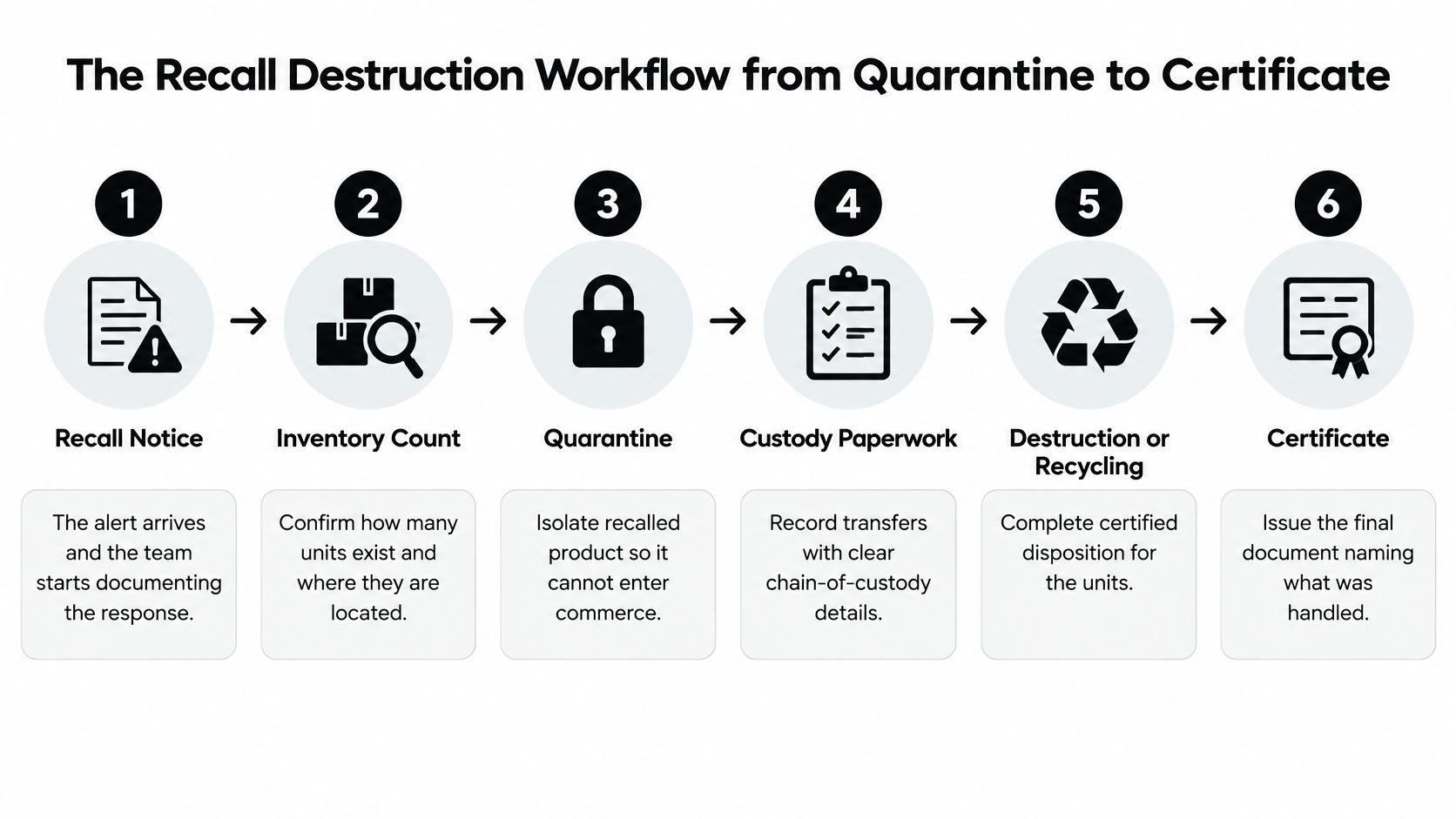
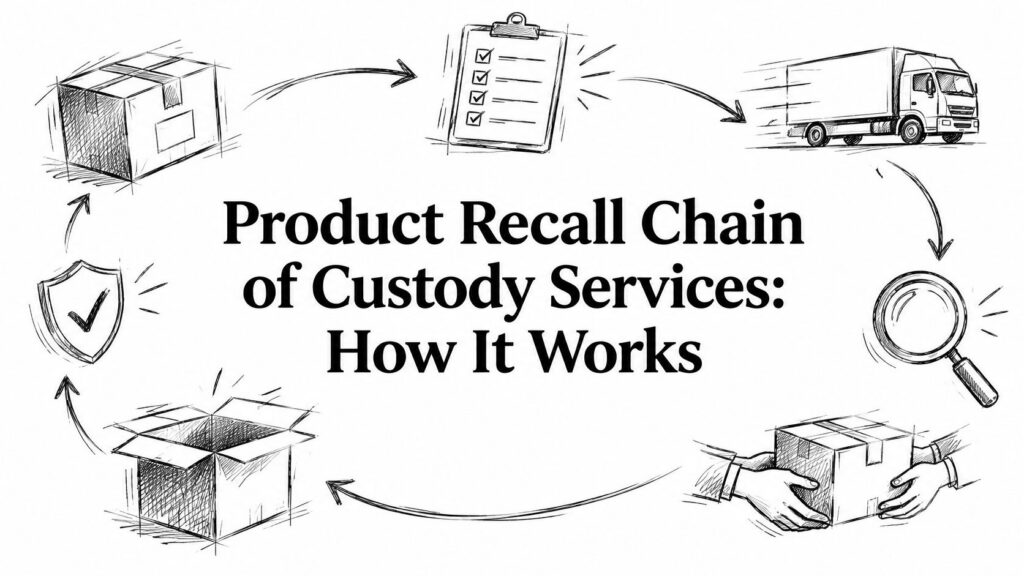
Seven Stages That Build the File
- Quarantine: Stop sales, tag affected pallets or bins, and move them away from non-recalled stock. This prevents accidental shipment while you scope the problem.
- Reconcile: Match the recall scope to SKU, lot, serial number and quantity, using inventory counts and returns. The common slip is accepting a system count without a physical recount.
- Authorize: Confirm with the recall plan or regulator whether repair, reuse, recycling or destruction is permitted. Destroying goods you weren't authorized to destroy creates a second compliance problem.
- Transfer under custody: Use sealed manifests, labeled containers and signed hand-offs at every move, with support from documented reverse logistics services. If someone opens a sealed container, log who did it and why.
- Treat: Remove the hazard first, including lithium-ion packs, refrigerants and defective components. Then dismantle, shred, crush or send the remains to certified recycling.
- Verify: Count units out against units in, capture photos that show identifiers, and add a witness where required. Blurry photos of an unlabeled pile verify nothing.
- Certify and close: Obtain a certificate of destruction, update inventory records and file the complete package.
Teams that skip stage two usually discover the gap at stage six, when it's too late to fix cheaply. Building quality checks into each hand-off, much as PureHQ's guide to quality assurance describes for process control, keeps small counting errors from becoming closure blockers.
Practical rule: If a unit cannot be traced from quarantine tag to final certificate in one pass through the file, the workflow has a gap.
A finished, defensible file contains the recall notice, reconciled inventory, authorization, signed custody forms, treatment records, identifier photos, witness statements where needed, and the certificate. An auditor should be able to follow any single serial number through that package without asking you for missing pages.
Keeping Recalled Units Out of Commerce
Announcing a recall doesn't return a single physical unit. The 2015 Blue Bell ice-cream recall shows the gap starkly. According to FDA materials on the Blue Bell recall, approximately 493 million Blue Bell products were recalled after a Listeria contamination incident, but only 39 million products, about 8%, were recovered and successfully destroyed. The recall was issued piecemeal, and many products had already been sold, consumed or discarded by customers.
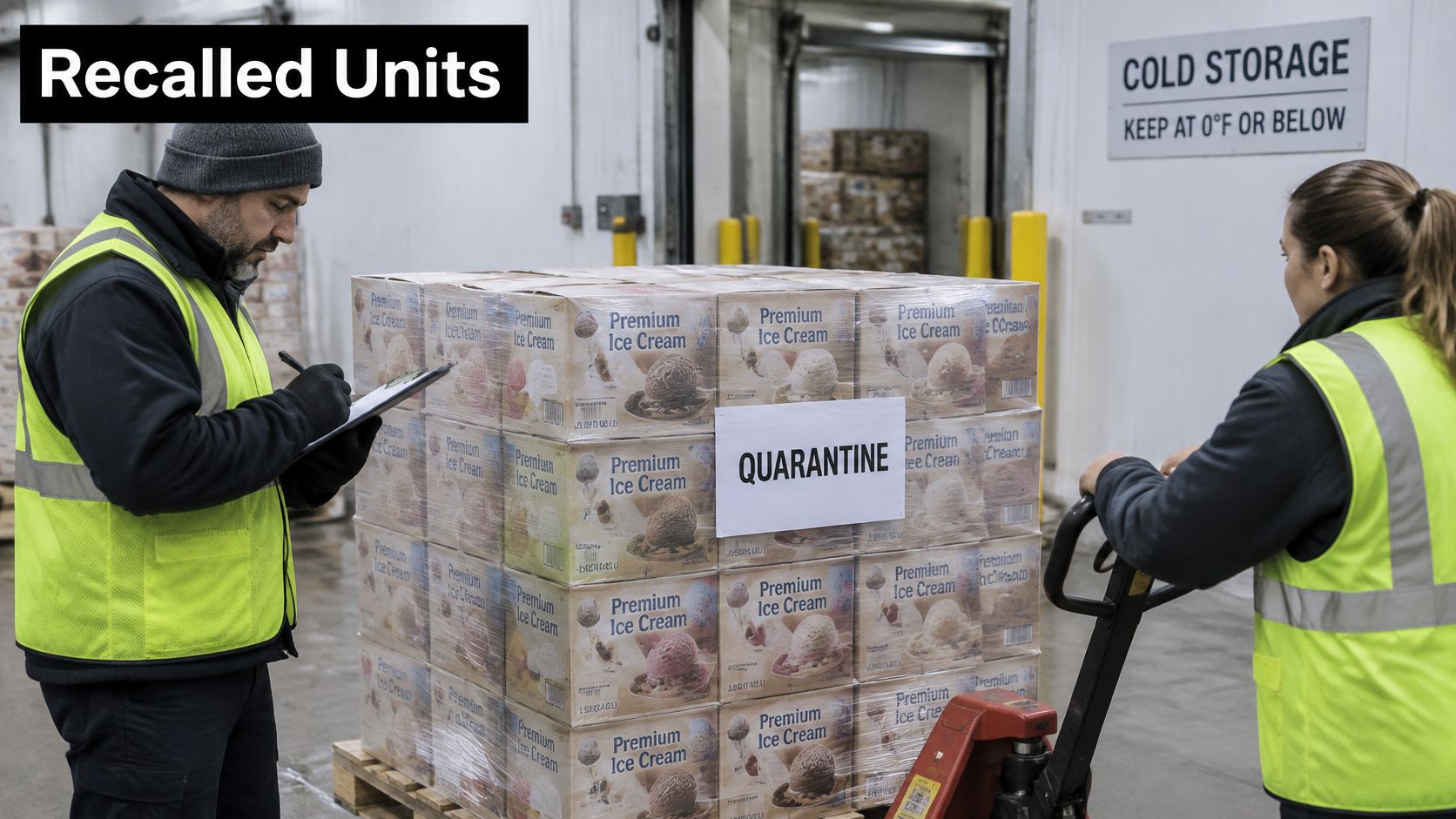
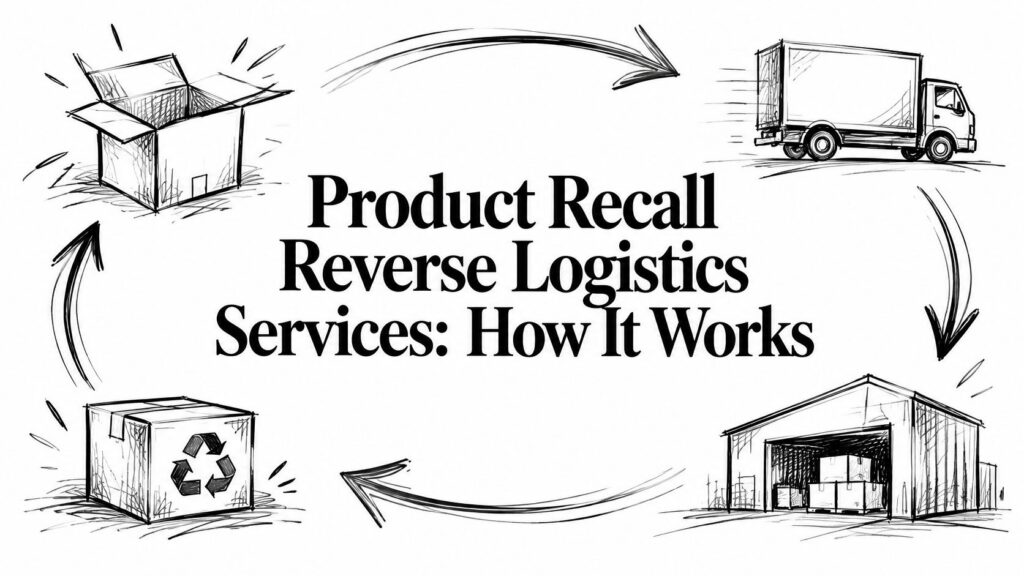
That gap is why destruction depends on documented reverse logistics. You must identify, trace, retrieve and segregate affected inventory before anything gets destroyed. Units sitting with retailers, distributors and customers won't come back on their own, so each holder needs clear retrieval instructions and a way for you to track what's been returned against what they received.
Controls That Keep Goods Contained
Segregated storage is the first control. Recalled units go into a locked or clearly marked area, physically apart from sellable stock, so a picker can't grab the wrong pallet during a busy shift.
Uniquely labeled pallets and containers come next. Each label ties the container to the recall, the lot and the count inside. The CPSC Regulated Products Handbook requires recalling firms to prevent recalled goods from re-entering commerce and to monitor any third-party destruction provider, using serialized inventory records, chain-of-custody documentation and written disposition instructions that prohibit commingling or salvage resale.
Written disposition instructions do the quiet work. They state, in plain language, that recalled product can't be mixed with other goods, donated, discounted or sent to salvage. Without that instruction in writing, a well-meaning warehouse lead may route sealed boxes to a liquidator.
Recall remedies also attract fraud, including people claiming refunds for units they never returned. Custody records that tie each serial number to its final destination protect you from paying twice for the same unit.
Your First 48 Hours
- Freeze movement: Halt sales and shipments of every affected SKU and lot.
- Tag and segregate: Label pallets uniquely and isolate them from active inventory.
- Count physically: Reconcile hand counts against system records and note gaps.
- Notify holders: Send retailers and distributors retrieval and return instructions.
- Issue written instructions: Ban commingling and salvage resale across all sites.
For regulated recalls, coordinate timing and verification with agency staff, who may witness destruction or require an affidavit with photographs. Containment done in the first two days determines whether later destruction is orderly or chaotic.
Deciding Between Destruction, Repair, Refund and Resale
Destruction isn't the default remedy, and treating it as one wastes money and materials. The CPSC published five-year recall-remedy data show 23 cases, or 1.1%, listed under “Dispose,” compared with 1,110 refunds (54.5%), 537 repairs (26.4%), and 345 replacements (17.0%).
| Remedy | Cases | Share of Cases |
|---|---|---|
| Refund | 1,110 | 54.5% |
| Repair | 537 | 26.4% |
| Replacement | 345 | 17.0% |
| Dispose | 23 | 1.1% |
Refunds dominate because they make the consumer whole without touching the product. Repairs follow when a defect can be corrected safely, through a component swap, a software update or new instructions. Disposal sits last because it's irreversible.
A Decision Sequence That Holds Up
Quarantine first, then verify the recall scope. Next, check whether the defect can be corrected through repair, software update, component replacement, return to supplier or regulator-approved resale. Only after those routes fail should you choose destruction through a documented reverse logistics returns process.
Premature destruction carries real costs. Shredding a repairable product wastes embedded energy and critical materials, and pushing goods into uncontrolled downstream channels creates more reputational risk than an auditable recovery route. The same judgment applies outside electronics, where refurbished equipment can remain useful when assessed properly, as with safer mobility choices for loved ones.
Policy is moving in that direction. Under the EU Ecodesign for Sustainable Products Regulation, a prohibition on destroying certain categories of unsold consumer products applies from July 19, 2026, signaling a shift toward reuse, remanufacturing and material recovery. I would treat that as a planning signal even if you sell only in the United States.
Destroyed does not automatically mean responsibly disposed of. The method and the destination determine that.
Destruction is the right call in three situations. The hazard can't be neutralized, the regulator requires it, or no safe reuse path exists. A swollen lithium-ion pack fits the first case, since it can't enter household trash or curbside recycling safely.
Document the reasoning either way. Record who authorized the choice, why destruction was selected, and whether salvage, refurbishment or parts recovery was checked. That short memo protects you if a regulator, insurer or sustainability auditor questions the decision later.
Destruction Methods Matched to Product Type and Hazard
The method follows the hazard and the product's construction, not the equipment you happen to own. Start by asking what makes the unit dangerous, then pick the process that eliminates that failure mode and prevents diversion back into use.
| Method | Best Suited For | Hazard Handling | Typical Output |
|---|---|---|---|
| Shredding | Hard drives, storage media, paper, small electronics | Remove batteries first; data destruction built in | Granules or fragments for recycling |
| Crushing or baling | Bulk plastics, housings, appliances | Remove batteries and refrigerants before crushing | Compacted material for downstream recyclers |
| Disassembly and component removal | Laptops, servers, power supplies | Pull lithium-ion packs, capacitors and mercury switches | Separated metals, plastics and circuit boards |
| Degaussing | Magnetic hard drives | Demagnetizes media; physical destruction usually follows | Demagnetized drives, often then shredded |
| Incineration | Combustible materials where permitted | Controlled facilities only, with emission controls | Ash and energy recovery where permitted |
| Chemical neutralization | Liquid or reactive hazardous materials | Licensed specialist treatment | Treated residue for hazardous waste disposal |
Neutralize the Failure Mode First
Sequencing matters more than brute force. CPSC guidance on recalls asks firms to define whether products will be reworked, broken down for reclamation of critical components, or destroyed, while maintaining control and tracking of defective materials. In practice, you first neutralize the failure mode, removing a defective battery, cutting a dangerous power cord, disabling a pressure-bearing component or separating contaminated material. Then you reduce the product to non-saleable parts through disassembly, granulation, baling or certified material recycling.
Removing labels or packaging doesn't count. A functional product without a box can still be used or resold, which is exactly the outcome destruction exists to prevent. If someone could plug it in and use it, you haven't destroyed it.
Hazards That Change the Route
Batteries are the clearest example. Recalled lithium-ion packs present a heightened fire risk and shouldn't enter ordinary trash, curbside recycling or standard retail battery boxes. They need an approved household-hazardous-waste or equivalent specialized channel, and businesses should route bulk volumes through dedicated lithium battery recycling handling instead of general scrap.
Storage media adds a second hazard, data. Shredding a hard drive handles the physical product and the information in one step. Degaussing works on magnetic drives but not solid-state storage, so I would follow it with physical destruction for recalled units rather than relying on demagnetization alone.
Refrigerants, chemicals and other hazardous materials rule out ordinary landfill disposal. Those units need component removal and specialist treatment before any crushing or baling happens. Sending a refrigerator to a crusher with refrigerant still charged turns a product recall into an environmental violation.
Incineration belongs only in controlled facilities with emission controls, and certified material recycling is generally preferable where the output can be recovered safely. Recycling doesn't eliminate environmental impact, but it keeps metals and plastics in use instead of converting everything to ash.
A Short Decision Rule
Match the method to the hazard first. Then confirm two things before anything moves. The downstream facility is authorized to receive that material, and the output can't be resold or reassembled into a working product. If either answer is no, change the method or the facility, not the paperwork.
Records and Proof That Every Unit Was Destroyed
A destruction photo is not proof. It shows something was crushed on some day. It rarely shows which units, how many, or whether the pile in the frame matches the population you were supposed to destroy. Proof comes from records that connect the recall notice to each unit's final destination.
Two Documentation Paths
The CPSC Recall Handbook specifies different expectations for off-site and on-site destruction. For off-site processing, it recommends clear written instructions identifying what is being shipped, requiring recalled products not to be commingled with other goods or sent to salvage, clearly marking boxes and pallets, and obtaining a certification of destruction after completion.
For on-site destruction approved by CPSC, the minimum record should identify the destruction date, the recalled products destroyed, the quantity, the employee who performed the work, and a witness, with both the employee and witness signing the statement. Inventory systems should then be updated to reflect the destruction.
| Requirement | Off-Site Processing | On-Site Destruction |
|---|---|---|
| Instructions | Written instructions naming what ships | Approved procedure before work begins |
| Segregation | No commingling, no salvage, marked boxes and pallets | Controlled area, counted before treatment |
| Completion record | Certification of destruction from processor | Signed statement by employee and witness |
| Record content | What shipped, quantity, destination | Date, products, quantity, employee, witness |
| Closure step | Reconcile certificate against manifest | Update inventory to reflect destruction |
Either path works if you follow it completely. The failures happen in the middle ground, where goods ship off-site with on-site levels of informality, or on-site work happens without a witness because the shift was busy.
The 14-Unit Gap
Say you're closing a recall of 1,200 laptops. Your inventory system says 1,200 units were quarantined. The destruction facility's intake count says 1,186. That 14-unit gap stops the file from closing, and it should.
Work the gap methodically. Pull the return logs and check for units logged twice under different asset tags. Check whether a pallet shipped under the wrong lot number, whether 14 units were set aside for regulator inspection, and whether the original quarantine count was wrong. Teams in other batch-driven industries face the same discipline, and operations managers who find practical batch tracking methods will recognize the pattern of reconciling lot counts before release.
Every explanation needs a document behind it. A miscount gets a signed recount sheet. Units held for inspection get a transfer record. Units shipped under the wrong lot get a corrected manifest. Writing "probably a counting error" in an email isn't reconciliation.
A certificate alone is weak evidence if it doesn't identify the processed population and the treatment route.
I would not sign off on a file with an unexplained variance, however small. Fourteen laptops with storage drives are fourteen potential data exposures, and an auditor will ask about them by serial number.
Data Sanitization Is a Separate Proof
Destroying a laptop's chassis proves nothing about its drive. Treat data sanitization as its own verified step, with its own records, alongside physical destruction through chain of custody documentation.
EPA guidance for federal electronics disposal emphasizes sanitizing media, removing storage media where applicable, and retaining records of units or weight sent for reuse or recycling. Our recycling processes follow EPA rules for e-waste disposal, and our third step, Certification & Reporting, provides the customer with detailed reports and a Certificate of Destruction. The strongest record proves both that the product was rendered unusable and that confidential data couldn't be reconstructed.
Fraud control belongs in the same chain. The CPSC request for information on consumer product recall fraud shows the agency opened a 2026 request for information on fraudulent or abusive conduct involving recall-remedy redemption. Connect each SKU, lot, serial number, quantity, custody transfer, treatment method and final destination, so a unit can't be redeemed twice or resold.
Verification Checklist Before You Close
- Identifiers captured: Serial or asset numbers are legible in photographs.
- Counts match: Count out equals count in, with variances explained in writing.
- Hand-offs signed: Each lot or pallet is signed at every transfer.
- Facility named: The authorized downstream facility appears on the manifest.
- Witness present: Regulated units were witnessed where required.
- Certificate complete: It lists processed quantity, treatment method and date.
- Inventory updated: System records close the loop on every unit.
Retain certificates, manifests, count sheets, photos, signatures and facility authorizations for the period your recall plan and state rules require. Store them as one package per recall, not scattered across email inboxes. Then run one final test. Hand the certificate to someone who wasn't involved and ask whether they could rebuild each unit's path from recall notice to final disposition. If they can't, the file isn't done.
Choosing a Disposition Partner for Your Next Recall
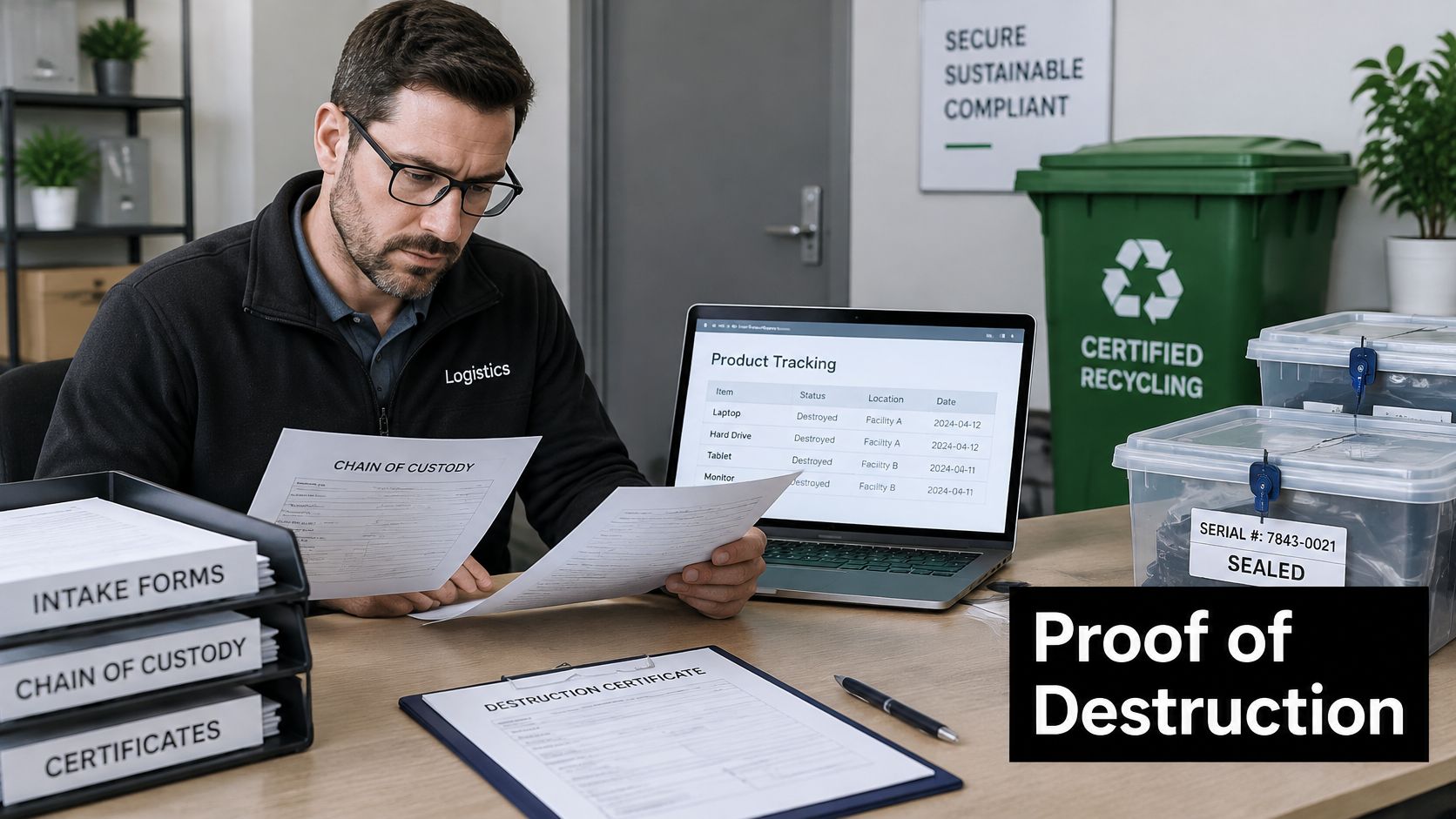
A disposition partner should be able to show, not just promise, five things. Look for item-level intake counts, custody paperwork, documented data destruction, certified recycling and a certificate that names exactly what was processed. If a provider offers only a weight ticket and a generic receipt, keep looking.
Questions Worth Asking
- Facilities: Which facilities receive the material, and are they authorized for it?
- Tracking: How is each serial number tracked from pickup to destruction?
- Certificate content: What exactly does the certificate of destruction contain?
- Data handling: How are data-bearing devices wiped or shredded?
- Compliance: Does the process meet EPA guidance and local e-waste rules?
Use consistent vendor selection criteria so you can compare answers side by side, and get the documentation samples before you sign anything. A sample certificate tells you more in thirty seconds than an hour of sales conversation.
Reworx Recycling is a donation-based electronics recycling and IT asset disposition partner offering secure data destruction, decommissioning and business pickups. We treat recalled units under the recall plan first, so written disposition instructions come before any donation decision. We offer free data destruction, and after data destruction, we recycle the electronics responsibly and in an environmentally friendly way.
That model pairs environmental responsibility with community impact. Equipment cleared for reuse supports digital inclusion and workforce development, and customers can donate old electronics to us through corporate donation programs. Businesses can also schedule a pickup for an office cleanout or facility cleanout, or use secure data destruction for devices holding sensitive information.
If a recall is on the horizon, talk with your disposition partner before the first unit moves. Setting the plan in advance costs a phone call. Reconstructing it afterward costs weeks.
If you're facing a recall, an office cleanout, or a warehouse of retired IT equipment, Reworx Recycling can handle documented product destruction, secure data destruction and responsible electronics recycling with the chain-of-custody records your file needs to close. Donate old equipment, schedule a business pickup, or partner with us to turn compliant disposition into community impact. Start the conversation at Reworx Recycling before the first unit moves.