87% of the banned or recalled products inspected were still listed online in an October 2021 sweep across 21 OECD countries and partner economies, according to the OECD's online product-safety review3/FINAL/en/pdf). For an IT asset manager, that finding exposes the gap between announcing a recall and controlling the equipment.
To prevent recalled products from being resold, you need more than a deleted listing. You need an asset record that identifies the affected unit, a transfer block that follows it, and evidence showing what ultimately happened to it.
Why Recalled Products Keep Reaching Resale
A Smyrna, Georgia, business retires laptops during an office cleanout. IT removes them from the active register, facilities moves them into a returns area, and someone earmarks the usable machines for donation. If nobody checks the batteries against the recall scope, that ownership change becomes an uncontrolled release.
That failure scales online. The OECD's review of online product safety enforcement3/FINAL/en/pdf) found an average 79% rate of non-compliance or potential non-compliance across the products examined. Approximately 77% of inspected products were available through online marketplaces, where non-compliance averaged 54%. Those findings concern the inspected products, not all secondhand electronics, but they show why marketplace availability is not evidence of safety.
Where inventory controls break
Recalled equipment leaves through routes procurement never treats as sales. Returns bins hold devices staff classify as functional without checking recall status. Inter-site transfers ship equipment while the safety notice stays at the originating location. Donation and employee take-home programs approve redistribution because no money changes hands, which creates the same compliance exposure as a resale and draws the same auditor questions about serial numbers, authorization records, and final disposition.
ITAD handoffs add a fourth gap. A downstream partner receives a mixed load without unit-level restrictions, and the recalled unit disappears into bulk processing.
Build recall holds into reverse logistics and returns workflows, rather than leaving them in a separate email thread. The hold should freeze fulfillment, donations, internal transfers, and recycler releases until the unit is cleared or quarantined.
The financial exposure is significant. The CPSC's guidelines for retailers and reverse-logistics providers describe civil penalties for knowing violations of up to $100,000 per violation, capped at $15.15 million for a related series, and explain that each consumer product may constitute a separate offense.
Control principle: Removing an asset from your main inventory doesn't establish that you've prevented its resale.
Positively identify each affected unit, isolate it, and block its release. Auditors will ask for the identifier match, the hold record, and proof of where the unit went next.
How to Quarantine Recalled Inventory Step by Step
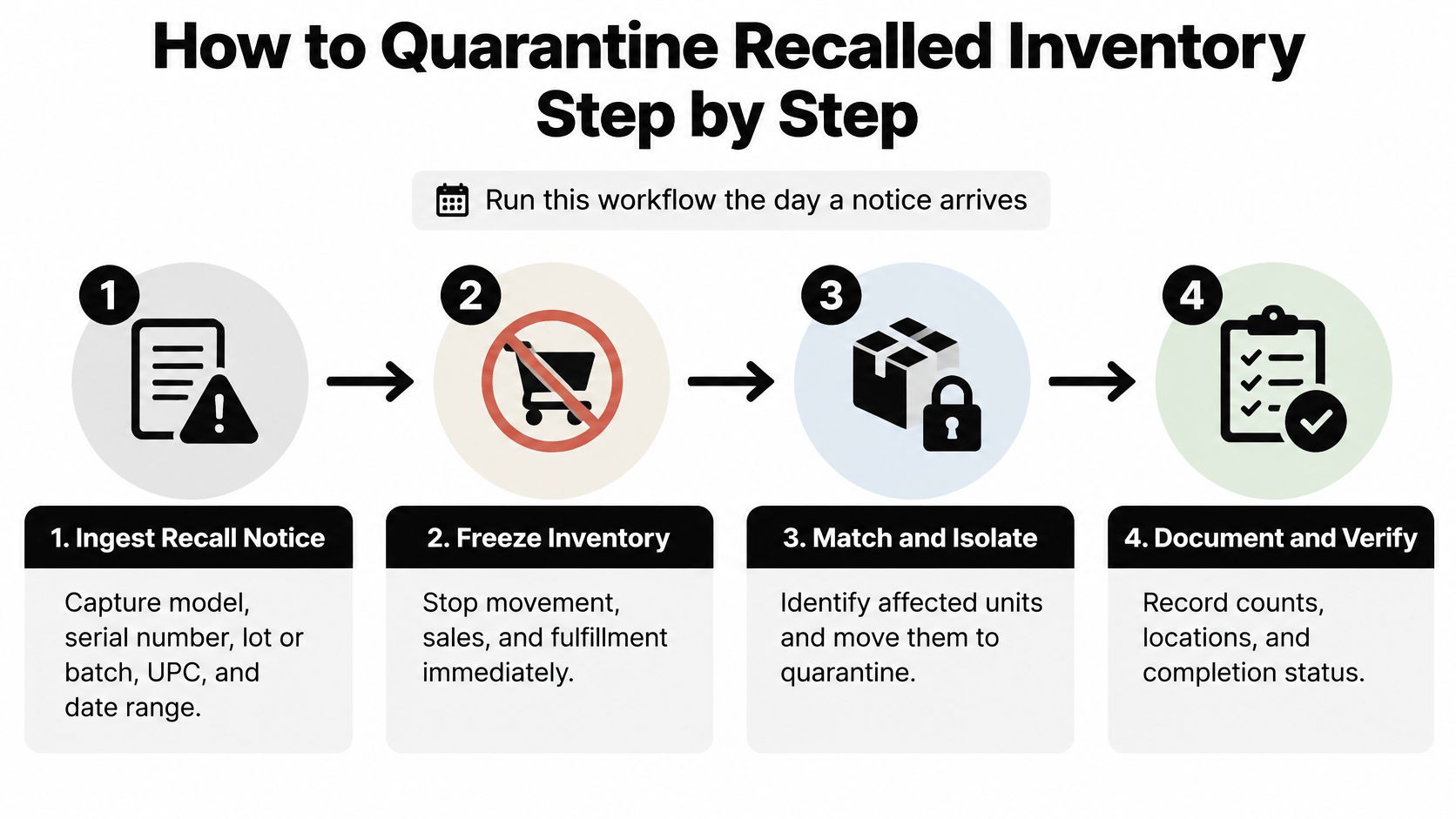
Run the quarantine workflow when the notice arrives, not when the next shipment is ready. Give the recall owner authority to stop fulfillment, donation releases, and internal transfers without waiting for separate departmental approvals.
Establish the affected population
Ingest the notice and normalize identifiers. Save the manufacturer's notice and capture its model numbers, serial ranges, lot or batch identifiers, UPCs, and production dates. Preserve the original values alongside normalized search fields. A spreadsheet that strips leading zeros can turn a valid identifier into a missed match.
Freeze every outbound channel. Suspend affected stock across warehouses, stores, returns areas, donation queues, and online listings. If the scope isn't clear yet, temporarily hold the candidate population. A broader initial hold costs handling time, but releasing an unidentified unit creates a harder recovery problem.
Cross-reference serial and lot data. Search active assets, retired inventory, pending shipments, and downstream distribution records. The NIST traceability framework describes comparing recalled lot numbers with active inventory and passing recall information through downstream customers. Record both confirmed matches and units that require label inspection.
Identifier matching methods compared
| Identifier | Catches Variant-Specific Recalls | Best Use |
|---|---|---|
| Product name | No | Initial triage only |
| Photograph | No | Visual confirmation after a database match |
| Model number | Partly | Narrowing the recall scope |
| Lot or batch number | Yes, for production runs | Matching units from the same run |
| Serial number | Yes | Confirming each unit before disposition |
A product name can identify a family without identifying the affected production run. A photograph can confirm appearance, but it can't reliably distinguish otherwise identical units with different batteries, components, or manufacturing dates.
Control movement and close the records
Quarantine matched units physically and electronically. Move them into a controlled location and attach a visible HOLD / DO NOT RESELL status. Block listing, picking, shipment, and donation transactions through permissions, not just a free-text note. Follow the recall notice's handling instructions, especially for damaged or hazardous batteries.
Record the serial-level disposition. Assign the approved path, such as manufacturer return, authorized repair, destruction, or manufacturer-directed recycling. Keep the approval, movement record, receiving party, completion date, and supporting evidence attached to the asset. A pallet-level receipt alone won't explain what happened to an individual laptop.
Reconcile physical counts and resolve exceptions. Compare scanned units with the database and investigate missing, duplicated, unreadable, or unidentified records. Keep the hold active while exceptions remain. Don't close an exception by deleting the asset or changing its description.
Use inventory-management practices that keep recall status in the same record used for location and ownership. Separate spreadsheets are easy to create, but difficult to keep synchronized when warehouse staff move equipment.
The completion test is straightforward: every matched unit has a documented disposition, physical counts agree with the register, and the exception report reaches zero. Zero means resolved, not hidden.
Choosing Safe Disposition Paths for Recalled Units
Donated isn't automatically safer than sold. The CPSC's recalled-product resale guidance states that recalled products cannot knowingly be sold or given away and warns that selling, offering, or keeping them in resale inventory can violate federal law.
That distinction matters to corporate donation programs. A charity recipient or employee taking equipment home doesn't eliminate the underlying product hazard.
Separate reusable assets from unresolved recalls
Use the following table as a release decision, not as permission to bypass the manufacturer's instructions. An authorized transfer for recall correction is different from distributing equipment for continued use.
Disposition paths by recall status
| Recall Status | Permitted Path | Evidence to Keep |
|---|---|---|
| Remedy completed and verified | Return to commerce with the remedy stated in the listing | Remedy record, date and recipient |
| Remedy available, not yet performed | Authorized repair before any transfer | Repair confirmation for each serial number |
| No safe remedy or remedy unverifiable | Controlled destruction or manufacturer-directed recycling | Destruction or recycling certificate |
| Donation or employee take-home | Not permitted for any unremedied unit | Quarantine log showing the unit stayed out of transfer |
The CPSC's guidance for buying and selling products online permits resale when the applicable remedy has been completed and the listing clearly states that the remedy is included. Keep the identifier, recall notice, correction performed, correction date, and recipient together.
A working device isn't necessarily a corrected device. Passing a power-on test, replacing an unrelated part, or wiping the drive doesn't establish that the recall remedy was completed.
Make the disposition decision defensible
Verify the model and serial number before choosing a path. Freeze transfers, contact the manufacturer or appropriate regulator for unresolved instructions, and document the authorized remedy. If no safe remedy exists, use controlled product destruction or a manufacturer-directed recycling route.
A donation receipt proves a transfer occurred. It doesn't prove the product was safe to transfer.
During computer recycling, laptop disposal, medical equipment disposal, or laboratory equipment disposal, keep potentially reusable assets separate from restricted equipment. Medical and laboratory devices may also require product-specific controls beyond an ordinary consumer-product workflow.
Environmental obligations remain after the recall decision. Our recycling processes follow EPA rules for e-waste disposal, and applicable local appliance and electronics-disposal requirements still apply. For businesses operating across Smyrna and nearby Fulton County sites, don't assume the receiving location follows the same local disposal procedures as the originating facility.
Securing Data on Recalled Devices Before Recycling
A recall hold protects people from an unsafe product. It doesn't protect the information stored inside it.
The FTC's business guide to protecting personal information recommends secure-erasure software for old computers and portable storage devices because ordinary deletion can leave files retrievable. It also recommends a written retention policy covering what information is retained, how it's secured, how long it's kept, and how it's disposed of securely.
Tie sanitization to the asset record
Flag data-bearing equipment at intake. Include laptops, servers, point-of-sale systems, portable drives, and removable storage. Customers gather unwanted electronics and note devices containing sensitive data. Record the device serial number and, where accessible, the storage-media identifier.
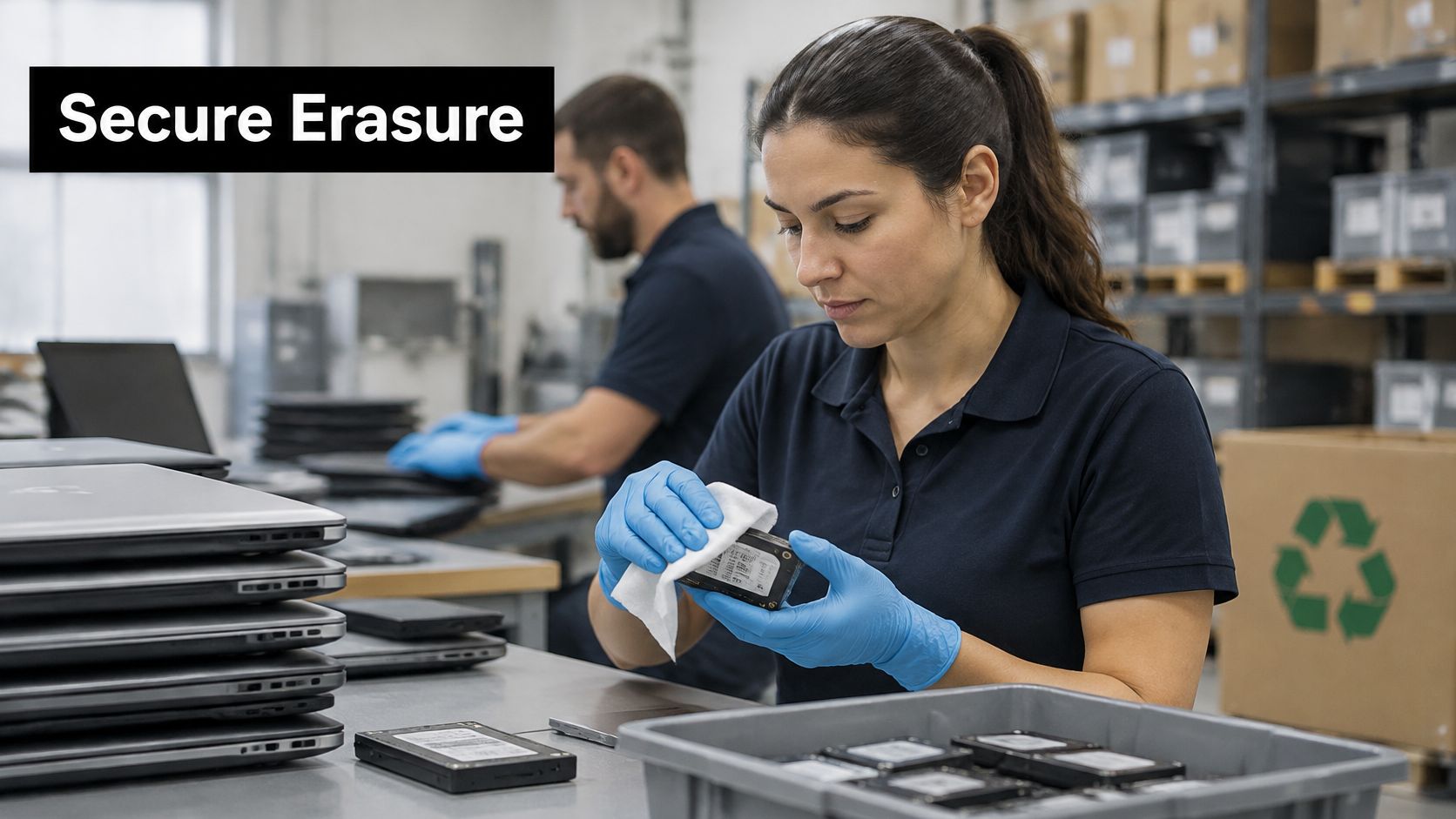
Erase safely and retain the result. Run suitable secure-erasure software only when powering and handling the recalled device is safe under the recall instructions. Attach the completion log, method, verification result, operator, and date to the asset record. A job marked started isn't a verified erasure.
Shred media that can't be verified as erased. Failed drives and inaccessible storage need a controlled destruction decision. If a recalled battery or damaged enclosure makes disassembly unsafe, keep the device held for qualified handling rather than asking office staff to remove the drive.
Maintain quarantine until the outcome is confirmed. Data clearance and recall clearance are separate approvals. A sanitized laptop may still be unsafe to reuse, while a corrected device may still contain confidential information.
Retain the evidence under your written policy. Store erase logs and destruction records with restricted access. Apply the organization's retention schedule to the records themselves, including their eventual secure disposal.
Account for the handoff
At Reworx Recycling, we securely wipe or shred data-bearing devices to protect customers' information. Identifying sensitive equipment during preparation helps preserve that requirement through collection and processing.
Use a data-sanitization procedure that explains who approves the method and who verifies completion. During data center decommissioning, don't let a server-level inventory conceal drives that were removed and placed in a separate container.
An auditor should be able to retrieve the serial number, erase log or shred record, and completion date without reconstructing the chain from emails. Where erasure failed before shredding, retain both records so the final decision is understandable.
Proving Every Downstream Party Removed Recalled Units
Resale listings disappear faster than inventory gets controlled. A reseller can archive one offer, move the unit to a second storefront, or bury it in a mixed bulk lot the same afternoon. That gap is why auditors treat donation bins and employee take-home cages as resale risk, not as goodwill exceptions. Each path needs the same owner, deadline, and evidence standard.
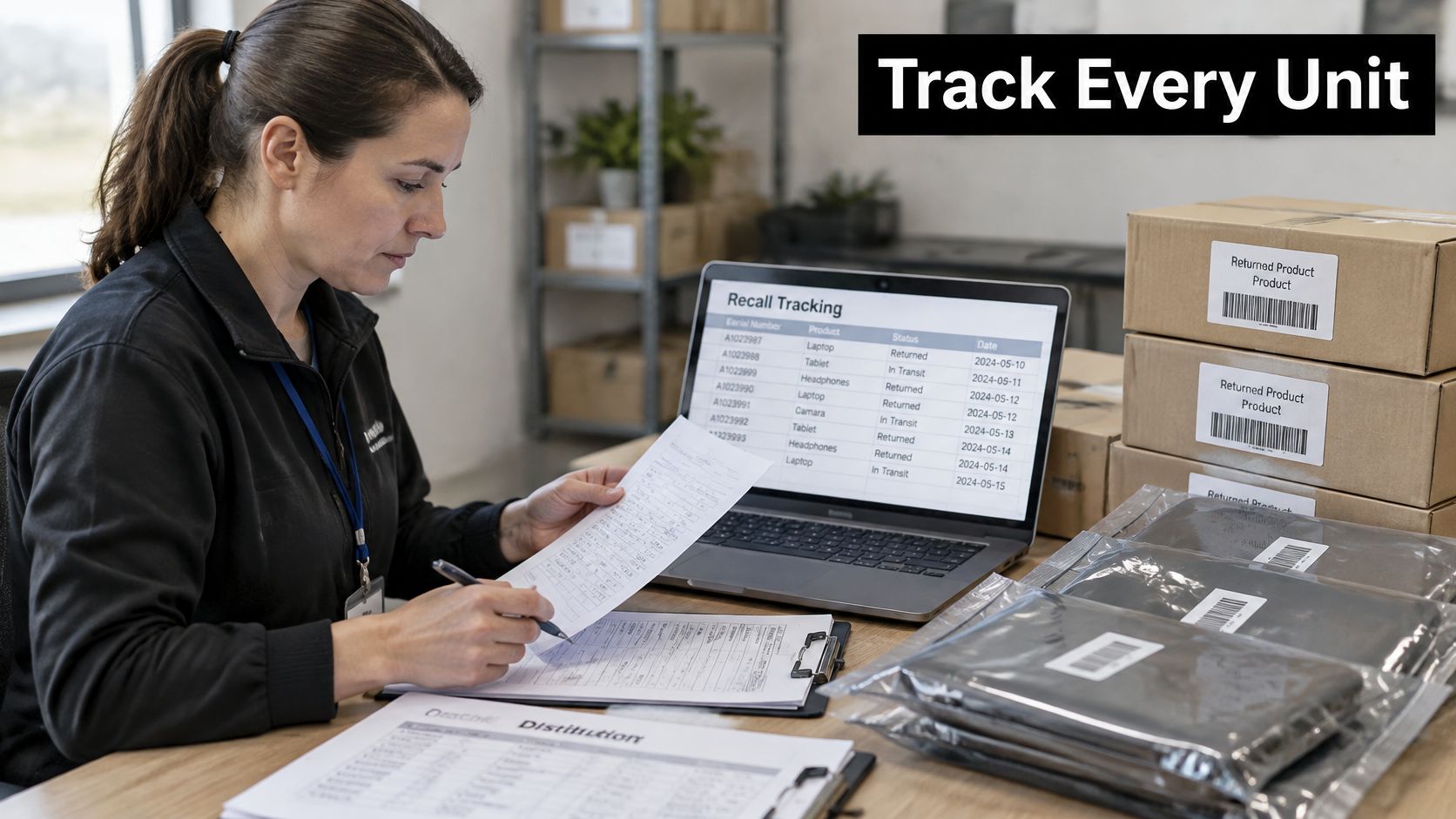
Define recall depth before you send notice: warehouse, retail, reseller, consumer, or user. Assign every downstream party a named contact, a response date, a contact method, and the exact record you will accept as closure.
Verify action rather than acknowledgment
The FDA's medical-device recall procedures describe effectiveness checks confirming that consignees received notice and took appropriate action, using visits, telephone calls, letters, or combinations. They also call for investigating further distribution and whether additional consignees were notified.
Apply that discipline to downstream IT asset disposition. Require recipients to confirm notice received, inventory searched, units blocked or removed, and final quantity accounted for. For donated electronics and take-home equipment, demand the same four statements. A signed receipt from a charity does not close the file.
Evidence that proves a downstream removal
| Evidence | Counts as proof | What it shows |
|---|---|---|
| Inventory export | Yes | Affected identifiers were searched and quantities recorded |
| Quarantine photograph | Yes | Matched units are physically held |
| Blocked-listing report | Yes | The online offer was removed |
| Return authorization | Yes | Units are coming back under control |
| Destruction or recycling certificate | Yes | Units cannot re-enter commerce |
| Unverified email reply | No | No quantity, identifier, or system record |
These records prove different stages, not interchangeable outcomes. A return authorization shows intent. It does not show receipt. A recycling certificate only works when it lists the restricted serials and confirms a disposition that prevents reuse. Pair photographs with identifiers and dated system records, and hold chain-of-custody documentation across every subcontractor handoff. Escalate nonresponses. Never file them as assumed compliance.
Keep searching after the first removal
Secondhand channels have repeatedly been found offering recalled children's products, which is why donation inventory needs the same screening as resale stock.
In 2025, the European Commission's Safety Gate results recorded 4,671 alerts, more than 5,794 follow-up actions, and crawler scans of more than 1.6 million websites that identified over 20,800 products already listed in Safety Gate.
Set a documented rescreening cadence for aged stock, returns, donated electronics, and live marketplace listings. Trigger an additional check when a new notice changes the affected population.
Your dashboard should distinguish identified, frozen, recovered, repaired, destroyed, and unresolved units, with the age and owner of every open exception. I recommend keeping those status totals separate, because the same unit can pass through several stages and a summed total hides what is still unresolved.
Put Recall Blocks into Vendor Contracts
A recall procedure needs contractual support before equipment leaves your control. Use these clauses as operational drafting language for counsel to adapt to the equipment, jurisdiction, and vendor relationship.
Clauses for the next outbound agreement
- Scope: Recalled product means a unit covered by a manufacturer notice or CPSC or comparable regulator alert, matched using applicable model, serial, lot, batch, UPC, or date-range identifiers.
- Response: The recipient must immediately suspend affected listings and transfers and provide confirmation within one business day. Confirmation must state that notice was received, inventory was searched, units were blocked, and quantities were accounted for. This is a proposed contractual deadline, not a universal statutory period.
- Restricted distribution: The recipient must not sell, auction, donate, or release an unremedied unit through an employee take-home program.
- Conditional release: Commercial release requires a verified authorized remedy and a listing that states the remedy is included. Retain the identifier, notice, remedy, correction date, and recipient.
- Evidence: Maintain chain-of-custody records and quarantine photographs. Where no safe remedy exists, provide the approved destruction or recycling certificate, plus applicable erase logs or shred records for data-bearing equipment.
- Breach response: Recover improperly released units, identify and notify further recipients, preserve records, and cooperate with corrective action. Counsel should allocate recovery costs, indemnity, and applicable penalty exposure expressly.
Use vendor contract negotiation to resolve subcontracting rights and audit access before signing. A restriction that binds only the first recipient leaves a gap when that recipient sends equipment to another processor.
Release authorization: No transfer until recall status is recorded and disposition evidence is attached to the asset record.
Have the accountable asset owner sign that internal policy. Procurement should verify that the vendor agreement supports it, and warehouse staff should have a clear route to escalate any instruction that conflicts with the hold.
Confirm Your Recall Process Before the Next Batch
A recall drill fails most often at the handoff. Facilities releases a pallet while IT still shows an unresolved hold, or a donation bin leaves the building without serial numbers recorded. Run a small controlled test this month to prove staff can execute without the person who built the process.
Start with channel owners for returns bins, inter-site transfers, donation programs, employee take-home arrangements, and ITAD handoffs. Donation and take-home carry the same exposure as resale in an audit. Each needs the same recall-status check, identifier match, and disposition record.
Update the ownership record to add recall-status and serial-number fields. Make unresolved status block outbound approval. Then run a quarterly drill from a sample manufacturer notice and time each step: freeze stock, match identifiers, complete serial-level disposition. Store drill results with the exception report and the matching destruction, repair, or recycling evidence.
Reworx Recycling is a full-service electronics recycling and IT asset disposition partner in Smyrna, Georgia, offering electronics recycling, equipment buyback, equipment decommission, IT asset disposition, IT asset management, recycling consultation, hard drive shredding with free data destruction, junk removal, and recycle-by-mail. Keep recall restrictions and sensitive-data flags with the equipment as you prepare the handoff. Visit Reworx Recycling to arrange a business pickup or schedule a drop-off for retired electronics.