Yes, running your car's air conditioner can reduce fuel economy by 5% to 25% depending on conditions, but home and building air conditioners don't burn gas at all, they run on electricity. So when someone asks does having the air conditioner on waste gas, the honest answer is, it depends on whether you're talking about a car or a building.
A lot of confusion comes from using one word, “AC,” for two very different systems. In a vehicle, the air conditioner adds load to the engine. In a house or office, the unit uses electrical power to move heat, not fuel to create it.
Understanding How Air Conditioning Affects Fuel and Energy Use
The cleanest way to answer does having the air conditioner on waste gas is to separate the two worlds people mix together all the time. A car's AC can raise gasoline use because the compressor is tied to the engine. A building's AC doesn't burn natural gas or propane for cooling, it uses electricity to run the compressor, fans, and controls, while the refrigerant just moves heat around as a working fluid. Standard residential and commercial AC systems are electric, not gas-fired for cooling, which is why “gas use” in a building is usually indirect, coming from the power grid rather than the AC unit itself. See the refrigeration-emissions context in this overview from Our World in Data and the plain-language explanation of electricity-powered systems in this HVAC breakdown.
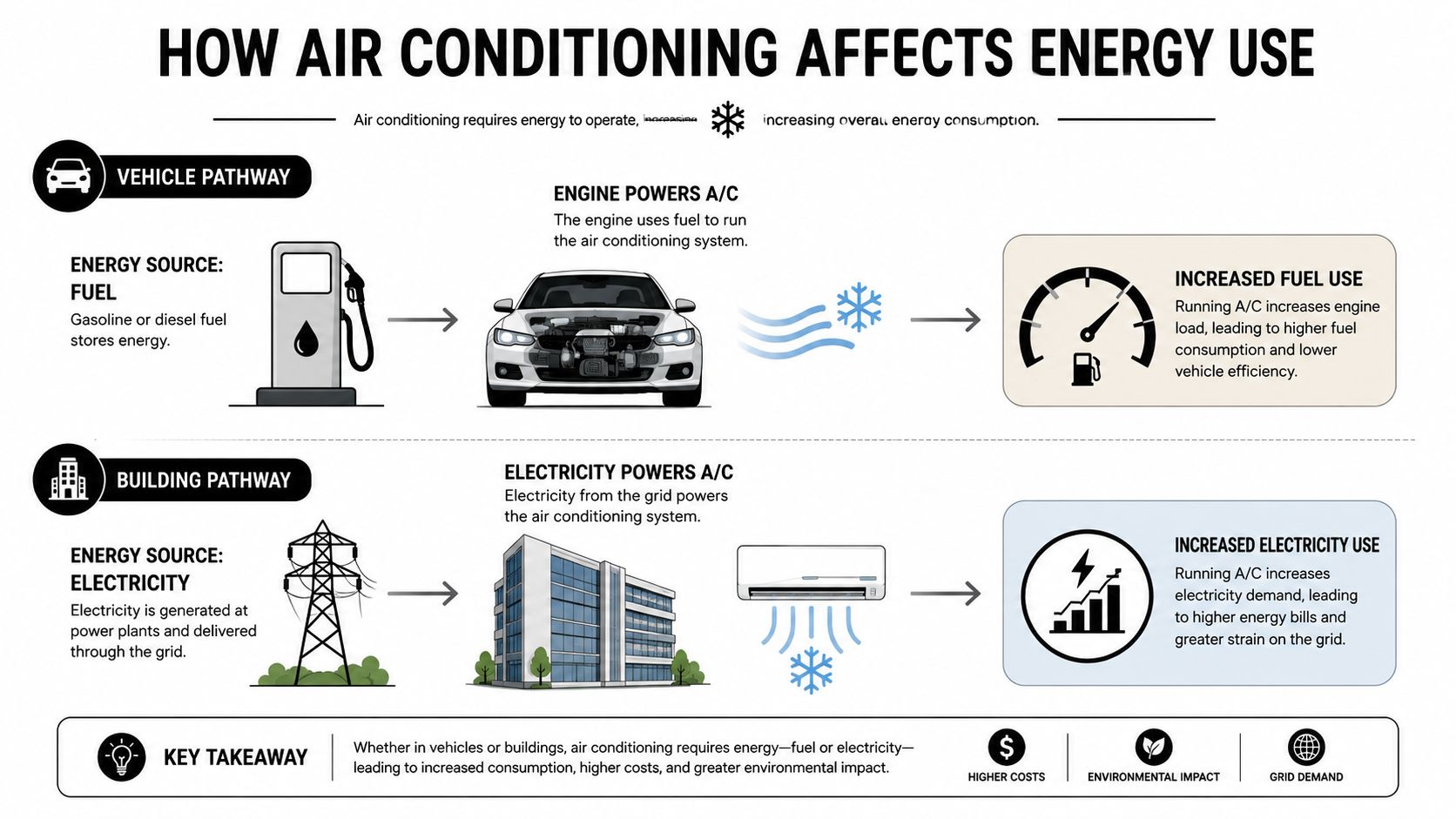
A car's AC behaves a lot like power steering, a comfort feature that adds work for the engine. A home AC behaves more like a refrigerator, it needs electricity, but it isn't burning fuel in the box itself.
Practical rule: If the system is in a car, ask how much fuel it uses. If it's in a building, ask how much electricity it uses and what that electricity costs.
For anyone comparing comfort systems across categories, a side-by-side resource like compare golf cart fuel types can be useful because it shows how the same question changes once the vehicle or machine uses a different power source. If you're tracking building efficiency rather than vehicle fuel burn, a carbon offset calculation can help frame the broader energy impact without confusing fuel with electricity.
How Car Air Conditioning Reduces Fuel Economy
A car's AC doesn't sip gasoline directly. It asks the engine to do extra work, and the engine responds by burning more fuel to keep speed and acceleration where you want them. That's the basic reason AC hurts mileage in a conventional car. A belt-driven compressor, or an engine-driven load in similar systems, is part of the penalty, and the impact shows up most when the car is already under stress from hot weather, stop-and-go traffic, or short trips.
The numbers vary by source and driving condition, but the message is consistent. The U.S. Department of Energy says AC can cut a conventional vehicle's fuel economy by more than 25% under very hot conditions, Natural Resources Canada says AC can increase fuel consumption by up to 20%, and other guidance places the penalty in the 5% to 25% range depending on how and where you drive. In consumer testing cited by automotive sources, mileage dropped by about 3 mpg at 65 mph in a Honda Accord, which shows how a specific vehicle can feel the load in real traffic. For a driver, that means the answer isn't abstract, it shows up at the pump.
Why short trips hurt more
Short trips are rough because the AC has less time to stabilize the cabin before the drive ends. In hot weather, the compressor may stay on more often, so the duty cycle climbs and fuel use follows. That's why two drives of the same distance can feel very different on the dash, especially if one starts in a heat-soaked parking lot and the other begins after the car has been shaded.
The compressor doesn't have a fixed “gas tax.” It has a load that rises and falls with demand, so hot starts and low-speed driving are where many drivers notice the biggest hit.
A simple commute example
Take a 30-mile commute. If that trip is mostly city driving on a blazing day, the AC may cycle hard and the fuel penalty can be noticeable. If it's mostly steady-speed highway travel, the load may feel smaller even though it's still there. That's why the same person can swear AC “kills gas” on one day and barely notice it on another.
For drivers researching broader mobility systems, Atlanta transportation tech and smart mobility is a good reminder that efficiency questions are never just about one component. They're about the whole machine, the weather, the route, and how often the system has to fight heat.
The Windows Down vs AC Debate at Different Speeds
The windows-down-versus-AC argument is one of those garage debates that stays alive because both sides are right in different conditions. At lower speeds, open windows usually create only modest drag, so they can be the better fuel choice. At higher speeds, the extra aerodynamic drag from open windows can force the engine to work harder, which is why a moderately efficient AC can be the smarter option on the highway. One source citing Department of Energy and Douglas Aircraft studies says that at about 40 mph or more, efficient air conditioners in late-model cars can save gas compared with driving with the windows down, and a Time archive piece with that guidance makes the tradeoff easy to understand: speed changes the answer. Read the historical discussion in Fuelish Myths.
The speed crossover matters
Below that speed range, rolling the windows down can be a good choice because the engine isn't fighting much drag. Above it, the shape of the car starts to matter more. A boxier vehicle will usually pay a steeper penalty from open windows than a sleek one, because airflow breaks up sooner and the engine has to overcome that resistance.
That's why there isn't one universal rule for every driver. A commuter in stop-and-go streets, a highway driver in a modern sedan, and someone in a tall SUV won't get identical results. The road speed, the body shape, and even how much cooling the cabin needs all feed into the outcome.
A decision framework that actually works
Use this simple split when you're deciding on the fly.
- Below roughly 40 mph: Windows down can be the more efficient choice if traffic, weather, and comfort allow it.
- At highway speeds: AC is often the better option because drag from open windows starts to cost more.
- In extreme heat: Comfort and safety matter, so AC can be the practical choice even if it uses more fuel.
- In an EV or hybrid: The question shifts from gas use to range loss, which is a different calculation entirely.
If you want a practical way to compare your own car instead of guessing, the most honest method is to drive the same route twice and compare trip mpg or fuel used. That hands-on approach shows what your specific vehicle does rather than what a generic rule says it should do, and this field test approach is a sensible model for checking your own mileage.
Why Home and Building Air Conditioners Don't Burn Gas
A lot of people get tripped up here. A home or office air conditioner doesn't burn natural gas or propane to cool the space. The compressor, the fans, and the controls run on electricity, and the refrigerant is just the heat-transfer fluid that carries warmth out of the building. Cooling happens through a refrigeration cycle, not combustion, so there's no flame and no fuel line doing the cooling work.
That's why it helps to separate cooling from heating. Many homes use gas furnaces for heat, which makes people assume the cooling side also uses gas. It doesn't. The AC is an electric appliance, much closer to a refrigerator than to a furnace.
What “gas use” means in a building
If a building owner sees higher energy costs after installing or using AC, that cost usually comes from the electricity bill. The system may also indirectly reflect the grid's fuel mix, but the AC unit itself isn't consuming gas as its cooling input. That distinction matters for both budget planning and emissions planning, because the appliance's direct energy source is electricity.
For equipment owners trying to keep systems efficient, even simple maintenance can matter more than people expect. A clogged filter, dirty coil, or badly sealed duct system can waste more comfort than a clean, tuned-up unit. If you're exploring old equipment replacement in a building context, window air conditioner recycling is a useful reference for what happens when cooling equipment reaches end of life.
The common misconception
The myth usually comes from mixing up a gas furnace with an AC system or from assuming “fuel” must be involved because the unit is making the air colder. In reality, the unit is moving heat out of the building. That's a very different process from burning fuel to make heat in the first place.
Cooling can raise electric use without burning gas, and that's the part people often miss.
Electric and Hybrid Vehicles Change the AC Equation
The rise of EVs and hybrids changes the question from does having the air conditioner on waste gas to something more precise. In those vehicles, cabin cooling usually comes from the battery or the vehicle's power management system, not directly from gasoline. That means the cost is better measured in range loss, battery load, and thermal management, not in fuel economy at the pump.
That shift matters because the cabin is only part of the story. EVs also have to manage battery temperature, and hot weather can force the car to use more energy just to keep the pack and cabin in a safe operating zone. In a gas car, the AC load shows up as extra engine work. In an EV, it shows up as reduced driving range. Same comfort goal, different accounting.
If you're comparing powertrains, that distinction is easy to miss in older content that assumes every car burns gasoline. But buyers now compare operating cost, charging behavior, and comfort together, especially during heat waves. The right question isn't “does AC waste gas?” for every vehicle anymore. It's “what does AC cost in this drivetrain?”
For organizations tracking fleet transition, Atlanta energy sector tech innovations is a reminder that vehicle electrification and building electrification are part of the same bigger shift. Cooling load doesn't disappear, it moves to a different source.
What drivers should expect
- Gasoline vehicles: AC mainly affects fuel economy.
- Hybrids: The effect depends on how the vehicle blends engine and battery power.
- EVs: AC affects driving range more than fuel use.
- Heat waves: Thermal management becomes part of the driving cost, not just cabin comfort.
That's why EV shoppers often need a different mental model. The AC isn't “free” in an electric car, but it also isn't burning gas. It's drawing from the same energy store that moves the vehicle, and that makes efficiency planning more nuanced than it is in a conventional sedan.
Practical Strategies to Reduce AC-Related Fuel and Energy Waste
The easiest savings usually come from how you use the system, not from obsessing over the fact that the system exists. In cars, the goal is to reduce how hard the compressor has to work. In buildings, the goal is to reduce the cooling load before the AC even starts. Those are different problems, but the logic is the same, fewer heat gains mean less work.
For drivers
If you're in an EV or plug-in hybrid, pre-cooling while plugged in is a smart move because you're using grid power instead of battery energy for the first blast of cooling. In a gasoline car, that same idea still helps if you can cool the cabin before the hardest part of the drive starts. Parking in the shade, using a windshield shade, and switching to recirculation once the cabin is reasonably cool all reduce the work the system has to do.
For building owners and managers
Thermostat programming matters because AC that runs harder than necessary wastes electricity fast. Maintenance matters too, because an efficient system doesn't stay efficient if coils are dirty or airflow is restricted. Insulation and sealing also matter, because cooling a leaky building is like trying to fill a bucket with a hole in it.
For facility teams looking at envelope improvements, the discussion of payback on duct sealing in Utah is a helpful reminder that efficiency gains often come from fixing distribution losses, not just buying new equipment. That same principle carries into offices, schools, and warehouses.
A simple checklist
- Pre-cool smartly: Start the trip with a cooler cabin when you can, especially in electrified vehicles.
- Use recirculation: Once the air inside is tolerable, recirculation lowers the amount of hot outside air the system has to cool.
- Park strategically: Shade and sunshades cut the cabin heat load before the AC starts.
- Maintain the system: Clean filters, healthy refrigerant charge, and normal airflow keep the unit from wasting energy.
For organizations building sustainability plans, sustainable business practices is a good fit for the larger picture, because cooling efficiency is one piece of a broader operating strategy.
Reworx Recycling helps businesses retire old IT equipment responsibly, including electronics recycling, secure data destruction, office cleanout, and IT asset disposition that keeps usable materials in circulation. If you're planning a refresh, a decommission, or a donation-based recycling program, visit Reworx Recycling to talk through pickup, donation, and disposal options that fit your operation.