
A facilities team usually discovers the window AC problem all at once. The upgrade is done, the new HVAC plan is live, and now a storage room is packed with retired units waiting for someone to “haul them away.” At that point, the job stops being a housekeeping issue and turns into an end-of-life asset decision.
For a business, school, clinic, or public agency, these units sit in an awkward category. They're small enough that people underestimate them, but regulated enough that casual disposal creates real risk. They can contain refrigerant, oil, switches, wiring, and mixed materials that need controlled handling. If the units are newer or connected, there can also be network-related settings or operational data worth clearing before release.
The mistake I see most often is treating bulk window AC retirement like junk removal. That approach usually breaks down on the first practical question. Who is recovering refrigerant, who documents it, who takes custody, and who makes sure the units don't end up back in circulation without proper decommissioning?
The End of the Cool Season for Your Old AC Units
A portfolio refresh often creates the same scene. Ten retired window AC units become fifty. Fifty become a fenced-off corner of the warehouse, a crowded maintenance bay, or a row of units behind a school gym waiting for someone to authorize removal.
At that point, the issue is bigger than surplus equipment. Bulk AC retirement affects floor space, pedestrian safety, forklift routes, and closeout timelines for the larger project. It also creates a chain-of-custody problem. If no one assigns ownership, the units sit, get moved twice, and leave the organization with weak records.
Why these units need a formal retirement process
Window AC units look simple, but the disposal decision is not. Each unit can carry regulated handling requirements, resale questions, and site-level safety concerns. In bulk, that mix starts to resemble a controlled asset-disposition project more than ordinary junk hauling.
A sound process starts with triage. Count the units. Separate obviously damaged equipment from potentially reusable units. Confirm who has authority to release assets, who will manage pickup, and what documentation the organization expects at the end. Teams that already follow responsible e-waste recycling practices usually adapt faster because they already understand custody, documentation, and downstream accountability.
One rule matters early. No one should cut lines, strip parts, or break down units to save space before qualified handling is arranged.
Where bulk retirements usually break down
The common failures are procedural, not technical.
- Storage without controls turns a short holding period into long-term clutter, with units stacked in unsafe ways or spread across multiple buildings.
- Informal sorting leads staff to pull metal, cords, or panels before the unit is properly processed.
- Unclear ownership leaves facilities, maintenance, procurement, and EHS each assuming another group is handling disposition.
- Weak vendor screening produces a pickup, but not a clear record of what was accepted, how it was handled, or whether any units were diverted for reuse.
I have seen organizations lose more time coordinating internal approvals and resolving pickup disputes than they would have spent setting up a formal retirement workflow at the start. The trade-off is straightforward. A controlled process takes some planning up front, but it reduces storage time, keeps staff out of risky improvised work, and gives the business a cleaner closeout record.
That is the right frame for window air conditioner recycling. It is a facility management and compliance task with financial, operational, and community impact attached to it.
Why Professional AC Recycling Is a Business Requirement
A maintenance team clears out a storage room after cooling season and finds 40 retired window units stacked along one wall. At that point, the job is no longer a cleanup task. It is a controlled disposition project with refrigerant handling, hazardous component management, pickup coordination, and documentation requirements attached.
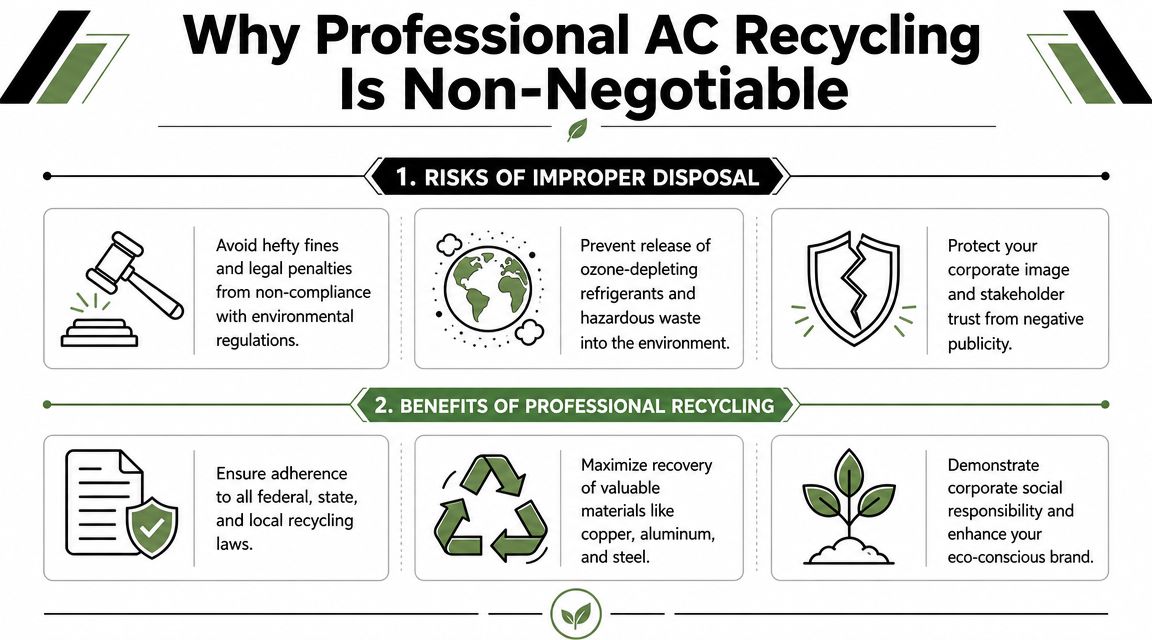
The main reason businesses use a qualified recycler is simple. Window AC units are mixed-material appliances that can create compliance problems before any scrap value is realized. Refrigerant has to be recovered properly. Oils, capacitors, switches, and other components may also require controlled handling, depending on the unit design and downstream process.
That changes how EHS, facilities, and procurement should evaluate the work. The question is not who will haul the units away. The question is whether the provider can accept intact equipment, recover regulated materials correctly, document what was done, and keep the organization out of preventable enforcement and audit trouble.
Teams that already apply responsible e-waste recycling and environmental control practices usually adapt faster here because the operating discipline is similar. Clear custody, approved downstream handling, and usable records matter just as much with appliances as they do with IT assets.
Compliance risk begins before dismantling
The first technical step is refrigerant recovery by qualified personnel using the right process. If a unit is crushed, stripped, or broken down before that happens, the business can lose control of the part of the job regulators care about most.
I have seen organizations focus on pickup price and overlook acceptance conditions. Then the load gets delayed, partially rejected, or rerouted because the vendor cannot process the units as presented. Those mistakes cost more than a properly scoped recycling project.
Professional handling also protects internal staff. Facility teams should not be improvising disassembly, cutting lines, or trying to separate metal from a sealed appliance in a loading area. That creates unnecessary exposure and leaves the company with weak records if questions come up later.
Professional processing protects more than compliance
A qualified provider reduces several business risks at once:
- Regulatory exposure tied to refrigerants, oils, and other controlled materials
- Operational waste from rejected pickups, repeat scheduling, and inconsistent site prep
- Poor documentation that creates problems during audits, sustainability reporting, or vendor reviews
- Brand risk if units are dumped, handled carelessly, or sent into unclear downstream channels
Connected room ACs add one more review point. Some newer units may retain Wi-Fi settings, app pairings, or other configuration data. That does not make every air conditioner an IT asset, but it does mean facilities and IT should confirm whether any reset or account removal step is needed before release.
The practical standard is straightforward. Use a recycler that can manage intact appliances, recover regulated materials in the right order, and provide a clear disposition record. For bulk retirements, that is basic business control, not extra caution.
Evaluating Your Disposal Options for Bulk Units
Most organizations start with the wrong question. They ask where to take old window units. The better question is which disposal path gives the business the right combination of compliance, documentation, logistics, and predictable cost.
That's where the common options separate quickly.
How the options compare
| Disposal path | Best use case | Main weakness |
|---|---|---|
| Municipal or local drop-off | Small one-off volumes | Often awkward for business quantities and business paperwork |
| Informal scrap outlet | Lowest-effort attempt to move material | Little visibility into refrigerant recovery, final handling, or documentation |
| Full-service recycler or ITAD-style provider | Bulk retirements, facility cleanouts, multi-site projects | Requires coordination up front, but usually reduces downstream risk |
The practical gap in the market is paperwork and logistics. Many online guides stop at “find a recycler,” but businesses usually need answers to operational questions before they can approve removal.
One source on AC disposal notes that room air conditioners contain refrigerants and oils that must be recovered by law, and that some programs require a receipt or refrigerant-recovery certificate. It also notes that some recyclers charge handling fees for intact units, which is why disposal cost and documentation need to be clarified before scheduling, as discussed in this practical disposal guide for old air conditioners.
What businesses should ask before approving pickup
Use a short screening checklist. It prevents most bad handoffs.
- Who provides pickup if the load is commercial and staged indoors?
- What proof is issued for refrigerant recovery, recycling, or destruction?
- Are handling fees involved for intact units, difficult access, or mixed loads?
- Does the provider want pre-disassembly by your staff? If yes, that usually creates more risk than value.
- Will the units be permanently decommissioned or could they re-enter secondary circulation?
A value-recovery lens also helps. If your facility is disposing of AC units alongside surplus electronics, office equipment, or related assets, it can make sense to evaluate broader equipment buyback programs for offices at the same time instead of treating every category as a separate removal event.
What works in real operations
Municipal drop-off can work for a homeowner or a single unit. It usually doesn't work well for a business with dock scheduling, internal approvals, and custody requirements.
Informal scrap channels can move material fast, but they rarely satisfy EHS, legal, or sustainability teams when questions come later.
The most reliable approach for bulk window air conditioner recycling is a provider that can handle pickup, controlled processing, and documentation in one process. That's what lowers total friction, even if the quoted line item isn't the cheapest at first glance.
How to Prepare Window AC Units for Pickup
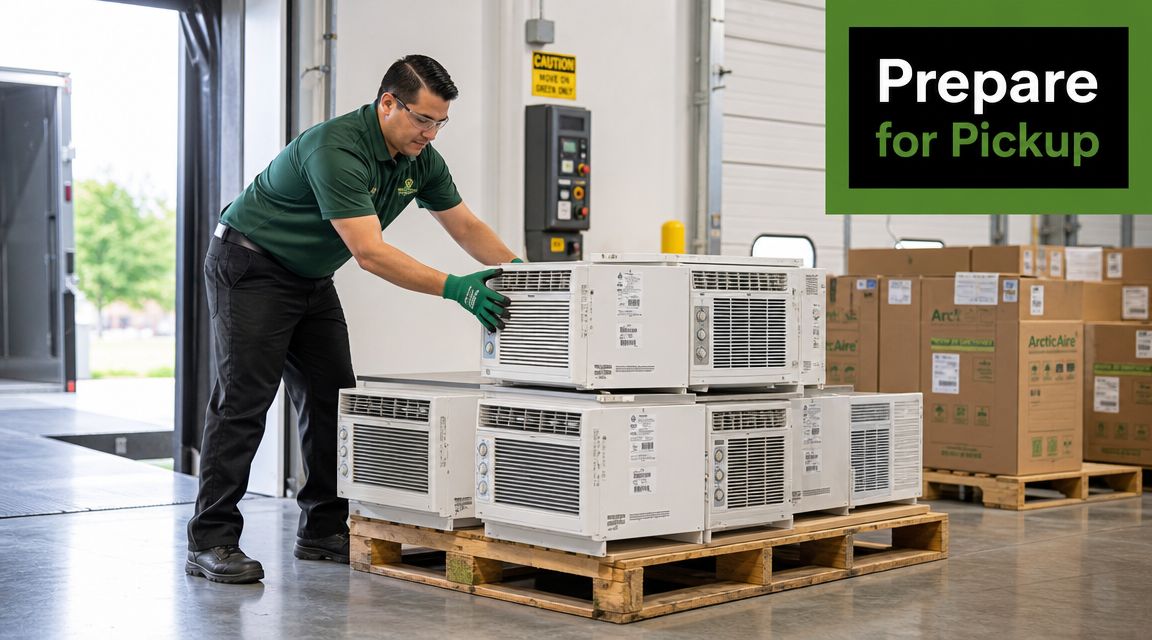
The safest prep plan is simple. Inventory the units, stage them for removal, and leave the technical work to the downstream processor. Most problems start when site staff try to “help” by opening the equipment.
ENERGY STAR notes that replacing a room AC that is 10 years or older can save an average of 132 kWh/year, which makes the oldest units the best starting point when deciding what to retire first, according to the ENERGY STAR room air conditioner turn-in and recycling guidance.
A prep checklist that actually helps the pickup crew
Start with basic control of the assets.
- Count the units. A rough count is better than no count. Separate obvious categories such as working, non-working, damaged, and unknown.
- Note model information if available. If the organization tracks assets, record model numbers, serials, or internal tags only to the level that's useful.
- Flag connected units. If any room ACs were app-enabled or tied to building networks, have IT confirm credentials or settings have been cleared where applicable.
- Stage for safe access. Keep units upright where possible, away from exits, and in an area the pickup crew can reach without moving unrelated inventory.
- Use pallets or stable ground staging. Don't build unstable stacks that can shift during loading.
What your team should not do
The bad idea list is short and important.
- Don't cut copper lines or open the sealed system.
- Don't remove compressors or capacitors on site.
- Don't break housings apart to reduce space.
- Don't leave units exposed to weather if labels and asset identifiers matter for records.
On-site rule: Prep means staging, not dismantling.
If your team wants a broader framework for sorting, labeling, and getting equipment ready before a collection event, this checklist on preparing your company's electronics for recycling maps well to mixed-asset cleanouts and helps standardize handoff conditions.
Prioritize the right units first
If the budget only allows a phased retirement, start with the oldest equipment. Units that have been in service the longest are usually the least efficient and the most likely to create maintenance headaches.
After that, prioritize units that are damaged, leaking, missing covers, or stored in areas where they create safety or space issues. Functional units should be evaluated separately for possible reuse before they're grouped into the recycle stream.
Streamlining Logistics and Ensuring Full Compliance
Good disposition projects succeed before the truck arrives. The pickup day itself should feel routine because the assessment, staging instructions, and paperwork expectations were all set in advance.
That matters even more for bulk appliance retirement than for ordinary junk removal. You're not just moving material off site. You're preserving chain of custody for regulated equipment.
What a smooth pickup process looks like
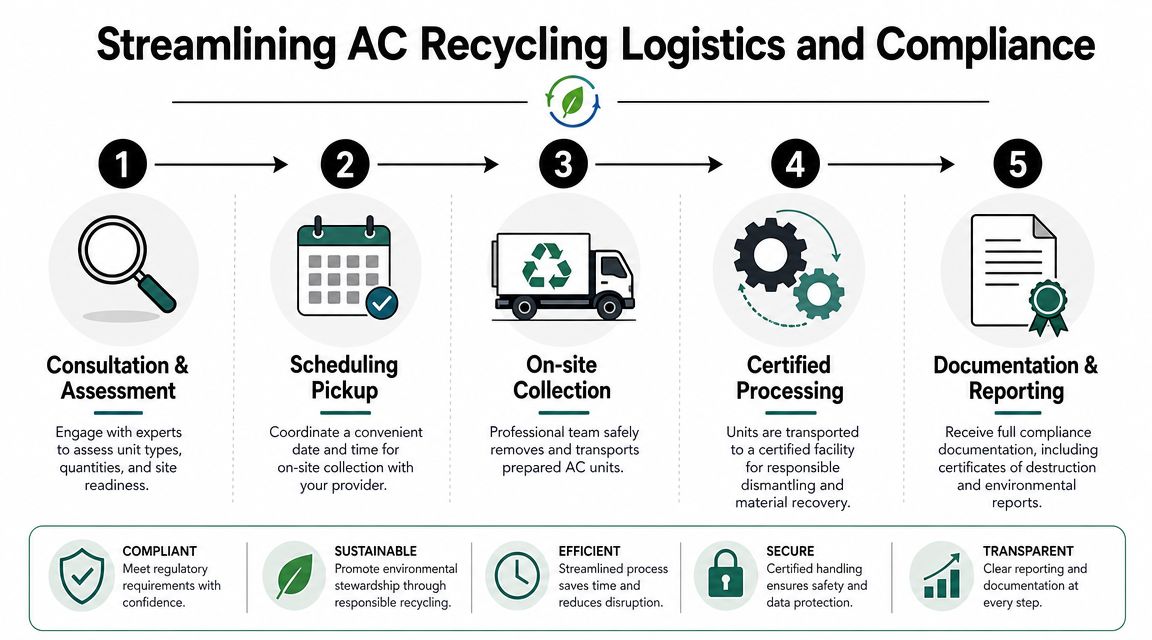
A competent provider usually asks for the same core details first: quantity, unit types, access conditions, loading constraints, and whether the assets are inside, dockside, or spread across multiple rooms.
From there, expect a workflow like this:
- Assessment first. The provider confirms volume, access limits, and whether any units need special handling due to damage or site conditions.
- Scheduling second. Pickup is set around dock time, labor availability, and any building rules for elevators, visitor access, or after-hours work.
- Removal day execution. The crew loads staged units without asking your maintenance team to dismantle equipment.
- Processing and documentation. The units move into a documented downstream process rather than disappearing into a vague scrap chain.
For multi-stop pickups or distributed properties, route planning makes a real difference. If your operations team wants a plain-language overview of how scheduling efficiency improves field pickups, this guide to route optimization for sales teams is useful because the same routing logic applies to collection logistics.
The documentation that matters
Businesses should ask in advance what records they'll receive after pickup. The exact document names vary, but the purpose doesn't. You need evidence that the material was handled through a compliant end-of-life process.
The record set often includes:
| Document type | Why it matters |
|---|---|
| Pickup record or bill of lading | Confirms transfer of custody |
| Recycling or destruction certificate | Supports compliance files and internal audits |
| Itemized asset list, if requested | Helps reconcile counts and internal approvals |
| Environmental reporting support | Useful for ESG, sustainability, or facilities reporting |
Organizations that already manage regulated waste streams often fold these units into their broader universal waste handling approach, especially when AC retirement happens alongside lamps, batteries, or other facility waste categories.
Preventing the biggest program failure
One of the most overlooked issues in appliance recycling is resale. ENERGY STAR program evaluation material notes that turn-in and recycling programs are designed to keep inefficient units out of second-hand circulation, and a major pitfall is the re-sale of old units instead of permanent removal, as reflected in the ComEd appliance recycling evaluation report.
That point deserves attention because it affects the business case. If old units re-enter use outside of defined channels, the energy and environmental gains are diluted. For regulated or publicly accountable organizations, it also creates an avoidable governance problem. The right disposition partner should be clear about whether units are recycled, destroyed, or routed into an approved reuse channel under defined criteria.
Permanent removal from circulation should be a stated outcome, not an assumption.
Value Recovery and Community Impact with Reworx
Not every retired window AC has the same end-of-life path. Some belong in the recycle stream immediately because they're old, damaged, inefficient, or not worth further handling. Others may still function and have real use left, especially when they're newer and can be safely redirected.
That's where the conversation gets better than scrap value alone.
A donation-focused reuse path can be legitimate and socially useful when the equipment is functional, acceptable to the receiving organization, and handled with clear screening standards. One charitable organization notes that working window or room AC units can be accepted for redistribution and that demand rises ahead of summer, as described on the Community Forklift AC donation page.
Reuse, recycle, or retire outright
The practical decision framework is simple.
- Reuse fits working units that pass inspection, meet age and safety expectations, and have a credible receiving channel.
- Recycle fits end-of-life units, obsolete equipment, damaged units, and any item that shouldn't remain in circulation.
- Dispose through controlled decommissioning fits units with compliance, safety, or documentation requirements that rule out casual transfer.
That middle path matters for organizations with active sustainability goals. It lets them separate material recovery from social impact instead of assuming every outgoing asset has only one type of value.
Why this matters to business leadership
For many organizations, the highest return from a cleanout isn't the scrap check. It's lower compliance risk, cleaner reporting, safer facilities, and a stronger story about how surplus assets were managed.
A partner that understands both recycling and value recovery can support that broader outcome. If your team wants to look beyond disposal and evaluate what equipment may still hold residual value, asset recovery planning is the right lens.
The strongest end-of-life program doesn't ask only, “How do we get rid of this?” It asks, “What is the most responsible final use for each unit?”
That's especially relevant for organizations already running donation-based recycling, office cleanout, IT equipment disposal, or corporate donation programs. Window AC retirement may sit outside the data center or computer recycling workflow, but the management logic is the same. Control the handoff, document the outcome, protect the environment, and direct usable assets where they can still do good.
If your business is clearing out old equipment, planning a facility upgrade, or needs a reliable partner for donation-based recycling and compliant pickups, Reworx Recycling can help you turn end-of-life assets into a cleaner, better-documented, community-minded outcome. Schedule a pickup, explore responsible asset recovery, or partner with Reworx Recycling to retire surplus equipment in a way that supports both environmental goals and local impact.