When you hear the term IT Asset Disposition (ITAD), it’s easy to think it’s just a fancy way of saying “getting rid of old office computers.” But for Connecticut businesses, it’s a whole lot more. ITAD is a critical process that touches on data security, environmental compliance, and even recovering value from your retired technology. A smart ITAD strategy ensures every single asset is securely tracked and managed, from the moment it leaves your office to its final destination, all while supporting your corporate social responsibility goals.
What Are Connecticut ITAD Services?
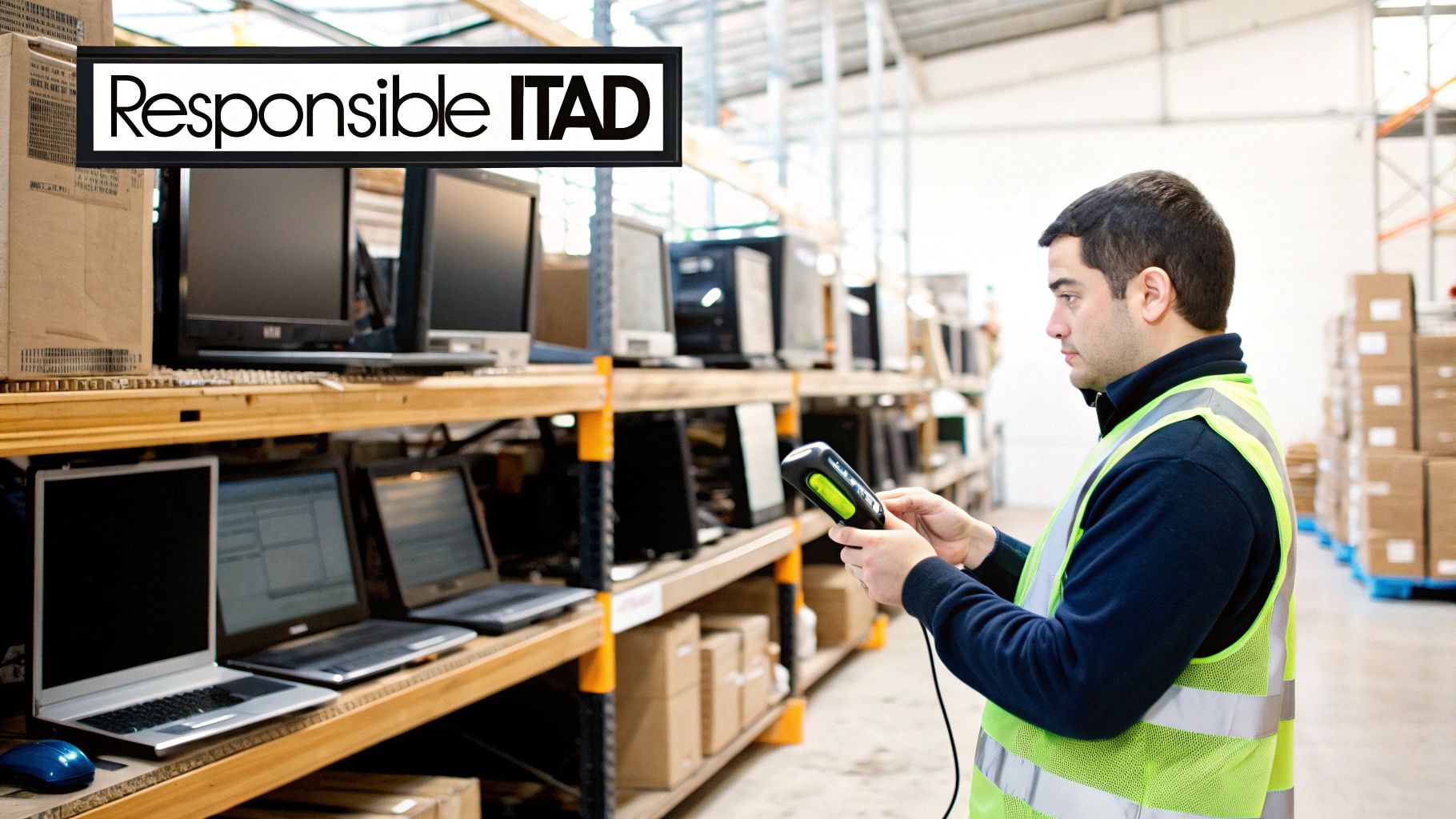
Imagine you’re decommissioning a corporate facility or performing an office cleanout. You wouldn't just throw things in a dumpster. You’d need to account for every desk, chair, and file cabinet. ITAD applies that same meticulous logic to your technology. Every piece of equipment, from laptops and servers to specialized medical or laboratory equipment, must be accounted for, scrubbed clean of sensitive data, and handled responsibly.
This structured approach to retiring technology protects your company from legal, financial, and reputational risks. In a state like Connecticut with its own specific e-waste rules, a formal ITAD program isn't just a good idea; it's a business necessity.
The process covers the entire end-of-life journey for your IT hardware. It starts the second a device is marked for retirement and only ends when you have a certificate of destruction and recycling in hand, giving you a clear, verifiable audit trail.
Core Components of ITAD
A solid ITAD program is built on a few key services that work together to protect your organization and maximize any leftover value.
Here’s what’s usually included:
- Secure Logistics and Pickup: This isn't just a guy in a van. It's safe, documented transportation of your assets from your facility to a secure processing center.
- Secure Data Destruction: This is the big one. It means the irreversible wiping of all data from hard drives and other storage, whether through sophisticated software, degaussing (using powerful magnets), or physical shredding for product destruction.
- Sustainable Recycling: This ensures that non-reusable materials are processed in an environmentally sound way, keeping you compliant with Connecticut's tough electronics recycling laws.
- Asset Remarketing: Some of your old gear might still have life left in it. This service identifies equipment that can be refurbished and resold, which can help offset your disposal costs.
For companies with serious IT infrastructure, ITAD is a non-negotiable part of the bigger IT lifecycle picture. Getting a handle on the full range of essential data center services helps you weave responsible asset disposition into your overall strategy from day one.
When Connecticut businesses partner with a donation-based social enterprise like Reworx Recycling, they add another powerful layer to their ITAD process. Instead of your old equipment just being recycled, it can be put to work for the community. Reworx transforms your retired assets into opportunities, donating refurbished devices to non-profits and workforce development programs. This approach turns IT equipment disposal into a genuine act of corporate social responsibility. You can dive deeper in our guide to electronics recycling in Connecticut.
This mission-driven approach means you meet all your compliance obligations while making a real, positive impact right here in our local community.
Navigating Connecticut’s E-Waste and Data Security Laws
For any business here in the Constitution State, understanding local rules for electronics disposal isn't just good practice—it's mandatory. Connecticut has some of the most established and specific regulations in the country, which elevates ITAD from a simple operational chore to a critical risk management function.
You can't just toss old office computers, printers, or monitors into a dumpster. That’s not just irresponsible; it’s illegal and comes with serious penalties. These laws are built to protect both your company's sensitive data and our local environment, which is home to key industries like advanced manufacturing and bioscience that rely on a clean ecosystem. Ignoring them can lead to hefty fines, legal trouble, and damage to your company's reputation. This is why partnering with a knowledgeable, state-approved ITAD provider is so important for any organization.
Connecticut's Landmark E-Waste Legislation
At the core of our state’s approach is its Extended Producer Responsibility (EPR) law. Connecticut is often pointed to as one of the first and most thorough adopters of EPR for electronics in the U.S., which has created a great environment for specialized Connecticut ITAD services providers to thrive.
Under Public Act 07-189, the state’s e-waste recycling program has been running since 2007 and was fully rolled out in 2011. This law requires manufacturers of TVs, monitors, printers, and computers to pay for their collection and recycling. Since 2011, it's been illegal to dispose of these electronics in solid waste facilities, which really pushes businesses toward certified recyclers. You can learn more about how Connecticut’s waste and recycling programs are set up.
What this all means for your business is that you must work with a recycler approved by the Department of Energy and Environmental Protection (DEEP). A DEEP-approved partner like Reworx Recycling ensures your old equipment is handled in complete compliance with state mandates, giving you the paperwork to prove it.
Data Destruction Requirements and Compliance
Beyond just the environmental rules, Connecticut law puts a heavy emphasis on data security. Getting rid of a hard drive without properly destroying the data on it is a huge liability. Businesses are expected to make sure all personally identifiable information (PII) and corporate data is rendered completely unrecoverable.
To really nail this, ITAD providers have to use certified and secure processes. There are several common data destruction and disposal methods, and picking the right one is absolutely critical for compliance.
Here are a few key data security points for Connecticut businesses to keep in mind:
- Proof of Destruction: Always get a Certificate of Data Destruction. It should detail the serial numbers of the devices that were sanitized.
- Industry Standards: Make sure your vendor follows recognized standards for wiping media.
- Auditable Trail: You need a clear chain of custody from the second that equipment leaves your office.
By partnering with a social enterprise recycling partner like Reworx Recycling, you not only meet Connecticut's stringent e-waste and data security laws but also contribute to a greater cause. Your compliant asset disposal can directly support community programs, turning a regulatory burden into a powerful act of corporate social responsibility.
The Core Services of a Comprehensive ITAD Program
So, we've covered the legal side of things. Now let's get practical. A solid IT Asset Disposition (ITAD) program is really just a collection of specialized services, each one tackling a different stage of a device's retirement journey. When they all work together, you get a process that's secure, compliant, and actually recovers some value. For any business in Connecticut, getting a handle on these core services is the first step to building a smart, responsible plan for your old tech.
This flowchart shows how a Connecticut business can team up with an ITAD partner to nail e-waste compliance from start to finish.

It’s a simple visual, but it traces the critical path from an asset's retirement all the way to documented compliance—a process that’s absolutely required under state law.
To help you see how all the pieces fit together, this table breaks down the main services you’ll encounter in an ITAD program. Think of it as your cheat sheet for understanding what a provider should be doing for your business.
Key ITAD Services for Connecticut Businesses
| ITAD Service | Description | Key Benefit for CT Businesses |
|---|---|---|
| Asset Inventory | Creating a detailed log of every device to be retired, including serial numbers and asset tags. | This creates an auditable "chain of custody" from the very beginning, ensuring no device is lost or unaccounted for. |
| Decommissioning | The physical act of safely unplugging and removing equipment from a live network or data center. | Prevents operational disruptions. For a data center in Stamford, this means no accidental outages. |
| Secure Data Destruction | Permanently erasing all sensitive data from storage media using certified methods. | The most critical step for risk management, protecting your company from devastating data breaches and liability. |
| Electronics Recycling | Responsibly dismantling old devices and separating raw materials for reuse. | Ensures compliance with Connecticut's e-waste laws and prevents hazardous materials from polluting local landfills. |
| Remarketing & Refurbishing | Repairing and reselling still-valuable equipment to recover a portion of its original cost. | Turns an old asset from a liability into a revenue stream, helping to offset the costs of the ITAD program. |
| Corporate Donation Programs | Refurbishing viable equipment for donation to non-profits and community organizations. | A powerful way to demonstrate corporate social responsibility and make a tangible local impact. |
Each of these services plays a specific role, but it’s how they work together that truly protects your organization and meets Connecticut's strict environmental standards.
On-Site Asset Inventory and Decommissioning
The whole process kicks off long before a truck ever shows up at your door. It starts with an on-site asset inventory, which is just a fancy way of saying we systematically catalog every single device you’re getting rid of. We capture serial numbers and asset tags to create a master list. This isn't just paperwork; it's the foundation for the entire disposition process, making sure nothing ever goes missing.
Once everything is logged, decommissioning begins. This is the physical work of disconnecting and removing all that equipment from your active environment. It’s especially important in complex setups like a data center decommissioning or lab cleanout, where yanking the wrong cord could disrupt your entire operation. Imagine a biotech lab in New Haven—they need specialized handling to remove sensitive lab equipment without causing downtime or safety issues.
Secure Data Destruction
This is, without a doubt, the most important service for any business. Period. Secure data destruction ensures every last bit of confidential information on your hard drives, SSDs, and other storage media is gone for good, completely unrecoverable. There are two main ways to get this done:
- Data Wiping/Sanitization: This is a software-based approach where the drive is overwritten with junk data multiple times, effectively erasing what was there before. The big plus here is that the drive itself is preserved and can be reused or resold.
- Physical Shredding: Exactly what it sounds like. We feed the storage device into an industrial shredder that chews it up into tiny, unrecognizable pieces of metal and plastic. This is the ultimate guarantee of data security and is often required for highly sensitive information.
For example, a Hartford-based financial firm would almost certainly choose on-site shredding. It allows them to witness the destruction firsthand, providing an airtight, auditable process that satisfies strict industry regulations.
Responsible Electronics Recycling and Remarketing
After the data is confirmed to be destroyed, we deal with the physical hardware. Any equipment that’s truly at the end of its life is sent for electronics recycling. A certified recycler will take it apart, separating materials like plastics, metals, and glass so they can be processed and reused. This keeps toxic materials out of our landfills, which is a big win for everyone.
But here’s the thing: a lot of retired equipment still has some life left in it. This is where a social enterprise model can make a real difference. Instead of just defaulting to destruction, Reworx Recycling's donation-based approach actively looks for viable equipment that can be refurbished. These renewed assets are then given to support community initiatives, turning what would have been a disposal cost into a tangible social benefit. This unique focus transforms standard Connecticut ITAD services into a powerful tool for corporate social responsibility.
Why Chain of Custody and Certifications Matter
When you hand over your company's old IT assets, you're doing more than just getting rid of used hardware. You're passing on a massive amount of risk and responsibility. This is exactly why the concept of chain of custody is an absolute must-have for any secure Connecticut ITAD services program. It's the paper trail—the documented, auditable log that tracks your equipment from the second it leaves your building until it’s finally destroyed or recycled.
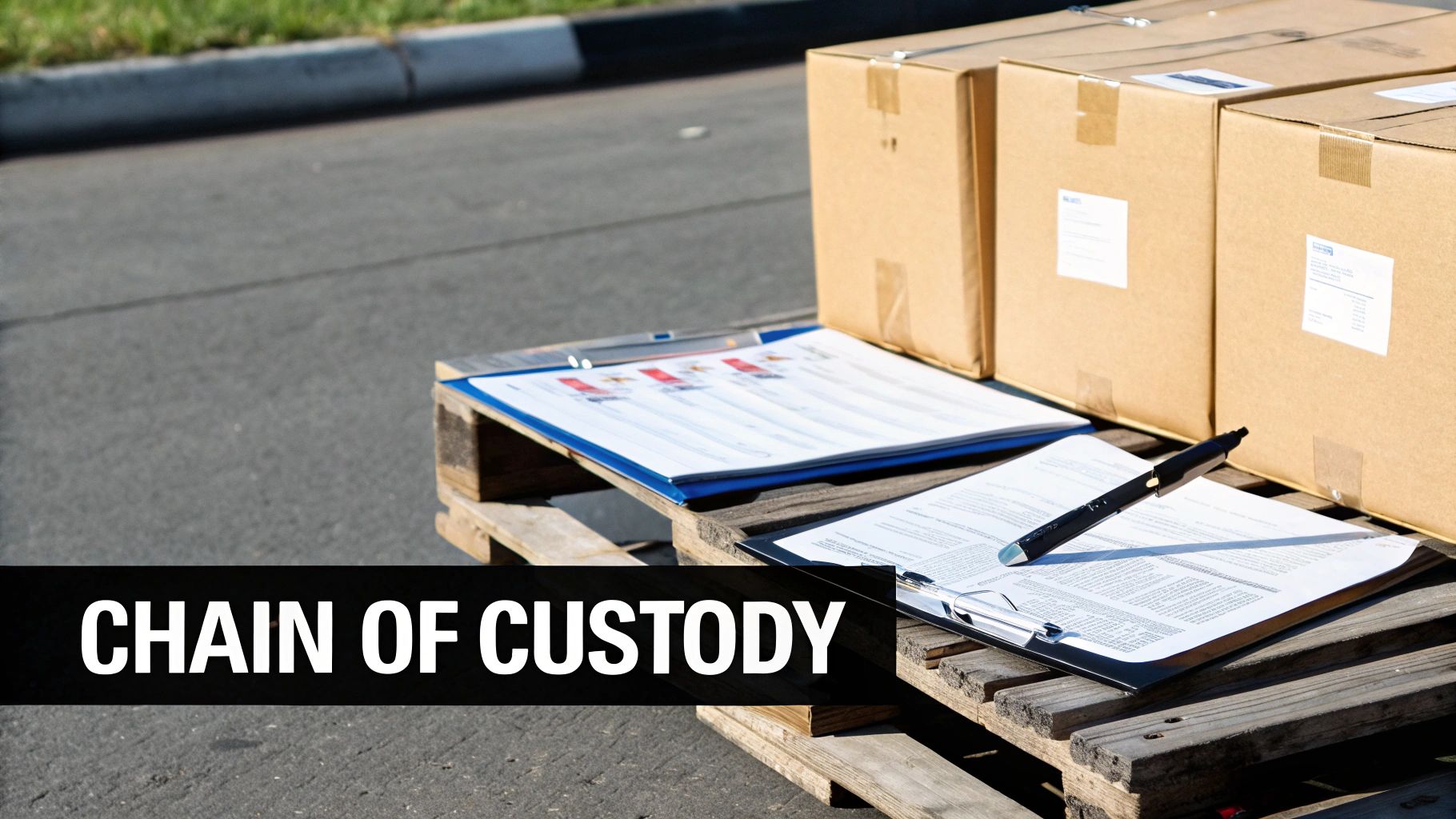
Think of it like the evidence log in a police investigation. An unbroken chain proves that nothing was lost, stolen, or tampered with along the way. Without that meticulous documentation, your business is left wide open to data breach fines and environmental penalties if a hard drive or server ever goes missing.
The Role of Industry Certifications
So, how can you be certain a potential ITAD partner actually sticks to these rigorous standards? The answer is third-party certifications. These aren't just fancy logos slapped on a website; they are hard-earned proof that a vendor's processes have been independently audited and verified against the industry's toughest benchmarks.
For businesses here in Connecticut, two certifications really stand out:
- R2 (Responsible Recycling): This standard is all about protecting the environment, the health and safety of workers, and the security of your data through the entire recycling process.
- e-Stewards: Often seen as the gold standard, e-Stewards has a strict zero-tolerance policy against exporting hazardous e-waste to developing nations and demands the highest possible levels of data security.
These certifications act as a reliable shortcut for vetting quality and compliance. When a provider like Reworx Recycling commits to these standards, it shows a dedication to excellence that directly shields your business from risk. You can get a deeper look at what these credentials mean in our guide to e-waste certification standards.
Compliance with Connecticut’s Universal Waste Rule
Having a solid chain of custody and working with certified partners is especially crucial right here in Connecticut. The state classifies most business electronics as federally defined “Universal Waste,” which means they can only be processed by licensed facilities.
Under Connecticut’s E‑Waste Recycling Law, you can't just toss old electronics in the dumpster. It's illegal. They have to be recycled at a permitted destination facility recognized by DEEP and the EPA. If your discarded hardware is ever found in an illegal dump, your business could be held financially liable without a proper compliance certificate and detailed audit trail to back you up.
A certificate of destruction is more than just a piece of paper—it is your legal shield. It provides auditable proof that you fulfilled your due diligence, securely destroying sensitive data and responsibly recycling hardware in full compliance with state and federal law.
By partnering with a certified social enterprise like Reworx Recycling, you get the transparent, secure, and fully documented process you need to meet these strict state requirements. Our process ensures you not only receive the proof of compliance you need but also make a positive impact on the community.
How to Choose the Right ITAD Partner in Connecticut
Picking the right partner for your Connecticut ITAD services is a big deal. This decision directly impacts your data security, your ability to meet environmental regulations, and even how your brand is perceived. It’s about much more than just finding the cheapest quote. A great partner becomes an extension of your own risk management team, giving you verifiable proof that your old tech is handled the right way from the moment it leaves your building.
This isn’t a choice to be taken lightly. You’re looking for someone who gets the fine print of ITAD but also shares your company's values, especially around corporate social responsibility. The right vendor will lay out a transparent, secure process that not only protects your business but helps you hit your sustainability targets.
Key Questions for Vetting an ITAD Vendor
To really get a feel for a vendor's capabilities and their commitment to doing things right, you have to ask some pointed questions.
Here’s a practical checklist to keep handy during your conversations:
-
DEEP Approval and Certifications: "Are you a DEEP-approved recycler, and can you show me documentation for your R2 or e-Stewards certifications?" This is your baseline. It confirms they’re legally allowed to operate in Connecticut and follow the industry’s most respected standards for security and environmental protection.
-
Data Destruction Methods: "How exactly do you destroy data on solid-state drives (SSDs) compared to traditional hard drives?" This is a trick question of sorts. Standard wiping software often doesn't cut it for SSDs. A partner who knows their stuff will immediately talk about physical shredding to guarantee that data is gone for good.
-
Downstream Recycling Policy: "Can you give me a transparent map of your downstream partners—where do our recycled materials actually go?" This is critical. You need to know your e-waste isn’t being illegally shipped overseas or dumped irresponsibly, which could come back to bite you in a big way.
-
Reporting and Chain of Custody: "What kind of paperwork will we get? I'm talking certificates of destruction, recycling reports, and asset serialization." A detailed, auditable paper trail isn’t just nice to have; it’s your legal proof that you did everything by the book.
The Social Enterprise Advantage
Once you've covered the technical side, think about the partner's impact on the community. When you work with a social enterprise like Reworx Recycling, you’re adding a powerful layer of corporate social responsibility to your ITAD program.
Instead of just grinding everything up, we focus first on refurbishment and donation. We turn your company's retired equipment into incredible resources for local non-profits and workforce development programs. This approach flips a simple compliance task into a genuine contribution to the community. Our guide on selecting a reliable e-waste recycling partner dives deeper into making a choice that helps both your business and your neighbors.
Connecticut’s data-security and recycling rules are getting stricter, raising the bar for what’s expected from enterprise-grade ITAD services. The state’s Electronic Recycling Law, updated for 2025, now connects disposal much more explicitly to data destruction. Businesses are now expected to use DEEP-approved recyclers, and new guidance makes it clear that for SSDs, only physical shredding or NSA-approved methods are considered compliant.
Partnering With Reworx for Responsible ITAD Solutions
Figuring out the complexities of ITAD in Connecticut can feel like a heavy lift. Between strict DEEP regulations and the ever-present risk to your data, it’s a lot to manage. Choosing the right partner isn’t just about getting rid of old gear; it’s about protecting your business, your community, and your reputation. This is where working with Reworx Recycling really changes the game.
We look beyond simple compliance. As a donation-based social enterprise, we see your retired assets as an opportunity to empower our community. Your old equipment, once its data is securely wiped, can find a new life supporting digital inclusion initiatives and local workforce development programs. It’s a unique model that allows your business to meet every environmental and security standard while making a real, measurable social impact. Instead of becoming a liability, your end-of-life technology becomes a legacy.
Choosing Reworx means your ITAD program does more than just tick a compliance box—it actively builds a stronger, more equitable community right here in Connecticut.
Ready to connect your ITAD strategy with your corporate social responsibility goals? Whether you’re planning an office cleanout, need secure data destruction, or have a facility full of equipment to pick up, we provide responsible and impactful Connecticut ITAD services. You can learn more about how we build these valuable relationships by exploring our approach to partnering for impact.
Answering Your Questions About ITAD in Connecticut
When you're dealing with old tech, a lot of practical questions come up. Business owners and IT managers in Connecticut often ask us about the specifics, so we've put together some straightforward answers to the most common ones.
Can My Business Just Drop Off Old Computers at a Local Recycling Center?
It’s a tempting thought, but the answer is a firm no. While your town's recycling center is perfect for residents, it’s not set up to handle the legal and documentation requirements for commercial e-waste.
Business electronics in our state are covered by Connecticut's Universal Waste rule. That means they have to be handled by a DEEP-approved recycler who can give you the proper paperwork. When you work with a certified provider for Connecticut ITAD services like Reworx Recycling, you get a formal certificate of recycling and data destruction. Think of this as your legal proof of compliance—it’s what protects you from liability down the line.
What Happens to the Equipment We Donate to Reworx Recycling?
As a donation-based social enterprise, our first thought is always about giving your retired equipment a second life. Once we’ve completed a secure, fully documented data destruction process, we get to work assessing everything for refurbishment.
Any devices that can be fixed up are repaired and then donated to support digital inclusion programs, local non-profits, and workforce development initiatives right here in Connecticut. This way, your end-of-life assets become powerful tools for someone else in the community. If a piece of equipment is truly beyond repair, it's responsibly recycled according to the highest R2 standards, guaranteeing nothing ever goes to waste.
How Much Do Connecticut ITAD Services Cost?
ITAD service costs can swing a bit based on a few key things. The final price depends on the amount and type of equipment you have, the logistics of getting it from your site to ours, and the specific level of data destruction your organization needs.
The good news is that these costs can often be offset if your assets still have some resale value. Reworx Recycling offers transparent consultations where we'll look at your inventory and give you a clear, competitive quote. Because our model focuses on refurbishment and donation, we can often create more value from your assets than a typical disposal company. That’s a win for your budget and for the community.
Ready to turn your retired IT assets into a force for good? Partner with Reworx Recycling to make sure your business meets all Connecticut compliance standards while supporting digital equity and workforce development. Schedule your pickup or consultation today to get started.
You can learn more by visiting our recycling blog.