Your laptop refresh is done. The new devices are deployed. Users are happy. Then the leftover problem shows up all at once: stacks of retired laptops, a few racks of old servers, damaged monitors, loose drives in a cabinet, and no one fully sure which assets still contain sensitive data.
That situation is common across Atlanta offices, warehouses, healthcare environments, schools, and distributed corporate sites. The mistake is treating it like a cleanup task. It isn’t. End-of-life hardware carries security exposure, compliance obligations, operational friction, and recoverable value. If your team handles it casually, you create risk. If you handle it systematically, you reduce liability and support sustainability goals at the same time.
That’s why IT Asset Disposition Services in Atlanta for Corporate IT Teams should be managed as a formal program, not an occasional purge. Atlanta is already a serious market for this work. The U.S. IT Asset Disposition market reached USD 2.9 billion in 2023, and Atlanta has emerged as a hub for large-scale electronics processing. Improper disposal also carries real consequences, including data breach exposure, with average global breach costs of USD 4.45 million per incident according to Ken Research’s U.S. ITAD market overview.
Navigating the Challenge of End-of-Life IT in Atlanta
A typical Atlanta IT manager doesn’t struggle because they don’t understand hardware. They struggle because retired assets pile up faster than normal operations can absorb them. A film production company finishes a workstation upgrade. A logistics firm replaces handhelds and networking gear. A regional office closes and sends everything to one main location. Suddenly the storage room becomes a holding area for unmanaged risk.
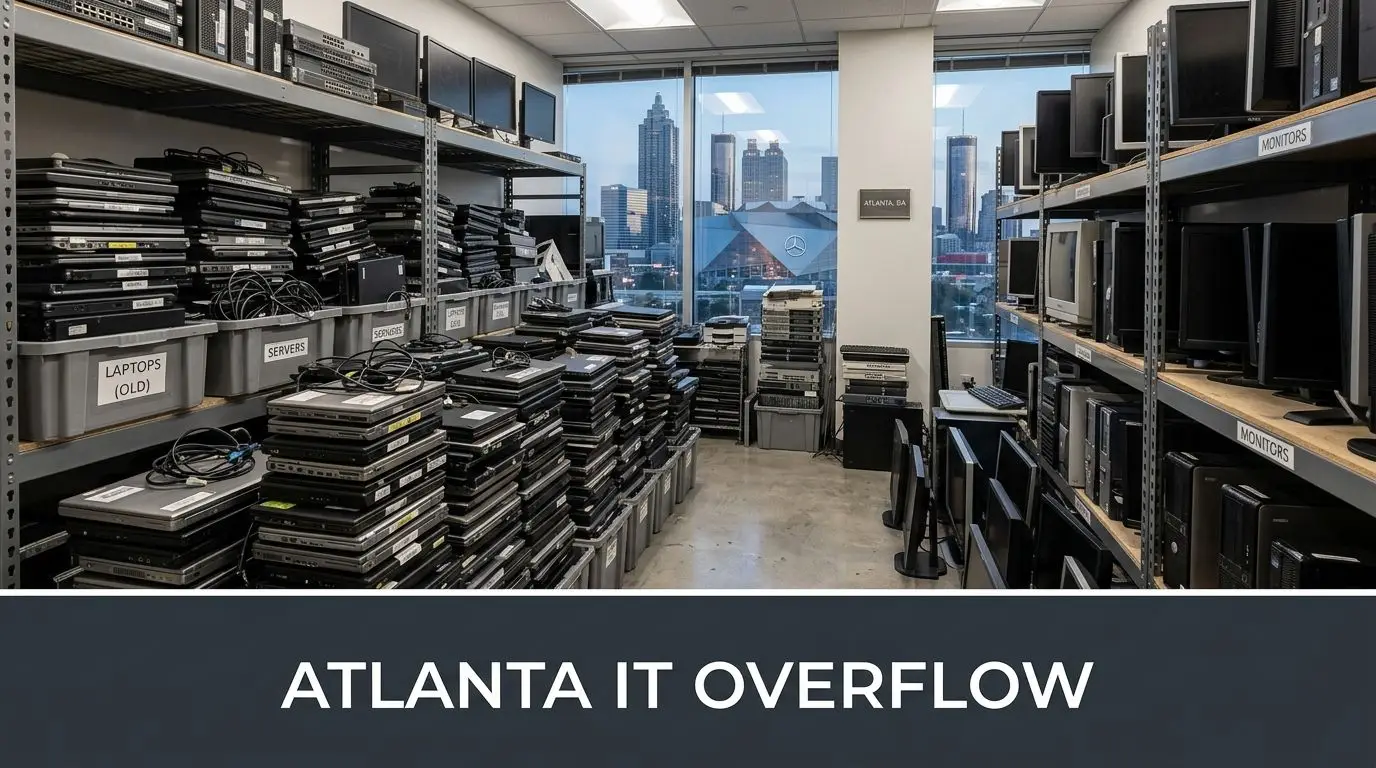
The problem usually starts with good intentions. Teams want to wait until there’s enough volume for a pickup. Finance wants to understand residual value. Security wants proof that drives were handled correctly. Facilities wants the room back. While those conversations drag on, the asset pile grows, labels get lost, and the chain of responsibility gets fuzzy.
Why old equipment becomes a business problem fast
Retired hardware creates three pressures at once:
- Security pressure because storage media may still contain client, employee, or operational data
- Compliance pressure because disposal records need to hold up under audit
- Space and operational pressure because decommissioned equipment disrupts normal workplace use
That’s why mature IT teams stop calling it junk. They treat it as an asset class that needs controlled retirement.
Practical rule: If your team can’t answer where a specific retired laptop is, who handled it last, and what happened to its data, your ITAD process isn’t finished.
Atlanta adds one more layer. The metro area is dense, fast-moving, and operationally spread out. A company may have assets sitting in Buckhead, Midtown, a warehouse corridor near the airport, and satellite sites across Cobb or Gwinnett. That makes pickup scheduling, on-site handling, and audit documentation more important than many teams expect.
Why a local operating model matters
The strongest ITAD programs in Atlanta combine local execution with structured documentation. That includes inventory capture, secure transport, data destruction, and clear downstream disposition. It also helps to work with a provider that understands both urban pickup logistics and the practical realities of business cleanouts, refresh cycles, and data center turnover.
For teams looking at electronics recycling in Atlanta through Reworx Recycling, the local angle matters because retirement decisions are rarely just about recycling. They affect donation pathways, redeployment, secure destruction, and reporting that can be used internally by IT, finance, and sustainability teams.
A strong program changes the conversation. The question stops being, “How do we get this out of the room?” It becomes, “How do we retire these assets securely, recover what we can, and document the outcome in a way leadership can trust?”
Phase One Creating Your Internal ITAD Blueprint
Most ITAD problems start before any vendor is contacted. They begin inside the company, usually with incomplete asset data, unclear ownership, or no agreed rule for what happens to different device types. If you want a clean disposition project, build the internal blueprint first.
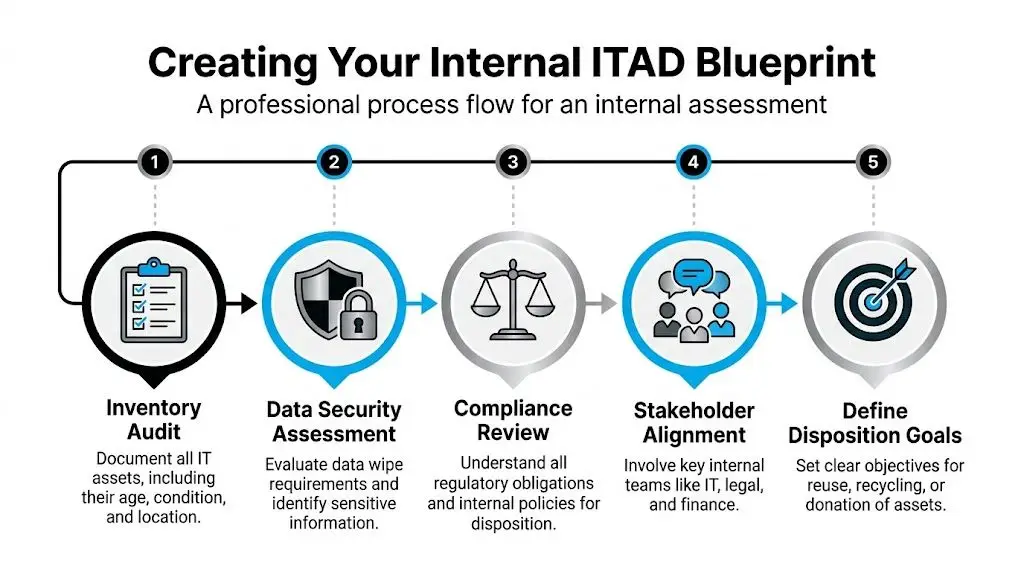
A complete ITAD methodology starts with inventory and assessment, then moves into secure data destruction and an auditable chain of custody. With certified providers, data sanitization success can exceed 99%, and value recovery can offset 10% to 30% of new IT costs, as described in Beyond Surplus’s Atlanta ITAD process overview.
Start with an inventory that an auditor could understand
A useful asset list does more than count devices. It should let someone outside your department understand exactly what is being retired and how sensitive it is.
Capture, at minimum:
- Asset identifier such as serial number, internal tag, or another unique reference
- Device category including laptop, desktop, server, monitor, switch, storage array, mobile device, or printer
- Make and model
- Physical condition
- Current location
- Last user or department
- Storage media present
- Data sensitivity
- Power status or bootability
- Disposition recommendation
Don’t let “miscellaneous electronics” appear on your worksheet. That label creates downstream confusion. If you have a pallet of mixed equipment from an office cleanout, break it down before pickup.
Separate data risk from hardware value
Teams often make one of two mistakes. They either focus only on resale value, or they focus only on destruction. Good ITAD planning keeps both in view.
A practical internal classification model looks like this:
| Asset stream | Typical fit | Management priority |
|---|---|---|
| Redeploy | Newer devices still useful internally | Standardize configuration and transfer records |
| Remarket | Functional assets with secondary market demand | Maximize condition and documentation |
| Donate | Usable equipment that aligns with corporate giving goals | Match devices to approved donation pathway |
| Destroy data and recycle | Broken, obsolete, or low-value assets | Secure sanitization and certified downstream handling |
| Physical destruction | High-risk media or damaged storage | Eliminate recovery risk |
Internal alignment matters. Security may prefer shredding by default. Finance may want remarketing wherever possible. HR may support employee buyback. Sustainability may want reuse and donation emphasized. None of those goals are wrong, but they need a priority order.
Define the outcome before the pickup
The clearest programs set goals in advance. Not vague goals like “dispose responsibly,” but operating goals tied to decision rules.
Use questions like these:
- What must be destroyed on-site? Drives from legal, finance, healthcare, or regulated environments often get stricter handling.
- What can be remarketed? Newer laptops, monitors, and enterprise hardware may justify more careful grading.
- What can be donated? Functional equipment can support community benefit if the chain of custody and data controls are still rigorous.
- What documentation is required? Decide this before the first box leaves the building.
If you wait until the truck arrives to decide whether assets should be wiped, shredded, remarked, or donated, you’ve already made the process harder and riskier.
Involve the right internal stakeholders early
IT shouldn’t build the blueprint alone. The best internal planning sessions include more than one perspective because end-of-life assets touch more than one budget and more than one policy.
The core group usually includes:
- IT operations for inventory accuracy and technical handling
- Security or compliance for sanitization requirements
- Finance for value recovery and write-off treatment
- Facilities for site access, staging, and pickup coordination
- Sustainability or CSR if donation-based recycling is part of the goal
If you need a framework for planning, implementing an IT asset disposition strategy is easiest when those groups agree on the disposition rules before assets leave the building.
A solid internal blueprint won’t make every later choice simple. It will make them defensible. That’s the standard that matters.
Phase Two Selecting the Right Atlanta ITAD Partner
Choosing an ITAD vendor is not a purchasing exercise in the ordinary sense. You’re selecting a company that will handle sensitive assets after they leave your direct control. That means the decision should be based less on marketing language and more on proof.
One issue comes up repeatedly in vendor reviews: pricing confusion. A 2025 Gartner report noted that 68% of SMBs cite unclear pricing as a barrier to adopting ITAD, and teams need ROI models that account for Atlanta transport costs and typical resale recovery of 10% to 30% on retired servers and related enterprise hardware, as noted by Reworx Recycling’s IT asset disposition services page.
What to test in an RFP process
A good RFP doesn’t ask broad questions like “Do you offer secure recycling?” It asks for documented process details.
Use a checklist like this during evaluation:
| Evaluation Criterion | What to Look For | Why It Matters |
|---|---|---|
| Certifications | Current environmental and process certifications, plus willingness to provide documentation | Confirms the vendor operates against recognized standards |
| Data destruction method | Clear explanation of wiping, shredding, and handling by media type | Reduces ambiguity around sanitization |
| Chain of custody | Serialized tracking, scan points, and reporting format | Shows whether you can trace each asset |
| Insurance coverage | Proof of relevant coverage and liability structure | Protects your organization if something goes wrong |
| On-site capabilities | Decommissioning, packing, drive shredding, and pickup procedures | Matters for high-risk or high-volume projects |
| Reporting package | Certificates, audit logs, serialized lists, downstream recycling records | Determines whether compliance review will be easy or painful |
| Logistics reach | Local support plus multi-site coordination if needed | Important for distributed Atlanta or national operations |
| Value recovery model | Transparent grading and resale methodology | Helps finance understand returns |
| Donation pathway | Documented process for reuse and community benefit | Supports CSR and digital inclusion goals |
| Escalation process | Named contacts and issue resolution path | Keeps projects moving when exceptions appear |
What works and what usually fails
The vendors that perform well tend to be specific. They can explain exactly how they receive, scan, segregate, wipe, shred, and report on assets. They don’t rely on broad promises.
The vendors that create problems usually show one or more of these warning signs:
- Unclear pricing language that makes it hard to separate logistics, destruction, and value recovery
- Weak reporting samples that don’t show serial-level accountability
- Generic answers on data destruction with no explanation by media type
- No practical plan for exceptions such as damaged devices, locked systems, or missing asset tags
Ask for sample deliverables, not just assurances. A certificate template, serialized inventory report, and destruction log reveal far more than a sales deck.
Understand the trade-off between lowest cost and lowest risk
Cheap ITAD can become expensive after the fact. A low pickup price might exclude on-site labor, detailed reporting, or proper handling of specialized equipment. On the other hand, the highest quote isn’t automatically the safest option either. What matters is whether the process matches your asset mix and risk profile.
Many teams require a more realistic ROI view. The right calculation includes:
- direct service fees
- labor your internal team still has to provide
- transport complexity
- reporting depth
- likely resale recovery
- risk reduction from stronger chain-of-custody controls
A provider that offers strong documentation and consistent handling can save substantial internal time during finance review, legal review, or audit response. That time is part of the business case, even if it doesn’t appear as a line item on the quote.
Why the social enterprise model deserves a serious look
Most ITAD discussions stay trapped in a narrow frame: wipe the devices, recycle the scrap, capture a buyback where possible. That approach is functional, but incomplete.
A donation-based social enterprise model adds another track for usable assets. Instead of treating every device as either resale inventory or waste stream, it creates a structured path for community benefit without weakening data security controls. For Atlanta organizations with ESG, CSR, or digital inclusion goals, that changes the value equation.
One option in this category is Reworx Recycling among IT asset disposition companies. The practical difference isn’t just where equipment goes. It’s that the disposition strategy can include electronics recycling, donation-based recycling, secure data destruction, computer recycling, office cleanout support, data center decommissioning, product destruction, and corporate donation programs under one operating model.
That matters when leadership asks a broader question: not just “Did we dispose of the hardware correctly?” but “Did we handle retired technology in a way that supports our risk posture, sustainability commitments, and community impact?”
If your vendor can’t answer all three parts, keep looking.
Phase Three Managing Onboarding and Reverse Logistics
Once the vendor is selected, most failures come from execution drift. Pickup gets scheduled before the site is staged. Assets are packed without clear labels. A branch office sends gear with no serial list. Someone assumes the vendor will “sort it out later.” That’s how chain-of-custody gaps appear.
An effective ITAD program includes on-site decommissioning and transport, and best practices can achieve 95%+ landfill diversion rates. Poor standards can also result in 15% to 20% non-compliance fines, according to Atlanta eWaste’s ITAD guidance.

Set service expectations before the first truck rolls
Vendor onboarding should produce a written operating playbook, even if the project itself is straightforward. That playbook doesn’t need to be bloated. It does need to answer who does what, when, and with what documentation.
At minimum, define:
- Pickup request process so sites know how to initiate service
- Site readiness rules covering boxing, palletizing, labeling, and access
- Accepted asset categories so no one mixes unsupported items into the load
- Data handling rules for devices that require wipe versus physical destruction
- Escalation contacts for access problems, quantity changes, or discovered exceptions
Use practical KPIs, not vanity KPIs
A good ITAD scorecard is simple enough to review and specific enough to reveal failure points. If you measure too much, nobody uses it. If you measure too little, problems hide inside “successful” projects.
A workable KPI set often includes:
| KPI | Why it matters | What to review |
|---|---|---|
| Pickup responsiveness | Shows whether sites can move assets out on schedule | Time from request to confirmed pickup |
| Inventory accuracy | Protects chain of custody | Match between site manifest and received assets |
| Reporting turnaround | Keeps finance and compliance work moving | Time to certificates and serialized reports |
| Exception rate | Reveals operational sloppiness | Missing tags, damaged packaging, undocumented media |
| On-site labor efficiency | Helps future planning | Whether staging and removal created disruption |
| Value recovery realization | Tests financial assumptions | Compare projected recoverable assets to actual outcome |
Strong reverse logistics looks boring from the outside. That’s the goal. When staging, pickup, scanning, and reporting happen without surprises, your controls are working.
Reverse logistics in Atlanta takes planning
Metro Atlanta projects often involve more than one type of site. A downtown office has elevator and loading dock constraints. A suburban campus may have easier truck access but larger volumes. A medical or lab environment may need tighter access control. A data center decommissioning project may require rack-level coordination, scheduled downtime, and specialized packing.
That means your logistics plan should answer practical questions early:
- Will assets be collected from one staging point or multiple floors?
- Who signs off at release?
- Are there after-hours access requirements?
- Are loose drives handled separately from whole units?
- Is on-site shredding required for some media?
- Will one project cover all Atlanta sites, or will pickups be phased?
For organizations with multiple locations, centralized oversight matters. One corporate contact should manage manifests, scheduling approvals, and final reports, even if local site contacts handle day-of access.
Don’t ignore the handoff details
The handoff is where internal control becomes third-party control. That transition should be deliberate.
Teams get better results when they:
- Stage by asset type so laptops, monitors, servers, and loose media aren’t mixed
- Label exceptions clearly such as damaged devices or assets without tags
- Photograph staging areas for internal recordkeeping before release
- Restrict ad hoc additions on pickup day unless they’re added to the manifest
- Confirm receipt process so site staff know what proof they’ll receive
If you’re building a broader operating model around reverse logistics services for business asset recovery, the main lesson is simple: logistics is not separate from compliance. It is compliance in motion.
That’s especially true for laptop disposal, facility cleanout work, product destruction, and multi-site computer recycling projects where physical control breaks down easily unless every handoff is recorded.
Phase Four Ensuring Long-Term Compliance and Value
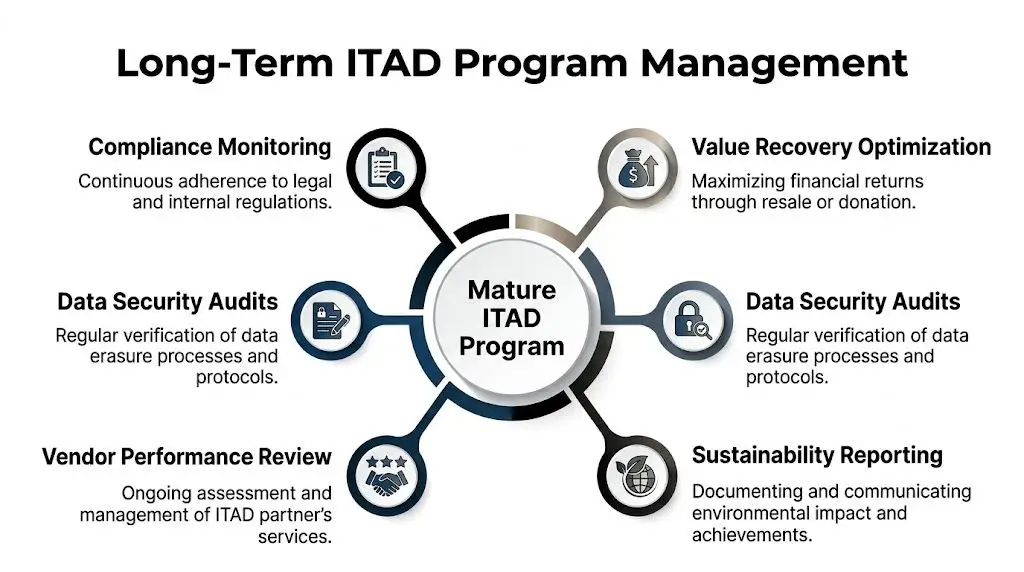
A mature ITAD program doesn’t end with a pickup and a certificate. The long-term value comes from turning each disposition cycle into a repeatable management system. That system should help your team answer four ongoing questions: Was the data handled correctly? Did we recover value where appropriate? Did we dispose of the remainder responsibly? Can we prove all of it later?
One emerging development in Atlanta is AI-driven inventory auditing and blockchain traceability. A 2026 EPA Southeast report noted that Atlanta’s e-waste volumes rose 22% year over year due to AI hardware upgrades, and these tools can reduce audit discrepancies by 40%, according to ITAD Tech’s overview of advanced tracking in ITAD.
The documents that actually matter
Many teams collect certificates but never audit them. That weakens the whole program. Documentation only protects you if it’s specific, complete, and tied back to your internal inventory.
Review these records carefully:
- Certificate of data destruction with clear reference to handled media and method used
- Serialized asset report that maps what was received and what happened to it
- Certificate of recycling or downstream disposition documentation
- Value recovery summary for assets sold or reused
- Exception report for items that arrived damaged, unscannable, or outside normal process
Look for consistency across documents. If the serialized asset list and the destruction report don’t align, stop and reconcile it before closing the project.
Value recovery is broader than resale
Finance teams often reduce ITAD value to buyback proceeds. That’s too narrow. Value can come from resale, redeployment, component harvesting, donation alignment, reduced storage burden, and smoother refresh operations.
A practical long-term review should separate value into three buckets:
| Value bucket | What it includes | Why leadership should care |
|---|---|---|
| Direct financial return | Remarketing or buyback proceeds | Offsets refresh cost |
| Risk avoidance | Better controls, fewer chain-of-custody gaps, cleaner audit trail | Reduces exposure to security and compliance issues |
| Mission and sustainability value | Donation pathways, landfill diversion, community benefit | Supports ESG and CSR reporting |
That last category matters more than it used to. Corporate sustainability teams increasingly want proof that end-of-life electronics were handled through a responsible, documented process. Donation-based recycling and sustainable recycling shouldn’t be bolted on at the end. They belong in the planning model from the start.
Mature ITAD programs don’t force a choice between security and sustainability. They design a process where reuse, recycling, and destruction each happen under the right controls.
Build a review rhythm instead of treating ITAD as an event
The best-run programs create a recurring review cadence. Quarterly or post-project reviews are often enough for most organizations. The point is to examine patterns, not just close tickets.
Review questions should include:
- Which asset categories created the most exceptions?
- Did certain sites submit poor manifests repeatedly?
- Were there delays in certificate delivery?
- Did expected value recovery match actual outcome?
- Are remote and hybrid worker returns creating chain-of-custody weak spots?
Forward-looking teams are also paying more attention to stronger tracking tools. AI-assisted auditing can help spot mismatches earlier, and blockchain-style traceability appeals to organizations that need a more durable custody record across distributed environments.
For companies that want stricter controls around secure data destruction services, the future-proof move is to ask not just how data is destroyed, but how the evidence of destruction is created, verified, and retained over time.
That shift matters for standard office refreshes, data center decommissioning, medical equipment disposal, laboratory equipment disposal, and any hybrid workforce environment where retired assets don’t all originate from one controlled room. Strong documentation turns one-off cleanups into a dependable governance process.
Transform Your ITAD Program with a Purpose-Driven Partner
Most Atlanta companies don’t need more retired hardware sitting in a closet while teams debate what to do with it. They need a disciplined operating model. Inventory first. Clear disposition rules second. Careful vendor selection third. Tight logistics and durable reporting every time after that.
That approach protects the company, but it also creates room for something better than simple disposal. A well-run ITAD program can support electronics recycling, secure data destruction, sustainable recycling, computer recycling, laptop disposal, office cleanout planning, facility cleanout projects, and corporate donation programs without treating those goals as separate initiatives.
The most useful shift is mental. Stop thinking of ITAD as the end of the hardware story. For many assets, it’s the point where business value is recovered, environmental impact is reduced, and social impact becomes possible. That’s especially true when usable devices can move through documented donation-based recycling channels rather than defaulting to scrap.
For Atlanta corporate IT teams, that broader view is practical, not sentimental. Leadership already expects stronger governance around security, procurement, sustainability, and community impact. ITAD sits at the intersection of all four. If your program only answers the disposal question, it’s incomplete.
A purpose-driven partner helps close that gap by making secure retirement, documented recycling, and community benefit part of the same operating process. That is a stronger model for modern IT management, and it gives your organization a better answer when someone asks what happened to the old equipment after the refresh.
If your team is planning a refresh, office cleanout, data center decommissioning, or ongoing IT equipment disposal workflow, Reworx Recycling is worth reviewing as part of your options. Atlanta businesses can use their resources to plan secure pickups, evaluate donation-based recycling opportunities, and build an ITAD process that supports environmental responsibility, digital inclusion, and reliable end-of-life handling.