In 2025, 52% of surveyed organizations reported compliance with the NIST SP 800-88 data-sanitization standard, up from 34% in 2024, according to Sage's IT asset disposition benchmarking report. That's a useful direction, but a company's disposal process still comes down to individual decisions: which equipment can stay useful, which storage needs destruction, and which records prove the work was completed.
Corporate IT equipment disposal isn't a choice between security and sustainability. A controlled program can protect information while preserving working computers for resale or community use. The mistake is treating either a shredder or a recycling certificate as a complete disposal strategy.
Plan the Disposal Program Before Any Asset Moves
Assign owners and deadlines before the refresh becomes a storage-room problem. A disposal program works like a move-out checklist for an entire building: every room has a named person, a date, and a definition of done. IT owns inventory and security decisions, facilities controls collection, and procurement defines what the disposal partner must deliver.
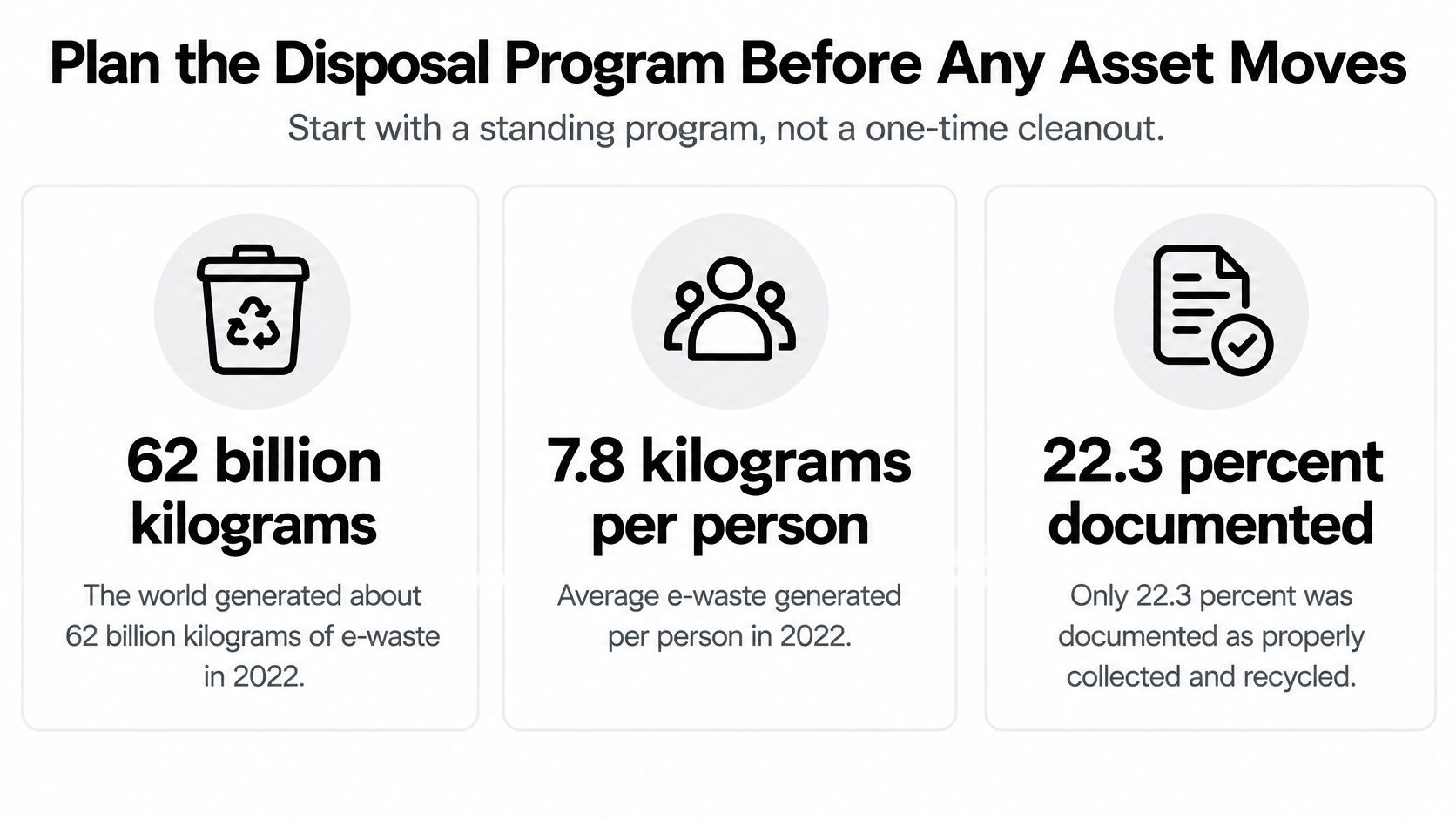
The scale warrants a standing program rather than a one-off pickup. In 2022, the world generated approximately 62 billion kilograms of e-waste, and only 22.3% was documented as formally collected and recycled, according to the Global E-waste Monitor 2024. Those totals cover household and business equipment, not corporate assets alone, but they explain why auditors and sustainability teams now ask where retired hardware went.
Give Each Team a Defined Deliverable
- IT: Maintain device records, sanitization logs, and serial-number reconciliation.
- Facilities: Set dock access, pickup windows, weight-ticket requirements, and responsibility for batteries and applicable state e-waste duties.
- Procurement: Own the statement of work, insurance requirements, and vendor accountability.
- Sustainability: Approve diversion reporting and the claims the company publishes.
- Legal or records management: Set document retention and identify assets subject to holds.
Three dates turn that list into a program: an inventory deadline, a pickup date, and a file-close date. Run an IT equipment audit to establish what is present before requesting collection, so the pickup quote and the final disposition record rest on counted assets rather than estimates.
Start With the Destination
Classify equipment for reuse, resale, donation, or destruction before anything is scheduled. The destination decides everything downstream: a laptop headed for buyback needs sanitization that can be verified, while a failed drive that cannot be read may need shredding. Treating destruction as the automatic answer wastes working gear, and treating a recycling certificate as proof of sanitization leaves data risk unaddressed, since that certificate confirms materials handling rather than what happened to the data on each serial number.
Reworx Recycling is a full-service electronics recycling and IT asset disposition partner based in Smyrna, Georgia, offering business pickups, equipment decommissioning, and secure hard-drive shredding. Classify assets before booking a truck, regardless of which partner you select.
Choose Reuse Resale Donation or Destruction
Sanitization Choice by Asset and Next Use
| Asset and sensitivity | Method | Allowed next step | Evidence to keep |
|---|---|---|---|
| Working laptop, low sensitivity, stays internal | Clear by overwrite or block erase using a supported, media-appropriate technique | Reuse inside the company | Per-device log with operator, time, tool, and version |
| Confidential drive leaving company control, still working | Purge or cryptographic erase when its prerequisites are satisfied | Resale or donation only after validation | Independent verification plus disposition record |
| Failed, unrecognized, or locked media that cannot be verified | Physical destruction, including hard-drive shredding | Materials recovery only | Chain of custody and representative destruction sampling, since the media cannot be read after shredding |
| High-sensitivity media with no reuse plan | Destruction, often the lower-cost choice | Recycle materials only | Method record tied to the serial, not a blanket recycling certificate |
| Cloud volume or keys held by an outside provider | Logical or cryptographic sanitization of the store and keys | Retire the account after associated data obligations are resolved | Key or volume destruction evidence, separate from the device |
NIST's September 2025 SP 800-88 Revision 2 guidance emphasizes an enterprise sanitization program tied to information sensitivity, intended reuse, validation, and accountable controls. Apply the matrix as a decision aid, not blanket authorization to use a particular tool.
Destruction can be the simplest choice when media won't be reused. Shredding working devices, however, removes resale and donation value and can conflict with sustainability goals.
Preserve Equipment When the Evidence Supports It
For an internal laptop reassignment, first identify the storage technology and confirm that the approved clearing technique supports it. An overwrite option that works for a magnetic disk isn't automatically appropriate for flash storage.
A confidential drive leaving company control requires a stronger decision. Choose an appropriate purge technique, confirm its successful execution, and obtain acceptance of the remaining confidentiality risk before release.
Cryptographic erase isn't just deleting a password. Establish whether encryption protected the relevant data, which keys must be sanitized, and whether copies of those keys remain elsewhere. Document those prerequisites before relying on the method.
A failed or locked drive needs a different route when the team can't demonstrate successful sanitization. Destroy the storage medium using an approved process, but assess the rest of the computer separately. A laptop may remain reusable after its failed drive is removed and replaced.
For reusable endpoints, IT asset recovery planning can establish whether resale or donation is practical. Mobile-device assessments also benefit from model-specific context, such as NeoTeo's phone guides and analysis, alongside the manufacturer's technical documentation. Consumer specifications alone don't establish sanitization assurance.
Close the Cloud Exception
Shredding a laptop doesn't sanitize its cloud volumes, backups, or externally managed keys. Assign an owner to those resources and require provider-side evidence where appropriate before closing the retirement ticket.
Corporate donation needs a verified method that leaves the equipment usable. Don't accept a certificate of recycling as proof of sanitization: it doesn't establish which method ran, whether it succeeded, or whether someone approved the result.
Qualify Recyclers Before Any Asset Moves
Qualify every organization that may handle the equipment before releasing it. Your statement of work should identify the processing facility, approved disposition routes, evidence requirements, and responsibility for subcontractors.
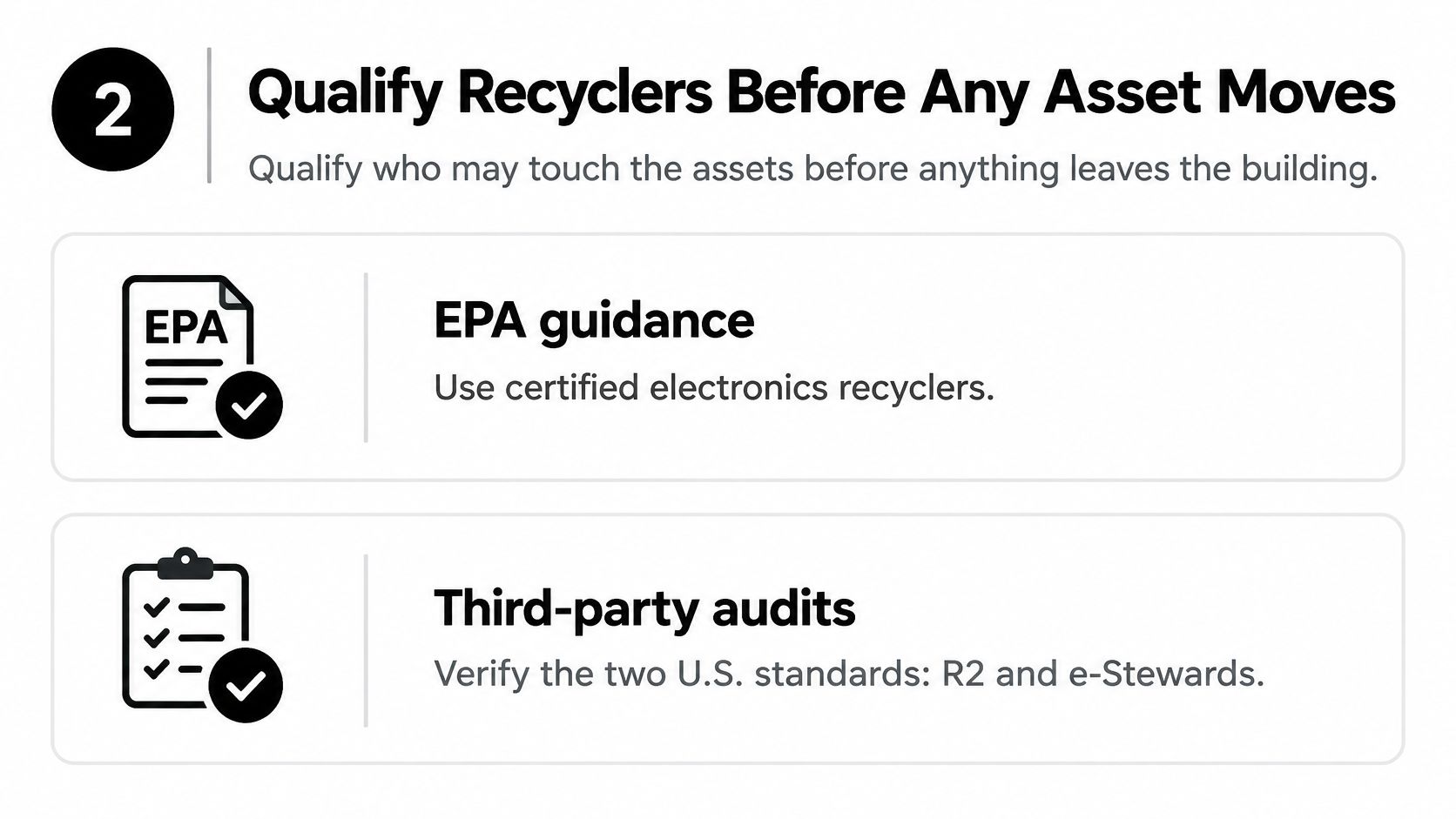
The U.S. Environmental Protection Agency's electronics guidance recommends certified electronics recyclers and identifies R2, Responsible Recycling, and e-Stewards as accredited certification standards in the United States. Independent third-party audits address environmental management, worker health and safety, and security practices.
Score Controls Before Unit Price
Use the following as pass-fail procurement questions rather than optional preferences.
RFP Checkpoints for an ITAD Vendor
| Checkpoint | Require in the bid | Reject the bid if |
|---|---|---|
| Certification | Current R2 or e-Stewards certificate and the independent auditor's name | Only a marketing claim that equipment is recycled responsibly |
| Data evidence | Per-serial method, tool and version, operator, and timestamp | One blanket certificate of recycling for the shipment |
| Downstream | Named processors and no uncontrolled export | Unknown brokers or unnamed overseas handoffs |
| Logistics | Serialized chain-of-custody manifest and sealed transport | A loose pickup with no manifest |
| Accountability | Insurance, worker safety program, and a contractual audit right | No right to review logs or downstream records |
Check that the certificate covers the facility and activities proposed for your project. Ask who performs sanitization, who handles exceptions, and whether another processor receives storage media.
These questions apply to ordinary laptop disposal and larger data center decommissioning projects. Medical equipment disposal and laboratory equipment disposal also need clear acceptance criteria: identify embedded storage, separate non-electronic hazards, and confirm that the vendor accepts the equipment's condition.
Contract for Distinct Outcomes
Product destruction and donation serve different purposes. If goods must not return to the market, specify that restriction and the required destruction evidence. If the goal is buyback or donation, require testing and handling that preserve usability after sanitization.
For an office cleanout or facility cleanout, don't let a broad removal contract override these distinctions. Label the approved route on the asset list and require written authorization before the vendor changes it.
Use documented vendor selection criteria to compare proposals consistently. The publisher should pass the same checks as any other shortlisted provider; a social mission isn't a substitute for operational evidence.
Certification also doesn't transfer every local obligation to the recycler. Facilities should ask the vendor to state who handles battery packaging, transport arrangements, and applicable state e-waste requirements. Procurement should resolve those assignments before comparing the final collection price.
Move Every Asset Through Six Controlled Stages
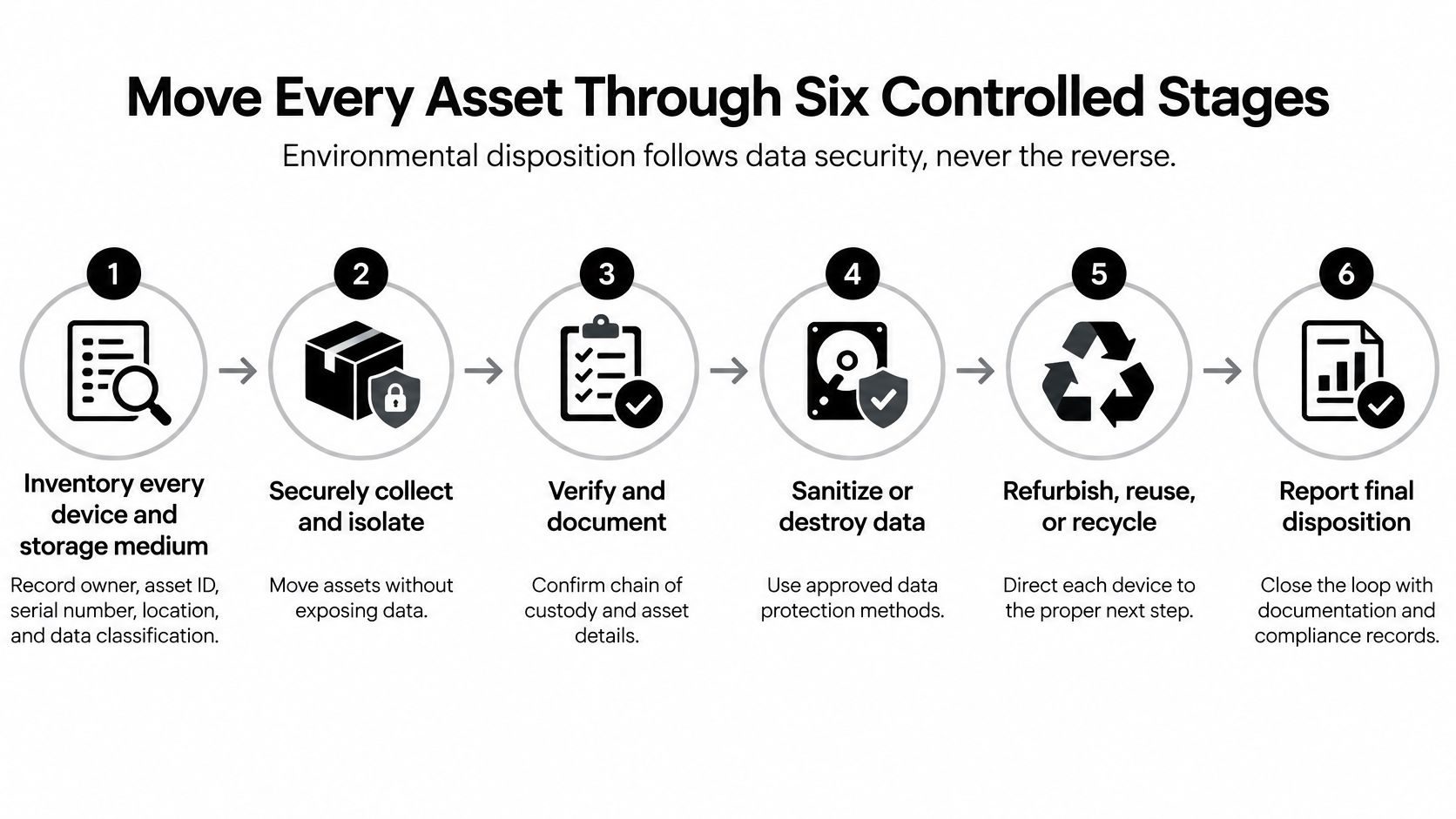
Environmental disposition follows data security, never the reverse. Equipment shouldn't enter an unrestricted reuse or recycling stream while its data status remains unresolved.
NIST SP 800-88 Revision 2 distinguishes verification, checking the technical result, from validation, deciding whether the evidence supports accepting the remaining confidentiality risk. Keep those decisions separate in the workflow.
Establish Identity and Control
Inventory every device and storage medium. Record owner, asset identifier, serial number, location, data classification, and disposition status. Reconcile the list against the physical count. Quarantine unknown, damaged, encrypted, or failed media until someone resolves its identity and treatment requirements.
Apply chain of custody. Use sealed containers, a serialized manifest, and a named receiver at each transfer. Record custody changes rather than assuming that a carrier's delivery receipt identifies everything inside the shipment.
Select the appropriate sanitization method. Match clear, purge, or destroy to sensitivity, storage technology, and intended destination. Confirm that the tool recognizes the correct media type and capacity. Stop when it reports an unexpected device size or fails to identify a drive.
For example, a server chassis may contain boot storage as well as its main drive array. Recording only the chassis serial leaves the team without an account of the individual data-bearing components.
Execute, Check, and Authorize Release
Execute the approved operation. Use trained personnel and tools whose calibration or maintenance status is documented where applicable. Capture machine-readable logs, including errors. Don't allow an operator to substitute another method when the approved process fails.
Verify the technical result. Confirm that the operation completed without errors and produced the required evidence. Where the method supports per-device results, sampling must not replace them. When destruction prevents read-back, use representative checks of the destruction process and output, with independent checking where feasible.
Validate the disposition decision. An authorized reviewer decides whether the evidence is sufficient for the information's sensitivity and intended release. Failed verification requires rework or escalation to a stronger method, typically destruction when adequate confidentiality assurance can't otherwise be demonstrated.
NIST's earlier verification guidance describes pseudorandom read-back locations across user-addressable and reserved areas, with non-overlapping samples covering at least 5% of each subsection, and two samples providing at least 10% coverage once all subsections are represented. That is a technique for readable media, not an instruction to read shredded fragments. Destruction requires appropriate physical and process checks.
Release gate: A completed operation isn't permission to release an asset until the designated reviewer accepts its evidence.
Maintain a disposition record for every serial: operator, timestamp, method, tool and version, calibration status where applicable, exceptions, and final outcome. Use chain-of-custody documentation to connect those records to physical transfers.
Track inventory completeness, recorded sanitization outcomes, independent verification results, and rework or escalation. Report each measure separately, with a defined denominator, rather than combining them into an unexplained success rate.
Book Buyback Donation and the Audit File
Choose the financial or community outcome after establishing the approved treatment. Finance needs evidence of ownership and value; community recipients need equipment that works; sustainability staff need records of what happened.
Separate Buyback, Donation, and Material Recovery
Buyback suits surplus laptops, desktops, and networking gear that the company owns and can legitimately transfer. Confirm that equipment is off lease, record cosmetic and functional condition, and obtain a written value quote before collection. State whether the quote is provisional and how inspection deductions will be approved.
Donation uses the same security threshold, with additional attention to usability. Confirm the recipient's needs, the equipment's operating condition, and what accessories or setup support are included. A working desktop without a suitable power supply isn't a complete donation.
Material recovery is the route for irreparable equipment and media that cannot safely enter reuse. Unverifiable data-bearing storage must first receive approved destruction; scrap eligibility doesn't remove that security step.
Proving Documents by Outcome
| Outcome | Eligibility | Proving documents |
|---|---|---|
| Buyback | Owned, off lease, sanitized, graded | Per-serial sanitization log, grade report, value quote, buyback receipt |
| Donation | Reusable, sanitized, recipient fits the program | Per-serial sanitization log, donation receipt, inventory export, recipient acknowledgment |
| Scrap or material recovery | Irreparable or unverifiable, with required data treatment completed | Chain-of-custody manifest, destruction log where applicable, certificate tied to batch IDs, weight ticket |
Build a Searchable Audit Packet
Keep the complete inventory export, custody manifest, sanitization or destruction logs, exception report, and final certificates together. Certificate batch identifiers should map back to individual serials. Include a downstream summary that sustainability staff can interpret without reconstructing the project from emails.
Set retention through the organization's security-records policy and counsel's direction. Store records in a controlled repository searchable by serial number, not only by pickup date or invoice.
- Weight diverted: Publish measured weight supported by tickets and a clearly defined destination.
- Units donated or reused: Count documented transfers or internal redeployments, not equipment merely marked as potentially reusable.
Don't publish a recycling percentage the processor hasn't measured. Keep donation counts separate from material-recovery weights so readers can understand the outcome.
Assign IT the sanitization logs and serial reconciliation, and facilities the weight ticket and collection records. Finance should retain the buyback settlement, while the program owner confirms that the shared audit packet is complete.
Avoid Operating Mistakes at the Dock
In 2025, 49% of data-center devices were reportedly destroyed for privacy reasons, and 47% of those destroyed devices were still functional, according to a Blancco Technology Group report summarized by Resource Recycling. That finding challenges a destroy-by-default habit, not the legitimate use of destruction for media that requires it.
The loading dock is where an approved plan can still become an unrecorded decision. Give the pickup coordinator authority to pause loading when the shipment doesn't match the paperwork.
Resolve Exceptions Before Loading
- Battery handling: Route lithium batteries and battery-containing equipment through the shipper's approved battery process before sealing the pallet. Don't improvise removal or pack damaged batteries with ordinary equipment.
- Count discrepancies: Photograph the staged equipment when the physical count and manifest disagree. Recount, identify the missing or additional assets, and obtain an amended manifest before departure.
- Lease-return equipment: Keep leased assets out of destruction queues until the lessor confirms ownership, return obligations, or written authorization. An internal retirement ticket doesn't establish title.
- Employee peripherals: During a mixed office cleanout, tag personal items and peripherals employees are authorized to retain. Resolve ownership before they enter the corporate disposal manifest.
A driver's signature should confirm a reconciled handoff, not serve as a promise to work out the missing equipment later.
Review Destruction Decisions
Ask IT and facilities to review the previous quarter's destruction log for functional equipment. Separate justified storage destruction from whole-device destruction that may have removed a donation or buyback opportunity.
For each questionable entry, identify the actual reason: failed sanitization, contractual restrictions, missing ownership records, or an unchecked default. Change the routing rule where appropriate, rather than asking dock staff to make security decisions during loading.
Schedule a Pickup or Corporate Donation
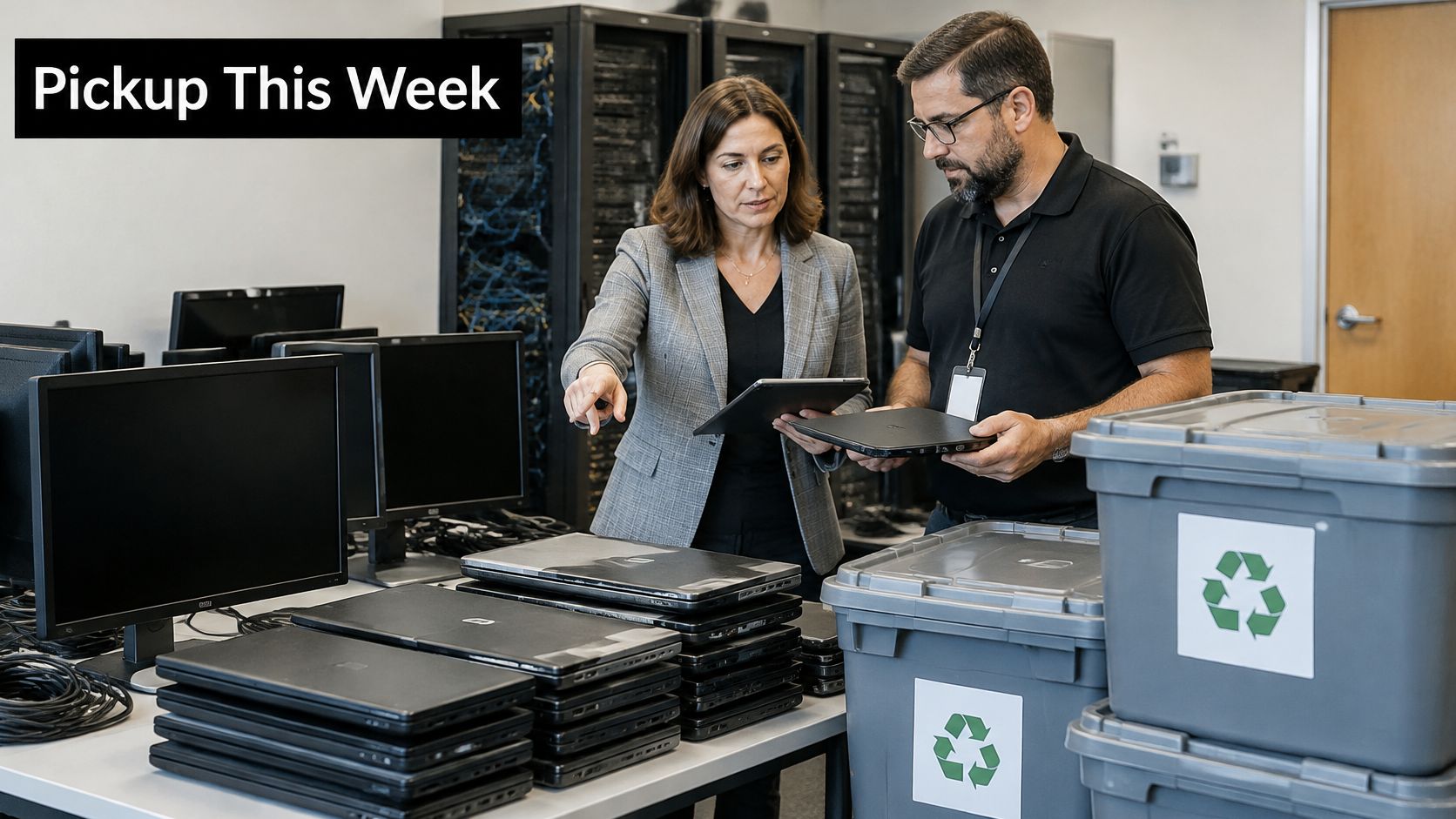
A vague pickup request produces a vague pickup. "Come collect our old computers" tells the provider nothing about dock access, data handling, or which machines could still serve a second life. Turn the next refresh date into a controlled collection request instead: start with the asset list, mark a proposed destination for each group, and state which equipment needs decommissioning, secure hard-drive shredding, buyback assessment, or donation screening.
That routing choice determines what evidence comes back to you. A device headed for shredding needs destruction records, while a functional laptop flagged for buyback or donation needs a data-wipe record that preserves its resale value, not a destroyed drive. Keep one distinction clear: a certificate of recycling confirms material handling, and it does not prove data was sanitized. Request sanitization evidence as its own line item.
For businesses planning computer recycling in Smyrna, Georgia, this preparation applies whether the project involves a small office or equipment from several locations. Schools, companies, and public agencies should also identify site-access restrictions, loading arrangements, and the person authorized to sign the handoff.
Make the Collection Request Actionable
- Send the inventory: Include equipment types, serials where available, condition, storage status, and proposed disposition.
- Offer a pickup window: Specify the site, dock access, loading constraints, and the onsite contact.
- Define the evidence: Require a reconciled per-serial custody record before departure, followed by sanitization or destruction records on the agreed schedule.
- Flag reusable equipment: Mark functional devices for donation screening and confirm recipient acceptance criteria before promising hardware to a program.
Use business electronics recycling pickup scheduling to open the logistics conversation. Fold donation assessment and secure data destruction requirements into the same project scope rather than arranging separate, disconnected collections.
Connect the Outcome to the Mission
Donation-based recycling can support technology access, digital inclusion, and workforce development when usable devices reach appropriate programs. Responsible material recovery addresses equipment that can no longer serve that purpose, helping keep e-waste out of landfills. One truck can carry both outcomes: failed drives under a destruction ticket, working laptops under a donation manifest.
Send the asset list and a pickup window, and require serial-level handoff evidence before the truck leaves. Corporate disposal and community donation work as one project when the equipment is suitable and the paperwork is complete.
Reworx Recycling offers business pickups, equipment decommissioning, secure hard-drive shredding, and buyback options. Visit Reworx Recycling to plan your equipment retirement, then share your asset list and preferred pickup window so the team can discuss secure handling, documented outcomes, and opportunities to support community technology access.