A facilities manager is standing in front of a locked storage room, looking at retired laptops, a few servers, and boxes of cables waiting for someone to decide what happens next. Legal wants to know whether the data was removed. Sustainability wants evidence for its reporting. Procurement wants to know whether the equipment has any residual value. A pickup receipt alone won't answer those questions.
Corporate Electronics Recycling needs to work as a controlled business process, not a last-minute cleanout. The organization must decide how to sanitize each asset, qualify the recycler for the specific work involved, and keep records that show where equipment went and what happened to it. Those decisions matter because an undocumented handoff can leave data, compliance, financial, and reputational risks unresolved.
This guide gives IT, facilities, procurement, and sustainability teams a practical way to make those decisions. You'll find a framework for vendor review, media sanitization, regulatory checks, chain-of-custody records, and reporting. For broader planning around equipment use and retirement, optimize asset lifecycle with Forge Reliability is a useful companion resource.
When the Storage Room Becomes a Liability
The first move isn't to call a recycler. It's to stop treating the storage room as an informal holding area and assign someone ownership of the retired equipment. Until the organization knows what's there, who is responsible, and whether the devices contain storage media, nobody can make a defensible decision about disposal.
Start with a basic inventory. Record each device's asset tag or serial number, device type, location, and known storage media. Flag equipment that may contain regulated, confidential, or proprietary information. Then identify which assets can be reused, which might qualify for donation or resale after sanitization, and which may need recycling or destruction.
Practical rule: If a device leaves your building before it appears on an inventory, your audit trail starts with a gap.
A hardware refresh can surface the problem quickly. IT may have already removed a laptop from management systems, but that doesn't prove its data was sanitized. A facilities team may have arranged a convenient pickup, but convenience doesn't establish who took custody or which downstream facility received the load. A sustainability report may claim responsible recycling, but a general receipt may not identify the equipment or its final disposition.
Assign an internal owner before scheduling pickup. That person should coordinate IT, facilities, procurement, information security, legal, and sustainability, then close the project only after records have been reconciled. This turns an ad hoc decision into a repeatable program: inventory first, risk-based sanitization, qualified processing, and evidence retained together.
What Corporate Electronics Recycling and ITAD Actually Mean
IT asset disposition (ITAD) is the end-of-life counterpart to procurement. It governs what happens when company technology is retired, including data sanitization, redeployment, donation, resale, material recovery, and responsible disposal. Corporate electronics recycling is the broader program around those outcomes.
Think of a fleet of devices like a household preparing for retirement. Data privacy is the pension, protecting what must not be exposed. Compliance is the legal paperwork, showing that obligations were met. Material recovery is the estate sale, finding useful value in equipment and components. Donation is charitable giving, extending the useful life of suitable devices through community organizations.
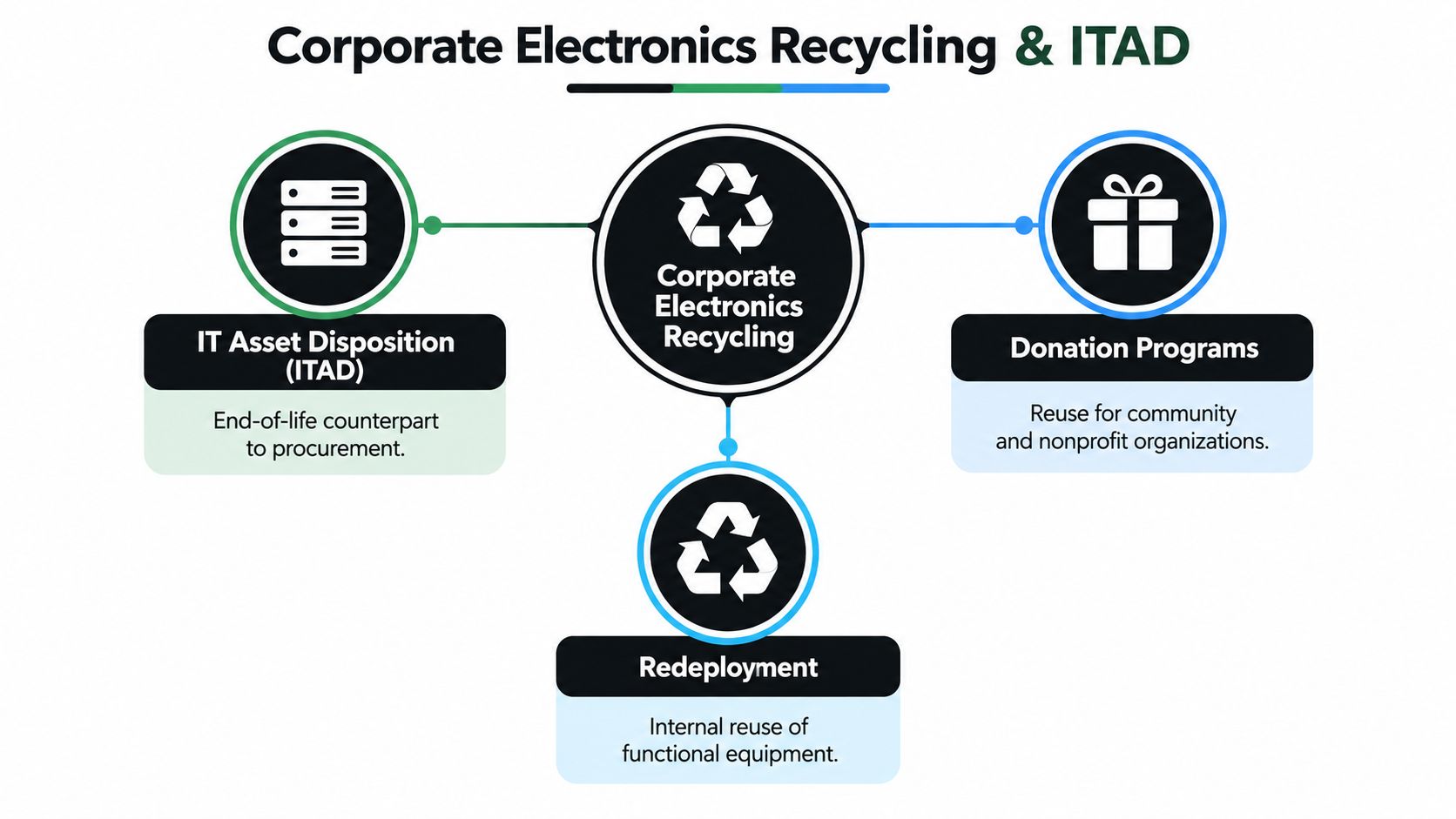
A consumer drop-off typically handles individual devices. A corporate program has different demands: equipment may include laptops, servers, monitors, mobile devices, networking equipment, and peripherals, all with different data risks and disposition paths. Business volumes also call for inventory controls, pickup planning, internal approvals, and records that support audits and sustainability reporting.
The people involved should be clear from the start. IT identifies assets and storage media; information security determines data sensitivity; facilities coordinates secure staging and access; procurement reviews contract terms and vendor qualifications; sustainability defines reporting needs. The recycler and its downstream processors carry out the agreed work, while internal auditors or external reviewers may later examine the evidence.
Use one program logic throughout: identify each asset, select a disposition path, apply the right data control, preserve custody records, and verify the final outcome. Donation, resale, redeployment, and recycling aren't competing goals. They're different routes for equipment, selected according to its condition, data risk, and business requirements.
Choosing How Data Dies on Each Device
Don't apply one destruction method to every device. NIST Special Publication 800-88 Revision 2 distinguishes Clear, Purge, and Destroy, giving organizations a way to match sanitization to media type, data sensitivity, and intended disposition. The standard was published in September 2025, and the choices have different consequences for security and reuse.
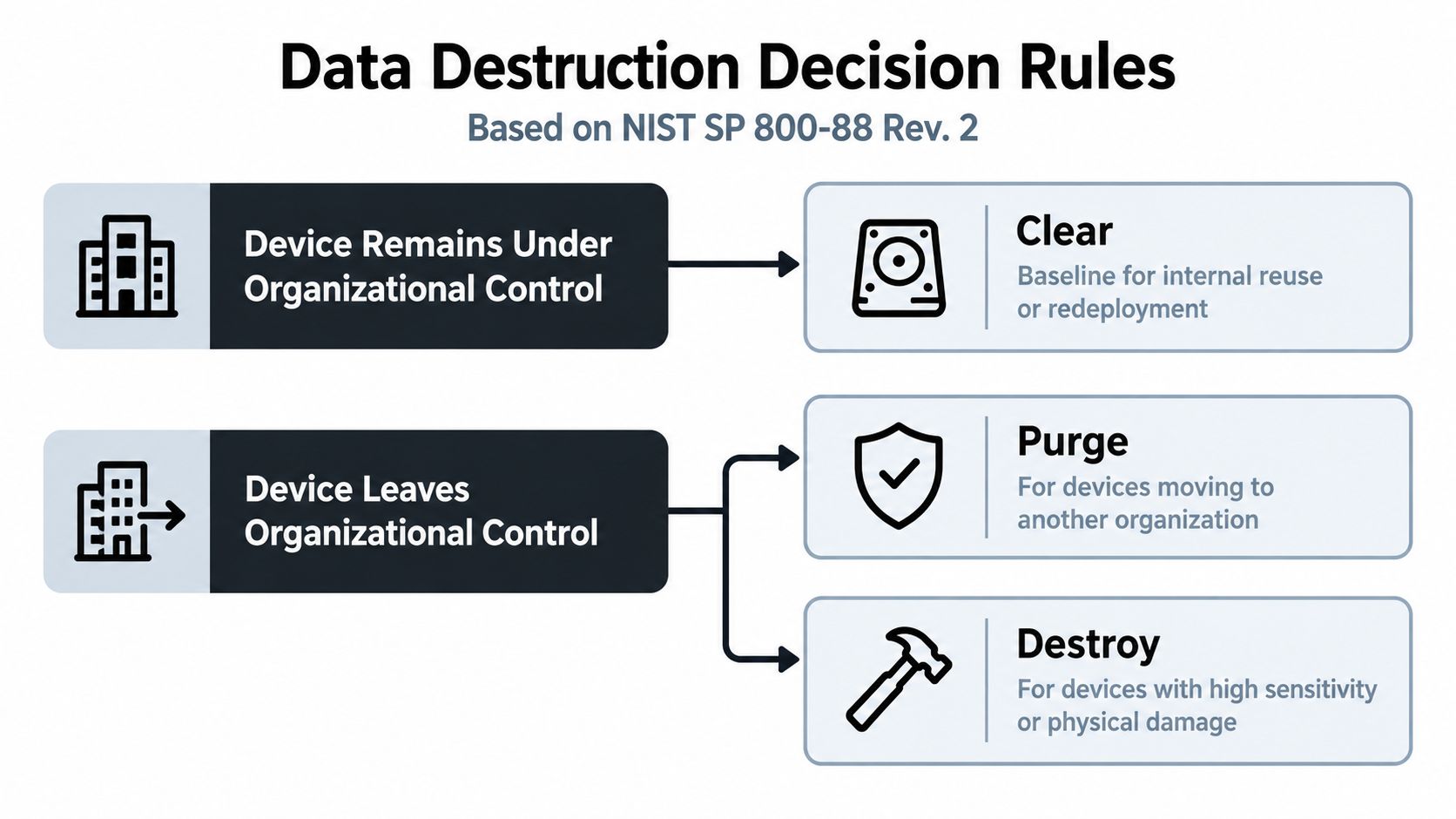
- Clear uses logical techniques to address user-accessible storage locations. It's a practical baseline when a device remains under organizational control and will be redeployed, with a verification step to confirm the operation completed.
- Purge uses methods intended to make recovery infeasible while potentially leaving the device usable. Consider it when equipment will leave the organization but the hardware has a suitable reuse path.
- Destroy renders the media unusable and makes data recovery infeasible. Use it when sanitization can't be reliably verified, the media is damaged, or the risk assessment calls for physical destruction.
The difference is like filing a paper document under a new name versus shredding it. Renaming doesn't remove the contents. But shredding every file, including documents that could be securely archived, sacrifices potential value without automatically improving the control for every situation.
Overwriting alone may not adequately address SSD and flash-media wear leveling. Cryptographic erase can be effective for encrypted laptops and servers when all relevant encryption keys are securely zeroized. If the organization can't confirm the method fits the storage technology, it shouldn't accept a generic “wiped” status.
Require a record for each asset: serial number or asset identifier, method used, verification result, date, responsible technician, and chain-of-custody history. NIST also distinguishes verification, checking that the sanitization operation completed without errors, from validation, where responsible personnel decide whether the result meets the required confidentiality level. Reworx Recycling's data destruction information can help teams review the available approaches. Unnecessary destruction can eliminate redeployment, resale, donation, and material-recovery options, so choose the method deliberately.
The Regulatory Requirements You Have to Map
Start the regulatory review where equipment piles up, not when a shipment is already staged on the loading dock. The first determination is a waste classification: does your retired equipment qualify as hazardous waste under RCRA before you accumulate, store, transport, or dispose of it? That answer dictates which downstream providers you can legally use and what records you must keep. If nobody on your team has made that determination in writing, you have a gap an auditor will find.
Then map the obligations that follow the data, not just the hardware. State e-waste laws and breach-notification rules apply in the locations where devices sat and where incidents could occur. Federal regimes, including HIPAA, GLBA, and FTC safeguards, can also govern how you protect information and oversee the service providers touching it. Which rules apply depends on your entity type, the data involved, and the activity performed, so have compliance and legal confirm the list. A vendor's blanket "we're compliant" is not a determination.
Cross-border movement demands the most scrutiny. Beginning January 1, 2025, international shipments of electrical and electronic waste or scrap destined for recovery or disposal generally require prior written consent from the importing country and any transit countries before departure, under Basel Convention amendments. The EPA also says U.S. imports and exports of hazardous waste regulated under RCRA are subject to requirements in 40 CFR Part 262, Subpart H, including prior informed consent, shipment tracking, and confirmation of receipt and recovery. Treat every export like controlled cargo: the route, the permissions, and each handoff need documentation before the container moves. See the EPA's guidance on international e-waste requirements.
The EU's WEEE framework shows why collection claims have to be measurable. According to the EU legal summary of the WEEE framework, Eurostat reported a 39% EU-wide WEEE collection rate in 2024, well below the framework's 65% target under the applicable calculation method. Corporate programs face the same discipline problem: "we recycled it" means nothing unless weights, serial numbers, and final disposition reconcile across every document in the chain. For practical guidance on building that record, review Reworx Recycling's data security and compliance information.
| Activity | Primary U.S. Rule | Key Documentation |
|---|---|---|
| Accumulating and storing retired electronics | RCRA hazardous-waste screening, as applicable | Waste determination and handling records |
| Sanitizing devices containing protected information | Applicable privacy and security obligations | Asset-level method, verification, and completion records |
| Transporting hazardous waste across borders | 40 CFR Part 262, Subpart H, as applicable | Consent, shipment tracking, and receipt or recovery confirmation |
Evaluating Vendors Beyond the Sales Pitch
A certification logo doesn't prove that a facility is certified for every service in your project. Under R2v3, process requirements apply to the activities a facility performs. SERI's R2v3 applicability guidance says facilities conducting logical data sanitization for ITAD and mobile-repair operations must be certified for the applicable requirements. Enhanced physical sanitization also brings added controls for physical security, traceability, records, and quality.

Ask to see the vendor's certification scope and compare it with the work you're buying. Does the scope cover logical data sanitization, mobile repair, or the enhanced physical sanitization method the vendor proposes? Which facility will perform the work? If the vendor uses downstream processors, who handles each stage, and what records will the vendor provide?
SERI's specialty-process requirements identify important proof for logical sanitization. Appendix B requires records generated by data-wiping software for each device and removal of cloud connections such as “Find My iPhone,” which could otherwise allow data to be repopulated. Ask whether the provider can produce those device-level records, not merely a general certificate stating that a batch was processed.
Watch for weak answers:
- Vague custody language: “We handle everything securely” doesn't identify handoffs, locations, or controls.
- Aggregate-only records: A certificate listing a quantity of devices can't be reconciled to your serial-number inventory.
- Unclear certification scope: A facility's certification may not cover the exact process in your contract.
- Evidence held back: If the vendor can't describe which records it will return, don't assume they'll appear after pickup.
Make the vendor demonstrate the process with sample documentation and a clear account of what happens to reusable, damaged, and unsanitizable equipment. A recycler acts as an extension of your organization's compliance posture. The contract should specify responsibilities, records, approved methods, and what happens when assets can't follow the standard path. Use Reworx Recycling's vendor selection criteria as a reference when structuring that review.
Logistics, Chain of Custody, and Downstream Documentation
Treat a retired-device shipment like high-value cargo. The loading dock receipt is only the first record. A defensible chain follows the equipment from your inventory through transport, receiving, processing, and final disposition.
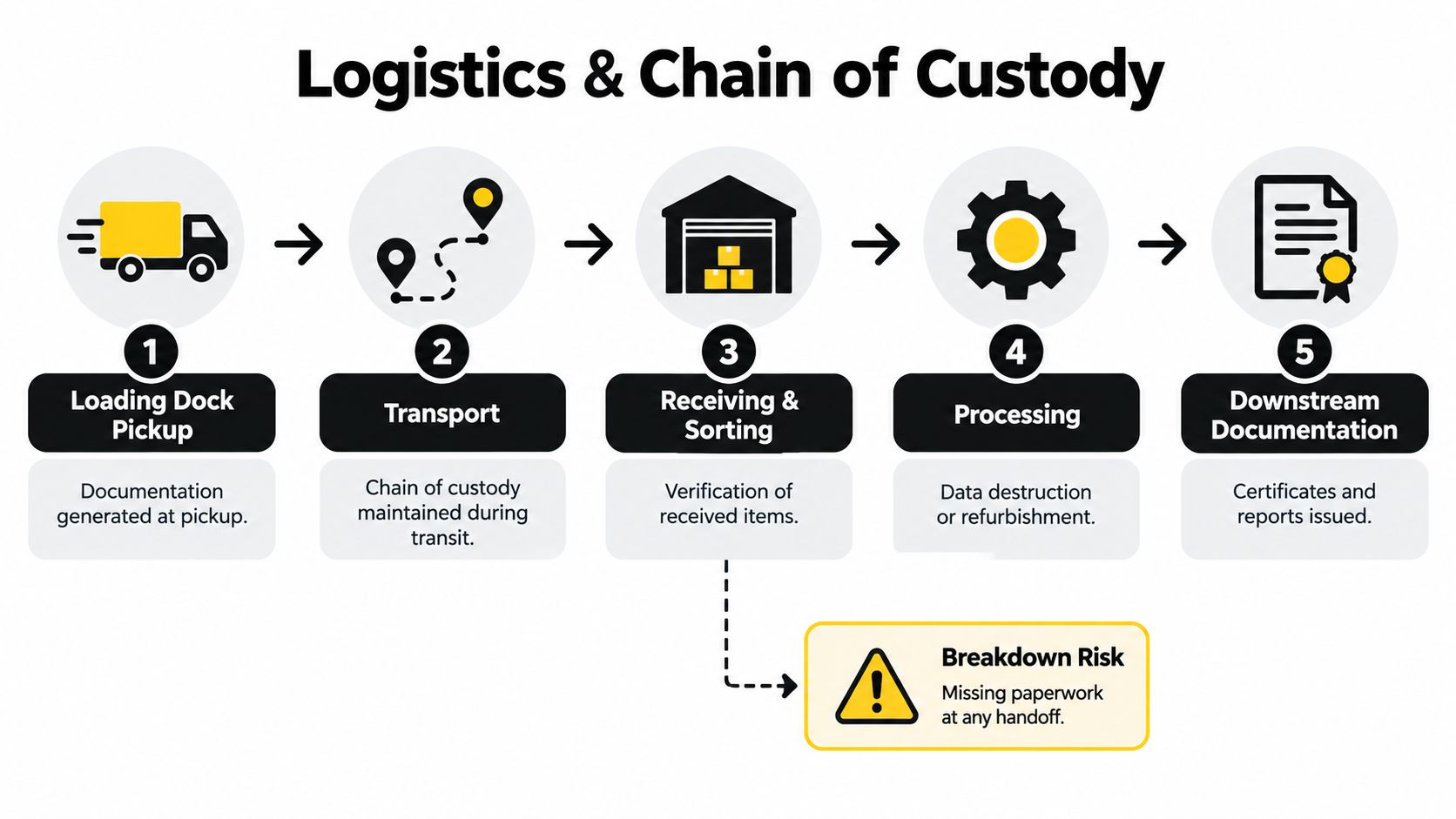
Before pickup, lock down the inventory and record who is authorized to release equipment. At collection, document the date, location, count, and transfer of custody. The vendor's receiving record should confirm what arrived and identify discrepancies while they can still be investigated. After processing, collect the sanitization results, certificates, weight tickets, destination information, and final disposition records.
Missing paperwork at a handoff isn't a clerical detail. It's a break in the evidence that connects your inventory to the final outcome.
Reconcile records rather than filing them separately. Match serial numbers from your original inventory to the vendor's received-device list and data-sanitization records. Compare total weights with weight tickets and the processor's report, allowing the vendor to explain differences such as packaging or equipment that was removed from the shipment. Then connect each asset or material stream to its destination and final disposition, such as reuse, resale, dismantling, commodity recovery, regulated-waste treatment, or destruction.
Edge cases need explicit treatment. If a device is uneconomical to repair, record whether it will be dismantled or recycled. If a battery is damaged, identify it before pickup and agree on safe handling. If media can't be reliably sanitized, document the reason and the approved destruction route. Don't let these assets disappear into a generic “recycling” category.
Businesses must determine whether discarded electronics qualify as hazardous waste before accumulation, storage, transport, or disposal. Downstream accountability may require reconciling inventory records with serial numbers, weights, sanitization results, destination facilities, and final disposition, as outlined in this corporate e-waste compliance guide. Keep pickup documentation, custody logs, certificates, weight tickets, and downstream evidence together so an auditor, grant reviewer, or public-records requester can follow the trail. Reworx Recycling's chain-of-custody documentation guidance is a useful reference for setting expectations.
Turning the Program into ESG and Audit-Ready Evidence
A credible sustainability claim starts with operating records. Diversion weights, reuse outcomes, sanitization certificates, and destination information give sustainability and procurement teams evidence to assess and report. Broad statements like “we recycle responsibly” don't tell a reviewer how much equipment was reused, where materials went, or whether data-bearing devices were handled as intended.
Build the reporting process from the same asset records used for operations. Define how the organization will classify reuse, donation, resale, material recovery, and disposal. Keep the supporting documents tied to the project and the relevant assets. If an external framework or customer questionnaire asks for environmental or social evidence, the team should be able to show the records behind its answer. Reworx Recycling's sustainability reporting overview offers context for connecting end-of-life activity with reporting needs.
Value recovery belongs in the conversation too. The 2024 Global E-waste Monitor estimated that US$62 billion in recoverable natural-resource value was not accounted for in 2022, according to UNITAR's summary of the Global E-waste Monitor. For a business, structured asset disposition can support reuse and material recovery while offering the possibility of residual-value recovery. That doesn't mean every device has resale value; it means the organization should assess value before defaulting to destruction or disposal.
Donation-based ITAD adds a social dimension when suitable equipment can be sanitized and given a useful second life. A partner such as Reworx Recycling can be considered as part of a program that connects responsible equipment retirement with technology donations, digital inclusion, and workforce development. That social outcome should be documented with the same care as environmental claims. Each refresh cycle should improve the inventory, vendor controls, and evidence available for the next one.
Four Assumptions That Get Corporate Programs in Trouble
Shredding every drive is the safest choice
It isn't. NIST's Clear, Purge, and Destroy framework supports decisions based on media type, data sensitivity, and whether equipment will remain usable. Physical destruction is appropriate when sanitization can't be verified or the risk warrants it, but destroying every drive can remove reuse and recovery options without a clear security benefit. Treat method selection like a prescription: the right control depends on the asset and the information, not on the most forceful recommendation.
A certificate proves the whole load was handled responsibly
A certificate can be useful and still leave gaps. If it doesn't identify assets, methods, dates, and verification results, it may not connect your inventory to the work performed. Even a serialized sanitization record stops at the vendor's dock. It tells you nothing about what happened at the dismantler or smelter that received your material next, whether those downstream facilities fall inside the processor's certification scope, or whether the commodities leaving their line went to an audited destination.
Reconcile the certificate against pickup documentation, custody records, weight tickets, destination details, and final disposition evidence. Ask the vendor for a downstream flow map showing each material stream and the facility receiving it. If they can't produce one, the certificate is a claim, not proof.
Overseas processing is automatically greener
A shipment crossing a border isn't proof of better environmental performance. The Basel Convention consent requirements described earlier apply here too, and a vendor calling an export “recycling” doesn't change what approvals were required or what happened on arrival. Distance adds freight emissions and audit difficulty. It adds nothing else by default.
Ask where each material stream goes, what consent documentation supports the shipment, and what records confirm receipt and recovery at the destination facility. If the answer is a port name and a promise, that's a red flag.
Donation means giving up all recoverable value
Donation can be one disposition route, not a blanket instruction to give away every asset. A reuse-first program assesses condition, sanitizes appropriately, and directs suitable devices toward redeployment, resale, or donation. Equipment that can't be reused follows a documented recycling or destruction path. That approach can preserve potential residual value while supporting technology donations and digital inclusion.
Use this checklist before the next refresh, office cleanout, or data center decommissioning:
- Set the policy: Define ownership, approval steps, asset categories, and retention of disposition records.
- Build the inventory: Capture asset tags or serial numbers, device type, storage media, and location before pickup.
- Choose sanitization by asset: Match Clear, Purge, or Destroy to media, data sensitivity, and intended disposition.
- Qualify the vendor: Verify certification scope against the actual work, including downstream facilities, and inspect sample device-level records.
- Require a complete custody trail: Collect pickup evidence, handoff records, processing results, weight tickets, destination details, and final disposition.
- Map the regulatory triggers: Screen for hazardous waste and review applicable privacy, state, federal, and international requirements.
- Connect evidence to reporting: Keep reuse, donation, recovery, and disposal claims tied to records that can substantiate them.
- Improve the next cycle: Investigate inventory mismatches and missing records, then adjust procedures and contracts.
The audit file should let another person follow each asset from internal inventory to final disposition. Keep records that identify devices, document sanitization decisions and verification, establish custody, show weights and destination facilities, and explain exceptions. That's what turns “we recycled it” into a claim the organization can defend.
Reworx Recycling helps organizations with electronics recycling, IT asset disposition, business pickups, equipment decommissioning, and secure hard drive shredding, while supporting technology donations, digital inclusion, and workforce development. If your team is planning a laptop disposal, office cleanout, or broader corporate recycling program, visit Reworx Recycling to explore responsible options and discuss donating retired equipment, scheduling a pickup, or building a partnership.