62 billion kilograms of electronic waste were generated worldwide in 2022, yet only 22.3% was formally collected and recycled through environmentally sound channels. IT asset disposition in Atlanta is therefore not a landfill run, but a structured reverse-logistics program that balances regulatory compliance, data security, reuse, and material recovery.
The situation is familiar. An office refresh leaves carts of laptops, monitors, phones, servers, and networking equipment in a storage room, while a data center closure adds racks of drives and cabling that nobody wants to move without a documented plan. Treating that equipment as ordinary scrap creates avoidable security, compliance, and environmental risks.
A practical ITAD program identifies every asset, protects the information stored on it, decides whether it should be reused or recycled, and records the final outcome. For Atlanta businesses, schools, healthcare organizations, government agencies, and technology companies, that process turns an awkward cleanout into a controlled business operation.
Understanding the IT Asset Disposition Process
IT asset disposition (ITAD) covers the controlled retirement of technology from the moment an organization approves removal through final reuse, resale, donation, parts recovery, or recycling. It includes inventory, transport, data sanitization, physical destruction when necessary, valuation, downstream processing, and reporting. A truck that merely removes old computers handles hauling, not a complete ITAD program.
The distinction matters because retired equipment can still contain confidential information and recoverable value. A laptop may be suitable for refurbishment, a server may have resale value, and a failed drive may require destruction rather than resale. The correct decision depends on the asset's condition, storage media, data classification, repair economics, and downstream controls.
The operating sequence
A defensible Atlanta ITAD workflow generally follows this sequence:
- Inventory and identify. Record serial numbers, asset tags, device type, storage media, location, and owner.
- Classify data risk. Separate ordinary office devices from equipment that held health, financial, student, government, or proprietary information.
- Choose disposition. Route equipment to functional reuse, repair, refurbishment, parts harvesting, resale, donation, or recycling.
- Sanitize or destroy media. Select a method appropriate to the confidentiality level and media type.
- Track custody and outcome. Preserve movement records, processing results, exception notes, and certificates.
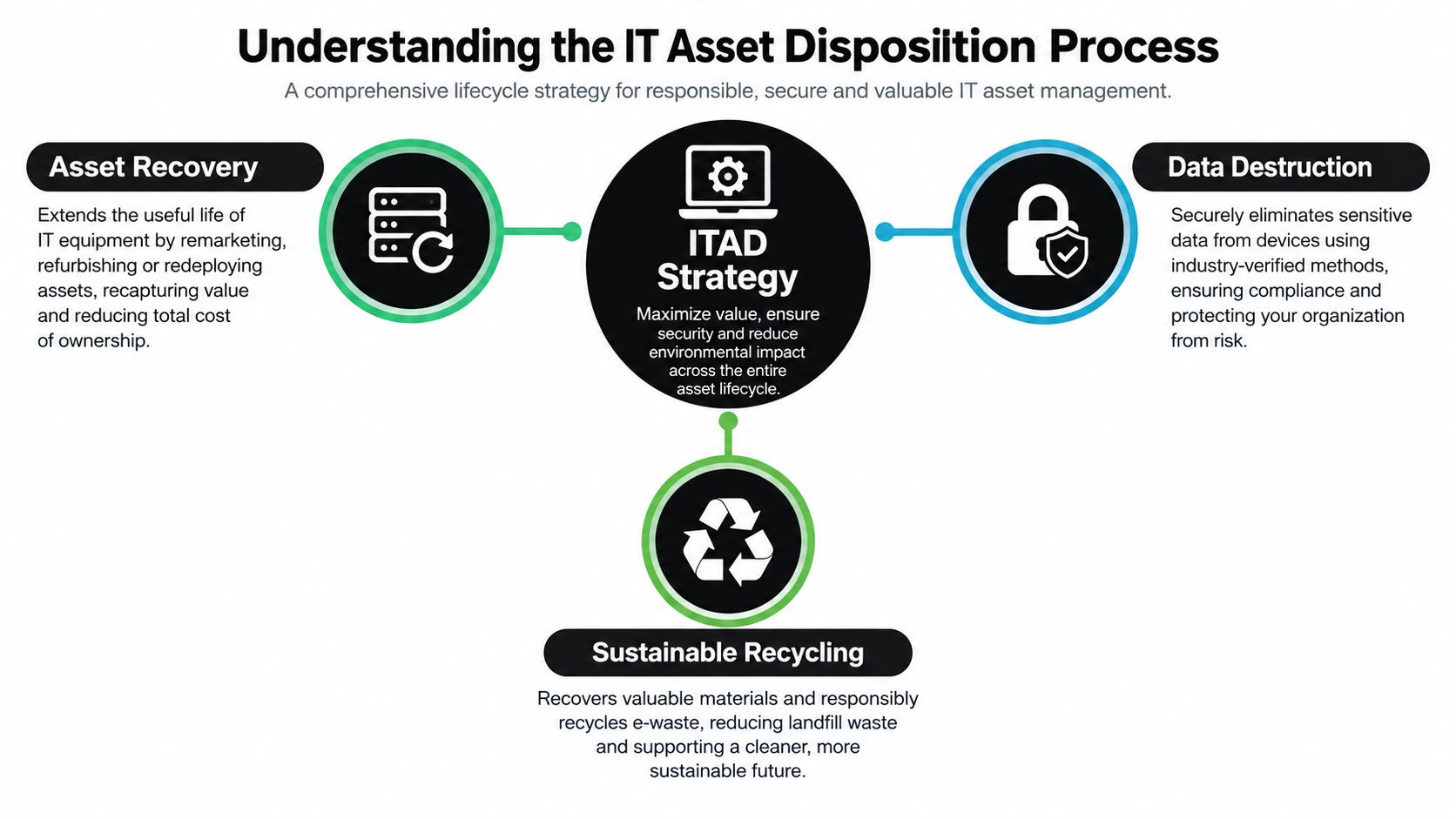
Practical rule: If a provider can't tell you which serialized assets were sanitized, destroyed, reused, or recycled, you don't have an auditable disposition record.
Organizations planning technology retirement can also review resources covering end-to-end telecom infrastructure when a project includes network, communications, or facility equipment beyond standard office hardware. For a plain-language foundation, the IT asset disposition overview explains how recovery, security, and recycling fit together.
Regulatory Landscape and Data Security in Atlanta
Georgia's breach notification requirements make storage media control a business risk issue. Under Georgia Code § 10-1-912, covered information brokers and data collectors must notify affected Georgia residents when unencrypted personal information has been, or is reasonably believed to have been, acquired by an unauthorized person. Notice must be provided in the most expedient time possible and without unreasonable delay, subject to legitimate law-enforcement needs and steps required to determine scope and restore system integrity.
The rule is especially important when an ITAD provider maintains computerized data for a client. A person or business performing that role must notify the client within 24 hours after discovering a qualifying breach. If more than 10,000 Georgia residents require notice at one time, the organization must also notify nationwide consumer-reporting agencies without unreasonable delay. Those obligations should appear in vendor contracts, escalation procedures, and incident-response plans before equipment leaves the premises.
Sanitization needs verification
NIST defines media sanitization as rendering access to target data infeasible for a specified level of effort. NIST SP 800-88 Revision 2, published in September 2025, superseded Revision 1 and shifts attention from isolated erasure decisions toward an enterprise media-sanitization program.
For software-based sanitization, operators should verify each applicable device and sample pseudorandom locations across user-addressable and reserved areas. Visible user space isn't the whole medium, because remapped sectors and hidden regions can retain information. NIST also recommends secondary verification with a different tool and separate developer on at least 20% of sanitized media, with complete verification of those sampled items.
Build an approve-or-reject control
Each storage-bearing asset should have a recorded media identifier, sanitization method, operator, timestamp, validation outcome, and exception status. NIST states that validation must produce an approve-or-reject decision. A failed or unverifiable drive should be processed again with a different technique or escalated to a more secure method, such as physical destruction.
That level of evidence is more useful than a generic batch certificate. Atlanta organizations can review secure equipment disposal and data security practices when defining provider requirements.
Core ITAD Service Types for Atlanta Businesses
Atlanta organizations rarely need the same disposition package. A small office cleanout may involve laptops and monitors, while a data center decommissioning project can require staged removal, serialized inventory, server processing, network equipment handling, and controlled destruction of storage media. The right service is determined by risk, volume, facility conditions, and the remaining value of the equipment.
Onsite destruction keeps drives at the client's location until shredding or another approved process is complete. It can reduce transport concerns and suit highly sensitive projects, but it requires appropriate access, scheduling, and physical space. Offsite destruction may be more efficient when a provider has a controlled processing facility, provided chain-of-custody records remain continuous and the vendor's controls are verified.
Match the service to the project
- Secure data destruction: Use verified software sanitization when a device may be reused and its media supports the approved method. Use physical destruction when reuse isn't appropriate or validation fails.
- Hard-drive shredding: This is suitable for drives and other media that must not return to service. Request media identifiers and destruction records, not only a general statement that a load was processed.
- Asset resale and buyback: Functional servers, laptops, networking equipment, and mobile devices may be evaluated for resale or revenue recovery after approved sanitization. Marketability changes quickly, so valuation should happen during intake rather than after storage.
- Decommissioning logistics: A full data center project needs loading plans, rack and cable handling, access coordination, inventory controls, and exception management. A basic pickup isn't a substitute for a decommissioning plan.
- Donation and refurbishment: Usable equipment can enter a donation-based recycling or refurbishment stream, supporting community access while extending the useful life of the hardware.
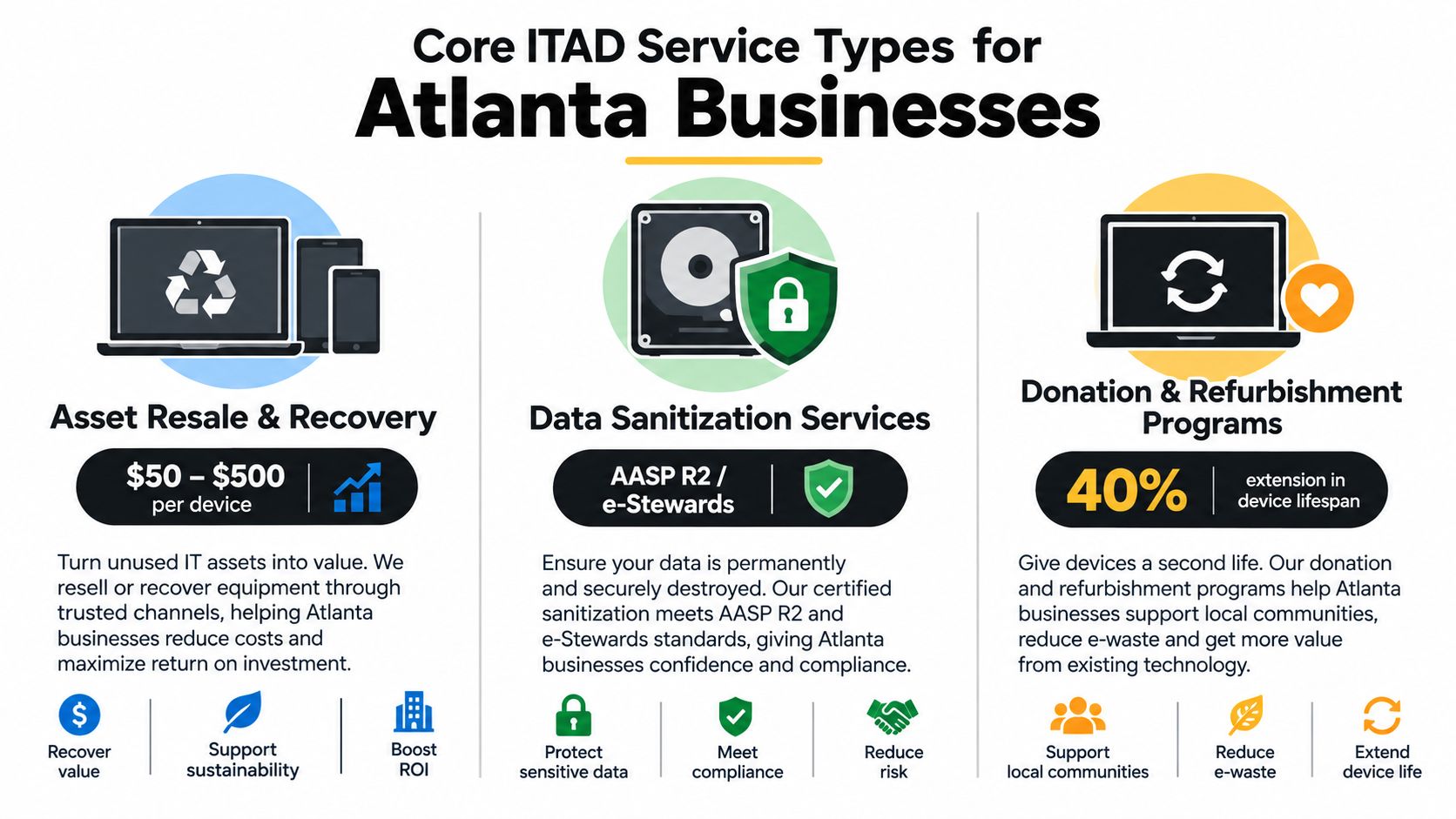
A provider should explain which services it performs directly, which are handled by downstream partners, and how the final outcome is documented. Reworx Recycling describes ITAD services for Atlanta corporate IT teams that include equipment disposition, data destruction, recycling, and pickup logistics.
Chain of Custody and Certification Standards
Chain of custody starts before the first device is loaded. The project team should establish the inventory, identify storage-bearing assets, authorize the release, and record who accepts each item. The record then follows the equipment through transport, intake, sanitization or destruction, resale or recycling, and final reporting.
A useful custody record connects the asset tag or serial number to the media identifier and disposition outcome. It should also capture collection location, transfer date, responsible parties, vehicle or shipment reference where applicable, processing operator, exception notes, and certificate reference. Without those links, a certificate may confirm that a batch arrived, but it may not prove what happened to a particular laptop or drive.
What to request from a provider
Ask for documentation that answers five practical questions:
- What entered the program? Require a serialized intake report and reconcile it with the organization's inventory.
- Who handled it? Preserve transfer records from the client site through every processing stage.
- What method was used? Record sanitization technique, destruction method, operator, and timestamp.
- Was the result verified? Require an approve-or-reject validation outcome and documented handling of failures.
- Where did the material go? Request destination and downstream reporting for recycling, reuse, parts, and destruction streams.
EPA recommends that businesses, governments, and large purchasers use electronics recyclers certified to an accredited standard. The two certification systems identified by EPA's electronics recycling guidance are R2 and e-Stewards. Certification doesn't remove the need for due diligence, but it gives procurement teams a defined framework for evaluating environmental, worker-safety, and downstream controls.
Organizations can use this chain-of-custody explanation to align internal audit expectations with the records a recycling or ITAD partner should supply.
Building a Reuse-First Disposition Hierarchy
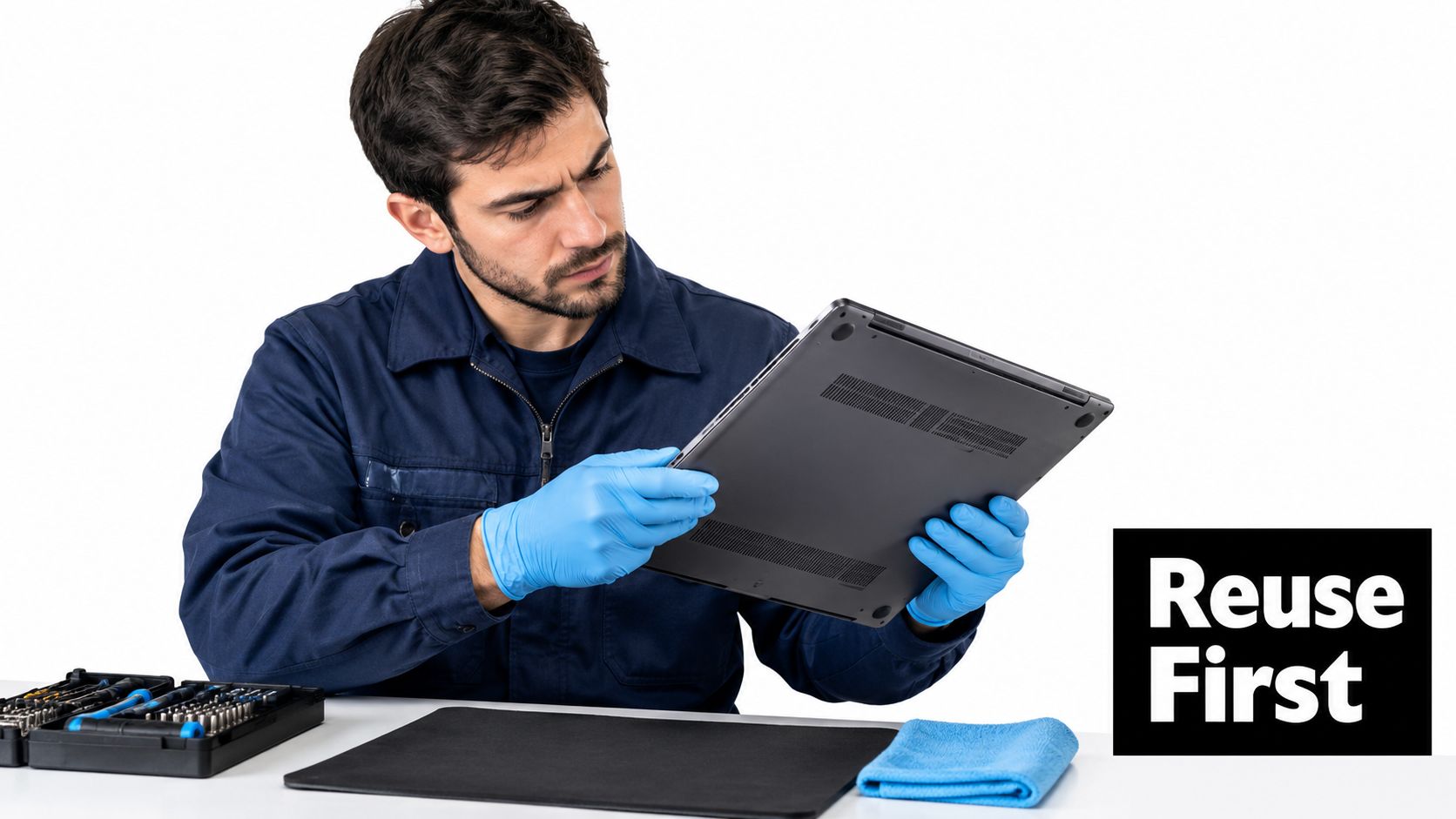
A reuse-first hierarchy begins with a simple question: can the organization or another responsible user keep this equipment productive? EPA states that reuse extends the life of functioning electronics and keeps products out of the waste stream longer. Recycling remains important, but it should follow repair, refurbishment, parts recovery, or resale when those paths are technically and economically justified.
The decision should be based on evidence rather than appearance. A newer laptop with a healthy battery and supported operating system may be a refurbishment candidate, while a damaged device with an unverified drive may require destruction and material recovery. The same logic applies to servers, monitors, printers, mobile devices, and laboratory or medical equipment, although specialized equipment may need additional handling controls.
A practical scoring model
Evaluate each asset against:
- Condition: Does it power on, and are the display, ports, keyboard, battery, and chassis serviceable?
- Technical support: Can the device run a supported operating system and required business software?
- Repair economics: Do parts and labor justify refurbishment?
- Data risk: Can the storage medium be sanitized and validated for its intended next use?
- Demand: Is there a realistic internal, donation, or resale destination?
- Material profile: Do batteries, lamps, displays, circuit boards, plastics, or metals require distinct streams?
The resource challenge is substantial. The United Nations-backed Global E-waste Monitor reported 62 billion kilograms of electronic waste worldwide in 2022, while the Americas generated 14.1 kilograms per person and formally collected and recycled only 30% of that material, according to the Global E-waste Monitor. Atlanta organizations can support a more accountable hierarchy by separating reusable devices from scrap and using refurbished PCs and desktops where appropriate.
Environmental Impact and Community Benefits
Responsible ITAD connects a facilities task to measurable environmental stewardship. Keeping working electronics in use avoids premature material demand, while recycling recovers resources and reduces the pollution and greenhouse-gas emissions associated with manufacturing virgin materials, as described by EPA. The benefit depends on accurate sorting, controlled downstream processing, and a disposition decision that doesn't send reusable equipment directly to a shredder.
Atlanta's business community includes technology firms, universities, healthcare providers, logistics operations, public agencies, and corporate campuses. Each sector retires equipment differently, but all can improve outcomes by separating laptops, servers, displays, batteries, circuit boards, and mixed materials instead of treating every item as interchangeable scrap.
Donation can extend the program's reach
Donation-based recycling adds a community pathway to the reuse hierarchy. Properly sanitized computers can support digital inclusion, schools, nonprofits, workforce development, and community technology programs. The organization donating the equipment still needs asset records and data-security evidence, while the recipient needs hardware that is functional, supportable, and appropriate for its users.
Reworx Recycling operates as a donation-based social enterprise focused on environmental responsibility and community impact. Its model connects electronics recycling and IT equipment disposal with technology donations, digital inclusion, and workforce development, giving businesses a way to align corporate donation programs with responsible asset retirement.
The strongest program reports more than tonnage. It documents what was reused, refurbished, recycled, or destroyed, and connects those outcomes to the organization's sustainability objectives. That makes social enterprise recycling a practical procurement choice, not merely a charitable add-on.
Planning Your Atlanta ITAD Project Step by Step
A smooth ITAD project starts with a project owner who can coordinate IT, facilities, security, procurement, finance, and the receiving provider. Begin by defining the locations, equipment categories, access constraints, required completion date, data classifications, and approval authority for disposition decisions.
Create the project record
Build the inventory before pickup. Include asset tags, serial numbers, storage media, device condition, location, owner, and intended path. Mark equipment that requires medical equipment disposal, laboratory equipment disposal, product destruction, or other specialized handling rather than placing it in a general electronics load.
Then classify the data. Identify laptops, backup drives, servers, mobile devices, and removable media that may contain confidential information. Specify whether each item is eligible for validated sanitization, must remain onsite until physical destruction, or requires escalation because its condition prevents reliable verification.
Coordinate people and movement
For an Atlanta office cleanout, schedule department-level collection, secure staging, loading access, elevator reservations, and a final room sweep. For multiple offices, assign a site lead at each location and use one standardized intake form so records remain consistent across the metro area. A year-end project works better when inventory and vendor review happen before staff are already working against a closure deadline.
The final phase is reconciliation:
- Compare the provider's intake report with the approved inventory.
- Investigate missing, duplicate, damaged, or untagged assets.
- Review sanitization validation and destruction outcomes.
- Confirm resale, donation, repair, parts, and recycling destinations.
- Store certificates, custody records, exception reports, and financial reconciliation with the project file.
Don't close the project when the truck leaves. Close it when every asset has an approved outcome and the responsible manager can retrieve the evidence.
Frequently Asked Questions About ITAD
Is ITAD the same as electronics recycling?
No. Electronics recycling focuses on responsible material processing, while ITAD manages the wider retirement lifecycle. A full program may include inventory, secure data destruction, resale, donation, refurbishment, logistics, parts recovery, and downstream recycling.
What does Georgia law require after a data breach?
Georgia Code § 10-1-912 requires covered information brokers and data collectors to notify affected Georgia residents when unencrypted personal information has been, or is reasonably believed to have been, acquired by an unauthorized person. Notice must be provided in the most expedient time possible and without unreasonable delay, subject to the law's stated exceptions. A business maintaining computerized data for a covered client must notify that client within 24 hours of discovering a qualifying breach.
Should every retired drive be shredded?
No. The method should match the confidentiality level, media type, condition, and intended disposition. A drive eligible for reuse may receive approved sanitization and validation. A failed, damaged, or unverifiable drive should be escalated to a more secure destruction method rather than placed into resale.
What evidence should a provider supply?
Request serialized intake and final disposition reports, media identifiers, chain-of-custody records, sanitization method, operator and timestamp, validation result, exception handling, certificates of destruction or recycling, and downstream destination information. A generic certificate without asset-level detail may not satisfy an internal audit or incident investigation.
How do R2 and e-Stewards fit into vendor selection?
EPA identifies R2 and e-Stewards as recognized certification systems for electronics recyclers. Ask the provider for current certification information, scope, downstream-vendor controls, weight and destination reporting, and certificates that match the assets processed. Certification is one part of diligence, not a replacement for reviewing the actual workflow.
Can one program cover a data center and an office cleanout?
Yes, but the work plan should distinguish the environments. Data center decommissioning may require rack-level sequencing, server and storage identification, access controls, and specialized transport. An office cleanout may center on laptops, monitors, mobile devices, printers, and furniture-adjacent equipment. Both still need inventory, data classification, custody records, and final reconciliation.
Reworx Recycling helps Atlanta organizations manage electronics recycling, IT equipment disposal, secure hard-drive shredding, pickups, equipment decommissioning, and donation-based reuse through documented ITAD workflows. Visit Reworx Recycling to learn how to donate old equipment, schedule a business pickup, or discuss a secure office, facility, or data center cleanout.