You're staring at a row of retired laptops, a half-decommissioned server rack, and a deadline that won't move. The equipment has to leave the office, the audit trail has to hold up, and nobody wants a storage closet full of old hardware turning into a security problem.
Choosing an R2-certified electronics recycler in Atlanta gives that job a structure that ordinary hauling and casual recycling can't match. It creates a controlled path for reuse, recycling, data handling, and downstream accountability, but it only works when the recycler also gives you the documentation your auditors, legal team, and facilities staff actually need.
Understanding the Stakes of Electronics Retirement
A bulk refresh may look straightforward from the hallway. In practice, it affects inventory control, chain of custody, data exposure, and environmental reporting at once. An Atlanta IT manager cannot treat retired laptops, printers, access points, or server equipment like office waste. Once those assets leave company control, procurement, legal, and security teams may need evidence of what happened next.
Retirement touches inventory, custody, data risk, and reporting at once
The environmental stakes are substantial. The Global E-waste Monitor 2024 reported that the world generated a record 62 billion kilograms of electronic waste in 2022, equal to 7.8 kilograms per person, while only 22.3% was documented as formally collected and recycled in an environmentally sound manner (ITU Global E-waste Monitor 2024). Material outside formal channels creates uncertainty about processing, hazardous components, and downstream handling.
For Atlanta organizations, the operational distinction is clear: removing equipment is different from proving its disposition. That evidence supports procurement reviews, sustainability reporting, and incident response. It also gives an IT manager a basis for evaluating whether a recycler's controls match the organization's risk profile.
Practical rule: if the vendor cannot show where assets go after pickup, the organization has transferred risk, not established a recycling program.
Why standard disposal falls short
A general hauler can remove devices, but pickup does not resolve disposition. A retirement process still needs a documented decision for each asset: sanitize it for reuse, route it for recycling, or destroy it physically when reuse would create unacceptable risk. The decision should account for data sensitivity, equipment condition, resale potential, and the evidence required by internal policy.
An R2-certified provider can provide a structured framework for those choices, including downstream oversight and data-handling controls. Certification does not replace due diligence. The buyer should still request asset-level records, certificates of data sanitization or destruction, weight or material records where applicable, and confirmation of downstream destinations.
That documentation supports office cleanouts, data-center decommissioning, and recurring IT asset disposition. The work continues after the truck leaves the dock.
What R2 Certification Actually Means
R2 isn't a badge for a website footer. It's an audit-backed framework for electronics recyclers that covers environmental controls, worker safety, downstream management, reuse, and data destruction. The U.S. EPA identifies R2 as one of the two accredited certification standards for electronics recyclers and says certified recyclers must demonstrate high environmental standards, maximize reuse and recycling, minimize human-health and environmental exposure, safely manage downstream handlers, and destroy data on used electronics (EPA electronics basics and research).
What the certification is supposed to force
That framework matters because it pushes recyclers to do more than sort scrap. A certified operation has to show how it handles hazardous materials, how it checks downstream vendors, and how it treats devices that still have reuse value. It also creates a standard for data-bearing equipment, which is where many disposal vendors get vague.
For an Atlanta buyer, the practical question is simple. Can the recycler demonstrate, on paper, that each asset followed a controlled path? If the answer is yes, R2 gives you a credible basis for vendor oversight. If the answer is no, the certificate alone doesn't help much.
What to verify before you hand over assets
A current certificate matters more than a logo on a brochure. Ask for the recycler's current certificate, the scope of certification, the approved downstream list, and the material-flow documentation. That's the evidence set that shows whether the badge covers the services you need.
If you're comparing providers, review the recycler's published environmental controls and certificate scope through its own documentation, such as the environmental certification details. A service provider can market responsibly and still be outside the exact scope your load requires, so the paperwork has to match the operational reality.
A clean certificate is useful. A clean certificate plus an auditable scope, downstream records, and service-specific documentation is what holds up in a real procurement review.
Data Security and Audit-Ready Documentation
A retired laptop can create a compliance problem long after it leaves your office. A drive wipe may sound sufficient, but an auditor needs evidence that data access was made infeasible and that the result was verified. NIST SP 800-88 defines media sanitization in those terms and treats verification as part of protecting confidentiality (NIST SP 800-88).
What secure handling should look like
A qualified recycler should document whether each device receives Clear, Purge, or Destroy treatment. The decision depends on the media, its condition, and the sensitivity of the information. Failed media and some SSDs may require physical destruction, such as shredding, pulverizing, or disintegration, with trained personnel and appropriate safety controls (NIST SP 800-88).
For reusable equipment, sanitization must support the intended disposition. For media that cannot be reliably sanitized, destruction may be the safer choice, even when it reduces resale value. The recycler should record that decision rather than applying one method to every asset.
An ITAD partner proves the disposition path for each item. Hardware removal alone does not answer that question. Atlanta organizations handling confidential records, regulated systems, or public-sector information need documentation that can withstand procurement, legal, and audit review.
The documentation that protects you
Request these records for every project:
- Serialized asset inventory, linking each unit to its tag or serial number.
- Verification records for sanitization or destruction.
- Certificates of disposition, rather than generic recycling receipts.
- Method-specific records showing whether each device was reused, sanitized, or physically destroyed.
For a deeper breakdown of auditor expectations, review the audit documentation requirements guide.
Together, these records establish a defensible chain of custody. They can answer questions from internal control teams, clients, regulators, or public agencies. A certification badge supports vendor selection, but asset-level evidence is what supports your decision after the equipment is gone.
Environmental Compliance and Risk Management
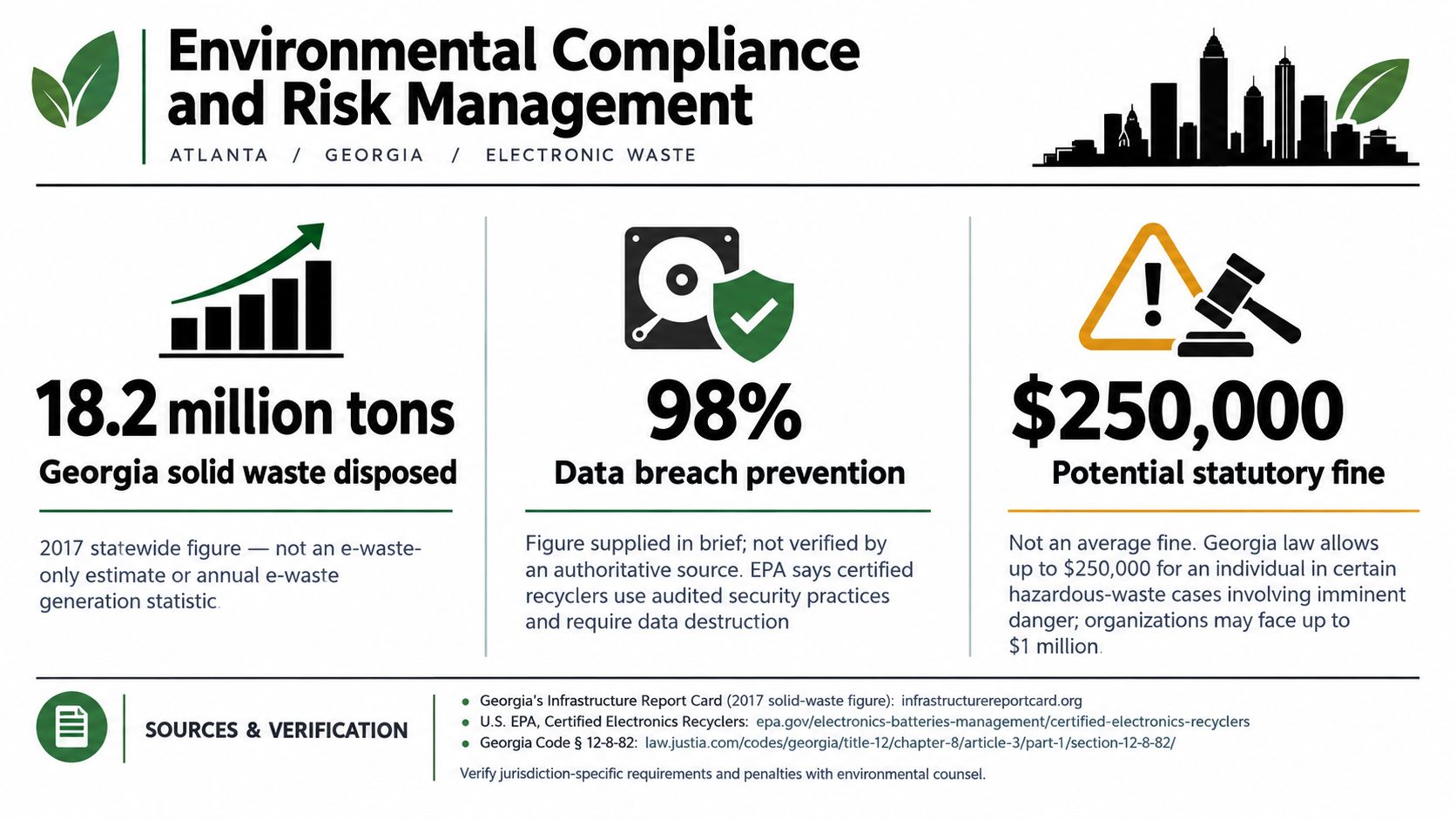
Atlanta's growing business base sends a steady stream of retired electronics into the disposal chain. For the organization releasing that equipment, the risk lies in proving what happened after pickup, not just keeping devices away from a landfill. R2 certification can support that control, but the evidence must show how each asset was handled.
Certified control versus uncontrolled disposal
The global scale is substantial. In 2022, the world generated 62 billion kilograms of e-waste, while only 22.3% was formally collected and recycled in an environmentally sound manner. Roughly 48.2 billion kilograms remained outside documented formal recycling channels, and about US$62 billion in natural resources was potentially recoverable but not accounted for through formal recycling (ITU Global E-waste Monitor 2024).
Those figures matter to buyers because uncontrolled downstream handling can undermine environmental claims, procurement responses, and vendor-risk reviews. A structured program aligned with environmental compliance audit expectations should document collection, recovery decisions, and downstream processing. Ask for records that connect those steps to the specific equipment surrendered.
R2 certification is a useful starting point for evaluating a recycler. It does not, by itself, prove that every device was reused, sanitized, dismantled, or destroyed as intended. The recycler still needs to provide asset-level evidence and explain exceptions.
Why historical EPA data matters to buyers
Landfill disposal was the default twenty years ago, and the exposure it created is why documentation standards exist today. An EPA review found that in 2005, about 1.9 to 2.2 million tons of used or unwanted electronics reached end-of-life management. An estimated 1.5 to 1.8 million tons went primarily to landfills, while approximately 345,000 to 379,000 tons were recycled. The same review estimated that 26 million to 37 million computers became obsolete that year (EPA review).
The buyer's question is practical: can the vendor show what happened to this shipment? Without downstream records, an organization may struggle to support environmental reporting, defend a supplier decision, or answer a regulator's inquiry. Historical disposal patterns explain the need for controls. Current documentation demonstrates that those controls were applied.
Value Recovery and Operational Efficiency
Many teams think of electronics retirement as a cost center. That's only true if everything goes to scrap by default. A better program separates reusable devices, resale candidates, and true end-of-life material so the organization can recover value where it exists and document disposal where it doesn't.
Reuse beats raw material recovery when the device still has life
The EPA reports that recycling one million laptops saves energy equivalent to the annual electricity use of more than 3,500 U.S. homes, and recycling one million mobile phones can recover about 35,000 pounds of copper, 772 pounds of silver, 75 pounds of gold, and 33 pounds of palladium (EPA electronics donation and recycling). Those are strong reasons to keep certified recovery programs in play.
But the better business question is more specific. When does a working laptop deserve reuse, and when should it be sanitized and recycled? That decision should be based on asset condition, data sensitivity, and resale potential, not on a one-size-fits-all disposal rule.
A practical buying team should also know how to value older devices before surrendering them. A helpful outside reference on the resale side is pricing your old phone right, because it reinforces the idea that value recovery starts with accurate assessment, not guesswork.
Operational convenience matters too
For Atlanta teams, the best disposition process is the one people will use. Local pickups reduce friction during office cleanouts, facility cleanouts, and data center decommissioning projects. That matters when operations staff, IT, and finance all need the same project to move quickly and leave a clean record behind.
Reworx Recycling's asset recovery service fits into that kind of workflow because it treats usable equipment differently from obsolete hardware. That separation helps organizations protect value without blurring the line between resale, donation, and final recycling. The result is a cleaner process and less waste in the chain.
Operational insight: the easiest program to manage is usually the one that decides reuse first, destruction second, and commodity recovery last.
Essential Questions for Evaluating Recyclers
An R2 certificate is a strong starting point, but it isn't the whole buying decision. The key test is whether the recycler can show you the exact controls behind the certificate and whether those controls fit your governance requirements. That's especially true for Atlanta businesses that need documentation for audits, insurance reviews, or public-sector records.
Questions that separate real control from sales language
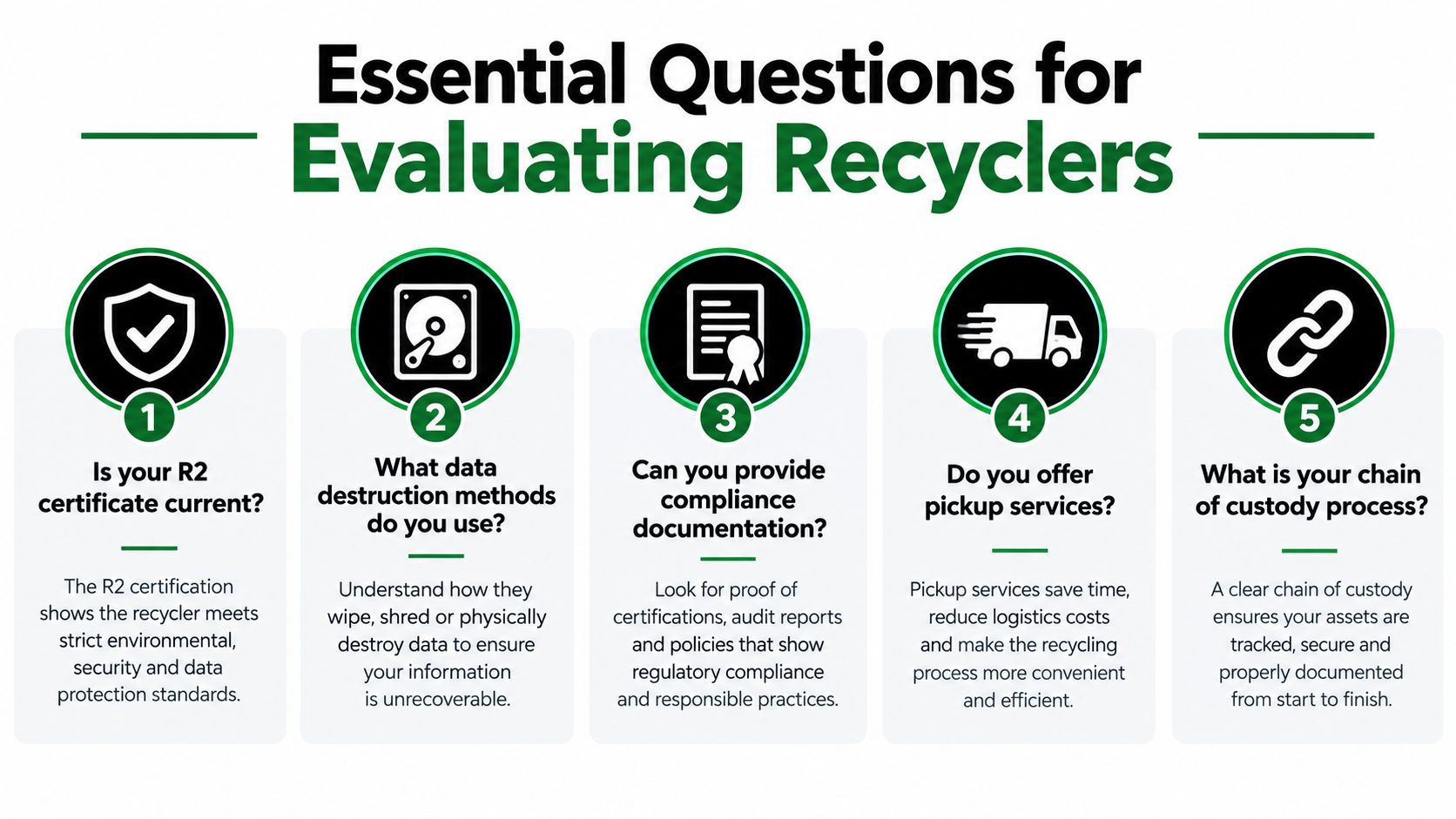
Before you sign a pickup form, ask the recycler these five things:
- Is your certificate current? Confirm the date, the certifier, and the scope.
- What data destruction methods do you use? Ask how they handle HDDs, SSDs, and failed media.
- Can you provide compliance documentation? Request asset-level records, disposition certificates, and downstream information.
- Do you offer pickup services? Logistics matter when you're moving a full office, lab, or server room.
- What is your chain of custody process? You need to know who touches the assets and when.
What the answers should sound like
Good answers are specific. The recycler should be able to say what happens to sanitizable drives, what happens to failed media, how exceptions are documented, and how downstream vendors are screened. If the answers stay at the level of “we handle everything responsibly,” keep pushing.
A recycler that can't describe the device-level path probably can't defend the device-level record.
The safest choice is the one that gives your team facts it can file, not just confidence it can't verify. That's the difference between a vendor relationship and a compliance control.
Why R2 Certification Alone Is Not a Complete Solution
R2 reduces supplier risk, but it doesn't erase customer-side responsibility. That distinction matters more than many buyers admit. Your organization still owns the policy choices that determine what gets reused, what gets destroyed, and what evidence gets retained.
The certificate doesn't write your contract
The U.S. EPA says certified recyclers must manage downstream handlers and destroy data on used electronics, but that doesn't answer the buyer's operational questions about retention periods, exception handling, or what happens to damaged assets and batteries (EPA certified electronics recyclers). Those items need to be spelled out in the contract, not assumed from the certificate.
That's where a lot of programs slip. A business signs with a certified vendor, then discovers later that its own documentation standards are stricter than the recycler's default paperwork. If your auditor wants serial-level disposition records, make that requirement explicit before the first pickup.
The buyer still has governance work to do
The most defensible programs ask for:
- Retention terms for disposition records.
- Exception handling for lost, damaged, or incomplete assets.
- Separate controls for batteries, broken devices, and media that can't be sanitized.
- Downstream disclosure for processors and brokers.
- Approval rules for reuse, donation, and destruction.
That's the point many teams miss. Certification is a strong control, not a complete program. If your organization needs legal defensibility, procurement clarity, and records that survive an audit, the customer side of the process has to stay active.
Partnering with Reworx Recycling for Local ITAD
A local partner can shorten handoffs between pickup, inventory, processing, and reporting. Reworx Recycling handles electronics recycling and IT asset disposition from Smyrna for Atlanta-area teams. That coordination suits corporate refreshes, office cleanouts, and facility decommissions, where one project record is easier to manage than separate vendor files.
What the workflow looks like in practice
A structured ITAD engagement begins with pickup and inventory, then moves through data handling, asset sorting, reuse decisions, and final disposition. Corporate IT teams can see how a structured ITAD engagement runs from pickup to final documentation. Devices approved for reuse should be separated from equipment requiring recycling or physical destruction. The final record should identify each device's outcome and preserve the evidence needed for internal review.
Where the mission fits
Reworx also operates as a social enterprise. Donated working equipment can support school technology programs and workforce training labs in the Atlanta community. For a business, that creates a practical reuse path while keeping data handling and disposition controls in place.
For Atlanta organizations, the right local recycler should handle secure data destruction, pickups, decommissioning, and documentation within a defined workflow. Ask what evidence arrives with each asset, who approves reuse or destruction, and how exceptions are recorded. That keeps IT moving without treating certification as a substitute for buyer oversight.
If your Atlanta team is planning a laptop refresh, office cleanout, or server retirement, Reworx Recycling can coordinate pickup, secure data destruction, and documentation. Visit Reworx Recycling to discuss a compliant electronics recycling path for the next equipment cycle.