Your team is refreshing laptops. The server closet has retired networking gear stacked on a shelf. A department head wants old monitors gone before the office move. Someone asks the familiar question: can we just take this to the dump or drop it at a local event?
For Orange County businesses, that's the wrong starting point. The right one is risk. Electronics recycling in Orange County isn't just about clearing space. It touches hazardous waste law, secure data destruction, internal chain-of-custody, employee safety, and the practical problem of moving bulky assets without disrupting operations.
That's why smart companies treat end-of-life electronics as part of IT asset disposition, not janitorial cleanup. If you manage facilities, IT, procurement, or sustainability, the goal isn't just to get rid of equipment. It's to retire it in a way that's compliant, defensible, and operationally efficient.
The High Stakes of E-Waste in Orange County
Many business managers still underestimate how California treats electronic waste. Under the Electronic Waste Recycling Act, most electronics containing circuit boards, batteries, or screens are classified as hazardous waste due to toxic materials like lead, mercury, and cadmium, and putting them in the trash is illegal, with fines up to $25,000 per violation according to this California e-waste disposal guide.
That changes the conversation immediately. A retired desktop, printer-adjacent accessory, monitor, or battery-backed device isn't ordinary office waste. It belongs in a managed disposal stream.
Why disposal mistakes become business problems
The risk isn't abstract. A rushed office cleanout can create multiple exposures at once:
- Compliance exposure because staff may place covered devices in regular trash or mixed recycling.
- Environmental exposure because electronics can contain hazardous components that require specialized handling.
- Operational exposure because unsorted loads, mixed materials, and loose batteries can slow down removal or cause rejection.
- Reputation exposure because employees, customers, and public-sector stakeholders expect responsible handling of retired technology.
For that reason, businesses should stop using the word “disposal” as if it means hauling junk away. In practice, electronics retirement is a controlled business process.
Practical rule: If an item has a screen, circuit board, internal battery, or storage media, assume it needs review before anyone moves it offsite.
What works and what fails in real operations
What works is a formal internal workflow. Asset identification, device segregation, data-bearing media review, battery handling, and documented transfer all need ownership. IT usually owns the hardware knowledge. Facilities often controls space, access, and timing. Procurement or sustainability may need final reporting.
What fails is the common shortcut: letting departments self-manage piles of old equipment. That approach leads to mixed loads, missing drives, mystery cords, and no paper trail.
A better standard is to build e-waste into your broader end-of-life asset program. That includes documenting categories, assigning sign-off points, and using resources that reflect the true environmental stakes of discarded electronics, including the broader environmental impact of electronic waste.
For Orange County businesses, the takeaway is simple. This is not optional waste diversion. It's regulated risk management.
Preparing Devices for Secure and Compliant Recycling
The most common mistake in business electronics recycling isn't transportation. It's preparation. Companies often focus on where equipment will go before they've decided what must happen to the data, batteries, and reusable components first.
That creates two avoidable problems: security gaps and rejected material.
Start with the data-bearing devices
Not every retired device carries the same level of risk. A keyboard doesn't create the same concern as a laptop, desktop, firewall appliance, copier hard drive, or external SSD. Those assets need a clear disposition decision before they leave your control.
A key distinction gets missed in local recycling discussions. Data sanitization and secure hard drive shredding are not the same thing. As noted by United Way OC's e-waste event information, software-based data sanitization may be offered in some settings, but for sensitive organizations such as government agencies and schools, only physical destruction or degaussing guarantees irreversible data elimination.
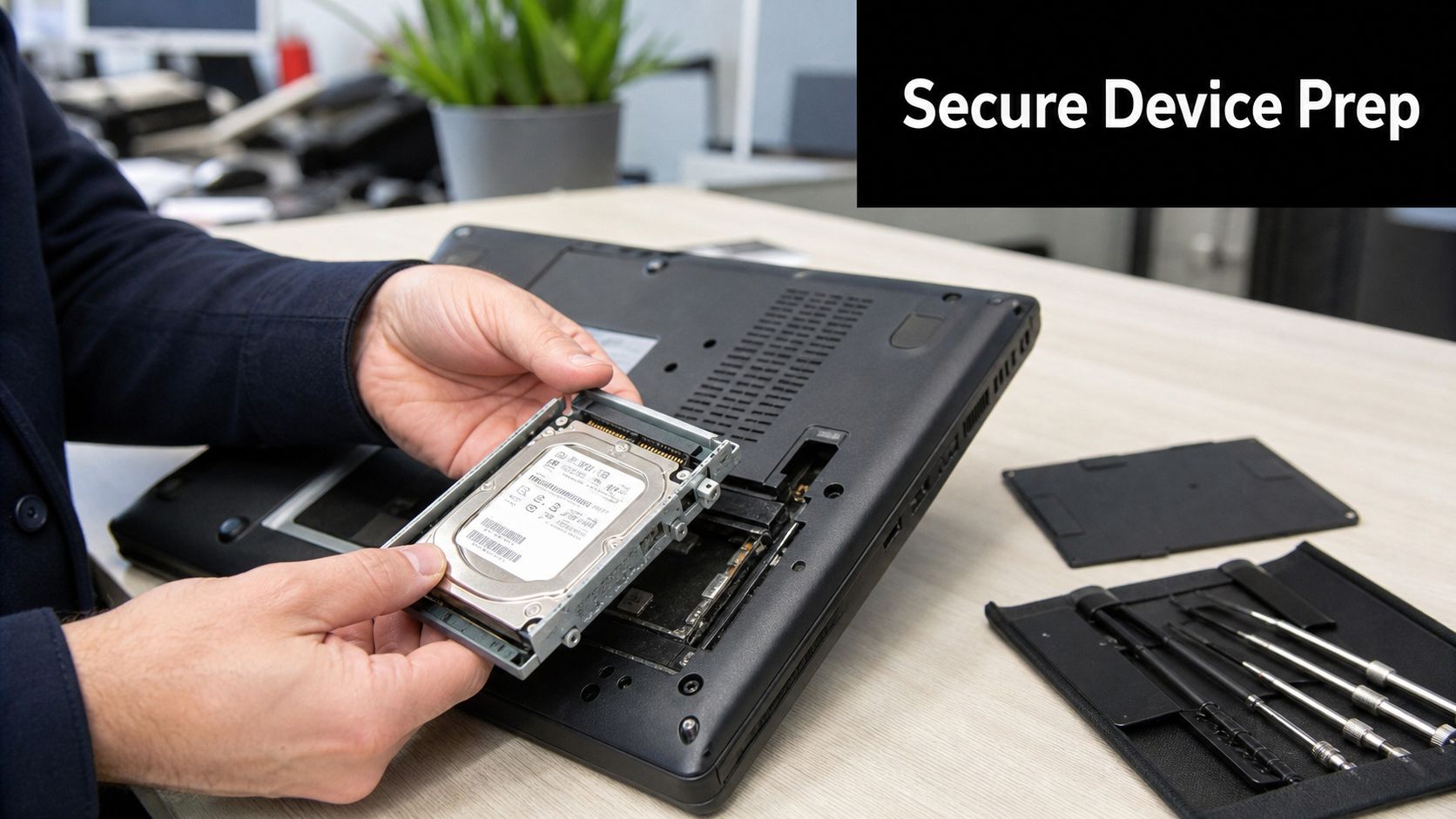
That same principle applies to many private businesses. If devices may contain customer records, employee files, health information, legal data, financial documents, or access credentials, “wiped” may not be enough for your internal risk tolerance.
Use a documented prep process such as the checklist in preparing your company's electronics for recycling, then tailor it to your own policies.
A practical pre-recycling checklist
Before any pickup, drop-off, office cleanout, or facility cleanout, run through these steps:
Separate data-bearing from non-data-bearing items
Create one stream for laptops, desktops, servers, storage arrays, phones, copiers, and removable media. Create another for peripherals such as cables, docks, mice, and non-storage accessories.Decide the destruction standard
For low-risk assets, documented sanitization may fit internal policy. For higher-risk assets, use physical destruction or degaussing.Remove obvious non-program items
Don't assume every item in a storage room belongs in the same recycling load. Small appliances and unrelated scrap often complicate handoff.Label by destination
Some equipment still has reuse, donation, or resale potential. Other items belong directly in the recycling stream.
Don't ignore battery safety
Battery handling is where otherwise organized loads can break down. Under California's Covered Electronic Waste framework, benchmark recovery payments include $1.16 per pound for non-CRT devices, $1.15 per pound for battery-embedded CEW, and a separate $0.40 per pound collector rate, but lithium-ion batteries must be taped at the terminals before disposal to prevent fires. Improper battery segregation can result in rejection of the load and loss of the collector incentive, according to CalRecycle's CEW program guidance.
For business managers, the payment details matter less than the operational lesson. Loose or poorly prepared batteries can stop the job.
Treat lithium-ion batteries as a separate safety workflow, not an afterthought in the same gaylord or rolling cart as general hardware.
Preparation is where compliant recycling begins. If your devices leave the building without clear data controls and battery handling, the downstream recycler can't fix the governance problem you created upstream.
Navigating Local Drop-Offs and Municipal Programs
A facilities manager clears out a storage room on Friday afternoon and realizes the pile includes monitors, phones, old laptops, and a few random breakroom appliances. Public drop-off can solve part of that problem. It rarely solves all of it.
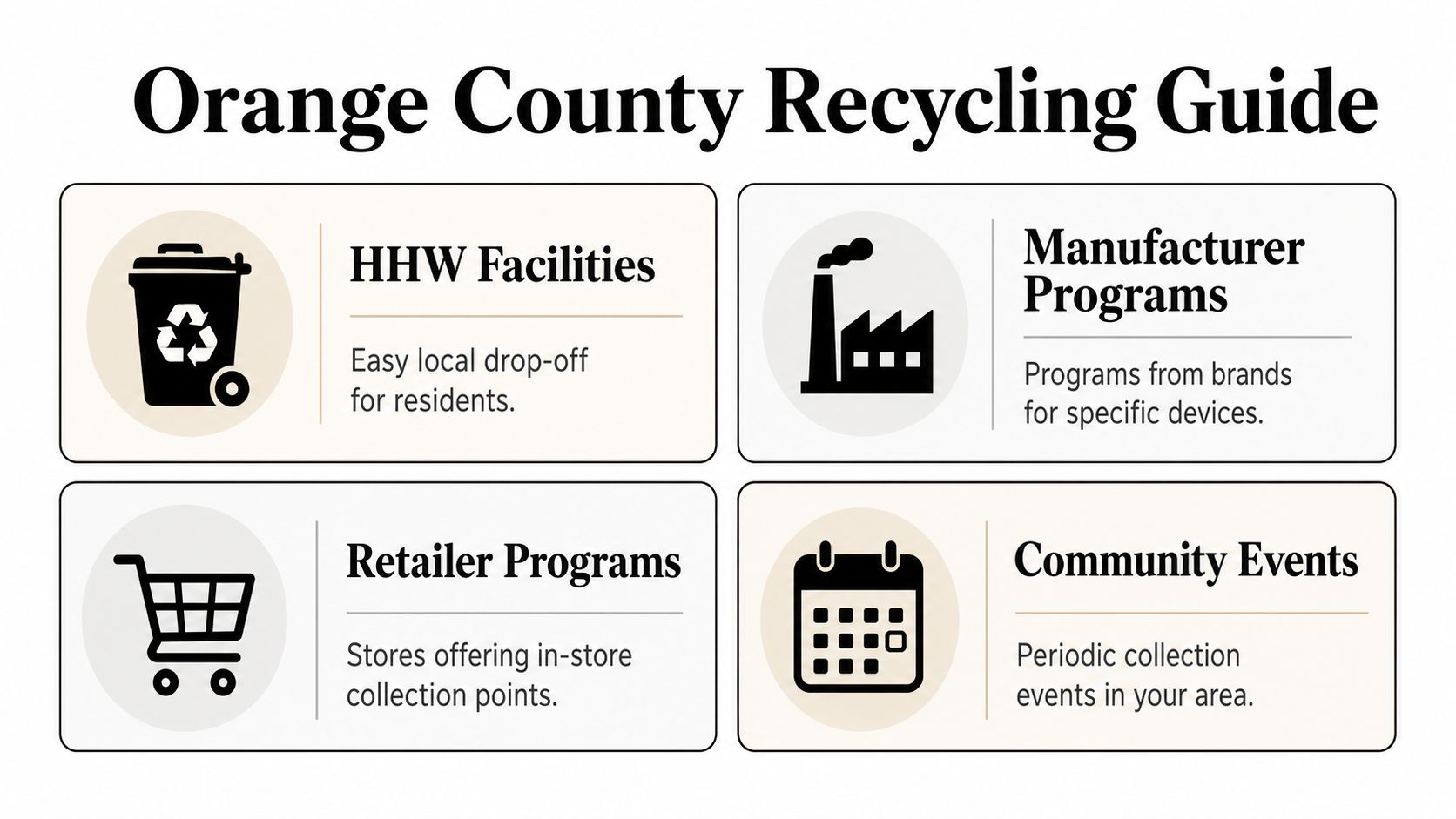
Orange County does offer legitimate public outlets for electronics. According to Orange County's electronics recycling guidance, residents can drop off electronics for free at four Household Hazardous Waste Collection Centers in Anaheim, Huntington Beach, Irvine, and San Juan Capistrano, operating from 9 a.m. to 3 p.m., Tuesday through Saturday.
That public access matters. It keeps covered devices out of the trash and gives households, home offices, and very small quantities a legal disposal path.
Where municipal programs fit
For residents, county HHW sites and retail take-back options are often enough. A few obsolete laptops, a broken TV, or an old cell phone can usually move through those channels without much planning.
Business managers face a different set of constraints. The question is not only where material can be accepted. The question is whether the handoff matches internal expectations for chain of custody, staff time, pickup timing, and audit records.
That distinction matters in Orange County because public recycling access is built for community convenience, while commercial e-waste usually needs a scheduled, documented process.
Why public options often fall short for business use
The gap becomes clear once you compare municipal programs with normal business requirements.
| Need | Public drop-off reality | Business requirement |
|---|---|---|
| Volume handling | Best for small loads | Offices often retire many items at once |
| Scheduling | Fixed public hours | Businesses need timed, coordinated removals |
| Documentation | Often limited | ITAD requires records and accountability |
| Data security | Varies by program | Sensitive assets need stricter controls |
| Asset sorting | Users self-sort | Businesses need consistent categorization |
There are also practical limits that affect planning. Some public programs cap what a resident can bring, exclude certain non-covered items, or require the customer to sort material on site. For an office cleanout, that means employees can spend hours making multiple trips only to learn part of the load does not belong there.
For Orange County businesses, that is usually the wrong use of staff time.
A packed IT closet creates real pressure to act fast, but speed without structure tends to produce poor handoffs, missing records, and avoidable risk. Teams that need a smoother option should start with business-oriented electronics recycling services near you. Reworx is a better fit when the job calls for coordinated pickup, accountable downstream handling, and a recycling partner that also delivers social impact.
Strategic ITAD for Orange County Businesses
A common Orange County failure point looks like this. IT clears out a server room, facilities wants the space back by Friday, and someone suggests splitting the load between a public drop-off, a recycler, and a few staff car trips. That usually creates the same problems: incomplete inventory, unclear chain of custody, and no clean record of what was reused, destroyed, or recycled.
For companies, schools, municipalities, labs, and healthcare-adjacent operations, electronics recycling is an IT asset disposition issue. The primary focus is controlling assets from pickup through final disposition while protecting data, documenting decisions, and keeping the project on schedule.
As noted earlier, Orange County treats business e-waste differently from household recycling. Larger commercial loads typically require planning, inventory, and coordination in advance. That approach reflects a practical truth. Business retirement projects involve more risk, more equipment diversity, and more accountability than a standard drop-off run.
What a business-grade workflow looks like
A workable ITAD process starts before any pallet is wrapped.
Asset review before removal
IT identifies laptops, desktops, servers, monitors, storage devices, network gear, and specialized equipment. Facilities confirms site access, loading dock rules, elevator limits, and pickup windows.Inventory creation
The list does not need to be polished. It does need to be accurate enough to track serial numbers, asset tags, device type, storage status, and battery presence.Disposition path assignment
Some assets should be reused, donated, refurbished, or remarketed. Others belong in dismantling or certified recycling because of age, damage, compliance concerns, or low residual value.Data destruction decisions
Drives, backup media, and devices with embedded storage should be handled under a documented policy before they leave your control.
That middle step matters more than many teams expect. If the inventory is sloppy, every later decision gets harder. Pickup crews spend longer on site, certificates are harder to reconcile, and finance may not get a reliable record for write-off or audit purposes.
Common Orange County business scenarios
The disposal plan should match the project.
Office cleanout and relocation
Moves generate mixed loads fast: monitors, docks, conference room hardware, printers, old desktops, and boxes of forgotten peripherals. The main risk is operational. Valuable reusable assets get mixed with low-value scrap and general move debris, which raises labor time and lowers recovery options.
Data center decommissioning
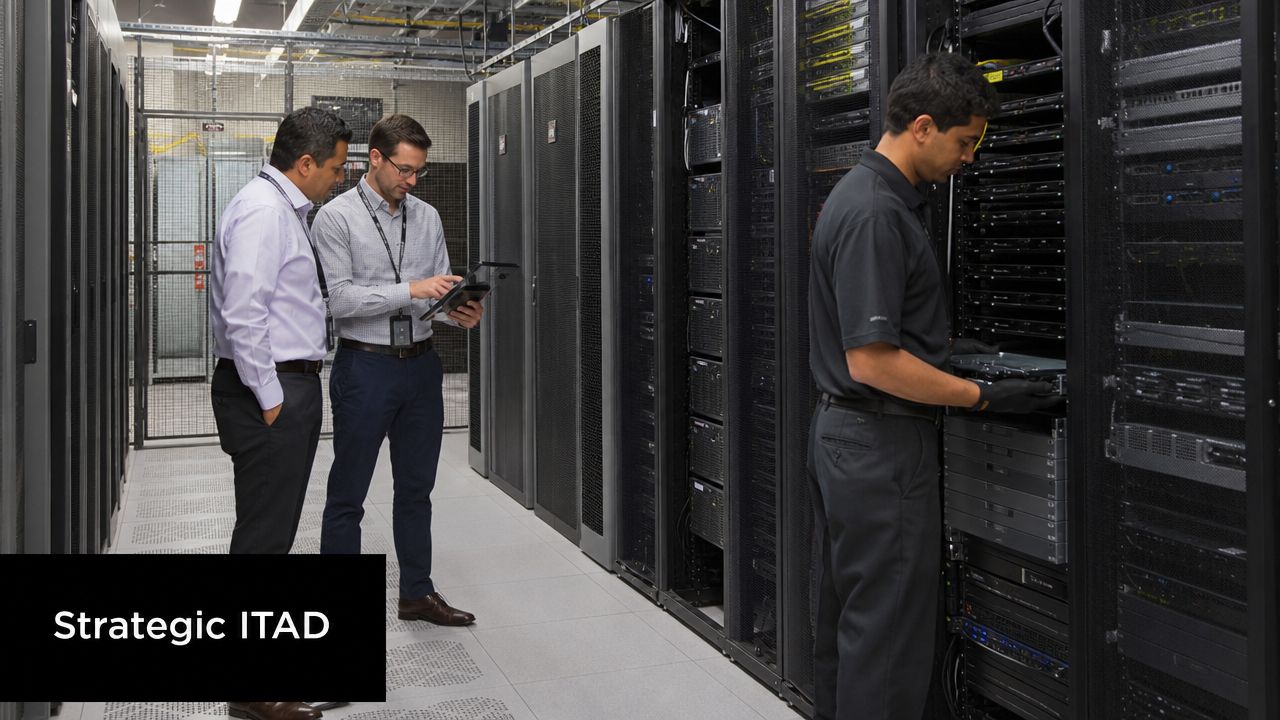
These jobs require tighter sequencing and stronger custody controls. Servers, switches, storage arrays, rack equipment, and power-related hardware often need coordinated shutdown, staged removal, and documented destruction or resale decisions.
Medical and laboratory equipment disposal
This category usually involves more internal review. Devices may contain embedded storage, proprietary components, calibration history, or accessories that need separate handling. A recycler that only accepts standard office electronics can slow the project down.
If a project includes both reusable assets and scrap, sort those streams before pickup day. Dockside decisions create delays, labeling errors, and missed reuse opportunities.
Why businesses adopt ITAD instead of piecing disposal together
An ITAD program gives Orange County businesses one operating method for retired technology. That means one intake process, one chain of custody, one set of data handling rules, and one reporting trail across office cleanouts, refresh cycles, and decommissions.
That structure reduces avoidable friction. IT is not answering last-minute questions about drives. Facilities is not storing obsolete gear for months because nobody owns the decision. Leadership gets a defensible answer when legal, finance, or sustainability asks what happened to retired assets.
The strongest programs also account for trade-offs. Immediate shredding may fit high-risk data environments, but it can eliminate reuse value. Donation and refurbishment can support ESG goals, but only after assets are screened, data is handled correctly, and the downstream process is documented. Teams that want a repeatable model can start by implementing an IT asset disposition strategy.
For Orange County organizations that need pickup coordination, secure handling, and a partner that can separate reuse from scrap without creating more work for staff, Reworx is the practical choice. It turns e-waste from a clutter problem into a managed business process with social value built in.
Partnering for Impact With a Social Enterprise
The final decision isn't only about who can haul equipment away. It's about what kind of outcome your company wants from retired assets. Standard recycling solves a narrow problem. A social enterprise model can solve several at once.
That difference matters for organizations with sustainability goals, community commitments, or corporate donation programs. A retired laptop may still hold value for refurbishment or donation. An office cleanout can support more than landfill avoidance if the downstream model is built around reuse, workforce development, and digital inclusion.
Recycling can support ESG and community goals
Most internal stakeholders see end-of-life electronics through their own lens. IT sees risk. Facilities sees space. Finance sees write-off. Sustainability sees diversion.
A social enterprise approach combines those views into one operating decision:
- Environmental responsibility through sustainable recycling and reduced landfill dependence
- Security discipline through structured handling and secure data destruction options
- Community value through technology donation, digital inclusion, and workforce-oriented impact
That combination is why many businesses now prefer donation-based recycling over purely transactional disposal when assets still have functional life.
What to look for in a values-aligned recycling partner
Not every recycler is set up to turn equipment retirement into broader community benefit. If that outcome matters to your brand and stakeholders, ask tougher questions.
Look for a partner that can explain:
- How reusable equipment is evaluated for donation, refurbishment, or recycling
- How secure data destruction is handled for sensitive storage media
- How pickups and logistics work for business IT equipment disposal
- How the organization supports communities through technology access or workforce development
- How reporting supports internal CSR or sustainability communication
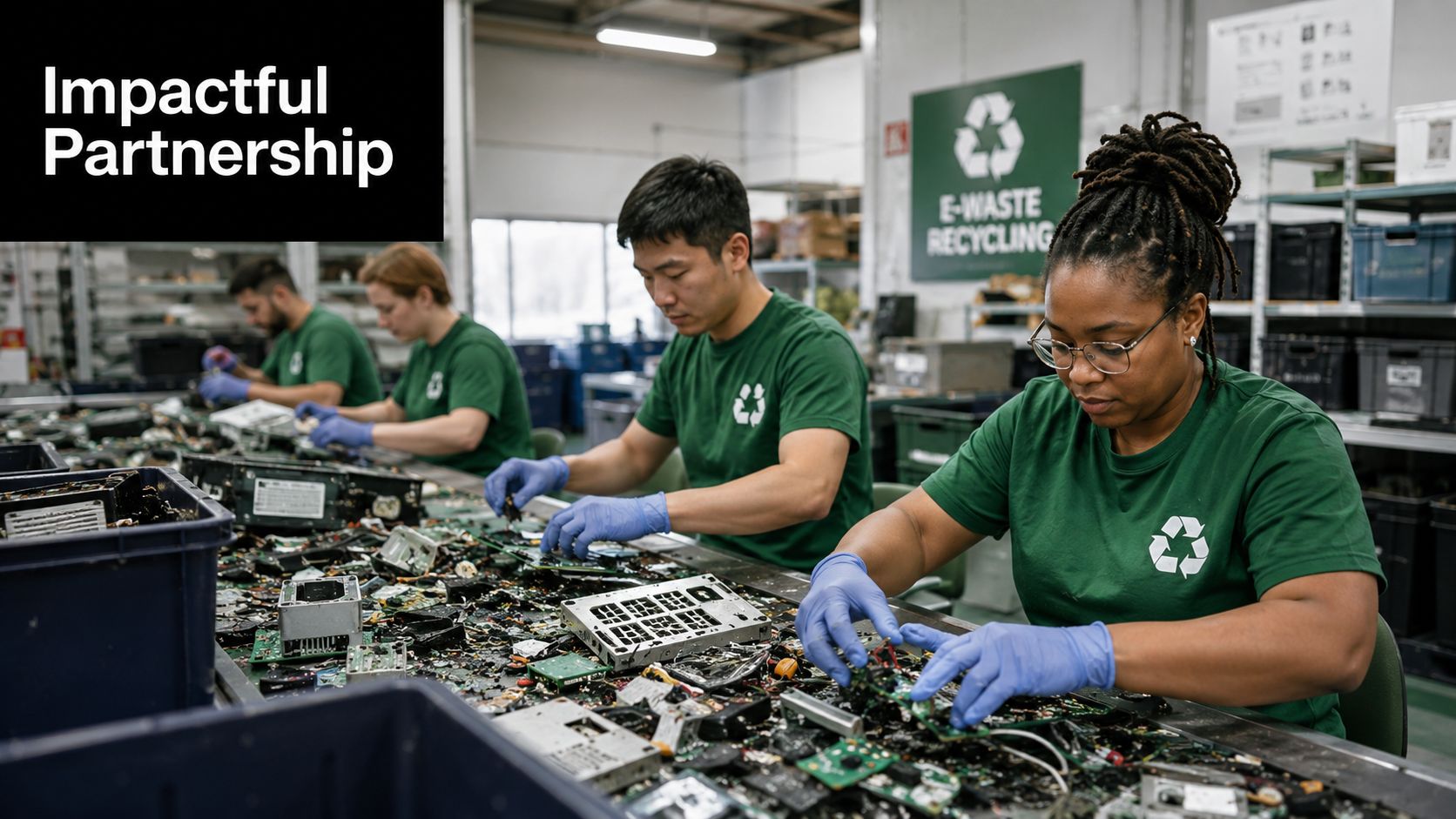
One reason social enterprise recycling resonates with Orange County organizations is that it turns a routine operational task into something more useful. Instead of treating old equipment as dead weight, the business can direct viable assets toward a second life where appropriate and recycle the rest responsibly.
A good partnership also reduces internal friction. Employees are more likely to support collection drives, office cleanouts, and asset retirement campaigns when the company can explain both the compliance logic and the human benefit.
The best end-of-life program doesn't force you to choose between security and social impact. It builds both into the same workflow.
Businesses that want that kind of alignment should explore what partnering for impact through Reworx can look like in practice, especially when donation-based recycling is part of the company's broader sustainability and community strategy.
Your E-Waste Action Plan From Office Cleanouts to Drives
Most Orange County organizations don't need a theoretical framework. They need a workable next step.
A small accounting firm may need laptop disposal after a device refresh. A growing medical office may need a facility cleanout with careful separation of data-bearing devices. A manufacturer may be planning a warehouse sweep that includes obsolete computers, monitors, handheld scanners, and product destruction for retired electronics. A school or local agency may want to run an e-waste drive but still maintain the right standard for secure media handling.
A simple path forward
Start with the project type, not the recycling label.
For a routine office refresh, gather an inventory and separate data-bearing devices from accessories. For a relocation, identify what can be removed early so old equipment doesn't get mixed with moving debris. For a data center decommissioning project, define who signs off on storage media, network hardware, and final removal windows before technicians arrive.
Then choose the service model that fits the volume and complexity:
- Small recurring batches may fit scheduled pickups tied to your refresh cycle.
- Single large events work better as planned cleanouts with inventory review in advance.
- Mixed-use environments such as labs, clinics, schools, and municipal offices usually need more careful sorting and documented handling.
- Community-facing initiatives such as corporate donation programs or e-waste drives need a partner that can support both logistics and mission impact.
What strong execution looks like
A well-run project is usually boring in the best way. Staff knows what belongs in the collection area. Sensitive drives are handled under policy. Pickup happens on schedule. The office regains space. Leadership gets a clear answer about where assets went.
That's what businesses should expect from electronics recycling in Orange County. Not confusion. Not improvised trips to public sites. Not a pile of mixed hardware sitting in a hallway for months.
If you're planning computer recycling, medical equipment disposal, laboratory equipment disposal, or a full office cleanout, the right move is to treat the work as a managed operational project. The same goes for sustainable recycling initiatives tied to social enterprise recycling and donation-based recycling goals.
If your organization is ready to retire old equipment responsibly, Reworx Recycling offers a stronger path than ad hoc disposal. Businesses can donate old equipment, request secure data destruction, schedule a pickup, or build a long-term IT asset disposition program that supports both compliance and community impact.