Shutting down a data center in Gaithersburg, Maryland, used to be a task left solely to the IT department. Not anymore. It's now a major strategic decision. For the local businesses, government contractors, and healthcare organizations that call this area home, decommissioning has become a direct response to a perfect storm of rising operational costs, changing local laws, and the undeniable need to modernize.
This isn't just about clearing out old hardware; it's about gaining a competitive edge by investing in your community and future-proofing your operations.
Why Gaithersburg Is Seeing a Strategic Shift in Decommissioning
The ground is shifting for data infrastructure in and around Gaithersburg. What was once a simple choice—build, maintain, or grow an on-premise data center—is now a complex strategic puzzle. This isn't just a trend; it's a direct reaction to some very real economic, regulatory, and tech pressures that are unique to our region.
For many, the math simply doesn't add up anymore. The cost of power from the PJM Interconnection, our regional grid operator, makes running older, less efficient data centers a huge financial drain. Add in the steep cooling and maintenance bills for legacy equipment, and the total cost of ownership can easily spiral out of control, siphoning funds that could be driving innovation or cloud migration.
The Push for Modernization
At the same time, technology is moving faster than ever, and older facilities just can't keep up. Modern demands for high-density racks—essential for AI and high-performance computing (HPC)—are impossible for many existing data centers to meet. These older sites simply weren't built with the power distribution or cooling capacity to handle today's hardware, creating a performance bottleneck that stalls growth.
When you decommission an outdated facility, you're not just cutting costs. You're freeing up capital and manpower to invest in more agile, powerful, and scalable infrastructure. For companies in Gaithersburg's prominent biotech and federal contracting sectors, that pivot is absolutely essential for staying competitive.
This process is often driven by a few key converging factors.
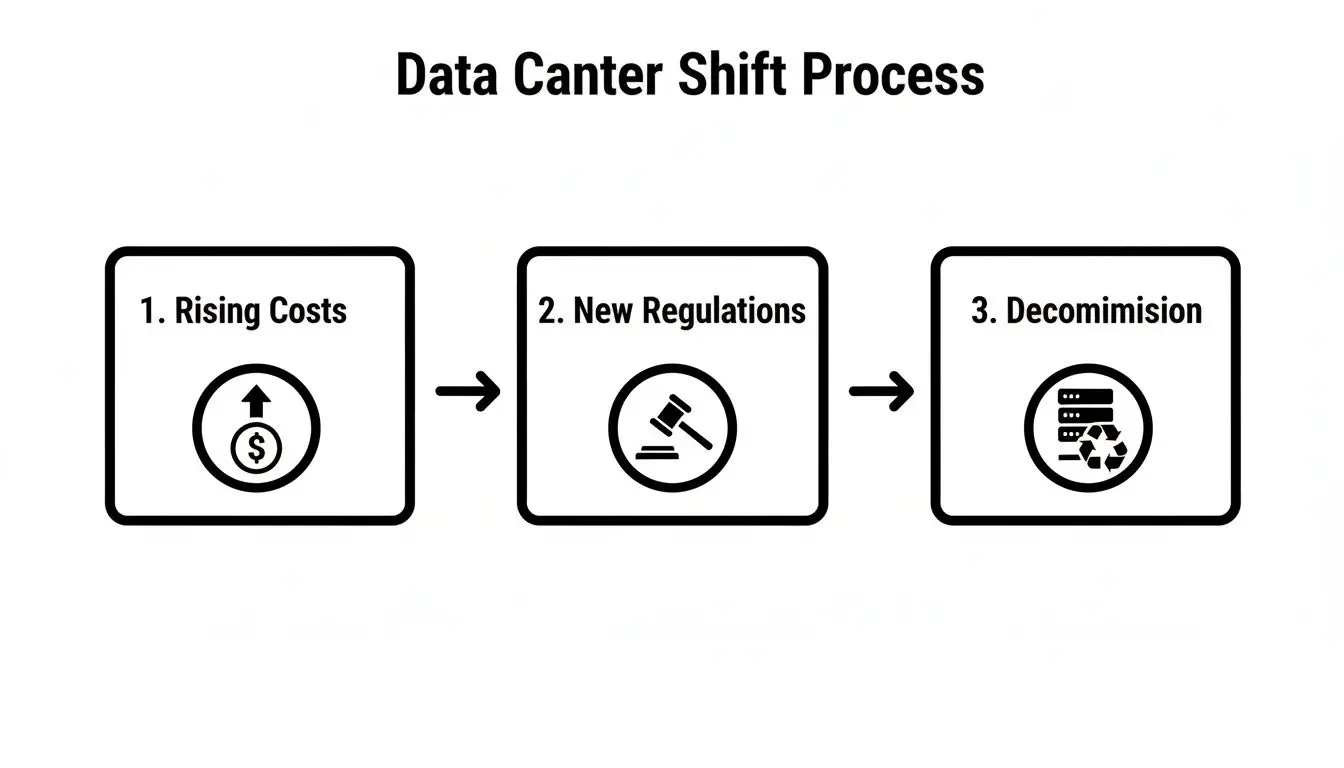
When you see escalating costs and new regulations piling up, decommissioning often becomes the most logical and strategic path forward.
Regulatory and Community Pressures
Local regulations and community sentiment are also powerful drivers. Montgomery County's recent pushback on new data center development, for example, has had a direct impact. As residents and local leaders voiced concerns over energy consumption and environmental impact, zoning laws were changed to restrict new builds to specific industrial areas.
This has forced operators of older data centers in what are now non-compliant zones to start decommissioning. In one notable Gaithersburg case, a 10,000-square-foot facility was shuttered, leading to the retirement of 1,200 servers. The good news? 85% of those assets were successfully repurposed or recycled, turning a regulatory headache into a sustainable outcome.
This is exactly where a social enterprise like Reworx Recycling can be an invaluable partner. We help businesses navigate this complicated transition by:
- Ensuring Compliance: We handle the entire disposal process in line with Maryland's strict environmental regulations and data security standards.
- Creating Community Value: Instead of just destroying assets, we find equipment that can be refurbished and donated, supporting local digital inclusion programs.
- Simplifying Logistics: Our team manages the secure removal and transport of all hardware, giving you a seamless, worry-free experience from start to finish.
Reworx Recycling helps Gaithersburg businesses turn a complex operational challenge into an opportunity for positive community impact. You can learn more in our guide to Maryland electronics recycling. Partnering with us ensures your decommissioning project is not only compliant and secure but also a powerful statement about your company's commitment to social responsibility.
Building Your Decommissioning Project Blueprint
When it's time for a data center decommissioning in Gaithersburg, Maryland, the real work starts long before you unplug the first server. A successful project hinges on a solid plan. For IT directors and facility managers, mapping everything out is the single best way to head off expensive delays and make sure the whole process runs smoothly. A good project plan is more than a generic checklist; it's about getting a handle on your inventory, getting your teams aligned, and being realistic about your timeline.
The first thing you need to do is figure out exactly what you have. That means a complete, accurate inventory of every single asset in the facility. I'm not just talking about counting servers. You need to document every piece of hardware—network switches, storage arrays, power distribution units (PDUs), and even the cabling. Each item needs to be cataloged with its make, model, serial number, and where it is in the data center.
This detailed asset inventory is the bedrock of your entire project. It’s what tells you which equipment can be remarketed to recover some value, which assets need secure data destruction, and what's headed for responsible e-recycling. It also gives you a clear picture of the physical scope of the job, which is crucial for logistics and budgeting.

Getting Everyone On The Same Page
A decommissioning project touches nearly every part of the business. If you don't get buy-in from key stakeholders early on, you’re setting yourself up for friction and roadblocks later. Everyone has different priorities, and you need to address them from the start.
- IT Department: Their world revolves around data integrity, hitting software migration deadlines, and making sure there's zero disruption to live services.
- Finance Department: They're focused on the budget, keeping costs in check, and getting the best possible return on investment (ROI) from retired assets.
- Legal & Compliance Teams: It's all about risk for them. They need to know that data is destroyed according to standards like NIST 800-88 and that you have the documentation—like Certificates of Data Destruction—to prove it.
- Facilities Management: They own the physical site. They're thinking about the power-down sequence, coordinating movers, and prepping the building for whatever comes next.
Pulling off a project this complex requires real project management skill. Earning credentials like Project Management Professional certifications can give your team the structured expertise needed to wrangle all these moving parts. When you bring all these groups to the table from day one, you build a unified strategy that works for everyone.
Setting A Timeline That Actually Works
One of the biggest mistakes we see is an overly ambitious timeline. The truth is, these projects are almost always more complicated and take longer than anyone first expects. A realistic schedule has to account for dependencies and the curveballs that inevitably get thrown your way.
Think about it: migrating all your applications and data off the old gear can take weeks, sometimes months. You might have to renegotiate or terminate software licenses, which can lead to long back-and-forths with vendors. A delay in one area can easily snowball and throw the whole project off track.
Here’s a piece of advice I always give: build buffer time into every phase of your plan. Just assume some tasks will take longer than you think. It's a simple, proactive way to keep a small delay from becoming a massive headache for your schedule and budget.
A well-planned project can be broken down into clear phases. Knowing what happens at each stage helps you line up the right resources and set clear goals. If you're looking for a more granular breakdown, our comprehensive server decommissioning checklist is a great tool to help you organize your tasks.
To help you get started, we've outlined the major phases and key activities that make up a typical decommissioning project. This table gives you a clear framework for building out your own project blueprint.
Data Center Decommissioning Project Phases And Key Activities
| Phase | Key Activities | Primary Stakeholder(s) |
|---|---|---|
| Discovery & Planning | Create a detailed asset inventory, define project scope, secure stakeholder buy-in, select an ITAD partner, and establish a budget. | IT Director, CFO, Facilities Manager |
| Pre-Decommissioning | Execute data and application migrations, validate backups, finalize software license transfers, and schedule logistics with your vendor. | IT Team, Application Owners |
| Execution | Physically disconnect and de-rack equipment, perform on-site data destruction, securely pack and transport assets off-site. | ITAD Partner, Facilities Staff |
| Post-Decommissioning | Receive final reporting, including Certificates of Data Destruction and asset settlement reports. Conduct a final project review. | IT Director, Compliance Officer |
This structure ensures all critical tasks are accounted for, from initial planning to final reporting.
By following a structured blueprint and planning for challenges, Gaithersburg businesses can turn a daunting project into a manageable one. Working with a partner like Reworx Recycling provides the certified services and hands-on expertise to execute each phase perfectly, ensuring your project is secure, compliant, and socially responsible from start to finish.
Executing Flawless Data Destruction And Security
Once you've got a solid plan for your data center decommissioning in Gaithersburg, Maryland, everything pivots to the most sensitive part of the job: data destruction. Let's be honest, for any business along the I-270 Technology Corridor—especially if you're in government, healthcare, or finance—this isn't optional. It’s a legal and reputational minefield. One slip-up can lead to astronomical fines and a brand crisis you might never recover from.
When we talk about this phase, "flawless" is the only acceptable standard. The objective is simple: make every bit of sensitive information completely unrecoverable and have the paperwork to prove it.
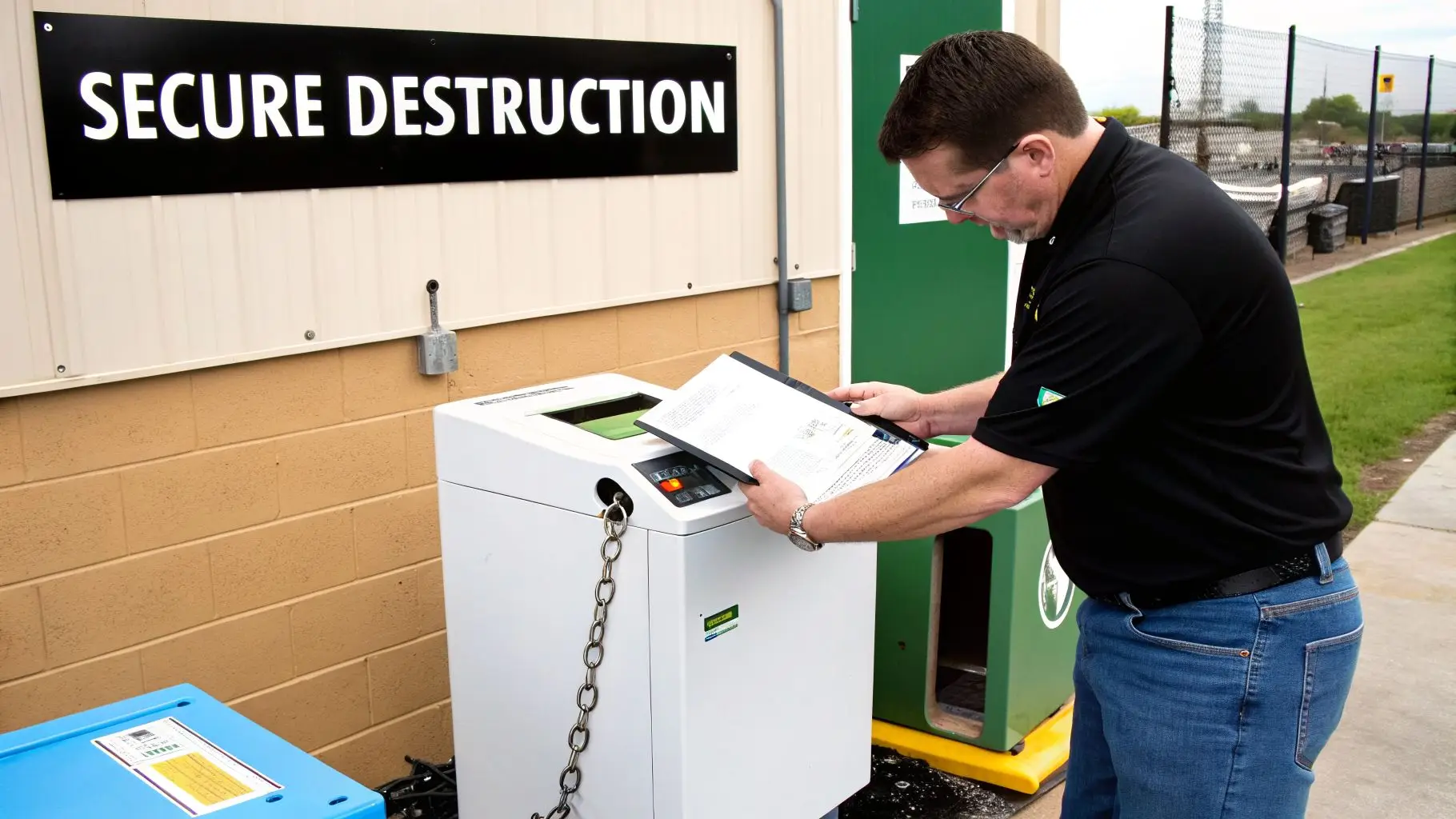
Choosing The Right Data Destruction Method
Here's a crucial point: not all data destruction methods are created equal. The best technique for your project will hinge on your specific security posture, the types of assets you're retiring, and your compliance mandates. The go-to guide for this is the National Institute of Standards and Technology (NIST) Special Publication 800-88, which sorts methods into Clear, Purge, and Destroy.
Let’s get practical and look at the most common techniques we see in the field:
- Data Wiping (Purge): This is where specialized software overwrites your data with junk characters, often in multiple passes. It's a great option for hard drives (HDDs) and solid-state drives (SSDs) you plan to resell or reuse, as it keeps the hardware intact and valuable.
- Degaussing (Purge): Think of this as a massive magnetic blast. It scrambles the magnetic fields on HDDs and tapes, wiping the data instantly. It's incredibly effective for magnetic media, but it also renders the drive useless afterward.
- Physical Shredding (Destroy): This is the final answer for any end-of-life media. Drives are fed into a shredder and torn into tiny, confetti-like pieces. When you need absolute, undeniable proof the data is gone forever, this is your method.
For Gaithersburg companies in highly regulated fields, we almost always recommend a layered strategy. You might wipe drives you're redeploying internally but insist on physically shredding every single retired asset that leaves your building.
The Critical Role Of Chain Of Custody
Destroying the data is only half the battle. The process itself is just as important. A rock-solid chain of custody is the documented paper trail that follows an asset from your server rack to its final destruction. It's your number one defense against theft or loss in transit.
A strong chain of custody isn't just paperwork. It's your proof of due diligence. For your CISO and legal team, it’s the verifiable evidence that demonstrates your company took every necessary step to protect its data.
This process must include serialized asset tracking, transport in secure, sealed containers, and delivery to an access-controlled facility. For total peace of mind, many Gaithersburg firms choose on-site shredding, where they can watch the destruction happen before a single drive leaves their property.
Your Auditable Proof Of Compliance
The last piece of this security puzzle is the Certificate of Data Destruction. This is the official document from your ITAD partner that formally certifies your assets were destroyed according to specific standards. It's not a generic receipt; it should list the serial number of every single drive, the method used, and the exact date of destruction.
This certificate is your key compliance artifact. If an auditor ever comes knocking, this is the proof you'll need to show you met your obligations under rules like HIPAA, SOX, or GDPR.
Local experience in this field is invaluable. For instance, in Gaithersburg, Maryland, some vendors have become notable players in managing regional IT asset disposition. In a 2026 project, one provider handled the decommissioning of a mid-sized Montgomery County data center, processing over 500 server racks and achieving 100% data destruction compliance using NAID-certified methods. This case underscores that certified destruction can reduce breach risks by as much as 99%, making expert partners essential for these transitions. You can find more details on leading decommissioning companies and their practices on Securis.com.
Partnering with a certified expert like Reworx Recycling provides this level of assurance. We offer on-site and off-site shredding services that adhere to NIST 800-88 standards, complete with serialized reporting and Certificates of Data Destruction. Our secure logistics ensure your assets are protected at every step, giving your compliance officers the peace of mind they demand. Explore our secure data destruction services to see how we provide auditable, worry-free security for your Gaithersburg business.
Maximizing Value And Environmental Compliance
A data center decommissioning project is so much more than just another line item on your expense report. It’s a genuine strategic opportunity. For any business in Gaithersburg, it's a chance to pull real financial value from retired hardware while showcasing a rock-solid commitment to corporate social responsibility. It's about turning what looks like an ending for your assets into a new beginning, all while carefully navigating Maryland's specific e-waste regulations.
Bringing an R2v3 certified recycler into the project is the clearest path to hitting both of these goals. That certification isn't just a fancy sticker; it's your peace of mind that a partner is held to the highest industry standards for environmental stewardship and data security. This partnership helps you not just meet but crush your Environmental, Social, and Governance (ESG) objectives, turning a simple compliance task into a powerful story for your brand.
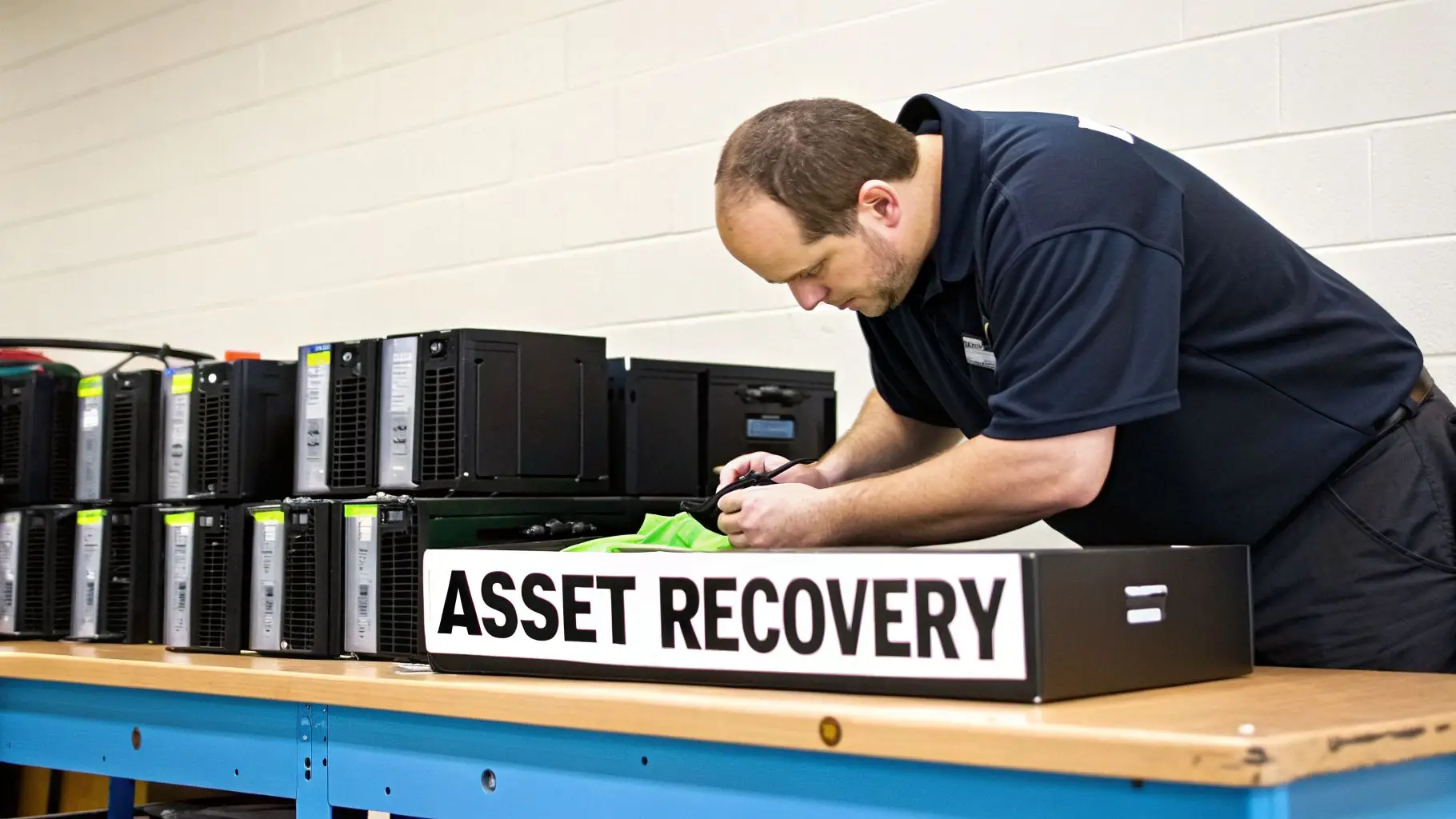
Turning Retired Hardware Into Revenue
The circular economy isn’t just a buzzword; it's a very practical, revenue-generating model for your old IT hardware. You’d be surprised how many components from a decommissioned data center still hold significant value. A good IT Asset Disposition (ITAD) partner knows exactly how to unlock that value through a careful, methodical process.
It typically works like this:
- Testing and Grading: Every single asset—from servers and storage arrays down to individual memory sticks and CPUs—gets put through its paces. We test them thoroughly to figure out their functional condition and performance specs.
- Remarketing: Based on that evaluation, we find the right buyers. Components are sold through established secondary market channels, generating a direct financial return for you that can help offset the project's costs.
- Commodity Recovery: What about assets that are truly at the end of their life? The process doesn't stop there. We de-manufacture them to recover valuable raw materials like copper, aluminum, and precious metals, which are then sold as commodities.
This approach makes sure every possible asset puts money back into your budget instead of becoming a disposal headache. You can learn more about maximizing value in IT asset disposition and see for yourself how a structured process pays dividends.
Navigating Maryland's E-Waste Landscape
Let's be clear: environmental compliance is non-negotiable for any data center decommissioning in Gaithersburg, Maryland. The state's booming data center industry means a corresponding boom in decommissioning projects, which puts a huge spotlight on managing e-waste responsibly.
Just to give you a sense of scale, a recent project for a government-affiliated center right here in the area processed 800 racks. The result? We diverted 30 tons of e-waste from landfills and recycled 95% of it back into raw commodities. This is exactly the kind of impact that aligns with Maryland's environmental goals. You can get more insights on the state's data center dynamics from the Maryland Office of People's Counsel.
By partnering with an R2v3 certified expert, you ensure every piece of equipment is handled according to strict local, state, and federal laws. This documented compliance protects your business from potential fines and reputational damage associated with improper e-waste disposal.
That certification is your guarantee. It means your partner is committed to an audited, transparent process that puts environmental safety first.
The Social Impact Of Your Decommissioning Project
Working with a social enterprise like Reworx Recycling adds a whole other layer of value to your project. While some equipment is best for remarketing or recycling, other assets have a different kind of value—community value.
We’re experts at identifying functional gear like laptops, desktops, and monitors that might not have a high resale price but are perfect for reuse. These assets are carefully refurbished and then donated to local nonprofits, schools, and community centers. It’s a direct line to supporting digital inclusion and workforce development programs right here in our community.
This unique model allows your decommissioning project to create a positive legacy that lasts. You’re not just getting rid of old tech; you're actively helping to bridge the digital divide and empower your neighbors. When you choose a partner with a social mission, your Gaithersburg decommissioning becomes a story of financial recovery, environmental leadership, and real, meaningful local impact.
How To Choose Your Decommissioning Partner In Maryland
Picking the right IT Asset Disposition (ITAD) partner is probably the most important decision you'll make for this whole project. Seriously. The success of your data center decommissioning in Gaithersburg, Maryland, hinges almost completely on their expertise, security chops, and overall reliability.
This choice will determine whether you nail your compliance goals, keep your brand safe from a data breach, and hit your financial and environmental targets.
It’s not about finding someone to just haul away old servers. You need to vet a partner who will act as a true extension of your own risk management team. The same principles apply here as when finding trustworthy repair companies for other mission-critical facility services—it all comes down to their certifications, reputation, and a proven track record.
Key Certifications To Look For
Let's be clear: certifications are non-negotiable. They are your first line of defense and the most straightforward way to gauge a vendor's commitment to doing things the right way. Without them, you're flying blind on trust alone, and that's a massive risk when sensitive data is on the line.
Two certifications, in particular, are absolute must-haves:
R2v3 (Sustainable Electronics Recycling International): Think of this as the gold standard for responsible electronics recycling and data security. An R2v3 certified partner has been through rigorous audits. They’re proven to follow a strict process that prioritizes reuse and proper recycling, and they’re forbidden from exporting hazardous e-waste.
NAID AAA: This one, from the International Secure Information Governance & Management Association (i-SIGMA), is all about data destruction. A vendor with a NAID AAA certification has had their entire process for sanitizing data—whether through wiping, degaussing, or shredding—audited and verified to be secure and compliant with all known data protection laws.
For any business in the Gaithersburg area, especially those in government, healthcare, or finance, a vendor missing either of these certifications should be a major red flag.
Essential Questions For Your RFP
Once you have a shortlist of certified vendors, it’s time to dig in. Your Request for Proposal (RFP) needs to go beyond the basics and ask specific, probing questions that reveal a vendor’s real-world capabilities.
Here are a few questions you should adapt for your own RFP:
- Chain of Custody: "Describe your chain of custody process in detail, from the moment assets leave our Gaithersburg facility to their final disposition. What documentation is provided at each stage?"
- Reporting and Transparency: "What specific information is included in your final asset settlement reports and Certificates of Data Destruction? Can we see a sample report?"
- Logistical Capabilities: "Detail your experience managing decommissioning projects in secure facilities. What security protocols do your on-site teams follow?"
- Value Recovery: "Explain your process for testing, grading, and remarketing assets. How is the final value shared with us, and what are your typical service fees?"
Choosing a partner is about more than just compliance checklists. It’s also about finding an organization whose values align with your own. When you select a social enterprise, your decommissioning project delivers a double bottom line—protecting your business and benefiting your community.
This is where a partner like Reworx Recycling really stands apart. We hold both R2v3 and NAID AAA certifications, which guarantees the highest level of security and environmental stewardship for your project.
But our commitment doesn't stop there. As a social enterprise, we actively look for opportunities to refurbish functional equipment for donation, which supports local workforce development and digital inclusion right here in the community.
You can learn more about how to compare vendors by reading our guide on what to look for when evaluating top IT asset disposition companies.
To help you get started, use this checklist to see how potential partners stack up.
ITAD Vendor Comparison Checklist
| Evaluation Criteria | Vendor A | Vendor B | Reworx Recycling |
|---|---|---|---|
| R2v3 Certified | Yes | ||
| NAID AAA Certified | Yes | ||
| On-Site Data Destruction | Yes | ||
| GPS-Tracked Logistics | Yes | ||
| Detailed Asset Reporting | Yes | ||
| Value Recovery/Remarketing | Yes | ||
| Social Impact/Donation Program | Yes |
When you partner with Reworx Recycling for your Gaithersburg project, you aren’t just hiring a vendor. You're gaining a partner who is completely dedicated to flawless execution, ironclad security, and making a positive impact.
Your Gaithersburg Decommissioning Questions Answered
When you're facing a data center shutdown in Gaithersburg, questions are going to pop up. It’s a complex job, and it’s smart to have all your ducks in a row. We’ve put together answers to some of the most common things IT managers and business owners ask us.
How Long Does a Decommissioning Project Take?
This is the big one, and the honest-to-goodness answer is: it depends. We’ve seen small server rooms wrapped up in a week. On the other hand, a huge, multi-megawatt data center can easily take several months from start to finish.
A few key things will shape your timeline:
- Data and Application Migration: Moving all your software and data to its new home is almost always the longest part of the journey.
- Asset Inventory Size: It’s simple math. A facility with 100 racks is a much quicker job than one with 1,000 racks.
- Compliance Requirements: If you're dealing with highly sensitive data, you’ll need to budget more time for on-site data destruction and all the verification that comes with it.
For a mid-sized Gaithersburg facility, a realistic timeline from initial planning to getting that final report is often in the 3-6 month range. The best advice I can give is to build some buffer time into your project plan. You never know when you'll run into an unexpected snag.
What Happens to My Old Equipment?
Your retired assets will head down one of three main paths, and every step is tracked under a strict chain of custody so you always know where your gear is.
- Value Recovery: Equipment that's still functional and has some life left in it—think servers, CPUs, and memory—gets tested, graded, and sold on the secondary market. This generates cash that can help offset your project costs.
- Sustainable Recycling: Anything that’s truly at its end-of-life or is proprietary gets de-manufactured according to strict R2v3 standards. We make sure hazardous materials are handled safely and recover commodities like steel, aluminum, and copper for reuse. This keeps tons of e-waste out of landfills.
- Community Donation: Through a social enterprise model like the one we have at Reworx Recycling, functional gear that might not have high resale value (like desktops and laptops) is refurbished. We then donate it to local schools and nonprofits, helping bridge the digital divide right here in our community.
Is On-Site Data Destruction Really Necessary?
For many businesses in Gaithersburg, especially those in regulated fields like government, healthcare, or finance, the answer is a firm yes. While sending drives to a secure, certified facility for off-site destruction is a perfectly good option, shredding on-site offers the ultimate level of security and peace of mind.
On-site shredding completely eliminates the risk of a data breach while your equipment is in transit. You get to watch your hard drives turn into scrap metal before they even leave your building, giving you undeniable proof of destruction.
This is especially critical when you're dealing with government data, patient records, or sensitive financial information. A partner like Reworx Recycling can bring a mobile shredding truck right to your Gaithersburg site. We’ll perform the service right there and hand you a Certificate of Data Destruction on the spot, giving your CISO and legal team the auditable proof they need.
Ready to turn a complex decommissioning project into a success story of security, sustainability, and community support? The team at Reworx Recycling has the certified expertise and local know-how to guide your Gaithersburg business every step of the way. Donate your equipment, schedule a pickup, or partner with us to transform your IT asset disposition into a powerful force for good.
Learn More & Partner with Reworx: https://www.reworxrecycling.org/category/recycling-blog