
Executing a data center decommissioning in Biddeford, Maine, is much more than simply unplugging servers. It is a strategic corporate initiative that requires meticulous planning, absolute data security, and strict adherence to environmental regulations to prevent significant financial and compliance risks. For business owners and IT managers, viewing this process as a project with a clear beginning, middle, and end is the key to a successful outcome.
Starting Your Biddeford Decommissioning Project
The initial phase of a data center decommissioning can seem daunting, but breaking it down into manageable stages is crucial. This planning stage sets the foundation for the entire project. A misstep here can easily lead to budget overruns, data breaches, or compliance violations with state and federal laws.
First, you must clearly define the project's scope and objectives. Is your company consolidating facilities after a merger? Are you migrating entirely to the cloud, or is this a standard hardware refresh? The answer shapes your timeline, budget, and required resources. Every subsequent decision must align with these core business goals.
Building Your Team and Setting Goals
A successful decommissioning is a collaborative effort requiring a team with diverse expertise. You should include stakeholders from IT, facilities management, finance, and information security. Each department offers a critical perspective, from understanding the building’s physical layout to assessing the financial implications of asset disposition. A detailed understanding of the facility's design, especially if it's a modern modular data center, is vital for efficient execution.
This graphic outlines the three foundational pillars of any decommissioning project: defining the scope, establishing the budget, and selecting the right partner to execute the plan.
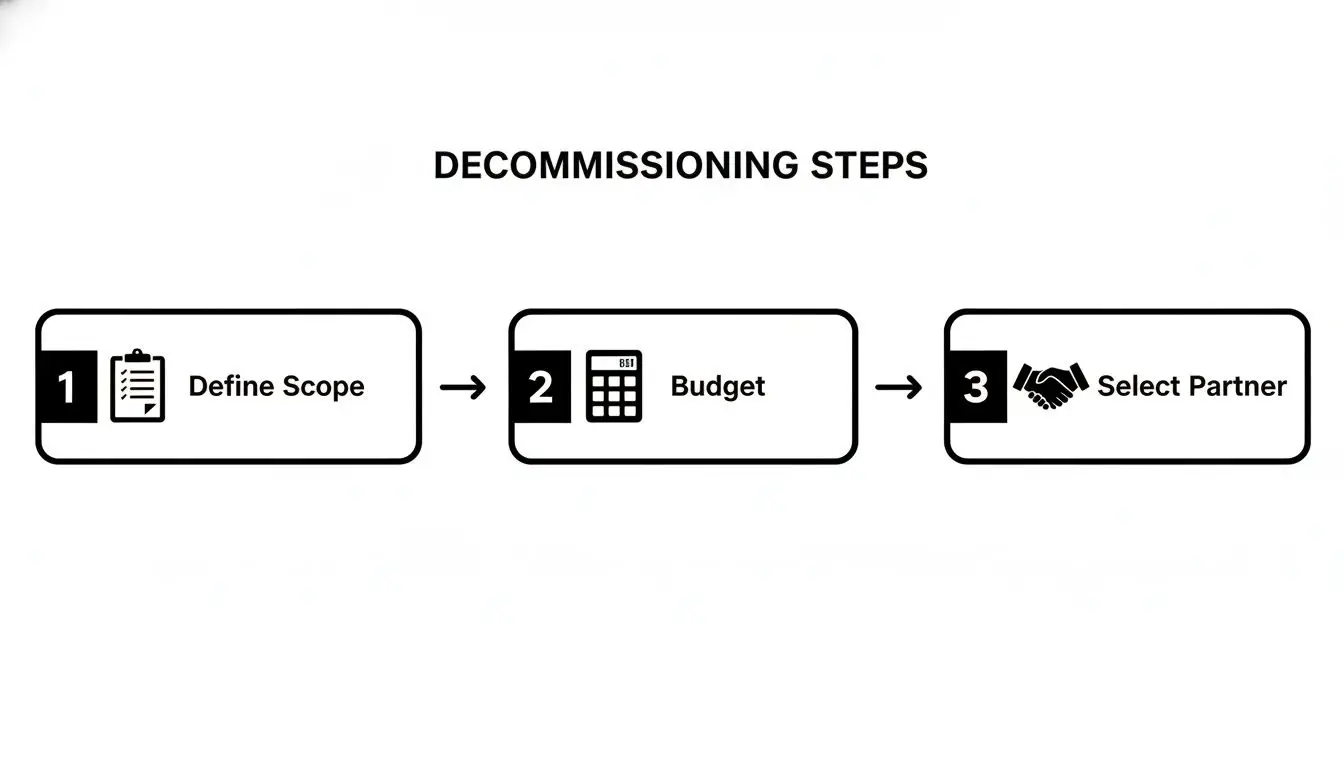
As you can see, each step logically follows the last. A clear scope enables accurate budgeting, and a well-defined budget helps you identify a partner whose services align with your financial parameters.
Preliminary Budgeting and Timelines
Once your team is in place and your goals are established, you can begin to assign concrete numbers and dates. Your initial budget should encompass several key cost centers:
- Labor Costs: Account for both contractor fees and the internal hours your team will dedicate to de-racking, packing, and project management.
- Logistics and Transportation: The expense of packing materials, pallets, and securely shipping equipment from your Biddeford facility can be substantial.
- Data Destruction: Whether you opt for software-based wiping or physical shredding, secure data sanitization is a necessary and budgeted expense.
- Recycling and Disposal Fees: Compliant e-waste disposal is not free. These fees vary based on the type and volume of equipment being processed.
A common oversight is underestimating "soft costs," such as project management hours and the potential for operational downtime. Incorporating these into your budget from the outset helps prevent unexpected financial strain.
This is also the ideal time to develop your IT asset disposition (ITAD) strategy. Will you attempt to resell newer equipment to recoup value, or is the primary goal responsible recycling? Partnering with a donation-based social enterprise like Reworx Recycling presents a unique alternative. Our detailed server decommissioning checklist is an excellent resource to ensure no detail is overlooked. By choosing a donation-based model, your Biddeford business can transform a logistical challenge into a powerful act of corporate social responsibility that supports digital inclusion and community programs across Maine.
Creating An Actionable IT Asset Inventory
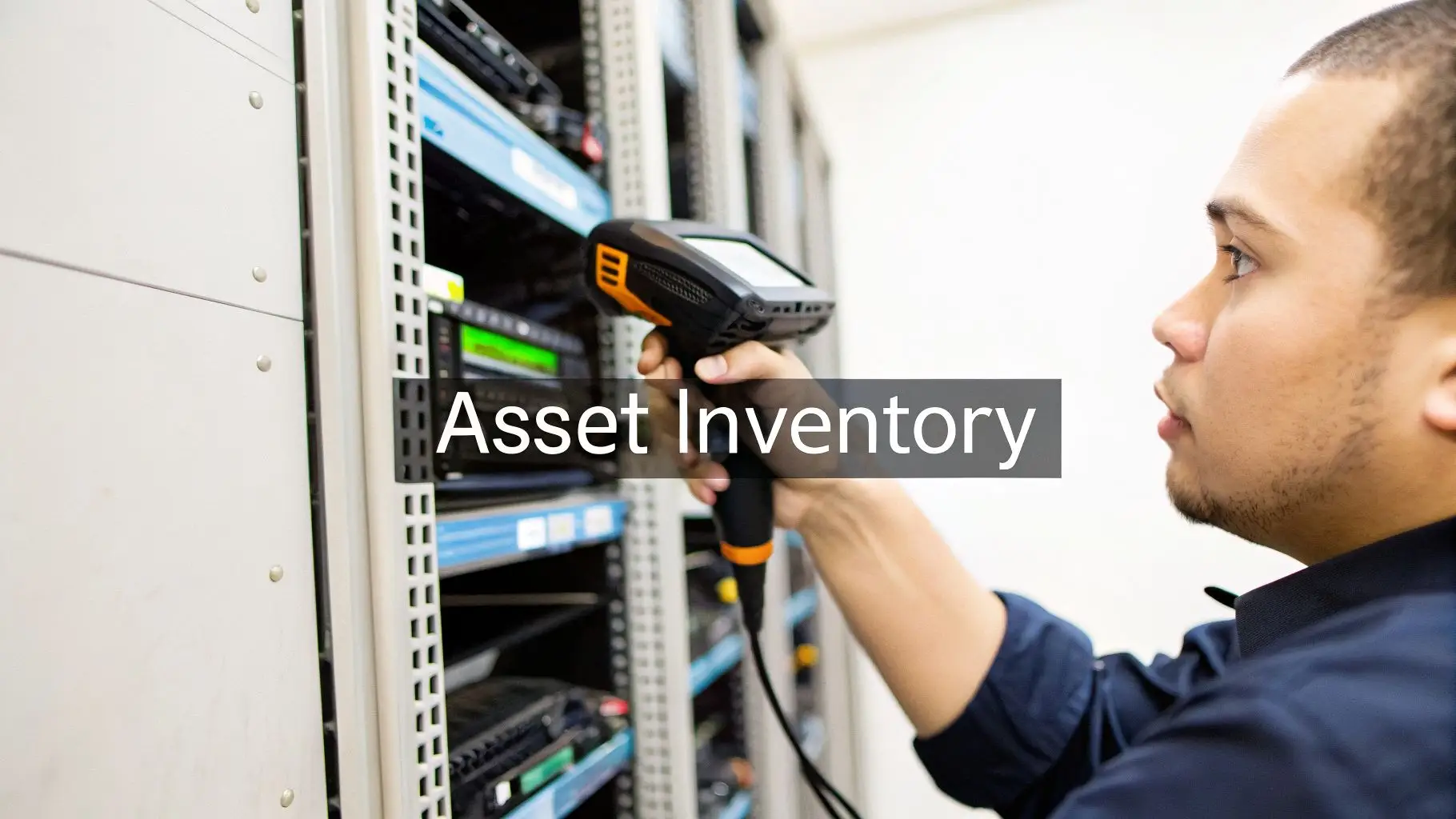
Before a single server is unplugged during your data center decommissioning in Biddeford, Maine, you must have a precise understanding of every asset involved. A detailed IT asset inventory is more than just a list; it is the foundational roadmap for the entire project. It informs your data destruction strategy, logistical planning, and any potential value recovery from the hardware.
For a project of this scale, a simple spreadsheet is insufficient. Modern asset management software, particularly when paired with barcode or RFID tagging, is the industry standard. This technology minimizes human error and creates a dynamic, searchable database that serves as the single source of truth for every server, switch, PDU, and storage array in your facility.
Capturing The Right Data Points
A truly effective inventory goes beyond a simple count of devices. You are creating a comprehensive profile for each piece of equipment, and this profile requires specific data points to guide the next steps of the decommissioning process.
This level of detail is non-negotiable. It helps prevent "ghost assets"—equipment listed in records but physically unaccounted for—and ensures every device is properly tracked from start to finish. To understand the full importance of this step, you can explore why IT inventory audits matter before recycling.
To ensure accuracy, use a standardized checklist for every item you document.
Essential IT Asset Inventory Checklist
This table outlines the critical information needed for each piece of hardware. Capturing these details accurately at the start will streamline every subsequent phase of your Biddeford decommissioning project.
| Asset ID | Asset Type (e.g., Server, Switch, PDU) | Make & Model | Serial Number | Physical Location (Rack/U-Position) | Condition (Working, Needs Repair, EOL) | Data Bearing (Yes/No) | Intended Disposition (Resell, Recycle, Donate) |
|---|---|---|---|---|---|---|---|
| SRV-001 | Server | Dell PowerEdge R740 | J4XF2G3 | Rack 12, U 5-6 | Working | Yes | Resell |
| SW-023 | Switch | Cisco Catalyst 9300 | FOC2234ABCD | Rack 04, U 42 | Working | No | Donate |
| SAN-004 | Storage Array | NetApp FAS2750 | 700001234567 | Rack 15, U 10-14 | Needs Repair | Yes | Recycle/Destroy |
| PDU-088 | PDU | APC AP8853 | ZA1725EFGH | Rack 12, Rear | Working | No | Recycle |
This structured data is the key to an efficient, compliant, and financially sound decommissioning project.
A well-documented inventory is your strongest defense during an audit. It demonstrates that you had a documented plan, executed it systematically, and can account for the final disposition of every piece of equipment and its associated data.
From List To Logistics Roadmap
Once your inventory is complete, you can begin tagging each asset with its final destination. Does it contain sensitive data that requires certified destruction? Is it new enough to have resale value? Or is it designated for responsible electronics recycling?
This is where a capable ITAD partner demonstrates their value. For example, a Biddeford-based manufacturing firm we worked with used its detailed inventory to identify a batch of servers that were only three years old. This data allowed them to quickly segregate these high-value assets for remarketing.
Simultaneously, older networking gear was tagged for donation through Reworx Recycling. What would have been a disposal cost was transformed into a tax-deductible contribution that provided technology to local community programs. The inventory provided the clarity needed to make these smart, strategic decisions efficiently.
Executing Flawless Data Destruction and Compliance
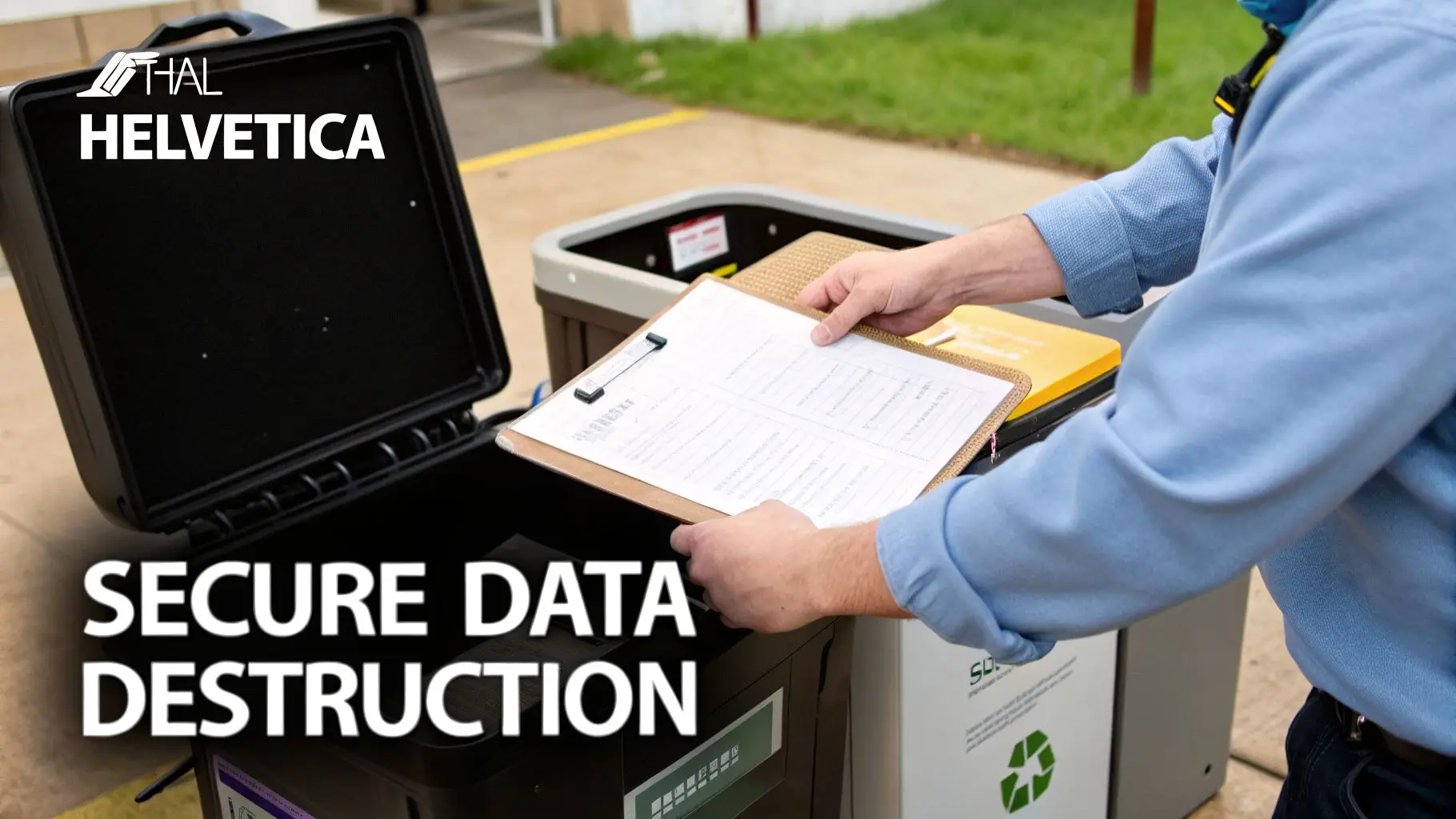
With a complete inventory, you arrive at the most critical phase of any data center decommissioning in Biddeford, Maine: ensuring every byte of sensitive information is irretrievably destroyed. This is not merely a procedural step; it is a legal and reputational imperative.
A single data-bearing device that is improperly handled can lead to a catastrophic data breach, resulting in severe regulatory fines, legal action, and an erosion of customer trust that is nearly impossible to repair. For businesses in regulated industries like healthcare or finance, compliance with standards such as HIPAA and SOX is not optional—it is the law.
Choosing Your Data Sanitization Method
The appropriate method for data destruction depends on the media type, its condition, and your organization's risk tolerance. The two primary approaches are software-based wiping and physical destruction. Both play a role in a well-managed decommissioning strategy.
Software wiping, typically performed to the NIST 800-88 standard, overwrites a drive’s data with random characters, rendering the original information unrecoverable. This method is ideal for newer, functional drives intended for resale or donation, as it preserves the hardware's value.
Conversely, physical destruction is the definitive end for a drive. This can involve shredding it into small metal fragments or degaussing it with powerful magnetic fields to obliterate the data. Physical destruction is the preferred method for drives that are non-functional, obsolete, or contain highly sensitive information where no risk is acceptable.
Comparing Data Destruction Techniques
The choice between wiping and shredding involves trade-offs. The right method for one set of assets may not be appropriate for another within the same project.
| Method | Best For | Pros | Cons |
|---|---|---|---|
| Software Wiping (NIST 800-88) | Functional drives intended for resale, reuse, or donation. | Preserves asset value. Environmentally friendly. | Time-consuming. Requires working hardware. |
| Physical Shredding | End-of-life, failed, or high-security drives. | Fast and definitive. Highest level of security assurance. | Destroys asset value. Creates physical waste. |
| Degaussing | Magnetic media like LTO tapes and older HDDs. | Quick and effective for specific media types. | Does not work on SSDs. Leaves no visible proof of destruction. |
For many Biddeford businesses, a hybrid approach is the most practical solution. You might wipe high-value servers to capture their resale value while sending end-of-life storage arrays directly to the shredder.
The Unbreakable Chain of Custody
Equally important as the method of destruction is the documentation proving it was done correctly. This is where the chain of custody becomes essential. It is a detailed, uninterrupted record that tracks every data-bearing device from the moment it leaves your control to its final destruction.
This documentation must capture:
- Serial numbers of every drive.
- The identity of personnel who handled the assets and when.
- Secure transport logs.
- The final method of destruction used.
Upon completion, your ITAD partner must issue a Certificate of Data Destruction. This is more than a receipt; it is a legally defensible document that lists every drive by serial number, confirming it was sanitized in accordance with industry standards. This certificate is your absolute proof of due diligence in any future audit.
Consider your Certificate of Data Destruction your insurance policy against a future data breach allegation. Without it, you have no verifiable proof that you acted responsibly. It is an indispensable component of your risk management strategy.
Partnering with a certified ITAD vendor like Reworx Recycling eliminates the guesswork and liability from this critical process. We provide a fully transparent, auditable trail for every asset. You can explore our approach to secure data destruction services and discover how we deliver complete peace of mind for businesses throughout Maine. This meticulous process ensures your company is protected and your project remains compliant.
Moving Gear and Minding Maine's Environmental Rules
Once the data is securely destroyed—and you have the certificates to prove it—the project's focus shifts from digital to physical. This next phase of your data center decommissioning in Biddeford, Maine, involves the de-installation, packing, and transportation of tons of equipment, all while adhering to Maine's stringent environmental laws.
This logistical stage can become chaotic without a well-defined plan. You must remove all hardware efficiently without disrupting ongoing business operations. This requires a coordinated effort of planned transit routes, off-peak pickup scheduling, and ensuring the on-site crew has the right equipment, from pallet jacks to specialized server lifts.
The Reverse Logistics Puzzle
This process is known as reverse logistics. It encompasses all activities involved in moving assets from their point of use back to a central facility for processing. In a data center, this means carefully de-racking servers, disconnecting heavy power distribution units, and dismantling complex network cabling. Each step is a mini-project, and a single mistake can cause property damage or, worse, personal injury.
A safe work environment is non-negotiable. It is imperative to follow proper procedures for lifting heavy equipment, handling electrical connections, and maintaining clear hallways and exits. A minor accident can cause significant delays and expose your company to serious liability.
How to Navigate Maine’s Groundbreaking E-Waste Laws
Compliance is a major component of this phase, and Maine has a long history of robust e-waste regulation. Maine was the first state to enact a "producer responsibility" law for electronics, a model that has since been influential nationwide.
For businesses in Biddeford, this means you cannot simply dispose of old servers or monitors in a dumpster. The Maine Department of Environmental Protection (DEP) has explicit rules requiring that e-waste be managed by authorized consolidators and recyclers. These regulations cover the majority of equipment found in a data center, including:
- Computers and Laptops: Every desktop and laptop must be properly recycled.
- Monitors and Displays: CRT and flat-panel displays contain hazardous materials like lead and mercury and require special handling.
- Printers and Scanners: All office electronics are classified as e-waste.
- Televisions and Other Video Displays: Though less common in a data center, these are also subject to strict disposal rules.
Ignoring these regulations can be a costly error. The Maine DEP actively enforces its laws to prevent toxic materials from entering local landfills and to protect natural resources like the Saco River.
Maine's e-waste program is built on the principle of shared responsibility. For a business, this means that partnering with a compliant recycler is not just a best practice—it is a legal obligation to ensure retired hardware enters the state's approved recycling stream.
A qualified ITAD partner is essential for navigating these regulations seamlessly. An experienced vendor understands the specific requirements for businesses in Maine and provides all the necessary documentation to prove you have fulfilled your environmental obligations, shielding you from fines and demonstrating a tangible commitment to corporate responsibility. You can find more details on compliant disposal in our guide to Maine electronics recycling.
Working with a social enterprise like Reworx Recycling adds another powerful dimension to your compliance strategy. Not only do we guarantee that every piece of your equipment is managed according to Maine DEP regulations, but our donation-first model also prioritizes finding a second life for functional hardware. This approach keeps usable technology out of the shredder and places it in the hands of community organizations and digital inclusion programs in Biddeford and beyond, transforming a regulatory requirement into a positive local impact.
How to Choose Your Decommissioning Partner in Biddeford
Selecting an IT asset disposition (ITAD) partner is one of the most critical decisions in your data center decommissioning in Biddeford, Maine. This choice will directly impact the project's security, compliance, and overall success. The right partner ensures a smooth, auditable process. The wrong one can expose your organization to data breaches, regulatory penalties, and reputational harm.
The goal is to find more than just the lowest bidder. You are looking for a true partner who can deliver a transparent and fully documented process from start to finish. You need an extension of your own team that you can trust with your most sensitive assets.
Key Certifications to Look For
Industry certifications are your first line of defense. They provide independent verification that a vendor has invested in the processes and infrastructure required to manage retired IT assets responsibly. For any business in Biddeford, the following certifications are essential:
- R2 (Responsible Recycling): As the leading global standard for electronics recycling, R2 certification ensures that your equipment is handled with environmental and worker safety as top priorities, and that no material will end up in a landfill.
- e-Stewards: Often considered the most stringent e-waste certification, e-Stewards enforces a strict zero-tolerance policy against exporting hazardous electronic waste to developing countries.
- NAID AAA: This certification focuses exclusively on data security. A NAID AAA certified vendor adheres to rigorous protocols for data destruction, including comprehensive employee background checks and 24/7 surveillance of their facility.
These are not merely logos for a website; they are hard-earned credentials that demonstrate a vendor's commitment to protecting your business and the environment.
Essential Questions for Potential Partners
Once you have a shortlist of certified vendors, it’s time to ask probing questions. You need to understand their procedures in detail to feel confident in how they will protect your assets and data at every stage.
Arrive at your meetings prepared with a list of questions for each potential partner. Their responses—or lack thereof—will reveal their expertise and commitment to transparency.
A vendor who provides vague answers regarding their chain of custody or data destruction methods is a major red flag. If they cannot be clear and direct during the sales process, it is unlikely they will be communicative once they are in possession of your equipment.
Be sure to ask:
- Can you provide a sample of a complete, serialized asset report that you deliver to clients?
- How do you document and secure the chain of custody from our Biddeford facility to yours?
- What are your specific methods for both on-site and off-site data destruction?
- Will we receive a Certificate of Data Destruction for every single drive, itemized by serial number?
- What does your downstream recycling and resale process look like? Can you provide proof that no e-waste is illegally exported?
- What are your insurance and liability coverage limits in the event of a data breach or environmental incident?
You are looking for confident, specific answers backed by sample documentation, not hesitation or generic assurances.
Comparing Decommissioning Partner Models
To make an informed decision, it is useful to compare the different types of partners you might encounter. While a standard vendor focuses on the transaction, a social enterprise like Reworx Recycling integrates community benefit into its core service. This table illustrates what that means for your Biddeford business.
| Evaluation Criteria | Standard Vendor | Reworx Recycling (Social Enterprise) | Your Notes |
|---|---|---|---|
| Primary Goal | Maximize profit from asset resale/recycling. | Securely process assets while maximizing community value. | |
| Data Security | Certified (NAID AAA, R2, etc.). | Certified (NAID AAA, R2, etc.) with the same rigorous standards. | |
| Reporting | Provides serialized Certificates of Destruction and asset reports. | Provides serialized Certificates of Destruction and asset reports. | |
| Environmental Impact | Follows certification guidelines for responsible recycling. | Prioritizes reuse and refurbishment to extend asset life before recycling. | |
| Community Impact | Minimal to none. Focus is purely on business-to-business transaction. | Core to the mission. Donates functional equipment to local schools & nonprofits. | |
| CSR Value | Limited. The project is an operational expense. | High. Turns an operational task into a measurable social good for Biddeford. |
Ultimately, both models can provide the security and compliance you require. The right choice depends on whether you are simply looking to dispose of assets or if you want that process to create a lasting, positive impact.
The Social Enterprise Advantage
Beyond the traditional vendor model, there is another path: partnering with a social enterprise. This approach transforms your decommissioning project, aligning it with your corporate social responsibility (CSR) goals and generating a positive impact that extends far beyond your data center walls.
A social enterprise like Reworx Recycling operates on a dual mission. We deliver the same certified, secure, and compliant ITAD services in Maine you would expect from any top-tier firm, but our business model is fundamentally different. Our primary focus is on maximizing the value of your retired assets for the community.
We prioritize donation-based recycling, meaning we refurbish and redirect functional equipment—laptops, desktops, and networking gear—to schools, nonprofits, and workforce development programs in and around Biddeford. This transforms a standard operational task into a powerful act of corporate citizenship. Your project doesn't just empty a room; it helps bridge the digital divide and equips your community with vital resources.
Frequently Asked Questions About Decommissioning in Maine
If you're planning a data center decommissioning in Biddeford, Maine, you likely have questions. It is a major undertaking, and everyone from IT managers to business owners needs clear answers to proceed with confidence.
We frequently hear the same questions from businesses across the state, so we have compiled straightforward answers to help you plan effectively.
What Is the Typical Timeline for a Decommissioning Project in Biddeford?
There is no single answer, as the timeline depends on the facility's size, the volume of equipment, and your specific data security requirements. A small server room might be completed in a week, while a large, multi-rack data center could take several weeks or even months from the initial planning meeting to the final report.
Key factors that will shape your schedule include:
- Inventory Auditing: A detailed audit is essential for a smooth project. It may take a few days but prevents significant issues later.
- Data Destruction: On-site shredding is very fast, whereas software-wiping hundreds of high-capacity drives can be time-consuming.
- Logistics: Scheduling trucks and coordinating with building management can easily add days to the project timeline.
A good partner will work with you to create a realistic, phased timeline that minimizes disruption to your Biddeford operations.
Are There Specific Maine Regulations I Need to Know?
Yes, and this is a critical point. Maine has some of the most established electronics recycling laws in the country, managed by the Maine Department of Environmental Protection (DEP). These "producer responsibility" laws mean you cannot simply discard old technology.
This means you are legally prohibited from throwing old servers, monitors, or networking gear into a standard dumpster. Doing so can result in significant fines and environmental liability. Your ITAD partner must be fully compliant with Maine's e-waste programs.
Working with a certified partner like Reworx Recycling removes the compliance burden. We are experts in the state's specific regulations and provide all necessary documentation to prove your old equipment entered the proper recycling stream, keeping your business protected.
How Much of Our Equipment Can Be Donated or Resold?
This is an excellent question, as the answer directly affects your budget and your company's social responsibility initiatives. The potential for remarketing or donation depends primarily on two factors: age and condition.
As a general rule, equipment that is less than three years old from major brands like Dell or HP will have the highest resale value. Networking gear and laptops also retain value well. For donations, the criteria are more flexible. A five-year-old computer may have no resale value but could be transformative for a local school or nonprofit right here in Biddeford. Your asset inventory is the key to identifying these opportunities.
While finding hard local data on e-waste can be challenging, the trend is clear: more organizations are focusing on extending asset lifecycles. If you're interested in how complex strategic planning efforts in Maine rely on data, you can review documents like the Maine Space Complex Strategic Plan.
Why Should We Choose a Social Enterprise for Our ITAD Needs?
Partnering with a social enterprise like Reworx Recycling completely changes the narrative of your decommissioning project. A traditional vendor views asset disposal as a transaction. A social enterprise views it as an opportunity.
We offer the same certified, secure, and compliant IT asset disposition (ITAD) services you would expect from any top-tier provider, including NAID AAA certified data destruction. The difference is our model is designed to generate community value.
By prioritizing the refurbishment and donation of your usable equipment, your project directly supports digital inclusion, creates job training opportunities, and enhances educational programs in the Biddeford community. It transforms a necessary operational expense into a powerful story of corporate social responsibility that you can measure and share. You're not just disposing of old assets—you're investing in your own community.
Ready to turn your old technology into an opportunity for your business and your community? Partner with Reworx Recycling for your next office cleanout or data center project. We provide secure, compliant, and socially responsible electronics recycling and ITAD services. Visit our blog to learn more and schedule your pickup today.