A Dallas business usually realizes it needs telecom help at the worst moment. The phones sound choppy during client calls, cloud apps lag in the middle of the workday, invoices keep arriving with charges no one can explain, and an office move or system refresh is already on the calendar.
That mix of pressure is common across the DFW market. Teams outgrow a patchwork of carrier contracts, aging cabling, old PBX hardware, and informal procurement decisions. Then a simple upgrade stops being simple. It becomes a network issue, a budgeting issue, a compliance issue, and eventually an equipment retirement issue too.
The mistake is treating those as separate problems. In practice, they're tied together. The Dallas companies that manage telecom well don't just buy better circuits or renegotiate rates. They also plan what happens to the gear, phones, switches, and related assets leaving the environment.
Navigating Your Next Tech Upgrade in Dallas
A familiar scenario plays out like this. A growing office in Dallas adds staff, shifts more workflows into cloud platforms, and rolls out more voice and collaboration tools. Suddenly, the network feels undersized. Support tickets pile up. Finance sees telecom spend rising, but no one can clearly say which services are still in use and which devices should've been retired months ago.

That's where telecom consulting services Dallas become practical, not theoretical. A good consultant steps in to sort carrier contracts, validate what the business is consuming, assess whether the underlying wiring can support the next phase of growth, and create a migration plan that doesn't break daily operations. That matters in a market where telecom consulting is expanding quickly. The global telecom consulting market was valued at USD 7,291.0 million in 2024 and is projected to reach USD 14,519.6 million by 2030, with a 12.2% CAGR, according to P&S Market Research's telecom consulting market analysis.
Where Dallas upgrades usually go sideways
Most upgrade problems don't start with technology alone. They start with sequencing.
- Carrier changes happen first: The business signs a new agreement before confirming internal infrastructure can support it.
- Old hardware stays in place: Legacy phones, edge devices, and closets full of telecom gear remain untouched because no one owns retirement planning.
- Billing lingers after migration: Teams move services but fail to disconnect everything tied to decommissioned assets.
Practical rule: If your upgrade plan ends at activation day, it isn't complete.
That final step is usually missed. Telecom projects generate a stream of retired assets, from handsets and conferencing equipment to network electronics and storage media. Businesses that need local guidance on the telecom side often start with Dallas telecommunications service support to map the operational side first, then build disposal and data handling into the same timeline.
What smart planning looks like
The strongest approach is simple. Audit first. Design second. Migrate in phases. Retire assets deliberately.
That keeps the business from solving one problem while creating three more. In Dallas, where office growth, relocations, and hybrid infrastructure changes happen fast, that discipline is what separates a clean upgrade from a costly mess.
Understanding Core Telecom Consulting Services
Most business owners hear "telecom consulting" and think carrier quotes. That's only one slice of the work. The total value is broader. A consultant examines the full communication environment, including network performance, contract structure, procurement decisions, migration planning, invoice controls, and the internal infrastructure that supports all of it.
The market has expanded in that direction for a reason. The telecom consulting market grew from USD 5,161.89 million in 2021 to USD 7,291.0 million in 2024, while demand accelerated as companies focused on digital transformation, remote work support, cybersecurity, and data analytics, according to Cognitive Market Research's telecom consulting market report.

Cost control and invoice auditing
This is often the fastest place to find waste. A consultant reviews bills, compares them to contract terms, identifies duplicate services, and flags lines that no longer match operational reality. That sounds administrative, but it isn't. Telecom bills are often a record of old decisions that no one revisited.
A useful consultant doesn't just say "you're overspending." They trace each charge back to a service, site, or asset and force clarity.
Procurement and vendor negotiation
Carriers write contracts every day. Most SMBs don't. That imbalance shows up in terms, renewal language, service assumptions, and disconnect procedures.
Good consultants know how to compare business internet, voice, UCaaS, and mobility options in a way that matches actual use. They also know when the cheapest option creates support headaches later. If your team is trying to understand the broader difference between telecom advisory and general technical support, this overview of Finchum Fixes IT consulting is a solid companion read.
Network design and migration planning
Many projects accrue significant expense. The business wants to move to hosted voice, consolidate sites, or support more cloud traffic, but no one has validated LAN readiness, QoS assumptions, or failover expectations. A consultant should map dependencies before change starts.
A practical migration plan usually includes:
- Current-state inventory: Active circuits, devices, contracts, and physical dependencies.
- Readiness review: Cabling, switching, power, endpoint compatibility, and site constraints.
- Cutover sequencing: Which users, floors, or sites move first, and what rollback looks like.
- Post-move validation: Billing cleanup, service testing, and decommissioning tasks.
Buy telecom advice that reduces uncertainty, not just price.
Vendor management after the deal
This is the part companies underestimate. The contract is signed, but activations slip, billing starts early, changes get mishandled, and support tickets bounce between provider teams. A consultant with strong vendor management capability acts as an escalation point and keeps carriers accountable.
That can matter more than the initial negotiation.
Compliance, security, and lifecycle coordination
Telecom touches regulated data, user access, call flows, and physical devices that may store sensitive information. During an upgrade, old phones, conferencing units, routers, and related systems don't become harmless just because they're unplugged. They become unmanaged assets.
A stronger operating model ties consulting work to operations and retirement planning. Businesses evaluating support options often look for managed telecom services near me because they need more than a one-time recommendation. They need repeatable oversight.
What matters most by business situation
| Business condition | Consulting priority | What usually doesn't work |
|---|---|---|
| Rising bills with poor visibility | Expense audit and contract review | Accepting invoices as accurate by default |
| Office move or expansion | Infrastructure review and migration planning | Moving circuits before validating cabling and room readiness |
| Voice quality problems | Network assessment and internal path analysis | Blaming the carrier before checking local environment |
| Multi-vendor complexity | Vendor management and consolidation | Letting each provider define the scope of the issue |
The key point is straightforward. Telecom consulting isn't one service. It's a set of disciplines that keeps communication systems aligned with budget, operations, and risk.
Why Your Dallas Business Can't Afford to Ignore Telecom Consulting
Ignoring telecom problems doesn't freeze them in place. It lets them spread into payroll time, customer experience, project delays, and compliance exposure. That's why many Dallas firms wait too long. The early signs look manageable. A few invoice questions. A recurring complaint about call quality. One more closet full of old equipment no one has documented.
Then those issues combine.
Cost leakage compounds quietly
Telecom spend is one of those categories that can look stable while hiding waste. Legacy circuits stay active because no one wants to risk disconnecting the wrong line. Mobile plans drift away from actual user needs. Old voice services remain on the books after migrations because the handoff between IT, procurement, and finance wasn't tight enough.
The problem isn't just overspending. It's weak control. Once a business loses confidence in what it's paying for, every renewal becomes harder and every expansion becomes more expensive to model.
Performance issues hit operations first
Poor telecom decisions show up in ordinary work. Sales calls sound uneven. Video meetings stutter. Remote workers struggle with access. Support teams blame applications when the underlying issue sits in the network path, the local wiring, or an underexamined service configuration.
Dallas businesses feel this acutely because many are balancing headquarters, branch offices, hybrid staff, and cloud-heavy workflows. Telecom is no longer a background utility. It's part of daily production.
The fastest way to overspend on telecom is to treat outages, voice quality issues, and billing disputes as unrelated events.
Compliance risk isn't limited to cybersecurity teams
A lot of firms still separate telecom from risk management. That's outdated. Communication systems carry sensitive business information, and the assets attached to them often hold data, credentials, or configuration details that matter during a refresh.
That means every telecom change should be reviewed through a risk lens. If your internal team needs a practical model for building that discipline, this guide to the IT security risk assessment process is useful because it frames risk review as an operational process, not just a security formality.
The real cost of inaction
What hurts most isn't one catastrophic failure. It's the accumulation of preventable friction.
Consider the pattern:
- Finance loses clarity: Invoices become hard to validate, and renewal negotiations start from weak data.
- IT gets dragged into reactive support: Skilled staff spend time chasing billing disputes and carrier escalations instead of modernization work.
- Facilities and operations inherit surprises: Moves, expansions, and floor reconfigurations expose old wiring, undocumented dependencies, and unsupported devices.
- Leadership delays decisions: Projects stall because no one trusts the baseline.
What consulting changes
A strong consultant gives the business a clearer operating picture. They define what services exist, what they cost, what supports them, and what can be removed or improved. Just as important, they create a decision path.
That shifts telecom from a recurring annoyance to a managed business function. In Dallas, where competition is fast and office environments evolve quickly, that shift matters. Businesses don't need more carrier promises. They need someone who can translate telecom into financial control, service reliability, and cleaner execution.
Decoding the Dallas Telecom and Infrastructure Landscape
Dallas gives businesses real telecom advantages, but only if they know how to use them. The region has dense provider activity, strong interconnection options, and the kind of infrastructure environment that can support demanding cloud, voice, and data needs. At the same time, local advantage on paper doesn't fix weak in-building design, poor cabling choices, or mismatched provider selection.

Why local market knowledge matters
Dallas is a large, competitive carrier environment. That creates opportunity, but also complexity. Two buildings a short drive apart can have very different serviceability, construction constraints, and vendor options. A consultant who knows the local market can often spot issues before procurement begins, especially during relocations or office expansions.
That local knowledge also matters for public and regulated work. Teams exploring provider positioning in government environments can use telecom industry government contracting as a reference point when evaluating how telecom services intersect with public sector procurement expectations.
The building matters as much as the bandwidth
A common mistake in Dallas office upgrades is focusing on the carrier handoff while overlooking the internal path from demarc to user. That's where cabling, patching, closet condition, and endpoint placement decide whether the purchased service performs the way it should.
In Dallas, Category 6A cabling supports 10GBASE-T Ethernet and reduces crosstalk by 70% over Cat6, while improper cabling in office retrofits can drive packet loss over 1%, leading to downtime and poor VoIP quality, according to NTi Technologies' Dallas cabling information. For practical decision-making, that means a speed upgrade can still produce a bad user experience if the internal physical layer is weak.
What to look at before a move or refresh
A serious infrastructure review should cover more than ports and patch panels.
| Area | Why it matters in Dallas offices | Common miss |
|---|---|---|
| Cabling standard | Determines readiness for higher-throughput applications and voice quality | Keeping older cabling because it "still works" |
| Closet condition | Affects supportability, heat, labeling, and troubleshooting speed | Treating telecom rooms as storage space |
| Provider entry path | Shapes install timelines and resilience options | Assuming every suite has equal access to fiber |
| Floor plan changes | Alters AP placement, cable runs, and handset locations | Reusing old layouts after staffing changes |
If a consultant never asks to inspect the inside of the building, you're not getting a complete telecom strategy.
Dallas-specific trade-offs
The local market rewards businesses that compare options carefully. A premium provider may offer stronger support and better business escalation paths. A lower-cost option may be enough for a small office with simple requirements. Neither is universally right.
The decision should depend on operational tolerance:
- Customer-facing teams need stability and escalation responsiveness.
- Hybrid offices need predictable performance for cloud voice and collaboration.
- Multi-site businesses need consistency across locations, not isolated best deals.
- Facilities teams need internal infrastructure that won't force premature rework.
The Dallas advantage is real, but it only pays off when external connectivity and internal infrastructure are treated as one system. That's the context a good consultant should bring into every recommendation.
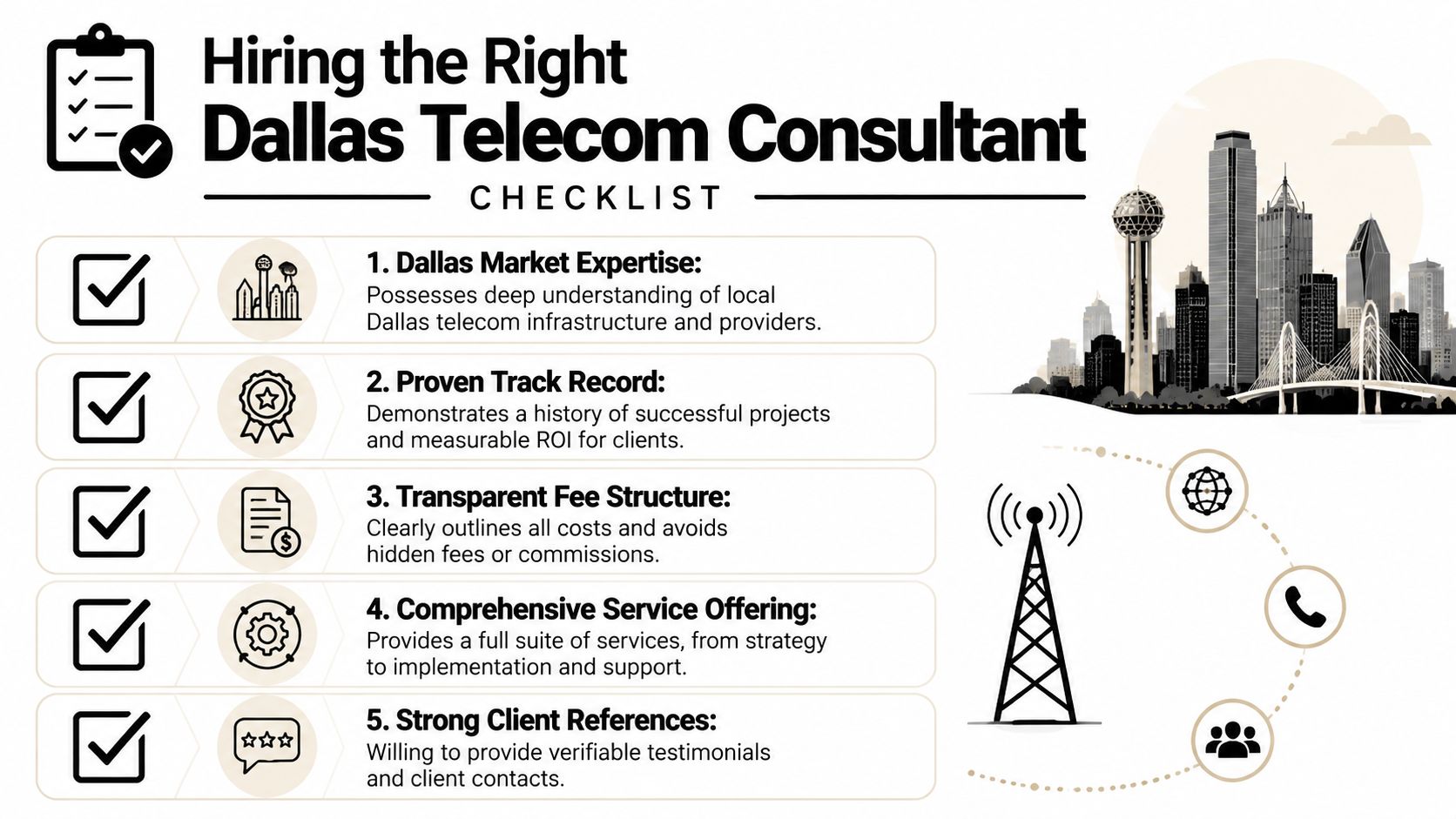
Your Checklist for Hiring the Right Dallas Consultant
Hiring a telecom consultant in Dallas shouldn't feel like buying a mysterious service package. You need a partner who can explain trade-offs, document decisions, and stay useful after the initial recommendations. The easiest way to separate real operators from polished sales language is to ask questions that expose process.
Start with how they assess your environment
Don't begin with rates. Begin with methodology.
Ask how they inventory existing services, review invoices, inspect physical infrastructure, and validate what the business currently uses. If the answer sounds vague, expect vague outcomes.
A strong consultant should be able to tell you:
- What they'll review first: Contracts, invoices, wiring, locations, device inventory, and support history.
- Who they'll need access to: IT, finance, facilities, and operations.
- What deliverable you'll receive: A written findings package, not just a call with opinions.
Test local market credibility
Many firms can talk generally about telecom. Fewer understand Dallas building realities, regional provider behavior, and the way local office buildouts affect implementation.
Use questions like these:
- Which Dallas-area providers do you evaluate most often for businesses our size?
- How do you account for differences between what a carrier sells and what a building can support?
- What do you review inside the office before recommending upgrades?
Those questions reveal whether they work from actual field conditions or from generic quoting templates.
Ask how they get paid
Compensation shapes behavior. If a consultant only gets paid when a specific provider wins, you need to know that before trusting the recommendation.
A simple evaluation table helps.
| Question | Strong answer | Concerning answer |
|---|---|---|
| How are you compensated? | Clear explanation of fees, commissions, or both | Evasive wording |
| Will you show side-by-side vendor comparisons? | Yes, with trade-offs | "We already know the best option" |
| What happens after implementation? | Ongoing audit, escalation, and cleanup support | Project ends at install |
What to listen for: Good consultants explain where they add value. Weak ones talk mostly about provider relationships.
Don't skip lifecycle questions
Many hiring processes often fall short. A telecom consultant may optimize procurement and migration while ignoring the old equipment and service remnants left behind. That's a mistake.
Ask directly:
- How do you handle decommissioned phones, PBX equipment, and related network hardware?
- How do you make sure disconnected assets aren't still tied to active billing?
- How do your recommendations align with our IT asset disposition process?
If they haven't thought about that, they're solving only part of the problem. Businesses looking for broader regional telecom support can compare service expectations against Dallas-area telecom solutions to understand how strategy and execution should connect.
References should be operational, not just complimentary
A polished testimonial isn't enough. Ask for references who can speak to implementation detail.
The most useful reference questions are practical:
- Did the consultant reduce confusion or just create another layer of communication?
- Were billing issues resolved?
- Did they stay engaged through disconnects, credits, and post-cutover cleanup?
- Would your IT and finance teams hire them again?
The right consultant should make telecom easier to govern. If they can't show that discipline, keep looking.
Unlocking ROI and Sustainable ITAD with Reworx Recycling
Most telecom upgrade plans are incomplete. They focus on selection, pricing, installation, and cutover. Then the business is left with old phones in cabinets, unused devices in storage rooms, disconnected systems still tied to invoices, and no clear chain of custody for retired assets.
That gap matters financially and operationally. According to Bearstone's Dallas telecom consulting page, telecom consulting can deliver 20-35% OPEX reduction, but most consultants don't coordinate with IT asset disposition planning, which creates compliance risk and missed opportunities when retiring old telecom hardware.

Where ROI is usually lost
A telecom project can look successful on paper and still leak value after go-live. The business gets new services and maybe a cleaner contract, but three common issues remain:
- Old assets stay untracked: Handsets, network appliances, conferencing equipment, and storage media sit in closets without documented disposition.
- Service relationships outlive hardware: Retired assets remain associated with lines, licenses, leases, or support charges.
- Data handling becomes informal: Devices are unplugged but not processed under a secure retirement workflow.
That's why telecom and ITAD should be treated as one lifecycle, not two separate tasks.
What integrated planning looks like in practice
A disciplined telecom refresh usually follows a chain like this:
| Phase | Telecom focus | ITAD focus |
|---|---|---|
| Audit | Inventory circuits, contracts, and live services | Inventory assets tied to those services |
| Migration planning | Define cutover sequence and vendor responsibilities | Tag assets for retention, redeployment, or retirement |
| Cutover | Validate service activation and disconnects | Remove legacy hardware from production |
| Closeout | Confirm invoices and credits | Execute secure data destruction and responsible downstream processing |
That structure solves a problem many organizations don't see until later. Finance assumes retirement happened because the project finished. IT assumes billing stopped because the hardware was removed. Neither assumption is safe without a joined-up process.
Treat retired telecom hardware like a controlled business asset, not leftover office equipment.
Why this matters beyond cost
There are three business reasons to care about integrated disposal.
First, compliance. Old telecom and network equipment can carry sensitive information or configuration data. Secure retirement isn't optional.
Second, space and operations. Telecom closets, storage rooms, and offices fill up quickly with legacy gear after moves and upgrades. Delayed removal slows future projects.
Third, sustainability and governance. If your business reports on environmental goals, responsible recycling and donation-based reuse belong in the same conversation as procurement discipline. That's especially relevant for companies managing office cleanouts, facility cleanouts, computer recycling, laptop disposal, data center decommissioning, product destruction, medical equipment disposal, or laboratory equipment disposal alongside broader modernization work.
What organizations should require from the disposal side
A mature ITAD partner should support more than pickup. The process should include secure data destruction, asset tracking, scheduling aligned with the cutover plan, and documentation suitable for internal governance. For Dallas organizations that need that level of control, secure IT asset disposition services for businesses in Dallas reflects the kind of service model that fits telecom refresh work rather than operating outside it.
The disposal side should answer questions such as:
- Which assets were removed from service?
- Which devices required data destruction?
- Which items were recycled, remarketed, or routed into donation-based recycling?
- How does the project support sustainable recycling and corporate donation programs?
The strategic upside
This is the missing connection in most telecom projects. Better contracts and cleaner infrastructure save money. Responsible disposition protects the business from loose ends those projects often create.
Handled well, the business gets more than cost control. It gets cleaner records, less storage clutter, stronger data handling, and a more credible story around social enterprise recycling and community benefit. That turns a telecom refresh into a broader operational improvement, not just a carrier decision.
Build Your Integrated Telecom and Disposal Strategy Today
A modern telecom plan shouldn't stop at procurement. It should cover what you're activating, what you're disconnecting, what your building can support, and what happens to every retired asset created by the change.
That's the practical lesson from the Dallas market. Businesses need help navigating carriers, contract terms, internal infrastructure, and service quality. But they also need a clear end-of-life process for phones, network hardware, storage devices, and related equipment that leaves the environment during an upgrade.
The full-lifecycle view works better
When telecom and disposal planning stay separate, companies usually end up with one of two outcomes. Either they optimize services but leave behind billing waste and unmanaged hardware, or they clean out equipment without fully linking those retirements back to contracts and invoices.
According to Prettyman's telecommunications consulting overview, telecom expense management consulting can identify invoice overcharges averaging 15-28%, and linking TEM with ITAD helps terminate services tied to decommissioned assets so companies don't keep paying for ghost assets. That's the kind of connection businesses should expect from the start.
What to do next
If you're planning a Dallas office move, VoIP migration, connectivity refresh, office cleanout, or broader IT equipment disposal initiative, use a simple sequence:
- Audit services and bills
- Validate internal infrastructure
- Map cutover and disconnect responsibilities
- Inventory affected hardware
- Schedule secure retirement and recycling alongside the migration
That sequence works because it mirrors how the business changes. New telecom decisions create old equipment. Old equipment creates risk unless the retirement process is planned.
Why the disposal partner matters
This part often gets delegated too late. It shouldn't. The right recycling and ITAD partner helps close the loop on secure data destruction, sustainable recycling, and responsible downstream handling. That matters for operating control, environmental reporting, and community impact.
For organizations tying telecom modernization to broader ESG goals, Dallas ESG electronics recycling programs show how disposal planning can support governance and sustainability expectations instead of being treated as an afterthought.
The best Dallas technology strategies are disciplined from beginning to end. They don't just improve performance. They reduce waste, tighten records, and keep retired assets from becoming tomorrow's problem.
If your business is upgrading systems, clearing out aging hardware, or trying to align telecom changes with secure end-of-life handling, Reworx Recycling is worth contacting. Reworx helps organizations with electronics recycling, donation-based recycling, secure data destruction, computer recycling, IT asset disposition, and pickup coordination so office cleanouts and telecom retirements don't stall after the cutover. Partner with a team that supports sustainable recycling, corporate donation programs, and practical execution when it's time to donate old equipment, schedule a pickup, or retire business technology responsibly.