
Atlanta enterprise managers usually reach this decision the hard way. The phone system still works, but every change request turns into a small project. Remote staff need better calling tools. Support teams want tighter CRM integration. Finance wants predictable telecom spend. Facilities wants the old gear out of closets and server rooms without creating a security problem.
That's the real shape of enterprise telecom solutions Atlanta buyers face. It isn't just a carrier decision or a VoIP refresh. It's a lifecycle decision that touches connectivity, uptime, security, deployment, and the retirement of legacy hardware that nobody wants to own once the cutover is done.
Navigating Atlanta's Evolving Enterprise Telecom Landscape
An Atlanta IT manager often starts with a narrow question. Should we replace the aging PBX, renegotiate circuits, or move everything into a cloud communications stack? The better question is broader. What telecom environment will support the business for the next phase of growth without creating a mess on the back end?
That pressure is showing up across the market. The global enterprise telecom services market reached USD 848.2 billion in 2022 and is projected to grow to USD 1.2 trillion by 2032 at a 3.5% CAGR, with growth tied to 5G investment and demand for high-speed connectivity, according to GM Insights on the enterprise telecom services market. For Atlanta businesses, that matters because modernization cycles are speeding up. Systems don't stay “current” for long.
What the Atlanta buyer is usually dealing with
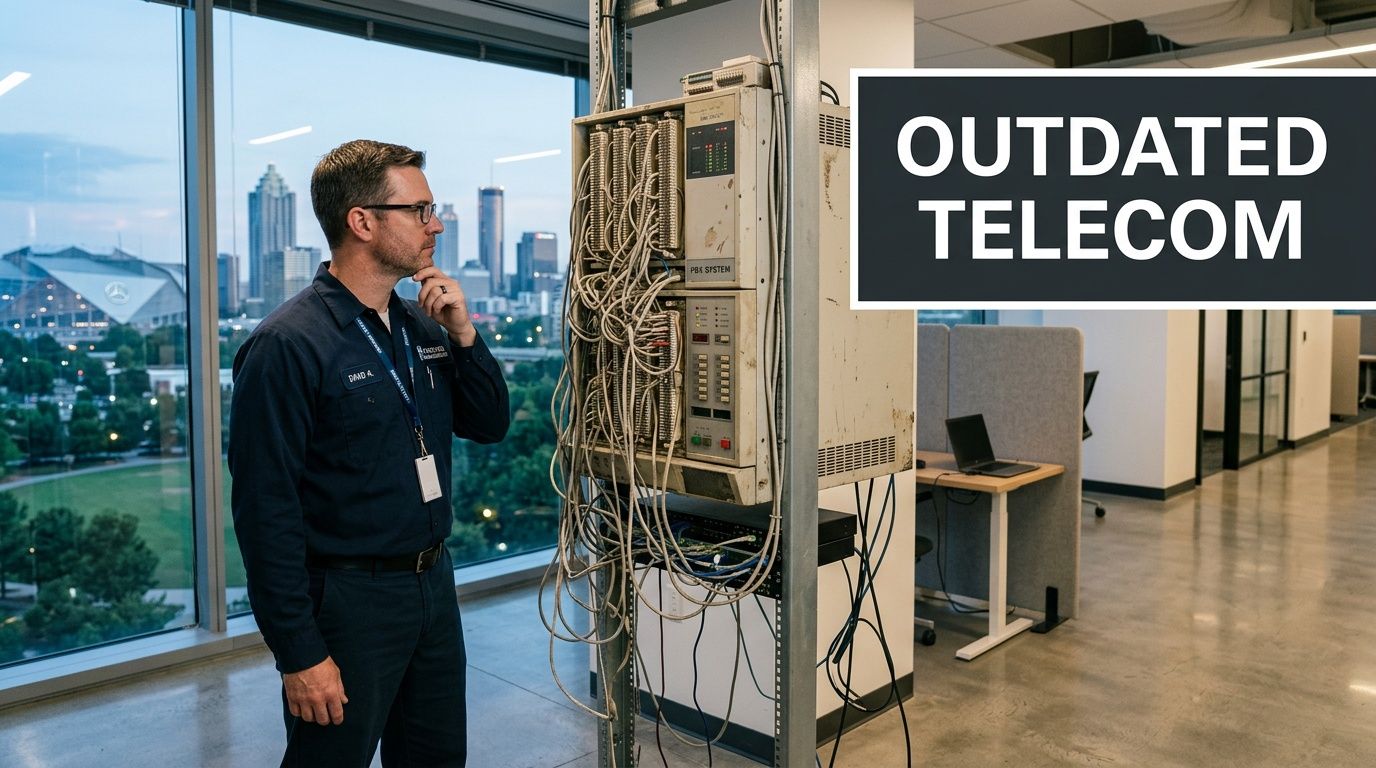
Legacy telecom environments rarely fail all at once. They become expensive in layers.
- Support gets harder: Older PBX platforms and handsets become difficult to source, patch, or expand.
- Operations get fragmented: Voice, conferencing, mobile, and site connectivity live in separate contracts and admin portals.
- Moves become disruptive: Every office reconfiguration, merger, or department shift creates avoidable labor and downtime.
- Retired equipment lingers: Old phones, network switches, gateways, and server hardware pile up after each upgrade wave.
Field observation: The telecom project that looks cheapest on paper often becomes the most expensive if no one plans for decommissioning, chain of custody, and asset removal.
Atlanta's business environment makes those issues harder to ignore. Regional headquarters, healthcare providers, distributed service operations, logistics teams, schools, and public agencies all need communications systems that can flex across locations and users. That means the selection process can't stop at “who has the best monthly rate.”
A stronger approach starts by treating telecom as business infrastructure with a beginning, operating life, and end-of-life plan. If your upgrade includes closet cleanouts, carrier transitions, or equipment removal from multiple sites, it helps to align that work with a local Atlanta data center decommissioning plan instead of leaving surplus hardware unmanaged until quarter end.
What works and what doesn't
A practical enterprise telecom strategy in Atlanta usually works when leadership does three things early:
| Focus area | What works | What usually fails |
|---|---|---|
| Scope | Defining voice, data, mobility, and site dependencies together | Buying voice first and discovering network limits later |
| Vendor review | Testing support model, roadmap, and local execution capability | Comparing only price sheets |
| End-of-life | Planning removal, data handling, and surplus disposition before cutover | Treating old gear as someone else's problem |
That last point gets missed far too often. It shouldn't.
Decoding Today's Key Telecom Technologies
Most Atlanta buyers don't need more jargon. They need a clear way to match business problems to the right telecom architecture.

VoIP and UCaaS
VoIP moves voice traffic over internet connectivity instead of traditional phone lines. UCaaS goes further and bundles calling with messaging, meetings, presence, and admin controls in a cloud-delivered service.
Think of VoIP as replacing the old phone wiring model. Think of UCaaS as replacing the whole communications control room.
For an Atlanta company with hybrid staff, multiple floors, or satellite offices, UCaaS usually makes the most sense when teams need:
- Flexible user management: Add or remove users without touching legacy PBX hardware.
- Shared workflows: Connect calling to helpdesk queues, CRM records, and collaboration tools.
- Remote continuity: Keep staff reachable from laptops and mobile apps during office disruptions.
What works: standardizing call flows, auto attendants, and user policies before rollout.
What doesn't: copying the old phone tree into the new platform without asking whether those workflows still make sense.
SD-WAN
SD-WAN is a traffic management layer for wide-area networks. A useful analogy is airport traffic control. The planes are your applications. SD-WAN decides which path each one should take based on business priority and network conditions.
This matters when Atlanta organizations run several offices, clinics, warehouses, campuses, or field operations. Voice and video don't tolerate unstable routing well. ERP traffic and guest Wi-Fi shouldn't compete the same way. SD-WAN helps IT decide what gets priority and where failover should happen.
If users complain that “the network is fine except calls keep breaking up,” that's often a traffic policy problem, not just a bandwidth problem.
A good fit:
- Distributed sites across metro Atlanta or the Southeast
- A mix of cloud apps and on-prem systems
- Need for centralized policy control without rebuilding every location from scratch
Fiber optic connectivity
Fiber remains the backbone for serious enterprise performance. It gives businesses the stable, high-capacity transport needed for voice, video, cloud access, and site-to-site connectivity. If your operation depends on low-latency communication between offices, data centers, or production systems, fiber usually belongs somewhere in the design.
Teams that manage facilities or maintenance environments may benefit from a simple technical primer to compare fiber optic cables for MRO, especially when physical plant decisions affect telecom performance and expansion planning.
For Atlanta buyers, fiber is often the difference between a telecom solution that scales cleanly and one that feels strained the moment call volume rises or a new cloud application comes online.
Private networks and wireless options
Private connectivity can mean dedicated circuits, MPLS-style architectures, private cellular environments, or tightly controlled wireless designs built around specific business needs. The right answer depends on how much control, isolation, and performance predictability your environment requires.
A few examples:
- Healthcare sites may prefer tightly governed paths for sensitive communications workflows.
- Large campuses may need controlled internal mobility and segmented voice or device traffic.
- Temporary or rapidly changing sites may use wireless options to accelerate deployment while a long-term wired plan is completed.
A quick decision view
| Technology | Best fit | Main upside | Common mistake |
|---|---|---|---|
| VoIP | Replacing legacy telephony | Lower hardware dependence | Ignoring network readiness |
| UCaaS | Unified user communications | Simpler scaling and remote access | Overbuying features nobody uses |
| SD-WAN | Multi-site environments | Better traffic control | Assuming it fixes poor circuit design by itself |
| Private networks | High-control environments | Security and predictability | Using them where simpler designs would work |
If you're sorting vendors, platforms, and migration paths, local teams often start by mapping current circuits, handsets, call flows, and site dependencies before speaking with providers. That groundwork makes telecom services near me searches far more productive because you're comparing real requirements instead of sales decks.
Choosing Your Atlanta Telecom Partner
Picking a provider is less about who has the loudest brand and more about who can survive your operating reality. That means reviewing technical capability, commercial clarity, local support depth, and the vendor's likelihood of still being the right fit after your next expansion, merger, or restructuring.

Market consolidation is a real factor here. Between Q1 2020 and Q2 2024, the enterprise telecom sector saw 424 acquisitions totaling $56 billion in capital, according to Jahani & Associates on enterprise telecom M&A and valuations. That kind of activity should change how you evaluate contracts. Product names, account teams, escalation paths, and strategic priorities can all shift after an acquisition.
Questions that expose vendor strength
A provider may demo well and still be a poor enterprise fit. Ask for operational answers, not polished positioning.
- How do they support Atlanta-area deployments? Local presence matters when cabling issues, circuit delays, or on-site coordination affect go-live timing.
- What happens after an acquisition? You want to know how contracts, service standards, and roadmaps are managed if ownership changes.
- How do they handle integrations? CRM, contact center, identity tools, and call recording requirements should not be “phase two surprises.”
- Who owns escalation? If voice quality drops across one site, you need named accountability.
Buying rule: Don't confuse a responsive sales engineer with a responsive support organization.
The practical checklist
Use a short evaluation model that procurement, IT, operations, and security can all understand.
| Evaluation area | What to verify |
|---|---|
| Platform fit | Does the solution match call flows, site count, and user types you actually have? |
| Support model | Are support hours, escalation routes, and local field capabilities clearly defined? |
| Roadmap stability | Is the product being actively developed, and is the provider clear about migration paths? |
| Commercial terms | Are licensing, implementation scope, and change-order triggers transparent? |
| Exit risk | Can you retrieve data, configurations, and hardware responsibilities cleanly if you switch? |
A useful way to pressure-test a provider is to review a digital transformation story outside your own environment. The Telkom digital transformation journey is worth reading for its operational perspective on how telecom modernization depends on execution discipline, not just technology selection.
What separates a partner from a seller
Strong telecom partners ask uncomfortable questions early. They ask about carrier diversity, failover expectations, contact center dependencies, and what happens to the equipment coming out of service. Weak providers stay at the feature level because it keeps the deal simpler.
For Atlanta enterprises, the better fit is usually the provider that can coordinate across facilities, security, networking, and procurement without losing control of scope. That standard matters whether you're replacing a single headquarters platform or redesigning communications for a regional footprint. It also matters if you're reviewing telecom services in Atlanta with an eye toward future consolidation instead of a one-time refresh.
From Procurement to Painless Deployment
Contracts don't create uptime. Implementation does. A solid procurement process should make deployment easier by forcing decisions before the migration team is under pressure.
Start with the SLA that matches business risk
Service Level Agreements often look strong until something breaks. Then you discover the language protects the provider more than your operation.
A useful benchmark for enterprise buyers in Atlanta is the kind of infrastructure found in carrier-grade environments. The tw telecom facility at 2 Ravinia Dr. uses fully redundant, self-healing SONET fiber rings, supporting near-instantaneous failover and more than 99.99% uptime SLAs for critical communications systems, as described by Cloud and Colocation's profile of the tw telecom Atlanta data center.
That doesn't mean every buyer needs colocation. It does mean your SLA discussion should focus on the underlying design, not just the headline number.
Ask specifically about:
- Failover behavior: What happens to calls and sessions during an outage?
- Support timing: When does response begin, and how is severity classified?
- Carrier dependency: Is resiliency built into the provider model, or assumed to exist on your side?
- Credits versus consequences: Service credits are helpful, but they don't restore a missed day of operations.
Map integrations before ordering hardware
Many telecom projects slip because teams treat integration as cleanup work. It isn't. It's part of the core design.
Common dependencies include:
- Identity systems such as single sign-on and role-based access controls.
- CRM and service platforms where click-to-call, call logging, or screen pops affect user adoption.
- Conference room and shared device workflows that need different policies than individual users.
- Legacy analog requirements like alarms, fax replacements, or specialty lines that nobody remembered until testing.
A deployment plan improves when IT documents those dependencies before procurement finishes. That gives vendors fewer opportunities to call critical work “out of scope.”
Sequence the rollout like an operations project
Telecom cutovers fail when they're treated as a one-night event. They succeed when the team stages them like any other business-critical change.
Keep the first site boring. Use it to test provisioning accuracy, training gaps, porting assumptions, and support responsiveness.
A practical sequence usually looks like this:
- Pilot first: Choose a user group that exercises real workflows without exposing the whole business.
- Validate call flows: Test hunt groups, voicemail routing, mobile apps, reception paths, and emergency procedures.
- Train by role: Reception, sales, support, executives, and field staff use communications tools differently.
- Cut over in waves: Site-by-site migration gives IT room to correct process errors before they multiply.
This is also the stage where old gear starts piling up. Handsets, PBX modules, switches, and related equipment often remain in closets because no one owns the handoff. It's smarter to assign that stream early and tie it to your broader search for telecom solutions near me so deployment and post-cutover cleanup stay connected.
Calculating True ROI on Your Telecom Investment
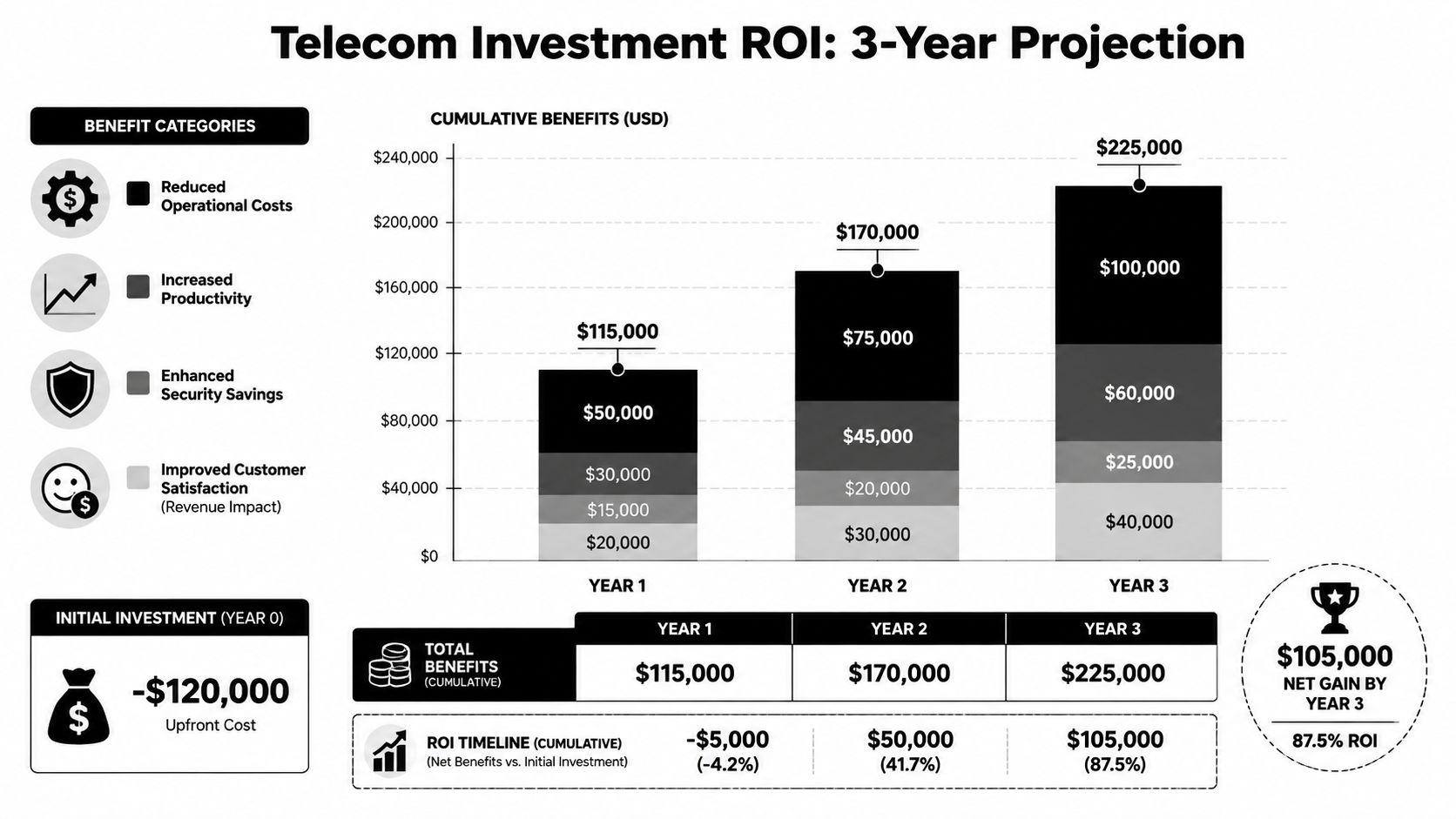
Too many telecom business cases collapse into one line item comparison. Old monthly bill versus new monthly bill. That's not ROI. That's partial arithmetic.
What belongs in the real cost picture
A credible telecom ROI model includes more than subscriptions or circuit charges. It should account for implementation labor, training time, integration effort, overlapping service during migration, and the internal cost of managing exceptions after go-live.
The most common mistake is evaluating the new system as a pure expense while ignoring the value trapped in the old one.
The overlooked offset
There's a practical financial angle that many telecom providers barely mention. Mid-market businesses can recover 15% to 40% of their upgrade costs through strategic equipment buyback and remarketing of surplus servers, PBX systems, and networking gear, according to Teledata Select's enterprise telecom overview.
That doesn't mean every retired asset has strong resale value. It does mean finance should ask a better question before approving the project: what portion of this transition can be offset by disciplined asset recovery instead of write-off and storage?
Finance lens: A telecom refresh looks different when retired hardware is treated as recoverable value, not dead inventory.
How to evaluate ROI more intelligently
A practical review usually separates the project into four buckets.
| ROI bucket | What to include |
|---|---|
| Direct cost changes | Carrier spend, support contracts, maintenance reductions, and license shifts |
| Operational effects | Admin time, user onboarding effort, site move complexity, and outage handling |
| Risk reduction | Better control over aging systems, unsupported gear, and fragmented telecom operations |
| Asset recovery | Resale, buyback, and remarketing potential for decommissioned equipment |
The asset recovery line is where many business cases get stronger. Old PBX chassis, network gear, handsets, servers, and related hardware may still hold value if they're removed, sorted, and processed before they become obsolete or damaged in storage.
What works in practice
The strongest telecom ROI models do three things well:
- They separate one-time migration cost from steady-state operating cost. That prevents procurement from understating implementation burden.
- They count labor. Internal engineering hours, user training, and exception handling are real costs even when no invoice arrives.
- They include disposition strategy up front. If no one plans resale, removal, and reverse logistics before the rollout, recovery value usually erodes.
This is one area where the lifecycle view matters. A buyer who plans both deployment and retirement can often present a stronger financial case than one who negotiates only the front-end contract. For teams sorting through surplus infrastructure, an asset recovery strategy for retired telecom equipment can help convert cleanup into budget relief instead of pure disposal cost.
Ensuring Security and Compliance for Your Network
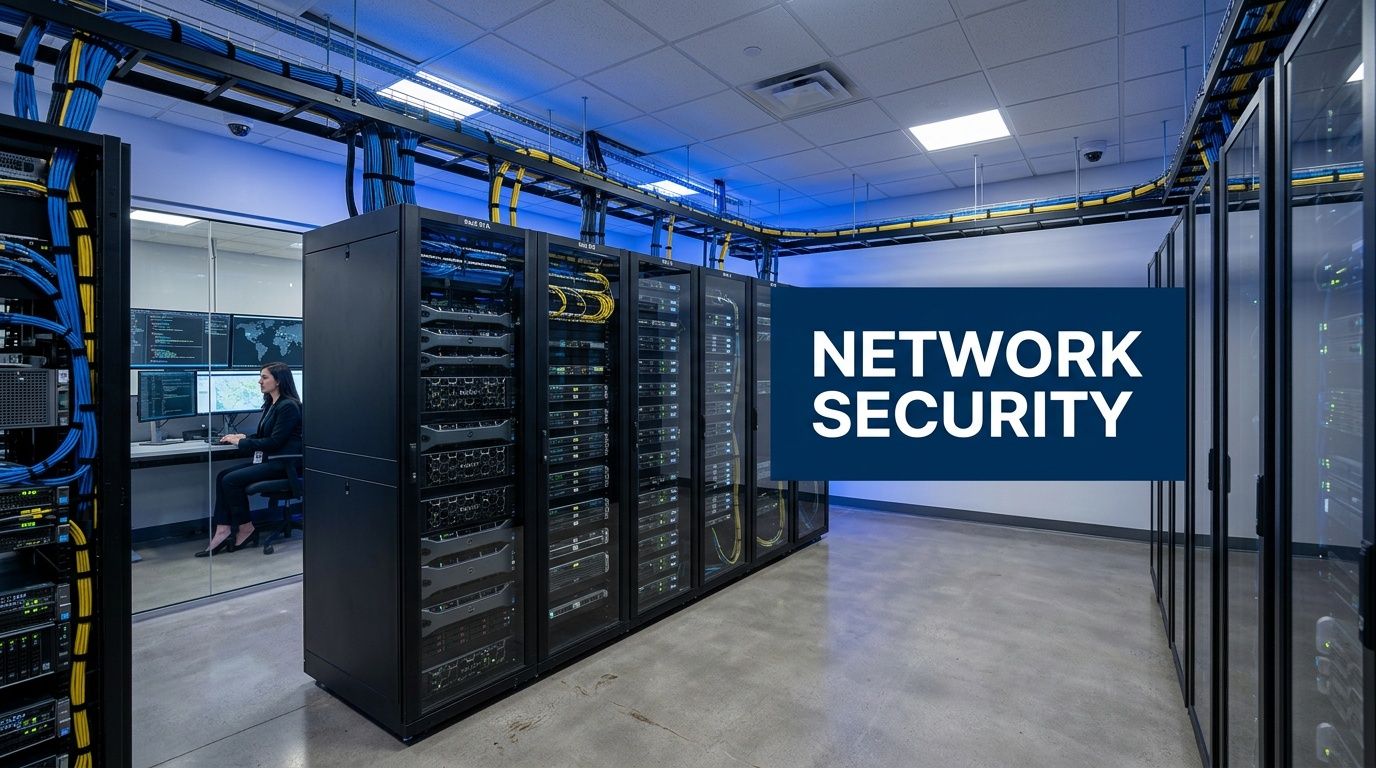
A telecom system isn't just a calling platform. It's part of your security perimeter. That's why weak telecom governance creates risk in places many teams don't look first, such as voicemail access, softphone sprawl, stale admin accounts, call recordings, and unsecured retired devices.
Security controls that should be non-negotiable
The basics still matter. Enterprises need encrypted voice and data paths where appropriate, disciplined identity and access controls, segmented admin rights, and logging that supports investigation when something goes wrong. If a provider can't explain how those controls operate in day-to-day administration, the design is too opaque.
For Atlanta organizations in healthcare, finance, education, and government-related work, the compliance angle gets sharper. A clean architecture should support privacy expectations, retention policies, and auditable handling of sensitive communications data. The exact framework differs by sector, but the principle is the same. Telecom can't sit outside your broader compliance program.
The hidden risk after cutover
The obvious concern is protecting the new platform. The less obvious concern is what gets left behind.
Old PBX appliances, voicemail systems, call logging servers, routers, firewalls, desk phones, and storage media can contain sensitive configuration data or user information. When telecom projects close without a controlled retirement process, those devices often sit in storage rooms, branch closets, or loading areas with weak chain of custody.
That's where security teams and facilities teams need to work together. It's not enough to secure the production environment. You also need documented handling for what leaves production.
A practical compliance review
Use a short review process before signing and again before decommissioning.
- Access governance: Confirm who can create, change, and disable telecom accounts and admin roles.
- Recording and retention: Align call data, recordings, and logs with legal and industry requirements.
- Third-party risk: Review provider support access, subcontractors, and escalation procedures.
- End-of-life handling: Define how retired hardware is inventoried, moved, wiped, destroyed, or remarketed.
Your compliance posture isn't judged only by the strength of the live system. It's also judged by what happens to the hardware that used to run it.
That last point often decides whether a telecom transition stays clean or creates a lingering audit headache.
Closing the Loop with Responsible IT Asset Disposition
Telecom projects usually end with a false finish line. The new platform is live, users are trained, tickets are down, and leadership moves on. But the old environment is still there in pieces. Phones in boxes. PBX shelves in a closet. Network gear stacked in a branch office. Hard drives nobody wants to touch.
That's the gap many Atlanta telecom projects leave behind. A review of Atlanta telecom solution positioning highlights that providers focus heavily on new implementation but rarely guide clients on the secure and responsible disposal of decommissioned equipment. For enterprise managers, that creates both data security and environmental risk.
Why telecom disposal needs its own plan
Telecom gear doesn't retire neatly. A migration can leave behind:
- Legacy PBX hardware
- Desk phones and conference phones
- Routers, switches, and firewalls
- Call recording servers and storage devices
- Structured cabling remnants and peripheral gear
Some of that equipment may still have residual value. Some of it may need secure destruction. Some may be suitable for donation-based recycling or remarketing. The wrong move is treating all of it as generic junk.
What works versus what usually fails
Here's the practical difference.
| Scenario | What works | What fails |
|---|---|---|
| Data-bearing devices | Verified secure data destruction and documented chain of custody | Sending equipment into informal recycling streams |
| Usable surplus gear | Testing, sorting, and value recovery before condition declines | Leaving equipment in storage until it has no resale path |
| Multi-site retirements | Pickup scheduling, inventory control, and centralized disposition | Asking local staff to improvise disposal |
| ESG and reporting | Partnering with a specialist that supports sustainable recycling and documentation | Treating end-of-life as an untracked facilities task |
Old telecom hardware is part of the project scope whether the implementation partner acknowledges it or not.
Why specialist ITAD matters
IT asset disposition, or ITAD, serves as a strategic component of telecom management rather than a mere cleanup task. A specialist approach helps enterprises manage secure data destruction, reverse logistics, office cleanout requirements, computer recycling, laptop disposal, product destruction, facility cleanout support, and broader electronics recycling with controls that general haulers or ad hoc recyclers often don't provide.
For Atlanta organizations, this matters across several common scenarios:
- Headquarters relocations or consolidations
- Carrier transitions after M&A
- Cloud migrations that retire on-prem voice infrastructure
- School, government, and healthcare refresh cycles
- Data center decommissioning and server room cleanouts
Donation-based recycling can also support broader social impact goals when equipment is eligible for reuse. That's especially relevant for enterprises trying to align technology transitions with community benefit, digital inclusion, and sustainability commitments. The key is disciplined triage. Reuse where appropriate, remarket where practical, destroy where necessary, and recycle responsibly when no higher-value path exists.
The lifecycle view is the stronger view
A mature telecom plan doesn't end at deployment. It includes the downstream work that protects data, avoids landfill disposal, supports compliance, and recovers value where possible.
That's why end-of-life planning should sit in the same project timeline as vendor selection, contract review, cutover planning, and site cleanup. When that happens, the transition feels controlled. When it doesn't, old hardware becomes a slow-moving liability.
Building a Future-Ready Telecom Strategy for Atlanta
The strongest enterprise telecom solutions Atlanta strategy is the one that treats communications infrastructure as a full lifecycle decision. Choose technology that fits the business. Vet providers for stability and execution. Negotiate for uptime that matches operational risk. Build deployment around real integrations and user behavior. Then finish the job by retiring old equipment with the same care you used to buy the new system.
That approach is more disciplined, but it also produces fewer surprises. Finance gets a clearer ROI model. IT gets a cleaner operating environment. Security gets better control. Facilities doesn't inherit forgotten hardware. Sustainability leaders get a process that supports responsible electronics recycling instead of delayed disposal.
Atlanta organizations are upgrading in a market that keeps moving. The companies that handle telecom transitions best don't separate modernization from end-of-life management. They connect them from the start.
If your organization is replacing phones, PBX hardware, servers, networking gear, or related infrastructure, Reworx Recycling can help you handle the final phase responsibly through electronics recycling, secure data destruction, IT equipment disposal, donation-based recycling, asset recovery, and pickup support. If you're planning an office cleanout, data center decommissioning, or broader telecom refresh in the Atlanta area, partner with Reworx Recycling to donate old equipment, schedule a pickup, and turn technology turnover into a secure, sustainable outcome.