

Boston's 2026 median rent sits around $2,500 across all unit sizes, while Apartments.com puts the typical one-bedroom closer to $3,587. That gap matters because a relocating renter who budgets from the median alone can underfund housing before utilities, transportation, move-in charges, and seasonal costs are added.
Boston remains one of the most expensive rental markets in the United States, but “Boston rent” isn't a single useful number. The right budget depends on whether you're comparing a market-wide median with active listings, choosing a studio or a three-bedroom, and deciding between central neighborhoods and transit-linked areas outside the urban core.
For employers relocating staff, graduate students arriving for a university program, and professionals taking short-term assignments, the practical question isn't whether Boston is expensive. It's which apartment market you're entering, what trade-offs you're accepting, and how much cash you need before the lease begins.
Why Boston Costs What It Costs in 2026
The median and the listing average answer different questions
Apartment List reported a July 2026 median rent of $2,513 across all apartment sizes and $2,416 for a one-bedroom in Boston. Apartments.com reported higher September 2026 averages, including $2,961 for a studio, $3,587 for a one-bedroom, $4,552 for a two-bedroom, and $5,761 for a three-bedroom in its Boston market overview, as detailed in this Boston cost-of-living and rental market guide.
Both figures can be useful. A median places every qualifying unit in order and identifies the middle listing or household experience, while an active-listing average can be pulled upward by newer buildings, luxury amenities, larger apartments, and the inventory currently available to shoppers. If you're moving for work, the second measure often feels closer to reality because you'll compete for available units rather than every unit that exists.
Practical rule: Use the median to understand the broad market, then stress-test your budget against the higher active-listing range.
Why Boston carries a structural premium
Apartments.com estimates Boston's overall cost of living at 48.3% above the national average, with housing costs 120.6% higher than the national average, before utilities and transportation are added. Those figures explain why a Boston relocation package that covers rent but ignores daily expenses can still leave an employee financially stretched.
Several forces keep pressure on the market. Boston has constrained land, a large stock of older triple-decker and brownstone-style housing, a complicated permitting environment, and major employment centers clustered around areas such as the Seaport, Longwood Medical Area, and the broader Cambridge life-sciences corridor. Universities and hospitals also create persistent demand from students, researchers, clinicians, and visiting professionals.
Boston's rental history shows that this isn't only a recent spike. Census-based figures compiled by Department of Numbers show median gross residential rent rising from $1,317 in 2014 to $1,579 in 2019, while the average rose from $1,327 to $1,558 during the same period, a roughly 19.9% median increase over those five years (Boston rental history and housing data).
For a broader orientation to the city before choosing a neighborhood, use this Boston travel and neighborhood reference. The essential budgeting lesson is simple: don't plan from one citywide number. Compare unit type, neighborhood, building age, transit access, and the date of the listing.
Average Rents by Unit Size Across Boston
Boston's rent curve steepens as apartments get larger. Apartments.com lists $2,961 for studios, $3,587 for one-bedrooms, $4,552 for two-bedrooms, and $5,761 for three-bedrooms in September 2026, while Apartment List's July median is lower because it uses a different methodology and covers the market differently.
| Unit Size | Boston Low | Boston Median | Boston High | U.S. Median | Notes |
|---|---|---|---|---|---|
| Studio | $2,300 | $2,961 | $3,300+ | Not provided | Newer core buildings can sit well above the market middle |
| One-bedroom | $2,400 | $3,587 | $4,500+ | About $1,550 | The most important comparison for individual relocations |
| Two-bedroom | $4,200 | $4,552 | $5,000+ | Not provided | Limited larger inventory creates strong competition |
| Three-bedroom | $5,700 | $5,761 | $6,200+ | Not provided | Family-sized apartments carry the sharpest burden |
The Boston figures in the table come from Apartments.com's September 2026 rental data, while the national one-bedroom comparison is included in the supplied market brief and should be treated as a broad benchmark rather than a like-for-like index. For readers who need property-level fields, lease details, or structured apartment data, details on apartment rental costs can help organize comparisons across listings.
Why larger units become disproportionately expensive
Families, roommates, and relocating couples compete for a smaller pool of two- and three-bedroom apartments. Condo conversions also remove some larger apartments from the rental supply, while new Class A buildings commonly price by square foot and package the unit with gyms, lounges, concierge services, and parking options.
That combination makes a larger apartment more than a simple multiple of a studio. A three-bedroom may serve a family, a group of professionals, or an employer housing several workers, so demand comes from several renter groups at once.
Luxury and new-build inventory in the Seaport, Fenway, and East Cambridge can sit materially above the citywide middle. Older apartments in Dorchester, Roxbury, and Hyde Park generally offer better space value, although condition, heating responsibility, laundry, parking, and commute time can change the effective cost.
Read the rent against the salary, not in isolation
A $3,587 one-bedroom isn't just a rent figure. It becomes a housing decision tied to salary, employer reimbursement, commuting costs, and savings goals. A renter who needs a central, amenity-rich building should budget for the upper part of the range, while someone willing to accept an older unit or a longer Red Line or Blue Line commute can search below it.
Neighborhood Breakdown Where Value Still Exists
Boston's value sits along transit lines, not inside a single “best neighborhood” list. Boston Pads reported a 2026 citywide average rent of $3,408, while premium submarkets such as Seaport and Back Bay were listed in the $4,200 to $6,200 range for one- and two-bedroom units. The same market report placed Dorchester and Quincy closer to $2,200 to $3,400, showing why neighborhood selection can change the housing burden more than small market-wide movements (2026 Boston apartment rental market report).
| Submarket | Approximate one-bedroom position | Best fit | Main trade-off |
|---|---|---|---|
| Seaport | About $4,200 | Professionals working in finance, technology, and consulting nearby | Waterfront amenities and walkability come at a steep premium |
| Back Bay | About $3,600 | High earners and professionals prioritizing prestige and central access | Historic buildings can mean smaller layouts and older systems |
| Dorchester | About $2,500 | Relocating families, couples, and space-conscious renters | Commute and block-by-block variation require careful screening |
| East Boston | About $2,300 | Airport-linked workers and value-focused professionals | Blue Line and ferry access may not suit every commute |
| Quincy | About $2,100 | Remote workers, dual-income commuters, and budget-conscious renters | Living outside Boston proper adds a longer trip for some jobs |
The Seaport makes sense when your office is there and eliminating the daily commute has real value. Otherwise, the premium is difficult to justify unless new construction, waterfront access, and full amenities rank above apartment size.
Back Bay offers unmatched centrality and architectural character, but older brownstone buildings can include narrow stairs, limited elevators, uneven air conditioning, and less predictable utility arrangements. It suits a well-paid professional who wants location first.
The strongest value is usually farther south or across the harbor
Dorchester, particularly around Savin Hill and Fields Corner, gives renters more room and Red Line access. Adams Village is a useful budget-oriented reference point for people who want neighborhood retail and a less downtown feel.
East Boston is the clearest Boston-proper value play for renters who can use the Blue Line or ferry. It works particularly well for airport employees, hybrid workers, and professionals whose schedules don't require crossing the city at peak times.
Quincy offers the lowest entry point among these comparisons and keeps Red Line access for commuters. Wollaston is the practical anchor for renters who want transit without paying central Boston prices.
Market direction isn't uniform. Some 2026 sources report annual rent increases around 2.62% to 4.09%, while another report describes a 3.4% metro-wide decline in July 2026, so timing and neighborhood inventory matter. Vacancy improved to 1.43%, which Boston Pads described as 72.29% higher than a year earlier, but availability remained tight (Boston 2026 renter market perspective).
For employers and movers comparing neighborhoods, responsible equipment retirement can be part of the relocation plan too. A Massachusetts electronics recycling resource is useful when an office, home office, or temporary project site is being consolidated.
Cost of Living Beyond Rent in Greater Boston
Boston's headline cost pressure doesn't stop at the lease. Apartments.com places overall living costs 48.3% above the national average and housing costs 120.6% higher, which means relocating employers should calculate the full monthly burn rate rather than offering a rent-only allowance.
The supplied planning assumptions for a $4,000 national-average monthly spend translate the category premiums as follows. These are budgeting illustrations based on the stated comparison percentages, not official household expenditure averages.
| Category | National Avg | Boston Avg | % Above U.S. | Monthly $ Delta |
|---|---|---|---|---|
| Groceries | $4,000 baseline allocation | $4,600 | 15% | $600 |
| Transportation | $4,000 baseline allocation | $4,800 | 20% | $800 |
| Utilities | $4,000 baseline allocation | $5,200 | 30% | $1,200 |
| Healthcare | $4,000 baseline allocation | $4,400–$4,600 | 10%–15% | $400–$600 |
The table demonstrates the effect of applying each category premium to the same $4,000 monthly baseline. It isn't a claim that an individual spends $4,000 in every category. The useful point is proportional: a modest rent difference can be overwhelmed by recurring costs when food, transportation, heating, and healthcare all run above a national benchmark.
Taxes and car ownership add friction
Massachusetts sales tax is 6.25%, while the meals tax brings restaurant bills to 7%. Car owners also face a vehicle excise tax, an annual expense that renters coming from places without a comparable charge may overlook. Parking can make vehicle ownership especially unattractive in central neighborhoods.
A renter should separate unavoidable costs from lifestyle choices. Groceries, health coverage, and utilities belong in the core budget. Restaurant meals, garage parking, rideshare use, and frequent regional travel belong in a stress-tested scenario.
Budgeting standard: If your relocation allowance covers only the apartment, it isn't a Boston cost-of-living plan.
The practical outcome is why a rent figure around $2,500 can become an all-in monthly cost around $5,500 for a renter who combines housing with normal utilities, food, transportation, and personal expenses. Employers should model both a median case and a higher-listing case because the city's methodology gap can otherwise create an unrealistic allowance. For organizations moving technical teams, IT asset disposition services can also help separate relocation costs from the retirement of obsolete office equipment.
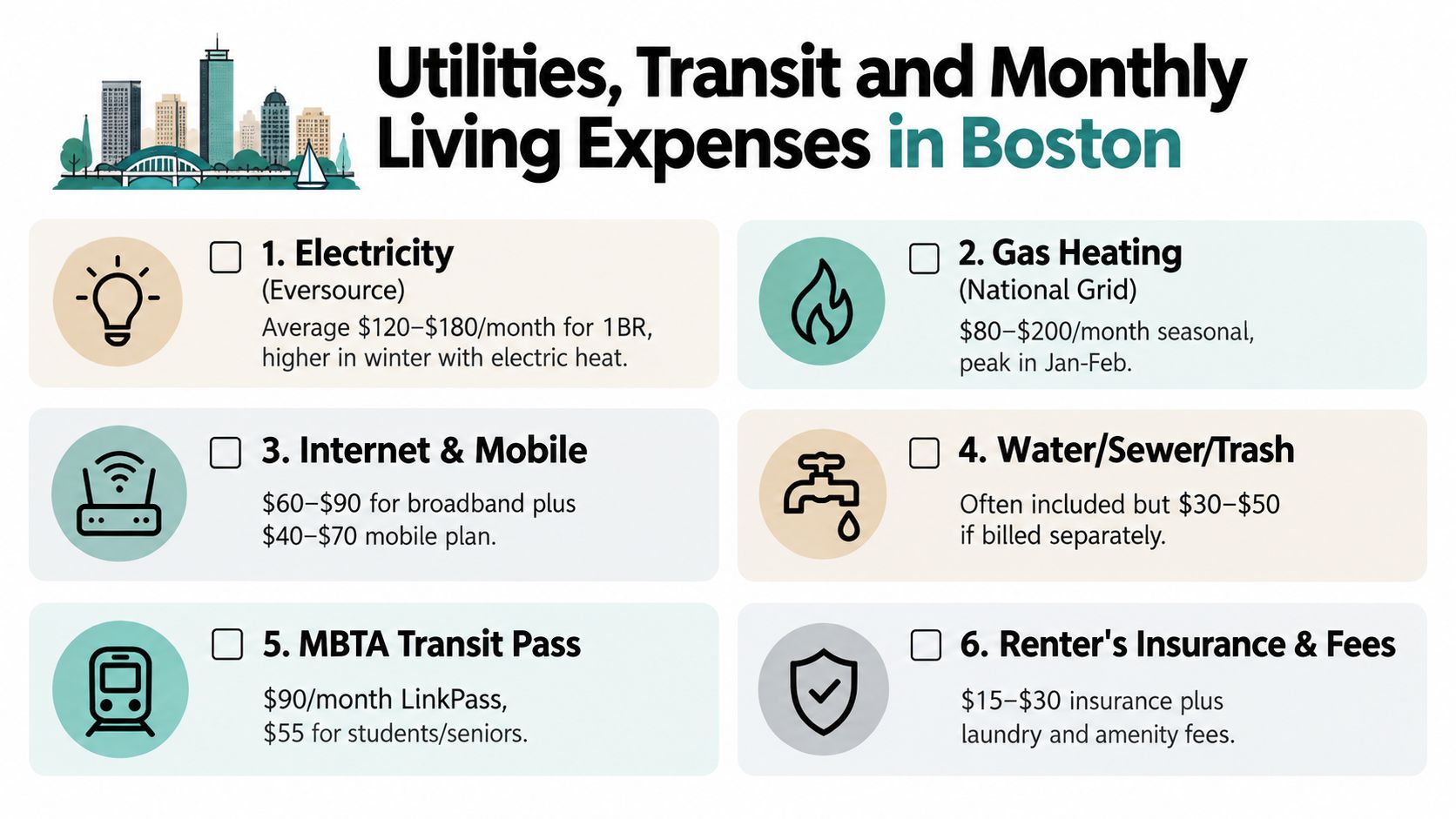
Utilities Transit and Monthly Living Expenses
Rent is only the first recurring charge. A Boston apartment budget should list every service separately, because older buildings often assign heating, water, and maintenance costs differently from newer developments.
For a 700 to 900 square foot apartment, electricity and gas can total roughly $150 to $220 combined, based on the planning ranges provided. Winter heating can push the bill higher, especially in units with electric heat, weak insulation, drafty windows, or a landlord who doesn't include heat.
Build the recurring bill stack
Use the lease and utility disclosures to identify who pays each charge:
- Electricity: Eversource service can be a significant line item, particularly when the apartment uses electric heat or air conditioning.
- Gas heating: National Grid bills often vary by season, with winter creating the sharpest spike.
- Water and sewer: Plan for roughly $40 to $70 when these aren't included in rent. Some buildings bundle water, sewer, or trash into monthly charges.
- Internet: Xfinity and Verizon plans commonly fall around $60 to $90, depending on speed and promotional terms.
- Renter's insurance: Budget $15 to $25 monthly, and confirm whether the landlord requires proof before move-in.
- Streaming and cable: A $25 to $45 monthly bundle is easy to overlook but belongs in the recurring budget.
The MBTA remains the default for many city renters. A monthly LinkPass costs $90, while commuter rail passes for the stated zones cost $132. Students and seniors may qualify for different pricing, so verify eligibility before building the allowance around a reduced fare.
Decide whether a car belongs in the plan
Daily parking in Allston, Back Bay, and the Seaport can run roughly $18 to $35. That cost is only the visible part of driving. Add fuel, insurance, maintenance, registration, and Massachusetts vehicle excise tax before deciding that a cheaper outer apartment is cheaper.
The strongest setup for many business travelers is an apartment near the workplace or a reliable MBTA route, paired with occasional rideshare or car rental use. A car can still make sense for a suburban assignment, family logistics, or a job outside the transit network, but central Boston parking can erase the savings from choosing a lower rent.
Salary Benchmarks and Budgeting a Boston Move
The 30% housing rule is a useful screening tool, not a promise that a renter will feel comfortable. Apply it to gross annual income, then subtract utilities, transportation, taxes, debt, and savings goals before signing a lease.
A household earning the Boston median household income of about $89,000 would cap housing near $2,225 per month under the 30% rule. That generally rules out most Seaport and Back Bay one-bedrooms, but it can leave options in Allston, Dorchester, East Boston, or nearby Quincy, depending on the unit and lease terms.
| Income Tier | Annual Salary | Max Rent, 30% Rule | Realistic Neighborhoods | Est. Move-In Cost |
|---|---|---|---|---|
| Early career | $65,000 | $1,625/month | Quincy, East Boston, shared Allston options | First month, last month, deposit, broker fee, plus $300–$600 moving costs |
| Dual-income household | $110,000 | $2,750/month | Dorchester, East Boston, South End options, Cambridge compromises | Same lease charges, with moving costs added |
| Senior professional | $175,000 | $4,375/month | Back Bay, Beacon Hill, Seaport, premium Cambridge inventory | Same structure, with higher rent-based deposits and fees |
The move-in calculation deserves as much attention as monthly rent. Massachusetts leases may require first month's rent, last month's rent, a security deposit up to one month's rent, and a broker fee of one month's rent in many cases, plus $300 to $600 in moving expenses. A renter should ask for a written itemization before transferring funds and confirm which party is responsible for the broker fee.
Choose flexibility when the assignment is uncertain
A business traveler on a short project shouldn't automatically accept a year-long unfurnished lease. Furnished housing, corporate apartments, extended-stay lodging, or a home swap membership for travelers can reduce furniture purchases and simplify an uncertain arrival, although the nightly or monthly rate may differ from a conventional lease.
For a permanent move, prioritize the commute and the lease's total cost. For a temporary assignment, prioritize cancellation terms, included utilities, furnished equipment, and the ability to avoid duplicate housing costs.
One practical advantage of the 30% rule is that it exposes false bargains. A $2,100 apartment can become expensive if it requires a car, paid parking, and a long commute, while a somewhat higher apartment near work may reduce transportation and time costs. If a home office is part of the move, plan the responsible retirement of old devices through zero-landfill electronics recycling in Boston rather than leaving laptops, monitors, or networking equipment behind.
Renter Checklist Lease Terms and Tenant Rights
Boston renters should verify the property before negotiating the rent. Confirm the landlord's ownership through the Massachusetts Registry of Deeds, check the unit's status in the Boston rental registration system, and ask whether the building falls under any applicable city stabilization or tenant-protection program.
Complete these checks before signing
- Verify ownership: Match the landlord or management company to the recorded property owner, and confirm who is authorized to sign.
- Check city registration: Ask whether the apartment is registered and whether required inspections have been completed.
- Read every fee clause: Identify first month, last month, security deposit, broker fee, utilities, amenity fees, laundry, and parking.
- Negotiate the lease term: Twelve months is common, but an 18-month term or another arrangement may be negotiable when availability improves.
- Review exit language: Look for subletting restrictions, early-termination charges, pet addenda, renewal rules, and short-term-rental prohibitions.
- Document condition: Photograph every room, appliance, floor, window, fixture, and existing defect before moving belongings inside.
Massachusetts tenant protections include an implied warranty of habitability, anti-retaliation safeguards for good-faith repair requests, and notice requirements for certain rent changes. Month-to-month tenants generally need 30 days' notice for a rent increase, and deposits over one month's rent require the applicable interest and escrow handling under state law. Because legal outcomes depend on the lease and facts, verify the current rule with a qualified Massachusetts housing attorney or tenant organization. For broader context on modern tenant protection policies, compare the policy framework with the specific language in your lease.
Before handing over money: Get receipts, confirm the deposit amount, request the landlord's written move-in documentation, and don't rely on verbal promises about repairs or included utilities.
Landlords commonly request renter's insurance proof, so arrange the policy before key pickup. If you're leaving a home office, don't place outdated computers, hard drives, printers, or networking devices in ordinary trash. Use secure electronics recycling services in Boston that address both data security and responsible material recovery.
Reworx Recycling helps businesses manage electronics recycling, secure data destruction, IT asset disposition, equipment pickups, and responsible technology donations during office moves and apartment relocations. Visit Reworx Recycling to donate old equipment, schedule a business pickup, or plan a compliant electronics retirement program that supports environmental responsibility and community access to technology.