A server room cleanout rarely ends when the last rack comes out. The laptops, switches, storage arrays, monitors, and drives still need a controlled path from the point of use to inspection, data sanitization, resale, donation, recycling, or destruction. That's where the difference between reverse logistics vs traditional logistics becomes operationally important. Forward logistics delivers new goods efficiently. Reverse logistics recovers value and controls risk after those goods leave normal use.
For IT managers, facilities teams, and sustainability leaders, extending an outbound shipping process usually isn't enough. Retired equipment arrives in inconsistent condition, carries sensitive data, may require documented handling, and can have several valid end points. A well-designed reverse program treats those variables as part of the system rather than as exceptions.
What These Two Logistics Models Actually Mean
An IT manager may start with a simple assignment: clear a server room before a lease ends or a data center migration begins. The outbound logistics mindset says to schedule labor, load equipment, and move it to a warehouse. That solves transportation, but it doesn't answer the important questions. Which drives contain data? Which servers can be redeployed? Which devices have resale value? Which components require certified recycling, and what evidence will an auditor need?
Traditional logistics, also called forward logistics, moves products from a supplier toward a customer. A manufacturer produces goods, a distributor stores them, a carrier transports them, and a customer receives them. The process is designed around planned demand, standardized products, predictable handling, delivery speed, freight efficiency, and service levels.
Reverse logistics moves products and related information from the customer or point of consumption back toward a seller, distributor, manufacturer, processor, or other point of origin. The reverse logistics definition and supply chain overview is useful because it places returns, reuse, refurbishment, recycling, and disposal in the same operating conversation.
Forward flow serves delivery
A forward shipment usually follows a linear path:
- Production: Goods are manufactured or assembled.
- Storage: Finished products enter inventory.
- Distribution: Orders move through a distribution center or third-party logistics provider.
- Delivery: The customer receives the goods and confirms fulfillment.
- Use: The product enters its intended operating environment.
The primary question is, “How efficiently can we deliver the right item to the right customer?” Product condition is generally known before shipment, packaging is standardized, and the intended destination is clear.
Reverse flow serves recovery and control
Reverse logistics begins after use, sale, lease, warranty service, recall, or decommissioning. The item may return because it's defective, obsolete, surplus, damaged, or no longer needed. Once received, it may be repaired, refurbished, resold, donated, harvested for parts, recycled, or securely destroyed.
That makes reverse logistics more than return handling. A return label only moves an item backward. A true reverse system decides what the item is, what it's worth, what risks it carries, and which downstream route preserves the most value while meeting legal and environmental obligations.
Practical rule: If your process ends at “received,” you have a returns function. If it documents inspection, disposition, recovery, and final accountability, you have reverse logistics.
Core Differences Between Forward and Reverse Logistics
The main distinction is simple. Forward logistics creates customer availability. Reverse logistics creates recovery, compliance, and risk control after the original transaction or operating cycle.
The flow direction changes the entire operating model. Forward networks usually distribute products from a smaller number of suppliers toward many customers. Reverse networks collect products from many locations and consolidate them at processors, refurbishers, recyclers, or resale channels. That convergent flow creates more sorting and decision-making than a standard outbound route.
Forward vs Reverse Logistics at a Glance
| Dimension | Traditional (Forward) Logistics | Reverse Logistics |
|---|---|---|
| Primary objective | Deliver products to customers efficiently | Recover value, meet disposal obligations, and reduce risk |
| Flow direction | Supplier, manufacturer, warehouse, customer | Customer, facility, processor, refurbisher, reseller, or recycler |
| Demand pattern | Planned and forecast-driven | Variable, irregular, and condition-dependent |
| Product condition | Known and standardized before shipment | Often unknown until inspection |
| Main stakeholders | Suppliers, carriers, 3PLs, distributors, and customers | ITAD vendors, carriers, recyclers, refurbishers, compliance teams, auditors, and resellers |
| Lifecycle stage | Production, distribution, sale, and use | Return, end-of-use, decommissioning, recovery, and end-of-life |
| Typical outcome | Delivery and customer acceptance | Resale, redeployment, repair, donation, parts recovery, recycling, or destruction |
| Core risk | Late, damaged, or incomplete delivery | Data exposure, undocumented disposition, regulatory breach, value loss, or improper disposal |
Forward logistics has a relatively narrow success condition. The shipment arrives complete, on time, and at an acceptable cost. Reverse logistics has competing objectives. A fast disposition may reduce storage cost but sacrifice resale value. A resale route may recover more money but require more testing and handling. Recycling may be the right outcome for a damaged device, while donation may create greater social value for functional equipment.
For electronics, the stakeholder map expands quickly. A single corporate laptop retirement can involve an internal IT team, facilities personnel, a pickup carrier, an ITAD provider, a data destruction technician, a refurbisher, a downstream recycler, and an auditor reviewing the records. That network doesn't exist in the same way for a routine shipment of new laptops from a distributor.
How Each Workflow Operates in Practice
Forward logistics starts with order entry and moves through outbound fulfillment. Staff pick the correct SKU, pack it, ship it, and confirm delivery. A standard warehouse management system can support much of that sequence because the item, destination, packaging, and expected condition are already known.
Reverse logistics starts with an authorization or recovery decision, then introduces inspection and disposition. The equivalent steps look like this:
- Returns authorization and triage: The organization identifies why the item is coming back, whether it's under warranty, and what handling rules apply.
- Transportation in: Equipment moves from a customer, office, branch, or data center to a processing location.
- Receipt and verification: Staff compare the physical shipment with the manifest, record serial numbers, and document missing or damaged items.
- Sorting and grading: Technicians assess condition, configuration, repair needs, resale potential, and recycling requirements.
- Data sanitization: Devices are wiped, verified, or physically destroyed according to the organization's security policy.
- Testing and refurbishment: Eligible equipment is tested, repaired, cleaned, reconfigured, and prepared for redeployment or resale.
- Disposition: Items move to resale, donation, parts harvesting, recycling, or product destruction.
- Residual reporting: The organization receives records covering custody, data handling, final disposition, recovery, and environmental outcomes.
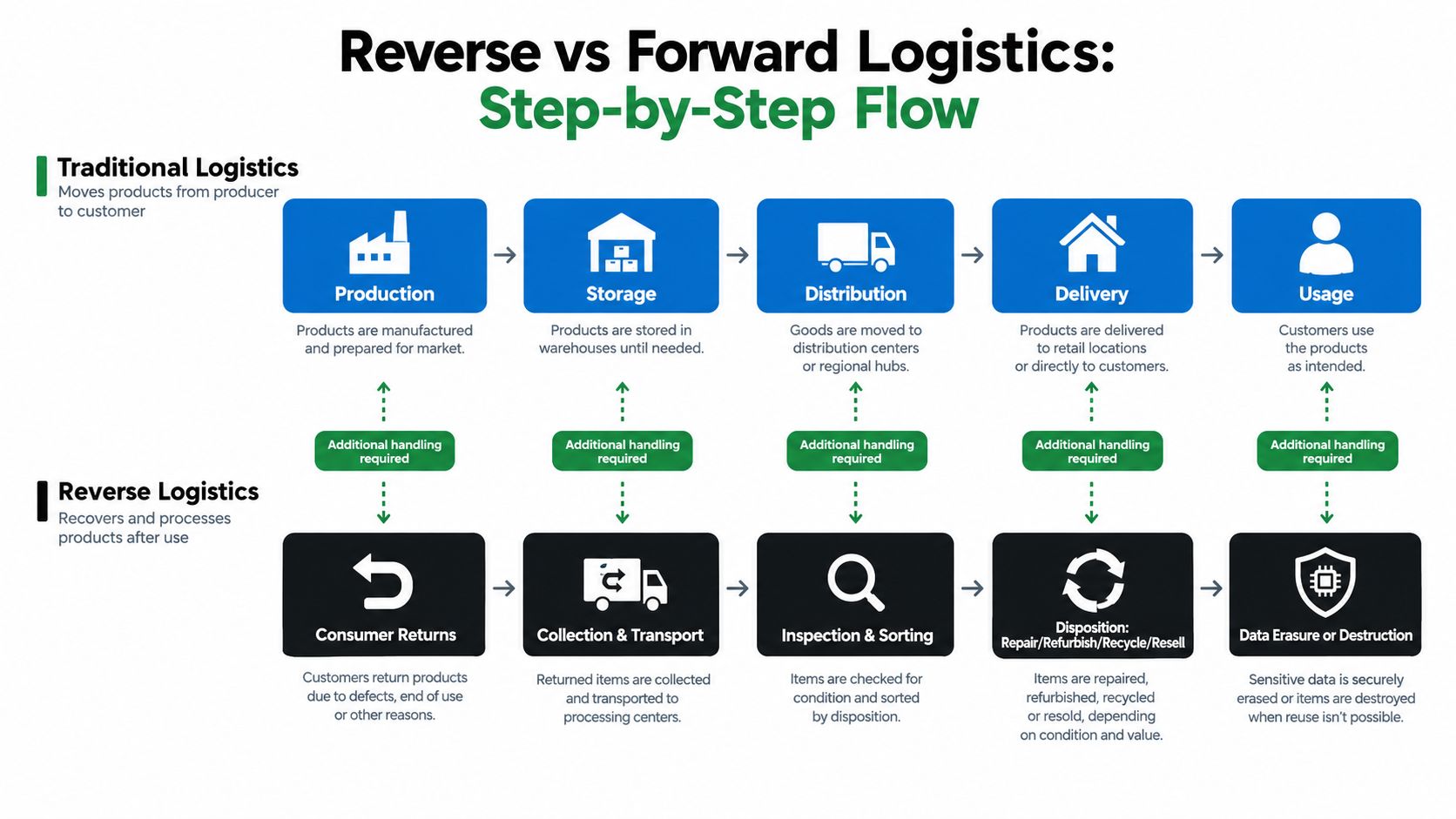
The biggest divergence appears at receipt. A forward warehouse expects a defined item in a defined state. A reverse facility may receive mixed models, incomplete systems, damaged screens, missing power supplies, locked devices, and storage media that require separate controls.
The reverse logistics services available for structured recovery should therefore include more than transportation. The provider needs a documented chain of custody, serial-level tracking, secure data destruction, disposition controls, and downstream accountability. Without those controls, an inexpensive pickup can become an expensive compliance problem.
KPIs That Matter for Each Logistics Direction
Forward logistics teams often monitor on-time, in-full performance, dock-to-stock time, order cycle time, cost per order, freight cost, and inventory turns. Those measures work because outbound operations generally move known products toward known destinations.
They break down when applied to returns and end-of-life assets. “On time” doesn't tell you whether a returned laptop was securely sanitized. “Cost per order” doesn't show whether a server was resold, recycled, or abandoned in storage. A fast receiving process can even hide poor grading if staff rush assets through without validating condition or serial numbers.
Forward vs Reverse Logistics Metrics Side by Side
| Logistics Objective | Forward KPI | Reverse KPI |
|---|---|---|
| Move goods efficiently | Delivery lead time | Return cycle time |
| Maintain throughput | Orders processed | Volume flexibility and assets processed |
| Control unit economics | Freight cost per unit shipped | Average disposition cost per asset |
| Preserve inventory value | Inventory turns | Net asset recovery rate |
| Maintain quality | Order accuracy and fill rate | Data sanitization pass rate and grading accuracy |
| Limit waste | Packaging or freight efficiency | Scrap rate and environmental diversion rate |
| Control exposure | Damage and delivery claims | Liability exposure, compliance disposition, and chain-of-custody completion |
A credible reverse scorecard should combine economic, environmental, and social performance. The sustainability framework published through the University of Glasgow research repository groups reverse-logistics measures around cost, timeliness, productivity, capacity, quality, environmental impact, labor practices, human rights, society, and product responsibility.
For an ITAD program, I'd put these measures on one dashboard:
- Time to grade: How long equipment sits before a disposition decision.
- Recovery rate: The share of assets routed to resale, redeployment, donation, or parts recovery rather than scrap.
- Data sanitization pass rate: Whether each applicable device has documented, successful sanitization or destruction.
- Disposition cost per asset: The full processing cost, not just the freight invoice.
- Diversion outcome: The documented share routed away from improper disposal.
- Liability exposure: Open gaps involving missing assets, incomplete certificates, or unverified downstream vendors.
The metric executives ignore most often is chain-of-custody completeness. It stays invisible until an audit, a security incident, or an ESG review makes the missing record impossible to explain.
For measurement design, Reworx impact measurement resources can help teams connect asset outcomes with environmental and community reporting.
Cost Drivers Unique to Each Model
Forward logistics costs are comparatively familiar. Finance teams budget outbound freight, pick-and-pack labor, warehouse space, inventory management, parcel delivery, and last-mile service. The unit is often straightforward because the product, packaging, route, and service promise are defined before shipment.
Reverse logistics adds costs that depend on what comes back and what staff find inside it. A pallet of identical new devices is easier to price than a mixed load of laptops, monitors, servers, drives, cables, and damaged equipment. The process may require inbound triage, testing, grading, data destruction, RMA administration, resale preparation, recycling fees, and downstream liability coverage.
Where reverse budgets expand
Disposition labor is usually the first surprise. Technicians must identify equipment, record serial numbers, separate accessories, assess condition, and decide whether each asset deserves redeployment, resale, donation, parts recovery, recycling, or destruction.
Data destruction creates another distinct cost. Secure erasure requires approved procedures and evidence. Physical destruction adds specialized labor, equipment, and certificate administration. An organization handling regulated or confidential information can't treat this as ordinary warehouse handling.
Downstream liability remains after the truck leaves. A processor's failure to document final disposition can expose the original owner to questions about data security, environmental compliance, or improper disposal. Vendor qualification, insurance review, audits, and record retention belong in the reverse budget.
Other common lines include remarketing channel fees, storage during disposition, packaging for resale, repair parts, serial-number reconciliation, and certificates of recycling or destruction.
The logistics business management software resource from OnRoute is useful for organizations trying to coordinate transport, work orders, inventory visibility, and service records across a more complex operating model. Software won't determine the correct disposition by itself, but it can prevent avoidable handoff and tracking failures.
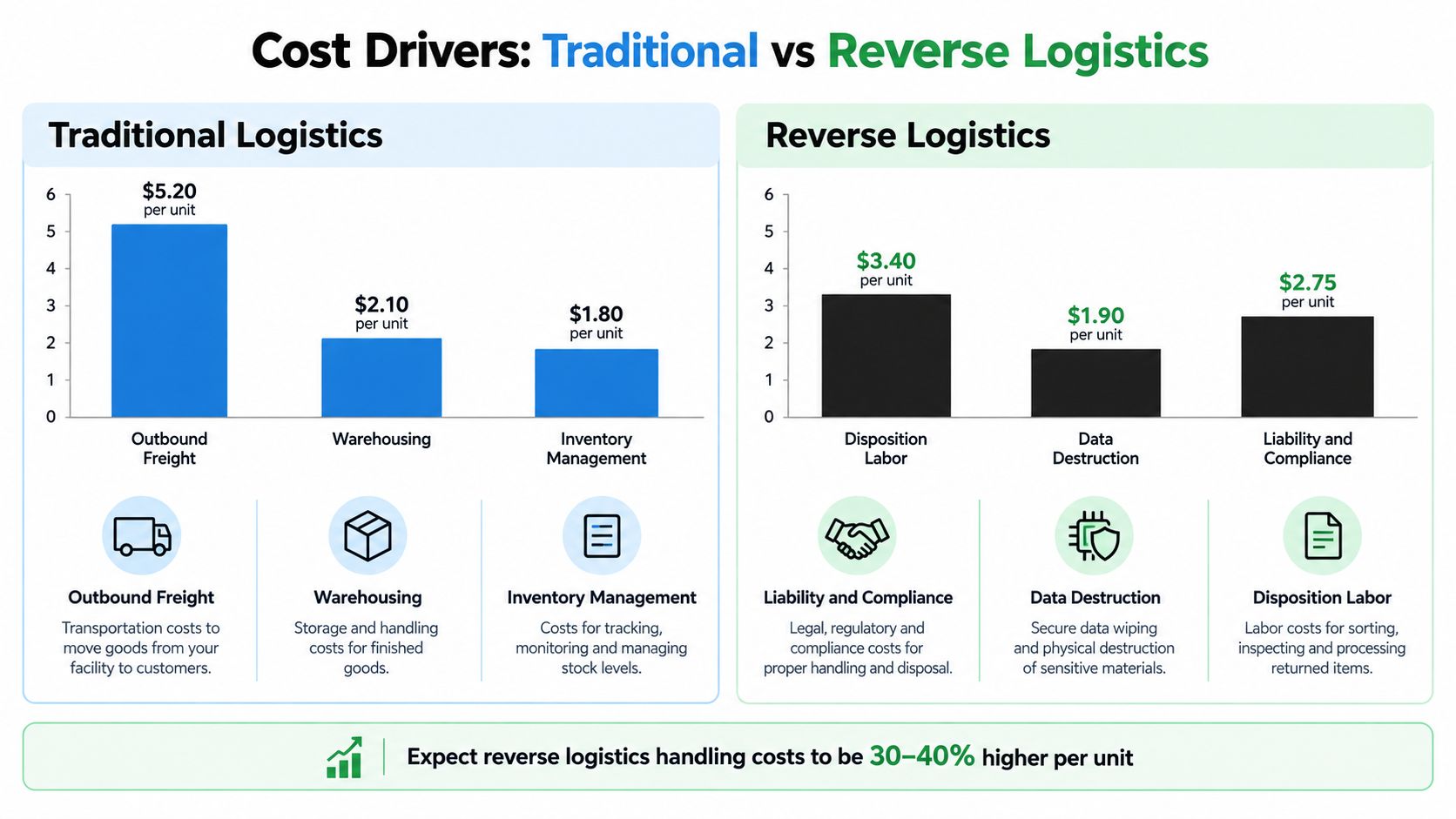
My budgeting recommendation is direct: build the reverse model around worst-case condition variability, not the average outbound shipment. Reserve capacity for missing components, locked devices, damaged assets, extra testing, and data destruction. The cost line that most often blows up a reverse budget is unplanned disposition labor, especially when teams discover that “one pallet” contains many different processing paths.
Technology and System Requirements Compared
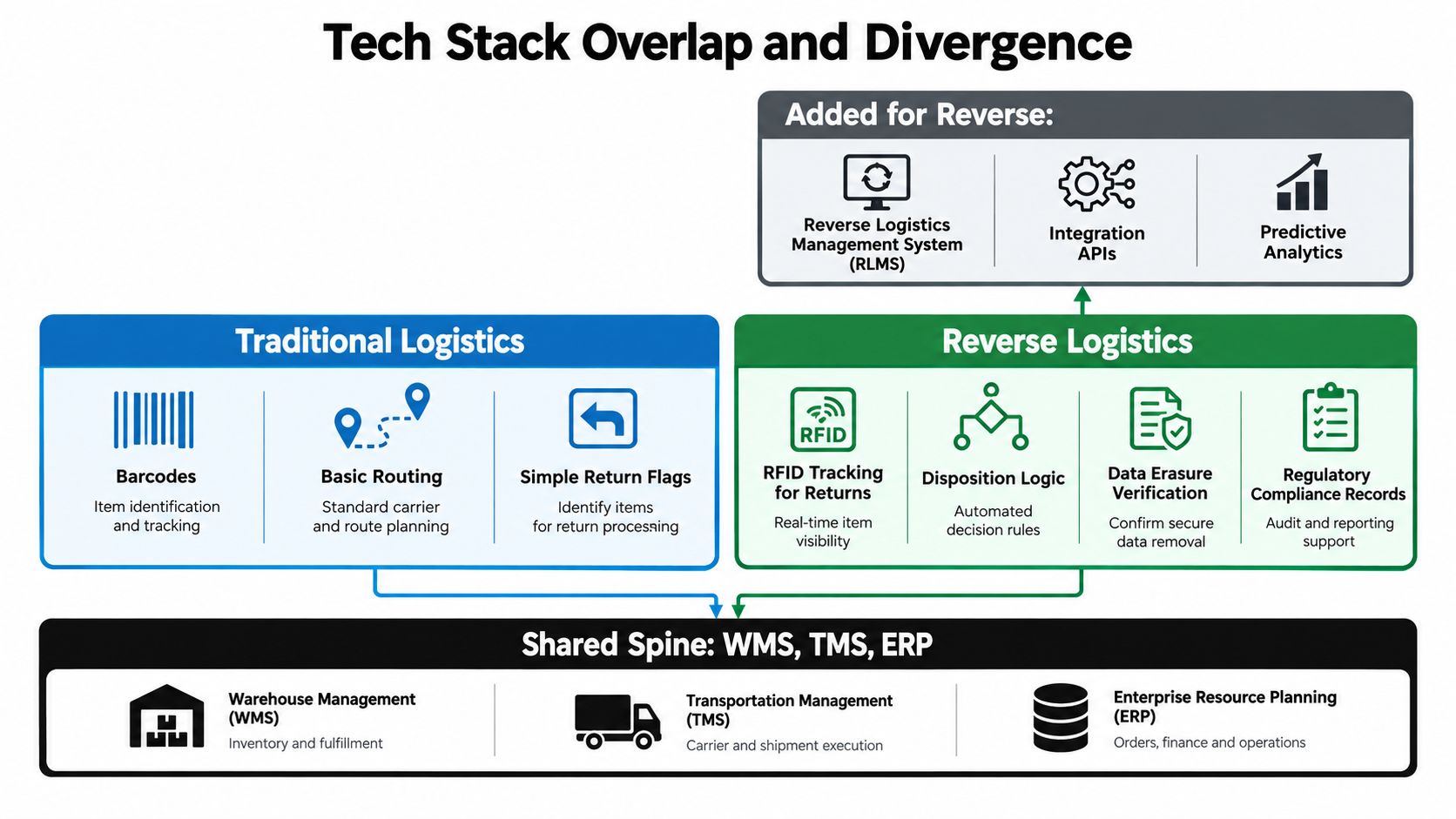
Forward and reverse programs can share a technology foundation, but reverse logistics needs deeper control at the asset level. A warehouse management system, transportation management system, and ERP connect inventory, movement, purchasing, finance, and reporting. Barcode scanning and routing support both directions.
A forward warehouse can count identical units by SKU. An ITAD operation must identify each device, record who handled it, verify whether its drive was sanitized, document its condition and destination, and retain proof of final disposition. That requires serialized asset tracking rather than a generic return flag.
The shared spine and the reverse layer
Forward environments typically rely on:
- SKU and barcode records
- Standard pick, pack, and ship workflows
- Carrier routing and delivery confirmation
- Inventory and order management
- Basic return flags
Reverse environments add:
- Serialized asset tagging through barcodes or RFID
- Chain-of-custody events
- Inspection, grading, and disposition logic
- Data sanitization evidence capture
- RMA and ticketing integration
- Processor and reseller portals
- ESG, diversion, and recovery reporting
- Regulatory and certificate records
For a mid-market organization, the right starting point is serialized asset tracking plus evidence capture for data sanitization and final disposition. These capabilities establish accountability, then support resale, recycling, reporting, and analytics without forcing every platform purchase at once.
Use disposition states that reflect actual work. “Awaiting inspection,” “pending sanitization,” “eligible for reuse,” “assigned to donation,” “approved for recycling,” and “destruction complete” give IT, finance, sustainability, and audit teams one shared record. Do not compress those decisions into outbound statuses such as “available” or “damaged.”
Real Use Cases and When to Choose Each Approach
Forward logistics fits predictable movement of standardized goods from suppliers to operating locations or customers. Use it for office-supply replenishment, new-laptop distribution, replacement-part shipping, and finished-product delivery through established channels.
Reverse capability earns its keep when an organization must recover value, protect information, or document what happened after use. Treat it as a multi-objective recovery system, not merely a cost center. It can support reuse, resale, recycling, compliance, and operational control in one program.
Scenario one, corporate IT asset disposition
A 500-employee company refreshes laptops every three years. The work includes employee collection, device inventory, de-installation, data sanitization, testing, redeployment, resale, donation, recycling, and reporting. Extending forward shipping would cover transportation while leaving the highest-risk decisions unmanaged.
Recommendation: Choose reverse logistics. The company needs serialized tracking, secure data destruction, grading, and multiple disposition paths.
Scenario two, business e-waste recycling
A business gathers obsolete computers, monitors, networking equipment, and peripherals from offices or facilities. A partner such as Reworx Recycling can coordinate collection and route equipment through a documented process that separates reusable devices from material destined for recycling or secure destruction.
The scale of the problem supports dedicated reverse infrastructure. The Global E-waste Monitor from the International Telecommunication Union reports that the world generated 62 billion kilograms of e-waste in 2022, while only 22.3% was formally collected and recycled in an environmentally sound manner. A repurposed outbound network cannot provide the inspection, custody, and downstream controls required for end-of-life electronics.
Recommendation: Choose reverse logistics because the processing outcome matters as much as the pickup.
Scenario three, retail returns
A retailer may use ordinary inbound freight for occasional returns. A branded returns program requires authorization, customer communication, inspection, restocking, repair, liquidation, and recycling. Each disposition affects customer satisfaction, inventory accuracy, and recovery economics.
Recommendation: Use a dedicated reverse model when returns are frequent, product condition varies, or the brand promises a simple customer experience. Forward logistics remains sufficient for isolated exceptions.
Use Case Fit, Forward vs Reverse Logistics
| Use Case | Forward Logistics Fit | Reverse Logistics Fit | Recommended Model |
|---|---|---|---|
| New equipment distribution | Strong | Limited | Forward |
| Corporate laptop refresh | Partial | Strong | Reverse |
| Data center decommissioning | Partial | Strong | Reverse |
| Mixed electronics recycling | Weak | Strong | Reverse |
| Occasional warranty return | Adequate | Useful | Forward with controlled returns |
| High-volume retail returns | Weak | Strong | Dedicated reverse |
Choosing the Right Model for Your Organization
The right answer isn't “always build reverse logistics.” It's to match the operating model to the assets, obligations, and value at stake.
Rank the decision signals in this order:
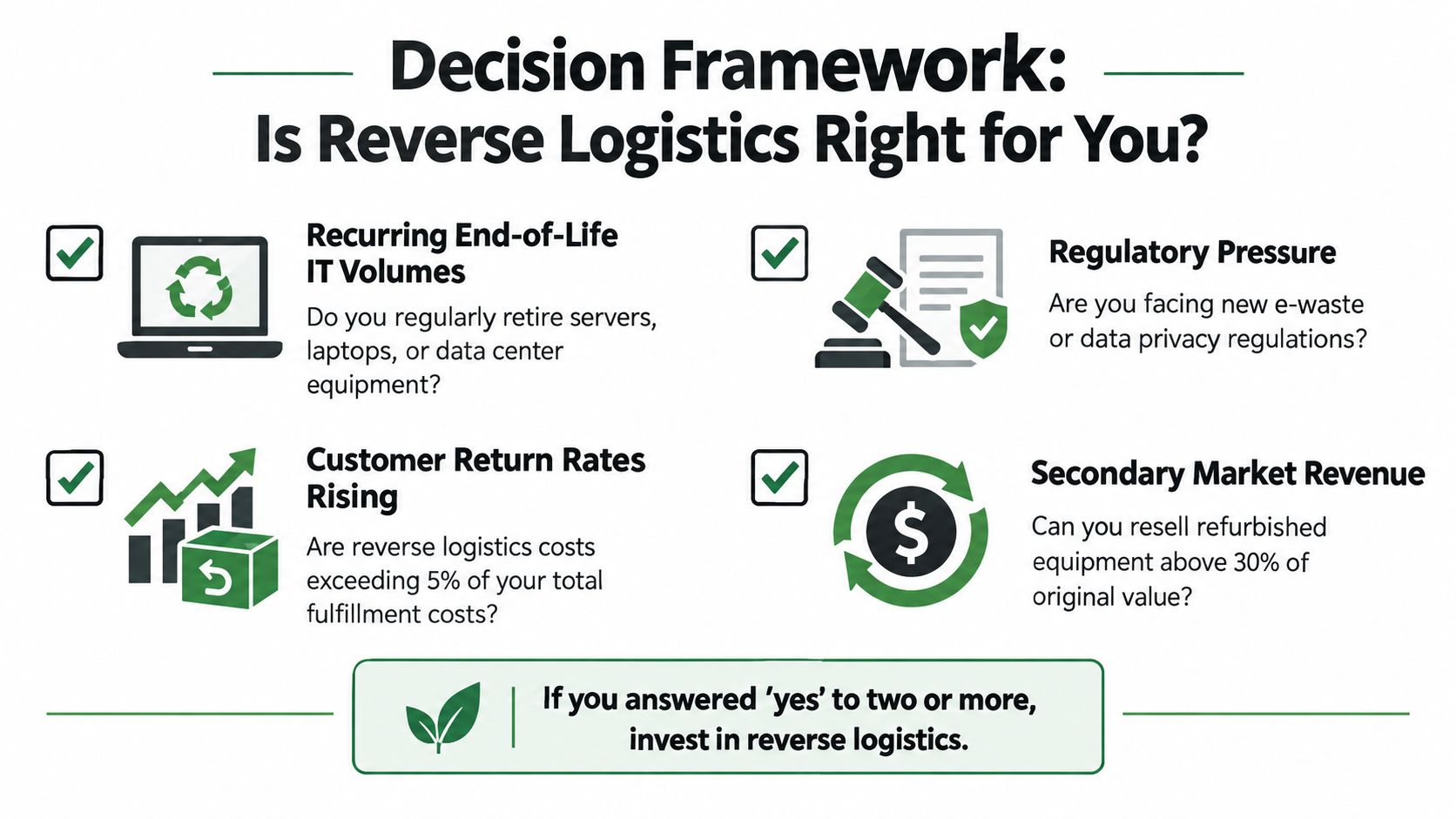
- Security and regulatory exposure: If retired equipment contains sensitive data or regulated materials, documented reverse handling is a requirement, not an optimization project.
- Recurring asset volume: Regular laptop disposal, server retirement, data center decommissioning, medical equipment disposal, or laboratory equipment disposal justifies repeatable workflows.
- Recovery potential: Resale, parts harvesting, refurbishment, and equipment buyback can make disposition a value-recovery activity instead of a disposal expense.
- Reporting requirements: Sustainability leaders need evidence for recycling, diversion, donation, workforce development, and community impact claims.
The International Telecommunication Union's e-waste backgrounder shows how strongly policy affects formal collection and recycling. Countries with e-waste legislation are reported to have collection and recycling rates around 25%, while countries without those legal instruments have rates close to zero. That's a clear warning for organizations that treat compliance as an optional add-on.
Forward logistics may remain sufficient when all of these conditions apply:
- Low return activity: Products rarely come back.
- Minimal regulated waste: The organization doesn't handle sensitive data or controlled equipment.
- No recovery program: There's no trade-in, refurbishment, donation, or resale channel.
- Stable product mix: SKU rotation and product condition remain predictable.
For end-of-life electronics, Reworx Recycling can coordinate business pickups, equipment decommissioning, secure hard drive shredding with data destruction, IT asset management, recycling consultations, and downstream electronics recycling. Its donation-based recycling model also connects usable equipment with community impact through technology donations, digital inclusion, and workforce development.
Reworx Recycling helps businesses build a controlled reverse path for outdated laptops, servers, monitors, and other electronics, from collection through secure destruction and responsible recycling. Visit Reworx Recycling to donate old equipment, schedule a business pickup, or discuss an ITAD, office cleanout, facility cleanout, or corporate donation program.