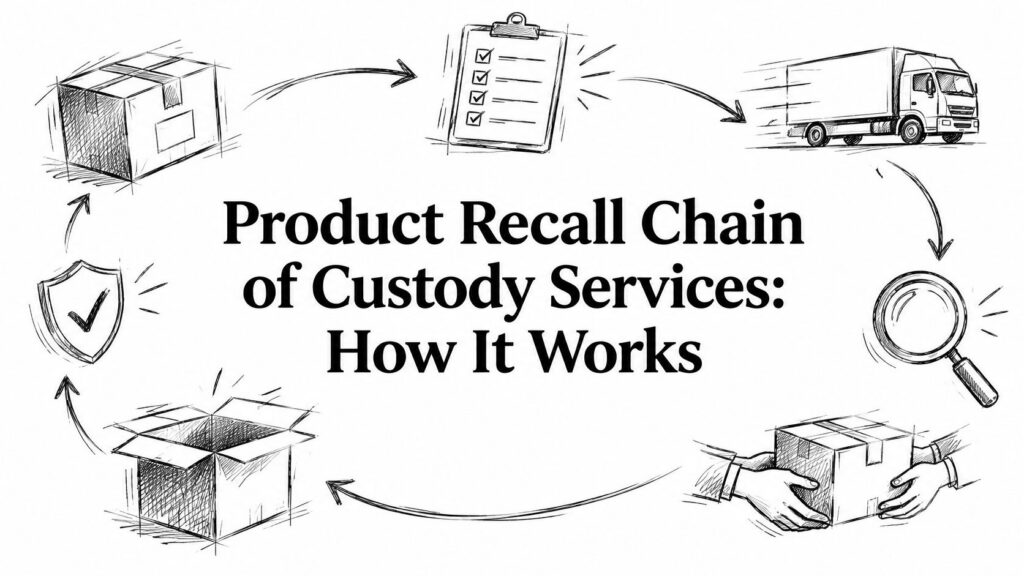
Global e-waste generation is projected to reach 82 million tonnes by 2030, according to the International Labour Organization's e-waste and employment report. A product recall adds another challenge to that growing waste stream: recovering equipment without allowing unsafe products, confidential data, or hazardous batteries into the wrong hands.
Product recall recovery and recycling starts with routing, not resale value. A working laptop may need destruction, while a defective device may contain reusable components. For businesses in Smyrna and across metropolitan Atlanta, Georgia, the practical question is how to move mixed inventories through a controlled process that protects people, preserves evidence, and recovers value only where it's safe.
Planning Policies and Reverse Logistics
Assign one accountable recall owner before a notice arrives. Give that person a cross-functional team from IT, operations, legal, procurement, and sustainability, plus authority to stop shipments and block inventory transfers.
The written playbook should define who approves repair, manufacturer return, refurbishment, recycling, and product destruction. Don't let a warehouse employee make those decisions from appearance alone.
Build a controlled return network
Set up the following before opening a return channel:
- Receiving locations: Name approved intake sites and a backup location. Establish sealed or access-controlled quarantine zones outside saleable inventory.
- Packaging instructions: Separate ordinary returns from loose lithium batteries and damaged devices. Have a qualified hazardous-materials specialist specify compliant packaging, terminal protection, labeling, and transport arrangements.
- Shipment identification: Match box and pallet counts to the return manifest. Track each pickup by shipment number rather than relying on a carrier's delivery confirmation alone.
- Transport documents: Include the return authorization, serialized manifest, packing list, bill of lading, and applicable hazardous-material shipping papers. The releasing custodian signs at dispatch; the receiving custodian signs at intake.
- Financial responsibility: Allocate freight, inspection labor, storage, battery handling, sanitization, and final processing costs in the manufacturer agreement.
A manufacturer-funded return isn't necessarily a fully funded recovery program. Storage and exception handling can remain your responsibility unless the agreement explicitly assigns them.
Test the handoffs
Run a mock recall with a small batch of assets. Include a missing serial number, a damaged battery, and a shipment arriving at the wrong dock so the team practices exceptions rather than just the ideal route.
Use the reverse logistics planning framework to define receiving, transport, and custody responsibilities before collection begins.
Operational rule: If nobody can identify who owns an exception, the equipment stays quarantined.
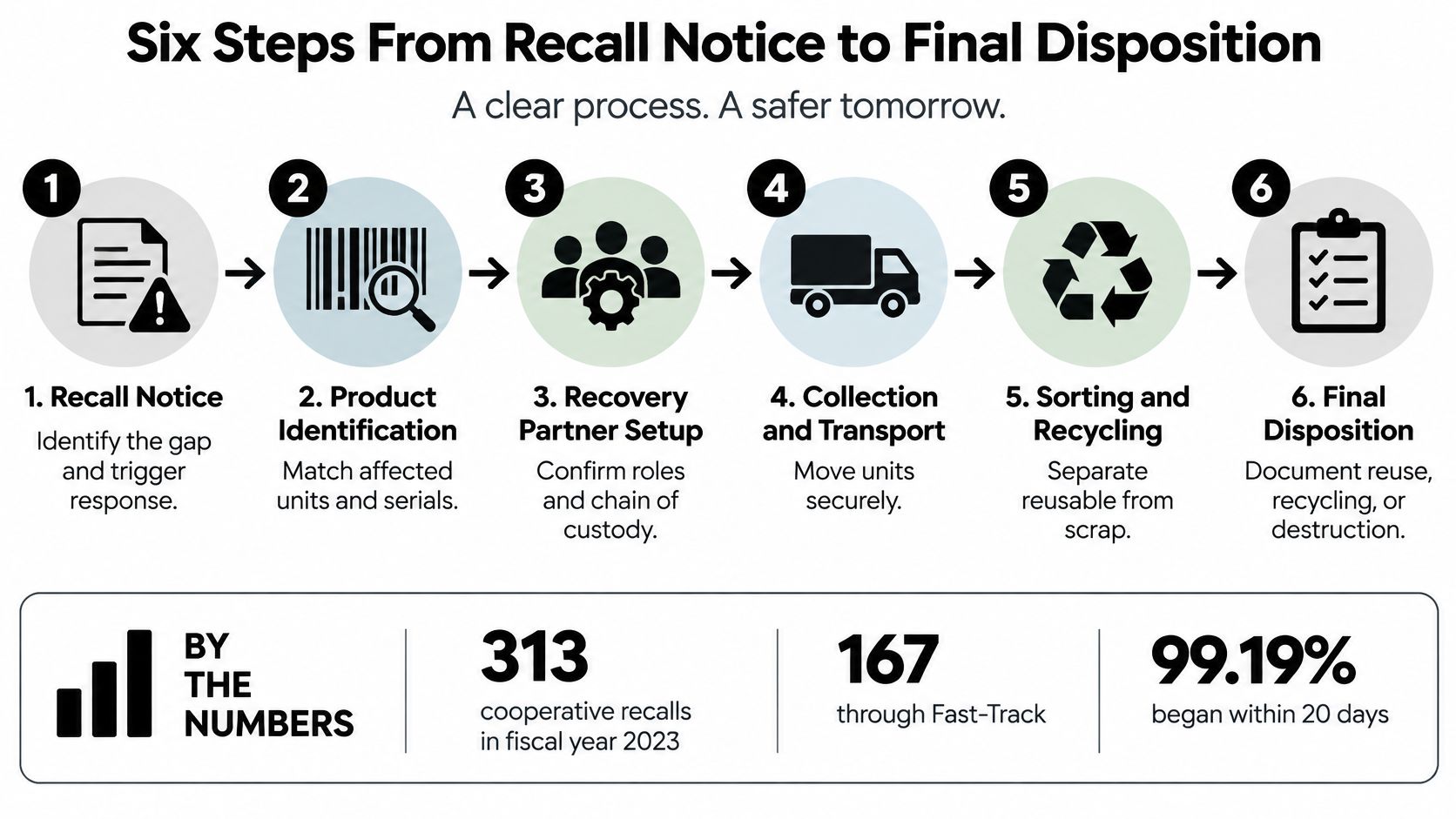
Six Steps From Recall Notice to Final Disposition
Fast announcements don't guarantee recovery. The CPSC's annual performance report records 313 completed cooperative recalls in fiscal year 2023, including 167 through Fast-Track, where 99.19% began within 20 days of a company's report, but the overall recall response rate was only 24%.
The wider disposal challenge is just as significant: the ITU and UNITAR Global E-waste Monitor 2024 reports 62 million tonnes of e-waste generated globally in 2022, with only 22.3% documented as formally collected and recycled in an environmentally sound manner. Intake records need to be ready when the recall starts, not assembled after returned equipment accumulates.
Record the physical journey
Log each returned unit. Capture its serial number, model, lot or batch, customer location, recall reason, condition, and first custody event. The proof is a dated intake record linked to a unique asset identifier. Avoid using a pallet description such as mixed laptops as the only inventory record.
Quarantine affected stock. Apply a visible recall label and an inventory-system hold so the unit can't re-enter saleable stock. Keep a quarantine register showing location and responsible custodian. The common slip is physically separating equipment while leaving it available for allocation in the asset system.
Inspect for hazards. Screen for swollen lithium batteries, damaged power supplies, leakage, heat damage, and other conditions requiring specialist handling. Keep a hazard assessment with photographs where appropriate. Don't power on an unsafe device merely to confirm its model or collect diagnostic information.
Prove the disposition decision
Evaluate the permitted recovery route. Test for repair, parts harvesting, reuse, or material recycling only after safety screening and review of recall restrictions. Record the inspection result and approved route in a disposition authorization. Avoid assuming that a successful startup test means the underlying recall defect is resolved.
Sanitize reusable storage media. Identify the media and select an approved method appropriate to its sensitivity and intended destination. Keep the device-level sanitization result, including verification and any failure. Don't substitute a general statement about company policy for evidence that the particular drive was processed.
Reconcile and close the record. Match the unit to the recall manifest, its shipment history, and its final processing evidence. The proof is a reconciled asset record with supporting certificates or manufacturer receipts. Avoid closing an asset merely because a carrier delivered it to a processor.
The NIST media-sanitization guidance supports selecting controls according to information sensitivity and documenting the outcome rather than applying a universal disposal method.
Readiness test: Choose a serial number and try to retrieve its complete history within a minute. Treat that as an internal drill, not a regulatory deadline. If the record requires searching personal inboxes, redesign the filing process before increasing collection volume.
Choosing Refurbish, Resell or Recycle for Each Unit
Ask two questions before assigning a route: Does the unit contain storage media? Is it safe to power on? Neither answer alone determines whether refurbishment is permissible.
The CPSC recalls database shows that refunds, repairs, and replacements dominate recorded recall remedies, while disposal represents a small share. That doesn't make disposal a failure. It means the remedy must address the defect and preserve consumer value where doing so is safe.
Material value still matters. ITU and UNITAR estimate that improperly managed global e-waste represented approximately USD 62 billion in recoverable natural resources in 2022. The operational challenge is recovering that value without restoring an unsafe product to circulation.
Routing by unit condition
| Unit condition | Holds data | Route | Record to keep |
|---|---|---|---|
| Working, no storage media | No | Quarantine, then repair or resale only after recall clearance | Serial number, condition and repair log |
| Working, reusable storage | Yes | Clear or purge, then redeploy or donate after recall clearance | Sanitization method and certificate |
| Recalled, safe but not reusable | Yes or No | Recycle through a certified processor | Weight record and recycling certificate |
| Swollen or damaged battery | Often | Isolate, handle batteries separately, send to a specialist recycler | Hazard notes and transport records |
| Failed or regulated media | Yes | Physical destruction when required by risk or policy, witnessed where required | Destruction certificate and photographs |
| Manufacturer take-back required | Check the model's storage configuration | Return under the manufacturer's instructions | Return manifest and receipt |
A working device without storage still needs an authorized repair and release record before resale. A reusable drive needs both an acceptable sanitization outcome and clearance of the product defect before donation.
Non-reusable equipment needs a documented material route. A damaged battery requires its own handling decision, while failed or regulated media may need destruction even when the surrounding computer remains valuable. Required manufacturer take-back overrides an attractive local resale opportunity.
Recovery is not automatically better than destruction. Recoverable value doesn't override unresolved safety or data risk.
Keep recalled units apart from ordinary IT refresh inventory throughout evaluation. That distinction matters during a Smyrna office cleanout or an Atlanta facility cleanout, where surplus equipment and recalled stock can otherwise share carts, loading areas, and asset labels.
In our Recycle step, Reworx Recycling customers choose between eco-friendly recycling and equipment refurbishment for their devices. Apply that choice only within the routes the recall permits, using a cost-recovery assessment that accounts for inspection, transport, sanitization, and documentation.
When in doubt, quarantine first and sanitize before final release decisions, but never energize unsafe equipment to perform the wipe.
Compliance Rules for Recalled Electronics
Meet the legal gate before choosing the destruction method. A processor's standard recycling procedure doesn't replace the instructions governing a particular recall.
The CPSC Regulated Products Handbook requires responsible parties to notify CPSC staff by email before recalled products are destroyed, disposed of, or recycled. It states that those actions must comply with applicable state and local regulations and occur under CPSC or U.S. Customs and Border Protection supervision; the agency may require an affidavit with photographic evidence or witness destruction directly.
Clear the export gate before booking freight
International returns need a separate classification review. The Basel Convention's e-waste amendments, effective January 1, 2025, subject transboundary e-waste movements to prior informed consent, including written notification to importing and transit states and written consent before shipment.
Hazardous or specially controlled waste generally can't move between a party and a non-party without an applicable agreement. Don't assume a manufacturer return label resolves those requirements, and don't classify discarded equipment as reusable merely because someone might repair it.
For Georgia organizations sending equipment outside the country, the practical question is whether the shipment is a product return or a waste movement under the applicable rules. Have the classification resolved before arranging transport.
Keep the approval package together
- Recall authority: Confirm the recall-specific CPSC instructions and the person authorized to communicate with the agency.
- Waste classification: Identify batteries, storage media, hazardous components, and other separately managed fractions.
- Receiving authorization: Obtain written evidence that the destination facility may handle the specific material.
- Export approvals: Complete required notifications, consent procedures, and destination-country checks before shipment.
- Disposition evidence: Retain transport documents, weights, approvals, photographs, and final processing records.
Reworx Recycling's recycling processes follow EPA rules for e-waste disposal. Use EPA e-waste guidance as a federal baseline, then confirm the state, local, transport, and recall-specific requirements that apply to the actual inventory.
Ask every processor, Reworx Recycling included, for relevant authorizations in writing. General recycling credentials don't establish permission to handle every recalled device, battery condition, or export route. Recall-specific CPSC instructions control over general guidance.
Secure Data Destruction Methods That Hold Up in Audits
A standard delete is not secure data destruction. The IRS media-sanitization guidelines explain that deleted information may remain recoverable through file-recovery and data-scavenging utilities.
A successful reset screen isn't proof that the required sanitization outcome was achieved. The NIST SP 800-88 sanitization framework distinguishes Clear, Purge, and Destroy, which address different levels of recovery resistance and future usability.
Sanitization methods and when to use them
| Method | What it does | Use when | Example technique |
|---|---|---|---|
| Simple file deletion | Leaves data recoverable with file-recovery tools | Never as final sanitization | Not applicable |
| Clear | Logical overwrite of user-addressable storage | Device stays in-house and the risk assessment permits it | Standard overwrite or factory reset where rewriting is unavailable |
| Purge | Makes recovery infeasible even with laboratory techniques | Media leaves your control for donation or resale and the selected method is appropriate | ATA Secure Erase or degaussing on compatible media |
| Destroy | Makes the medium unusable for future storage | Failed, high-risk or non-reusable media | Shredding, pulverizing, melting or incineration |
The destination is a useful starting point, not the sole decision rule. Match the method to data sensitivity, media type, device condition, and intended disposition. A command that works on one storage technology isn't automatically suitable for another, and degaussing isn't a universal treatment for electronic storage.
For reusable equipment, verification matters as much as execution. If the selected process fails or the media can't be accessed safely, record the failure and authorize a different route rather than issuing a successful sanitization certificate.
Make the certificate traceable to the drive
Create a serial-numbered record for each storage device, not just the computer chassis. Record the method, processing date, operator or responsible processor, verification result, and destination. For physical destruction, add photographs or witness records where the recall, contract, or governing authority requires them.
File the certificate against the recall asset record. If a laptop contains replacement storage, retain the relationship between its chassis serial number and the removed drive so the evidence doesn't become detached from the original asset.
Audit check: A certificate proves little if you can't connect it to the media that held the information.
Laptop disposal, medical equipment disposal, laboratory equipment disposal, and data center decommissioning all require a search for embedded storage. Check servers, workstations, instruments, controllers, and network appliances rather than limiting the inventory to obvious hard drives.
For teams also clearing mixed office property, DIYAuctions' data security tips for estate sellers offer supplementary awareness guidance. They don't replace enterprise sanitization requirements.
We securely wipe or shred data-bearing devices to protect customers' information. The asset owner still defines data-handling requirements and retains the evidence; our data sanitization methods guidance can support that decision.
Recovery Metrics That Survive an Audit
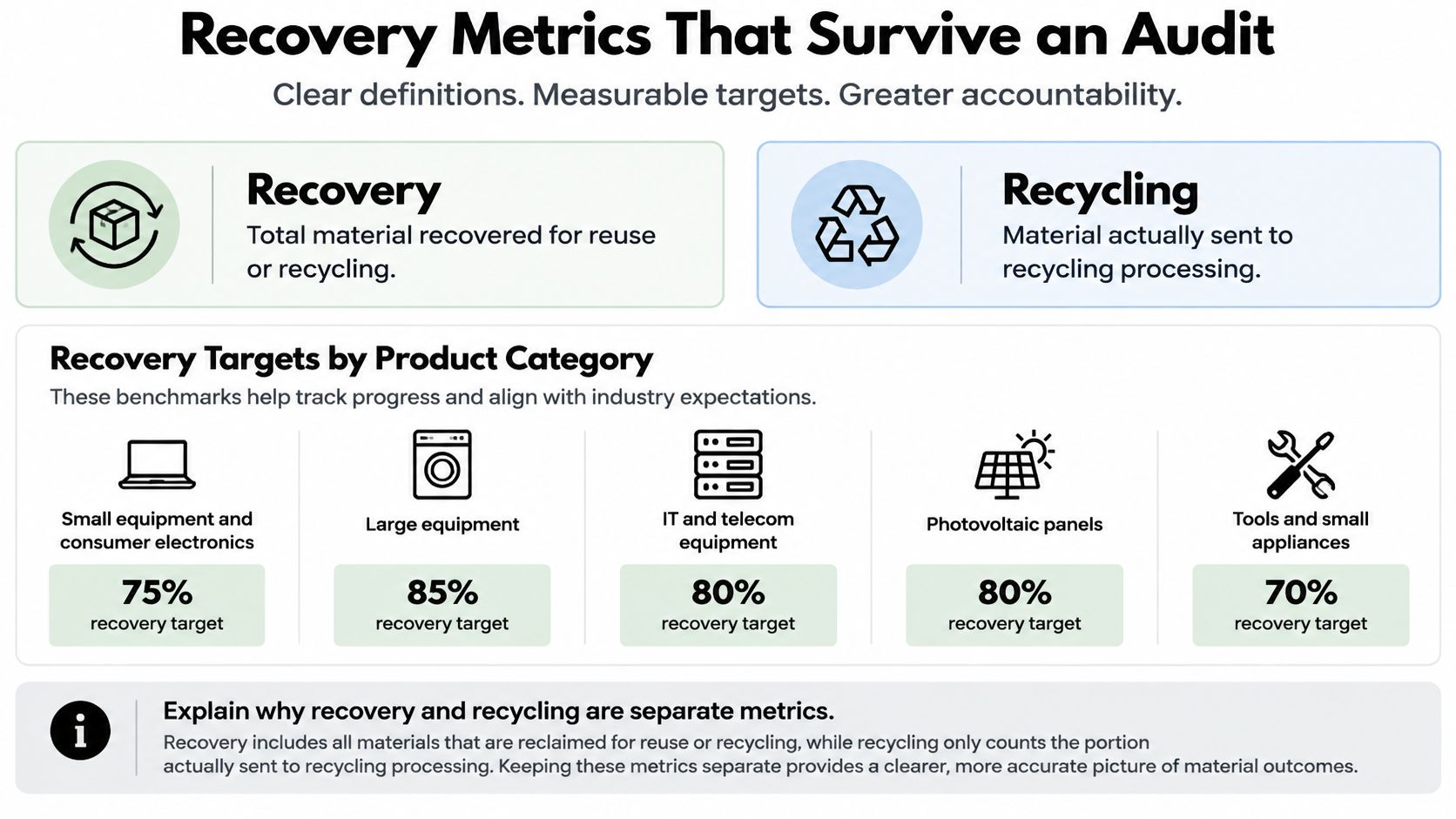
A European policy analysis of WEEE management targets summarizes 75% recovery and 55% recycling-or-reuse targets for small equipment and consumer electronics, and 85% recovery and 80% recycling-or-reuse targets for large equipment. Use these as category-specific benchmarks, not as universal U.S. recall requirements.
Recovery and recycling are different measures. Broader recovery accounting can include routes that aren't material recycling. Your dashboard should identify the treatment route rather than hiding everything beneath a diversion label.
Measure outputs, not promises
Weigh and count products at intake. Separate batteries, screens, printed circuit boards, cables, plastics, and metals, then record the downstream treatment route for each fraction.
Calculate material rates from verified output weights. Equipment delivered to a processor is not yet confirmed as recycled. Obtain downstream results before assigning the final recycling outcome, and report energy recovery and final disposal separately.
Recall recovery dashboard metrics
| Metric | How to calculate | Benchmark or target |
|---|---|---|
| Unit recovery rate | Units verified as processed divided by units recalled | Reconcile every unit to the manifest, including outstanding units |
| Mass recovery rate | Verified recovered output weight divided by intake weight | Use the applicable small- or large-equipment benchmark stated above |
| Recycling or reuse rate | Reused and recycled output divided by intake weight | Use the applicable material-category benchmark stated above |
| Hazardous-battery exception rate | Battery-related units divided by total units | Report every case; no universal target |
| Average days from notice to quarantine | Elapsed days from notice to isolation, averaged across units | Set an internal target and track weekly |
| Complete disposition evidence | Assets with certificates divided by total assets | No unexplained chain-of-custody gaps |
Set 100% asset reconciliation and zero unexplained custody gaps as internal audit objectives. Reconciliation doesn't mean every recalled unit has been recovered: it means the manifest accurately distinguishes processed, outstanding, unresolved, and otherwise documented units.
Keep separate reuse and recycling results behind the combined dashboard line. Otherwise, leadership can't tell whether improved performance came from safe redeployment or material processing.
Review exceptions monthly by site, using the same definitions across offices, schools, and facilities. A compliance reporting structure should make missing receipts, unexplained weight differences, and overdue certificates visible to named owners.
Keeping Customers, Staff and Regulators Informed
Say an Atlanta employer receives a recall notice affecting laptops across its office, remote workforce, and training room. The first communication should tell staff which models are affected, who owns the response, and how to stop further allocation.
As an internal response target, send that notice and freeze the opening manifest during the first 24 hours. Preserve later changes through version control rather than overwriting the initial population.
Match the message to the recipient
- Staff: Turn quarantine controls into site instructions identifying restricted locations, authorized handlers, and the prohibition on reissuing or donating uncleared devices.
- Customers and remote users: Within days, provide model-identification instructions, return or pickup steps, and the repair, replacement, refund, or recycling route applicable to their unit.
- Regulators: Send required notices before destruction and route agency instructions through the recall owner.
- Leadership and sustainability teams: Circulate weekly status reports showing reconciled units, recovered units, exceptions, and open evidence gaps.
These are planning cadences, not substitutes for deadlines in the recall instructions. An urgent safety notice may require faster customer contact.
Keep wording factual. Describe what the recipient must stop doing, where the equipment should go, and whom to contact. Don't speculate about the defect's cause or promise a remedy that hasn't been approved.
Make the next action easier than ignoring the notice.
Plan reminders and accessible return paths rather than relying on the opening message. At closure, issue a disposition summary with supporting certificates and a clear statement of any units still outstanding. Don't label the recall fully recovered because internal processing has ended.
Vetting a Recovery Partner Before the Recall Starts
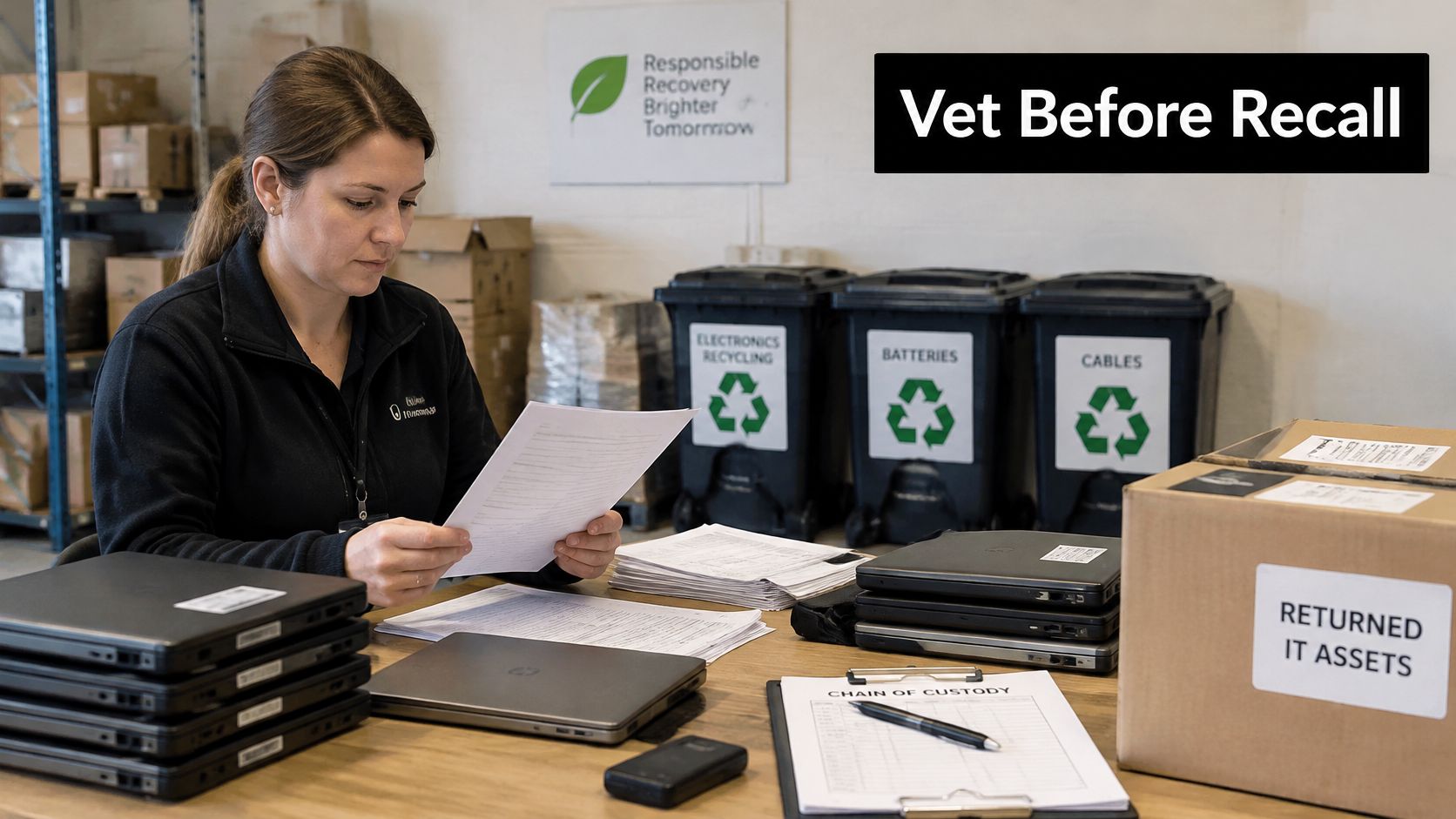
Choose the recovery partner before the warehouse fills. During a recall, an available truck can look more important than documented custody, but a fast pickup won't resolve missing serial numbers or an unauthorized downstream destination.
Require written evidence of unit-level custody controls, destruction and recycling certificates, downstream processor verification, battery-handling competence, and pickup capacity. Where relevant, confirm authority and capability for regulated media and cross-border movements rather than accepting a broad statement about compliance.
Put commercial terms beside technical controls
Ask how equipment is valued, when ownership transfers, and who bears freight and rejected-load costs. A buyback offer should identify deductions and exclusions before collection, especially when a mixed load contains unsafe or non-reusable equipment.
At Reworx Recycling, Consultation begins with analysis of the customer's recycling needs and development of an electronic-waste strategy. Our equipment buyback process follows Assessment, Offer, and Recycle, and we offer free e-waste pickups nationwide. Document the recall inventory and handling constraints during planning so pickup arrangements match the approved scope.
Use the same vendor selection criteria for Reworx Recycling as for any other candidate. Request the consultation output, buyback terms, pickup arrangements, and hard-drive shredding certificate format before signing.
As a donation-based electronics recycling social enterprise, Reworx Recycling connects environmental responsibility with community impact through technology donations, digital inclusion, and workforce development. Corporate donation programs belong in the approved reuse route, never as an outlet for unresolved recall stock.
Before the recall begins, confirm these items in writing:
- Chain-of-custody format: Asset identifiers, transfer events, signatures, and exception handling.
- Destruction certificate template: Media identifiers, processing method, and required supporting evidence.
- Processor list: Downstream destinations and material-specific authorizations.
- Battery handling method: Segregation, packaging, transport, and specialist routing.
- Freight and valuation terms: Cost allocation, buyback assessment, exclusions, and ownership transfer.
Reworx Recycling offers electronics recycling, secure data destruction, and nationwide business pickups to help organizations manage recalled equipment through documented disposition routes. Schedule a pickup, donate equipment that has cleared safety and data requirements, or partner with us on a recall recovery plan. Visit Reworx Recycling for practical guides to responsible IT equipment disposal and community-focused technology reuse.