Your warehouse has booked a pickup, branch managers are forwarding different versions of the recall notice, and the schools haven't confirmed what's still in classrooms. The immediate problem isn't finding a truck. It's proving which affected products are at each location, who controls them, and what remains unresolved after collection.
Why Multi-Location Recalls Stall at Each Site
Say a warehouse, three branch offices and two schools hold the same recalled lot of monitors. The warehouse counts unopened cartons, office managers count desks, and school staff report equipment by classroom rather than serial number. Everyone has responded, but the coordinator still can't identify which locations hold affected units.
The scale makes this more than an inventory nuisance. The Consumer Product Safety Commission's fiscal-year 2024 performance report records 333 voluntary recalls covering 41 million consumer-product units, compared with 308 recalls involving 97 million units in fiscal 2023, alongside 2,969 regulatory-violation notices requiring recalls or other corrective action. More recall events don't necessarily mean more affected units, and neither measure tells an operator where those units remain.
Count locations, not collection bookings
A single return address won't resolve products scattered among retail inventory, employee homes, workplaces and online stock. Each channel needs a responsible contact, an identification method and a way to record unresolved quantities.
Adding collection sites can improve access. It can also create duplicate claims, inconsistent intake decisions and unidentified stock if each site uses different rules.
Practical rule: A location is cleared only after signed reconciliation and documented disposition, not when the pickup truck leaves.
Reworx Recycling works with businesses coordinating these responsibilities across locations, pairing responsible electronics handling with attention to sensitive data. Its nationwide recycling information provides a starting point for organizations planning across state lines.
Effective multi-location product recall collection needs a workable sequence, named decision-makers, site handling rules, custody records and a measurement plan. Without those controls, a completed transport job can conceal an unfinished recall.
Stakeholder Roles and Decision Rights
Who owns and approves each part of the collection
| Role | Owns | Approves | Escalates when |
|---|---|---|---|
| Recall coordinator | Master record, timeline, closeout sign-off | Closing any location | Deadlines missed or exceptions unresolved |
| Site lead | Intake area, quarantine labels, daily log | Accepting or rejecting units on site | No acknowledgement within two business days |
| Logistics lead | Routes, carriers, transfer manifests | Carrier and route changes | Units unaccounted for in transit |
| IT and security lead | Asset identifiers, data-bearing flags, sanitization | Destruction method for each data class | Sanitization verification fails |
| Compliance or legal reviewer | State routing rules, notice wording | Notice text and disposition paths | Conflicting state requirements |
| Communications lead | Site-specific notices and reminders | Release timing | Low response from a site group |
| Sustainability lead | Diversion and reuse reporting | Reporting basis | Reported impact cannot be verified |
| Vendor manager | Contract terms, certificates, audit schedule | Vendor selection and renewals | Certificates missing or subcontractors undisclosed |
Separate execution from approval
The site lead can accept an affected device, but can't authorize an unapproved disposal route. The logistics lead can rearrange a collection, but can't resolve a missing serial number by changing the manifest quantity. Only the recall coordinator closes a location, after receiving the reconciliation sign-off.
Use the following internal notice schedule, rather than treating it as a regulatory deadline: the communications lead issues the approved notice on day zero, sends reminders on day five and day ten, and escalates missing acknowledgements after two business days to the coordinator and site manager. Legal approves the wording before release.
Keep the core notice consistent while changing the site contact, intake address, access arrangements and collection instructions. Separate email threads rewritten by local managers invite contradictory handling directions. The cross-department collaboration framework is relevant because facilities, IT, procurement and sustainability need the same record, not parallel versions.
Make procurement verify the handoffs
Our dedicated Reworx Recycling team handles everything from collection to recycling. That model reduces organizational handoffs, but buyers should still require documentary proof rather than verbal assurance.
Put these requirements into the purchasing review:
- Intake capability: Capture serial-level identifiers and controlled alternatives for unreadable labels.
- Custody evidence: Record every transfer, including receiving personnel and discrepancies.
- Disposition proof: Specify required destruction certificates and asset-level supporting records.
- Downstream visibility: Require processor disclosure and audit rights.
- Incident terms: Define notification timelines, investigation responsibilities and data handling obligations.
A vendor's collection confirmation is evidence of movement. Procurement should establish what additional evidence the coordinator needs before accepting the job as complete.
Collection Workflow and Reconciliation
Use a central record with controlled edits and an audit history. A spreadsheet can support a small operation, but emailed copies shouldn't become competing systems of record.
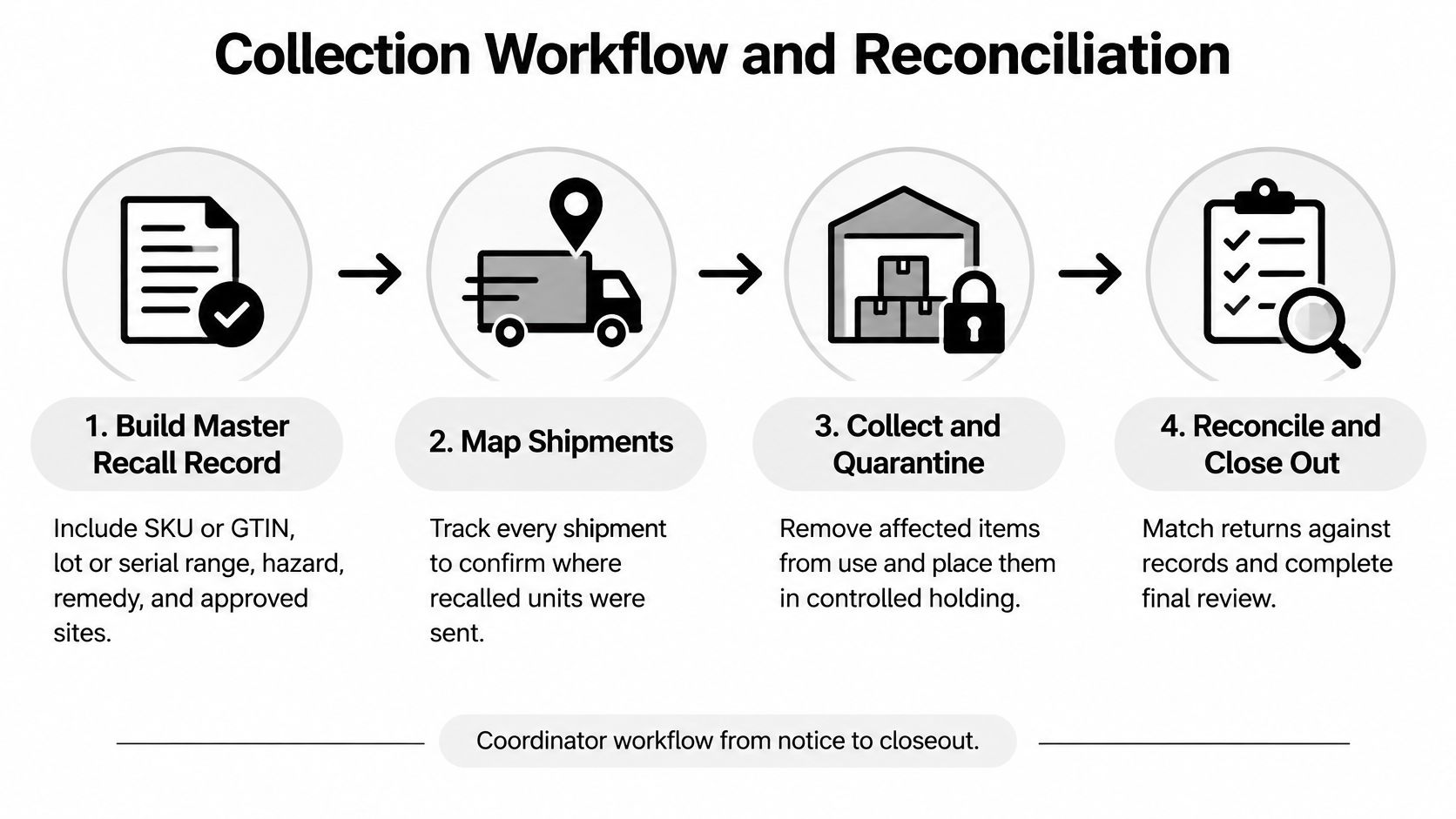
Establish the affected population
Build the master recall record. Enter the SKU or GTIN, affected lot or serial range, hazard, authorized remedy and approved collection sites, then attach the controlling notice. Give amendments a version history so an expanded serial range doesn't overwrite earlier instructions.
Map shipments to actual holders. Connect customers, distributors, employees and secondary sites to the affected identifiers, not merely the original delivery address. A GS1 US traceability exercise found that 59% of product records supported a detailed product journey, while 41% experienced delays involving GTIN mismatches, missing master data or inconsistent trading-partner practices.
Resolve conflicting identifiers before intake begins. Compare purchasing records, asset registers and manufacturer identifiers, then document which field determines recall eligibility. A company asset tag identifies ownership, but it doesn't necessarily establish whether the manufacturer's recall covers the unit.
Issue location-specific instructions and barcode intake forms. Include the eligibility check, permitted collection method, responsible contact and exception route so staff don't improvise when a label is missing. Provide an alternative for inaccessible sites or users who can't transport equipment safely.
Control receipt and transfer
Quarantine affected units immediately. Remove them from service or sale and keep them separate from non-recalled stock, with a distinct status for items awaiting identification. Don't let an uncertain match enter an approved disposal shipment merely because it arrived beside confirmed recalled products.
Assign a unique receipt ID and capture the device serial at every handoff. When the serial is absent or unreadable, retain a photograph, model identification and an exception record linking the item to its originating site. A pallet count without supporting unit records won't resolve a later dispute about a particular device.
Record the transfer event, not just the departure. The releasing and receiving parties should confirm identifiers, quantities, timestamp, destination and any seal reference, noting discrepancies before signing. Keep pickup, warehouse receipt and downstream acceptance as separate events so a short receipt isn't hidden by an earlier dispatch count.
Route each unit to its authorized remedy. Record whether it awaits refund processing, repair, replacement return or approved disposal, and retain the relevant authorization. For data-bearing equipment, physical collection doesn't authorize unrestricted access, sanitization or product destruction.
The product recall chain-of-custody guidance is useful when defining the evidence required between these events. Build the fields into intake tools rather than asking staff to reconstruct them after dispatch.
Reconcile quantities without double-counting
Give every unit a current status and a history. Compare receipts against distribution records, transfers, sales, repairs, destruction and outstanding quantities, while distinguishing historical transactions from present status. A unit sold and later collected mustn't appear as separate products in the reconciliation.
Review exceptions with an owner and deadline. Duplicate receipts, unidentified models, missing sites and unexplained serial gaps need evidence-based resolutions, not a general comment that the numbers look close. Keep unresolved units visible even when the physical collection route is complete.
Measure the location-level recovery funnel. Historical CPSC analysis of 21 recalls found that an average of 33% of products sold to consumers were returned or repaired, which is a different measure from units collected by a business program. Establish explicit internal targets for notice delivery, acknowledgement, recovery and disposition rather than treating that historical result as your operating benchmark.
Recovery funnel stages and example internal targets
These are proposed internal service levels, not industry averages or legal thresholds.
| Funnel stage | Measure | Example internal target | What a gap signals |
|---|---|---|---|
| Notification delivery | Known sites that received the notice | 100% | Missing contacts or wrong site records |
| Acknowledgement | Sites confirming receipt | 95% within two business days | Non-responsive site lead |
| Units located | Units identified against serial or lot range | Every affected unit located or assigned an exception | Incomplete distribution records |
| Units collected | Units physically retrieved | Every scheduled unit collected or rescheduled with an owner | Units still in homes, stock or other sites |
| Units reconciled | Received units matched to distributed, sold and outstanding counts | 100% of open units reviewed weekly | Quantity variances or unexplained gaps |
| Units remedied or destroyed | Units with documented disposition | Evidence attached before closeout | Stock waiting on a remedy or certificate |
- Obtain the signed location reconciliation. Attach the quantity explanation, resolved exceptions and disposition evidence, then have the coordinator approve closure. Units received alone are an unreliable success measure if the denominator omits stock held by distributors, employees, customers or secondary locations.
Site Setup, Quarantine and Device Handling
Give every site a designated intake area away from active stock, clear signage and a named lead. Use a location code such as MKT-ATL-02 consistently across the inventory, barcode form, manifest and certificate index. A familiar building nickname isn't a reliable identifier when multiple teams enter records.
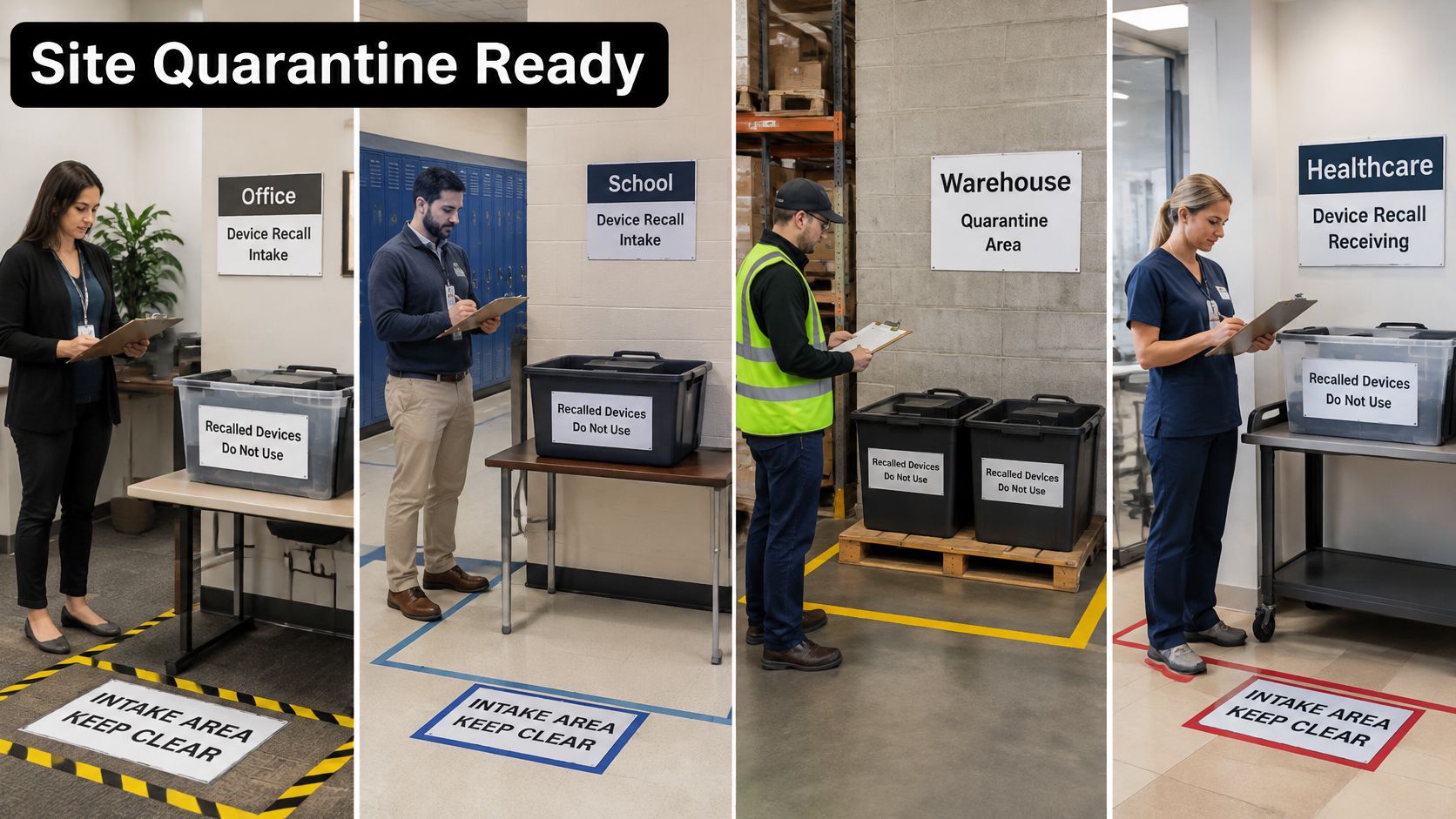
Adapt the intake area to the building
Office floors need a controlled collection point rather than an unattended pile beside the printer. Ask department contacts to identify equipment assigned to remote workers and meeting rooms, and prevent well-meaning staff from returning quarantined devices to service.
School buildings need staff-controlled intake that doesn't invite students to handle suspect equipment. Separate classroom identification from physical movement: teachers can report model and asset details while trained staff follow the approved collection instructions.
Warehouses should create a blocked inventory status and a clearly marked holding area. Match physical segregation with system controls so pickers can't allocate recalled stock to an outgoing order.
Healthcare sites need the clinical or facilities owner involved before equipment leaves its operating area. Arrange safe withdrawal, replacement coverage where necessary, and contamination-status documentation before considering medical equipment disposal.
Prepare the load before booking transport
Compile the equipment list against the acceptable-items list, then gather unwanted electronics and flag devices containing sensitive data. Keep unrelated office cleanout or facility cleanout material off the recall manifest unless it has a separate, clearly identified collection stream.
Each quarantine label should show recall ID, site code, date received, quantity, serial or model, and handler initials. Never share a bin between recalled and non-recalled stock, and don't use a generic recycling sticker as a substitute for the recall label.
A quarantine area must prevent accidental reuse, not merely make the equipment look ready for collection.
Storage, transport and disposition by device class
| Device class | Storage | Transport | Final disposition |
|---|---|---|---|
| Data-bearing devices, including laptops, drives and point-of-sale systems | Sealed, labeled, stored apart until a disposition decision is recorded | Locked container, serial numbers logged | Verified sanitization or destruction with a certificate |
| Lithium-ion batteries and battery-containing products | Isolated, not stacked, damaged units segregated | Applicable hazardous-materials rules, carrier confirmed before dispatch | Approved handling only, not ordinary recycling |
| Monitors and displays | Labeled by recall ID and site code | Secured transport, count verified at handoff | Recycling route set by state rules |
| Medical equipment | Quarantined under the clinical or facilities owner | Transport only with documented chain of custody | Disposition confirmed with the manufacturer and compliance lead |
| Non-data peripherals, including keyboards, cables and docks | Binned by recall ID, kept separate from stock | Counted and sealed | Recycling or remedy return per the recall notice |
Make battery and routing decisions before movement
For lithium-ion products, the recall instructions and condition assessment govern packaging and collection. Don't charge, test, dismantle or consolidate damaged units to make transport easier; have qualified personnel determine the safe holding arrangement and carrier acceptance. If a device shows signs of an active failure, follow the site emergency procedure rather than continuing routine intake.
The EPA electronics-legislation summary identifies 25 U.S. states with e-waste laws and three states with disposal bans. Treat that summary as a reason to verify current requirements for each location, not as a complete transport or disposal determination.
For an Atlanta, Georgia business coordinating out-of-state branches, the originating office address doesn't decide every receiving facility's obligations. Keep the state, device class, condition and proposed destination together in the routing record.
Protect data without creating another safety problem
Keep data-bearing devices sealed and separate until the authorized decision is recorded. Do not power up a hazardous recalled laptop just to run a standard wiping tool; IT and the safety lead must agree on a method compatible with the device's condition.
NIST's media sanitization guidance defines sanitization as making access to target data infeasible for a specified level of effort and recommends verifying the selected process, using item-level or representative-sample verification as appropriate. Where possible, personnel independent of the original sanitization action should perform sampling.
Escalate when the remedy stalls
The CPSC's five-year remedy data lists refunds at 54.5%, repairs at 26.4%, replacements at 17.0% and disposal at 1.1%, while noting that remedy counts can change. Disposal isn't the default, but damaged battery products may need specialized disposition rather than indefinite storage.
Set a documented review date, approved holding conditions and an escalation owner whenever manufacturer instructions remain unusable or delayed. Use the recalled-product quarantine and disposal checklist to prepare the handling questions before booking, including those affecting laboratory equipment disposal or other specialist assets.
Cost, Reporting and Record Templates
Prepare the record set before the first collection. Retrofitting identifiers after equipment reaches a processor costs staff time and can leave evidence gaps that no invoice resolves.
Required fields for each recall record
| Record | Required fields |
|---|---|
| Master recall record | SKU or GTIN, lot or serial range, hazard, remedy, approved collection sites |
| Location inventory | Site code, contact, state, units distributed, units outstanding |
| Barcode intake form | Receipt ID, site code, date, serial or model, photo flag, handler initials |
| Quarantine label | Recall ID, site code, date received, quantity, serial or model, handler initials |
| Reconciliation sign-off | Received versus distributed, sold, repaired, destroyed and outstanding, coordinator signature |
| Destruction certificate file | Asset IDs, method, verification sample, vendor, date, cost per location |
Track the cost of unresolved work
Maintain a location-level ledger for transport trips, intake labor, reconciliation hours, certificate charges where applicable, and carrier waiting time. Distinguish planned collection costs from exception costs, such as a return visit caused by an incomplete equipment list.
A consolidated route may reduce transport activity but extend holding time. A dedicated collection may cost more while avoiding an unsuitable storage arrangement. Compare the operational trade-off, not just the carrier quote.
For management reporting, show units distributed, units collected, units reconciled and units with documented disposition for each closed location. Keep certificate references attached to the asset records; the recall destruction certificate checklist helps define the supporting file.
Report environmental outcomes conservatively
The EPA electronics donation and recycling guidance states that recycling one million laptops saves energy equivalent to the annual electricity use of more than 3,500 U.S. homes. Present that as a published laptop-recycling benchmark, not a measured energy saving for a mixed load of monitors, medical devices and cables.
Keep donation, reuse, recycling and destruction outcomes separate. Sustainable recycling reporting shouldn't describe a destroyed recalled product as a technology donation.
Before approving the closeout pack, use a short checklist:
- Master record: Eligibility and remedy instructions are current.
- Site response: Every known location has acknowledged or has an active escalation.
- Quarantine: Holding arrangements are confirmed.
- Exceptions: Each unresolved item has an owner and deadline.
- Approval: Every closed site has signed evidence.
Book Your Multi-Location Collection With Reworx Recycling
A pickup does not clear a site. The location is cleared only when the collected equipment is reconciled against its records and the required sign-off is complete. More pickup locations without that verification can leave the recall program with more unresolved gaps.
Before contacting Reworx Recycling, prepare the equipment list and identify devices that contain sensitive data. Include the location, access restrictions, equipment condition, manufacturer instructions and the records your coordinator needs for closeout.
Reworx Recycling is a full-service electronics recycling and IT asset disposition partner based in Smyrna, Georgia. It offers nationwide commercial recycling services, including free e-waste pickups and secure drop-off locations.
Match the collection to the authorized outcome
Use the Reworx Recycling contact and service information to arrange a pickup or drop-off and discuss data destruction requirements. Describe whether the equipment is recalled product, routine computer recycling, laptop disposal or retired data center assets. Free e-waste pickups are available nationwide, but confirm any specialized handling or documentation requirements before scheduling.
For a program spanning branches in Georgia and other states, keep each location's instructions tied to the central record. Assign one owner to confirm the equipment list, another to verify the collection, and a coordinator to track signed reconciliation. Keep the required evidence clear before equipment leaves the site.
Count a location as cleared only after its equipment is reconciled and the required sign-off is recorded.
Keep community impact separate from recall authorization
Eligible surplus equipment can be managed separately from recalled products. Confirm that equipment proposed for reuse is not subject to an unresolved recall, and retain the approval record for any device considered for reuse.
Reworx Recycling offers equipment buyback and remarketing solutions for businesses, alongside electronics recycling and IT asset disposition services. Keep those options separate from recall authorization: a potential reuse or recovery outcome does not replace the required remedy or documented disposition.
A clean equipment list and a clear decision path give the collection team the information needed to handle the load. Agree on pickup arrangements and required documentation before releasing equipment, then reconcile the records by location.
Reworx Recycling provides nationwide electronics recycling and IT asset disposition support for organizations managing equipment across multiple sites. Visit Reworx Recycling to discuss collection arrangements for your recall program.