More than 83,000 FDA-regulated products were recalled between 2014 and 2024, according to the FDA's product recall guidance. That scale reframes destruction services for unsafe products: the challenge isn't just finding someone to destroy material. It's proving that affected units were located, controlled, and permanently removed from circulation.
For facilities, IT, procurement, and sustainability leads, a successful job ends with reconciled records, not an empty loading dock. Whether you're handling recalled batteries, defective laptops, or rejected branded inventory, the practical question is the same: Can someone trace each affected unit from the hold notice to its authorized final disposition?
When Unsafe Products Must Leave Circulation
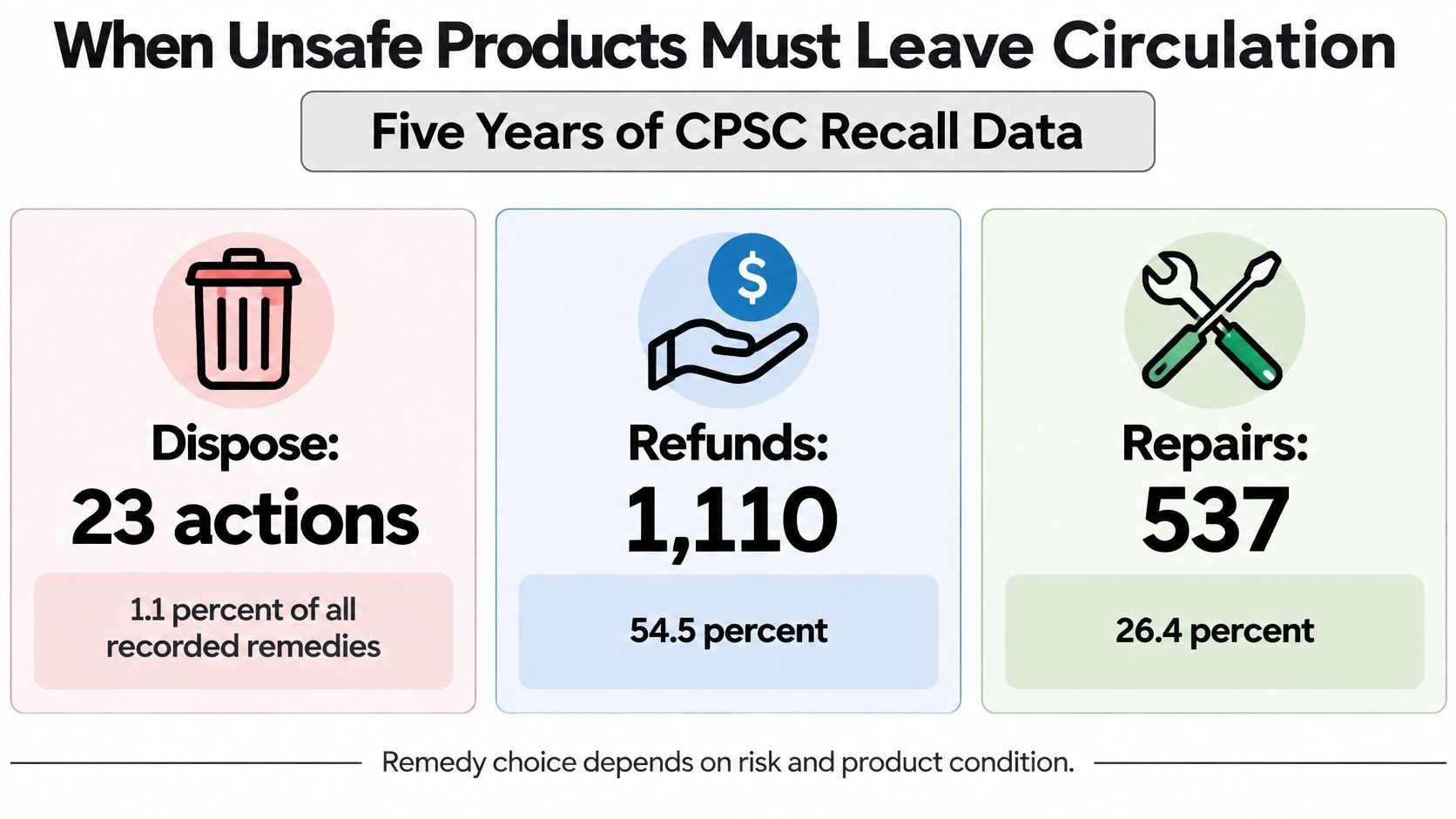
Disposal is a recall remedy, not a synonym for every recall. The U.S. Consumer Product Safety Commission's recall information defines disposal as throwing a product out or recycling it and reports five-year remedy totals of 23 Dispose actions (1.1%), compared with 1,110 refunds (54.5%), 537 repairs (26.4%), and 345 replacements (17.0%). Its guidance also directs consumers to throw out or recycle recalled products when the remedy is no longer available.
Those categories matter on the receiving dock. A refund may settle a financial obligation, but your team still needs instructions for the physical item. A repair may make a unit eligible for service again, while an authorized destruction decision means it must never return to usable inventory.
Follow the product beyond the credit memo
Say a school receives a recall notice for charging equipment. Procurement obtains a supplier credit, facilities collects the chargers, and someone places the cartons beside surplus computer equipment. The accounting issue appears closed, but the chargers could still leave through an auction, employee giveaway, or donation shipment.
The operational failure isn't the credit. It's the absence of a physical disposition decision linked to the affected inventory.
Facilities, procurement, IT, and sustainability teams encounter this problem with electronics, appliances, batteries, counterfeit goods, and off-spec lots. An off-spec item isn't automatically dangerous, and a cosmetic defect doesn't automatically justify destruction. Quality staff should establish the reason for rejection before anyone chooses a disposal route.
For teams formalizing that upstream review, the Genpire quality control overview offers useful context for connecting inspection decisions with disposition decisions. Keep the quality hold, recall status, and destruction authorization distinct in your records.
Define the required outcome
A finished destruction program must block more than resale. It must prevent return to stock, unauthorized reuse, donation of unsafe equipment, and disposal that introduces another hazard.
- Match the hazard: Identify batteries, stored data, chemicals, and components requiring separate treatment.
- Confirm authorization: Establish who can release the material and which corrective-action conditions apply.
- Prove custody: Connect the identified products to the actual destruction event.
Release test: If the unit could still be sold next month, it hasn't been destroyed.
This doesn't mean every component must become waste. Approved material recovery can remain possible after the unsafe product has been rendered unusable. The distinction is between recovering resources and allowing a dangerous product to function again.
Five Destruction Methods and the Right Fit
Choose the hazard-control method before deciding what can be reused. A machine that destroys a product's shape may leave confidential information recoverable. A process that neutralizes a chemical may leave branded packaging intact.
Bring the product description, safety data sheet where applicable, recall instructions, photographs, and proposed inventory list to the intake meeting. Don't book a shredder based only on the word equipment.
Use a selection sheet, not a generic destruction label
The destruction method selection sheet compares the physical routes. Treat its avoid column as a screening control, not a substitute for the receiving facility's written acceptance criteria.
| Method | Neutralizes | Best fit | Avoid when | Evidence to keep |
|---|---|---|---|---|
| Onsite shredding | Product form and data media in view of a witness | Hard drives, laptops, small branded lots after hazard removal | Lithium batteries, aerosols, liquids are present | Serial log, witness, certificate |
| Offsite shredding | Product form and data media at a licensed plant after sealed transfer | Palletized electronics and mixed goods with batteries removed | Loads must be watched onsite or can ignite in a shredder | Manifest, weights, certificate of destruction |
| Incineration | Product and packaging through permitted thermal treatment | Contaminated goods that cannot be safely recycled | Heavy-metal electronics and lithium batteries are present | Permit, date, quantity destroyed |
| Rendering | Certain animal by-products and accepted inedible food streams | Inedible animal or food material accepted by a renderer | Material contains electronics, chemicals, or branded consumer devices | Batch IDs and processor receipt |
| Chemical neutralization | Hazardous contents treated to an approved endpoint | Acids, bases, and laboratory reagents matched to an SDS and treatment profile | The objective is destroying branded electronics or data media | Waste profile, SDS match, destruction record |
The acceptance review should identify components requiring removal before treatment. A laptop described as ready for shredding needs a different preparation record from a container of laboratory reagents. Don't let mixed packaging obscure incompatible contents.
Chemical neutralization also needs a precise endpoint. Changing acidity doesn't establish that every hazardous constituent has been addressed. Have the specialist document the accepted waste profile, treatment outcome, and destination of residues.
Separate product destruction from media sanitization
For information security, the NIST media-sanitization guidance identifies clear, purge, and destroy as the primary methods. Clear uses logical techniques to protect against basic, non-invasive recovery; purge aims to make recovery infeasible even with more capable laboratory techniques; destroy uses physical processes such as shredding, disintegration, pulverizing, or incineration.
That distinction prevents an expensive misunderstanding. A factory reset is not automatically equivalent to physical destruction, and a visibly damaged laptop doesn't establish that its storage media is unreadable.
Purge techniques include ATA Secure Erase and degaussing where technically applicable. Degaussing generally destroys a magnetic drive's firmware, preventing reuse. It isn't a universal treatment for every storage technology, so record whether the asset contains a magnetic hard drive, solid-state drive, or other medium.
Use the information's sensitivity, the medium's capabilities, and the intended destination to approve the method. Verification belongs in that decision: an erasure process that reports failure must trigger another authorized route, not a successful-disposal label.
For electronics planning, our guide to methods for destroying old equipment helps frame the equipment decision. Our data destruction methods include hard drive shredding and data erasure designed to remove information beyond recovery.
The practical deliverable is a treatment instruction tied to a defined asset group. It should name the method, preparation requirements, verification record, and permitted destination for the resulting material.
Onsite and Offsite Destruction Side by Side
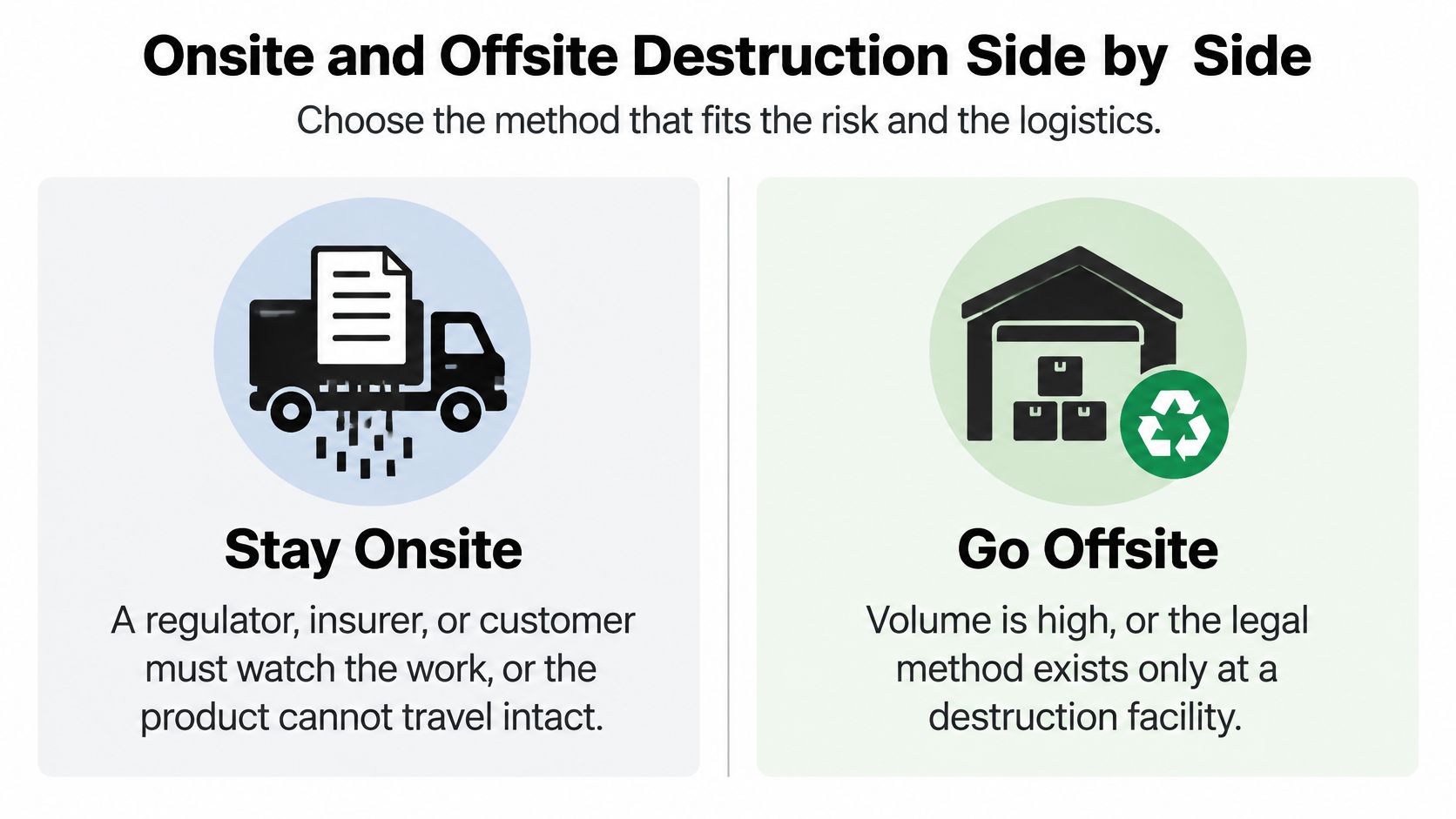
Stay onsite when an authorized witness must observe the work or intact goods cannot be released for transport. Choose offsite treatment when the approved process requires a suitable facility, the load warrants consolidated handling, and custody can be sealed and reconciled.
Location comes after method selection. A mobile shredder doesn't make an unsuitable material safe to shred, and a secure truck doesn't establish that the destination can accept the contents.
Onsite versus offsite destruction
Use these planning assumptions when comparing quotes. Confirm actual labor, access, power, and receiving arrangements before authorizing either option.
| Criterion | Onsite | Offsite |
|---|---|---|
| Witness control | Your staff or auditor watches the work | Facility records, video where agreed, and certificate |
| Transport risk | No highway movement of intact unsafe goods being destroyed onsite | Control relies on seals, manifest, and receiving check |
| Cost pattern | Higher event costs can weigh heavily on small lots | Consolidation can lower unit cost at pallet or trailer volume |
| Best volume | Small sensitive lots | Pallet and trailer loads |
| Floor impact | Crew, working space, and agreed power arrangements on your dock | Scheduled pickup and secure staging space |
| Data media | Shred or degauss compatible media in view | Purge or shred at a qualified, appropriately certified site |
| Poor fit | Batteries, aerosols, chemical treatment | Loads legally required to be witnessed onsite |
A hybrid arrangement can suit an electronics program. Authorized technicians separate batteries and storage media under local control, then route the remaining equipment to approved electronics recycling or shredding.
For sensitive drives, review our onsite hard drive destruction guidance while defining witness and access requirements. Facilities should confirm vehicle access and exclusion zones; IT should approve the asset list and media treatment.
The wrong destination can turn a controlled cleanout into a fire or hazardous-material problem. Both teams should approve the logistics before anyone books a pickup window.
Legal Triggers Before Any Destruction Starts
A hold notice should change what warehouse and inventory staff can do with the affected goods. Don't leave the hold as an email attachment that shipping staff may never see.
Clear the domestic release gates
Stop sale and distribution. Block affected inventory from orders, transfers, auctions, and routine surplus releases when the recall or hold arrives. Assign an owner who can approve status changes.
Identify the affected products. Capture model numbers, date codes, UPCs, serials, and lot identifiers that distinguish held units from similar acceptable stock. Product appearance alone isn't a reliable identifier.
Quarantine separately. Establish a labeled location and restrict movement. Keep the held material away from salvage, returns awaiting inspection, and donation inventory.
Confirm the corrective-action conditions. For products under CPSC jurisdiction, destruction may require advance approval and CPSC witnessing or an affidavit. Obtain the applicable written instructions before authorizing irreversible work.
Keep the domestic recall decision separate from waste classification. A product hold determines whether an item may move through commerce; waste rules determine how discarded material must be managed. For electronics planning, our universal waste guidance can help organize the classification questions without treating every device or component identically.
Review international movement separately
The Basel Convention's e-waste amendments subject transboundary movements of covered electrical and electronic waste to prior informed consent: the exporting state provides written notification to the importing state and relevant transit states, and the necessary written consents must be obtained before shipment begins.
An intact device with resale value isn't automatically ordinary freight. First determine whether it is waste or used equipment intended for legitimate reuse.
The Basel Convention's guidance on e-waste and used equipment addresses that distinction for transboundary movements. Document condition, intended use, destination, and management route before arranging international transport, particularly where donation and destruction programs share a dock.
Schools and public agencies should preserve the approval record so a later auditor, insurer, or records officer can understand the decision without interviewing everyone involved.
No pickup until the legal route is written down.
Prove Every Unit Reached Destruction
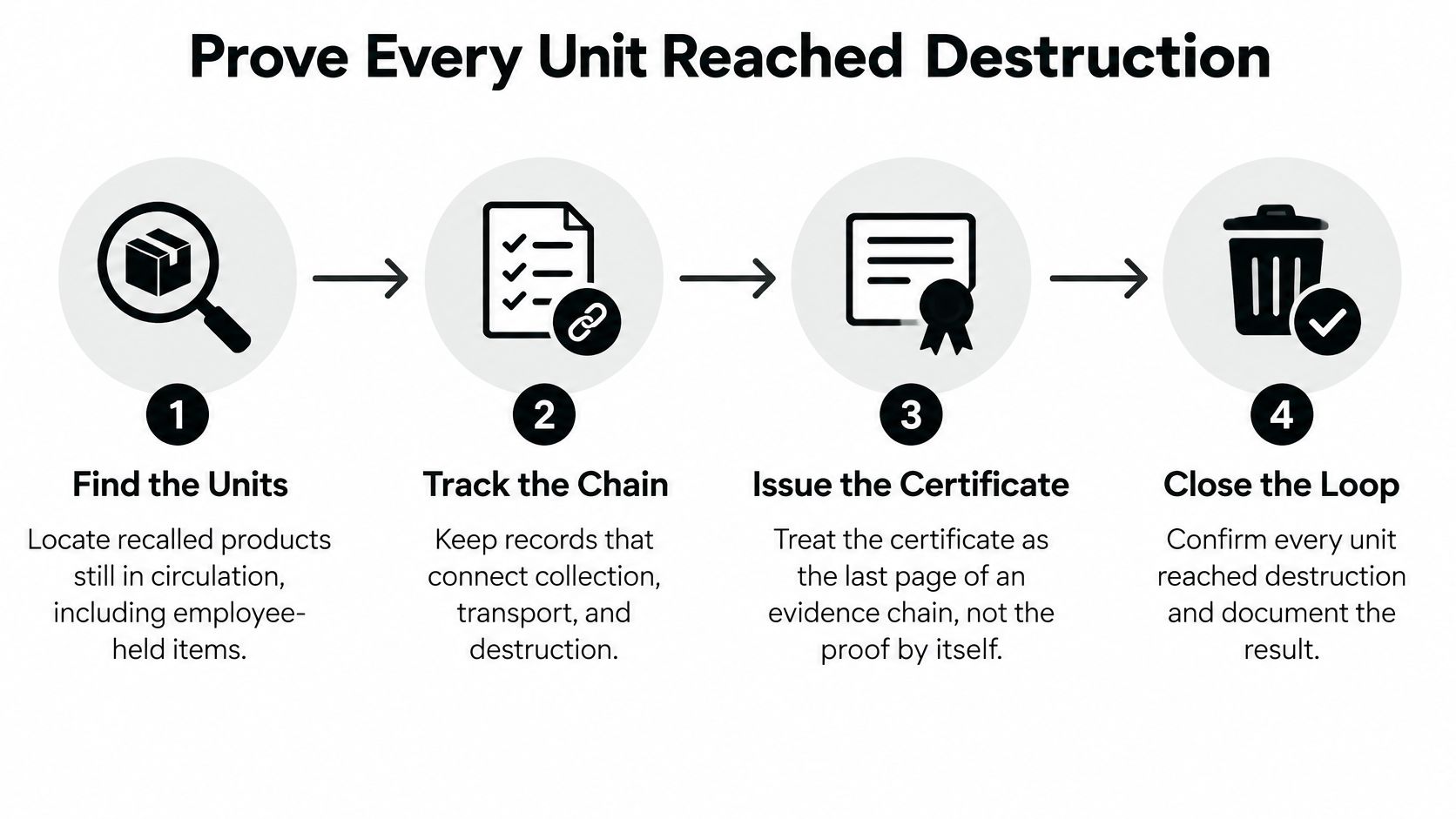
The certificate is the last page of an evidence chain, not the chain itself. A warehouse receipt can prove collection without proving destruction, and a destruction certificate can document a completed load without explaining missing assets.
The CPSC Recall Handbook calls for identifying affected products, segregating inventory, providing written offsite destruction instructions, obtaining completion documentation, and updating inventory records. Build your operating routine around those controls.
Run the custody routine
Freeze the affected inventory list. Reconcile warehouse stock with employee-held devices, loaners, returns, and customer shipments. Separate located units from outstanding recovery requests.
Secure the quarantine area. Label held stock and prevent commingling with salvage. Record authorized movements instead of relying on someone remembering where a carton went.
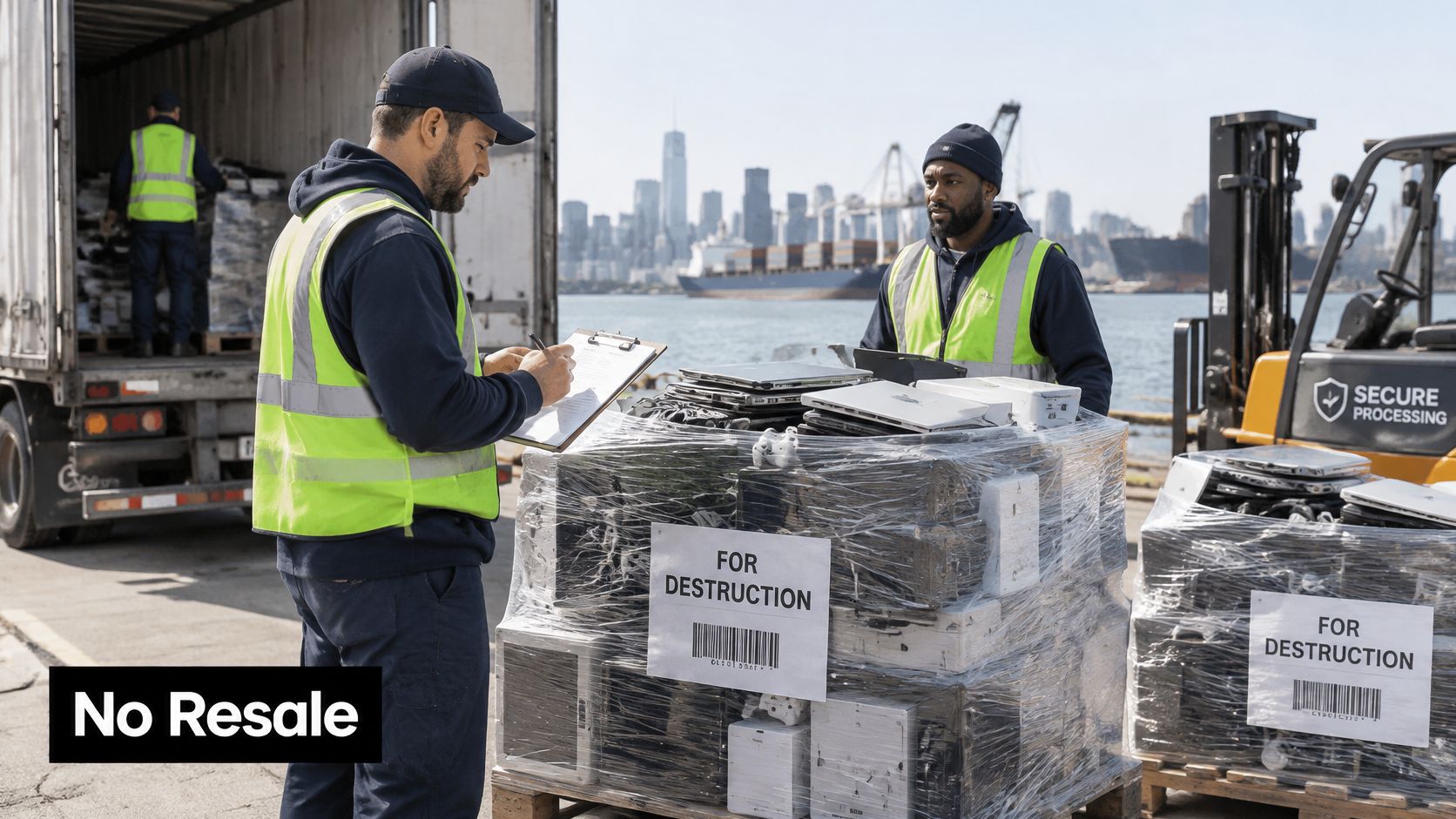
Build the manifest before shipment. Link serials or lot codes and quantities to pallet identifiers, photographs, weights, and condition notes. Use lot-level records where individual serialization isn't available.
Record every custody transfer. Capture the releasing and receiving people, time, signatures, and seal status. Resolve receiving discrepancies before treating the transfer as complete.
Issue written destruction instructions. Name the product, approved method, preparation controls, and required completion documentation.
Reconcile the result. Match quantity, date, method, responsible employee, witness where applicable, and exceptions against the manifest.
Update inventory and retain the file. Close completed lines while keeping unresolved assets visible.
Resolve discrepancies before closing the job
A missing employee laptop doesn't become destroyed because the warehouse load was processed. Keep that asset open until it is recovered or receives a documented administrative resolution; an approved write-off explains an absence but does not prove destruction.
Likewise, damage in transit requires investigation. Record the affected packaging, quantity, containment action, and final destination rather than adjusting the received count without documentation.
Evidence record for each destruction event
| Evidence item | What it proves | Checked against |
|---|---|---|
| Serialized manifest | Each serial, lot, and quantity entered custody | Warehouse and recall counts |
| Sealed-pallet photos | Load condition before transfer | Pallet IDs and manifest line count |
| Transfer signatures | Who released and received the load, with time | Custody log |
| Completion certificate | Quantity destroyed, destruction date, and method | Manifest quantities |
| Responsible employee and witness | Named people behind the destruction event | Certificate sign-off |
| Exception log | Missing or damaged units and their status | Open until recovered or formally resolved, with destruction status explicit |
Our chain-of-custody documentation guidance supports planning that record set. At Reworx Recycling, our third step, Certification & Reporting, provides detailed reports and a Certificate of Destruction, with a certificate supplied for every completed task for audit and legal documentation.
Reconcile intake counts before accepting the event as closed. A certificate disconnected from serials, lots, quantities, and exceptions cannot prove that every unsafe unit was neutralized.
Electronics Batteries and Off-Spec Lots
A single swollen battery or rejected product can turn a routine return into a fire, data-security, or resale risk. The dock team needs to identify what is in each load before deciding where it goes.
A recalled battery arrives with ordinary returns
A receiving employee opens a carton and finds a swollen lithium-ion pack. Keep damaged, swollen, recalled, or heat-affected batteries out of household trash and ordinary recycling streams. Their condition can create a fire hazard during handling and transport.
Segregate the batteries at intake. Prevent crushing, puncturing, or uncontrolled shredding, label the containers, and get written packaging and acceptance instructions from the receiving facility. A municipal household-hazardous-waste site is a possible destination only after it confirms that it can accept the organization's material.
Use lithium battery recycling guidance to prepare questions about routing and acceptance.
Fire-control priority: Send an unsafe battery through a confirmed specialist route, not the next available recycling bin.
A server leaves an equipment room
A data center decommissioning team places retired servers on a pallet. Asset tags identify the chassis, but IT must also account for installed storage, removable media, and devices removed before collection.
NIST's media-sanitization framework connects treatment decisions to information confidentiality and calls for safety, hazardous-material, and special-disposition needs to be identified before destruction. Apply the approved clear, purge, or destroy decision to each media group, including failed drives.
Reworx Recycling specializes in secure data destruction, including hard drive shredding and data erasure. After data destruction, electronics are recycled responsibly and in an environmentally friendly way. For other electronics streams, use recyclers that follow recognized safe-management practices, and identify batteries, contamination, and specialized components before treating laptop, medical, or laboratory equipment as ordinary electronics.
The key record connects each media identifier to its approved treatment and verified result. That link helps show that a server's data-bearing components received the intended disposition.
A rejected branded lot reaches surplus staging
A distributor rejects counterfeit charging accessories and places them beside usable surplus. Donation-based recycling does not resolve the risk that unsafe or counterfeit goods could return to sale.
Authorize a treatment method that prevents rejected items and packaging from re-entering a secondary market. Witnessed shredding or an appropriate permitted thermal route may fit, once the facility has accepted the material and its hazards.
The final check is physical: rejected products should no longer be usable or recoverable as saleable stock. Match the treated quantity to the lot record before closing the disposition.
Hire the Right Partner and Release the Lot
A destruction job is complete only when the records show that every rejected unit reached the approved treatment and cannot return to sale. Set the contractor's scope and the proof you expect before authorizing pickup.
Complete the buying checklist
Describe the lot. Record the hazard, quantity, condition, and material type, such as electronics, batteries, food, or chemicals. Include photographs and available identifiers.
Require method-specific authorization. Check permits and acceptance criteria against the actual treatment and material. A general recycling statement does not establish authorization to handle hazardous contents.
Agree on evidence fields. Specify how serial numbers, weights, photographs, and exceptions will connect to the completion record.
Confirm custody and witnessing. Set transfer signatures, receiving checks, and any observation arrangements before transport is booked.
Review downstream destinations. Confirm where components and residues will go. Prohibit unauthorized resale of recognizable rejected goods.
Price the complete job. Account for pickup, labor, special handling, preparation, and reporting. A per-pound quote alone may omit necessary work.
Release a pilot lot. Compare its intake and completion records before authorizing the remaining inventory.
For internal purchasing, score candidates from one to five on method fit, evidence quality, environmental routing, and data security. Reject a bid scoring below three on evidence quality, regardless of its overall price. These are procurement criteria, not regulatory thresholds.
Keep the partner's scope clear
Reworx Recycling is based in Smyrna, Georgia, and offers electronics recycling and IT asset disposition services, including equipment decommissioning, IT asset management, recycling consultation, hard drive shredding, equipment buyback, and Recycle By Mail. Business pickups are available, and Reworx provides complete equipment decommissioning services across the United States.
For a business cleanout, separate unsafe inventory from serviceable technology at the outset. Donation programs can support suitable equipment, but rejected or unsafe products must not re-enter circulation.
Chemical neutralization, rendering, and permitted incineration of non-electronic hazardous goods belong with qualified specialists. Keep those activities outside an electronics contract unless the provider is authorized to handle them.
Before release, isolate the lot, complete its identifiers, and agree in writing on treatment and documentation. Community reuse should follow sound safety decisions, not replace them.
Reworx Recycling offers business pickups, secure data destruction, and responsible electronics recycling for organizations retiring outdated IT equipment. Prepare the affected equipment's serial or lot list, then visit Reworx Recycling to arrange a business pickup or discuss IT equipment disposal. Keep safe, reusable devices separate so eligible donations do not return unsafe products to circulation.