A retired laptop is sitting beside the loading dock, its asset tag still attached and its last user still logged in to several business systems. An IT contractor collects it with a few other devices, but nobody records the serial number, confirms the storage media was sanitized, or documents who accepted custody. The organization has a data security policy, yet the physical process has already drifted away from it.
That gap is where compliance failures become real. Data security compliance isn't only about choosing a regulation or publishing an information security policy. It means performing repeatable actions on real devices, assigning responsibility to real people, and keeping evidence that shows what happened before equipment was reused, donated, recycled, or destroyed. A practical data breach prevention process should connect policy decisions to the final disposition of every data-bearing asset.
The Server Room Laptop That Started a Breach
The laptop had spent years in a server room office. It contained employee records, vendor correspondence, saved browser sessions, and local files used during infrastructure work. When the department upgraded its equipment, the laptop moved into a back hallway with other retired technology. The label said “surplus,” but it didn't say whether the drive had been wiped, whether the device was approved for donation, or who was authorized to release it.
A well-meaning contractor loaded the equipment into a vehicle. The handoff felt routine because the laptop looked ordinary. A device can look clean while its storage still contains recoverable information, and a missing custody record can leave the organization unable to show when control transferred or which sanitization method was used.
Practical rule: A device isn't compliant because someone marked it retired. It's compliant only when the organization can prove that the data was handled according to its risk and the asset's final destination.
The reader's four practical questions are straightforward:
- What does compliance require? Protect information through its full lifecycle, including retirement.
- Which rules apply? Match obligations to the data, sector, customers, contracts, and jurisdictions involved.
- How should hardware leave the building? Use a documented IT asset disposition, or ITAD, workflow with controlled transport and verified sanitization.
- What survives an audit? Asset inventories, chain-of-custody records, sanitization logs, certificates of destruction, and exception documentation.
Global requirements are becoming harder to coordinate. A 2025 survey found that 85% of organizations said compliance requirements had become more complex over the previous three years, while 47% identified regulatory complexity as the top factor making compliance harder. Cybersecurity and data protection or privacy were tied as the top compliance priorities, each cited by 51% of organizations, according to Vanta's 2025 compliance statistics.
The lesson isn't that every retired laptop requires the same treatment. The lesson is that every retirement decision needs a defensible path from classification to final disposition.
What Data Security Compliance Actually Means
Data security compliance is the combination of obligations and evidence used to protect information. Those obligations can come from laws, regulations, customer contracts, industry frameworks, and internal policy. Evidence shows that employees and vendors followed the required process rather than merely intending to follow it.
Three related ideas often get blended together:
- Cybersecurity focuses on technical defenses such as authentication, endpoint protection, monitoring, backups, and network controls.
- Privacy focuses on how an organization collects, uses, shares, retains, and deletes personal information.
- Data security compliance connects protection practices to formal requirements and asks whether the organization can demonstrate control.
A company can have strong firewalls and still fail a disposal requirement. It can publish a detailed privacy notice and still lose control of an un####What Data Security Compliance Means
A compliant program begins with a risk-based question: what information could this asset expose, and what effort would be required to recover it? A public marketing file and a drive containing medical, tax, payment, or identity information shouldn't automatically receive the same treatment. Storage technology matters too, because a method suitable for one medium may not work for another.
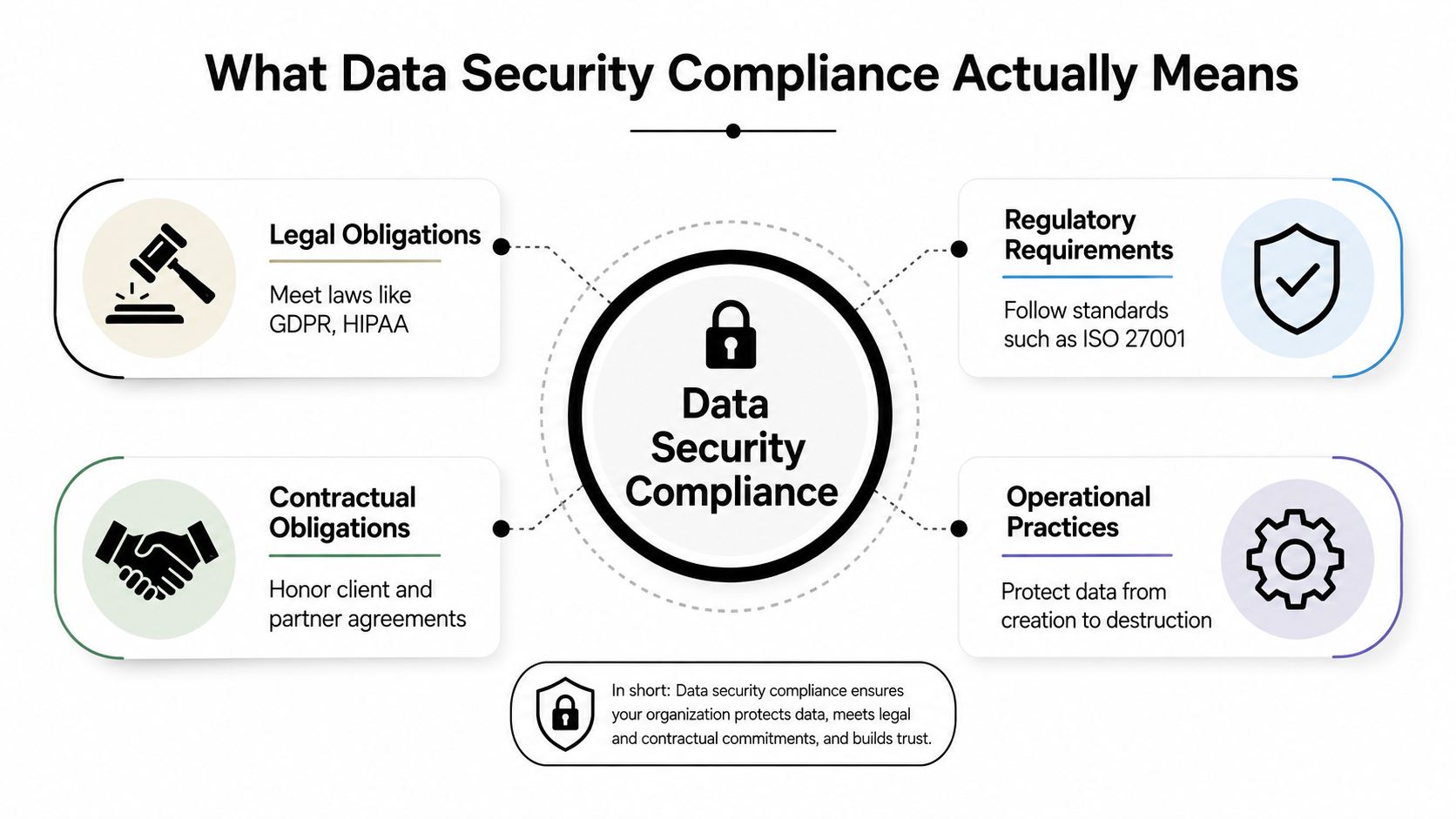
A useful operating model follows the asset through its lifecycle:
- Identify the data. Record the asset, owner, location, and likely data classification.
- Choose the control. Decide whether the media should be cleared, purged, destroyed, or handled through another approved method.
- Control movement. Document every transfer from employee, to facilities team, to carrier, to recycler or ITAD provider.
- Verify the result. Capture the method, date, operator, asset identifier, and outcome.
- Retain evidence. Store records where an auditor, customer, or incident-response team can retrieve them.
This is why information security standards and disposal controls belong in operational procedures, not only in policy libraries. Compliance is continuous because assets, vendors, applications, regulations, and business processes change. An annual review can identify gaps, but it can't replace control at the moment a device leaves the organization's custody.
The Major Regulations You Need to Know
No single rulebook covers every organization. The right starting point is to map the information and relationships involved, then identify the legal, regulatory, contractual, and sector-specific obligations attached to them.
HIPAA and healthcare information
HIPAA applies to covered healthcare entities and business associates handling protected health information. Its practical concern is whether access to medical information is limited, justified, protected, and documented. A retired workstation from a clinic, a diagnostic device with internal storage, or a laptop used by a billing team can all require controlled retirement when they contain protected health information.
Healthcare organizations should also examine the systems surrounding the device. Microsoft 365 mailboxes, shared folders, collaboration spaces, and exported reports can preserve sensitive content after a computer is removed. For a focused discussion of OCR enforcement realities for M365, Ollo's resource helps connect formal requirements to the way staff use cloud productivity systems.
GDPR and personal data
GDPR can apply when an organization processes personal data connected to people in the European Union, including organizations outside the EU that offer services to or monitor people in the EU. Its concerns include lawful handling, transparency, individual rights, retention, security, and accountability. Hardware retirement matters because deletion and access-control decisions don't end when a user replaces a laptop.
A company may need to coordinate GDPR with contractual requirements, internal retention schedules, and the controls used by processors or downstream service providers. The correct approach depends on the organization's processing activities and legal advice, but the operational principle is stable: maintain visibility over copies and document what happened to storage media.
US state breach notification laws
US breach laws vary by jurisdiction and can affect notification duties after unauthorized access to protected information. The relevant state may depend on the affected individuals, the organization, the type of information, and the circumstances of the incident. A lost or improperly retired device can therefore create obligations beyond the organization's headquarters.
Maintain an incident response plan that identifies decision owners, escalation routes, evidence requirements, and counsel involvement. A current state data breach law reference can support initial orientation, but legal teams should confirm the requirements that apply to a specific event.
NIST and technical guidance
NIST publications are widely used as practical references for security and media sanitization. NIST SP 800-88 Revision 2 is the current revision, after Revision 1 was withdrawn on September 26, 2025, because Revision 2 superseded it, as documented by NIST's revision history.
Government, education, healthcare, and enterprise buyers may also impose contractual standards that exceed a baseline legal requirement. A school district, public agency, or university should identify those requirements before equipment enters a surplus or donation stream. A hospital serving international patients could face overlapping obligations, and a single disposal workflow should be designed to satisfy the strictest applicable control without losing the ability to reuse suitable equipment.
Data Wiping Versus Physical Destruction
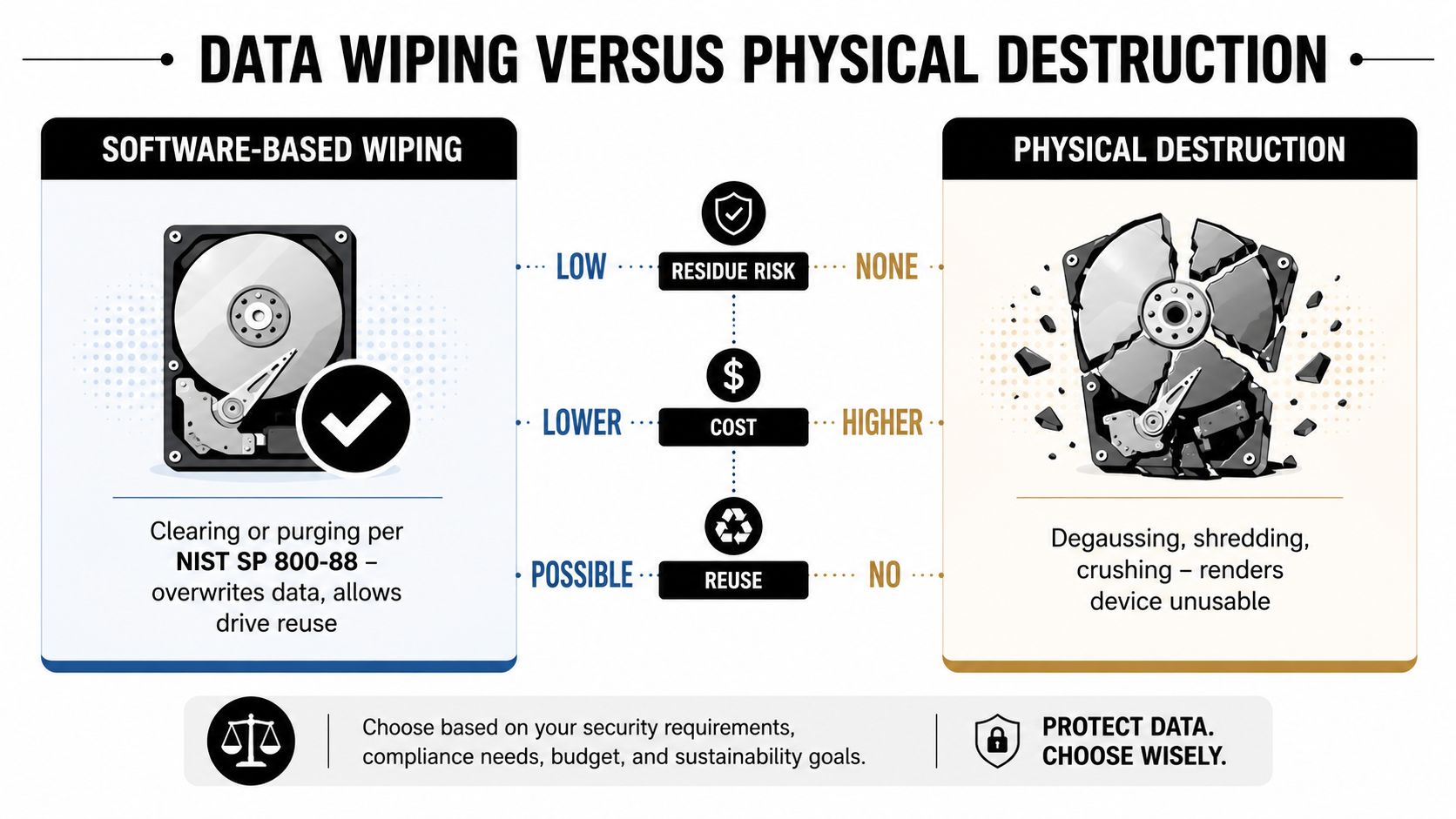
A laptop may look empty when it leaves the office, yet its storage can still contain recoverable information. Choosing between wiping and destruction requires four checks: the data classification, media type, device condition, and intended destination. Deleting files, emptying a recycle bin, or reformatting a drive isn't the same as sanitization. Those actions alter the user view of files, but may leave data accessible with specialized tools.
NIST SP 800-88 Revision 2 defines sanitization as a process that makes access to target data infeasible for a given level of effort. The publication connects the decision to the information's sensitivity and the storage technology involved. Read the NIST SP 800-88 Revision 2 publication before setting a retirement procedure.
When wiping is appropriate
Software-based clearing or purging can preserve reuse when the drive works, the method fits the technology, and the result can be verified. It may allow redeployment, resale, or donation. A defensible record identifies the tool or procedure, operator, asset identifier, verification result, and any exception. Teams can also follow this guide to wiping a hard drive when documenting the technical steps.
Wiping becomes difficult to defend when a drive is damaged, inaccessible, or encrypted without recoverable management keys. The same applies when the device will leave organizational control and the required assurance level is higher. A failed wipe should enter an exception process for review, not disappear into a recycling pile.
When destruction is the safer decision
Physical destruction may involve degaussing, shredding, crushing, or another approved method that makes storage media unusable. It fits damaged drives, highly sensitive information, and cases where reuse is not permitted. The tradeoff is clear: destruction removes reuse value, so asset owners should select it deliberately rather than using it whenever the facts are unclear.
A hybrid process can provide added assurance. An organization sanitizes a functioning drive, verifies the result, then destroys the media when policy or contract requirements call for both controls. That approach is not required for every asset. It may suit a particular data classification, threat model, or contractual obligation.
For federal tax information, the IRS identifies disposal, clearing, purging, and destroying as media sanitization categories. Its media sanitization guidelines explain which methods apply to media containing that information. The practical test is whether the selected method meets the control objective and whether the organization can prove the outcome through records, verification, and, where applicable, a certificate of destruction.
Operational Controls That Make Compliance Real
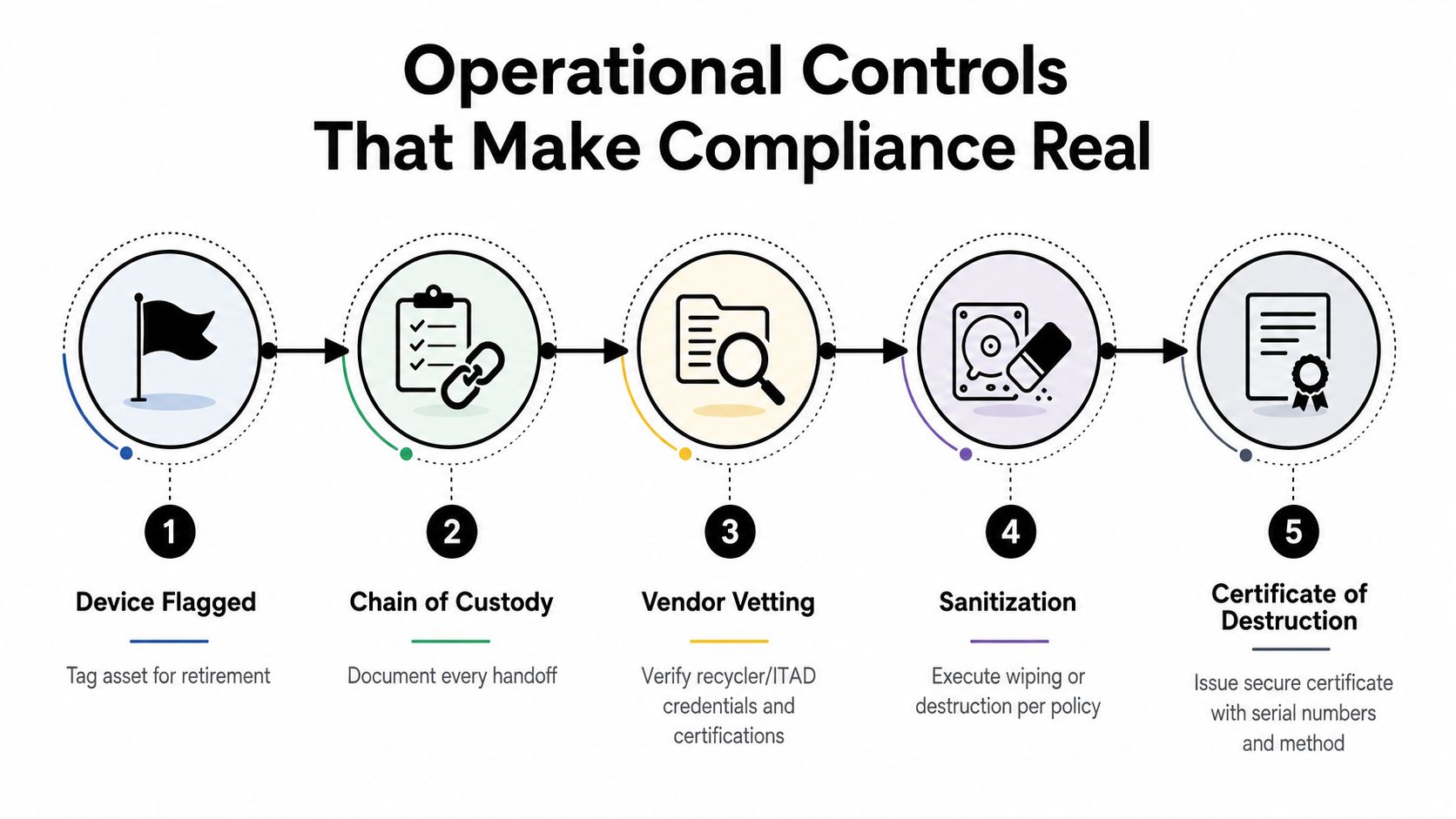
A policy becomes defensible when staff can follow it under pressure and an auditor can trace the evidence afterward. The strongest workflows don't rely on a single certificate issued at the end. They create a connected record from the moment an asset is flagged through its final disposition.
Start with a controlled handoff
The department owner or IT team should identify the device, apply an asset label, record its serial number, and mark its status. If the device contains storage, the record should show the data classification and the approved sanitization path. Sealed containers, controlled staging areas, and tracked transport reduce opportunities for confusion or unauthorized access.
A chain-of-custody record should answer simple questions:
- Who released the asset? Name the person or responsible business unit.
- What changed hands? Record the device type, asset tag, serial number, and media status.
- When did the transfer occur? Use dates and times that align with pickup and intake records.
- Who accepted custody? Identify the carrier, vendor, or receiving employee.
- What happened next? Link the asset to sanitization, reuse, donation, resale, recycling, or destruction.
Vet the downstream provider
Vendor selection is part of compliance, not a procurement detail to handle after the decision is made. Review the provider's security procedures, insurance, facility controls, employee practices, subcontractor terms, equipment handling methods, and ability to produce asset-level records. Certifications and independent audit evidence can support due diligence, but buyers should verify the scope and currency rather than relying on a logo in a proposal.
Contract language should define responsibilities for data protection, incident reporting, custody, approved subcontractors, retention, and evidence delivery. Ask for a sample certificate before the first shipment. A certificate that says only “electronics received” won't prove that a particular drive was sanitized by an approved method.
Record exceptions instead of hiding them
Failed drives, missing labels, mismatched serial numbers, and incomplete intake records should trigger documented exceptions. The responsible manager should decide whether to hold, destroy, investigate, or escalate the asset. A final report should tie each device to its outcome, including items that were removed from the original batch or sent through a separate destruction route.
Reworx Recycling offers electronics recycling and ITAD services that can include business pickups, equipment decommissioning, secure hard drive shredding, data destruction, and documentation. It can be evaluated alongside other providers against the organization's requirements for secure transport, sanitization evidence, and downstream disposition.
Where Device Retirement and E-Waste Fit In
A laptop cleared for donation can still contain regulated or confidential information. Its environmental destination does not answer the security question. Before the device leaves the building, the organization must classify the data, choose an appropriate sanitization method, control custody, and record who accepted responsibility. “Retired” describes a business status. “Compliant” describes a verified process.
Donation-based recycling can support data security when the control path is clear. A working laptop may be sanitized, checked, documented, and sent to an approved recipient. Equipment that cannot be reused can go through secure destruction and responsible material recovery. The final destination matters, but the evidence of each handoff matters just as much.
A responsible retirement workflow
Environmental goals and IT asset disposition work together when teams separate four decisions:
- Data decision: Determine the required sanitization method before reuse, donation, or recycling.
- Asset decision: Assess whether the hardware can be reused, donated, recovered, or recycled.
- Custody decision: Control movement from the office through transport and provider intake.
- Evidence decision: Retain asset-level records, verification results, certificates, and exception notes.
The certificate of destruction or sanitization should connect to the device identifier, not merely confirm that a shipment arrived. That record creates the bridge between a policy and an audit finding. If a drive fails wiping, a serial number does not match, or a device changes disposition, the exception needs an owner and a documented outcome.
This model supports sustainable recycling, digital inclusion, and workforce development without weakening security. Reworx Recycling operates as a donation-based social enterprise that helps organizations manage electronics recycling, equipment pickups, secure hard drive shredding, and technology donation pathways. Businesses, schools, public agencies, and nonprofits can evaluate such providers against their requirements for custody, sanitization evidence, and downstream handling.
Environmental rules can also set requirements beyond an organization's internal policy. Singapore's e-waste regulations require a licensed e-waste recycler to ensure that data stored on a data-bearing device received for disposal is permanently erased or destroyed before preparation for reuse or recycling, as stated in the Singapore e-waste regulations. The practical lesson is straightforward: a device remains a security responsibility until the organization can prove a controlled, documented outcome.
Your Compliance Checklist and Audit Documentation
An audit-ready program should function like a checklist, not a memory test. Each stage needs an owner, a record, and an escalation route when evidence is incomplete. The goal is to follow one device from the moment it leaves service through its verified final outcome.
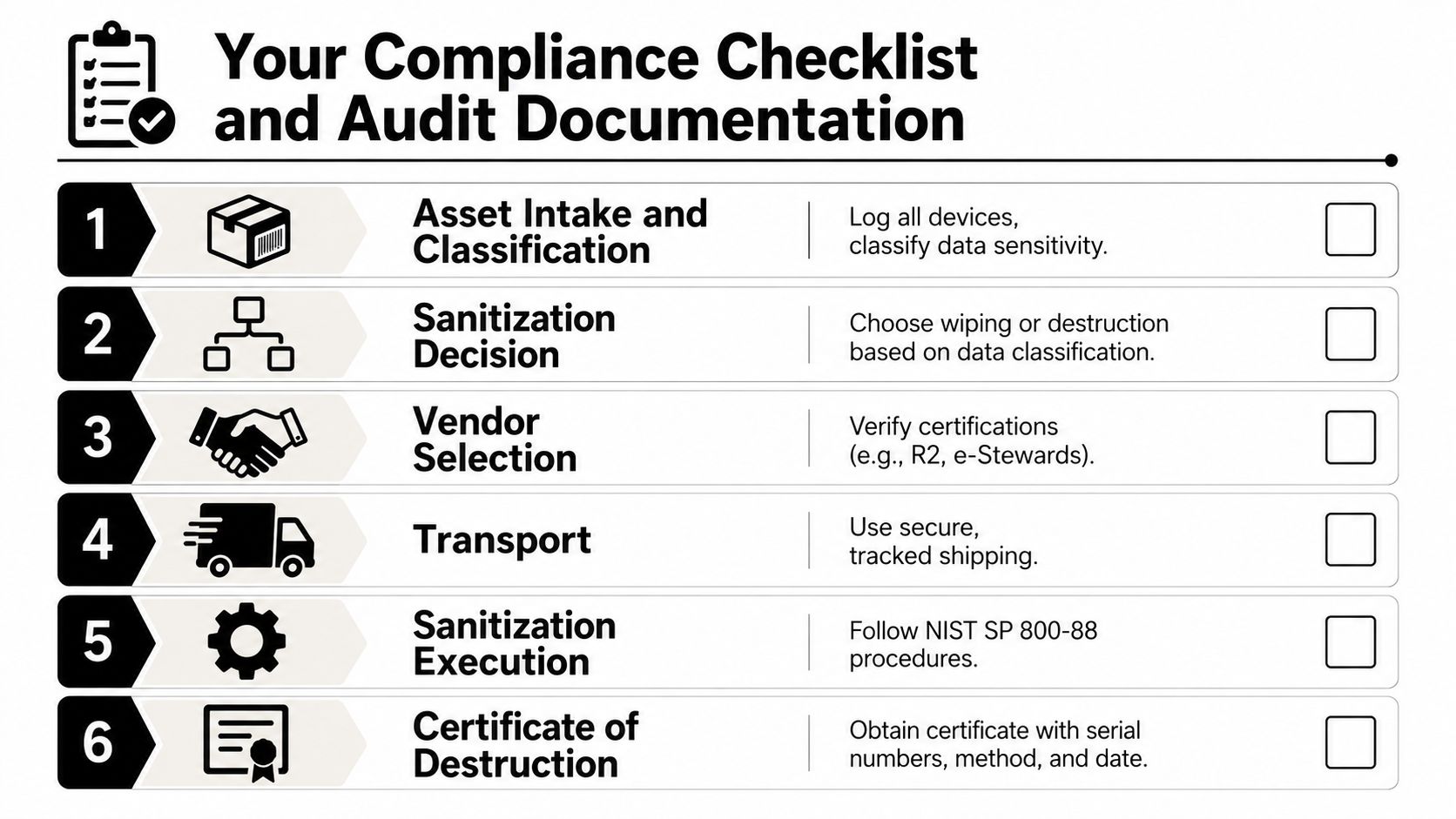
Lifecycle checklist
- Asset intake and classification: Record the asset tag, serial number, owner, location, storage media, and data sensitivity.
- Sanitization decision: Choose wiping, purging, clearing, destruction, or another approved treatment according to the media and information.
- Vendor selection: Review qualifications, certifications, insurance, security terms, subcontractor controls, and sample evidence.
- Transport: Document release, use sealed or controlled packaging, track movement, and confirm receipt.
- Sanitization execution: Record the method, operator, date, asset identifier, verification result, and any exception.
- Final disposition: Connect reuse, donation, resale, recycling, or destruction to the completed asset record.
ISO 27001-aligned disposal controls require an organization to verify that equipment is free of sensitive information before reuse or disposal and to retain supporting logs or an audit trail. NIST SP 800-88 Revision 2 addresses media sanitization and related verification considerations in its NIST SP 800-88 Revision 2 guidance. For audit-specific documentation requirements, use this audit documentation guide. Together, these records should show what happened to each relevant asset, rather than merely proving that a vendor was engaged.
Documents auditors can request
Keep a controlled file containing:
- Asset inventory: The starting population and each asset's current status.
- Sanitization logs: The method, date, operator, result, and media identifier.
- Certificates of destruction: Certificates indexed to serial numbers and the stated destruction method.
- Chain-of-custody records: Release, transport, intake, processing, and final disposition.
- Vendor agreements: Data protection, incident reporting, custody, subcontractor, and retention terms.
- Exception records: Failed drives, missing information, holds, investigations, and approvals.
- Retention schedules: Rules for keeping and disposing of business and personal data.
- Incident playbooks: Escalation procedures and breach notification decision paths.
An auditor will usually test whether the record is complete, consistent, and retrievable. A technically correct wipe can still create an audit problem if the organization cannot connect the result to the exact device, responsible person, approved policy, and final certificate.
Turning Compliance Into a Competitive Advantage
Compliance can reduce friction in procurement, strengthen customer confidence, and support sustainability goals when the organization treats it as an operating capability. Enterprise buyers often ask vendors how they handle ITAD, secure data destruction, chain of custody, and certificates of destruction before approving a relationship. A clear evidence package gives sales, procurement, security, and sustainability teams a shared answer.
The financial case is also concrete. IBM's 2025 Cost of a Data Breach Report found a global average breach cost of USD 4.44 million, while the U.S. average reached a record USD 10.22 million, up 9% year over year, according to the IBM 2025 Cost of a Data Breach Report. IBM also reported average detection-and-escalation costs of USD 1.47 million, nearly a 10% decrease from the prior year, which shows why faster response and documented controls matter economically.
A mature program doesn't default to shredding every device, and it doesn't donate equipment without proof of sanitization. It classifies assets, applies the right method, protects custody, and preserves evidence. That approach can reduce avoidable exposure while directing usable technology toward community programs and responsible material recovery.
Reworx Recycling helps businesses coordinate electronics recycling, secure data destruction, business pickups, equipment decommissioning, donation-based recycling, and IT asset disposition with documentation that supports audit readiness. Visit Reworx Recycling to learn how to donate old equipment, schedule a pickup, or discuss a retirement workflow aligned with your data security requirements.