
An office cleanout in Birmingham often starts with a practical problem: retired laptops and desktop towers are stacked in a storeroom, the replacement project is already underway, and nobody wants to sign off on disposal while sensitive company data remains on the drives. The equipment may look like waste, but it still represents information risk, recoverable value, compliance exposure, and a handling responsibility.
That's why computer recycling in Birmingham requires more than finding a drop-off point. Business owners, IT managers, and facilities teams need a controlled route for inventory, data destruction, collection, reuse, material recovery, and documentation. The right process keeps usable technology in circulation while ensuring end-of-life equipment doesn't enter an uncontrolled waste stream.
Navigating Computer Recycling in Birmingham for Business
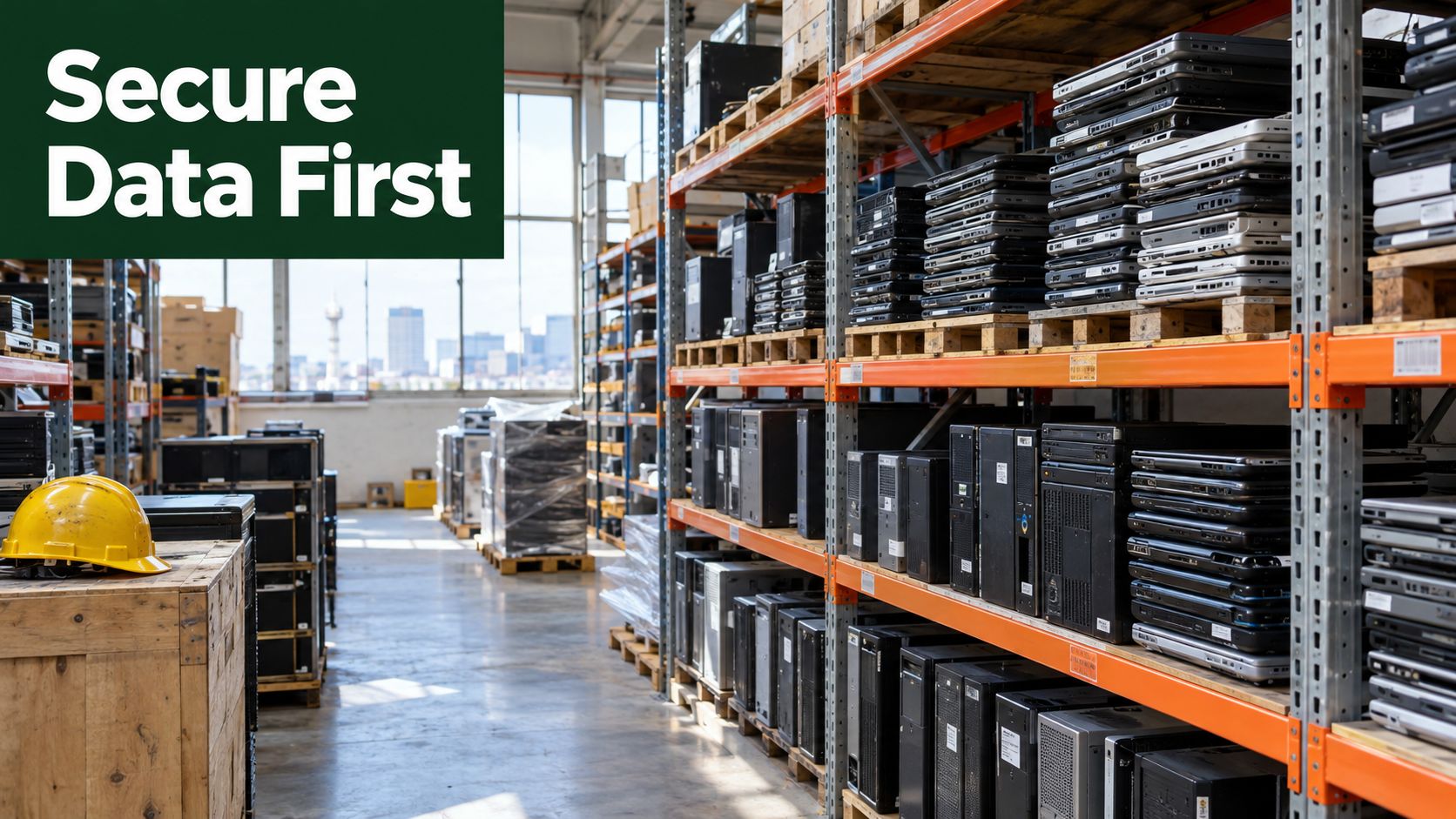
A warehouse full of retired equipment rarely arrives in a neat, ready-to-process condition. One pallet may contain laptops awaiting redeployment, desktops with storage drives, monitors that require separate handling, printers with residual documents, and boxes of cables with no clear owner. If those assets go out with general refuse, the organization loses control over both the equipment and the evidence needed to show how it was handled.
The operational mistake is treating IT equipment disposal as a simple removal job. For a Birmingham business, the disposal decision should account for data sensitivity, asset condition, ownership records, downstream processing, and audit documentation. A device that has no resale value can still contain confidential information. A device that appears obsolete may still be suitable for refurbishment, donation, or internal redeployment.
Birmingham's recycling history shows why sorting discipline matters. Public recycling efforts expanded after Earth Day in 1970, and an early ecologically motivated program used collection bins at sites including Vestavia Shopping Center. The program struggled when non-recyclable material was mixed into the bins, a problem that still has a direct equivalent in business electronics recycling. Mixed loads slow intake, complicate classification, and make it harder to identify data-bearing assets.
The local context for business e-waste
Birmingham has faced a broader diversion challenge. The city was estimated to divert only about 1% of solid waste from landfills to recycling programs by 2018, according to Birmingham's recycling history. The city later established a City Haul target to divert 25% or more of solid waste by 2031, a projection and policy goal described in the same source. In 2024, Recycle Birmingham added 5,100 blue wheeled bins, showing that local infrastructure is still being rebuilt around participation and cleaner sorting.
For businesses, the practical lesson is simple. Don't assume a mixed-waste pickup will produce strong recovery outcomes. Prepare IT assets separately, select a provider that can manage secure data destruction, and retain a documented trail from collection through final disposition.
Alabama electronics recycling for businesses can include organized pickups, equipment decommissioning, secure handling, and responsible recovery. Reworx Recycling is a donation-based social enterprise that works with organizations retiring electronics while supporting technology access and workforce development.
Preparing Your IT Assets for Secure Collection
A smooth pickup begins before a vehicle arrives. The collection team should receive an organized batch, not a mixed pile that requires the provider to determine what belongs in recycling, refurbishment, destruction, or a separate waste category.
Build the inventory before moving equipment
Start with a basic asset register. It can be a spreadsheet, an export from your IT asset management platform, or a physical count matched to existing labels. Record the device type, manufacturer, model, serial number, location, assigned user, and current condition. Note whether each item contains a hard disk drive, solid-state drive, removable media, or another storage component.
This inventory supports more than logistics. It gives the business a reference point for reconciling collected assets with certificates and internal records. If a laptop disappears between a storeroom and a loading bay, the problem is much easier to investigate when the organization has a pre-collection list.
Practical rule: Inventory first, disconnect second, pack third. A rushed cleanout reverses that order and creates avoidable uncertainty.
Separate data-bearing equipment from items such as keyboards, mice, docking stations, cables, and empty chassis. Keep monitors, printers, batteries, and televisions in distinct groups because acceptance criteria and charges can vary by item. Jefferson County's electronics program accepts computers, laptops, printers, scanners, fax machines, rechargeable batteries, security equipment, televisions, and monitors, while some televisions, CRT monitors, and certain printers may not qualify for free drop-off according to its electronics and hazardous materials guidance.
Control access and prepare the handover
Limit access to the storage area while the assets await collection. If devices came from departments handling patient, financial, legal, student, or customer information, record the department and sensitivity level. Remove accessories that aren't part of the disposition decision, but don't remove storage devices casually or leave them in an untracked box.
Data wiping and physical packing must follow the provider's documented process. If your internal policy requires an approved wipe before release, complete it and retain the relevant records. If the vendor performs secure data destruction, identify the storage-bearing assets clearly and confirm how the vendor will issue certificates.
Use sturdy containers, avoid overloading, and label each group by disposition category. Place the inventory, pickup confirmation, and any internal authorization with the shipment paperwork. That preparation reduces loading delays and lets the provider move directly into secure intake instead of performing a second sorting exercise at your expense.
Preparing your company's electronics for recycling offers a practical reference for organizing equipment before collection. The same discipline also supports office cleanout, facility cleanout, laboratory equipment disposal, and larger technology refreshes.
Determining Whether to Donate or Recycle Hardware
The environmentally responsible decision isn't always to recycle immediately. A functioning laptop may serve a student, nonprofit, community program, or another internal user. A failed drive, damaged motherboard, or unsupported device may be better suited to material recovery after secure data destruction.
The decision should combine technical condition, security requirements, reuse value, and handling cost. Donation can extend the useful life of equipment and support digital inclusion, but it demands a reliable data process and a clear standard for what the recipient receives. Recycling is appropriate for true end-of-life assets, but it shouldn't become a shortcut for avoiding basic refurbishment assessment.
Use the condition and risk together
A device with cosmetic wear and a healthy battery may be a strong refurbishment candidate. A newer laptop with a locked firmware configuration, missing ownership records, or an uncertain data history may require additional review before donation. A server can have material value even when it no longer fits the organization's production environment, but its storage devices remain a priority for controlled treatment.
| Asset Status | Primary Outcome | Key Consideration |
|---|---|---|
| Functional and supportable | Refurbishment, redeployment, or donation | Confirm data destruction, licensing, ownership, and recipient suitability |
| Functional but obsolete for internal use | Donation or resale assessment | Compare refurbishment effort with realistic reuse value |
| Damaged with recoverable components | Parts recovery or recycling | Separate storage media and document the disposition path |
| Failed, contaminated, or unsafe | Specialized recycling or product destruction | Confirm acceptance requirements before collection |
| Unknown condition or incomplete records | Quarantine and review | Don't mix it into a general load until ownership and data status are clear |
The Global E-waste Monitor reports that only 22.3% of global e-waste was formally collected and recycled in 2022 in its global e-waste findings. That figure supports a broader point, not a promise about one Birmingham program: keeping viable equipment in productive use can be more circular than sending it directly to a processor.
Donation still needs controls
Donation-based recycling works when the business separates social impact from informal handoff. Before releasing equipment, confirm that storage has been securely cleared or destroyed, the recipient can use the device, and the organization can document the transfer. Don't donate equipment just because recycling feels wasteful. A nonfunctional device creates transport, storage, and disposal work for the recipient.
For schools and small businesses, the best route may combine redeployment, donation, buyback evaluation, and recycling. Reworx's laptop donation service is one option for organizations that want to direct suitable equipment toward community use while routing end-of-life assets into secure recovery.
Arranging Professional Pickup and Data Destruction
Collection planning has two separate workstreams: moving the equipment and proving what happened to the data. Treating them as one task is how organizations end up with a signed pickup receipt but weak evidence that storage media was properly sanitized.
Begin with the batch profile. Count laptops, desktops, servers, monitors, printers, batteries, and unusual equipment separately. Some Birmingham-area providers set minimum quantities for premises collection. One provider states that free collection begins at 10 laptops, PCs, or servers in any combination, while charges may apply to some screens and printers, as described in its Birmingham computer recycling service information.
Schedule around the asset list
Give the provider a concise description of the load, access conditions, floor level, loading restrictions, parking arrangements, and whether the equipment is already palletized. Mention medical equipment, laboratory equipment, telecoms hardware, legacy media, batteries, and printers before booking. Those categories can require separate handling, and surprises at the loading point create delays or extra charges.
A professional pickup should include an agreed chain of custody. At minimum, the business should know:
- What leaves the site: Match serial numbers, asset tags, or batch identifiers to the collection record.
- Who receives it: Record the provider, driver or team, date, time, and collection location.
- Where data-bearing items go: Confirm whether drives are wiped, shredded, or processed through another controlled method.
- What documentation follows: Establish whether the provider issues certificates by device, batch, or disposition category.
- What exceptions apply: Clarify treatment for screens, printers, CRTs, batteries, and equipment that fails inspection.
Security control: A recycling certificate proves a disposition event. It doesn't automatically prove that every storage device was destroyed or sanitized. Request data-specific documentation.
Secure the storage media before recovery
Data-bearing items should be identified before recycling, resale, donation, or parts recovery begins. A provider may use software-based erasure, physical hard drive shredding, or another documented destruction method depending on the device and the customer's requirements. Solid-state storage requires particular care because conventional overwriting may not address every storage block in the same way as it does on a traditional hard disk.
One Birmingham service states that data is securely destroyed before recycling begins and offers an enhanced per-device audit trail for £5 ex. VAT, according to its service page. The amount is a quoted service price from that provider, not a universal Birmingham rate. The operational point is more important than the price: chain-of-custody evidence can strengthen an audit file even when physical recycling has already been completed.
Some services accept drop-off without collection, but data-bearing items still require separate handling and certificate issuance to support WEEE and GDPR expectations. Reworx's secure data destruction services can be considered when a business needs a documented route for storage media alongside its pickup or ITAD plan.
Meeting IT Asset Disposition Compliance Standards
Compliance in Birmingham starts with understanding what the rules do and don't say. Alabama doesn't have a dedicated statewide e-waste recycling law, but electronics remain subject to overlapping solid-waste and hazardous-waste requirements. A compliance overview notes that Alabama's Solid Wastes and Recyclable Materials Management Act sets a 40% waste-reduction and recycling goal and includes a $1-per-ton landfill disposal fee, as outlined in this Alabama electronics compliance guide.
That context doesn't turn every computer into hazardous waste, and it doesn't eliminate the need for due diligence. The organization remains responsible for choosing an appropriate channel, separating restricted items, protecting information, and retaining evidence that supports its disposal decision.
Distinguish recycling from reuse and recovery
The UK government's WEEE guidance sets separate recovery and recycling targets for IT and telecommunications equipment at 80% and 70%, respectively, as shown in the WEEE evidence and national protocols guidance. Those targets illustrate why the word “recycling” needs precision. Material recovery, reuse, refurbishment, and secure end-of-life treatment are related but different outcomes.
Birmingham's local performance also matters when organizations plan collection campaigns. Birmingham City Council was reported at 20.3% household waste recycling in 2024/25, placing it among the lowest-performing councils in England in the UK local-authority waste results. That household figure isn't a direct measure of a company's IT program, but it reinforces the need for businesses to manage segregation and vendor controls rather than relying on general local diversion performance.
Keep the audit file useful
A defensible IT asset disposition record should connect the business authorization to the final outcome. Keep the asset inventory, internal approval, collection receipt, chain-of-custody record, data destruction certificate, recycling or reuse certificate, and exception log together.
Alabama hazardous-waste guidance also says household waste is exempt from hazardous-waste regulation in the state, while warning that municipal landfill disposal is acceptable only for certain electronic equipment and that many landfills no longer accept CRTs or other electronic devices, according to ADEM's CRT guidance. Businesses shouldn't infer from the household exemption that office equipment can be placed in general refuse.
A written ITAD standard should cover laptops, desktops, servers, storage devices, displays, printers, batteries, network hardware, medical equipment disposal, and laboratory equipment disposal. Reworx's e-waste certification standards can serve as a reference point when evaluating the documentation and downstream controls a provider offers.
Partnering with Reworx for Sustainable Business Growth
A reliable computer recycling program gives the IT manager more than an empty storeroom. It creates a repeatable disposition path that protects information, reduces unmanaged equipment, supports sustainability reporting, and gives facilities teams clear instructions for the next refresh cycle.
That path should accommodate more than standard desktops and laptops. Businesses may need laptop disposal, data center decommissioning, office cleanout, facility cleanout, product destruction, medical equipment disposal, and laboratory equipment disposal within the same broader ITAD framework. The provider should help classify the load rather than treating every item as identical.
Build a program instead of booking isolated removals
A useful business process includes a recurring inventory review, an approved disposition policy, a secure storage location, a collection threshold, and a document retention routine. It can also include corporate donation programs for equipment that remains suitable for productive use. That approach connects sustainable recycling with practical asset management instead of separating environmental goals from security controls.
Reworx Recycling operates as a donation-based electronics recycling and IT equipment disposal social enterprise. Its service model includes business pickups, equipment decommissioning, IT asset management, recycling consultations, secure hard drive shredding with data destruction, equipment buyback options, and support for office recycling programs and ITAD initiatives. Its community focus includes technology donations, digital inclusion, and workforce development.
Measure the outcome your stakeholders care about
Sustainability leaders need evidence that equipment moved through an accountable route. IT managers need confirmation that storage media was handled correctly. Finance teams may want value recovery from surplus hardware, while community partners may benefit from usable devices.
Those needs can coexist when the organization separates assets early and assigns each category a documented outcome. Reuse should be considered before recycling where the device is suitable. Recycling should be reserved for equipment that has reached end of life or cannot be responsibly redeployed. Data destruction should remain a control across both paths.
Birmingham businesses can turn an overdue equipment pile into a controlled program by starting with an inventory, isolating data-bearing assets, and requesting a clear collection and certification plan. Reworx Recycling offers business pickups, secure data destruction, donation pathways, and responsible electronics recycling for organizations that want to reduce disposal risk while supporting community access to technology.
Visit Reworx Recycling to discuss a Birmingham business pickup, old equipment donation, secure data destruction, or a broader ITAD plan. Share your asset categories and collection requirements so Reworx can help you choose the right route for laptops, computers, servers, peripherals, and end-of-life electronics.