A lot of businesses reach the same moment at once. The warehouse has obsolete inventory. The marketing team has outdated branded materials. IT has pallets of retired laptops, failed drives, and networking gear waiting for an office cleanout. Operations wants the space back, finance wants the write-off documented, and legal wants proof that none of it can come back to haunt the company.
That’s where a product destruction service stops being a disposal line item and becomes a business control.
Handled well, destruction protects your brand, closes off data exposure, supports IT asset disposition (ITAD), and keeps electronics recycling aligned with sustainability goals. Handled poorly, the same materials can leak into the gray market, expose sensitive data, or create audit headaches months after everyone thought the project was finished.
Why Product Destruction Is a Critical Business Process
A common trigger is simple: products and equipment pile up faster than the business can make a clean decision.
A manufacturer may have recalled units sitting in storage. A hospital network may be replacing workstations and medical-adjacent devices across several facilities. A corporate office may be dealing with an office cleanout that includes branded signage, old access devices, laptops, servers, and printed materials. None of that is harmless because it’s no longer useful.

Liability starts before the truck leaves
Once an item is obsolete, recalled, defective, or retired, the business still owns the risk.
That risk shows up in several ways:
- Brand exposure: Defective or outdated goods can resurface in secondary channels.
- IP loss: Prototypes, engineering samples, and embedded electronics can reveal design choices or firmware.
- Data exposure: Storage media inside ordinary office equipment can contain more information than teams expect.
- Environmental liability: Electronics, batteries, and mixed materials require controlled downstream handling.
A lot of managers treat destruction as the last step in a cleanup. In practice, it should be planned earlier, alongside legal review, ITAD policy, and sustainability reporting.
Destruction is growing because the stakes are growing
The market is moving in that direction. The global Secure Product Destruction and Disposal Services market was valued at USD 437 million in 2024 and is projected to reach USD 698 million by 2031, with a 6.9% CAGR according to Intel Market Research’s secure destruction and disposal services analysis.
That growth lines up with what business managers feel on the ground. More regulations. More scrutiny over chain of custody. More pressure to keep retired assets out of landfills and unauthorized resale channels.
Practical rule: If an item could damage your brand, expose data, or create compliance questions after disposal, it should move through a controlled destruction workflow, not a general waste stream.
The biggest mistake is assuming disposal and destruction are the same thing. They aren’t. Disposal removes material from your site. Destruction removes the risk tied to that material.
For electronics recycling programs especially, that difference matters. Businesses planning laptop disposal, facility cleanout work, or data center decommissioning should also understand the environmental and legal impacts of improper commercial e-waste disposal. The business issue isn’t clutter. It’s uncontrolled downstream exposure.
What Exactly Is a Product Destruction Service
A product destruction service is a managed process that makes products, components, materials, or media unusable, unrecoverable, and auditable.
That’s different from trash hauling. It’s also different from standard recycling pickup.
What the service includes
At a professional level, the job includes several controls working together:
Inventory identification
The provider and client identify what’s being destroyed. That may include hard drives, laptops, SSDs, branded merchandise, prototypes, uniforms, packaging, expired stock, or mixed electronics from a facility cleanout.Secure handling
Materials are segregated, containerized, labeled, and controlled before movement.Approved destruction method
The method has to match the risk. Shredding fits many electronics and media assets. Crushing may work for some devices or components. Incineration is reserved for pharmaceuticals, hazardous materials, or goods that require thermal destruction.Documented chain of custody
Every transfer matters. Someone received it, someone moved it, someone witnessed it, and someone recorded the outcome.Final proof
The client receives records showing what was destroyed, when, and through what process.
What it is not
A lot of businesses blur the line between these categories:
| Activity | What it does | What it doesn’t do |
|---|---|---|
| General disposal | Removes unwanted material | Doesn’t prove irreversible destruction |
| Standard recycling | Recovers material value | Doesn’t always address sensitive data or brand risk |
| In-house office shredding | Handles light paper volume | Doesn’t scale well for bulk electronics or auditable destruction |
| Product destruction service | Creates controlled, irreversible destruction with documentation | Doesn’t replace asset planning upstream |
The word certified matters here, but not as a buzzword. It matters because legal, compliance, and IT teams need a process they can defend later.
Why businesses buy this service
Most managers don’t buy product destruction because they enjoy being cautious. They buy it because weak disposal controls create messy consequences.
A disciplined destruction program is triggered by one of these events:
- Technology refreshes: Retired endpoints, drives, servers, and storage arrays need secure data destruction.
- Product recalls or quality failures: Unsellable goods must be removed permanently.
- Rebranding: Old uniforms, printed collateral, packaging, and signage can’t drift back into circulation.
- Lab or facility closures: Specialized equipment needs careful handling, not a hurried dumpster solution.
- Donation triage: Some equipment should be reused. Other equipment must be destroyed because reuse would create data, safety, or compliance risk.
The strongest programs separate assets into three paths: reuse, recycling, and destruction. Trouble starts when everything gets pushed into one pile.
That distinction is important in donation-based recycling and broader social enterprise recycling models. Not every asset should be destroyed. Some hardware still has reuse value through corporate donation programs or redeployment. But once an asset fails the reuse test, the destruction process has to be final and documented.
The practical test is simple. If your general recycler can’t explain how they prevent reuse, prove destruction, and document custody, you don’t have a product destruction service. You have a pickup vendor.
Key Product Destruction Methods Explained
The method matters because destruction is a control decision, not a disposal step. Choose the wrong process and you can create three avoidable problems at once: residual data risk, weak compliance evidence, and unnecessary loss of reusable or recyclable material.
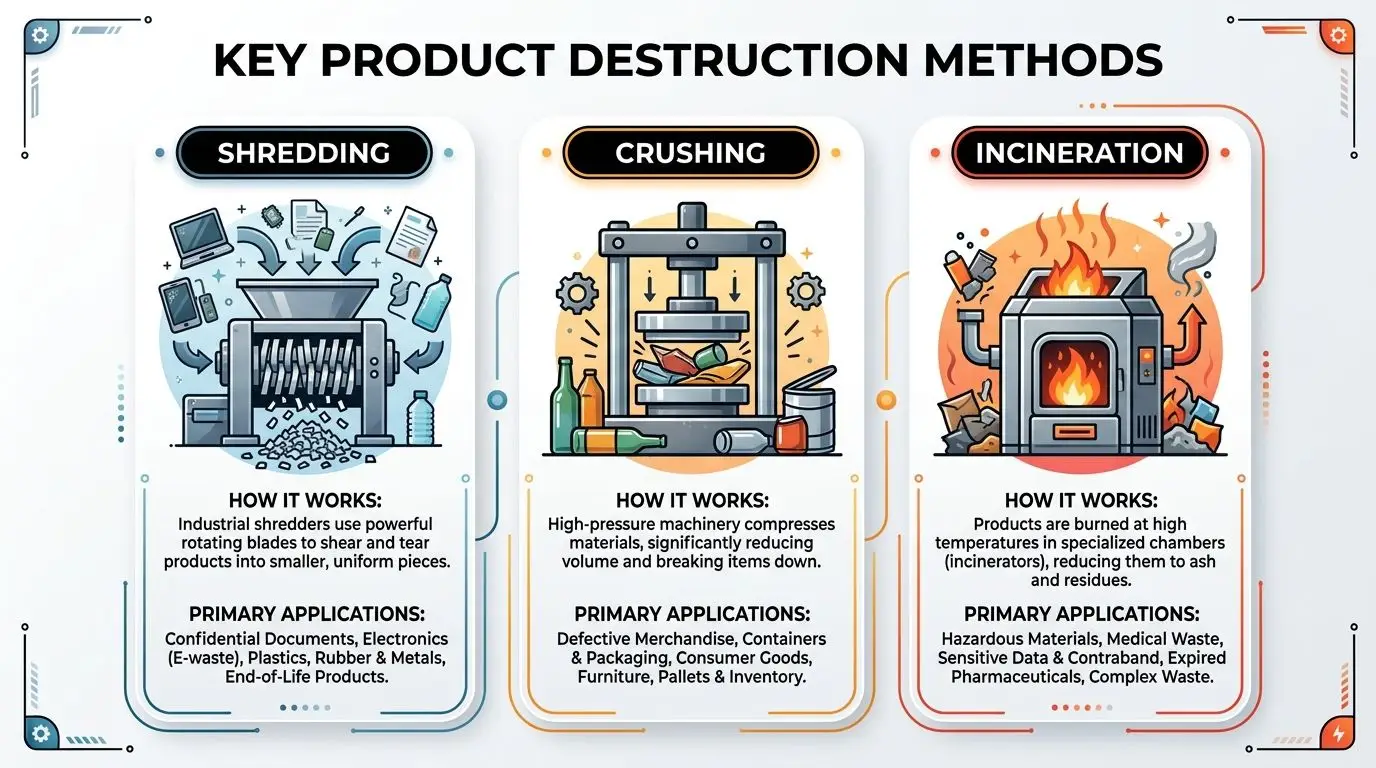
A sound program starts with a simple question. Is the main risk data exposure, brand diversion, product misuse, safety, or contamination? The answer determines whether you should shred, crush, or send material through a permitted thermal process. It also determines whether destruction is even the right outcome, because some assets belong in reuse or donation channels first. That is where an experienced social enterprise partner can add value. They can separate recoverable assets from true destruction candidates instead of treating every pallet as waste.
Shredding
For electronics, shredding is the most practical high-security method.
Industrial shredding breaks devices and media into fragments that cannot be reconstructed. For sensitive electronics, industrial shredding can reduce materials to particles smaller than 2mm x 2mm x 0.5mm, exceeding NIST SP 800-88 guidance for high-security media sanitization.
Shredding is used for:
- retired hard drives
- SSDs
- backup media
- embedded storage modules
- prototype electronics
- branded devices during IT equipment disposal
This method works best when the item itself presents the risk. That includes storage media, failed devices, electronics with firmware, and products that contain confidential engineering or design information. It also works well for large office cleanouts and data center decommissioning because it handles volume efficiently.
The trade-off is permanent loss of reuse value. If a laptop, server, or peripheral can still be redeployed, refurbished, or donated safely, shredding destroys that option. Good operators screen assets before they shred them. That is one reason businesses planning a project should review the methods for destroying old equipment before approving scope, especially when ESG goals matter alongside security.
Crushing
Crushing uses mechanical force to deform or break an item so it cannot function as intended.
This approach is used for:
- hard drives slated for physical deformation before downstream processing
- mobile devices
- branded goods
- certain product samples
- small-volume destruction where immediate disablement matters more than material separation
Crushing is useful when you need fast disablement and visible physical damage. I see it used frequently for hard drives that need to be rendered inoperable on-site before transport, or for branded goods that cannot re-enter the market intact.
Its limitation is consistency. Crushing may disable a device, but it does not consistently produce the same final condition as fine shredding. For some media types and compliance standards, visible damage is not enough. Confirm whether crushing alone satisfies your destruction requirement for that asset class, or whether it should be followed by shredding or another downstream step.
Incineration
Incineration is a specialized method for materials that cannot be safely reused, conventionally recycled, or mechanically processed.
It is used for pharmaceuticals, hazardous materials, contaminated goods, and products that present chemical or biological risk. It can also be the right choice when regulations call for documented thermal destruction through a permitted facility.
Where incineration makes sense
Incineration is appropriate when:
- the product is hazardous
- the contents cannot be safely landfilled or conventionally recycled
- regulations require documented destruction through a permitted thermal process
- the material presents contamination or diversion risk
The trade-off is straightforward. Incineration is not a default answer for ordinary electronics or standard branded goods. It can solve the wrong problem at a high cost if the actual objective was data security, material recovery, or controlled brand protection.
Comparison of Product Destruction Methods
| Method | Best For | Security Level | Environmental Impact | Key Benefit |
|---|---|---|---|---|
| Shredding | Hard drives, SSDs, laptops, servers, branded electronics | High | Supports downstream material recovery when processed through recycling channels | Irreversible destruction for sensitive electronics |
| Crushing | Drives, mobile devices, selected branded goods | Moderate to high, depending on asset and follow-up process | Varies by material handling after deformation | Fast physical disablement |
| Incineration | Pharmaceuticals, hazardous materials, contaminated products | High for appropriate regulated materials | Can reduce volume sharply and support waste-to-energy, but not suitable for standard reuse paths | Destroys materials that cannot be safely recycled conventionally |
What works in practice: Match the method to the risk. A provider that pushes one method for every item is optimizing its own workflow, not your security, compliance position, or sustainability outcomes.
What businesses often get wrong
The most common mistake is selecting the cheapest visible action instead of the most defensible method.
A few examples:
- Small office shredders do not solve bulk device retirement.
- Breaking screens with a hammer does nothing for internal storage.
- Sending mixed electronics straight to scrap skips asset triage, data-bearing components, and custody controls.
- Destroying everything by default eliminates reuse and donation paths that could support sustainability targets and community impact.
Strong destruction programs make a deliberate sort before anything is processed. Reuse, recycling, and destruction each have a place. The operational advantage of working with a social enterprise partner such as Reworx is that the sort is part of the value. Usable equipment can be directed into responsible reuse channels, while higher-risk assets move into documented destruction with the right method for the actual risk.
Ensuring Data Security and Regulatory Compliance
For most organizations, the hardest product destruction questions aren’t about pallets of obsolete goods. They’re about data-bearing devices.
An old laptop doesn’t look dangerous. A retired copier doesn’t look dangerous. A failed server drive in a box of e-waste doesn’t look dangerous either. But for compliance teams, those items can be the highest-risk materials in the building.
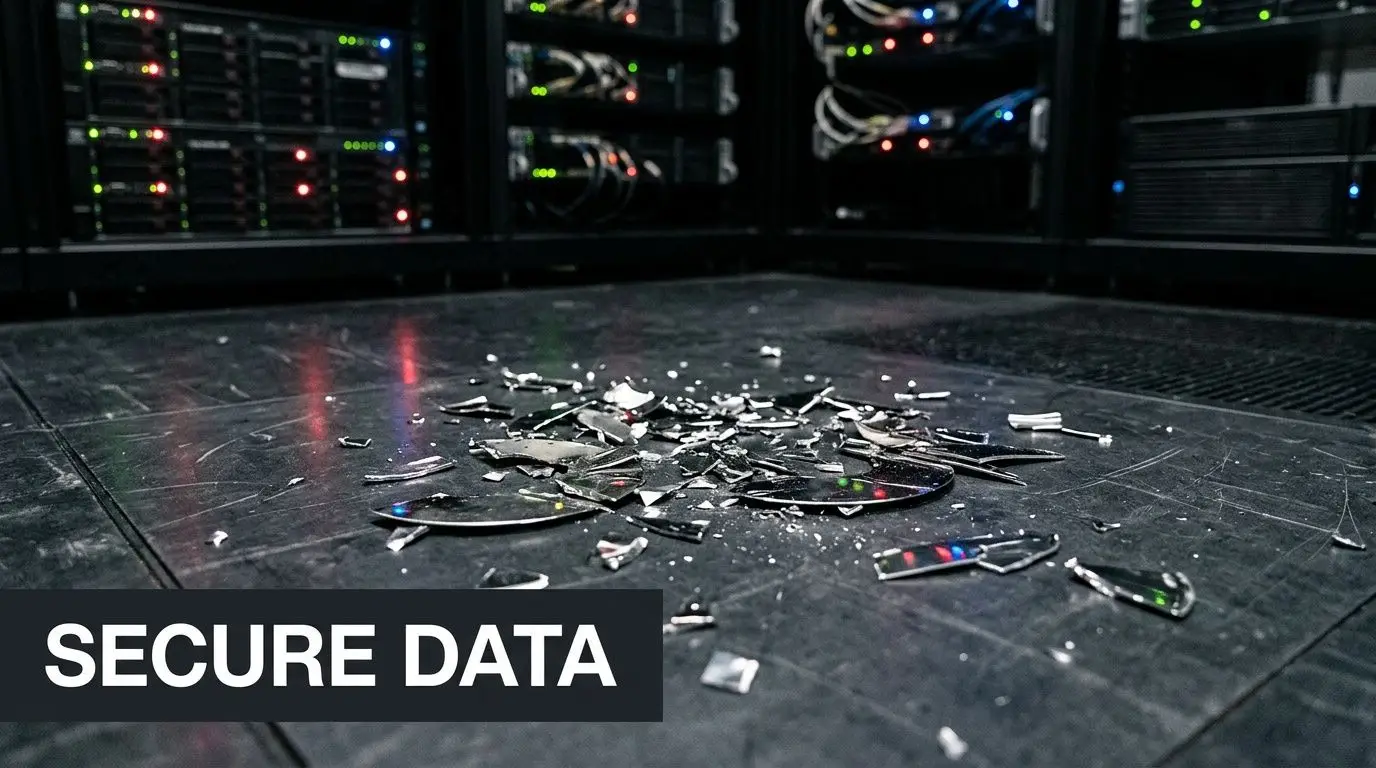
Why physical destruction still matters in a digital business
Cloud adoption didn’t remove the need for physical media destruction. It increased it.
Organizations cycle through endpoint devices, backup systems, network storage, failed media, and embedded storage in office equipment. That’s one reason the global Hard Drive Destruction Service market was valued at USD 1.65 billion in 2024 and is forecasted to reach USD 5.05 billion by 2035, with a 10.7% CAGR, according to Spherical Insights’ hard drive destruction market analysis.
The point for business managers is straightforward. Product destruction and cybersecurity aren’t separate conversations when devices are involved.
Regulations don’t care that the device was “old”
If your business handles personal, financial, health, student, or employee data, retired equipment can trigger the same compliance obligations as live systems.
Examples include:
- HIPAA for covered healthcare information
- CCPA for California consumer data obligations
- GDPR for organizations handling EU personal data
- internal retention and destruction policies tied to legal hold, audit, or security frameworks
A secure destruction process helps demonstrate that the organization didn’t abandon control at end of life. That matters during audits, investigations, internal reviews, and contract disputes.
NIST language matters for IT managers
When security teams discuss end-of-life media handling, they frequently want to hear one thing: whether the destruction method is aligned with recognized sanitization standards.
That’s why NIST SP 800-88 keeps showing up in ITAD and secure data destruction conversations. It gives organizations a language for evaluating whether media sanitization is logical, physical, or both, and whether the chosen action fits the sensitivity of the asset.
For high-risk media, physical destruction can be the cleanest path to certainty.
If a provider talks generally about “wiping drives” but can’t explain how they handle failed drives, SSDs, and embedded flash storage, the program has a gap.
Compliance depends on the process, not the machine
A shredder alone doesn’t create compliance.
The full process has to answer these questions:
- Who identified the asset?
- Was the data-bearing component removed or verified?
- Who maintained custody before destruction?
- Was destruction witnessed or otherwise documented?
- Can the organization produce records later?
That’s where certified workflows matter. A company like Reworx Recycling offers secure hard drive shredding, on-site options, and IT asset disposition support within a broader electronics recycling process. For managers evaluating vendor controls, it helps to understand what NAID AAA certification is intended to verify in secure data destruction environments.
The practical compliance view
From a practitioner’s standpoint, secure data destruction works best when it’s built into every refresh and decommissioning cycle.
That means:
- laptop disposal isn’t treated as a facilities errand
- data center decommissioning includes media control from the start
- copier and printer retirement includes drive review
- office and facility cleanout projects are screened for hidden storage devices
- sustainability goals don’t override security requirements
Businesses get into trouble when they run these as separate projects. Facilities clears space. IT comes in later. Legal asks for proof after the fact. The clean version is one controlled workflow.
Logistics and Documentation The Proof of Destruction
A common failure point looks like this. Operations clears out obsolete inventory, IT assumes disposal is being handled, and a vendor truck leaves with mixed material that no one can fully account for two weeks later. The destruction itself may have been real, but from a risk and compliance standpoint, the business has a problem.
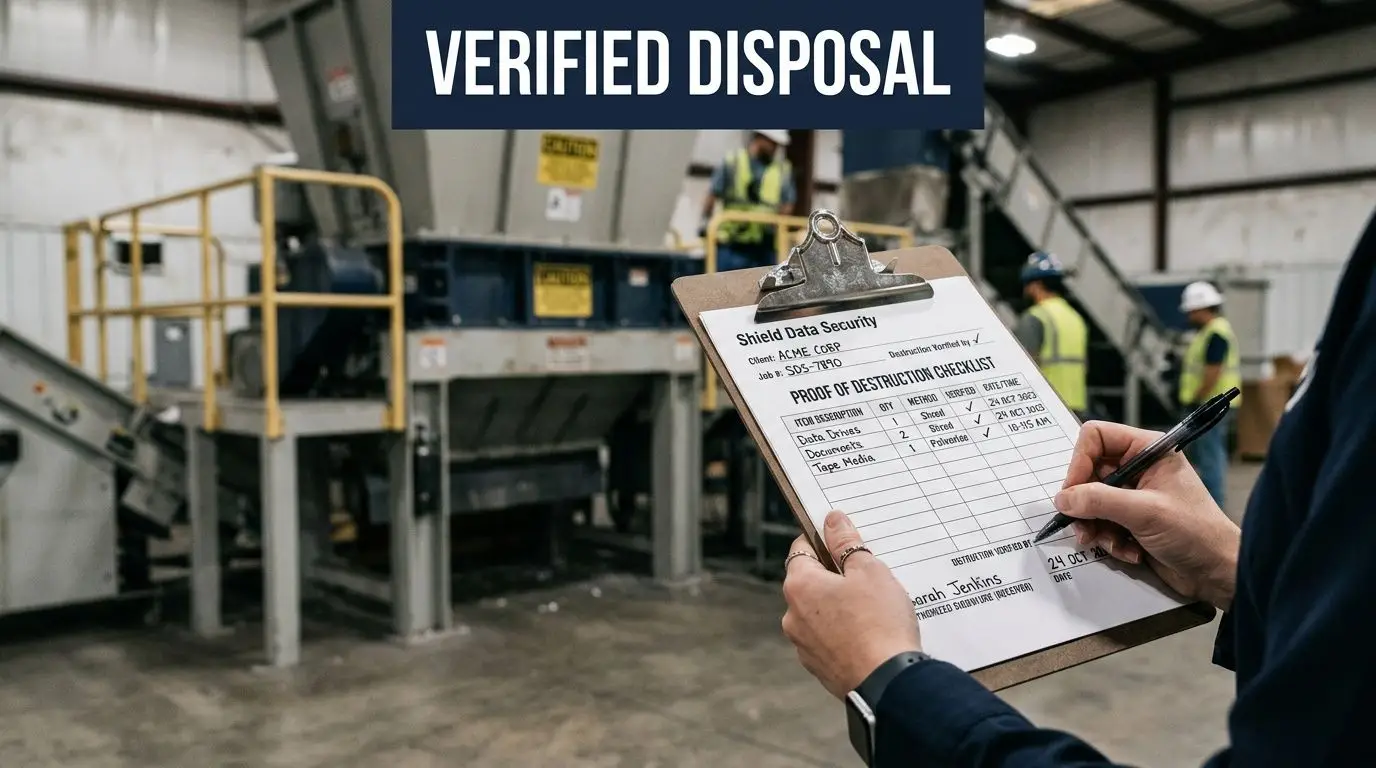
Strong product destruction programs are built on logistics discipline and defensible records. That matters for audit readiness, legal review, insurance questions, and ESG reporting. It matters if your organization needs to prove that branded goods, recalled products, data-bearing equipment, or regulated materials were removed from circulation in a controlled way.
On-site versus off-site
The first decision is location. Destruction can happen at your site or at the provider’s facility, and each option carries trade-offs.
On-site destruction gives immediate visibility and tighter control at the point of disposition. It works well for sensitive media, high-value branded goods, or projects where internal stakeholders want to witness the process and sign off before anything leaves the property.
Off-site destruction can make more operational sense for larger volumes or mixed loads. A qualified facility may have better equipment for sorting, shredding, material segregation, and downstream recycling. That can improve efficiency and recovery outcomes, but only if custody controls remain intact during transport.
The right answer depends on exposure, not preference.
Chain of custody is what makes proof credible
Managers frequently ask for proof of destruction as if it starts with the final certificate. In practice, proof starts at pickup.
A defensible chain of custody includes:
- Scope definition: which items are approved for destruction, and which are excluded
- Packaging and containment: sealed bins, labeled pallets, locked containers, or serialized transport units
- Pickup documentation: date, site, quantities, and the personnel releasing and receiving the material
- Transfer records: each custody change logged clearly enough to reconstruct the movement later
- Final processing records: the destruction method used, where it occurred, and when it was completed
If any of those steps are weak, the paperwork at the end carries less weight. I have seen organizations discover this too late, typically when legal, procurement, or an auditor asks for more than a one-page certificate.
Documentation supports compliance and business decisions
The Certificate of Destruction is the closing record, not the whole control system. It should support internal governance, customer commitments, and liability transfer. It should be detailed enough to stand up months later, after the project team has moved on.
Good documentation lets your business answer specific questions without reconstructing the event from emails and vendor invoices:
- What exactly was destroyed?
- When and where did destruction occur?
- Was the work performed on-site or off-site?
- Which destruction method was used?
- Who had custody before final destruction?
- What record should audit, legal, or security teams reference later?
For data-bearing assets, a formal certificate of destruction for hard drives can be part of the control package because the disposal record may need to satisfy both security and compliance review.
Regulated loads require tighter operational records
Pharmaceuticals, hazardous materials, recalled products, and controlled branded goods typically need more than a generic destruction receipt. The provider should be able to document accepted materials, handling conditions, final disposition, and any environmental controls tied to the process.
Thermal destruction projects are a good example. They are tightly managed because the method, acceptance criteria, permitting, and downstream records all affect compliance exposure. In those cases, logistics and documentation are inseparable from the destruction method itself.
There is a strategic layer that many businesses miss. A well-run destruction program does more than reduce legal and brand risk. It helps the company show disciplined governance, responsible material handling, and measurable diversion from landfill where reuse or recycling is possible. A social enterprise partner such as Reworx can add value here by combining secure destruction controls with reporting that supports broader ESG and community impact goals.
If a provider can describe trucks, containers, and shredders in detail but cannot explain the custody trail or the final records package, the service is incomplete.
How to Choose the Right Product Destruction Partner
Price matters. It is not the first filter.
The better way to choose a product destruction service is to ask whether the provider can remove risk in a way your legal, IT, sustainability, and operations teams can all live with.
Start with the questions most vendors hope you won’t ask
A strong screening call should cover topics like these:
What destruction methods do you use for specific asset classes?
Ask separately about hard drives, SSDs, laptops, branded goods, hazardous materials, and mixed electronics.How do you document chain of custody?
Listen for specifics. Pickup logs, sealed containers, witnessed handling, serialized reporting, and final documentation all matter.Which items are eligible for reuse, and which are forced into destruction?
A capable provider knows the difference between donation, refurbishment, electronics recycling, and destruction.What certifications or audited controls support your process?
If they answer in vague marketing language, keep pushing.How do you handle cross-border or multi-jurisdiction compliance issues?
This matters more than many SMBs realize.
International compliance is where weak vendors get exposed
A lot of providers can talk about general EPA or state-level handling. Fewer can explain what happens when the organization has customers, employees, or devices tied to multiple jurisdictions.
That gap matters. According to All Points’ discussion of product destruction compliance gaps, many providers fail to detail how they handle GDPR or emerging U.S. e-waste requirements, even while 68% of global e-waste crosses borders informally, creating exposure that can include fines of up to 4% of revenue.
That doesn’t mean every client needs a global legal memo. It does mean your vendor should be able to explain their compliance roadmap if your organization handles multinational devices, regulated data, or public sector assets.
The right partner doesn’t just destroy material. They explain the control environment around that destruction in plain language.
ESG value comes from judgment, not slogans
A provider’s environmental claims only matter if they can sort assets intelligently.
That means asking:
- Can usable devices move into donation-based recycling or legitimate reuse channels?
- Can non-reusable equipment enter responsible electronics recycling streams?
- Can destroyed materials be processed for commodity recovery where appropriate?
- Can the provider support your reporting around sustainable recycling and community impact?
Business managers should look beyond commodity disposal vendors. A social enterprise model can support both security and mission goals when it has operational discipline behind it.
For example, organizations comparing partners may review factors such as pickup logistics, secure data handling, reporting, and downstream accountability through resources like this guide to factors choosing ewaste recycling partner. The best fit is the provider that can separate assets into reuse, recycling, and destruction without compromising compliance.
Frequently Asked Questions About Product Destruction
Can we handle product destruction in-house?
Sometimes for low-risk materials, yes. For regulated, branded, or data-bearing items, that is a poor choice.
In-house destruction tends to break down in three places: scale, documentation, and consistency. A team might physically damage some items, but fail to produce an auditable chain of custody or prove that destruction was complete.
What’s the difference between electronics recycling and product destruction?
They overlap, but they aren’t the same thing.
Electronics recycling focuses on responsible material handling, recovery, and downstream processing. Product destruction focuses on making an item unusable and unrecoverable for business, legal, brand, or data reasons.
A mature ITAD program uses both. Usable equipment may go to redeployment, resale, or corporate donation programs. Non-usable but non-sensitive equipment may go into computer recycling. Sensitive or restricted assets go through secure data destruction or full physical destruction.
Does every retired device need to be shredded?
No.
That’s a common misconception. Some assets have reuse value, and destroying them too early wipes out recovery and donation opportunities. The decision should depend on the condition of the asset, the presence of regulated data, the sanitization requirement, and the organization’s policy.
If a device can’t be safely sanitized, tracked, or reused within policy, destruction becomes the cleaner answer.
What happens to material after destruction?
That depends on the material and the method.
For electronics, shredded output can move into downstream recovery streams for metals and other commodities. For hazardous or regulated materials, downstream handling may involve ash management, specialized waste processing, or other controlled channels.
The important question isn’t “Is it destroyed?” It’s “What happens next, and can the provider document it?”
How is pricing usually determined?
Pricing reflects the mix of materials, handling requirements, pickup logistics, destruction method, and documentation needs.
A straightforward batch of retired laptops for scheduled pickup is a different project from witnessed on-site shredding, laboratory equipment disposal, or mixed hazardous product destruction. Costs shift when the provider has to sort reusable assets from non-reusable ones, support data center decommissioning, or coordinate across multiple facilities.
Is witnessed destruction worth it?
Frequently, yes.
If the materials involve regulated data, public sector oversight, legal sensitivity, or executive concern about transit exposure, witnessed on-site destruction can simplify internal signoff. It gives stakeholders immediate confidence that the risk has been closed.
For lower-risk or high-volume material, off-site plant destruction may be appropriate if the chain of custody and reporting are solid.
What should we do before scheduling a service?
Get organized before pickup day.
A simple prep list helps:
- Separate asset types: Don’t mix laptops, loose drives, monitors, batteries, and general junk if you can avoid it.
- Flag sensitive items: Label any media, regulated products, or branded materials that need special handling.
- Identify reuse candidates: Some equipment may belong in donation-based recycling instead of destruction.
- Confirm internal owners: IT, compliance, facilities, and finance should all know who signs off.
- Ask for documentation upfront: Don’t wait until after the project to ask what records you’ll receive.
The cleanest projects start with an asset decision tree, not a loading dock scramble.
If your business is planning an office cleanout, laptop disposal project, secure data destruction event, or broader IT equipment disposal effort, Reworx Recycling can be part of that evaluation. Review their recycling resources, schedule a pickup, or explore how donation-based electronics recycling and certified destruction can support both compliance and community impact.