You've got a pallet of retired laptops, two printers nobody wants to plug in again, and a server rack that needs to leave the building before the next refresh cycle. In Cheney, the problem usually isn't finding a place that takes electronics, it's finding a window that matches how business works. The city's Cheney Recycling Center is a real municipal drop-off site, but for IT managers, facilities leads, and sustainability teams, that doesn't automatically solve the timing, security, or reporting side of the job.
The facility sits at 100 Anderson Road and has been part of Cheney's waste system since 1994. City documents describe it as open to the public on a limited schedule, with one city study listing 15 hours each week and another report describing 21 hours per week of access, which is enough for routine household loads but rarely enough for a coordinated office cleanout. The site processes about 550 to 600 tons of recyclable material annually, and the city's study says it has substantial excess capacity, which tells you two things at once, the center is established, and it's built for local throughput, not concierge-level handling. That's where planning matters, and where a partner such as Reworx Recycling fits when the load is bigger than the public window.
A practical way to start is to treat Cheney's drop-off center like a useful municipal option, not a catch-all. If you're consolidating gear for an office move, a lab closeout, or a rolling hardware refresh, it helps to understand what the city will take, what it only takes during special events, and what belongs with a secure ITAD provider instead. If you want a reminder of the kind of prep that makes any move easier, how to declutter before moving is a solid framework, even if your “move” is really just an end-of-life equipment pull.
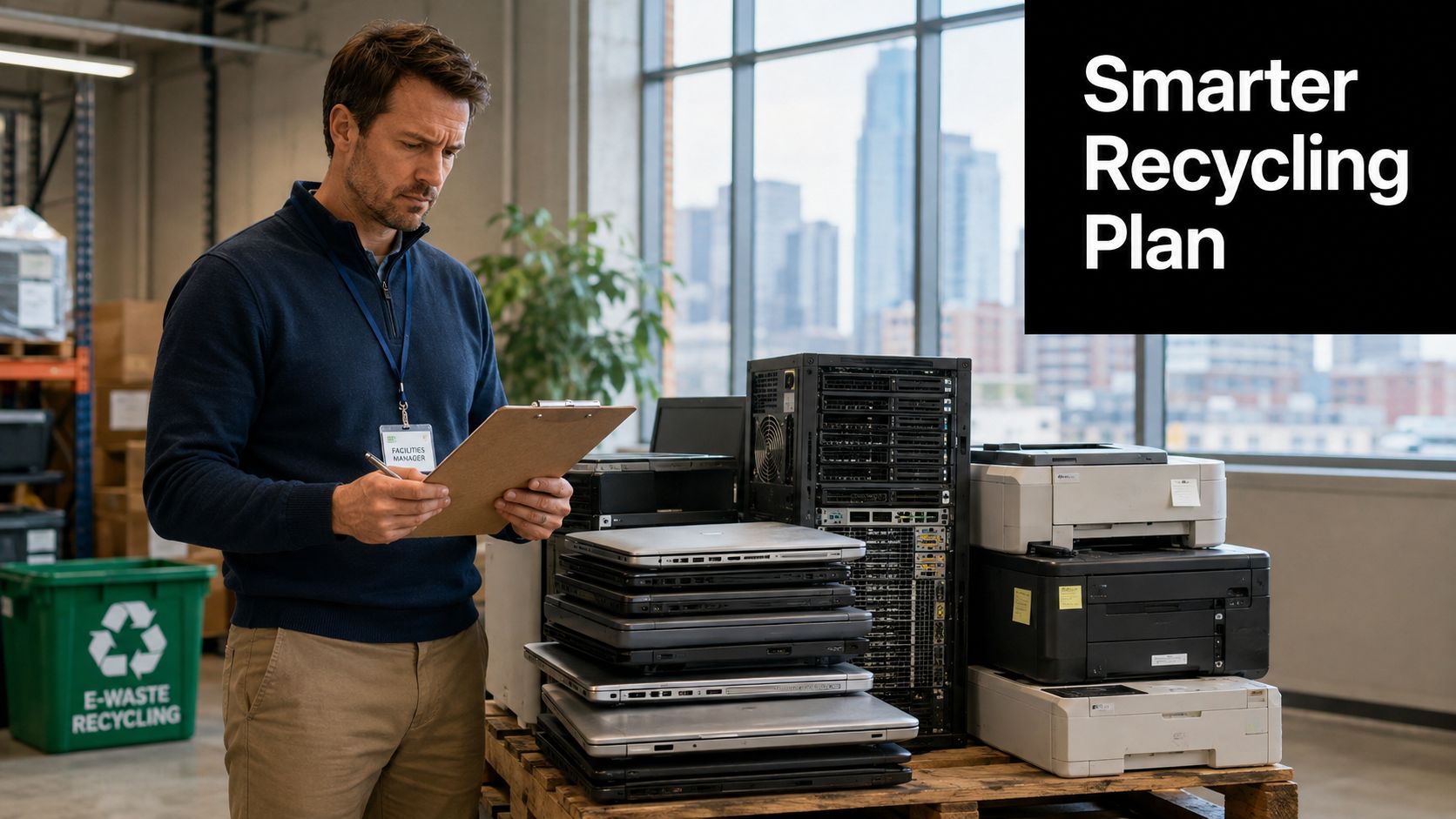
Why Cheney Businesses Need a Smarter Recycling Plan
A lot of Cheney teams run into the same mismatch. The laptops are ready to leave, the printer closet is already full, and the server room refresh is tied to a vendor schedule, but the public recycling window doesn't line up with any of it. Cheney's recycling center is a municipal drop-off facility, not a private hauler, so the expectation is simple, arrive, unload, sort, and go. That works for a household cleanup. It's much less forgiving for a business that has a truck, a time window, and a chain-of-custody record to protect.
Why the timing gap matters
Cheney's city materials show the recycling center is open on limited public hours, and the solid-waste study spells out operating windows that include Wednesdays and Fridays from noon to 5 p.m. and Saturdays from 10 a.m. to 4 p.m. Those hours are useful, but they're still a public schedule, not a business service desk. If your team has to stage assets, pull drives, and get sign-off from IT, finance, and facilities, you can miss a window fast.
That timing gap is a key reason small college towns need more than a drop-off bin. Eastern Washington University, local offices, and city operations all generate the same kinds of end-of-life devices, but not on the same calendar. The center's long history, since 1994, and its annual throughput show that it has become a stable part of Cheney's material flow, yet the same scale also explains why space on-site is tight and why users need to come prepared.
Practical rule: If your load needs sorting, documentation, or secure handling, don't assume the municipal window will cover it.
What this guide helps you decide
The goal is to separate three paths. First, the city center for ordinary recyclable material and occasional electronics events. Second, a prepared drop-off for businesses that can move equipment on their own and don't need full-service handling. Third, a recycling partner when the job includes data-bearing assets, reuse value, or enough volume to make public hours the wrong tool for the job.
If you're bringing a commercial load, call ahead and make sure your vehicle can be unloaded in the space available. A truck that can't maneuver cleanly or a pallet that needs more time than the public line allows turns a simple trip into a delay. That's the difference between a municipal convenience and a business-ready workflow.
Accepted Items at the Cheney Recycling Center
The Cheney Recycling Center handles the core streams you'd expect from a local drop-off site. City reporting shows the facility processes single-stream material, miscellaneous plastics, mixed paper, steel cans, aluminum beverage containers, oil, and batteries on-site, with the 2019 contamination-reduction plan documenting 100.76 tons of collected recyclables for that year. That mix matters because it shows the center is not a symbolic kiosk, it's an active sorting point with real commodity flow.
| Material | Accepted During Regular Hours | Requires Clean Sweep Window |
|---|---|---|
| Cardboard | Yes | No |
| Mixed paper | Yes | No |
| Single-stream recyclables | Yes | No |
| Miscellaneous plastics | Yes | No |
| Aluminum | Yes | No |
| Steel | Yes | No |
| Motor oil | Yes | No |
| Batteries | Yes | No |
| Computers | No | Yes |
| Printers | No | Yes |
| Servers | No | Yes |
| Routers | No | Yes |
| Televisions | No | Yes |
Electronics need a special window
The most important point for business users is that electronics are not part of the everyday drop-off flow. Cheney's public materials say computers, printers, servers, routers, and televisions are accepted only during a special Clean Sweep window, free of charge on that day only. If your team misses that window, the equipment doesn't disappear, it sits in storage until the next opportunity, which is exactly how offices end up with “temporary” piles that become permanent.
That is also why the city's separation rules matter. Materials are comingled at the facility, then sorted on-site and stored in separate areas before off-site disposal. In plain terms, the center can handle a lot, but it still depends on users bringing the right material in the right condition. Lids, bags, and mixed debris slow the process down and can create contamination problems for the next load.
What to question before you load the truck
If you have something outside the normal stream, call before you leave. Medical devices, lab instruments, and specialized IT gear can look similar on a pallet, but they're not handled the same way. Municipal centers and ITAD providers are built for different jobs, and guessing wrong can waste a day.
For a closer look at how a broader program defines material acceptance, the Reworx accepted items guide is useful background when you're deciding whether a device belongs in a public drop-off flow or a managed business pickup.
Preparing Electronics for Drop-Off or Pickup
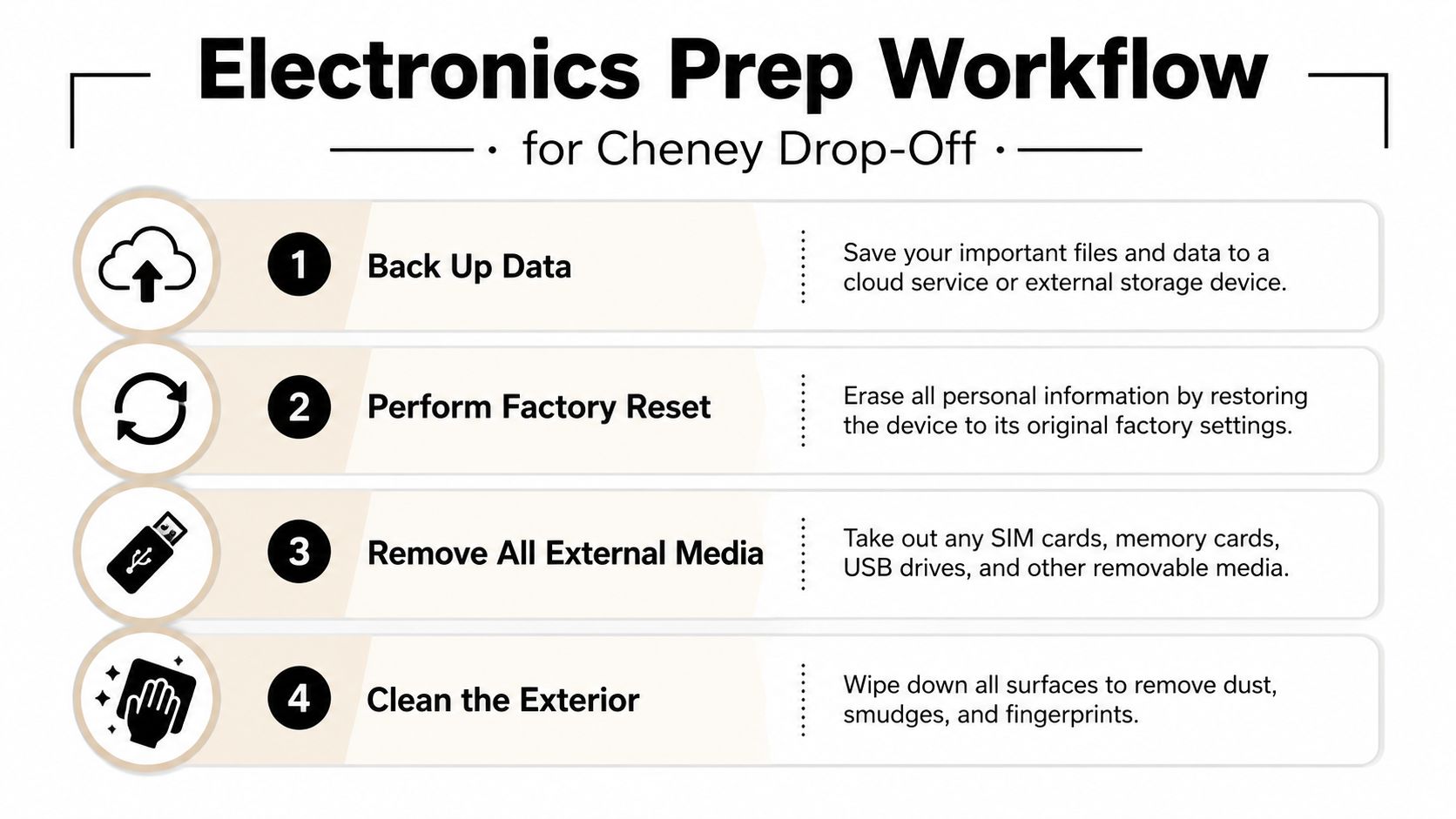
For any business, the risky part isn't the recycling bin. It's the data still living on the device. A laptop, desktop, server, router, printer, or television may all be ready to leave the office at the same time, but the drives inside those systems need a deliberate prep process before they move anywhere.
Build the asset trail first
Start with an inventory. Log the asset tag, serial number, model, and assigned user for each device before anyone touches a wipe tool or unplugs a cable. That inventory is the piece auditors ask for later, and it's the easiest thing to miss when the room is full and the deadline is close.
Then separate the data-bearing components from the accessories. USB drives, SSDs, and HDDs can survive sloppy deletion attempts, and removing them before transport keeps the risk visible. Batteries also need separate handling where regulations or device design call for it, so don't leave them buried in the case.
Skipping the inventory creates the worst kind of cleanup, not on the floor, but in email threads after the fact.
Wipe, reset, and document
Software deletion isn't enough. Use proper wipe tools, perform a factory reset where the hardware allows it, and keep a record of what was done to each asset. If a device can't be wiped reliably, tag it for secure destruction instead of sending it out with the assumption that a simple erase is good enough. That assumption causes most of the follow-up headaches in office cleanouts.
A clean exterior matters too, but only after the data work is done. Dust, tape labels, and adhesive notes don't matter as much as the ownership trail. What matters is that the person receiving the load can match the asset list to the devices leaving the site.
If you'd rather not manage that sequence internally, prepare your company's electronics for recycling is the right internal reference point for setting up a cleaner handoff.
How Reworx Recycling Handles Business Pickups in Eastern Washington
A public drop-off center works well when the load is small and the hours line up. Once the project turns into a closet full of desktops, a data center decommissioning, or a facility cleanout, a managed pickup is usually the better fit. Reworx Recycling, the social enterprise electronics recycler in Smyrna, Georgia, provides business pickups, free customer drop-off at its facility, secure data destruction, and IT asset disposition support for organizations that need a formal process rather than a public unloading bay.
What the pickup flow looks like
The process starts with a pickup request and a basic load description. From there, the team schedules collection, tags the assets, and transports them under a documented chain of custody. For hardware with storage media, hard-drive shredding and secure destruction can be added so the IT, finance, and compliance teams all end up with the paperwork they need.
That documentation is the point. A business doesn't just need the devices gone, it needs evidence that the devices were handled correctly. Serialization reports, certificates of destruction, and diversion summaries belong in the same packet when the load touches sensitive systems or regulated records.
Where donation-based recycling fits
Not every retired machine needs the same end path. Working equipment can be routed into donation-based recycling instead of immediate destruction when the hardware still has reuse value. That keeps useful devices circulating longer and supports the broader community impact side of the program.
For facilities that are planning office cleanout, facility cleanout, or data center decommissioning work, the right question isn't “Can somebody take it?” It's “Who can take it, document it, and separate the reusable from the non-reusable without creating extra risk?” That's the value of a managed ITAD partner.
If you're comparing service territory and pickup coverage, Reworx service areas are the place to confirm what kind of coordination makes sense for your site and timeline.
Contamination Rules That Protect Cheney's Recycling Stream
Cheney's recycling guidance is strict for a reason. Containers need to be empty and clean, lids and plastic bags don't belong in the load, and comingled material still depends on good prep upstream. If the office sends in half-empty containers or loose bagged material, the downstream sort gets slower and the recovery stream gets less reliable.
What the city is trying to prevent
The city's 2019 contamination-reduction plan shows a program that handles a broad material mix, from paper and plastics to aluminum, steel, oil, and batteries. That mix only works because the center sorts on-site and uses multiple contracted haulers to remove collected material. In other words, the system is built around discipline at the front end.
The EPA's general e-waste guidance reinforces the same idea, electronics do not belong in curbside recycling bins and often need special handling. That's especially true for batteries, routers, televisions, and other items that users assume are “just another recyclable.” They're not. They travel differently, and they contaminate differently.
Clean prep at the office is what keeps the recycling stream commercially viable.
A simple field example
A facilities team brings in office containers with labels still attached, food residue inside, and a few loose batteries mixed into the bin. The load is technically “recyclable,” but it's messy enough to slow down sorting and create extra handling. By contrast, a cleaned, separated, and clearly labeled load moves faster whether it ends up at Cheney's public facility or with a partner handling secure pickup.
For readers trying to understand the difference between broad recycling and true material control, what commingled recycling means is a useful reference point before the next cleanup day.
Choosing Between the City Drop-Off and a Recycling Partner
The right path depends on volume, sensitivity, and how much reporting you need after the haul leaves the building. A public center is a good fit for a one-time household load or a small office with a few items. A recycling partner makes more sense when the project includes more devices, more data risk, or more coordination than the public window can handle.
Three Cheney scenarios
A household or solo office with one laptop can usually work through the city center, especially if the device falls into the ordinary recyclable stream or lines up with a Clean Sweep electronics window. A growing SMB retiring a closet of desktops may still use the city option, but the prep burden rises fast once drives, cables, and accessories are all part of the same job. A school, agency, or business with a lab refresh or small server room is usually better off scheduling a pickup, because the reporting and data-control requirements start to outweigh the convenience of self-hauling.
That same decision shows up in how people search for recycling help. If you're trying to improve local visibility for a service, resources like top Google categories for visibility can help frame how a provider is positioned, but the core question for Cheney businesses is still operational: who can take the load cleanly and prove what happened to it.
What each path gives you
The city drop-off gives you access to a public recycling system with local rules and limited hours. A partner gives you scheduled collection, data destruction, and documentation. Donation-based recycling adds a third layer, because functional equipment can be redirected into reuse instead of breakdown.
For businesses that want a simple public drop-off reference point, the Cheney recycling drop-off center page is useful context when deciding whether your load belongs in a municipal line or in a managed pickup workflow.
Next Steps and a Quick Checklist for Cheney Businesses
A Cheney business usually saves time by matching the load to the right path before anything leaves the building. Check the Cheney Recycling Center hours, confirm whether your material belongs in the regular recycling stream or the Clean Sweep electronics program, and make sure your vehicle can unload at the site. If the load includes data-bearing equipment, regulated devices, or enough assets to require a chain-of-custody trail, handle it like an IT project, not a casual cleanup run.
What to confirm before you go
- Check the schedule first. The city's posted hours are limited, and electronics access follows its own rules instead of the regular drop-off rhythm.
- Sort the load before arrival. Keep cardboard, paper, cans, plastics, batteries, oil, and electronics in the correct stream so the line moves faster.
- Plan for unloading. A municipal drop-off expects your team to unload and leave, so do not arrive assuming on-site labor or full-service help.
- Separate sensitive assets. Drives, routers, servers, laptops, and printers should be inventoried before they leave your control.
A small office can often work within those limits. A larger cleanout usually cannot.
When to escalate to a partner
If the job includes secure data destruction, office cleanout, facility cleanout, data center decommissioning, or devices with reuse value, a recycling partner is the cleaner path. The public center works well for the right load, but it does not cover every ITAD problem a business creates. Finance may need certificates, IT may need serialization, and sustainability may want diversion reporting in the same package.
Reworx Recycling handles those business-side needs through donation-based recycling, secure hard drive shredding, and scheduled pickup workflows that fit corporate timelines. If your team is ready to donate old equipment, schedule a pickup, or build a longer-term IT asset disposition plan, start with Reworx Recycling and make the next cleanup count for both compliance and community impact.
If you need a practical partner for Cheney-area electronics recycling, Reworx Recycling can help with business pickups, secure data destruction, and donation-based recycling for usable equipment. Visit Reworx Recycling to plan your next office cleanout, schedule a pickup, or connect a retired IT load with a responsible end-of-life path.