Commingled recycling is a system where paper, cardboard, plastics, metals, and sometimes glass go into one container and are sorted later at a material recovery facility. It's built for convenience, but that convenience creates a real quality tradeoff, which is why facilities and IT managers need to know where commingled recycling works and where it doesn't.
If you're managing an office, warehouse, school, clinic, or multi-site business, you've probably seen the same problem play out. Staff want a simple recycling setup, leadership wants better diversion, and vendors promise an easy single-bin program. Then the questions start. What happens after pickup? What counts as recyclable? And can the same system handle old laptops, monitors, cables, or retired servers?
The short answer is no. Commingled recycling is a system where multiple types of recyclables like paper, plastic, and metal are collected in a single bin to be sorted later at a specialized facility. That model can work well for common office recyclables, but it becomes risky when businesses treat every unwanted item as part of the same stream.
Unpacking Commingled Recycling and How It Works
What is commingled recycling? In plain terms, it means employees place different recyclable materials into one shared bin instead of separating them at the point of disposal. Industry guidance describes commingled recycling, also called single-stream or mixed recycling, as a system that collects paper, cardboard, plastics, metals, and sometimes glass in one container, then sends the load to a material recovery facility, or MRF, where machinery separates it into commodity streams for sale to reprocessors, as outlined in Washington recycling system guidance on commingled residential recycling.
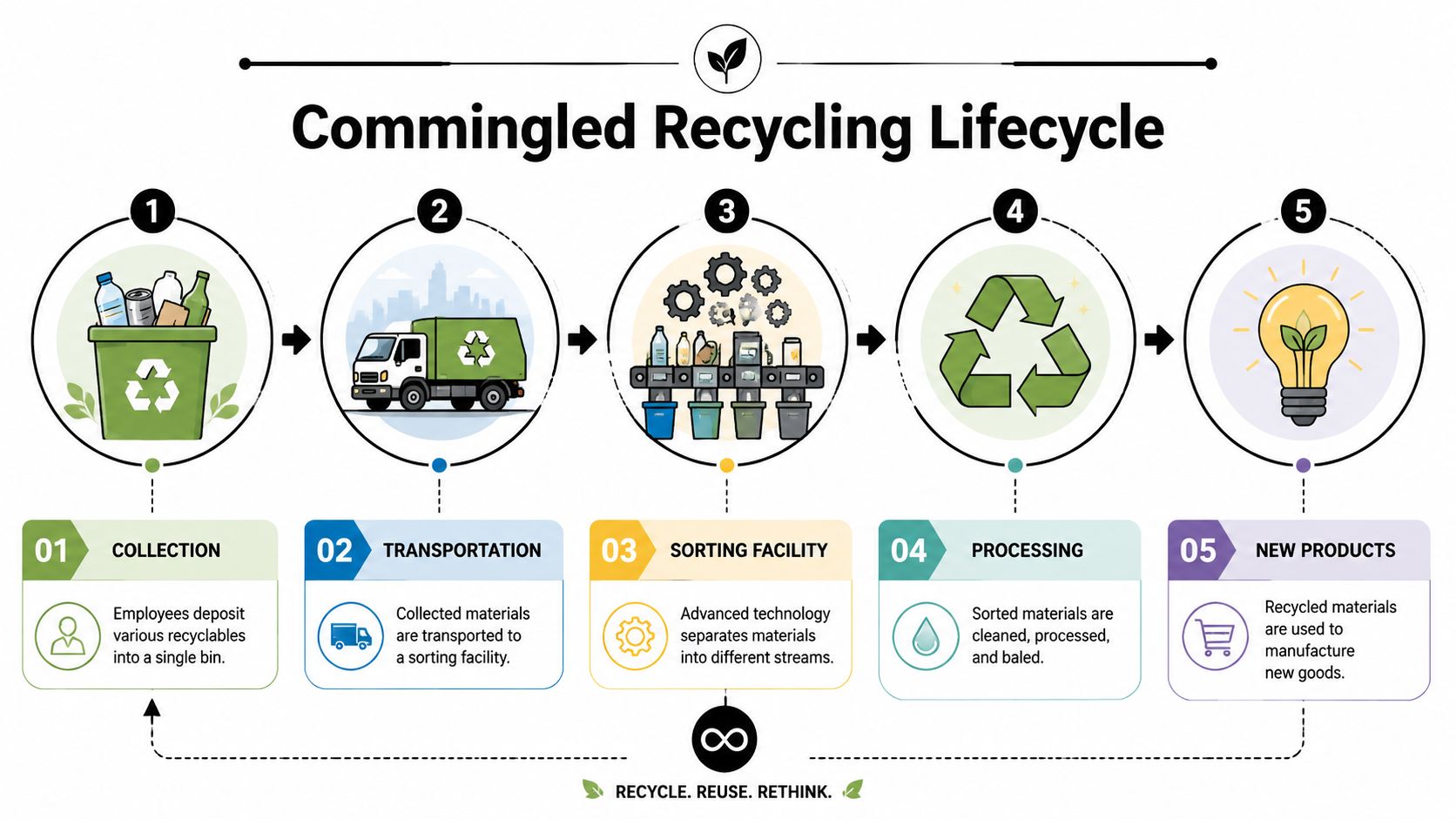
From office bin to sorting line
Think of commingled recycling like a scrambled puzzle dumped onto a table. Your team doesn't solve the puzzle at the desk, break room, or loading dock. The MRF does.
The path usually looks like this:
Collection at your facility
Employees drop paper, bottles, cans, and similar accepted materials into one bin.Transport by hauler
A truck collects the mixed load and moves it to the sorting facility.Mechanical separation
At the MRF, equipment such as screens, magnets, and optical sorting systems helps separate flat paper from containers and isolate metals, plastics, and glass.Processing into marketable streams
Those separated materials are cleaned, consolidated, and baled so mills and reprocessors can use them.Manufacturing into new goods
The recycled material becomes feedstock for new products.
Practical rule: A commingled bin is a collection shortcut, not proof that every item inside will become a new product.
That distinction matters for business buyers. A hauler may offer one recycling container, but your sustainability outcome still depends on what the MRF can sort, what contamination enters the stream, and what downstream buyers will accept.
How commingled differs from source-separated systems
Many readers get stuck on this point because “recycling” sounds like one thing. Operationally, it isn't.
Here's the simplest comparison:
| System | What employees do | Where sorting happens | Main advantage | Main risk |
|---|---|---|---|---|
| Commingled | Put multiple recyclables in one bin | At the MRF | Convenience | More contamination and lower material quality |
| Source-separated | Sort paper, metals, plastics, and other materials into separate bins | At the point of disposal | Cleaner material streams | More effort on site |
| Dual-stream | Usually separate fiber from containers | Split between site and facility | Balance of convenience and quality | More bins and more training |
For facilities teams, the appeal is obvious. One recycling station is easier to place, easier to explain, and often easier to service. But ease at the front end means the back end has to work harder.
If your company also handles retired electronics, how e-waste recycling works in practice is a separate process entirely, which is exactly where many business recycling programs go off course.
The Pros and Cons for Your Business Operations
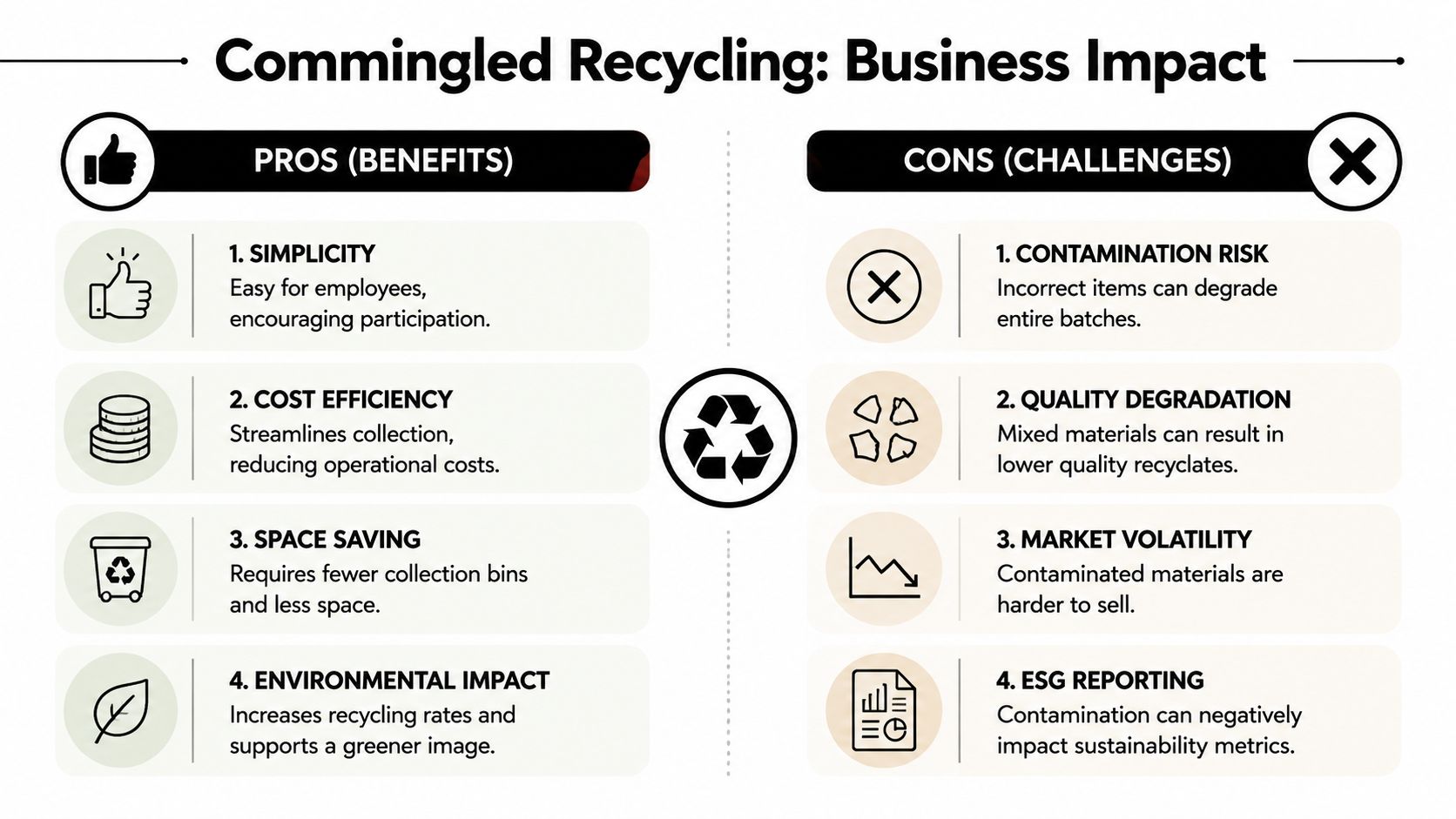
For most businesses, commingled recycling is a tradeoff between simplicity and material quality. It can make day-to-day operations easier, but it can also weaken the value and reliability of your recycling stream if staff treat the bin like a catch-all.
Where commingled systems help
The strongest argument for commingled recycling is operational ease.
A facilities manager doesn't need to find room for multiple bins in every break room, print station, conference area, and shipping zone. Employees don't need to pause and decide whether a can, paperboard carton, or plastic bottle belongs in one of several containers. Collection routes can also be simpler when a hauler services one recycling stream rather than several.
That convenience often improves participation. People are more likely to use a recycling bin when the rules are clear and the setup feels frictionless. In offices with constant foot traffic, visitors, contractors, and hybrid staff, simplicity matters.
Common operational benefits include:
- Fewer decision points for employees. A simpler bin setup reduces hesitation and lowers the chance that recyclable office paper or drink containers go into general trash.
- Less floor space used for collection. This can help in smaller offices, shared suites, healthcare back rooms, and educational facilities.
- Simplified service arrangements. Vendor coordination may be easier when pickups revolve around a single mixed stream.
Some organizations also prefer commingled systems because they align with broader workplace behavior. If employees are already juggling badge access, visitor procedures, records retention rules, and security protocols, adding a complex recycling chart can fail quickly.
Where businesses run into trouble
The downside is quality. The convenience of commingled systems comes with a significant tradeoff. Guidance on mixed recycling notes that recovered paper from commingled collection can contain high unusable material content, lowering its value, and that even one non-recyclable item can contaminate an entire truckload and potentially send it to landfill, as discussed in industry guidance on commingled waste contamination and quality loss.
That's the part many business recycling programs underestimate.
A single-stream setup looks efficient in the office. But once food residue, bagged recyclables, liquids, plastic film, or the wrong containers enter the load, the MRF has to remove those contaminants. Some items damage equipment. Some reduce bale quality. Some make the whole load less marketable.
Mixed recycling works best when your accepted material list is narrow, your signage is specific, and your vendor can explain exactly how contamination is handled.
A practical way to decide
Use commingled recycling when the material set is predictable and easy to control. Office paper, cardboard, metal cans, and common beverage containers usually fit that model better than messy break-room waste or specialty materials.
A quick decision screen helps:
Good fit for commingled
Standard office paper, shipping boxes, empty drink containers, and routine workplace recyclables.Poor fit for commingled
Food-soiled items, plastic film, unusual packaging, broken items, and anything employees are likely to “wish-cycle.”Never assume fit
Electronics, batteries, storage media, cords, devices, or anything with data or regulated components.
If your team is building the business case for better handling, this overview of the benefits of e-waste recycling for organizations helps draw the line between standard recycling and specialized recovery.
Navigating Contamination and ESG Reporting
A recycling bin doesn't strengthen your sustainability program by itself. What matters is whether the material is recovered, documented, and counted in a way your business can defend.
That's why contamination is more than an operational nuisance. It's an ESG reporting risk.

Collection is not the same as recycling
Many organizations report recycling activity based on bins serviced or materials collected. That can create a false sense of progress.
In the broader U.S. system, the gap between collection intent and the recycling achieved remains large. The 2020 State of Curbside Recycling Report says curbside programs recovered an average of 357 pounds per household per year, while an industry summary cited in that reporting says only 21% of residential recyclable materials are ultimately recycled and 76% end up in the trash at home, according to The Recycling Partnership's State of Curbside Recycling report.
Your business is not a household. But the lesson applies. A lot can be collected without a lot being successfully recovered.
How contamination distorts sustainability claims
The most common problem is simple. Employees put items in the recycling bin that feel recyclable but don't belong there. Facilities teams often call this wish-cycling. It usually starts with good intentions.
Examples include:
- Bagged recyclables that can interfere with sorting
- Food or liquid residue that lowers material quality
- Break-room confusion around cups, liners, lids, and takeout packaging
- Small electronics or batteries dropped in because they “seem recyclable”
When contamination rises, diversion claims get weaker. If a mixed load is downgraded, rejected, or sent for disposal, a company can't treat that material as a clean sustainability win.
If you can't verify what happened after pickup, your ESG statement is weaker than you think.
What credible reporting looks like
Strong reporting depends on records, not assumptions. For facilities leaders, that means asking vendors harder questions and requiring clearer documentation.
Focus on these basics:
Accepted materials list
Your staff need precise instructions, not broad recycling language.Load measurement method
Vendors should explain whether reporting is weight-based, volume-based, or based on facility averages.Contamination handling
Ask what happens to mixed loads when non-accepted items are found.Audit trail
Sustainability, compliance, and procurement teams should be able to review records without guesswork.
Businesses that want stronger internal controls often look for electronic recycling certification standards and vendor credentials when evaluating high-risk waste streams, especially once devices and data enter the picture.
The Critical Exception E-Waste and Data Security
Many otherwise solid recycling programs falter when staff learn that mixed paper, bottles, and cans can go in one recycling bin, then assume old electronics should follow the same path.
They shouldn't.
Why electronics don't belong in commingled recycling
A commingled stream is built for common recyclables that a MRF can sort into broad commodity categories. Electronics are different in every meaningful way.
A desktop computer is not just “mixed material.” It's a bundled asset containing metals, plastics, circuit boards, storage media, proprietary equipment tags, and often sensitive business data. The same goes for laptops, phones, printers, network gear, drives, tablets, medical devices, point-of-sale hardware, and lab equipment with embedded memory.
Three risks stand out.
First, material handling risk. Electronics aren't designed for a standard commingled line. They can break, shatter, leak, or contaminate adjacent loads when tossed into general recycling.
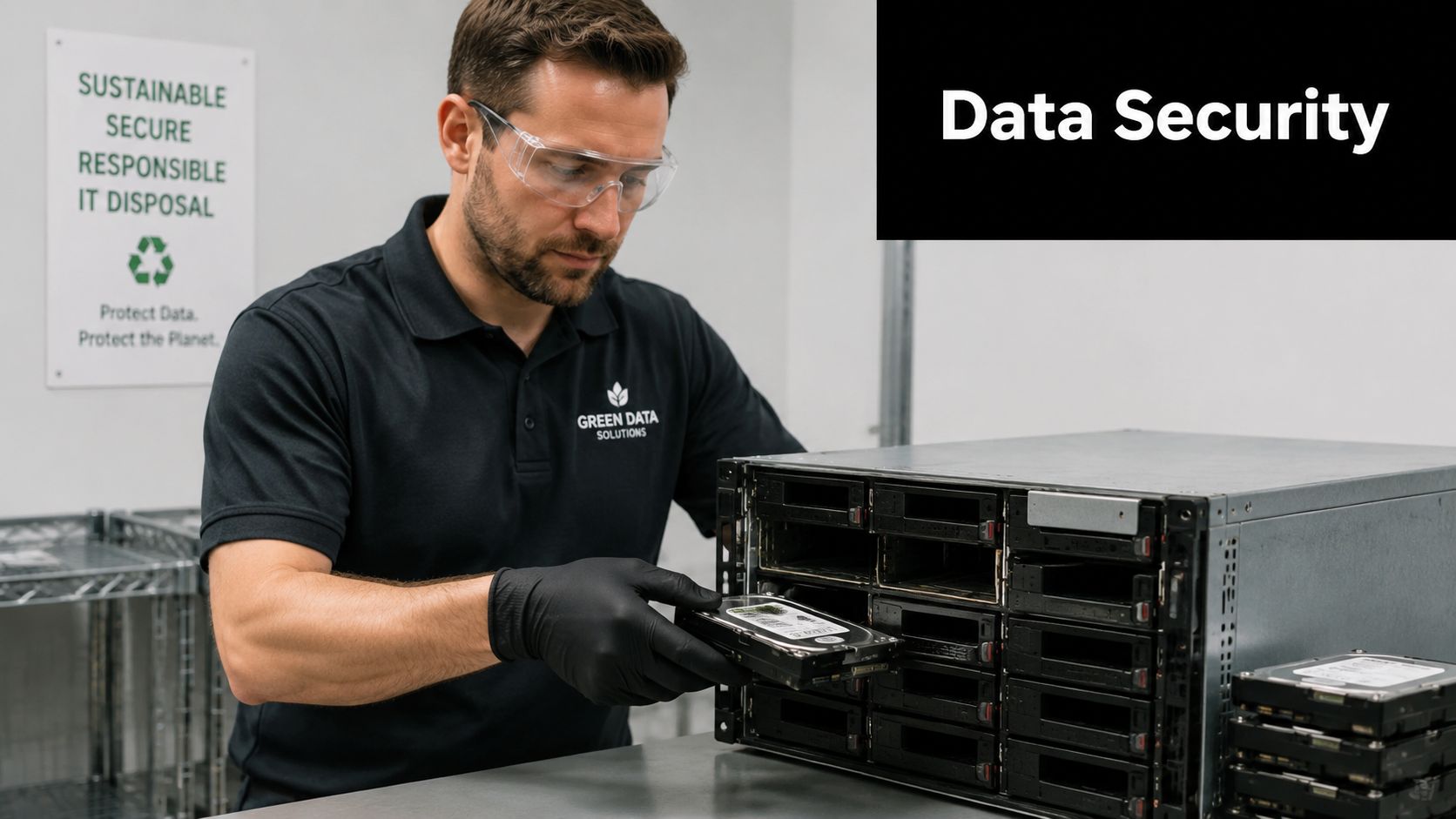
Second, data security risk. A retired device can still contain employee records, customer information, login credentials, contracts, patient data, financial files, or internal emails. Once that device enters an ordinary recycling stream, chain of custody becomes murky fast.
Third, compliance and asset control risk. Most businesses already track devices through procurement, deployment, and retirement. End-of-life handling should be just as disciplined. For teams that want a useful framework, this overview of IT asset management for UK businesses is a good reminder that asset control doesn't stop when equipment leaves active service.
The real business mistake
The biggest mistake isn't failing to recycle electronics. It's treating them like low-risk trash once they're obsolete.
An office cleanout often exposes this problem. Someone finds old laptops in a storage closet, aging switches in an IDF room, decommissioned drives in a desk drawer, or test equipment in a back lab. Because the devices no longer have business value, teams assume they no longer require business controls.
That assumption creates avoidable exposure.
Old equipment still carries responsibility. Retirement changes the handling process, not the duty of care.
What proper electronics disposition looks like
A sound electronics program separates e-waste from commingled recycling at the source.
That usually means:
- Dedicated collection processes for laptops, desktops, monitors, servers, phones, and peripherals
- Secure data destruction controls for hard drives, SSDs, and other media
- Documented chain of custody from pickup through downstream processing
- Asset-level reporting when organizations need inventory reconciliation, audit support, or disposition records
- Reuse and donation evaluation before recycling, when equipment still has safe functional life
The phrase IT asset disposition, or ITAD, holds significance. ITAD is not just recycling with a different label. It's the structured retirement of technology assets with security, documentation, logistics, and environmental controls built in. If your organization is sorting out that distinction, this explainer on what IT asset disposition means for businesses is a helpful next read.
For facilities managers, the practical takeaway is simple. Use commingled recycling for the materials that belong there. Build a separate, controlled lane for electronics. Don't let convenience erase risk boundaries.
Building a Smarter Waste Strategy with the Right Partners
The best business approach usually isn't choosing one recycling model for everything. It's building a hybrid system.
Use commingled recycling for the common office materials your employees can identify easily and your hauler can process consistently. Use a separate process for electronics, storage media, batteries, and other specialized materials that need tighter control.
A better operating model
A practical setup often looks like this:
| Waste stream | Best handling approach | Why it works |
|---|---|---|
| Office paper and cardboard | Commingled or fiber-focused collection | Easy for staff to identify and keep clean |
| Cans and bottles | Commingled collection with clear signage | Convenient in shared spaces |
| Food-contaminated packaging | Trash or organics, depending on local program | Reduces contamination in recycling |
| Electronics and IT gear | Dedicated ITAD or electronics recycling program | Protects data and supports proper downstream handling |
| Storage media | Secure destruction workflow | Preserves chain of custody and auditability |
This model gives facilities teams the simplicity they want without forcing high-risk materials into a low-control system.
Questions worth asking vendors
For sustainability and certification purposes, commingled material is often treated as a single diversion stream unless a facility can provide project-specific diversion data or an approved facility-average diversion rate, and visual estimation isn't considered acceptable for measurement, as discussed in guidance on commingled recycling documentation and LEED-related reporting.
That makes vendor questions much more important.
Ask your recycling and IT disposition partners:
How do you measure material amounts?
Look for auditable mass-based or volume-based records, not rough visual estimates.Can you provide project-specific reporting?
This matters when a site, move, cleanout, or decommissioning project needs defensible documentation.What contamination controls do you use?
A good partner should explain accepted materials, rejection criteria, and what happens to problem loads.How do you handle data-bearing devices?
The answer should include chain of custody and secure destruction procedures.Can reusable equipment be directed into donation or reuse channels?
That supports both sustainability and community impact goals when done responsibly.
A vendor review gets much easier when you use defined selection criteria for recycling and disposition partners instead of comparing providers on pickup availability alone.
Where strategy becomes value
A smarter waste program does more than reduce clutter. It protects reporting integrity, lowers the chance of contamination mistakes, and keeps obsolete devices out of insecure channels.
For IT managers, that means fewer surprises during refresh cycles, office moves, and data center decommissioning. For facilities teams, it means cleaner recycling streams and clearer signage. For sustainability leaders, it means claims backed by records rather than assumptions.
Commingled recycling has a place in business operations. It just shouldn't be asked to do jobs it wasn't built to do.
If your organization needs a better plan for electronics recycling, donation-based recycling, secure data destruction, office cleanout support, or IT equipment disposal, Reworx Recycling can help you build a practical program that separates everyday recycling from high-risk e-waste. Businesses can explore responsible next steps through Reworx resources, then donate old equipment, schedule a pickup, or partner with the team on IT asset disposition, computer recycling, medical equipment disposal, product destruction, and corporate donation programs that support both sustainability goals and community impact.