

Powering Atlanta's Ambition: Choosing Your Next Telecom Partner
In Atlanta, connectivity problems don't stay in the server room. They hit customer calls in Midtown, cloud apps in Buckhead, warehouse systems south of the city, and every video meeting your team tries to run without apology. If you're shopping for the best telecom company in Atlanta, you're probably not doing it for fun. You're doing it because your current service has become a bottleneck, your lease is changing, your office footprint is growing, or your IT team is tired of building workarounds around a circuit that was never designed for the business you've become.
Atlanta also isn't a small-market telecom decision. It's one of the strongest telecom hubs in the country. Select Georgia notes that more than 70% of Fortune 1000 companies have operations in metro Atlanta, and the City of Atlanta ranks as the 4th most concentrated city for those companies. That kind of enterprise density shapes the market. Providers build for high-capacity demand here, not just basic office internet.
The upside is choice. The downside is that brand familiarity can fool buyers into picking convenience over fit. A law firm with one downtown office needs something different from a healthcare group with multiple clinics, a manufacturer with warehouse connectivity, or a company moving infrastructure into colocation. If you're still comparing access types, this quick guide to compare leased line and broadband is a useful primer before you commit to a contract.
The list below gets straight to the practical options. Some are broad, all-purpose business carriers. Others make more sense for data-center-heavy environments, carrier-neutral designs, or custom fiber builds. The best telecom company in Atlanta usually isn't the biggest name. It's the provider that can deliver the right service, at your address, with the resilience your operation needs.
1. AT&T Business
AT&T Business is usually one of the first providers Atlanta companies check, and for good reason. In a market where Lightyear estimates about 54 providers are available citywide and identifies AT&T as a major local telco with extensive fiber infrastructure, AT&T often shows up with the broadest practical availability for standard business addresses. If you need one vendor for internet, voice, wireless, and backup connectivity, it's a strong starting point.
For smaller locations, AT&T Business Fiber can be the easy on-ramp. For larger offices and multi-site organizations, Dedicated Internet Access is the more serious product because you're buying a business circuit with stronger service commitments and cleaner support escalation. The gap between those two products matters. Many buyers hear “fiber” and assume they're equivalent. They aren't.
Where AT&T fits best
AT&T works well when the business problem is operational simplicity. One contract. One support organization. One provider that can pair fixed connectivity with wireless lines and failover options such as 5G backup. That's especially useful for professional services firms, retail groups, branch-heavy organizations, and teams that don't want to manage multiple carriers unless they have to.
A few practical strengths stand out:
- Broad access menu: AT&T offers shared business fiber, dedicated internet, and wireless backup paths depending on the site.
- Wireless integration: If your field teams already use AT&T mobile service, bundling can simplify billing and support.
- Managed add-ons: Business customers can also layer in managed security and network support instead of piecing together separate vendors.
Practical rule: Ask AT&T to quote both Business Fiber and Dedicated Internet Access for the same address. The cheaper option isn't always the better value if outage response and performance consistency matter.
What buyers often miss
AT&T can be an excellent fit, but buyers should go in with open eyes. Promotional pricing often assumes a bundle. Dedicated services usually require custom quotes and a term commitment. For a simple office with moderate cloud usage, that may still pencil out well. For a site with strict uptime expectations, the right answer may be AT&T primary plus another carrier for diversity.
This is also where telecom upgrades spill into equipment retirement. New circuit installs often trigger router swaps, firewall changes, access point refreshes, and closet cleanup. If you're removing old modems, phones, switches, or decommissioned edge gear, use a local partner for telecom equipment recycling in Atlanta so the transition doesn't leave surplus hardware sitting in storage.
You can review AT&T's business services directly at AT&T Business.
2. Comcast Business
Comcast Business is often the fastest practical answer when a company needs business internet in Atlanta without waiting on a custom fiber construction process. In the same Lightyear market view that outlines Atlanta's provider depth, Comcast is highlighted among the cable providers offering Ethernet Private Line services. That distinction matters because Comcast isn't just a cable internet option for small offices. In the right building, it can scale into a serious business connectivity provider.
The reason Comcast stays on so many shortlists is speed to install. If your team is opening a new office, moving into a suite that needs service now, or bringing a temporary location online while a larger network design is still in progress, Comcast can be a practical bridge and sometimes the long-term solution.
Why Comcast wins deals
Comcast Business tends to be strongest when time matters almost as much as bandwidth. Its HFC-based business internet can be faster to deploy than a fresh fiber build, and the company also offers fiber-based dedicated internet and Ethernet for organizations that need stronger business-grade architecture. Public sector locations, branch offices, medical practices, and distributed service businesses often like Comcast because it can cover a lot of operational ground quickly.
A few trade-offs are straightforward:
- Fast deployment path: Cable-based business service can often get a site live quickly.
- Enterprise options available: Dedicated internet and Ethernet products make Comcast more capable than many buyers assume.
- Remote work support: It can also fit hybrid organizations that need home-office connectivity options for key staff.
Where Comcast falls short
The weakness is consistency across product types. A quick-turn cable circuit and a custom fiber-based enterprise service are not the same experience, even when they come from the same logo. Upload performance, SLA structure, and support expectations can differ a lot. If your applications are heavily cloud-based, if you move large files, or if your team runs latency-sensitive systems, don't assume the fastest-installed option is automatically the best telecom company in Atlanta for your environment.
A fast install helps on day one. It doesn't fix a weak network design on day one hundred.
That's why I usually tell Atlanta buyers to treat Comcast as either a rapid primary option for straightforward sites or a useful secondary carrier for resilience. It can be very effective in both roles. Just don't let convenience override architecture.
If the switch to Comcast means you're clearing out old gateways, desk phones, cabling bundles, or branch networking gear, plan the disposal step at the same time. Reworx Recycling offers help with telecom equipment disposal near you so your rollout doesn't create an e-waste mess after the installers leave.
You can explore current offerings at Comcast Business.
3. Lumen Technologies
Lumen belongs on the shortlist when internet access is only part of the requirement. If your Atlanta operation depends on cloud on-ramps, backbone performance, security posture, or data-center adjacency, Lumen is a different kind of conversation from a mainstream office internet quote. It's more enterprise-focused, and that's exactly why some buyers should look at it early.
Atlanta's role as a data-center market makes providers like Lumen more relevant. CBRE reports that Atlanta led the nation in data-center net absorption. For telecom buyers, that's a practical signal. Markets with heavy data-center demand tend to reward carriers with strong interconnection presence, cleaner backbone access, and better options for multi-site and hybrid infrastructure designs.
Best use case for Lumen
Lumen is a smart fit for companies that care about network performance beyond the last mile. Think regional headquarters, cloud-heavy application environments, financial services, software teams, healthcare systems, and any business that has already outgrown “business internet” as a buying category. Its Dedicated Internet Access, broader backbone footprint, and on-demand style networking options are built for organizations that want a more engineered result.
What stands out:
- Tier-1 backbone orientation: Lumen is attractive when low-latency backbone reach matters.
- Enterprise security story: Security services are more central to the offer than with many basic access providers.
- Data-center relevance: It aligns well with colocation, hybrid cloud, and interconnection-heavy deployments.
The real trade-off
Lumen isn't usually the easiest buy for smaller offices. Quoting can take longer, terms can be firmer, and the sales process often assumes an enterprise-level discussion. That doesn't make it a bad option. It just means small and mid-sized companies need to decide whether they want simple procurement or stronger long-term architecture.
What works: Use Lumen when the network design starts with application performance, cloud paths, and resilience.
What doesn't: Choosing Lumen for a basic single-office setup if your team mainly wants the cheapest path to getting online.
There's also a lifecycle issue that rarely gets discussed in telecom roundups. Moving to an enterprise-grade carrier often triggers hardware standardization. Old routers, branch firewalls, copper handoff gear, and retired WAN appliances pile up fast. If you're consolidating infrastructure as part of a Lumen migration, Reworx can support the broader ITAD and telecom services process so you don't leave regulated or sensitive equipment unmanaged.
Lumen's service portfolio is available at Lumen Technologies.
4. Zayo
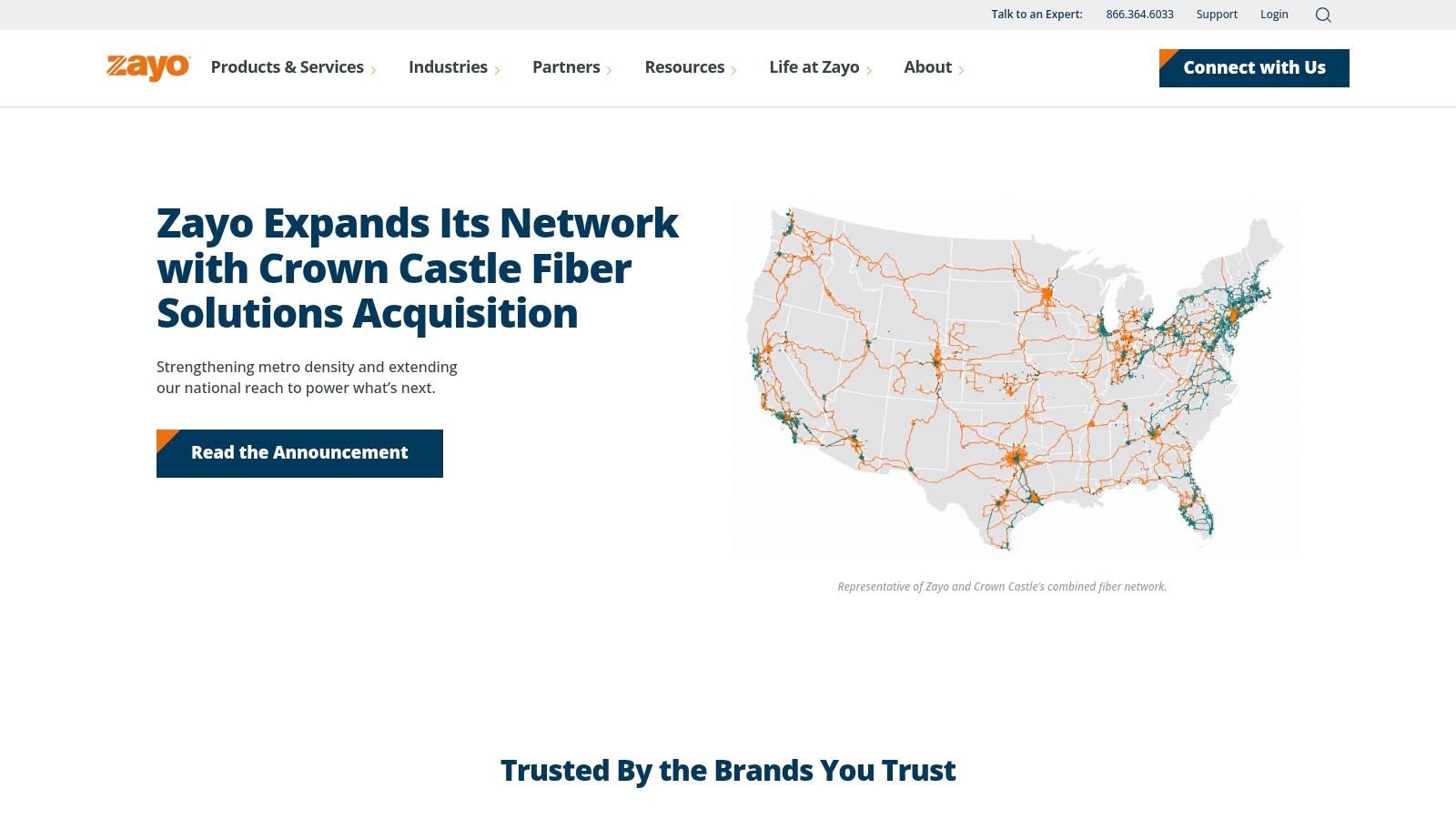
Zayo is rarely the first name a small office manager mentions, but it's often one of the first names enterprise network architects bring into the room when route diversity and custom fiber design matter. That difference says a lot. Zayo isn't trying to be the default internet brand for every address in Atlanta. It's strongest when the project involves dark fiber, high-capacity wavelengths, metro interconnection, or a network footprint that needs more control than a bundled ISP will give you.
This matters in Atlanta because the market isn't just large. It's dense with serious infrastructure demand. GovTech says metro Atlanta has been the country's hottest data-center market since 2023. Buyers near major colocation corridors or carrier-rich facilities often need more than a standard handoff and an invoice. They need path options.
When Zayo makes sense
Zayo is a strong candidate for campus environments, large healthcare systems, universities, manufacturers with regional operations, and companies building around colocation campuses. If your team wants dark fiber for control, wavelength services for scale, or diverse entrances between key sites, Zayo can be the right answer where mainstream providers feel too packaged.
Use cases that fit well include:
- Carrier-neutral design: You want more control over routes and provider mix.
- Data-center-centric builds: Your environment depends on interconnection and transport between facilities.
- Growth beyond internet access: You may start with DIA but know the network will evolve.
Where buyers get burned
Zayo requires a different procurement mindset. Pricing is custom. Construction can be part of the conversation. Support and implementation feel more like working with a carrier than buying a boxed business service. That's not a flaw. It just means the internal buyer needs technical clarity and patience.
A common mistake is asking Zayo to compete with a simple business broadband quote on convenience. That's not where the value shows up. The value shows up in control, resilience, and the ability to engineer around future requirements instead of replacing the entire design later.
If your outage tolerance is low, ask every provider to explain physical path diversity in plain language. The ones that answer clearly are usually the ones worth keeping in the process.
Telecom upgrades at this level also generate more surplus hardware than is generally expected. Legacy optical gear, edge appliances, old rack equipment, and retired network electronics shouldn't get boxed up and forgotten. Reworx supports responsible electronics recycling for Atlanta businesses when a fiber redesign or carrier migration leaves you with obsolete infrastructure.
For service details, visit Zayo.
5. FiberLight
FiberLight is the kind of provider that makes sense once a buyer stops asking, “Who's the biggest?” and starts asking, “Who can build what I need in Atlanta?” Regional fiber operators can be very effective in that middle ground between giant national incumbents and highly specialized wholesale carriers. FiberLight often fits organizations that want enterprise connectivity but also want a provider with strong local build awareness.
Atlanta's broader digital infrastructure supports that kind of provider. Mordor Intelligence's Atlanta data-center market summary identifies major ecosystem players including Digital Realty, Equinix, Vantage Data Centers, QTS Realty Trust, and Switch. Providers that serve this environment need to support serious business requirements, not just basic office access.
Why FiberLight is worth a look
FiberLight tends to work well for enterprises, schools, government agencies, and distributed organizations that need metro fiber connectivity with room for customization. If your business has hybrid cloud traffic, disaster recovery concerns, or a need to tie office, warehouse, and data-center environments together, FiberLight can be a practical alternative to larger household-name carriers.
Its appeal usually comes down to three things:
- Regional focus: That can help when national providers feel too standardized.
- Enterprise transport options: DIA, Ethernet, and wavelength services support more than simple internet access.
- Good fit for interconnect needs: Especially useful for organizations leaning on colocation or backup sites.
What to verify before signing
With FiberLight, address-level availability matters a lot. That's not unusual in telecom, but it matters more with regional fiber providers because the difference between on-net and near-net can change the timeline and economics of the project. Ask whether your building is already lit, whether construction is likely, and whether the proposed path supports your failover strategy.
I'd also push buyers to think beyond bandwidth. A telecom refresh often overlaps with a server room cleanup, branch consolidation, or a broader office move. That's when old storage arrays, backup appliances, workstations, and network gear need secure retirement, not just a corner in the warehouse.
Field note: The best provider quote can still produce a bad project if nobody owns the decommissioning plan.
If your rollout includes retiring drives, network hardware, or aging office technology, Reworx can help with data destruction services in Atlanta for businesses. That's especially relevant for schools, healthcare groups, and public-sector teams that can't treat old equipment casually.
You can review FiberLight's network services at FiberLight.
6. Google Fiber Business
Google Fiber Business solves a problem many Atlanta small businesses have. They want real business fiber without a drawn-out quoting process, buried pricing surprises, or a contract structure that feels built for a much larger company. GFiber Business is at its best when simplicity is the priority and the address is inside its service footprint.
That last point matters. Atlanta has a lot of providers on paper, but actual service still depends on the building. In practical buying terms, the best telecom company in Atlanta may be the one that can give you a clean install and predictable support at your exact location, not the one with the biggest statewide brand.
Best fit for GFiber Business
GFiber Business is well suited to small offices, creative firms, clinics, retail spaces, coworking environments, and startups that need straightforward fiber service. The appeal is clear pricing, simple plan structure, included equipment, and less procurement friction than you get from enterprise-heavy carriers.
It is most effective when:
- Single-site small businesses: You want strong internet and don't need custom network engineering.
- Teams that hate telecom complexity: Transparent service is part of the value.
- Offices with cloud-first workflows: Fast, symmetrical-style business fiber is often enough for modern SaaS environments.
A related concept shows up in broader fiber operations too. If your business is mapping assets across locations or managing field infrastructure, systems that improve network visibility can help. This example of a SharePoint fiber system shows how some organizations track fiber-related workflows more systematically.
Where GFiber stops being enough
GFiber Business is not the answer for every Atlanta organization. If you need custom SLAs, multi-carrier failover design, dark fiber, wavelength services, or a provider that can engineer around a complex data-center footprint, look elsewhere. That isn't a criticism. It's just a clean definition of the product.
For many small businesses, though, that simplicity is a strength. You don't need a carrier-style relationship if your real need is dependable service, fast installation, and no billing drama. In those cases, GFiber can absolutely be the best telecom company in Atlanta for the job at hand.
Before you sign, verify building availability, static IP needs, voice requirements, and whether your future growth could outpace the product. If there's a decent chance you'll need multi-site WAN design within the term of your lease, it may be smarter to pick a provider with broader enterprise headroom from the start.
You can review business plans at Google Fiber Business.
7. Cogent Communications
Cogent is a smart option when your office sits in the right building and your team knows exactly what it wants. It's not a lifestyle brand for general business telecom. It's a connectivity provider that often shines in on-net buildings, carrier hotels, and data-center-adjacent environments where straightforward dedicated internet beats a bloated bundle.
That niche is more relevant in Atlanta than many buyers realize. Southern Telecom emphasizes long-haul and metro dark fiber, rights-of-way, conduit, and colocation as core parts of the market. That's a reminder that Atlanta telecom decisions are often about resiliency and infrastructure design, not just whichever provider has the most familiar ad campaign. Cogent fits into that more technical side of the market.
Why Cogent gets shortlisted
Cogent is often appealing for dedicated, symmetrical internet access where the building is already well connected. If you're in a downtown multi-tenant property, a lit commercial building, or near a carrier-dense location, Cogent can be a clean and cost-conscious way to get serious bandwidth without layering on services you don't need.
Its strengths are easy to understand:
- Simple product story: Dedicated internet, IP transit, and related connectivity services.
- Strong in the right buildings: On-net availability can make deployment much smoother.
- Good for technically mature buyers: Teams that know what handoff, SLA, and routing structure they want often appreciate the simplicity.
When to pass
Cogent is less attractive when you need a lot of hand-holding, fully managed services, or broad off-net flexibility. If your site requires a new last-mile build or your internal team wants one provider for wireless, voice, security, and managed networking, a full-stack carrier may be a better fit.
This is also one of the easiest places for buyers to make a location mistake. A provider can be excellent in one building and impractical three blocks away. That's why Atlanta telecom buying should start with the address, building status, and route options before brand preference.
For more on its enterprise connectivity portfolio, visit Cogent Communications.
Top 7 Atlanta Telecom Providers Comparison
| Provider | Implementation Complexity 🔄 | Resource Requirements ⚡ | Expected Outcomes ⭐📊 | Ideal Use Cases 💡 | Key Advantages ⭐ |
|---|---|---|---|---|---|
| AT&T Business | Moderate–High, multiple access types and custom DIA quotes | Medium–High, fiber/DIA equipment, possible wireless bundles | ⭐⭐⭐⭐, broad metro coverage, bundled mobility and resilience | Single- or multi-site businesses wanting unified access + mobility | Wide Atlanta reach; single-provider stack; 24/7 support |
| Comcast Business | Moderate, HFC for quick deploy, fiber/DIA for larger builds | Medium–High, HFC/fiber install, managed connectivity for enterprises | ⭐⭐⭐⭐, rapid turn‑up and strong metro reach | Multi-location orgs, public-sector sites, data‑center/cloud interconnects | Fast HFC deployments; MEF-certified Ethernet; account management |
| Lumen Technologies | Moderate–High, enterprise quoting and provisioning cycles | High, Tier‑1 backbone, NaaS ports, security integration | ⭐⭐⭐⭐⭐, low latency, backbone performance and cloud interconnects | Enterprises prioritizing performance, low latency and security | Tier‑1 backbone; Internet On‑Demand; embedded security services |
| Zayo | High, dark fiber and custom route builds require planning | High, dark fiber capital/engineering and custom wavelengths | ⭐⭐⭐⭐⭐, maximum control, scalability and route diversity | Campuses, data‑center centric deployments and route‑diverse networks | Dark/metro dark fiber; high‑capacity wavelengths; route diversity |
| FiberLight | Moderate, regional builds vary by footprint and timelines | Medium, metro fiber builds and DC interconnect work | ⭐⭐⭐⭐, responsive local builds and strong DC connectivity | Regional enterprises, schools, public sector, hybrid cloud/colocation | Local responsiveness; Atlanta metro expertise; DC interconnect options |
| Google Fiber Business | Low, simple, contract‑lean provisioning and installs | Low, consumer-style equipment included; minimal custom work | ⭐⭐⭐, straightforward, reliable small‑business fiber | Small offices, retailers, co‑working in GFiber neighborhoods | Transparent pricing; free professional install; no long contracts |
| Cogent Communications | Low–Moderate, quick on‑net installs; off‑net adds complexity | Low–Medium, minimal on‑net gear; off‑net last‑mile costs | ⭐⭐⭐⭐, cost‑effective DIA where on‑net; strong carrier‑hotel presence | Sites in carrier hotels/data‑center hubs needing low‑cost DIA | Competitive pricing on‑net; published SLAs; fast turn‑ups in lit buildings |
Beyond Bandwidth A Sustainable Approach to Your Tech Upgrade
Choosing the best telecom company in Atlanta is a real infrastructure decision. You're not just buying internet. You're choosing how your offices connect to cloud platforms, how branches fail over during problems, how your phone system performs, and how much operational pain your IT team absorbs over the next contract term. In Atlanta, that decision happens in a market with serious enterprise depth, strong fiber competition, and growing data-center gravity. That's good news for buyers, but it also means the smartest choice usually comes from matching provider strengths to your actual environment instead of chasing a generic “top provider” label.
The practical shortlist often narrows fast. AT&T Business makes sense when broad availability and a single-provider stack matter. Comcast Business is often strong when speed to install is the immediate priority. Lumen fits buyers who care about backbone, cloud paths, and enterprise-grade network posture. Zayo stands out when route control and fiber customization are part of the design. FiberLight can be a strong regional option for specific metro connectivity. GFiber Business works well for smaller offices that want simple fiber without telecom theater. Cogent is compelling in the right buildings for buyers who want clean dedicated connectivity.
What many businesses forget is that a telecom upgrade rarely ends with the circuit install. It usually triggers an equipment transition. Old firewalls get replaced. Legacy routers come off the wall. PRI gear disappears. Branch switches, desk phones, wireless access points, batteries, and retired edge devices start stacking up in closets and storage rooms. If you're moving offices, consolidating facilities, or modernizing a WAN, that pile gets bigger fast.
That's where Reworx Recycling should be part of the plan from day one. Reworx is a local social enterprise that helps Atlanta-area organizations handle electronics recycling, donation-based recycling, IT equipment disposal, computer recycling, laptop disposal, office cleanout projects, facility cleanout work, product destruction, secure data destruction, and broader IT asset disposition. For companies upgrading connectivity, that matters because network transitions create e-waste and data risk at the same time.
A responsible telecom migration should include four parallel tracks:
- Network replacement: New circuit, new handoff, and validated failover.
- Asset recovery: Removal of obsolete telecom and IT hardware from the site.
- Data protection: Secure handling of storage-bearing devices and retired systems.
- Community and sustainability impact: Reuse and donation pathways where equipment still has value.
That combination is where Reworx stands out. The company's donation-based model helps businesses retire equipment responsibly while supporting community impact through technology access and reuse. If your organization has sustainability goals, ESG reporting priorities, or wants a cleaner story around end-of-life hardware, that approach is far better than letting gear age in storage or disappear through informal disposal channels.
There's also a compliance and facilities angle. During telecom changes, IT teams are busy with cutovers and testing. Facilities teams are dealing with vendors, move schedules, and space planning. Nobody wants to argue later about who was supposed to remove the old server rack gear, shred the drives, or document the pickup. Bringing Reworx in early reduces that friction and gives the project a clear end-of-life path.
If your business is upgrading circuits, moving into colocation, refreshing branch infrastructure, or retiring old office hardware, this is the moment to treat decommissioning as part of the project, not an afterthought. Reworx can support secure pickups, responsible downstream handling, and a practical ITAD process that matches the professionalism you expect from the telecom side of the upgrade. For general guidance on compliant e-waste handling, the EPA's page on electronics donation and recycling is also worth reviewing.
Ready to upgrade your technology responsibly?
Don't let old IT assets become a liability after you've solved the bandwidth problem. Whether you're retiring a few network appliances, planning a full office cleanout, managing data center decommissioning, or coordinating a broader IT asset disposition effort, Reworx can help. You can schedule a pickup, learn more about donation-based recycling, or contact Reworx Recycling to plan a custom transition that protects data, supports sustainable recycling, and strengthens your impact in the Atlanta community.
If your Atlanta business is upgrading carriers, clearing out old network gear, or planning a larger IT refresh, Reworx Recycling can help you turn that change into a secure, sustainable transition. Partner with Reworx for electronics recycling, secure data destruction, donation-based recycling, and practical ITAD support that keeps usable technology in circulation and keeps e-waste out of landfills.