
Your telecom bill lands. You scan the first page, look at the monthly total, and wonder whether you're paying for service your business needs, service you forgot to cancel, or a bundle that only looked affordable when the rep presented it.
That's the moment a lot of owners and IT managers start searching for Affordable Telecom Services Near Me. The problem is that local results usually push headline prices, not operating reality. A cheap plan that can't support cloud apps, field staff, video calls, or reliable uptime isn't cheap. It's a recurring disruption.
The better approach is to treat telecom selection like any other business utility decision. Define what your team uses. Verify what your address can support. Compare the full contract, not just the sticker rate. Then handle the old equipment being replaced so you don't create a security, storage, or e-waste problem at the end of the project.
Beyond Price Finding True Telecom Value for Your Business
A low monthly quote is easy to advertise. Actual telecom value is harder to spot because it sits inside reliability, billing accuracy, contract terms, support quality, and what your team can accomplish once the service goes live.
That matters because pricing conditions aren't uniform. The International Telecommunication Union's ICT price tracking notes that mobile broadband became more accessible in 2024, but “stark disparities persist,” and affordability remains a central obstacle to universal connectivity, especially for fixed broadband. For a business buyer, that means two locations in the same metro can face very different service options and cost structures.
What business buyers get wrong
The first mistake is shopping by advertised speed alone. Speed matters, but it's only part of the decision. Upload performance, latency, install lead time, support responsiveness, and billing discipline often have more operational impact than the headline rate card.
The second mistake is ignoring the internal cost side. If your team is trying to cut service spend, the same discipline you use to boost marketing ROI applies here too. You need to connect monthly spend to usable business output, not to a promotional line item on a sales sheet.
Practical rule: Buy telecom the way you buy power or insurance. Price matters, but continuity matters more.
There's also an asset question that most telecom guides skip. New circuits, routers, phones, access points, and modems usually mean old hardware comes out. If you're planning a refresh, your telecom review should sit alongside an IT asset recovery strategy so replaced equipment doesn't pile up in a closet with data still on it.
What works better
A strong buying process usually has four traits:
- Clear requirements: You know which locations, users, devices, and applications matter.
- Address-level validation: You verify service where you operate, not just where a carrier says it serves.
- Full-cost review: You include installation, support, taxes, fees, and switching costs.
- Lifecycle planning: You decide in advance what happens to retired telecom and IT equipment.
That's how you stop chasing “cheap” and start buying something that's affordable, supportable, and durable.
Defining Your Needs Before You Shop
Most telecom overspending starts before the first quote arrives. Businesses ask carriers for pricing without a clean inventory of what they already have, what users need, and what performance problems they're trying to fix.
A requirements document doesn't need to be fancy. It just needs to be specific enough that Provider A, Provider B, and Provider C are quoting the same job.
Start with your current environment
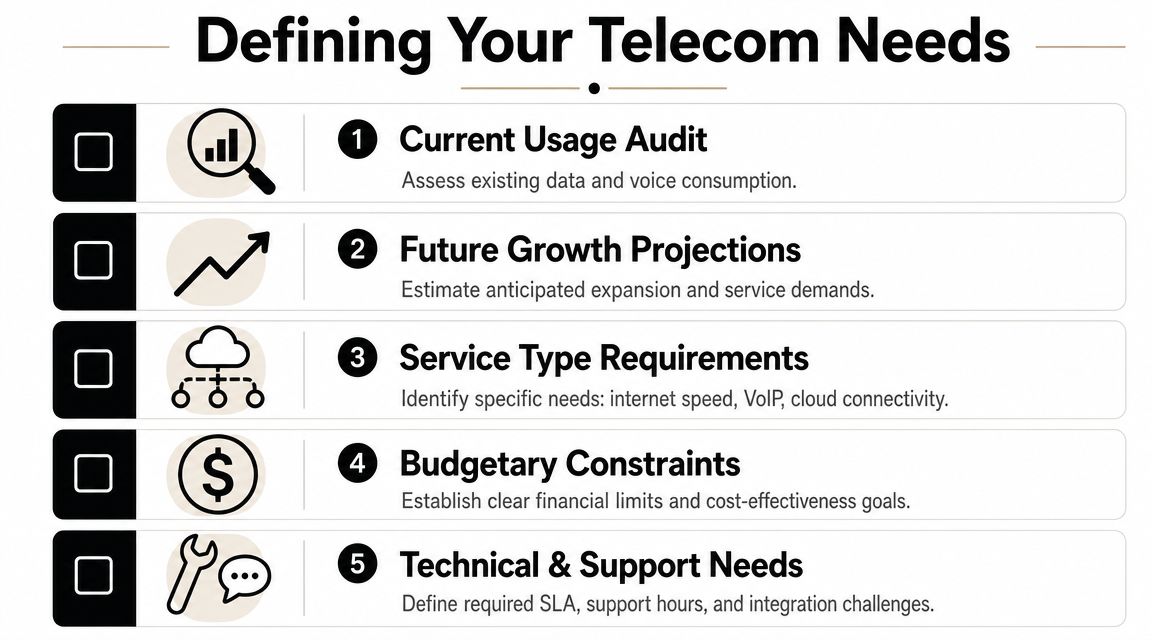
The first pass is operational, not technical. List every office, remote site, mobile team, and business-critical application. Then document every active circuit, line, handset, SIM, modem, router, and internet drop you're paying for today.
That inventory matters because billing cleanup often creates the first savings. Tellennium's review of telecom cost management says billing errors can drive 12–20% overspending, with orphaned services and rate discrepancies among the biggest issues, as outlined in its analysis of why telecom cost management fails so often.
Build a practical telecom blueprint
Use a working checklist like this:
Count users by role
Office staff, call-heavy teams, remote employees, and field technicians don't use telecom the same way. Separate them.List business-critical applications
Microsoft 365, CRM platforms, VoIP, video meetings, cloud backups, and line-of-business apps all shape your network needs.Define downtime tolerance
Some offices can live with a brief interruption. Others can't. A medical office, logistics team, or customer support floor usually needs a very different support model than a low-traffic branch.Document voice and mobility needs
Note hunt groups, direct lines, mobile hotspot use, and whether employees rely on softphones or desk phones.Capture future changes
New hires, new locations, hybrid work, or a planned move can make today's cheapest option tomorrow's expensive mistake.
A carrier quote is only useful if it matches the way your staff actually works.
Separate needs from preferences
A lot of businesses overbuy bandwidth and under-spec support. That's backwards. It's often smarter to define the minimum acceptable performance standard first, then decide where extra capacity is worth paying for.
For voice-heavy teams exploring cloud calling, it helps to understand the benefits of hosted telephony before comparing internet and phone bundles. Hosted systems can simplify adds, moves, and remote work, but they also place more weight on connection stability and internal network readiness.
If you're evaluating multiple providers, keep one shared worksheet that includes location details, contract end dates, monthly charges, equipment ownership, and support issues. That document becomes your baseline when reviewing business internet provider options and makes quote comparisons much cleaner.
Understanding Local Telecom Cost Drivers
Why does one business park get competitive fiber pricing while another address a few miles away gets a slow install timeline and weaker options? The answer is usually local infrastructure economics, not salesmanship.
TRC Companies notes that broadband affordability is often shaped by local deployment realities, and that over $65 billion was allocated for Broadband Equity, Access, and Deployment under the Infrastructure Investment and Jobs Act, alongside $759 million for rural electric cooperatives and additional support from the FCC's Rural Digital Opportunity Fund, as discussed in its review of rural telecommunication broadband planning. If public funding is that large, it tells you something important. In many areas, building and maintaining last-mile infrastructure is expensive.

The technology choice changes the bill
Different access types carry different trade-offs.
| Access Type | Typical Strength | Typical Limitation | Best Fit |
|---|---|---|---|
| Fiber | Strong consistency, business-grade performance, better upload capability | Availability can be uneven and install timelines can be longer | Multi-user offices, cloud-heavy operations |
| Cable | Broad metro availability, often faster to install | Performance can vary by area and plan structure | Small offices that need practical business internet |
| Fixed wireless access | Fast deployment in some locations, useful where wireline options are weak | Performance can vary based on network conditions and local environment | Temporary sites, backup links, underserved areas |
| Cellular or 5G plans | Flexible for mobile teams and quick failover | Data thresholds, device management, and variable performance can complicate budgeting | Field teams, backup connectivity, light office use |
Hidden cost drivers most buyers miss
The advertised monthly rate rarely tells the whole story. Review these line items before you compare quotes:
- Installation charges: Ask whether construction, activation, or truck-roll fees apply.
- Equipment terms: Confirm whether modems, gateways, phones, or managed routers are rented or included.
- Billing conditions: Some lower prices depend on autopay, e-billing, or multi-month prepay structures.
- Service model: A “business” plan may still offer limited support windows or weaker escalation paths than you expect.
- Performance fit: Asymmetrical service may look inexpensive until cloud backups, large uploads, and video calls start choking your workflow.
Why local knowledge beats generic pricing pages
A provider may quote one rate downtown and a different one in a light industrial corridor or edge-of-city office. The physical plant serving the building often determines what's possible. That's why local site checks matter more than national marketing.
If you're comparing higher-capacity circuits, it helps to understand nearby fiber optic installation considerations before assuming a fiber quote is interchangeable with cable or fixed wireless. The delivery method shapes not only price, but also timeline, service expectations, and what happens when your business grows.
How to Vet and Compare Local Telecom Carriers
Once your requirements are documented, the actual work begins. Carriers are easy to compare on a sales sheet and much harder to compare when you look at support discipline, address-level performance, and how they behave after installation.
The key question isn't “Who's cheapest?” It's “Who gives me the lowest risk-adjusted cost for my exact location and workload?”
Verify your exact address
Coverage maps are marketing tools. Your building is the test.
Allconnect's Wichita market overview shows how local variation can be. It reports that Starlink covers 100% of the city, Cox cable 99%, and AT&T is identified as the cheapest internet provider in some comparisons, while on mobile AT&T and Verizon cover 100% of Wichita land area with 4G and T-Mobile has 97.60% 5G coverage in that market, according to its page on internet and mobile availability in Wichita. Even with strong citywide figures, availability and performance can still vary by block.
Never sign based on a map alone. Ask the carrier to confirm serviceability, install method, and expected performance for your suite, not just your ZIP code.
Ask operational questions, not just pricing questions
Use the same question set for every provider. That forces an apples-to-apples review.
| Carrier Evaluation Checklist | Provider A | Provider B | Provider C |
|---|---|---|---|
| Service confirmed at exact address | |||
| Install timeline documented | |||
| Support hours for business accounts | |||
| Escalation path provided | |||
| SLA terms reviewed | |||
| Equipment ownership clarified | |||
| Billing format and fees explained | |||
| Upgrade and disconnect process defined |
Questions worth asking on every call
- What's the actual installed service at this address? Don't accept broad coverage language.
- What are the support channels for business customers? You want named channels and escalation steps.
- What's included in the monthly rate? Ask for every recurring and non-recurring charge in writing.
- What happens if we need to upgrade or disconnect a location? This reveals how painful future changes may be.
- What hardware is required and who owns it? Ownership affects both cost and end-of-term logistics.
For businesses that rely heavily on local visibility and inbound demand, telecom downtime can disrupt more than internal operations. It can interrupt sales response, customer follow-up, and appointment handling. That's one reason teams that invest in search performance often also pay attention to carrier support quality. If local lead flow matters, the service expectations you'd demand from this Miami digital marketing agency should also apply to your telecom vendors. Responsiveness counts.
If you want a wider shortlist before calling carriers, use a directory of local telecom companies and then narrow the list based on your service type, support requirements, and location fit.
Contract Negotiation and Long-Term Cost Control
A telecom agreement isn't expensive because of one monthly rate. It gets expensive when weak terms lock you into avoidable charges, awkward upgrades, or cancellation pain.
That's why negotiation should focus on total contract value. A slightly higher monthly number may still be the better deal if it removes install charges, limits annual increases, includes better support, or gives you room to scale without reopening the agreement.
Negotiate the parts sales reps don't lead with
Most buyers focus on recurring price because it's visible. Mature buyers push on these terms too:
- Installation relief: Ask whether activation, setup, and equipment charges can be reduced or waived.
- Price stability: Request written protection against mid-term increases where possible.
- Upgrade flexibility: Make sure service changes don't trigger punitive resets or hidden fees.
- Renewal control: Review notice periods and auto-renewal language carefully.
- Exit clarity: Define what happens if you move, close a site, or replace the service.
The cheapest quote on day one can become the most expensive contract by month six.
Don't ignore switching costs
Many “affordable telecom services near me” searches go wrong because businesses compare the new carrier's sticker rate and forget the cost of leaving the old one.
The T-Mobile Wichita home internet page highlights a starting price of $40/month, no annual contract, and no data caps, while noting that speeds vary with network conditions, as shown on its Wichita home internet offer page. That kind of headline price can be attractive, but it doesn't tell you whether you still owe on devices with your current provider, whether you'll pay termination charges, or whether your workflows can tolerate variable performance.
A better negotiation stance
Walk into every negotiation with at least two competitive quotes and one internal baseline: the verified cost of what you already have. Then push for contract language that protects your future operating flexibility.
A useful rule is simple. If a provider won't put a fee, condition, or billing assumption in writing, don't model your business case around it.
A Smart Transition Upgrading Tech and Retiring Old Assets
The contract gets signed, the install date is set, and then the overlooked part of the project shows up. Old phones come off desks. Legacy routers get unplugged. A switch in the closet gets replaced. Spare handsets, modems, access points, and small office network gear start collecting in boxes.
That's not a side issue. It's part of the telecom project.

Treat the upgrade as a lifecycle event
A telecom refresh affects procurement, operations, facilities, security, and sustainability. If you plan only for the new service and ignore the equipment coming out, you create three common problems:
Data exposure
Some retired devices hold credentials, call logs, network settings, or stored configuration data.Inventory confusion
Teams lose track of what was removed, what's leased, what's company-owned, and what should have been returned.Storage creep
Unused hardware ends up sitting in a server room, branch closet, or warehouse shelf long after the project is supposedly complete.
Build disposal into the project plan
The handoff should be scheduled, not improvised. A practical transition checklist includes:
- Tag outgoing hardware: Record model, serial, location, and whether the device is leased or owned.
- Separate return obligations: Carrier-owned gear should follow the provider's return process.
- Isolate company-owned devices: These should move into your IT asset disposition workflow.
- Document chain of custody: Especially for network and storage devices.
- Coordinate pickup timing: Don't leave old gear unsecured after cutover.
Retiring equipment responsibly isn't an environmental add-on. It's part of risk control.
For organizations replacing telecom and network hardware, one option is Reworx Recycling's telecom ITAD support. Its services are relevant when a business needs pickup logistics, equipment decommissioning, secure data destruction, and structured end-of-life handling for retired devices.
Why this matters beyond cleanup
The telecom decision directly connects to broader business priorities. A rushed switch might lower the service bill but leave you with unmanaged e-waste, poor internal tracking, and devices sitting unprocessed with sensitive data concerns attached.
Handled well, the same project can support several outcomes at once:
- Operational closure: The old environment is fully decommissioned.
- Security discipline: Data-bearing devices move through secure destruction processes.
- Sustainability reporting: Electronics recycling and donation-based reuse fit into broader environmental goals.
- Community impact: Viable equipment can sometimes support reuse pathways rather than simple disposal.
That last point matters more than many buyers realize. Telecom upgrades often coincide with office cleanouts, laptop replacement cycles, phone refreshes, and small infrastructure projects. Once you view the work as one coordinated lifecycle event, the cleanup becomes more organized and easier to govern.
A strong closeout file should include your final circuit inventory, carrier return confirmations, internal asset list, certificates or documentation tied to data destruction where applicable, and records of what equipment was recycled, remarketed, or donated. That's the kind of documentation that helps during audits, office moves, M&A integration, and future budgeting.
If your business is upgrading telecom service and needs a responsible plan for retired phones, networking gear, laptops, or other surplus electronics, Reworx Recycling can help you complete the project cleanly. Use them to explore equipment pickup, secure data destruction, donation-based recycling, and broader IT equipment disposal workflows that align cost control with environmental responsibility.