The recall notice lands while your team is already staging an equipment pickup. Some affected laptops sit in a storage closet, others are assigned to staff, and a return pallet may already be with a processor. Facilities wants the space back. Nobody can yet prove which units are affected, where they are, or where they will go.
Recalled product quarantine and disposal is an auditable reverse-logistics process. Storage is only one point in the chain. For a Smyrna, Georgia, office, school, or warehouse, the work is controlling equipment across desks, loading docks, vehicles, and receiving facilities. Route each item by hazard first: batteries that can swell, drives that hold data, and assets cleared for reuse follow different paths and different records. Reworx Recycling's focus on environmental stewardship fits alongside those controls, and recalled assets should stay physically separate from any equipment cleared for reuse or donation.
Seven Steps to Quarantine a Recalled Product
A recall notice starts the clock, and affected equipment remains an exposure while it's accessible on shelves, in transit, or in a closet. Isolate it before arranging disposal so a convenient pickup doesn't become an unauthorized handoff.
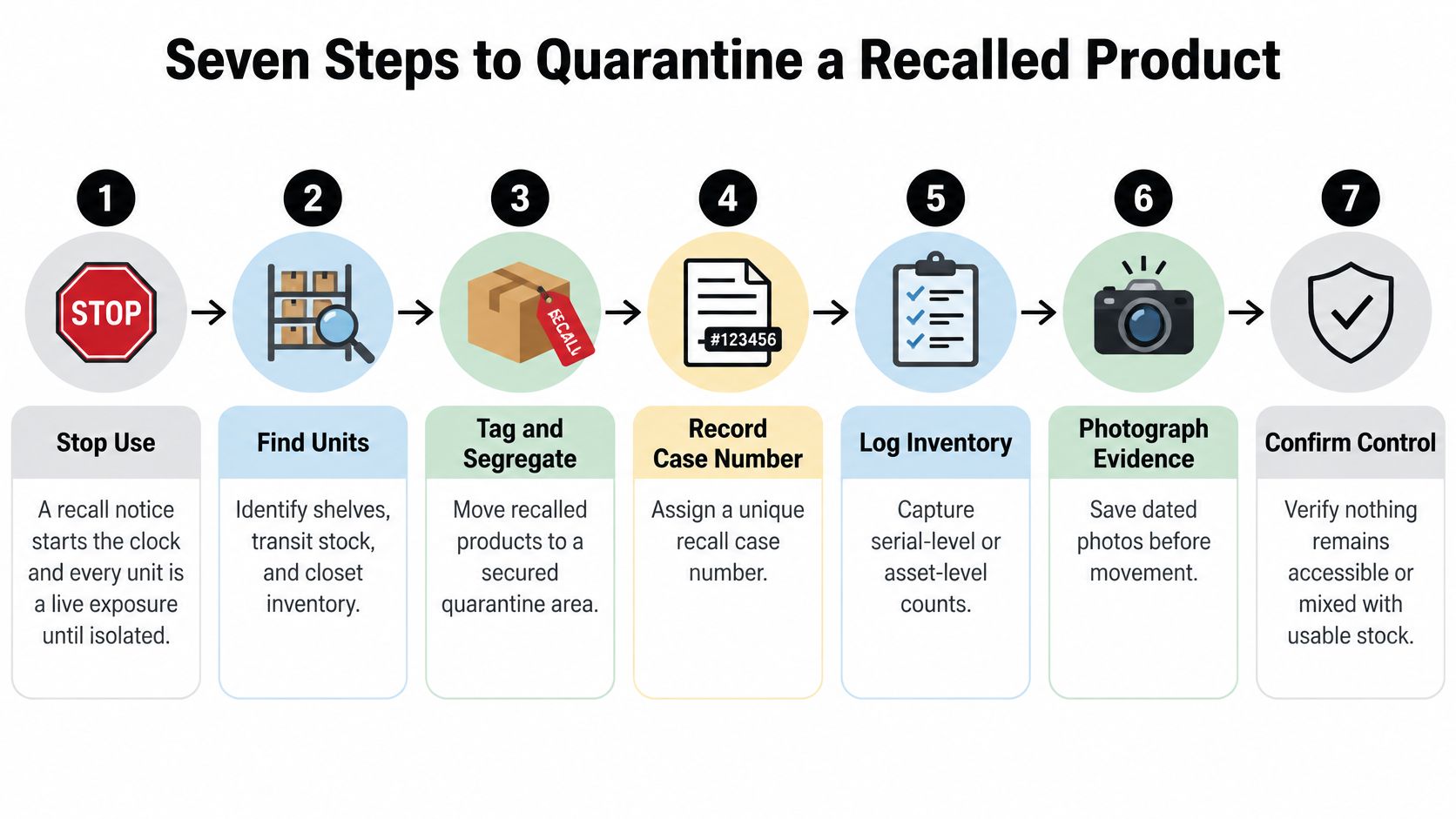
Establish control before arranging movement
Match the notice to physical inventory. Stop use while comparing UPCs, model numbers, serial ranges, and date codes. Inspect assigned devices, receiving areas, closets, and transit records rather than trusting the asset system alone, because recorded location isn't proof of possession.
Block affected items electronically. Place a recall hold in your asset register or warehouse management system. Disable sale, issue, transfer, and donation transactions so another team can't release equipment while you're organizing physical controls.
Create a restricted quarantine zone. Use a separate, labeled area marked as recalled and not for sale, distribution, or donation. Restrict access to designated custodians, since a label won't prevent someone from collecting a working-looking replacement.
Give every unit an identifier. Connect an asset tag or serialized label to the recall case number. Record model, serial or lot, quantity, location, owner, hazard classification, and custody transfers so the record survives packaging changes.
Notify everyone downstream. Include staff, branches, return desks, carriers, and third-party processors. Give recipients a deadline for written acknowledgment and specific instructions, because sending an email doesn't establish that anyone acted.
Follow up and reconcile. Track nonresponders and compare physical counts with the register every week as an internal operating cadence. Investigate differences immediately rather than carrying unexplained adjustments into the next report.
Authorize closure deliberately. Require final disposition evidence, completed reconciliation, and management approval. The FDA recall guidance recommends effectiveness checks and ties termination to reasonable assurance that affected products have been removed and properly corrected or disposed of.
For smaller teams building the underlying register, Networking2000's guidance to manage small business IT assets provides useful context for organizing ownership and equipment records. Keep the recall hold distinct from ordinary retirement status.
Retrieve shipped units and track exceptions
When equipment has already shipped, notification becomes retrieval. Send a written stop-use and return notice, record each recipient's dated response, and send a second notice within your documented follow-up window before recording the recipient as outstanding.
Use a status board that counts inventory lines by their current status: located, quarantined, disposed, or outstanding. Don't count a quarantined unit again under located, and keep historical transitions in the activity log.
Status definitions for recall units
Each unit should occupy exactly one current status.
| Status | Meaning | Evidence required |
|---|---|---|
| Located | Unit matched to a recall serial number, lot or date code | Inventory line and dated photo |
| Quarantined | Unit physically held in the restricted, labeled zone | Dated photo and access log entry |
| Disposed | Unit destroyed, returned or corrected under written authorization | Destruction certificate or return receipt |
| Outstanding | Unit not yet accounted for | Named owner and exception entry |
Matching Each Recalled Item to Its Disposal Route
| Item | Disposal route | Key requirement | Check before shipping |
|---|---|---|---|
| Laptop or desktop with no battery damage | Secure data destruction, then electronics recycling | Serial-level destruction certificate | Written recall authorization |
| Recalled lithium-ion battery pack or power bank | Manufacturer return or household hazardous-waste facility | Advance acceptance confirmation | Fire-safe packaging and transport |
| Swollen or damaged battery device | Qualified hazardous-material handler | Isolated staging with no short-circuit risk | Handler authorization and state rules |
| CRT monitor or mercury-containing component | Hazardous-waste recycler | Applicable universal-waste or state requirements | Downstream route documented in writing |
| Device with storage media and no battery | Shredding or media-compatible degaussing, then recycling | Device-to-certificate cross-reference | Approved sanitization method |
| Non-hazardous accessory with no data | Recycling or return to manufacturer | Quantity reconciled to the recall record | Disposition approved by the owner |
Let the hazard determine the route
Use this table as a routing screen, not blanket permission to process equipment. A laptop containing a recalled battery follows the battery route even if its chassis is undamaged, while a storage device needs a data decision regardless of whether it contains a battery.
Degaussing is a magnetic-media method, not a substitute for destroying an SSD. Likewise, a CRT and a mercury-containing component shouldn't receive the same waste classification merely because they share a row; confirm the requirements applicable to the actual component.
Routing rule: Select the authorized remedy first, then choose a receiving facility capable of carrying it out.
The CPSC's recall guidance distinguishes recalled lithium-ion packs because of their greater fire risk and directs users to confirm acceptance with a household hazardous-waste facility before delivery. Confirm business eligibility, too, because a household collection program isn't automatically available to commercial generators. If the facility refuses the pack, obtain further instructions from the municipality rather than trying another general collection bin.
Recalled battery packs don't belong in general trash, curbside recycling, ordinary retail battery boxes, or mixed product-disposal streams, as explained in the CPSC Recall Handbook, which also prohibits selling, distributing, or donating recalled products. An apparently usable device therefore doesn't gain a refurbish-and-redeploy route because someone wants it.
Separate waste planning from recall authorization
Fillaree's one-year trash audit offers a useful waste-planning reference, but a recall inventory serves a different purpose: proving control of specific affected items. Keep sustainability reporting connected to that inventory without allowing diversion goals to determine safety decisions.
Use our lithium battery recycling guidance when preparing condition and configuration details for review. At Reworx Recycling, every piece of e-waste is recycled according to industry practices and regulations.
Before assigning a route, answer these questions:
- Is there a battery? Identify its chemistry, recall status, and condition.
- Does the device store data? Select a compatible destruction or sanitization method.
- Does the remedy require manufacturer return? Preserve that route until written instructions authorize another outcome.
Chain of Custody Records That Pass an Audit
A recall file is judged by evidence, not intentions. The CPSC Regulated Products Handbook emphasizes segregation throughout the distribution chain and monitoring third-party disposal providers, with disposal potentially involving advance notice, witnessing, affidavits, or photographic proof.
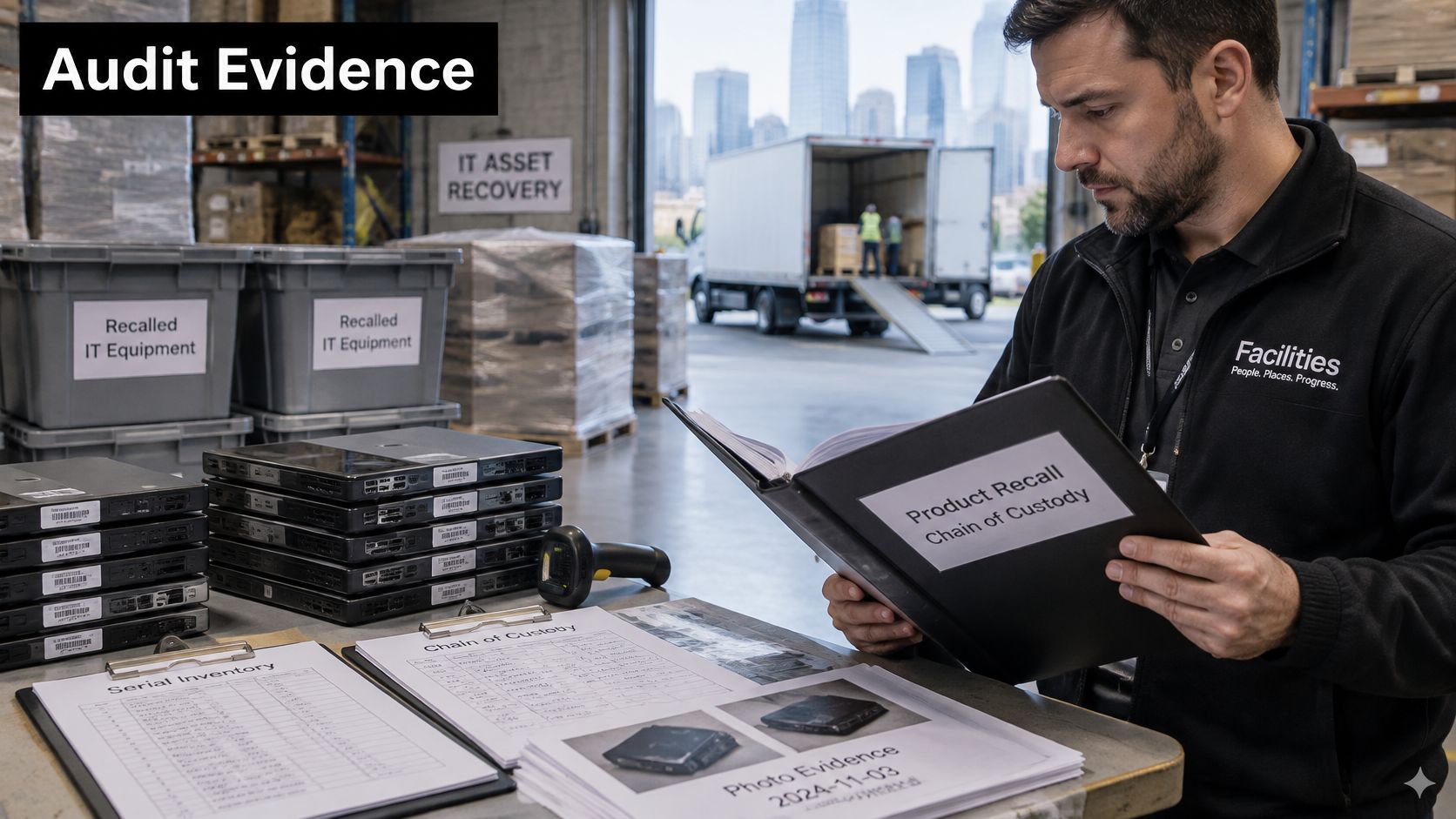
Follow an identifier through every handoff
Say your register contains a laptop identified as Asset RCL-A. Its inventory entry links the manufacturer serial number to the recall case, a dated label photograph, its quarantine location, and its assigned custodian.
When the laptop leaves, the signed transfer receipt identifies Asset RCL-A or references an attached serialized manifest. The final certificate must then connect that same identifier to the authorized outcome. If a processor assigns a new identifier, retain the cross-reference rather than replacing the original record.
Build the case file around these documents:
- Case and inventory records: Recall notice, unique case number, asset-level inventory, and authorization correspondence.
- Physical-control evidence: Dated quarantine photographs, status labels, and restricted-access logs.
- Handoff documents: Signed transfer receipts, shipping records, and receiving confirmations.
- Exception records: Missing, rejected, or damaged units, with explanations and named owners.
- Final evidence: Destruction certificates, manufacturer return receipts, or correction records.
Our chain-of-custody documentation guidance supports this record structure. In our process, the third step, Certification & Reporting, provides customers with detailed reports and a Certificate of Destruction.
Reconcile outcomes without double counting
Calculate the opening population minus completed outcomes to identify what remains unresolved. If your ledger separates destroyed units from manufacturer returns, subtract each separately; if “disposed” already includes returns, don't subtract those returns again.
A remaining difference needs an exception entry, an explanation, an owner, and a next action. A signed receipt proves transfer, but it doesn't automatically prove that final treatment occurred.
A vendor's summary letter is weaker than device-level evidence when nobody can connect its total to your inventory.
Specify that a Certificate of Destruction should identify the devices, processing date, destruction method, and vendor or witness signature. For combined product destruction and data destruction, distinguish the outcomes rather than assuming a single certificate title proves both.
Keep acknowledgment records showing that the right recipients received and understood the instructions. Set retention according to applicable sector requirements, contracts, legal holds, and auditor expectations, then store the complete file in a controlled repository outside the quarantine area.
Handling Batteries and Data Safely and the Failures to Avoid
A recalled pallet stops being inventory the moment the notice posts. From that point it is reverse logistics with hazards attached, and each item needs a route based on what can burn, leak, or expose data.
Identify hazards before anyone packs equipment. Screen for lithium-ion batteries, swollen or damaged packs, CRT monitors, mercury-containing components, and storage media. Do not power up a suspect device merely to read its specifications.
The EPA's lithium-ion battery recycling FAQ recommends that businesses consider managing all used lithium batteries under federal universal-waste rules, which generally allow accumulation for up to one year, subject to state requirements and facility authorization. The downstream route still needs documentation whether material goes to recycling or disposal.
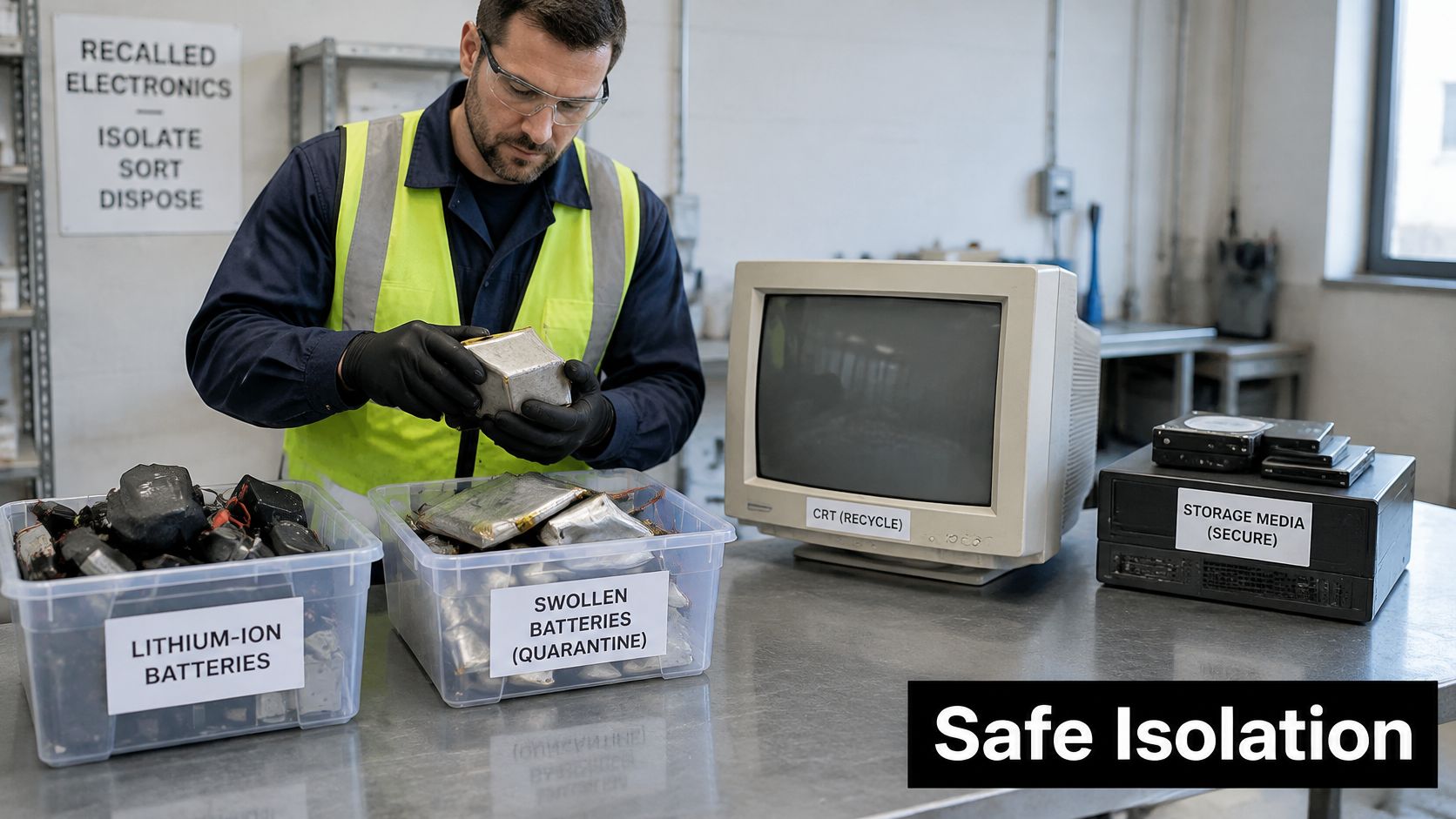
Prepare batteries without improvising a shipment
Protect against short circuits. For stable packs that staff are authorized to handle, cover exposed terminals with nonconductive tape or isolate each battery individually. Preserve readable identification.
Stage damaged packs under specialist direction. Use suitable non-combustible containment away from flammable materials when trained personnel determine handling is safe. Do not improvise sealed containers or ask an untrained employee to move a heating pack.
Keep batteries out of shared e-waste bins. Package units individually using the receiving facility's and carrier's specified containment and applicable hazard labels. A generic battery sticker does not establish transport compliance.
Escalate damaged units. Assign preparation and movement to a qualified hazardous-material handler. Active heating, smoke, or venting requires the site's emergency response procedure, not routine packing.
Confirm acceptance for the actual condition presented. Approval for intact embedded batteries does not establish acceptance for swollen packs, loose cells, or devices covered by a recall.
Verify data treatment separately
Sanitize data-bearing devices before authorized reuse, or physically destroy media where reuse is prohibited. Maintain a device-to-certificate cross-reference so an equipment transfer cannot conceal an unresolved information-security obligation.
Verification works best when each device is checked directly. When individual verification is impractical, use representative sampling that covers different areas of the media and different devices in the lot. I recommend recording the method, sample basis, and result so an auditor can see what was checked.
Our data sanitization explanation helps distinguish treatment methods. Reworx Recycling securely wipes or shreds data-bearing devices to protect customers' information, and recycling processes follow EPA rules for e-waste disposal.
Correct the failures that leave cases unresolved
The CPSC recall checklist calls for physical separation across the distribution chain, including products in transit and material designated for salvage or liquidation. Apply that control to every office cleanout and facility cleanout.
- Stopping at direct customers: Verify whether recipients redistributed affected equipment and obtain downstream confirmations.
- Combining recalled and cleared stock: Maintain a separate labeled zone rather than relying on pallet position.
- Treating recalled laptops as ordinary e-waste: Check individual identifiers against recall ranges before release.
- Destroying equipment without data evidence: Require documentation naming each affected data-bearing device.
- Skipping RCRA or state checks: Confirm applicable requirements and retain the downstream route in writing.
- Donating usable-looking recalled items: Put the prohibition explicitly into the quarantine policy.
Test readiness with a timed retrieval exercise: can the team produce a serial-level account of every unit's destination within an hour? Treat that as an internal operational target, not a regulatory deadline.
Sample SOP and Close-Out Checklist for Your Team
A usable standard operating procedure gives staff an owner, an action, and a record to produce. It should work when the usual coordinator is absent and when a loading crew is waiting at the dock.
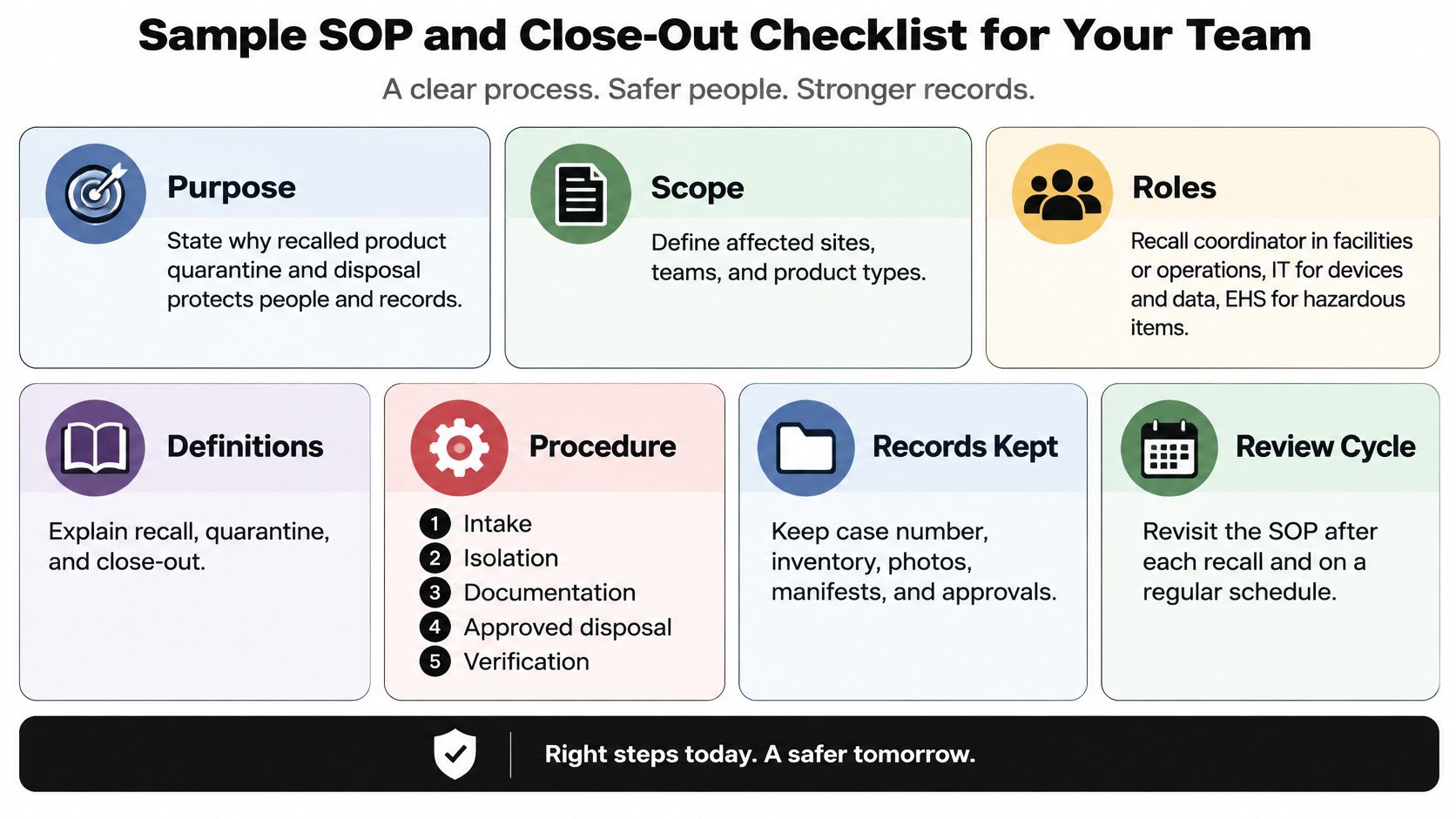
Sample SOP outline
- Purpose: Prevent affected equipment from returning to use or commerce while preserving evidence of its authorized outcome.
- Scope: Name covered sites, remote workers, storage locations, vendors, and equipment categories. Include temporary staging and goods awaiting collection.
- Roles: The facilities or IT recall coordinator owns the case number. A custodian controls quarantine keys; a compliance or finance approver signs disposition; a vendor liaison confirms the downstream route. IT owns data decisions, while environmental health and safety handles hazardous-material decisions.
- Definitions: Define recall, quarantine, custody transfer, exception, written authorization, and close-out. Distinguish movement approval from final processing approval.
- Procedure: Adopt the seven-step protocol, with a stop-work provision for unidentified equipment, changing battery condition, or conflicting manufacturer instructions.
- Records kept: Specify the master inventory, photographs, access records, communications, transfer documents, certificates, and approvals. Name the repository and its backup owner.
- Review cycle: Revisit the SOP after each recall and audit finding, and assign a recurring review under your document-control policy.
Use our compliance checklist template as a starting point, then tailor responsibilities to your organization. A general template won't decide who can stop a shipment or authorize destruction; your SOP must name those roles.
Close-out sign-off checklist
Complete these checks before changing the case to closed:
- Inventory reconciled: No units remain outstanding.
- Exceptions resolved: Each exception has an owner and documented resolution.
- Certificates matched: Every applicable certificate connects to the corresponding serial or asset identifier.
- Vendor route confirmed: Written receiving and downstream-route records are filed.
- Approval recorded: The authorized approver has signed and dated closure.
- File retrievable: Someone other than the coordinator can locate the complete record.
An exception owner isn't a substitute for resolving a missing unit. If unresolved assets remain, keep the operational case open or escalate under the applicable recall process rather than forcing the checklist to pass.
Close-out discipline: An empty quarantine room proves that equipment moved, not that the recall is complete.
For a school district, specify a key log, substitute-custodian arrangements, and collection procedures for devices held in classrooms. For a warehouse, emphasize pallet tags, dock holds, shipment release permissions, and carrier instructions.
Apply the same ownership model to data center decommissioning, medical equipment disposal, and laboratory equipment disposal, while adding the hazard and acceptance checks each stream requires. After every recall or audit finding, revise the SOP, record the change, and brief the staff whose actions must change.
Schedule Your Recalled Equipment Pickup Now
A recall hold fails at the loading dock when the truck arrives before the paperwork does. Facilities wants the pallet gone, IT wants serials confirmed, and the driver can only take what the receiving facility agreed to accept. That conflict is avoidable. Treat the pickup as auditable reverse logistics, with each unit routed by hazard and data risk, and get authorization in writing before anything moves.
Reworx Recycling is an electronics recycling and IT asset disposition partner based in Smyrna, Georgia. The company offers business pickups, responsible recycling, and free data destruction, with a Certificate of Destruction documenting the applicable process. 99.9% of the electronics we process are saved from landfills.
Prepare the case before requesting a truck. A clear equipment list lets facilities, IT, and the receiving team resolve acceptance questions before loading begins. Gather the recall notice with the manufacturer remedy and contact, an inventory with models, serial ranges, and lot or date codes, dated quarantine photographs taken without disturbing unsafe equipment, and hazard and data flags that identify battery condition and storage media.
Submit an electronics recycling pickup request for recalled equipment with separate inventories for recalled and cleared equipment. Include the notice, condition information, and proposed disposition so authorization and acceptance can be settled before movement. I recommend building that same intake into a repeatable ITAD process for equipment retirement, so you are not rebuilding controls during each cleanout.
Route recalled units only after written authorization and receiving-facility acceptance are established. Keep recalled inventory physically and administratively separate from cleared equipment until certificates and downstream records close the file.