You know the feeling. A refresh starts on Monday, a row of laptops gets boxed up, a few monitors move to staging, and by Friday nobody's fully sure which device went where, who signed for it, or whether the retired gear reached the recycler or the donation partner. That's where real-time asset tracking stops being an abstract IT term and becomes the difference between a clean handoff and a messy chain-of-custody problem.
For IT teams, facilities managers, and sustainability leads, the point isn't just to see a dot on a map. The value is knowing where assets are, what condition they're in, who handled them last, and how they moved through disposal, donation, or redeployment. That matters even more when organizations are managing distributed offices, hybrid work, and end-of-life IT workflows at the same time.
What Real-Time Asset Tracking Actually Means
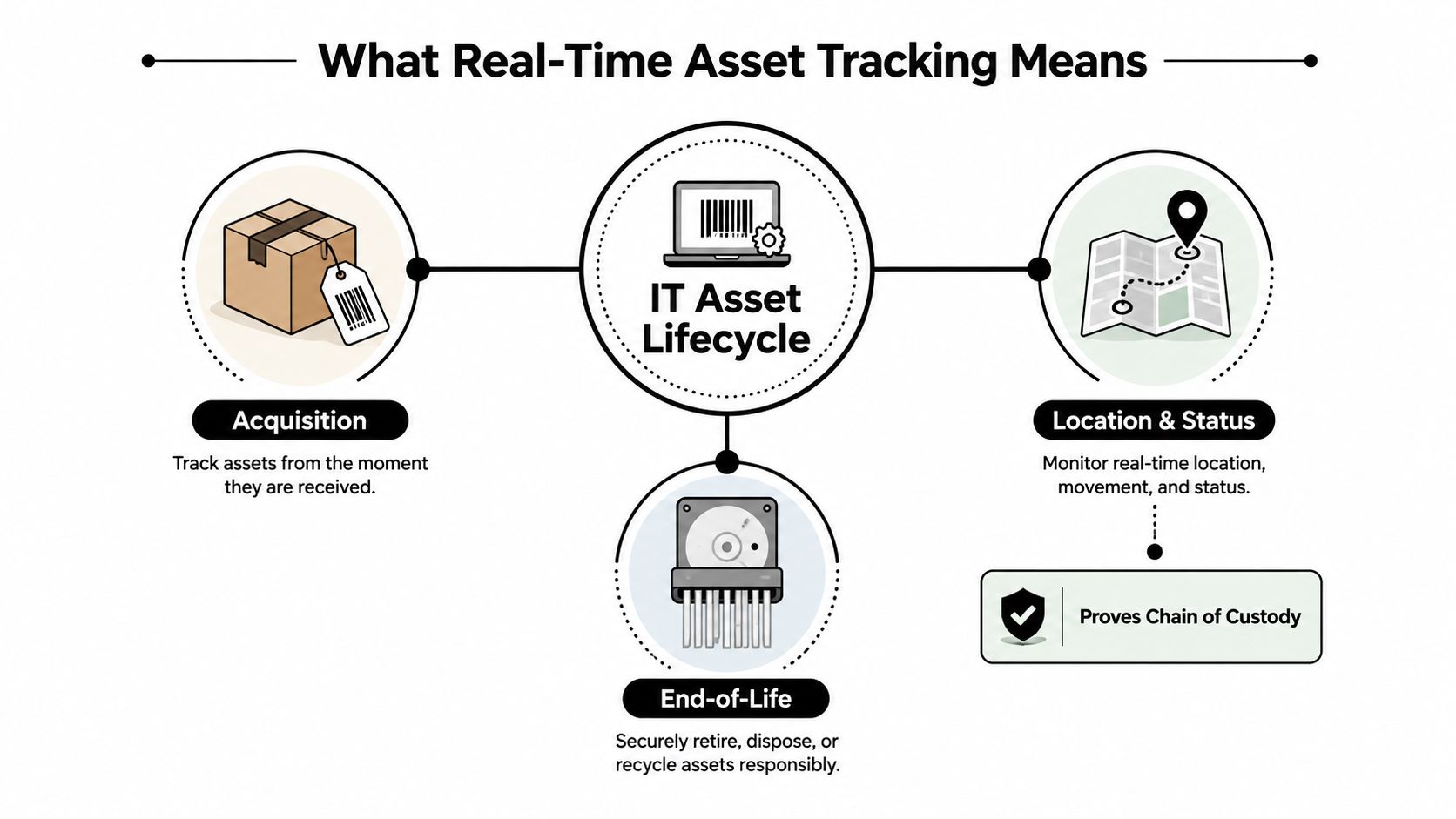
The simplest way to understand real-time asset tracking is to treat it as a live visibility layer for physical equipment. It uses unique identifiers, sensor data, and a positioning engine so teams can see where an asset is, what state it's in, and how it moved over time. That's different from periodic inventory checks, which only show a snapshot and can go stale quickly.
A practical workflow usually starts before any tag goes on a device. The team needs to identify every asset, assign a unique ID, and record location, condition, and criticality so the system has a reliable baseline. That's why asset tracking works best when it's tied to actual operational process, not treated like a labeling exercise. A good overview of the end-user side of this work is available in Reworx Recycling's asset tracking systems guide.
Why the distinction matters in practice
Barcode-only systems still have a place, but they're snapshot tools. They tell you that someone scanned a laptop at receiving or in storage, not whether it has since moved to a donation cage, a staging area, or a hard drive destruction queue. Real-time systems keep updating as assets move through the organization, which is why they're better suited to chain-of-custody use cases.
The market context helps explain the shift. IoT Analytics reported that large enterprises were tracking an average of 166,000 assets per day, and estimated that about 3.7 billion of the world's 18.8 billion connected IoT devices, roughly 20%, could be classified as IoT asset tracking devices, showing how mainstream this capability had become by 2025 (IoT Analytics). That scale tells you this isn't a niche tool anymore, it's part of enterprise operations.
Practical rule: if a team can't answer “where was it last seen, who touched it, and what happened next?”, it doesn't have real chain-of-custody visibility yet.
For end-of-life IT work, that distinction is huge. A device that is physically present, but not tied to a current status, can create audit risk, disposal delays, and unnecessary manual follow-up. Real-time visibility gives operations and sustainability teams one shared record instead of multiple versions of the truth.
How the Underlying Architecture Produces Location Data
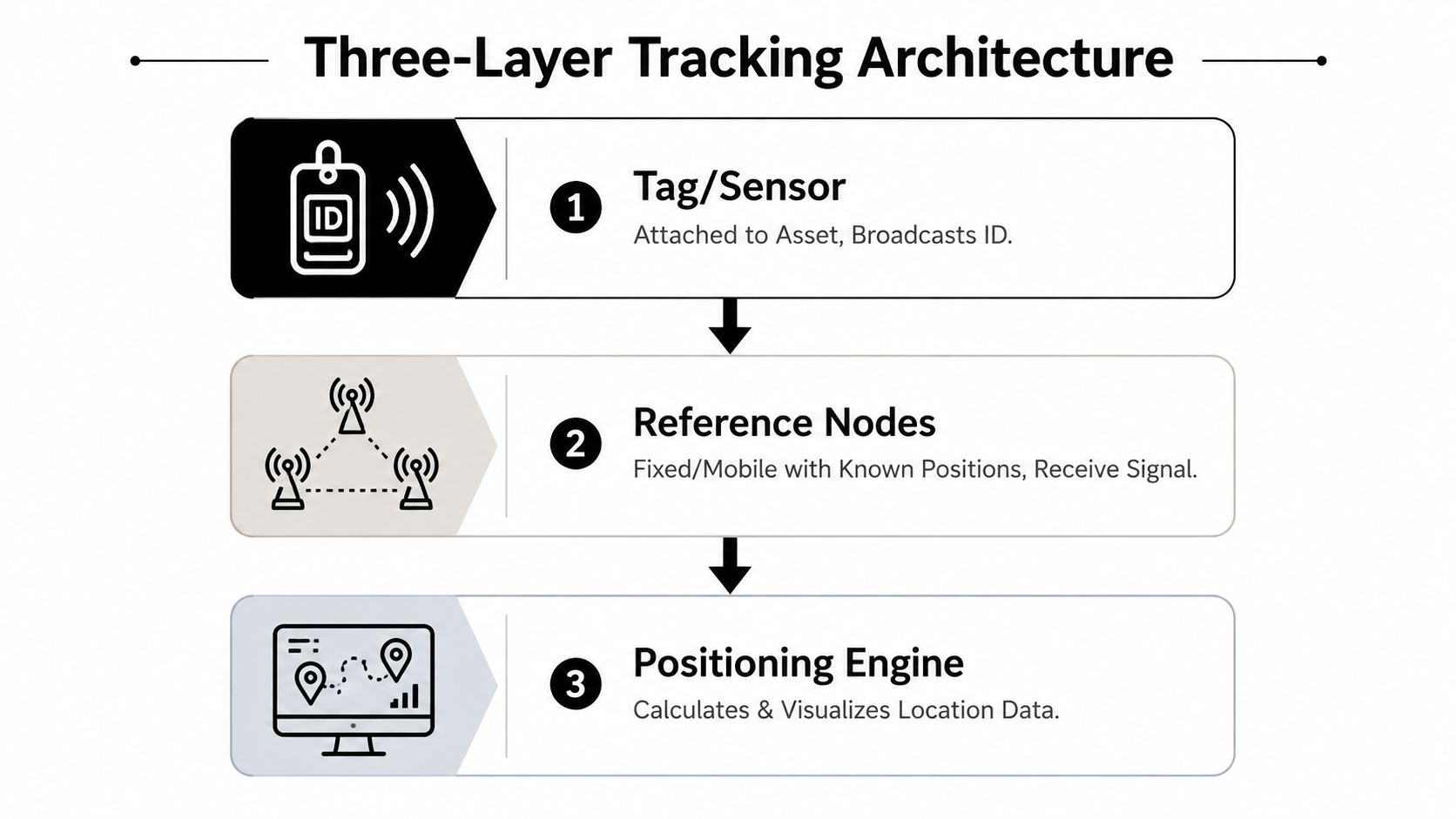
A laptop leaves a decommissioning room, passes through staging, and reaches a recycling or donation queue. The location record only stays trustworthy if the system keeps updating as that move happens. Real-time location does not come from the tag alone. It comes from a three-layer system, a tag or sensor on the asset, reference nodes or gateways with known positions, and a positioning engine that turns radio measurements into coordinates. That architecture is what makes the system useful, and it is why accuracy depends on the whole design, not just the hardware label.
The engineering trade-off is easy to miss at first. A tighter location estimate usually needs more infrastructure, better calibration, and smarter algorithms. A lower-cost deployment can still be useful, but it may provide zone-level awareness instead of precise coordinates. For teams building an asset tagging system for end-of-life IT, that difference matters because the goal is often to prove custody and movement, not just to know that something exists somewhere in the building.
How the signal becomes a location
The signal path starts with the tag, then moves through the reference layer, then ends in software that interprets the measurements. Signal strength estimates distance by judging how strong a signal arrives at a node. Time-of-flight measures how long the signal takes to travel. Angle-of-arrival estimates direction based on how the signal hits one or more receivers. Each method has strengths, and each one behaves differently indoors versus outdoors.
Indoor environments are where teams usually run into trouble. Walls, metal racks, elevators, and dense equipment can distort radio behavior, so anchor placement and calibration matter a great deal. A deployment inside a lab, warehouse, or server room does not behave the same way as an open campus or a yard, even if the same tag is used in both places.
GPS breadcrumbs and chalk outlines around a zone solve different problems. One is better for broad movement outside, the other for localizing activity inside a defined area.
That is why UWB RTLS can reach centimeter-level tracking in indoor deployments, while lower-cost BLE or Wi-Fi setups are often better for broader visibility than exact coordinates (A*STAR PDF). If the business need is audit-grade movement logs for retired servers or high-value laptops, accuracy is a system property, not a tag property. A tag can only report what the surrounding infrastructure can interpret.
A useful way to judge the architecture is to follow the asset lifecycle instead of the radio diagram. For end-of-life IT, the objective is not just location. It is proving movement from pickup to staging to disposal, donation, or destruction, with fewer gaps in the record and fewer disputes about who had the device at each step.
Choosing the Right Tracking Technology for Your Environment
Different tracking methods solve different problems, and IT teams usually need more than one. A laptop that moves between offices, a pallet of retired switches in a warehouse, and a server rack leaving a data center won't all need the same tracking stack. The right choice depends on where the asset moves, how often it moves, and how much precision the process requires.
| Tracking Technology Comparison for IT Environments | Typical Accuracy | Indoor Performance | Battery Life | Best Fit |
|---|---|---|---|---|
| GPS or GNSS | Strong outdoors, weaker indoors | Limited indoors | Often strong for low-reporting devices | Fleet assets, yard equipment, outdoor containers |
| BLE | Zone-level to room-level | Good in many buildings | Usually efficient | Office assets, low-cost visibility |
| UWB | Very high precision | Excellent in controlled indoor sites | Varies by design | High-value assets, chain-of-custody workflows |
| RFID or NFC | Reads at checkpoints | Strong at portals and handoff points | Tags can be passive | Receiving, staging, disposal checkpoints |
| LPWAN | Broad coverage over distance | Depends on local environment | Often designed for long life | Distributed assets, low-frequency status updates |
Match the tool to the environment
GPS or GNSS works well when assets spend time outdoors or move between sites. It's less effective in places where the signal is blocked, so it's not a complete answer for indoor IT estates. BLE is often a practical middle ground when teams need affordable visibility without demanding pinpoint coordinates.
UWB earns its place when precision matters. Think of clean chain-of-custody events, restricted storage rooms, or controlled handoff areas where a misplaced asset becomes a real compliance problem. RFID and NFC are especially useful at handoff points because they create verifiable checkpoints rather than constant live location.
LPWAN can be a fit when the asset is dispersed and the organization wants longer-lived telemetry with fewer updates. That said, mixed indoor and outdoor operations often work better with a hybrid model, since no single technology covers every environment cleanly.
The main decision isn't technical purity, it's operational fit. If the team needs to know whether a decommissioned laptop is inside the staging cage, a portal scan may be enough. If it needs to know whether a high-value server has been moved into the wrong bay, tighter location tooling becomes worth the complexity.
For teams standardizing labels across the lifecycle, the inventory labeling system guide is a useful reference point before deployment decisions get locked in.
A Practical Implementation Roadmap
The fastest way to derail a tracking project is to start with tags instead of process. The better approach is to define the workflow first, then apply the technology around it. That means deciding what must be tracked, who handles each transfer, and what event counts as proof for the record.
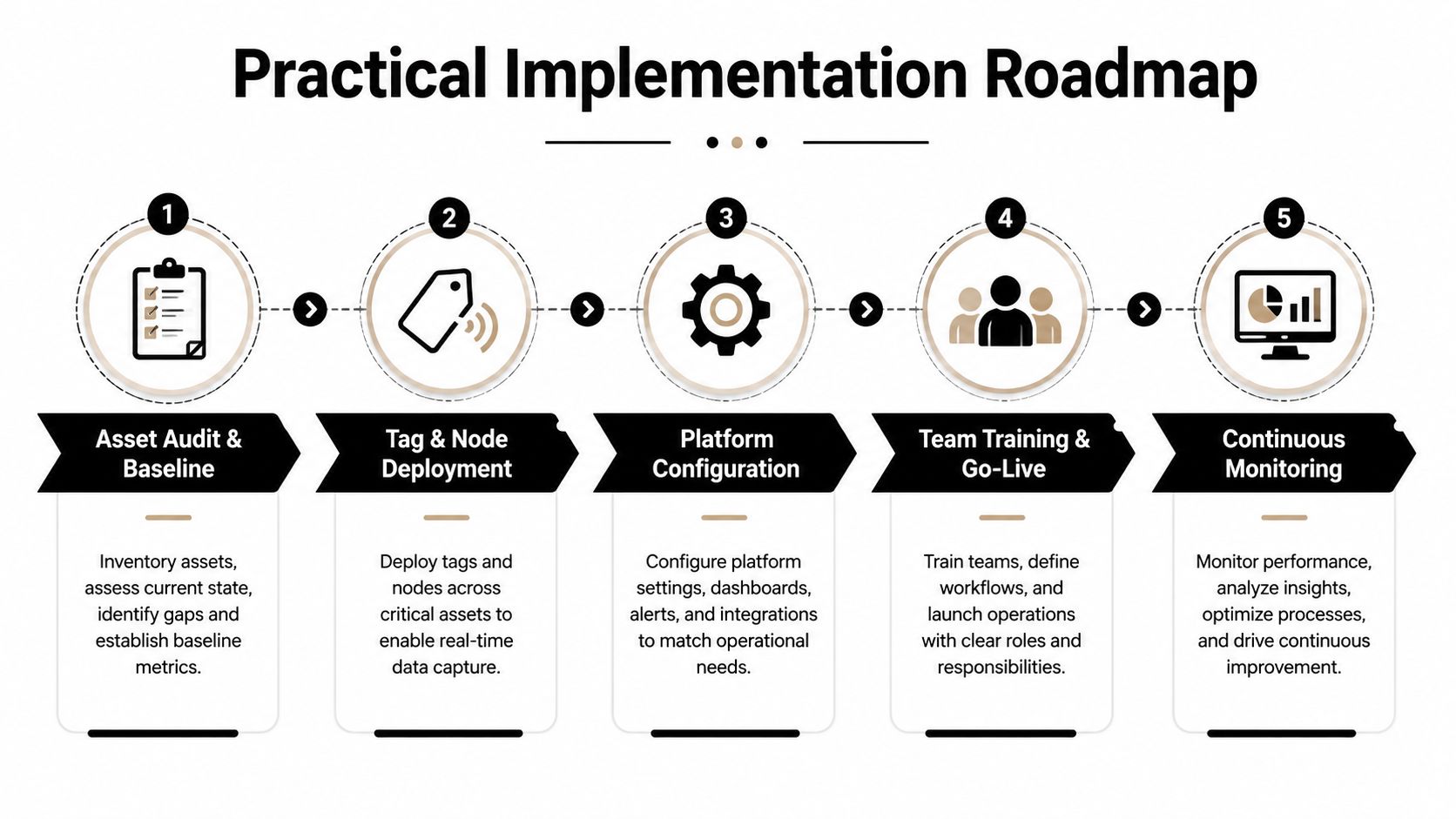
A strong rollout usually begins with a complete asset audit. Teams identify every device, assign a unique ID, and record current location, condition, and criticality before the first tag is attached. After that, the organization can decide where anchors, readers, or gateways need to sit and how updates should flow into the asset database.
The rollout sequence that holds up under pressure
A practical sequence looks like this.
- Asset audit and baseline. Capture every item, its label, and its current state before movement begins.
- Tag and node deployment. Attach sensors or tags, then place gateways or anchors where movement really happens.
- Platform configuration. Map events into the ITSM or asset record system so updates don't live in a silo.
- Team training and go-live. Make sure handlers, technicians, and managers know what counts as a transfer event.
- Continuous monitoring. Review exceptions, missed scans, and location mismatches as part of regular operations.
The best implementations also handle change management early. A naming mismatch between facilities and IT can create bad records that ripple through the whole program. Poor onboarding can do the same thing, because people fall back to old habits when the new process feels slower than the old one.
If you want a useful example of how location logic gets applied in operational workflows, browse geofencing fleet success cases from Faberwork LLC and compare the logic to how a campus or decommissioning route is managed. The underlying point is the same, define boundaries clearly and enforce them consistently.
For planning the operational rollout, Reworx Recycling's implementation timelines can help teams think about sequencing instead of treating the project like a one-time equipment purchase.
Connecting Tracking to ITAD, Recycling, and Sustainability
An asset's value often becomes clearest when it is leaving the building. Live location data and custody events make IT asset disposition (ITAD) easier to control because teams can see how devices moved before they were wiped, reused, donated, or destroyed. That matters any time a load passes through multiple hands, whether that is an internal staging area, a carrier, or a third-party processor.
The same record supports data center decommissioning and donation-based reuse. A server, laptop, or peripheral can be marked as it leaves service, arrives in staging, reaches secure destruction, or is transferred to a vetted donation partner. For sustainability teams, that chain of events becomes a practical record for reuse, diversion, and responsible disposition, instead of a general statement that equipment was recycled.
Organizations often compare device lifecycle platforms before they compare disposal partners. For a useful lens on that planning stage, managing device lifecycles in 2026 from Nutmeg Technologies frames the conversation around process, not just hardware. The same logic applies here, because the record matters most when it shows what happened and who handled it.
Where the tracking record becomes operational proof
Reworx Recycling fits naturally into that workflow as a donation-based electronics recycling and IT equipment disposal option for organizations that want documented end-of-life handling. Teams usually need more than a pickup confirmation. They need to know whether a retired device was received, processed, and routed correctly, and whether the disposition trail can stand up to internal review. Real-time tracking for ITAD and recycling workflows helps make that handoff visible, especially when devices move from office storage to staging, then to final processing.
Tracking also supports sustainability conversations that go beyond “we recycled it.” Corporate donation programs, secure data destruction, and product destruction each create different records and different levels of confidence for downstream reviewers. A live custody trail makes those differences easier to explain to finance, compliance, and leadership teams, because the timeline shows what happened at each handoff instead of leaving the process to memory.
Operational takeaway: the best end-of-life process is the one that leaves a clean, searchable record from pickup through final disposition.
For organizations trying to close the loop on donations, reuse, and disposal, the tracking layer becomes the bridge between IT operations and environmental reporting. It gives teams one shared timeline instead of separate spreadsheets, invoices, and email threads, and it helps align disposal work with responsible recycling and verifiable chain of custody.
Security, Compliance, and What Location Data Alone Cannot Do
A map dot shows where a device was seen. It does not show whether the handoff was approved, whether the device stayed within policy, or whether the record is complete enough for an audit. Real value appears when real-time asset tracking is tied to secure data destruction, geofencing, role-based access, and the compliance steps an organization already uses for sensitive equipment.
That matters in healthcare, education, financial services, and government, where moving an asset can trigger chain-of-custody requirements. The system needs to make clear who can view the data, who can change the status of an asset, and which actions create a formal record. Without those rules, tracking becomes another visibility layer, useful for status checks, but weak as a control.
Design the workflow, not just the screen
A hospital RTLS project described in the source brief showed that deployment succeeds or fails on the details around the system, not on the map alone. Usability, tag design, technical limits, solution functions, operational support, the chosen asset types, the tracking area, and the sensor type all shape whether people use the tool. If the workflow is confusing or ownership is unclear, adoption slows even when the hardware is working.
That is why the tracking layer should connect to ITSM and disposal workflows. A missing hard drive should not sit as a passive location alert. It should become an operational event with a clear response path, just like a device that enters a restricted area or leaves an approved geofence. In end-of-life IT and ITAD work, those alerts matter because they help teams verify transfer, recycling, donation-based reuse, or secure destruction with less guesswork.
For teams that need to prove control design and evidence quality, Cloudvara's guide to SOC reports is a useful companion read. The practical lesson is straightforward. Security and compliance improve when the system is built to show what happened, who handled it, and which step produced the record, not only where the asset was last seen.
ROI Patterns and What to Measure by Organization Type
The ROI story changes by organization, but the measurement logic stays similar. Small and mid-sized businesses usually want fewer lost devices and less manual chasing. Enterprises care about decommissioning throughput, audit readiness, and cleaner handoffs across teams. Schools, universities, and public-sector groups often focus on documented donation outcomes and reduced disposal friction.
For small and mid-sized teams, the most useful metrics are simple. Track missing assets, time spent reconciling inventory, and the number of manual follow-ups needed after a move or pickup. If the team can't spend less time hunting for equipment, the system isn't solving the right problem.
What each group should watch
- Small and mid-sized businesses: fewer shrinkage events, faster move-out and refresh workflows, less time spent on spreadsheets.
- Enterprise IT and facilities teams: cleaner data center decommissioning, stronger custody records, fewer exceptions during bulk moves.
- Schools and universities: documented donation outcomes, easier lab and office cleanouts, better visibility into retired technology.
- Government and public-sector agencies: searchable audit trails, stricter handoff control, better support for secure data destruction and disposition records.
Grand View Research estimated the global asset tracking market at USD 24.14 billion in 2024, with a projection to reach USD 51.59 billion by 2030, implying a 14.9% CAGR from 2025 to 2030 (Grand View Research). That market growth doesn't guarantee ROI for every buyer, but it does show sustained demand for visibility, compliance, and continuous control across physical assets.
For many teams, the ROI is less about a single dramatic savings number and more about removing repeated friction. Fewer lost devices, cleaner audits, and fewer disputes over where equipment went create measurable operational value. In end-of-life IT work, that value often shows up as fewer delays, fewer exceptions, and more confidence in the record.
If your team is trying to connect real-time asset tracking with ITAD, donation-based recycling, or secure data destruction, Reworx Recycling can help you turn retired equipment into a documented, responsible process. Visit Reworx Recycling to explore electronics recycling, pickup coordination, and end-of-life IT options that fit your next office cleanout, refresh, or decommissioning project.