You're staring at the same mess a lot of San Antonio offices face after a refresh, a move, or a storage-room cleanout. The pile is always awkward, a few retired laptops, a dead server, two monitors, a printer nobody wants, and a manager asking what can go to the city, what needs a pickup, and what has to stay locked down until the data is gone. electronic recycling San Antonio Texas sounds simple until you're the one responsible for chain of custody, facility timing, and making sure nothing sensitive walks out the door undocumented.
The right answer starts with separating the city's public drop-off path from business-grade ITAD work. San Antonio does have a real municipal electronics stream, but once you're dealing with recurring volumes, sensitive storage media, or equipment that needs to be removed from a facility rather than hauled around in a personal vehicle, the public system stops being the right tool. If you run IT, facilities, or procurement, you need a workflow that handles the devices, the data, and the paperwork in the right order.
When San Antonio Offices Hit the Wall on Old Equipment
The first mistake many teams make is treating all old electronics the same. A box of obsolete keyboards is not the same as a rack server with drives still in place, and a pile of mixed assets is not a plan.
A San Antonio office refresh usually starts innocently. Someone opens a storage closet and finds old laptops from the last lease cycle, a dead desktop tower, a monitor with a cracked panel, and a printer that hasn't moved since the last department shuffle. That's the point where the wrong choice costs time, because the easy answer, “just recycle it,” doesn't say who handles the data, who moves the equipment, or who signs off on the disposition record.
For business buyers, the question is not whether the gear is old. It's whether it can leave the building safely, with documentation, and without slowing the next project.
Sort the assets before anyone touches the calendar
A clean inventory comes first. If you don't know which machines still have reusable parts, which ones are scrap, and which ones contain sensitive storage, every later step gets slower. That's why an IT inventory audit matters before recycling, especially when multiple departments are involved, and why a structured intake beats a rushed haul-out. IT inventory audits and why they matter before recycling
Practical rule: If your team can't answer who owned each device, what data lived on it, and whether it still powers on, it's not ready for pickup.
Once that separation is done, the path is much clearer. City drop-off can handle some material. Private pickup and IT asset disposition handle the rest. The mistake is trying to force every device through the same channel just because it's convenient on paper.
Using the City of San Antonio Drop-Off System the Right Way
San Antonio's public electronics route is useful, but it's specific. The City's Household Hazardous Waste system publishes two permanent drop-off locations, 7030 Culebra Road and 2755 Rigsby Avenue, and the City's guidance says electronic devices must go to an HHW drop-off center and never in curbside carts. The rule is direct, not optional. San Antonio HHW drop-off locations and hours and City disposal guidance for electronics
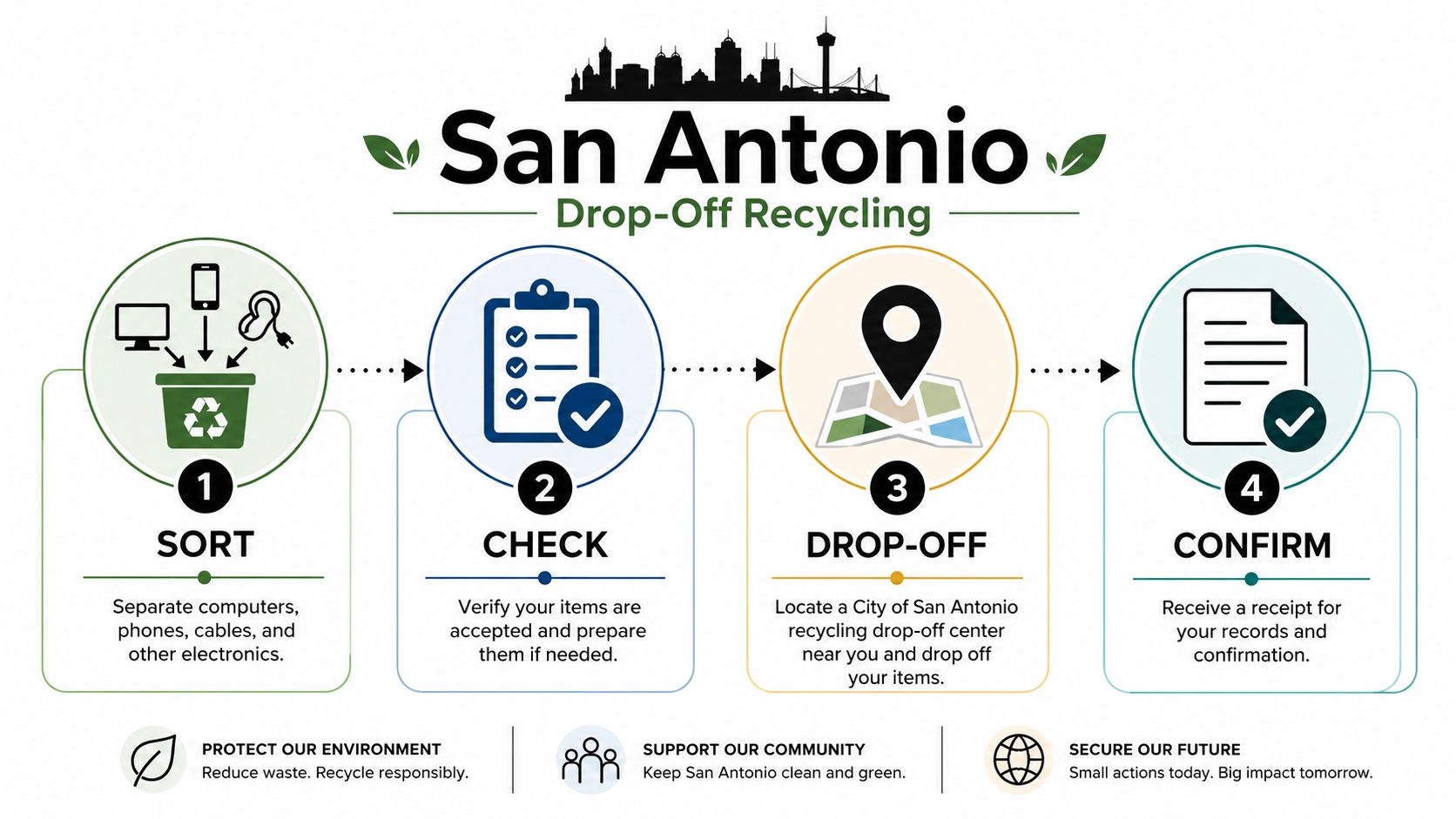
The city system is built for household-scale streams and small office overflow. It handles the familiar stuff, TVs, monitors, PCs, laptops, cell phones, stereos, and VCR-style devices, which makes it useful for families, solo operators, and school staff with a few boxes to clear out. For a business with recurring refreshes, though, the city line is only part of the picture.
Use the municipal system for the right kind of load
Drop-off is smart when you have a small, non-sensitive batch and the schedule can flex around posted hours. It's a poor fit when the equipment has to be removed from a live workplace, when the load includes storage drives, or when the volume is large enough that staff time becomes the primary cost. That's where businesses should stop thinking like households and start thinking like operators.
The City also runs rotating mobile collection locations each year, which helps residents and smaller organizations in different parts of the city get access without driving to a permanent center. That distributed access model is useful, but it still doesn't replace a pickup for offices, clinics, and campuses that need a documented, scheduled chain of custody.
If your material fits the city program, use it. If it doesn't, don't stretch the system past what it was built to absorb. That's how projects get delayed and data gets mishandled.
Free computer and laptop recycling in San Antonio
When to Step Up to Business Pickups and ITAD
The trigger point is simple. If you're looking at pallets instead of carloads, you're past the point where a public drop-off is the cleanest answer. The same is true when hard drives, multifunction printers with internal storage, or specialized equipment need a formal disposition trail. At that stage, the question shifts from “where can we recycle this” to “who can take custody of this with documentation.”
Compare the options like an IT buyer, not a consumer
Municipal drop-off works for a small batch with little complexity. Business pickup works when your team needs the devices removed from the site. Full IT asset disposition fits when you need testing, sorting, remarketing, data handling, and reporting tied together in one workflow. The right choice depends on four things, volume, data sensitivity, asset value, and the documentation standard your auditors or leadership expect.
A hospital refresh, for example, can't afford casual handling. A school district needs the clear chain of custody. A corporate office often wants both, plus a way to recover value from equipment that still has life left. That's why a private partner makes sense once the equipment is no longer just “old stuff” and starts becoming a compliance item.
Reworx Recycling's IT asset disposition overview is worth reading if you're trying to separate simple recycling from formal disposition work. What is IT asset disposition
If a vendor can't explain how they move from intake to documentation, they're not ready for business assets.
The practical difference is control. Drop-off is fine when control doesn't matter much. Pickup and ITAD matter when control is the whole point. That's also where medical equipment disposal, laboratory equipment disposal, office cleanout, and facility cleanout start to look like project work, not errands.
Locking Down Data Before Anything Leaves the Building
Data destruction should never be an afterthought. If it is, someone's guessing at risk instead of managing it. The cleaner approach is to sort devices by type and condition, separate reuse candidates from scrap, and assign a data-treatment path before anything gets staged for transport.
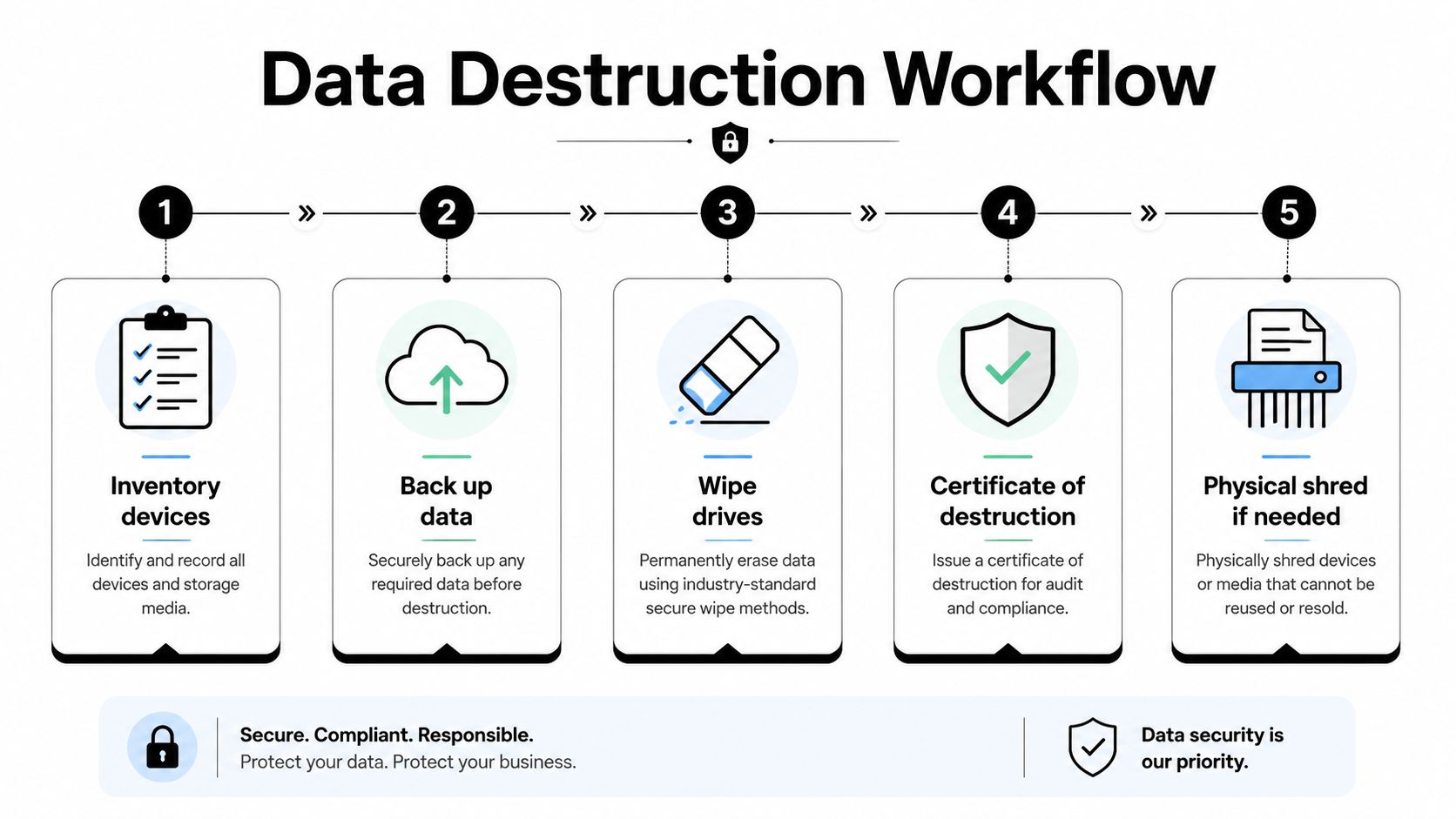
That triage step does real work. It keeps mixed loads from clogging the process, and it helps staff catch loose batteries, stray cables, and forgotten accessories before they create safety or sorting problems. More important, it forces the security question early, which is where it belongs.
Match the destruction method to the asset
Reusable drives can be wiped with approved software methods. End-of-life media that won't be redeployed should be degaussed or physically destroyed. Drives with uncertain history should not be handed off on trust alone. They should be shredded, documented, and tracked at the serial-number level.
The buyer should get a certificate of destruction, chain-of-custody records, and enough audit support to show exactly what happened to each asset. That paperwork is what turns disposal into defensible IT asset disposition. Without it, you have recycling. With it, you have compliance.
Secure data destruction services
Bottom line: If the data can trigger legal, regulatory, or reputational exposure, the drive gets treated as a security object, not a scrap component.
That's the part many teams underestimate. The truck move is the easy part. The proof after the move is what protects the organization.
What Actually Happens to Your Devices After Pickup
This is the question most local guides dodge. It's also the one CFOs and sustainability leads eventually ask. Once the truck leaves your site, the devices don't all follow the same path. Functional units may be refurbished for donation or resale. Working parts can be harvested for spares. Non-functional gear goes to downstream processors for material recovery. Some material is unrecoverable, and that should be stated plainly, not hidden behind marketing language.
Follow the downstream chain, not the slogan
A responsible vendor should be able to explain which assets are reused, which are repaired, which are dismantled, and which move to material recovery. That matters because donation-based recycling is not the same thing as dumping a load into a commodity stream. It extends product life when hardware still has value, and it gives organizations a way to connect disposition with community impact, digital inclusion, and workforce development.
Reworx Recycling's model fits that social-enterprise approach, because donation-based recycling and IT equipment disposal can be tied back into community benefit rather than stopping at diversion alone. What happens to recycled electronics
Texas gives you a strong benchmark for judging those claims. The Texas Commission on Environmental Quality reports that the state's electronics recovery programs have, over their lifetime, collected 488,032,667 pounds of electronics-related material, including 441,898,491 pounds of computers and televisions and 46,178,324 pounds of other electronics-related equipment. Of the computer-and-TV total, 429,287,470 pounds were recycled and 8,536,550 pounds were reused. Texas electronics recovery report
The scale matters because it shows San Antonio sits inside a mature statewide recovery system, not a one-off cleanup effort. Texas also reported 17,392,335 pounds of collected material in calendar year 2025, which included computers, additional electronic equipment, and televisions. The point isn't the headline number. The point is that downstream handling should be concrete, trackable, and tied to documented recovery outcomes.
Vetting a San Antonio Recycler Without Getting Burned
A lot of vendors sound fine until you ask for paperwork. That's the wrong time to discover gaps. A competent recycler should be able to name its standards, show its insurance, explain its chain of custody, and let you review how downstream partners are handled.
Run the vendor through a real checklist
Start with certifications. R2v3 and e-Stewards are the names worth knowing because they signal recognized industry standards. Then ask for proof of insurance that covers your data exposure, not just their trucks or warehouse. If a vendor can't produce that quickly, move on.
Then ask for operational evidence.
- Written chain of custody: Each handoff should be documented, not assumed.
- Serial-level reporting: You need to know which devices were received and processed.
- Certificates of destruction: These should come back per lot or per defined batch.
- Audit access: A serious vendor won't panic when you ask to review the process.
Red flags are usually obvious. Vague promises without named downstream partners. No written documentation. Pressure to skip wiping. No insurance. A reluctance to answer questions about where the material goes after pickup. Those are not small issues, they're warning signs.
If your organization also cares about community impact, the social-enterprise angle matters too. A donation-based recycler can turn retirements into technology donations instead of just disposal, which supports digital inclusion and workforce development. Reworx Recycling's service mix includes pickup scheduling, ITAD, secure data destruction, and buyback, so you can compare that package against any other bidder without having to translate sales language into operational reality.
Putting It Together and Taking the Next Step
A good San Antonio electronics recycling plan is boring in the best way. Inventory the assets. Separate reusable equipment from scrap. Decide whether the load belongs with the city's drop-off system or with a private ITAD partner. Lock down data destruction before anything moves. Then verify the downstream handling and keep the records.
That workflow works because it respects the difference between household-scale convenience and business-scale accountability. It also keeps the social piece in view. When reusable devices are donated and tracked properly, the result isn't just landfill diversion. It supports community access to technology and gives retired equipment a second life instead of a silent trip to a crusher.
The smartest move this week is to stop guessing at the path and assign one owner to the disposition plan. Once that owner knows the inventory, the data risk, and the required documentation, the rest becomes a straightforward operations task instead of a scramble.
If you need a practical path for electronics recycling, IT equipment disposal, or secure hard drive destruction in San Antonio, Reworx Recycling can help you set up the process around your inventory and documentation needs. Visit Reworx Recycling to schedule a pickup, ask about donation-based recycling, or start a conversation about an ITAD plan that fits your site.