The world generated 62 million tonnes of e-waste in 2022, yet only 15% to 20% of used electronics in the United States are collected for reuse and recycling. That gap explains why every laptop, server, phone, and networking device a business retires matters.
For business leaders, the question “why is it important to recycle electronics” has a broader answer than keeping devices out of a dumpster. Responsible electronics recycling protects soil and water, recovers materials that supply chains need, reduces climate impacts, and creates a documented path for data security and regulatory compliance.
A retired device sitting in a storeroom still carries value and risk. It may contain recoverable metals, sensitive business information, batteries, and components that require controlled handling. Companies that treat end-of-life technology as a managed business process can connect sustainability reporting with IT asset disposition, facilities planning, procurement, and corporate donation programs.
Why Electronics Recycling Matters More Than Ever
The world generated 62 billion kilograms, or 62 million tonnes, of e-waste in 2022, compared with 34 billion kilograms in 2010, an 82% increase over that period, according to the Global E-waste Monitor 2024. Annual generation is projected to reach 82 million tonnes by 2030. For business leaders, that trend signals growing pressure on waste systems, material supplies, and internal controls.
The collection gap is just as important. The U.S. Government Accountability Office reports that only about 15% to 20% of used electronics by weight are collected for reuse and recycling in the United States. Equipment outside formal channels may remain in storage, enter unsuitable waste systems, or lose its recoverable materials.
A retired device connects three business risks:
- Environmental risk: Mishandled electronics can release substances that threaten soil and water.
- Supply-chain risk: Formal processing can return metals, plastics, and other resources to manufacturing, reducing dependence on newly extracted materials.
- Data-governance risk: Storage media can retain confidential information after ordinary deletion, exposing the company if disposal is informal.
These risks reinforce one another. A missing asset record can weaken chain-of-custody evidence, while an uncontrolled vendor may create both data exposure and regulatory uncertainty. Electronics recycling therefore works like a control point in the supply chain. It directs devices, materials, information, and documentation through known channels instead of leaving each outcome to chance.
Regulation adds cross-border obligations. The Basel Convention e-waste amendments tightened oversight in 2025, requiring Prior Informed Consent documentation for international movement of e-waste, including non-hazardous electronics. Companies shipping equipment across borders need documented approvals, vendor controls, and visibility into downstream handling.
A formal program gives IT, sustainability, procurement, and facilities teams one operating model. The approach described in Reworx Recycling's sustainability guidance connects environmental handling with responsible asset disposition, helping leaders treat an old laptop as a managed business responsibility rather than a simple cleanup task.
What Counts as E-Waste and What Recycling Actually Does
E-waste is any powered or battery-operated device that has reached the end of its useful service life, whether the device is broken, obsolete, surplus, or no longer supported. For a business, that category can include laptops, desktop computers, servers, monitors, printers, mobile phones, network switches, routers, point-of-sale equipment, IoT sensors, laboratory equipment, and medical devices.
A circuit board is like a pocket mine. It can hold traces of gold, silver, copper, palladium, and other valuable materials, while the wider device may also contain lead, mercury, batteries, and brominated flame retardants. The combination makes informal disposal a poor choice. The same complexity that creates environmental risk also creates an opportunity for careful recovery.
The recycling workflow
A responsible recycler doesn't treat every device as raw waste immediately. The process usually begins with controlled collection and chain-of-custody records, followed by sorting and triage.
- Collection and identification: Staff record equipment, serial numbers, ownership, and transport details.
- Reuse assessment: Working devices may be tested, repaired, refurbished, or prepared for donation.
- Parts and material recovery: Non-reusable equipment is dismantled, with components routed for appropriate processing.
- Mechanical and downstream processing: Shredding, magnetic separation, eddy-current separation, smelting, and refining help separate ferrous metals, nonferrous metals, precious metals, plastics, and other fractions.
This is why Reworx Recycling's e-waste recycling process should be understood as a triage system rather than a single disposal action. The correct outcome may be a second life, parts harvesting, secure product destruction, or elemental recovery.
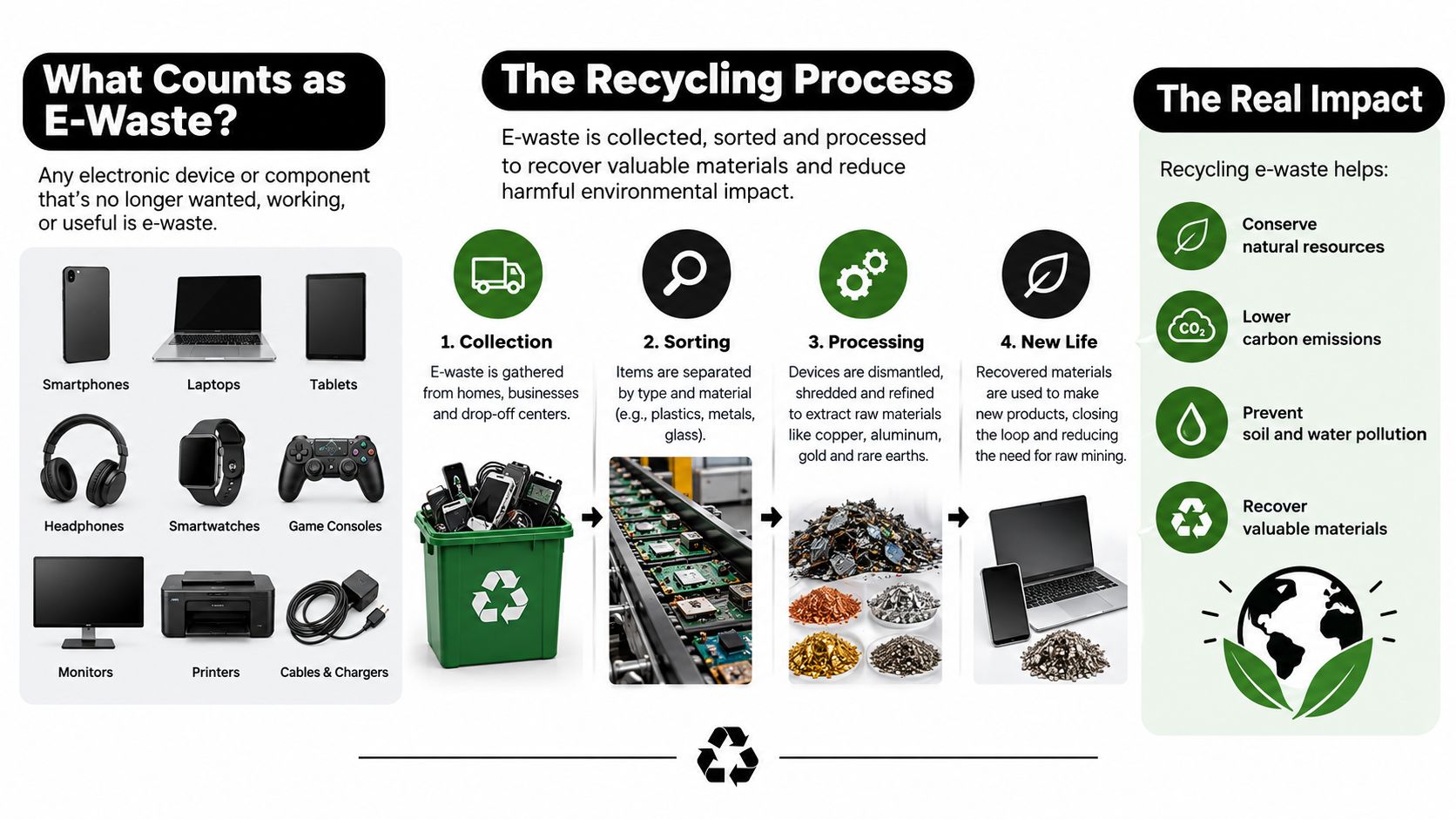
The three decision lenses remain consistent throughout the workflow: protect the environment, recover useful resources, and govern the asset and its information from pickup through final processing.
The Environmental Cost of Sending Electronics to Landfills
Sending electronics to landfills creates two connected risks. Materials that could support manufacturing are lost, while complex products enter a waste stream that may not be designed for their contents. Only a minority of used electronics reaches formal reuse or recycling channels, leaving companies with less visibility into the final destination of retired assets.
Electronics may contain lead in solder and older displays, mercury in switches or certain display components, cadmium in batteries and some older parts, and brominated flame retardants in plastics and circuit boards. If equipment is crushed, damaged, or exposed to moisture under unsuitable conditions, these substances can move into soil or groundwater. Removing an asset from an inventory does not remove that risk. It can continue through transportation, disposal, and downstream handling.
Common substances and their disposal implications
| Substance | Common Source | Environmental Impact |
|---|---|---|
| Lead | Solder, older displays, and circuit assemblies | Can contaminate soil and water when electronics are mishandled |
| Mercury | Switches, lamps, and some display components | Can persist in the environment and create contamination concerns |
| Cadmium | Batteries and electronic components | Can enter waste residues and affect soil and water quality |
| Brominated flame retardants | Plastic housings and circuit-board materials | Require controlled handling during dismantling and processing |
Formal recycling changes the conditions under which equipment is handled. Permitted facilities can isolate hazardous fractions, send them to specialized downstream processors, and recover metals and plastics without treating the entire device as ordinary municipal waste. The environmental impact of electronics recycling therefore includes both pollution prevention and better control over material flows.
For business leaders, landfill disposal also creates governance concerns. It can increase reputational exposure in sustainability disclosures, weaken supplier due diligence, and make it difficult to show what happened to retired equipment. A documented recycling program gives procurement, IT, and compliance teams clearer evidence of collection, processing, and recovery.
Practical rule: If a device contains a battery, circuit board, display, or storage media, do not assume ordinary trash is an acceptable end-of-life route.
Recycling works best as part of a broader asset strategy. Teams should first assess whether equipment can be reused, repaired, or kept in service longer. Assets without a safe or practical second life can then enter controlled recycling, reducing environmental exposure while strengthening records for audits, supplier reviews, and sustainability reporting.
Recovering Critical Resources and Strengthening Supply Chains
Electronics recycling is also a form of urban mining. Instead of opening new ground to obtain every needed input, processors recover materials from products already in circulation. The International Telecommunication Union's e-waste backgrounder reports that formal recycling in 2022 avoided extraction of 900 million tonnes of primary ore, prevented 93 million tonnes of CO2e emissions, reclaimed USD 28 billion in secondary raw materials, and preserved USD 91 billion in embedded metals value.
Those figures change the business conversation. A retired server or laptop isn't only a disposal cost. It may represent copper, aluminum, steel, gold, plastics, and other material inputs that can be recovered instead of lost. The value depends on collection quality, sorting, processing technology, and downstream accountability. Informal or mixed waste streams often lose high-value fractions before they reach a controlled recovery facility.
Secondary materials support resilience
Supply chains for copper, cobalt, lithium, rare earth elements, and other inputs can face price volatility, geographic concentration, transport disruption, and geopolitical pressure. Recycling can't eliminate those risks, but it can provide an additional source of material and reduce reliance on virgin extraction.
| Material | Primary Mining Yield | E-Waste Recovery Yield | Strategic Value |
|---|---|---|---|
| Copper | Requires extraction and processing of primary ore | Recovered from wiring, motors, boards, and connectors | Supports electrical and network hardware supply |
| Gold | Obtained through ore mining and refining | Recovered from high-grade circuit-board fractions | Retains high-value material already present in devices |
| Plastics | Produced from virgin feedstocks | Separated from housings and components | Reduces demand for new material inputs |
| Rare and critical materials | Often tied to specialized, concentrated supply chains | Recovered where processing streams support separation | Adds an alternative source for material security |
Climate performance strengthens the case. An Australian government e-stewardship evidence review found that, on average, each kilogram of CO2e emitted during recycling processes was associated with 18 kilograms of CO2e recovered through secondary-material production. The review also found that recycling one tonne of mixed television and computer waste could avoid about 1.2 tonnes of CO2e.
Businesses that need stronger traceability can also explore guidance on audit-ready mineral sourcing. That type of governance connects procurement, sustainability, and downstream material accountability.
For high-value equipment, a documented precious-metals recovery process helps turn end-of-life handling into a resource-retention activity. The broader point is strategic: recycling electronics can buffer material shortages while supporting environmental objectives.
Data Security and Compliance Responsibilities for Businesses
An electronics recycling program can fail even when the environmental outcome looks acceptable. If a retired laptop leaves the building with recoverable customer information on its drive, the organization still has a data-governance problem.
Deleting files, emptying a recycle bin, or reformatting a drive changes what a user sees. It doesn't necessarily remove the underlying data from storage media. Businesses need a documented sanitization decision based on the asset, the sensitivity of the information, and whether the device will be reused or destroyed.
Match sanitization to the asset
The National Institute of Standards and Technology's NIST Special Publication 800-88 provides a framework for media sanitization. In practice, organizations commonly distinguish among:
- Clear: Apply logical techniques appropriate to the storage technology and risk level.
- Purge: Use stronger techniques intended to make data recovery impractical, including supported cryptographic or device-specific methods.
- Destroy: Physically destroy the media when reuse isn't appropriate or the risk requires it.
Physical hard-drive shredding is a direct destroy method. Degaussing can also be relevant for suitable magnetic media, although it isn't appropriate for every modern storage technology. A qualified ITAD provider should identify the media type before selecting a method, then document the result.
Build an evidence trail
A defensible workflow includes:
- Asset inventory and serial-number capture.
- Secure transport and chain-of-custody records.
- Sanitization or destruction at an approved location.
- Certificates of destruction tied to specific assets.
- Downstream processing records for equipment that enters reuse or recycling.
Regulatory obligations may arise under HIPAA, FACTA, GDPR, and state privacy laws, depending on the organization, information, and jurisdiction. Those laws don't all impose identical requirements, so legal and compliance teams should map the applicable rules to internal policy.
Cross-border movements add another control point. Under the 2025 Basel Convention Prior Informed Consent amendments, international shipments of e-waste require stricter documentation and oversight, including for non-hazardous electronics. Companies should verify exporter responsibilities, shipment classifications, destination facilities, and records before equipment crosses a border.
A secure data destruction service can support the operational side of this process. The company still owns the policy decision, vendor due diligence, and retention of compliance evidence.
How Donation-Based Recycling Works in Practice
Consider a representative mid-sized company retiring 200 laptops during a technology refresh. The organization doesn't want to send usable devices into a mixed waste stream, but it also can't release equipment before protecting employee, customer, and business information.
The first step is a scheduled business pickup. The recycler receives an asset list, tags each laptop by serial number, and records custody as the equipment moves from the office to the processing facility. That record gives the IT manager a reliable starting point for reconciliation.
One retirement event, several outcomes
The laptops then move through separate paths:
- Data security: Drives receive an approved sanitization treatment, or the storage media is physically shredded when reuse isn't suitable.
- Functional testing: Technicians inspect power, displays, keyboards, batteries, ports, and operating condition.
- Refurbishment: Usable devices may be prepared for redistribution through schools, nonprofits, or community programs.
- Material recovery: Broken or obsolete units are dismantled and routed to responsible downstream processors.
- Reporting: The business receives asset records, destruction certificates where applicable, and documentation of the equipment's final pathway.
A donation-based recycling model connects compliance with community impact. Instead of viewing every device as scrap, the recycler evaluates whether the equipment can support digital inclusion or workforce development after secure preparation. Devices that can't be donated still contribute through responsible recovery of metals, plastics, and components.
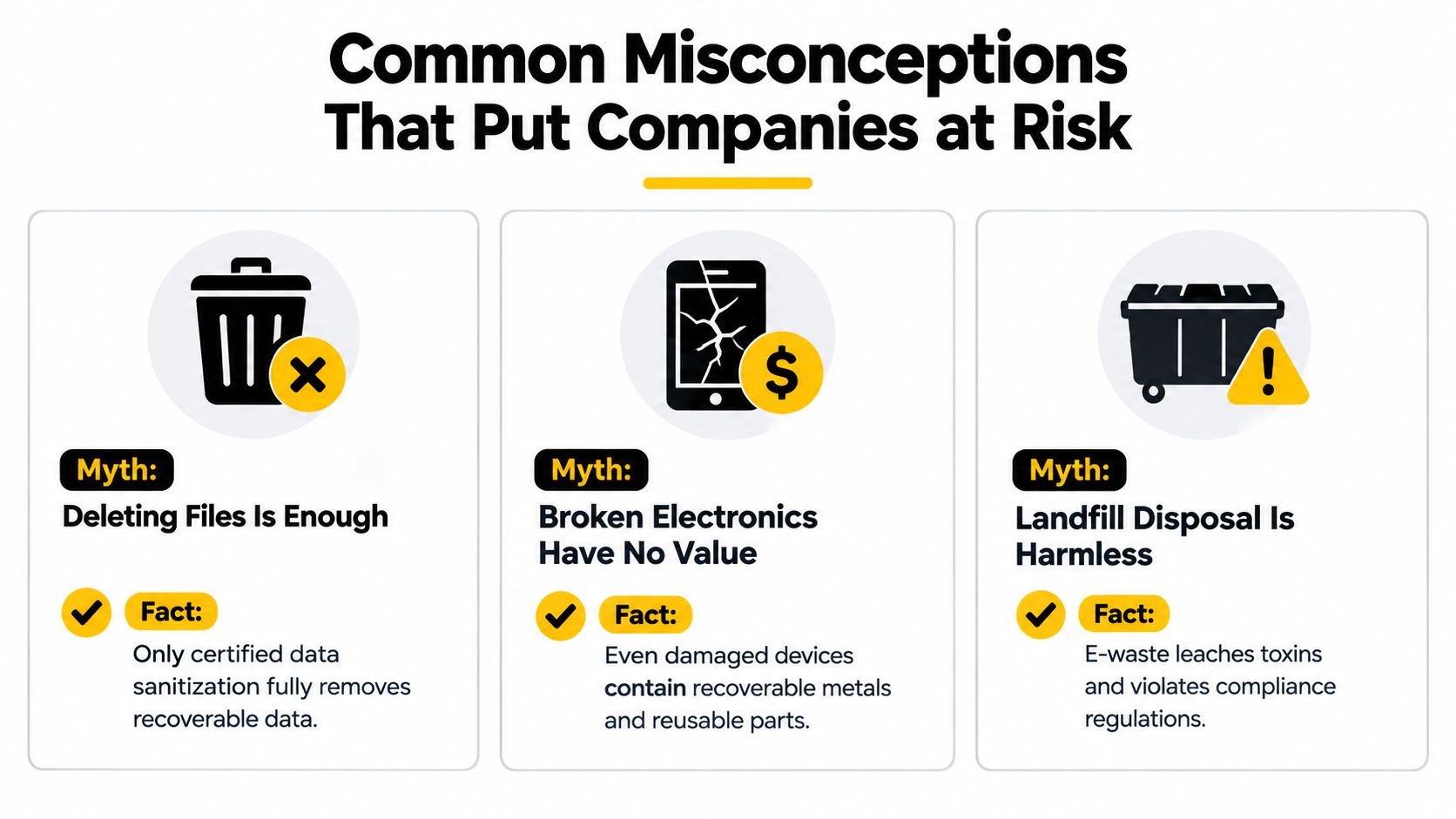
The value of this workflow isn't limited to a sustainability narrative. A facilities team can close an office cleanout, an IT department can reconcile retired assets, and a sustainability leader can document landfill diversion and community benefit. The same model can support laptop disposal, computer recycling, medical equipment disposal, laboratory equipment disposal, product destruction, and data center decommissioning, provided the provider has the right handling capabilities.
Reworx Recycling operates as a donation-based social enterprise that helps organizations manage electronics recycling, secure hard-drive shredding, pickups, equipment decommissioning, and equipment donations. Businesses should still evaluate any recycler's certifications, downstream controls, insurance, and documentation before engagement.
Common Misconceptions That Put Companies at Risk
Myth one, deleting files is enough
Dragging files to a trash folder isn't the same as sanitizing storage media. Reformatting can also leave recoverable remnants, depending on the device and method used. A responsible ITAD policy maps each asset to a suitable NIST 800-88 clear, purge, or destroy method and preserves evidence of completion.
Reality: Data security requires a repeatable process, not a user action. If a laptop will be donated or resold, the organization needs confidence that its information is no longer recoverable. If the drive can't be reliably sanitized, physical destruction may be the appropriate outcome.
Myth two, broken electronics have no value
A device can be unusable as a computer and still contain valuable materials. Circuit boards, connectors, wiring, motors, batteries, and plastic housings may enter separate recovery streams. The European Commission Joint Research Centre's e-waste resource analysis estimates that about US$62 billion in recoverable natural resources is lost each year because e-waste isn't properly recycled.
Reality: Function and material value are different decisions. A cracked monitor may not be suitable for reuse, while its metals and components can still be recovered through controlled processing.
Myth three, recycling alone solves the e-waste problem
Recycling is necessary, but it can't compensate for poor product design, weak inventory controls, premature replacement, or missing reverse logistics. The ITU reports that generation is outpacing documented recycling, and the Basel-related reporting cited earlier describes a more complex waste environment as data center and AI infrastructure add new equipment streams.
Reality: Businesses need a hierarchy. Extend useful life where practical, repair and reuse equipment, donate suitable devices, recover materials from the remainder, and design procurement and return channels that keep future assets visible.
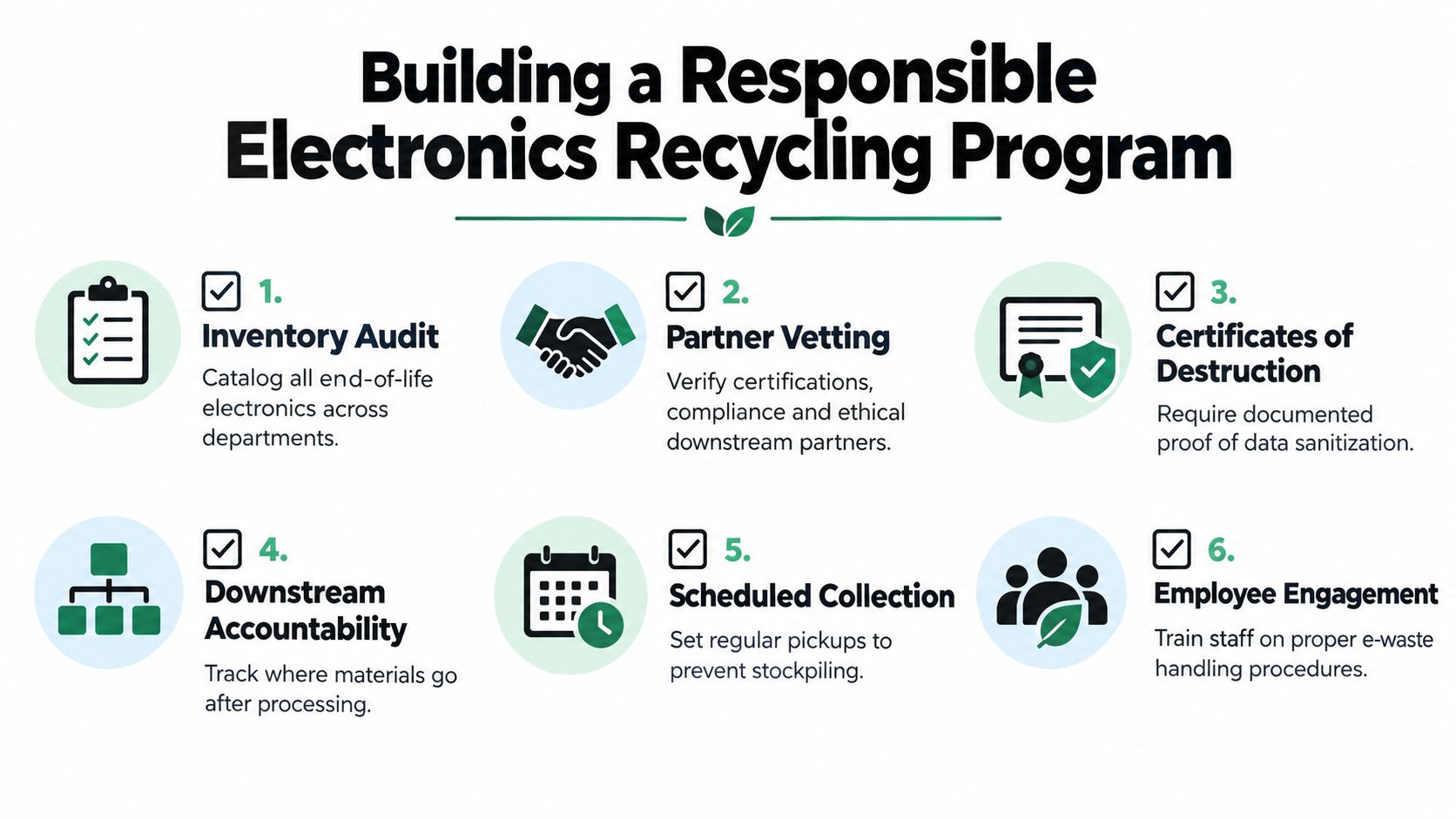
These distinctions help leaders audit their own assumptions. Ask whether the current policy addresses reuse, data destruction, material recovery, vendor accountability, and cross-border movement. If one answer is unclear, the organization has a process gap rather than merely an equipment backlog.
Building a Responsible Electronics Recycling Program
A practical program starts with visibility. Before scheduling a pickup, IT and facilities teams should identify what exists, where it sits, who owns it, what information it contains, and whether it remains usable. Guidance on mastering SMB asset tracking can help smaller organizations improve that inventory discipline.
Use a repeatable decision checklist
- Audit the inventory: Include laptops, servers, phones, printers, displays, networking equipment, batteries, and specialized assets.
- Separate reuse from recovery: Identify equipment suitable for repair, donation, resale, parts harvesting, or material recycling.
- Vet the partner: Review environmental controls, insurance, data-security practices, downstream transparency, and references.
- Ask about certification signals: R2v3 and e-Stewards certification can help buyers evaluate recycler management systems and downstream controls.
- Document chain of custody: Require serialized records from collection through sanitization, destruction, reuse, or recycling.
- Align reporting: Connect certificates, weights, donation records, and recovery outcomes to sustainability and compliance reporting.
- Schedule recurring collection: Regular pickups prevent stockpiling and reduce the chance that employees use informal disposal routes.
- Train employees: Explain what belongs in the program and how to handle devices, batteries, storage media, and accessories.
The process can cover a single office cleanout or a complex data center decommissioning project. It can also include secure data destruction, product destruction, computer recycling, laboratory equipment disposal, medical equipment disposal, and corporate donation programs, as long as the provider confirms the required capabilities and acceptance criteria.
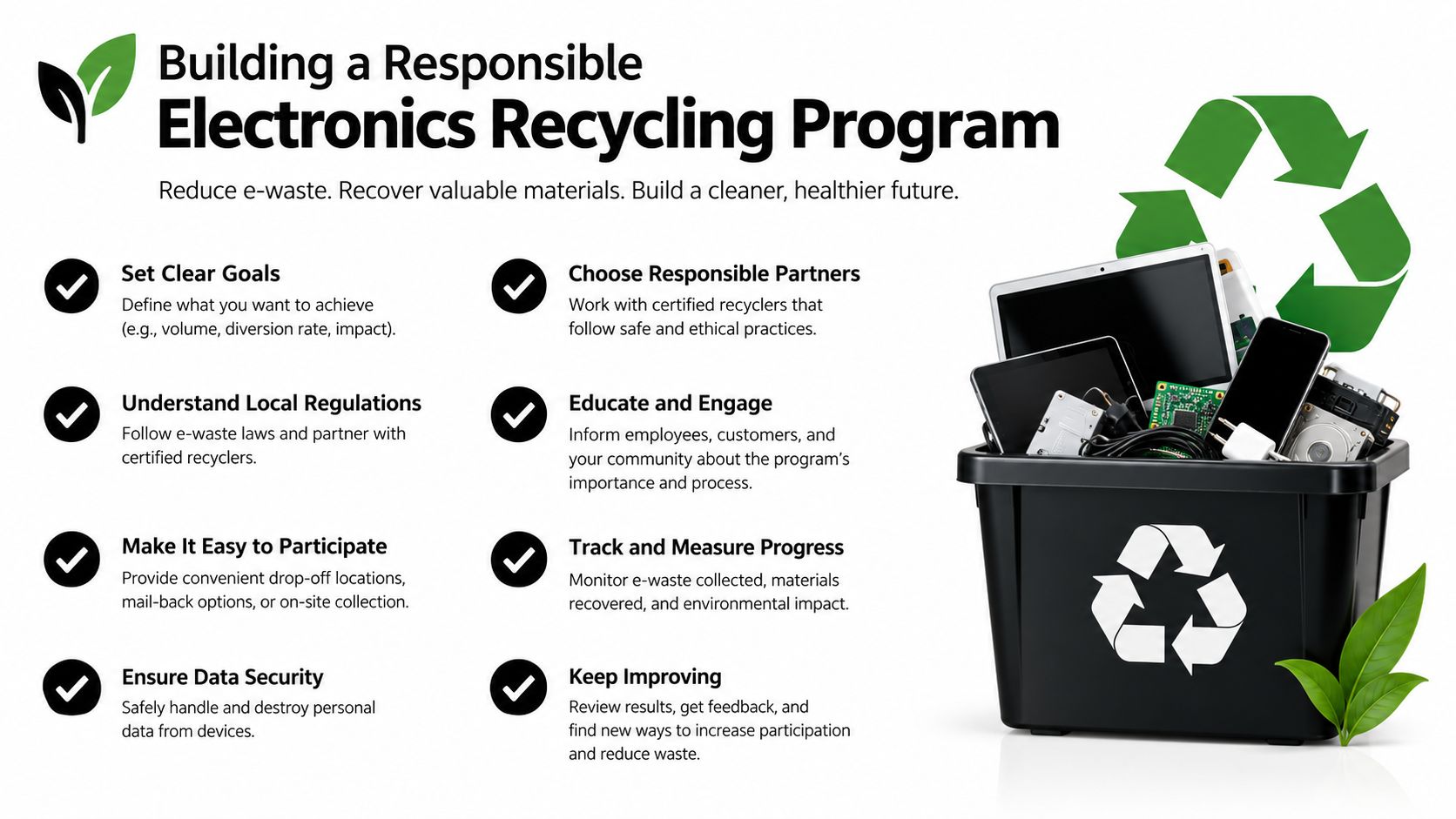
Reworx Recycling gives businesses a practical option for donation-based recycling, business pickups, equipment decommissioning, IT asset disposition, secure hard-drive shredding, and responsible material recovery. Schedule a pickup, donate usable equipment, or discuss a transparent recycling partnership through Reworx Recycling to turn retired electronics into documented environmental, security, resource, and community outcomes.