An Atlanta IT manager can inherit a surprisingly difficult pile overnight. A technology refresh leaves laptops beside cracked monitors, networking equipment, batteries, printers, and servers. A school trade-in adds Chromebooks and chargers. An office relocation uncovers storage media that nobody wants to place in a general recycling bin.
That pile isn't one waste stream, and it shouldn't receive one generic treatment. Electronics recycling in Atlanta involves data security, regulated components, transport, downstream accountability, reuse, and community impact. The right program creates an auditable path for every asset, from intake through final disposition.
Reworx Recycling is a donation-based social enterprise rooted in Smyrna and serving the Atlanta metro. Its model connects responsible IT equipment disposal with technology donations, digital inclusion, and workforce development. Before scheduling a pickup, use this guide to build a process that protects information, satisfies internal controls, and produces a credible sustainability record. Start with preparing your company's electronics for recycling so equipment arrives sorted and ready for documented handling.
What Atlanta Businesses Really Need to Know Before They Recycle
The most common failure starts with a reasonable assumption: all retired electronics can go into the same truck. In practice, a working laptop, a failed server drive, a mercury-bearing lamp, and a damaged lithium battery present different operational questions. Reusing one item may create social value, while destroying another may be the only defensible security decision.
Practical rule: Treat every device as an asset with a material profile, a data profile, and a final-destination requirement.
Consider a Midtown finance office replacing employee workstations. The laptops may contain confidential files, the monitors may contain regulated components, and the networking equipment may retain resale value. A healthcare organization decommissioning a server room faces a different risk profile from a school collecting student Chromebooks, even if both programs use the phrase computer recycling.
The pile needs a decision process
A structured electronics program answers five questions for each asset:
- What is it? Identify the device, model, serial number, battery status, and storage media.
- What does it contain? Separate data-bearing equipment from displays, printers, cables, batteries, and other components.
- Who controls it next? Record the handoff to the carrier, recycler, refurbisher, or destruction provider.
- What happens to the data? Select clear, purge, or destroy based on confidentiality and reuse.
- What evidence comes back? Require asset-level records, sanitization results, recycling documentation, or destruction certificates.
That approach works for an office cleanout, a facility cleanout, a school e-waste drive, or a data center decommissioning project. It also prevents a common mistake, using a residential drop-off receipt as if it proves commercial chain of custody.
Atlanta's scale makes ad hoc disposal risky
The global context is sobering. The United Nations Global E-waste Monitor recorded 62 million tonnes of e-waste in 2022, equal to 62 billion kilograms and an average of 7.8 kilograms per person worldwide. Only 22.3% was documented as formally collected and recycled in an environmentally sound manner, leaving approximately 48.2 million tonnes outside documented formal recycling channels, according to the Global E-waste Monitor 2024.
For Atlanta businesses, the message is not merely “recycle more.” It is control the entire disposition chain. Inventory first, classify the equipment, protect the data, separate regulated materials, and select a downstream route that can support the records your organization may need later.
Georgia Rules, Local Ordinances, and the Compliance Boundary
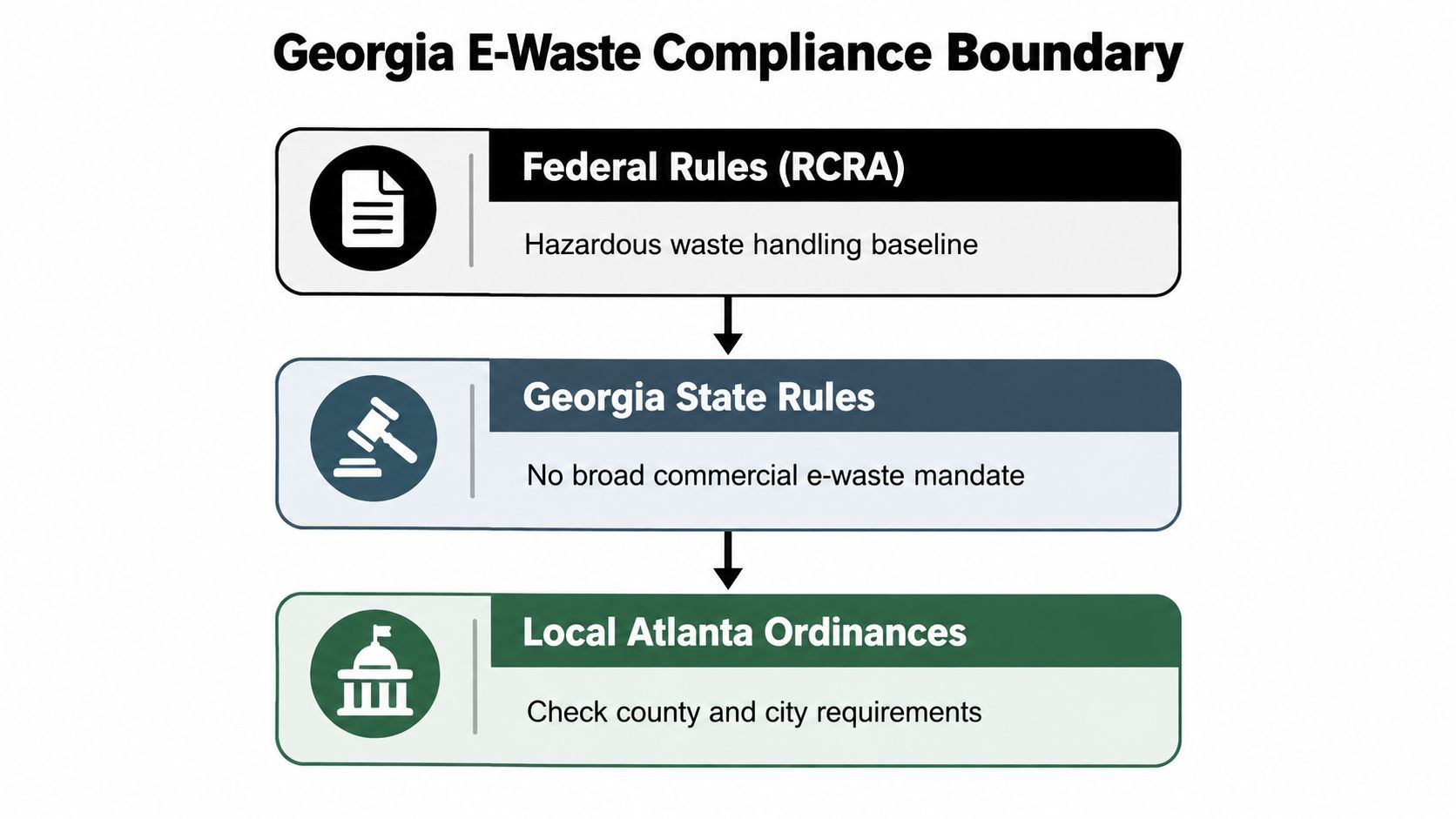
Atlanta businesses need a device-specific compliance process, not a generic “recycle everything” policy. Georgia does not impose a broad statewide commercial e-waste recycling mandate or a universal producer take-back system. However, the device, its components, destination, contracts, security requirements, and environmental policies can each affect the correct disposition route.
A computer may sit outside one sweeping commercial recycling requirement while its CRT glass, lead solder, mercury lamp, lithium battery, or another component requires separate handling. Federal RCRA requirements and Georgia solid-waste rules may apply when equipment contains regulated materials or enters a disposal stream unsuitable for ordinary trash.
Classify equipment before pickup
Build the disposition decision around the equipment type:
- Laptops, servers, and phones: Keep them in the data-bearing asset category until the required sanitization has been verified.
- Monitors and televisions: Identify CRT glass, lamps, and other components that may need a specialized processing route.
- Batteries: Separate damaged, swollen, leaking, or loose batteries from general equipment and package them according to the selected route.
- Printers and copiers: Check for internal storage, toner, and component-specific handling requirements before shipment.
- Medical and laboratory equipment: Determine whether the unit contains patient information, chemicals, lamps, sealed sources, or specialized components.
Local conditions can change the operating requirements. A facility in Atlanta may face different property, access, contractor, or disposal conditions from one in Cobb, DeKalb, or Gwinnett County. Procurement teams should review city, county, lease, customer, and insurer requirements, then retain the applicable terms. For sites with controlled access, include council conditions and security plans in the same review as waste-handling procedures.
Documentation sets the compliance boundary
Ask every commercial provider where the equipment goes, which parties process it, how regulated components are separated, and what final records it issues. Keep the inventory, pickup record, transport handoff, processing report, and final disposition evidence together. Those records support a defensible decision process across regulated materials, downstream accountability, and data-bearing assets.
A residential drop-off receipt may confirm that a load was accepted, but it may not provide serialized intake, commercial transport records, or asset-level destruction certificates. Limited loads can still use free residential programs when their documentation matches the business requirement. For larger cleanouts, server decommissions, and office programs, select a route that proves what happened to each risk-bearing asset.
Reworx Recycling's Georgia electronics recycling service can be compared with other qualified providers using those criteria. The right choice is the one that aligns the equipment classification, local operating conditions, downstream route, and records your organization must retain.
Data Security and ITAD Fundamentals for Atlanta IT Teams
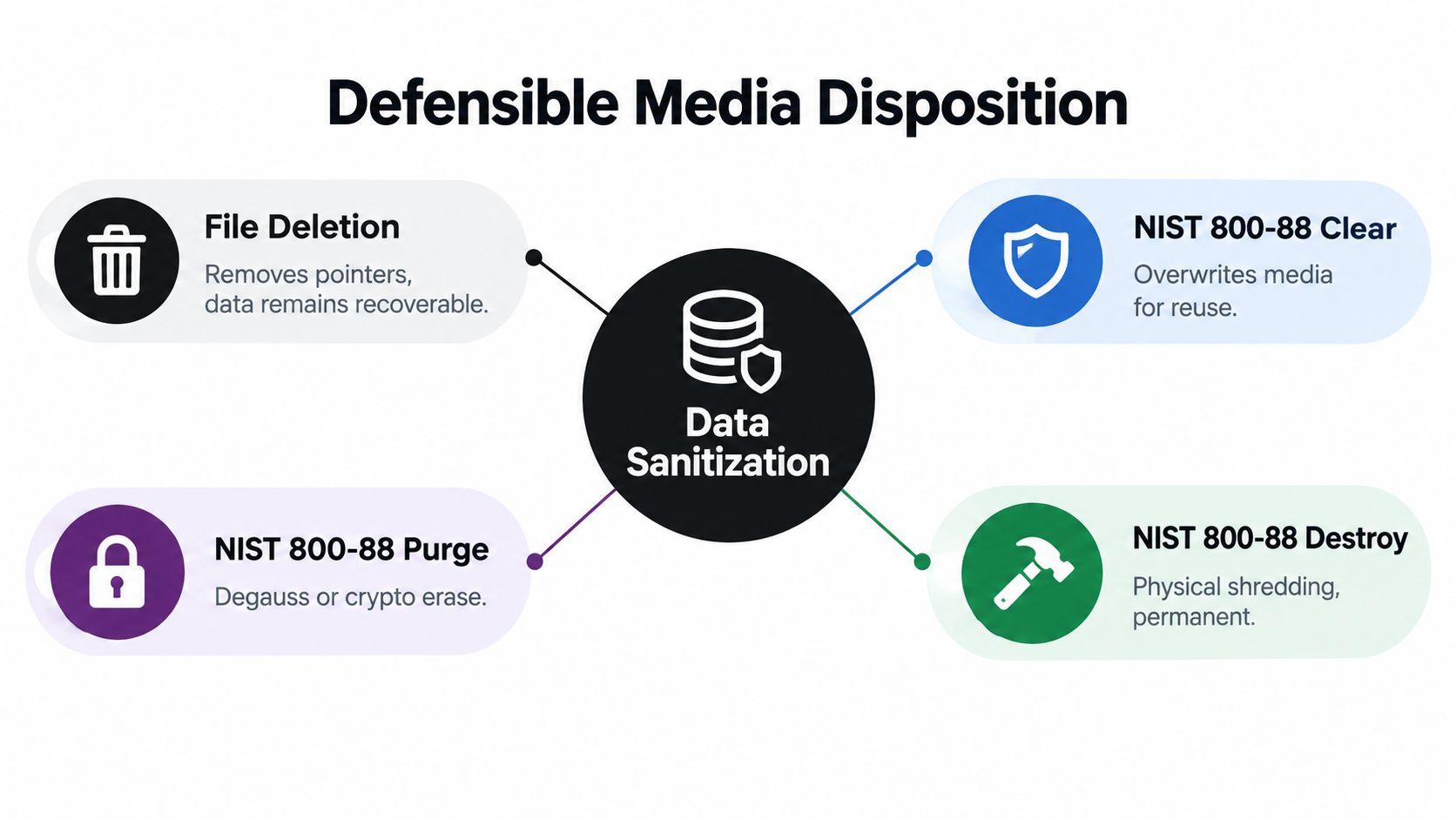
A laptop can leave an Atlanta office with its files apparently gone and still expose recoverable information. Deleting a file usually removes its pointer, not the underlying data. NIST defines sanitization as making access to target data infeasible for a relevant level of effort, with three recognized approaches: clear, purge, and destroy.
Choose the method from the information's confidentiality, the device's intended destination, and its storage technology. A laptop's age or resale value does not set the security requirement. An encrypted device may still require destruction if your team cannot verify an appropriate purge.
Match the method to the media
Clear uses logical or device-level techniques that can support reuse when the technology and risk profile permit it. Purge applies stronger controls, including suitable cryptographic erasure or technology-specific methods. Destroy makes media unusable through shredding, disintegration, pulverizing, or melting.
NIST's media sanitization guidance identifies physical destruction when reuse is unnecessary or logical methods cannot provide sufficient assurance. Trained, authorized personnel should perform the work, and residues must be reduced enough to prevent reconstruction. The cited specification gives nominal limits of 5 mm edge dimensions and 25 mm² surface area for relevant media.
Storage technology changes the answer
Magnetic hard drives, SSDs, flash media, encrypted laptops, phones, and tapes require different handling. A process built for conventional hard drives may not address flash translation layers or an SSD's internal architecture. Mobile devices may also require account removal, encryption verification, and controlled physical handling.
Apply the decision to the actual asset:
- Hospital laptops: Classify patient and operational information before approving verified purge for reuse.
- Finance workstations: Document a method proportionate to confidential financial information and verify the result.
- Student Chromebooks: Confirm account removal and sanitization before donation or refurbishment.
- Failed server drives: Use witnessed physical destruction when logical sanitization cannot be verified.
NIST's current media sanitization framework reinforces this risk-based choice. Require the recycler to record the media type, selected method, verification outcome, and exceptions. A generic “data wiped” statement is not enough for a defensible IT asset disposition program. Review these data security best practices for IT asset disposition before finalizing your sanitization policy.
Chain of Custody, Logistics, and Documentation Across the Lifecycle
A secure ITAD workflow begins before the truck arrives. If your team waits until loading day to identify assets, separate batteries, or decide which drives require destruction, the program is already behind.
Build the workflow around evidence
Use a controlled sequence:
- Inventory the assets. Capture serial numbers, asset tags, device type, location, ownership, and storage media.
- Classify the risk. Mark confidentiality, reuse eligibility, regulated components, and destruction exceptions.
- Approve the method. Select clear, purge, or destroy for each relevant media type.
- Prepare the site. Stage equipment in an access-controlled area, separate batteries and lamps, and label media requiring witnessed destruction.
- Record transport. Document who collected the load, when it left, and which assets transferred.
- Process downstream. Require reporting for reuse, refurbishment, material recovery, or product destruction.
- Reconcile the results. Match final reports against the original inventory and investigate every exception.
A Midtown office cleanout may need little staging space but strict asset identification. A laboratory move may require segregation of specialized equipment. Data center decommissioning demands controlled removal, rack documentation, media handling, and a clear distinction between equipment suitable for resale and equipment that should be destroyed.
Audit test: A reviewer should be able to select one serial number and trace it from intake through sanitization and final disposition.
Receipts don't prove enough
A truck weight or generic recycling receipt confirms that material moved. It doesn't necessarily prove that a particular server drive was destroyed or that a laptop's data was sanitized. A stronger certificate identifies the asset population, serial numbers where available, method used, completion date, and the provider responsible for the work.
Keep these records in one controlled file:
- Original asset inventory and exceptions
- Pickup appointment and loading record
- Chain-of-custody transfers
- Sanitization method and verification results
- Witness or video evidence when required
- Certificates of destruction and recycling
- Downstream processor information
- Reuse, resale, donation, and material-recovery outcomes
- Final reconciliation signed by the responsible manager
For a reusable operational template, review Reworx Recycling's chain-of-custody documentation approach. The provider you select should explain how records are generated, stored, and retrieved before you approve the work, not after an auditor asks for them.
Cost, Buyback, and Choosing the Right Disposition Path
Electronics recycling doesn't have one universal price. The right route depends on volume, handling complexity, data sensitivity, equipment condition, and whether the asset can support reuse. A free option may be appropriate for a small, clean load, while a multi-site pickup or secure destruction project requires planning and labor.
Compare the paths before requesting a quote
| Disposition Path | Best-Fit Devices | Data Sensitivity | Documentation Produced | Typical Atlanta Scenario |
|---|---|---|---|---|
| Free customer drop-off at the Reworx Smyrna facility | Small, sorted loads of standard electronics | Devices should be sanitized before arrival or separately secured | Intake or recycling documentation, subject to the agreed service | A small office bringing boxed monitors, laptops, and peripherals |
| Scheduled business pickup | Mixed office equipment, servers, phones, printers, and monitors | Requires a defined custody and sanitization plan | Pickup record, asset inventory, recycling or destruction records | An office cleanout across the Atlanta metro |
| Buyback and refurbishment | Working laptops, servers, networking equipment, and other recoverable assets | Sanitization must be verified before reuse or resale | Asset valuation, disposition report, donation or resale records | A technology refresh with usable surplus |
| Secure destruction | Failed drives, damaged media, and highly sensitive equipment | High or unverifiable risk | Destruction certificate, method, date, and asset population | A data center decommissioning with inaccessible drives |
The decision should be made at the asset level. Working laptops with cleared drives may fit donation and refurbishment. Older servers with failed drives may require physical destruction. Surplus networking equipment can have residual value, while medical equipment disposal and laboratory equipment disposal may call for documented product destruction rather than ordinary recycling.
Read the quote for what it excludes
Ask whether the price covers packing, stairs, loading, palletization, transportation, sorting, data destruction, regulated components, certificates, and downstream reporting. A flat pickup fee may be simple, but per-asset pricing can make more sense when the load contains high-value equipment or a large number of data-bearing devices.
The most sustainable path isn't always destruction. Reuse can preserve functional value and support corporate donation programs, but only after data security is proven. Conversely, a cheap recycling route becomes expensive if it leaves your team unable to explain where sensitive media went.
A Vendor Selection Checklist for Atlanta Recyclers
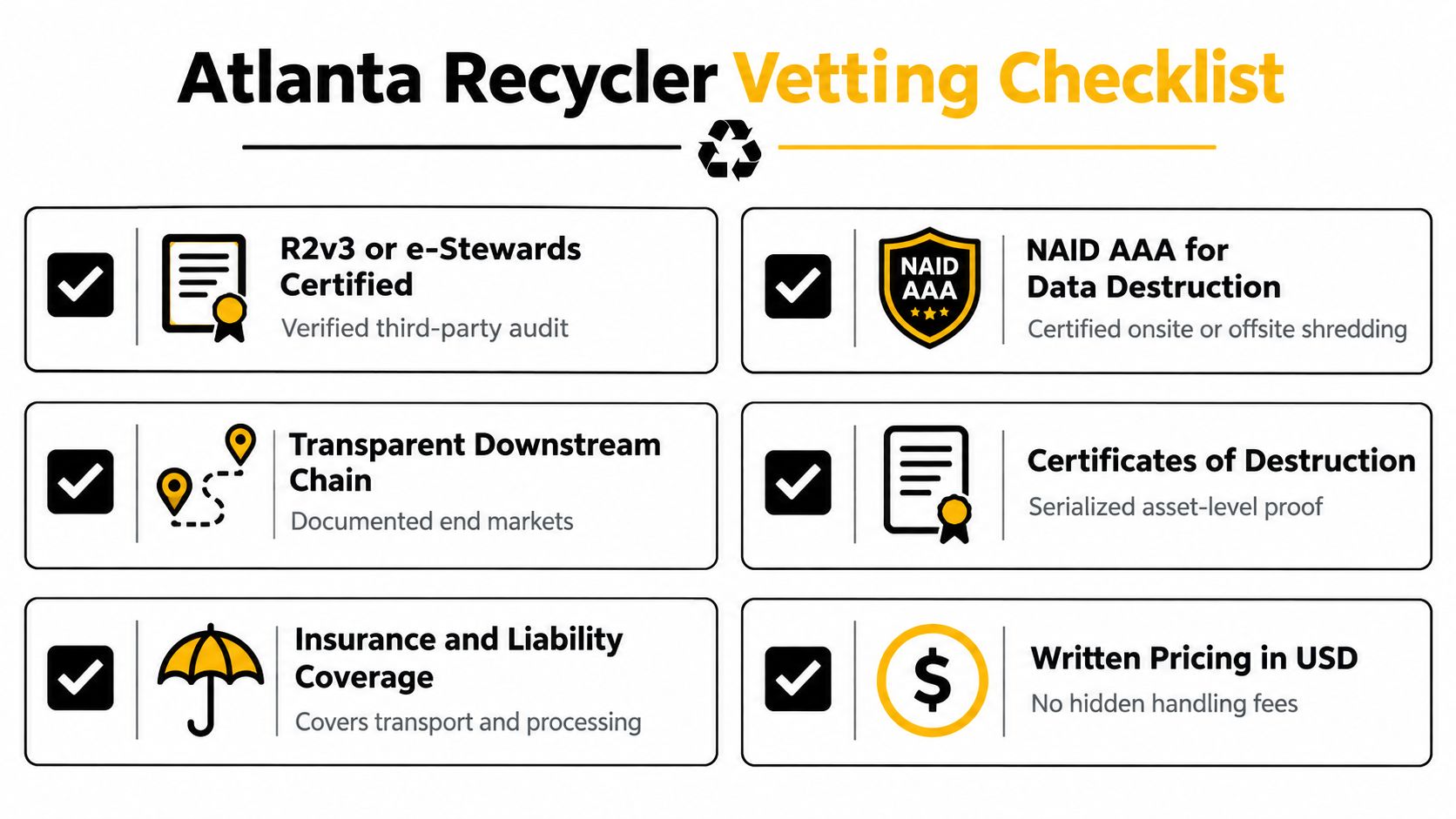
A vendor's marketing language shouldn't decide your ITAD program. Require evidence. Certifications, written procedures, insurance, downstream transparency, and asset-level reporting matter more than a polished “green” claim.
Verify technical and operational controls
Ask each candidate for the following:
- R2v3 or e-Stewards status: Confirm the certification and audit scope rather than accepting an unverified logo.
- NAID AAA status for data destruction: Determine whether certified onsite or offsite shredding is available for your media and risk profile.
- Downstream transparency: Request the names or documented categories of downstream processors and end markets.
- Serialized certificates: Confirm that certificates can identify serial numbers, destruction method, date, and exceptions.
- Insurance and liability coverage: Check transport, processing, data-security, and site-access coverage.
- Mixed-load capability: Verify that the provider can separate batteries, lamps, displays, servers, mobile devices, and other regulated or specialized components.
- Witnessed or video-documented destruction: Establish whether evidence can be supplied when policy, insurer, customer, or regulator requirements call for it.
Evaluate the community outcome
Environmental handling is only part of the decision. Reworx Recycling's donation-based recycling model connects usable equipment with technology donations, digital inclusion, and workforce development. That social-enterprise recycling outcome can give a sustainability team more meaningful reporting than a tonnage figure alone, provided the provider documents what was donated, refurbished, recycled, or destroyed.
Use a written interview sheet:
- Which downstream partners process each material category?
- Do certificates list serial numbers or only total weight?
- What happens when a drive fails verification?
- How are encrypted SSDs and mobile devices handled?
- Can you provide witnessed or video evidence for selected assets?
- How do you track charitable donations and community benefit?
- What does the quote include, and which handling fees are separate?
Before approving a provider, review its vendor selection criteria against your procurement, security, insurance, and sustainability requirements. A vendor that can't answer these questions clearly isn't ready to manage your risk.
Running an Atlanta Electronics Recycling Drive or Office Program
A successful recycling drive starts with scope, not posters. Decide whether the program covers laptops, monitors, printers, phones, tablets, batteries, laboratory equipment, medical equipment, or only standard office technology. Then choose a single-day event, an ongoing office cleanout process, or a multi-site enterprise rollout.
Design the intake station
Create one controlled staging area with separate containers for general electronics, data-bearing media, batteries, and items requiring special review. Use asset tags or serialized intake forms for laptops, servers, phones, and storage devices. Don't allow employees to place loose drives into an unmonitored box.
Communicate the rules before collection begins:
- Accepted equipment: Publish a clear list of devices and components.
- Data responsibility: Tell employees not to assume that deleting files protects information.
- Packaging: Ask departments to preserve asset labels and chargers where practical.
- Security: Restrict access to the staging zone and appoint a responsible coordinator.
- Closeout: Reconcile the intake list against the loaded equipment before the carrier leaves.
An Atlanta school might pair the event with a technology donation partner. A corporate office could connect the collection to ESG reporting, employee engagement, and a local community program. A city or public-sector office should add procurement and records-retention requirements to the intake plan.
Report outcomes that leadership can use
Track total assets processed, the proportion reused versus recycled, certificates issued, unresolved exceptions, and community-benefit outcomes. Keep donation records separate from recycling records so leadership can distinguish material recovery from technology redeployment.
The strongest program produces a usable report, not just a photograph of full bins. That report can support sustainability reporting, supplier reviews, internal audits, and future budget decisions. It also gives employees a concrete account of what happened to the equipment they contributed.
Partnering With Reworx Recycling and Frequently Asked Questions
Reworx Recycling provides free customer drop-off in Smyrna, business pickups, ITAD, equipment decommissioning, secure hard-drive shredding, recycling consultations, and business equipment handling. Its donation-based social-enterprise model connects responsible recycling with community technology programs.
Can businesses drop off equipment themselves? Yes, coordinate the Smyrna drop-off requirements in advance and keep data-bearing assets controlled until the sanitization decision is complete.
When should we request destruction certificates? Request them for every asset population requiring documented destruction, then reconcile them against the original inventory.
What should we do with batteries and lamps? Segregate them during staging and confirm the correct downstream pathway before pickup.
Can one pickup cover multiple Atlanta locations? Provide a site list, asset inventory, access restrictions, and preferred sequence so the provider can build the transport plan.
Reworx Recycling can help Atlanta organizations coordinate electronics recycling, office cleanouts, ITAD, secure hard-drive shredding, pickups, and donation-based reuse. Visit Reworx Recycling to donate old equipment, schedule a pickup, or request a recycling consultation that connects data security with responsible community impact.