For Huntsville's defense, aerospace, and government clients, the right ITAD provider must deliver more than recycling. It must provide verified data destruction and strict chain-of-custody documentation, especially in a city where NASA received approximately 4,670 civilian employees and 1,840 acres of facilities and land when the George C. Marshall Space Flight Center was established at Redstone Arsenal on July 1, 1960.
What does a recycling certificate prove when a retired server once supported a sensitive engineering program, a laptop stored Federal Tax Information, or a damaged solid-state drive leaves your facility without a device-level record? Conventional ITAD marketing often treats pickup, wiping, and recycling as interchangeable services. Huntsville organizations need a more exacting standard.
The local technology environment grew around Redstone Arsenal, NASA Marshall, the U.S. Army, and Cummings Research Park. Redstone Arsenal began as a chemical-munitions manufacturing and storage facility in 1941 before becoming a center for rocket research after World War II. A Huntsville-developed Jupiter-C rocket launched Explorer 1 on January 31, 1958, and Marshall-managed Saturn V technology supported the Apollo program. Those milestones help explain why ITAD Services in Huntsville must account for sensitive data, specialized electronics, controlled hardware, and documented disposition.
Navigating IT Asset Disposition in a Tech-Driven City
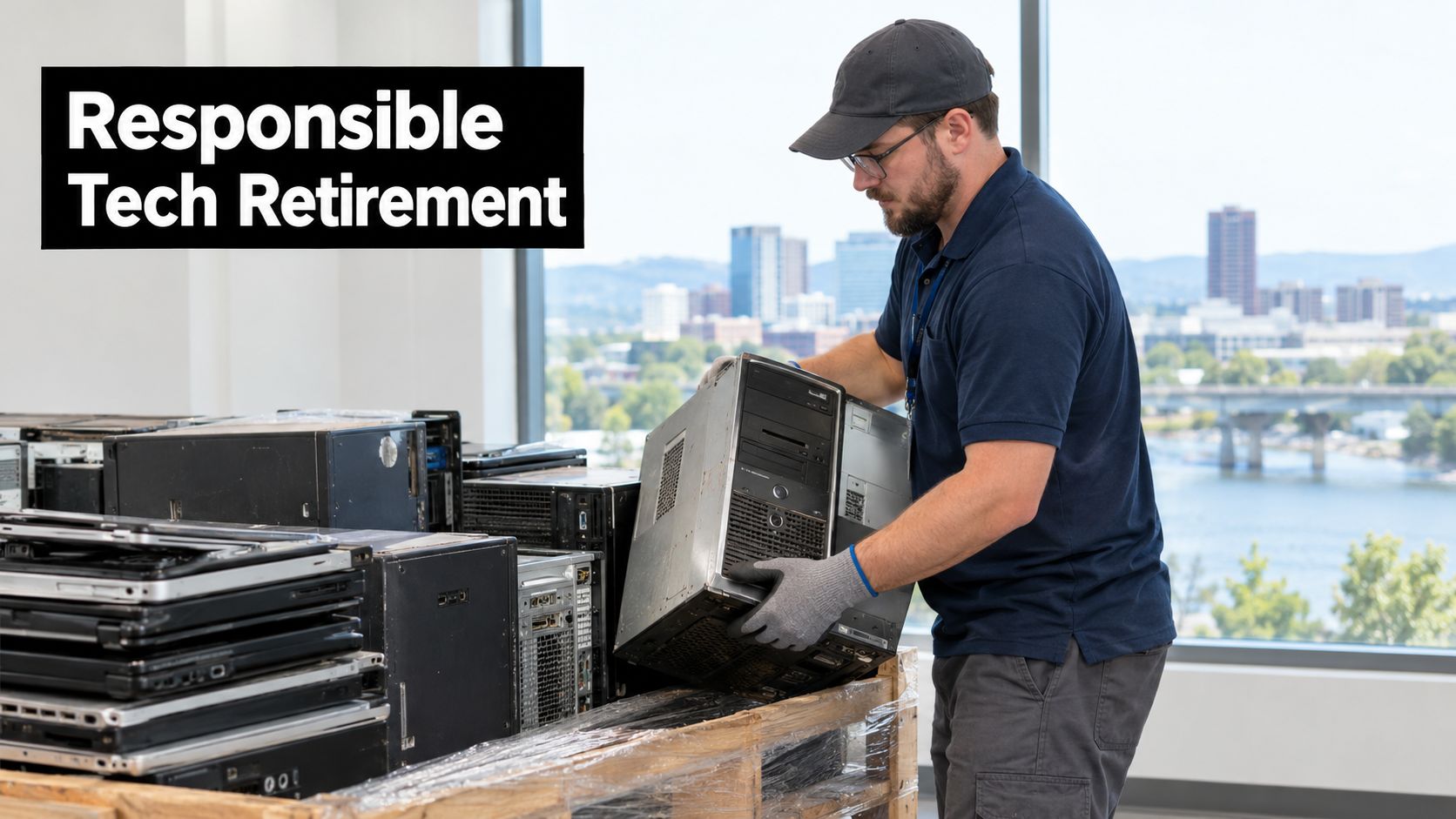
An IT manager overseeing a facility cleanout in Huntsville rarely faces a simple “old equipment” problem. The pallet may contain laptops assigned to contractors, rack servers from a test environment, laboratory equipment, network appliances, removable media, and devices that have passed through several owners. Each asset has a different security profile, reuse potential, and disposition path.
A provider that treats every device as general e-waste creates avoidable risk. A provider that sends every device directly to destruction may protect confidentiality, but it can also discard equipment that could have been securely reused, donated, or materially recovered. The operational challenge is to classify first, then select a defensible method.
Why Huntsville requires a different ITAD conversation
The Army's Redstone Arsenal rocket mission was formally reactivated in 1949, and the Army Ballistic Missile Agency was established there on February 1, 1956. When NASA's Marshall Space Flight Center followed on July 1, 1960, Army records describe the transfer of roughly 4,000 civilian employees, $100 million in facilities and equipment, and space-related missions to NASA. The historical record shows that Huntsville has managed large technology transitions long before modern ITAD terminology existed. (Army historical account of Redstone Arsenal)
That environment now includes missile development, propulsion, human spaceflight, space-shuttle programs, International Space Station hardware, and newer deep-space systems. The resulting disposition workload can include servers, workstations, communications equipment, test instrumentation, encrypted devices, and specialized electronics.
Practical rule: In Huntsville, evaluate an ITAD provider by the evidence it can produce for each asset, not by how quickly it can remove a pallet.
What a capable provider should handle
A useful service scope should cover more than computer recycling. Depending on the organization, the project may involve:
- Laptop disposal: Inventory, media assessment, sanitization, reuse, donation, or destruction.
- Data center decommissioning: Rack removal, serialized tracking, storage-media routing, and final disposition records.
- Laboratory equipment disposal: Careful handling of test instruments, embedded storage, cables, and specialized electronics.
- Medical equipment disposal: Separation of data-bearing components from equipment that requires additional handling.
- Office and facility cleanout: Consolidated pickup for workstations, printers, displays, networking hardware, batteries, and peripherals.
- Product destruction: Controlled destruction of obsolete prototypes, failed units, or equipment that must not return to circulation.
For small businesses and schools, the same discipline may apply at a smaller scale. An office refresh still needs an asset list, a decision about reuse or destruction, and proof that data-bearing equipment didn't disappear between pickup and processing.
The right partner also understands that sustainability and security aren't opposing goals. Working equipment can move through a verified donation-based recycling program, while failed or high-risk media can move to destruction. Social enterprise recycling adds another consideration by connecting responsible disposition with technology donations, digital inclusion, and workforce development.
Understanding Local Regulatory and Security Requirements
Huntsville's regulatory exposure often begins with the data, not the equipment's resale value. A defense contractor may handle proprietary engineering information or controlled technical material. A healthcare organization may manage patient data. A public agency or financial organization may retain Federal Tax Information. Each context can require a documented decision about whether media should be cleared, purged, or destroyed.
NIST defines media sanitization as a process that makes access to stored data infeasible for a given level of effort. Its three principal approaches are Clear, Purge, and Destroy. Clear uses logical techniques against ordinary recovery attempts. Purge uses physical or logical methods intended to make recovery infeasible with advanced techniques, while potentially preserving reuse. Destroy makes recovery infeasible and prevents the media from being reused for storage. (NIST SP 800-88 media sanitization guidance)
Why a certificate alone isn't enough
A certificate of destruction can be useful, but it shouldn't be the entire control. A defensible record should connect the device or controlled lot to its serial number, method, date, technician, and downstream disposition. It should also show how exceptions were handled.
NIST recommends a workflow that starts with an inventory identifying the asset, media type, ownership, sensitivity, and intended disposition. The organization then selects Clear, Purge, or Destroy, uses a media-appropriate technique, verifies completion, validates the evidence against its data-classification policy, and retains an auditable record.
A factory reset may remove user access without addressing every storage area. Overwriting assumptions developed for hard disk drives may not apply to modern solid-state storage, where reserved cells and overprovisioned areas can complicate sanitization. A provider should explain how it handles manufacturer-supported purge or cryptographic-erase capabilities instead of applying one method to every drive.
Questions for Alabama organizations
A vendor review should distinguish federal security obligations from general electronics handling. Ask the provider:
- Which media types are accepted? The answer should address hard disk drives, solid-state drives, removable media, encrypted devices, and damaged equipment.
- How is the method selected? Sensitivity, reuse plans, encryption architecture, and device condition should influence the decision.
- Who verifies the result? Tool completion and management acceptance are separate activities.
- What happens to exceptions? Missing serial numbers, unreadable media, failed devices, and encrypted units should enter quarantine rather than flow into routine recycling.
- Where does processing occur? The provider should disclose downstream geography and the legal classification of equipment moving through the chain.
For Federal Tax Information, IRS guidance accepts clearing, purging, or destroying as sanitization methods and says simple disposal isn't sufficient. If media leaves organizational control for a new purpose, purging may be appropriate. If the media won't be reused, destruction is required under that decision framework. (IRS media sanitization guidelines)
Organizations can use Alabama ITAD services as one local option to discuss equipment disposal, secure data destruction, and documented disposition requirements. The important point isn't the provider's label. It's whether the workflow matches the organization's classification policy and contractual obligations.
Verifying Data Destruction and Chain of Custody
Reliable ITAD work becomes visible in the records. A vendor should be able to show what happened from pickup through final disposition, not just provide a broad statement that a batch was processed.
The process starts before the truck arrives. Pre-authorize the asset list, identify sensitivity tiers, and decide which equipment may be reused, which requires purge, and which must be destroyed. Use tamper-evident containers during transport when the risk profile warrants them, then reconcile received serial numbers against the manifest.
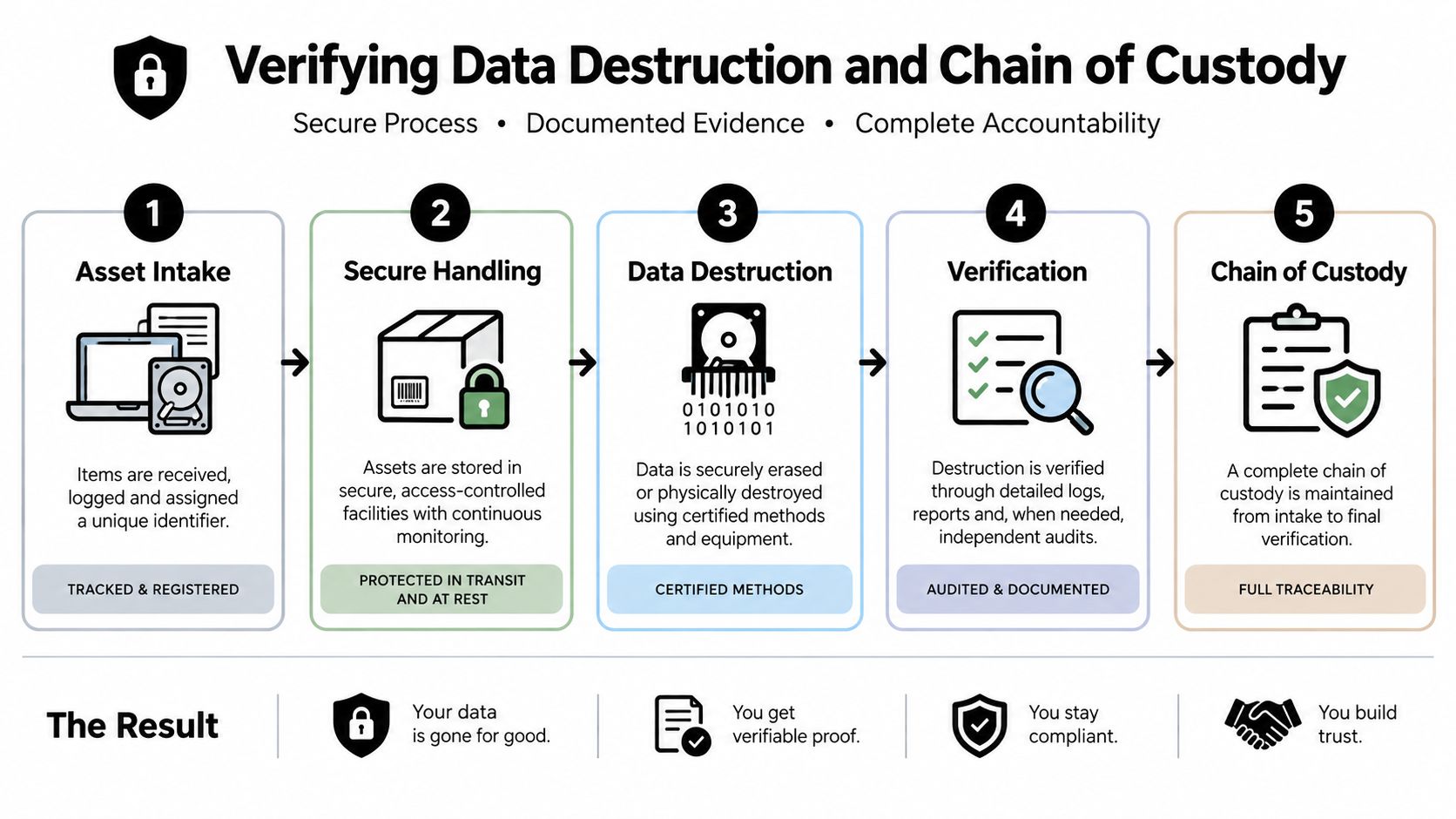
The evidence trail that matters
At receipt, quarantine anything with missing identifiers, damaged or unreadable media, unexpected encryption, or a mismatch between the physical item and the manifest. Quarantine prevents an exception from unnoticedly entering a standard processing stream.
Then route the assets according to the approved decision:
- Reusable equipment goes to an approved Clear or Purge process that matches the media and risk.
- Failed or high-risk media goes to Destroy when logical sanitization can't provide an acceptable risk level.
- Processed assets receive records tied to the device identity, method, operator, timestamp, and disposition.
- Certificates and downstream outcomes are reconciled against the original manifest.
- Open exceptions remain active until someone investigates and closes them.
For high-risk media, 100% verification is a practical control when technically feasible. If representative sampling is necessary, the sampling should be pseudorandom and should cover both user-addressable and reserved areas. NIST materials distinguish operational verification, which asks whether the tool completed without technical errors, from validation, which asks whether management accepts the confidentiality risk for the specific data and disposition decision. (NIST verification and validation FAQ)
What to request from the vendor
A strong chain-of-custody package should include:
- Asset identity: Serial number, asset tag, device type, and media type.
- Custody events: Pickup, receipt, transfer, processing, and final disposition.
- Sanitization result: Clear, Purge, or Destroy, plus the technique used.
- Personnel record: Technician or operator associated with the action.
- Verification evidence: Tool result, sampling record, or physical-destruction confirmation.
- Exception log: Missing assets, failed procedures, unreadable media, and corrective actions.
- Disposition outcome: Reuse, donation, recycling, resale, or destruction.
A single batch certificate with no device-level traceability may be inadequate for a sensitive environment. The same applies to an operator checkbox that says “wiped” without identifying the method or verifying the result.
Chain-of-custody documentation should support the internal audit question, “Can we prove what happened to this specific asset?” That question matters for a government decommissioning project, a school fleet replacement, and a corporate laptop refresh alike.
Evaluating Environmental Impact and Sustainability
Sustainable recycling depends on what happens after security controls are complete. Destroying every device may reduce data exposure, but it also eliminates reuse value. Reusing every device may preserve value, but it can be inappropriate when media can't be purged reliably or when the organization can't validate the encryption architecture.
The better approach separates the security decision from the material decision. A working laptop with acceptable sanitization evidence may support donation or reuse. A failed drive may require physical destruction before the remaining components enter material recovery. A server from a data center decommissioning project may need component-level review rather than a single treatment for the entire rack.
Comparing disposition paths
| Disposition path | Where it works | Main trade-off |
|---|---|---|
| Clear | Lower-risk reuse where the organization accepts protection against ordinary recovery | May not address advanced recovery concerns or every storage area |
| Purge | Equipment leaving the organization when the media and process support stronger sanitization | Requires careful technique selection and verification |
| Destroy | Failed, high-risk, or non-reusable media | Protects data but removes storage reuse and residual asset value |
| Donation or reuse | Working equipment with an acceptable sanitization record | Requires clear ownership, recipient controls, and documented transfer |
| Material recovery | Non-reusable electronics after data-bearing components are handled | Requires responsible downstream processing and documentation |
The Environmental Protection Agency reports that recycling one million laptops saves the energy equivalent of the annual electricity use of more than 3,500 U.S. homes. The same EPA guidance explains that electronics contain recoverable metals, plastics, and glass, and that recovery can reduce the energy, pollution, and virgin-resource demand associated with manufacturing new products. (EPA electronics donation and recycling guidance)
Look beyond the pickup truck
Ask where equipment goes, how batteries and damaged devices are handled, and whether downstream processors are identified. Cross-border movement can change the compliance profile. The Basel Convention's e-waste amendments took effect on January 1, 2025, adding prior-informed-consent requirements for transboundary movement of hazardous and non-hazardous e-waste. (Electronics disposal compliance overview)
That matters to Huntsville manufacturers, universities, defense contractors, and public agencies using processors outside Alabama. Environmental certifications and responsible recycling practices can help a procurement team compare environmental controls, but certification shouldn't replace questions about actual processing geography, asset traceability, and final disposition.
A donation-based recycling model can create community value when equipment is suitable for reuse. Reworx Recycling operates as a social enterprise that evaluates equipment for donation, recycling, and other disposition paths, linking corporate donation programs with environmental responsibility and community impact.
Making the Final Decision and Moving Forward
The strongest Huntsville ITAD decision balances three tests: Can the provider protect data? Can it prove what happened? Can it handle the equipment responsibly after security work is complete? Price matters, but a low quote becomes expensive if it omits serial-number reconciliation, exception handling, secure transport, or downstream visibility.
Use a practical vendor scorecard:
- Security fit: The provider maps Clear, Purge, and Destroy decisions to media type, sensitivity, and reuse.
- Evidence quality: Records identify assets, methods, operators, timestamps, verification, and final disposition.
- Operational capacity: The team can manage a laptop pickup, office cleanout, medical equipment disposal project, laboratory equipment disposal, or data center decommissioning without losing control of the manifest.
- Environmental responsibility: Reusable assets move toward donation or reuse, while non-reusable material reaches appropriate recovery channels.
- Logistics: Pickup planning, access requirements, containers, transport, and communication fit the facility.
- Community impact: The program supports technology donations, digital inclusion, and workforce development rather than treating recycling as only a disposal transaction.
These ITAD vendor selection criteria give business owners, IT managers, and sustainability leaders a structure for comparing providers. Reworx Recycling can support business pickups, equipment decommissioning, secure hard-drive shredding, data destruction, electronics recycling, and equipment donation programs. Its social-enterprise model also connects responsible asset retirement with community-focused reuse.
The final benchmark is straightforward: no unresolved chain-of-custody or sanitization exceptions at final disposition. That standard keeps the conversation grounded in evidence. It also helps Huntsville organizations protect sensitive information, recover appropriate value, meet sustainability goals, and choose the right outcome for every asset instead of forcing every device into the same disposal path.
Reworx Recycling helps Huntsville businesses manage electronics recycling, IT equipment disposal, secure data destruction, donation-based recycling, and responsible equipment pickups with documented disposition in mind. Visit Reworx Recycling to learn how to donate old equipment, schedule a pickup, or build an ITAD partnership that supports both data security and community impact.