The most popular advice about electronics recycling in Fayetteville, AR is also the least reliable for a business: load everything into a municipal recycling stream and let the city handle it. Fayetteville's residential programs weren't designed to manage an office cleanout, a school technology refresh, a government surplus shipment, or a data center decommissioning project. They also don't solve the questions that matter most to facility directors, including chain of custody, media sanitization, battery safety, asset classification, and documentation.
A practical IT asset disposition (ITAD) program starts by separating household convenience from institutional responsibility. The right destination depends on the device, its condition, the presence of storage media or batteries, the volume involved, and whether the owner is a household or a non-household generator. That's why a dedicated business process is more dependable than trying to force commercial equipment through consumer channels.
The Hidden Complexity of Local E-Waste Rules
Fayetteville's household hazardous-waste trailer doesn't accept electronics. The city also specifically excludes electronic waste, including computers and televisions, from ordinary bulky-waste collections, as explained in its household hazardous-waste guidance. That combination defeats a common assumption: if an item contains hazardous materials, the city's hazardous-waste program must be the correct destination.
It isn't. The city's own instructions direct residents toward separate electronics channels, while the bulky-waste rules make clear that computers and televisions don't belong in standard bulk collection. A business trying to clear an office can therefore arrive at a site with a truckload of equipment and discover that the location, program, or customer category doesn't match the load.
Why consumer programs create business problems
Municipal drop-off services are useful for residents handling a small number of eligible items. They're a poor substitute for commercial IT equipment disposal because they generally don't provide the operational controls an organization needs.
A facility director has to answer practical questions before anything leaves the building:
- Who owns the equipment: Is it company property, school property, government inventory, or donated material?
- What does each device contain: Does a laptop, server, multifunction printer, or removable drive hold sensitive information?
- How will the load move: Can staff safely stage, palletize, and transport the material without mixing batteries and damaged devices?
- What evidence will remain: Will the organization receive an inventory record, processing confirmation, and data-destruction documentation?
The city's standard recycling drop-off sites also prohibit electronics, and the household-hazardous-waste trailer doesn't correct that gap. Even a well-intentioned office cleanout can become a rejected-load problem when staff treat every public recycling location as interchangeable.
Practical rule: A residential drop-off option is not automatically a compliant commercial disposition channel.
The same issue appears in other cities, where acceptance rules differ by item and site. For a broader look at how local programs can vary, the guide to recycling electronics in Chicago offers useful comparative context. Fayetteville organizations should apply the same caution locally: confirm the exact item list, quantity policy, and customer eligibility before loading a vehicle.
For businesses, schools, and public agencies, the viable path is a dedicated B2B recycling workflow. It combines inventory control, secure data destruction, safe handling, transportation, and downstream processing instead of treating a technology refresh as ordinary trash removal.
Arkansas Regulatory Milestones and Global Impact
Arkansas recognized the hazards of discarded electronics when the state Legislature gave the Arkansas Department of Environmental Quality authority to ban electronic waste from municipal solid-waste landfills beginning in January 2010. The agency's electronics guidance explains why this material requires special attention: cathode-ray-tube televisions and computer monitors contain an average of approximately 4 pounds of lead, electronics are a leading source of mercury in municipal waste, and rechargeable nickel-cadmium batteries are identified as the largest source of cadmium in municipal waste. These facts are documented by the Arkansas Department of Environmental Quality.
The statewide landfill ban hasn't been implemented statewide, so residents may still be able to place e-waste with household garbage unless a local landfill imposes restrictions. That gap creates a dangerous practical impression. Legal availability of a disposal route doesn't make ordinary trash the right choice for an organization managing sensitive equipment or hazardous components.
Household handling is not institutional disposition
Businesses and government offices can face additional hazardous-waste requirements because they're non-household generators. Many consumer electronics are generally managed as universal waste, but classification and handling still depend on the material and the generator. A school, clinic, laboratory, office, or public agency should document how equipment is accumulated and confirm local landfill rules rather than assume household disposal practices apply.
The global context makes material recovery just as important as regulatory caution. The Global E-waste Monitor 2024 reported that the world generated a record 62 billion kilograms, or 62 million metric tonnes, of electronic waste in 2022. That equaled an average of 7.8 kilograms per person, while only 22.3%, or 13.8 billion kilograms, was documented as formally collected and recycled in an environmentally sound manner.
| Global e-waste indicator | Reported figure |
|---|---|
| Electronic waste generated in 2022 | 62 billion kilograms |
| Documented formal collection and recycling | 13.8 billion kilograms |
| Documented formal recycling share | 22.3% |
| Metals contained in 2022 e-waste | 31 billion kilograms |
| Estimated value of those metals | Roughly US$91 billion |
E-waste generation rose from 34 billion kilograms in 2010 to 62 billion kilograms in 2022, while documented formal collection and recycling increased from 8 billion kilograms to 13.8 billion kilograms. The report projects generation will reach 82 million tonnes by 2030, a 33% increase from 2022, and says the documented recycling rate could fall to about 20% if collection capacity doesn't keep pace.
The material value includes approximately US$19 billion in copper, US$15 billion in gold, and US$16 billion in iron, according to the same report. Fayetteville organizations contribute to the solution when they direct equipment toward reuse, refurbishment, secure recycling, and documented material recovery instead of relying on ambiguous municipal disposal routes.
For organizations building a local program, Arkansas electronics recycling services can be evaluated alongside the organization's own generator classification, security policy, and material profile.
Executing Secure Data Destruction Protocols
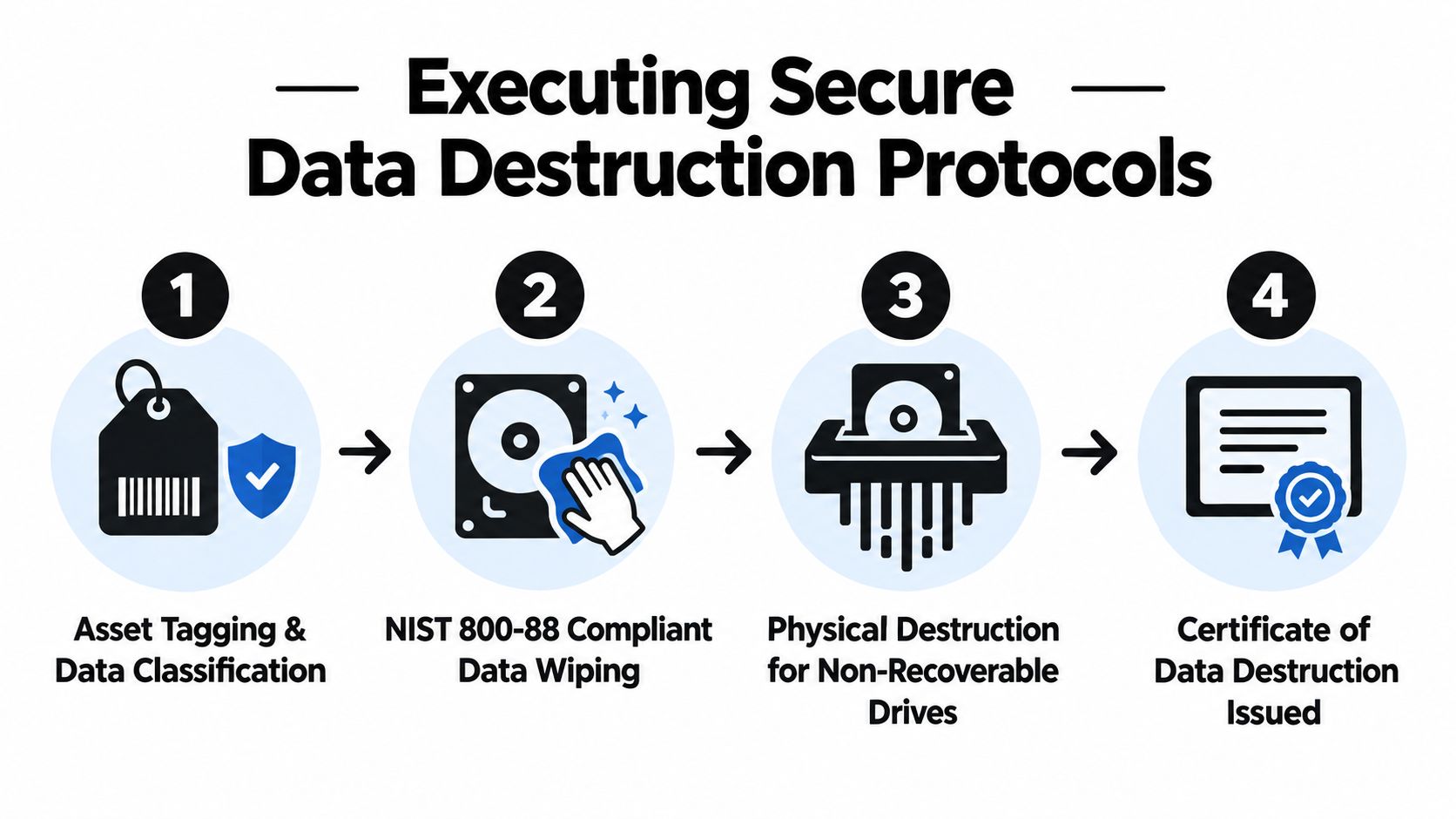
Deleting files isn't the same as sanitizing media. A laptop may appear empty while recoverable information remains on its storage device, and a multifunction printer may retain documents, credentials, or address-book data. NIST SP 800-88 distinguishes among clear, purge, and destroy methods and says organizations should sanitize or destroy digital media before disposal or release outside organizational control. It also calls for documenting and verifying the action.
A defensible workflow begins before equipment reaches a loading dock.
Build the disposition record first
Start with an inventory that identifies the asset tag, device type, serial number where available, assigned department, storage technology, and intended disposition. Include laptops, desktops, servers, SSDs, removable media, smartphones, and multifunction printers. The storage technology matters because a method suitable for one device may not provide the required assurance for another.
Next, classify the information risk. A device used for public marketing materials may have a different confidentiality profile from a device used by payroll, student services, a medical office, or a government department. The classification should determine whether the asset is eligible for reuse after sanitization or must move directly to destruction.
The NIST guidance recognizes three broad approaches:
- Clear: Apply a logical technique that protects against ordinary recovery using standard interfaces.
- Purge: Use a stronger sanitization method appropriate to the media and threat level.
- Destroy: Permanently render the media unusable through methods such as disintegration, pulverizing, shredding, or melting.
Match assurance to the asset
Reuse preserves potential value, but only when the organization can verify that sanitization worked. Physical destruction provides the highest assurance when reuse isn't permitted, although it permanently eliminates resale value. Destruction should be performed by trained, authorized personnel with applicable safety and hazardous-material requirements addressed.
Keep the chain of custody intact from collection through final processing. Use labeled staging areas, restrict access, and record transfers between staff, carriers, and processors. A certificate or equivalent record should identify the asset, method, date, responsible personnel, and verification result.
Security standard: Treat every storage device as a controlled information-bearing asset until its disposition decision has been documented.
The same logic applies during laptop disposal, server retirement, printer replacement, and data center decommissioning. Staff shouldn't rely on factory resets or file deletion as universal solutions. A professional secure data destruction service should be assessed by its documented process, verification practices, and ability to handle both reuse candidates and destruction-required media.
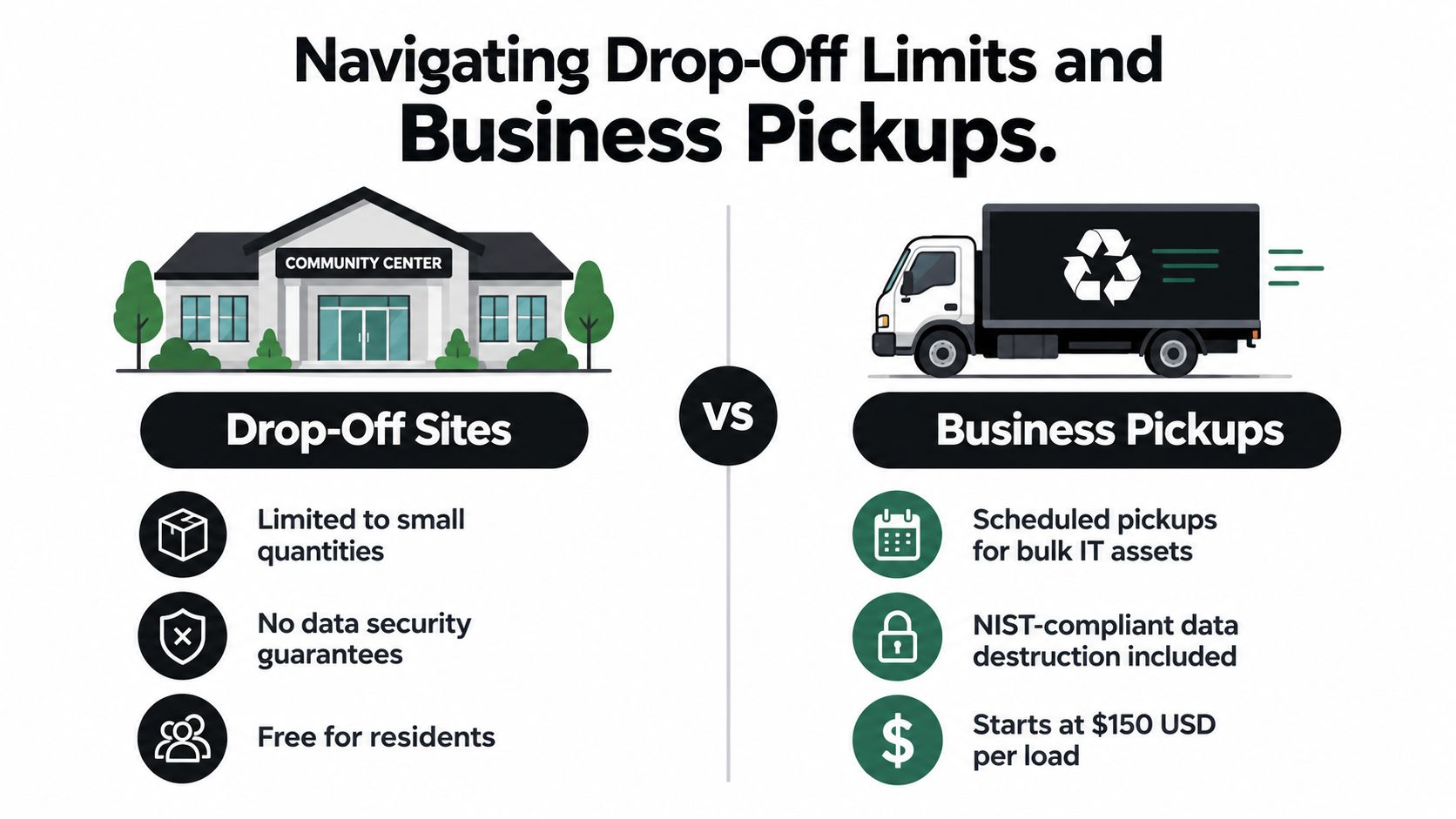
Navigating Drop-Off Limits and Business Pickups
The difference between a consumer drop-off and a business pickup is more than convenience. It's a difference in load control, acceptance criteria, safety, and evidence. Fayetteville's municipal curbside program explicitly excludes batteries and electronics from household recycling carts. The EPA also advises that lithium-ion batteries and devices containing them shouldn't enter household garbage or recycling bins because damaged or improperly handled batteries can create fire risks in collection and processing systems, as reflected in the city's curbside recycling rules.
Local destinations can have narrower rules than residents expect. Free Geek and Boston Mountain Solid Waste are identified by the city as options for unwanted electronics, but acceptance can vary by item, quantity, and customer type. Habitat for Humanity NWA's ReStore accepts many electronics but excludes televisions, monitors, lightbulbs, and all batteries. A site that accepts a household printer may not accept a pallet of mixed corporate equipment.
Separate the material before pickup
A workable reverse-logistics plan doesn't begin with the truck. It begins with sorting.
- Inventory the load. Group computers, monitors, printers, networking equipment, peripherals, appliances, and storage media. Record quantities and identify anything that may contain sensitive data.
- Isolate battery hazards. Separate lithium-ion batteries and damaged devices. Prevent battery terminals from contacting conductive materials, and use labeled accumulation areas.
- Palletize by category. Keep equipment stable and organized so the processor can identify material without repeatedly opening mixed boxes.
- Protect the record. Match pallet or container identifiers to the asset inventory and retain pickup documentation.
- Confirm downstream controls. Choose a recycler certified under an accredited third-party standard. The EPA identifies R2 and e-Stewards as the two principal certification systems.
A business pickup reduces the chance that staff will make multiple trips to unsuitable sites or discover acceptance restrictions after loading a vehicle. It also gives the organization a controlled handoff for office cleanout, facility cleanout, and corporate donation programs.
Logistics reality: “Free drop-off” describes price for an eligible user or item. It doesn't guarantee acceptance of every device, volume, or business load.
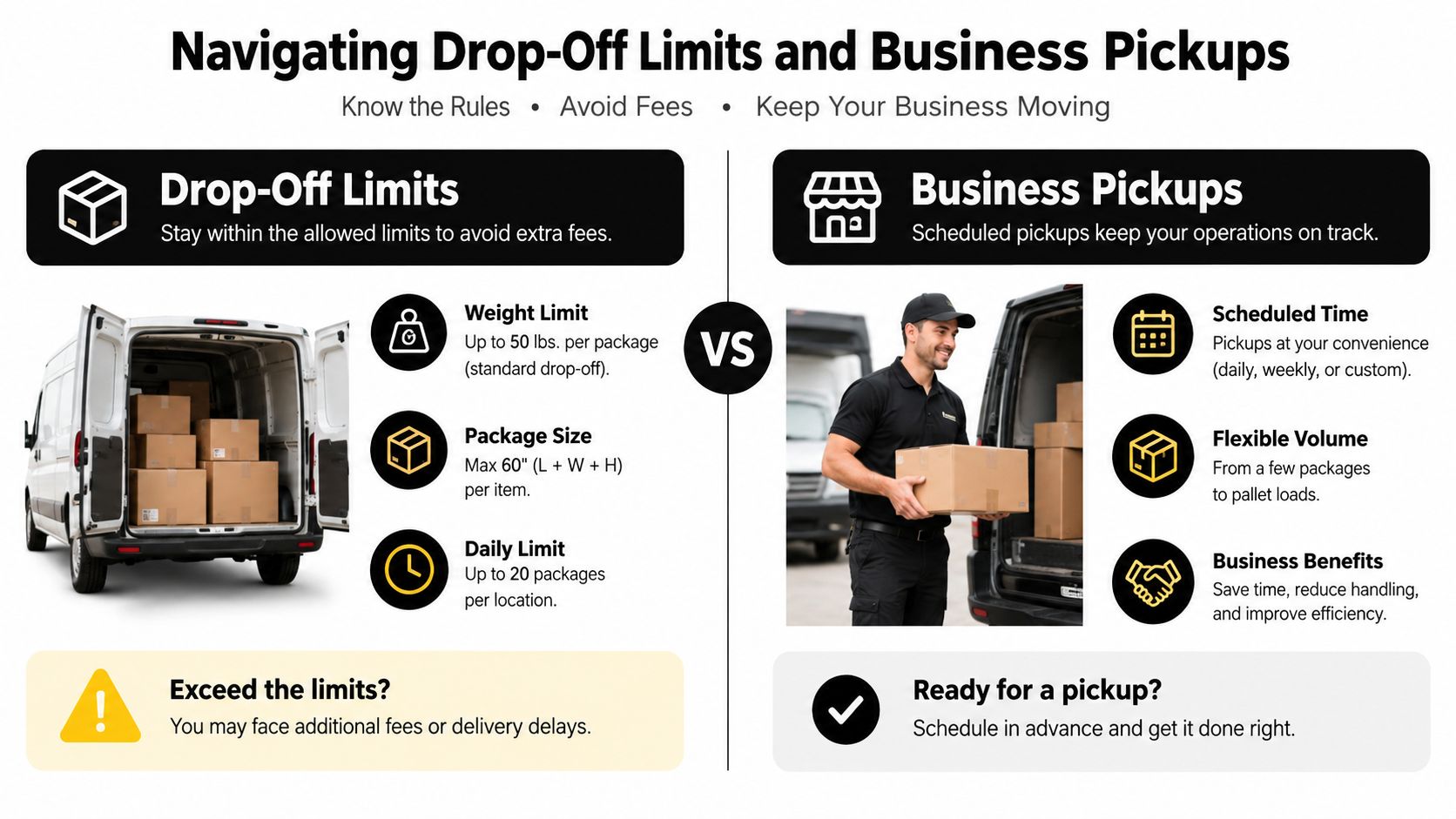
For larger projects, schedule the collection around the refresh window, loading-dock access, staffing, and data-security requirements. A structured business e-waste pickup process is more predictable than sending employees to several consumer sites with a mixed load.
Aligning ITAD with Corporate Sustainability Goals
Sustainability reporting becomes more credible when it follows the asset, not just the disposal invoice. A business that sends viable laptops for refurbishment and destroys non-reusable media can connect environmental responsibility with risk management. That approach is stronger than treating every retired device as either trash or a donation without assessing its condition and data exposure.
A donation-based recycling model gives organizations a practical middle path. Working equipment can be evaluated for reuse, while obsolete, damaged, or security-sensitive material can move through controlled recycling or product destruction. The social value comes from extending useful technology into communities, supporting digital inclusion, and contributing to workforce development without weakening data controls.
Use condition-based decisions
A good ITAD policy distinguishes among several outcomes:
- Reuse: Equipment in suitable condition is sanitized, tested, and prepared for another user.
- Donation: Viable devices are directed through a structured community or corporate donation program.
- Recovery: Components and commodities such as copper, steel, and glass are routed to appropriate downstream processors.
- Destruction: Equipment or media that can't be safely reused is destroyed with documented controls.
- Value recovery: Eligible surplus may support a buyback assessment rather than being discarded without review.
This model works for computer recycling, laptop disposal, laboratory equipment disposal, and medical equipment disposal, although specialized equipment requires careful identification and handling. Facilities should also consider whether a refresh includes networking hardware, storage arrays, telecom equipment, or a full data center decommissioning project.
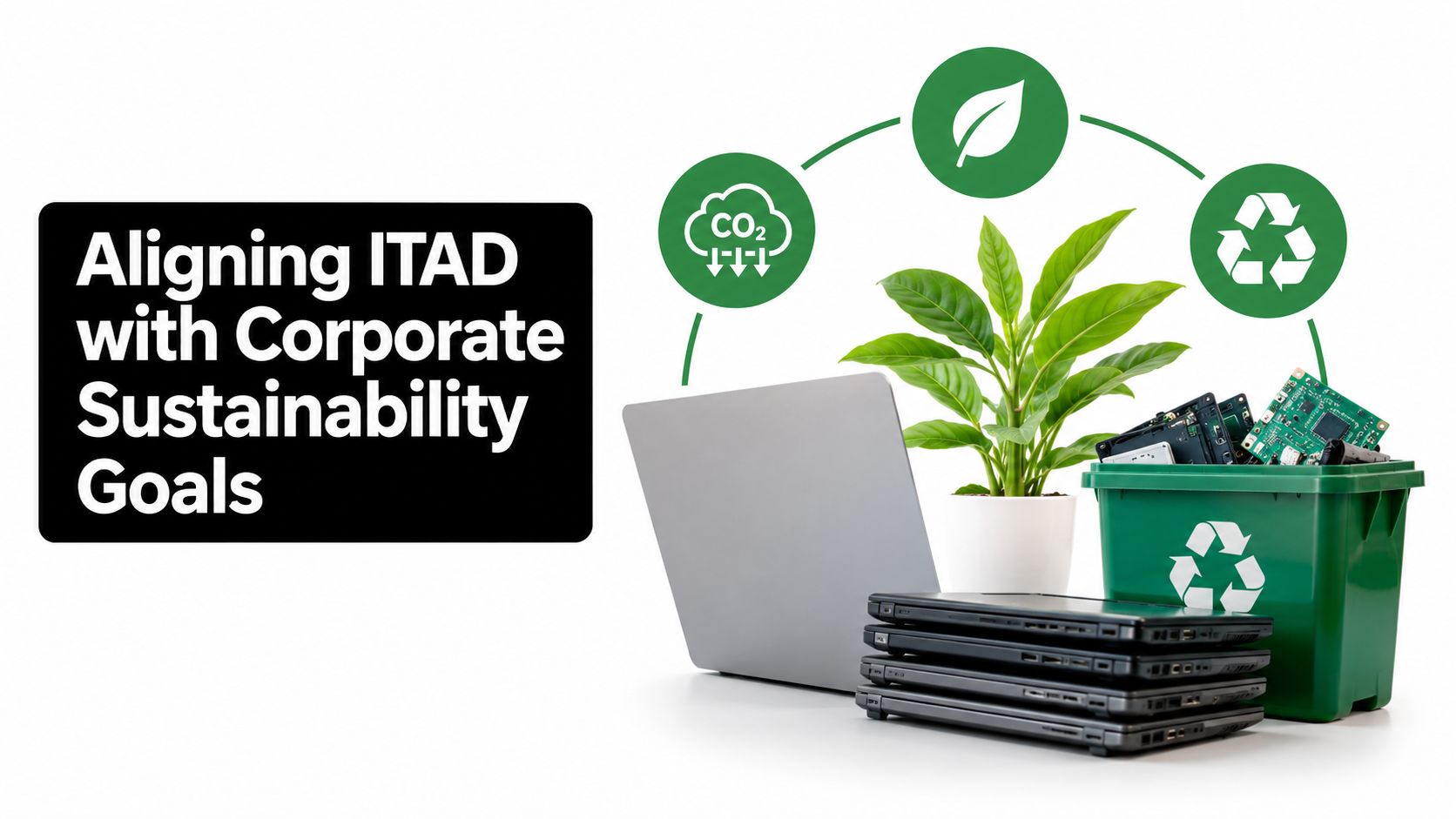
Sustainability leaders can document more than diversion. They can track the number and categories of assets assessed for reuse, the media-sanitization method, the disposition outcome, and the downstream processor's credentials. That evidence supports internal audits and makes environmental claims less dependent on broad, unverifiable language.
Design choices also matter upstream. Organizations evaluating equipment-intensive production methods may find useful context in this discussion of the sustainability and green aspects of 3D printing, particularly when procurement teams are comparing lifecycle impacts across operational technologies.
A social enterprise recycling partner can connect secure disposition with community impact. The corporate sustainability goals approach should therefore include both environmental controls and a clear account of how usable equipment supports people beyond the organization.
Planning Your Next Facility Technology Refresh
A successful technology refresh is planned as an asset transition, not a last-minute hauling job. Facility directors should begin while the replacement project is still being scoped, because the disposition workflow affects storage space, staffing, security, transportation, and reporting.
Use this sequence for a Fayetteville project:
- Survey the stockpile. Identify equipment types, approximate condition, storage media, battery status, and ownership. Include items in closets, repair rooms, server spaces, classrooms, labs, and satellite offices.
- Create disposition categories. Separate reuse candidates, donation candidates, recyclable commodities, and assets requiring product destruction. Don't mix data-bearing devices with low-risk peripherals.
- Set the security decision. For each storage device, select clear, purge, or destroy according to confidentiality and technology. Record the method before collection.
- Prepare the staging area. Use labeled zones, protect battery terminals, isolate damaged devices, and palletize material by category. Keep the inventory accessible to the project lead.
- Verify the processor. Ask about R2 or e-Stewards certification, downstream handling, data-destruction verification, certificates, and chain-of-custody records.
- Schedule around operations. Coordinate pickup timing with loading-dock access, security staff, school calendars, clinical operations, or government-site restrictions.
- Close the project. Reconcile collected assets against the inventory and retain processing records with the organization's ITAD documentation.
This checklist also exposes when a project needs a more specialized plan. A server-room retirement may require equipment decommissioning, rack-level coordination, and media segregation. A facility comparing infrastructure approaches can separately compare modular data center options while planning how future equipment transitions will be handled.
For organizations that refresh technology regularly, a recurring reverse-logistics process is more effective than an occasional scramble. The IT asset disposition service strategy can help structure inventory, pickup scheduling, secure data destruction, reuse, donation, and reporting as one repeatable program.
Reworx Recycling helps Fayetteville businesses, schools, agencies, and facility teams manage electronics recycling, secure data destruction, equipment decommissioning, and donation-based disposition through a controlled ITAD process. Visit Reworx Recycling to plan a business pickup, donate usable equipment, or discuss a compliant technology refresh with a partner focused on environmental responsibility, digital inclusion, and workforce development.